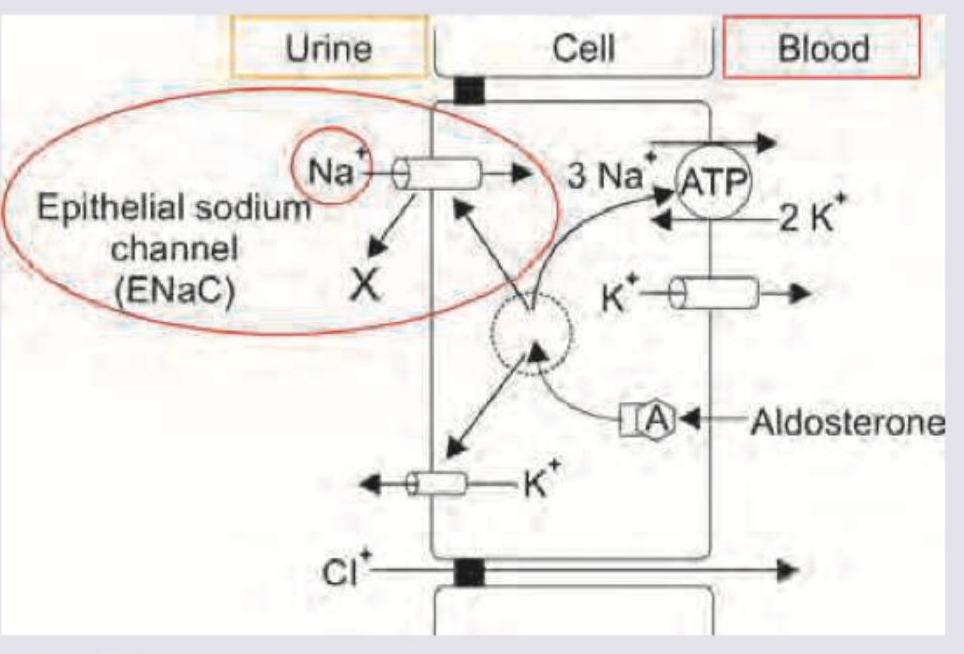
Which diuretic can be considered appropriate for combining with ACE inhibitors?
Mannitol produces diuresis by which mechanism?
Which diuretic is used in the treatment of hypercalcemia?
Which diuretic causes gynecomastia?
Which of the following drugs is used in the management of nephrogenic diabetes insipidus?
Which of the following is NOT a potassium-sparing diuretic?
All of the following diuretics act from the luminal side of the renal tubules except?
Tolvaptan is approved for use in which of the following conditions?
NSAIDs attenuate the action of which of the following diuretics?
Acetazolamide can be used in all the following conditions except:
Explanation: **Explanation:** The combination of **Hydrochlorothiazide (HCTZ)** and ACE inhibitors (ACEIs) is a standard, synergistic therapeutic strategy in managing hypertension and heart failure. **Why Hydrochlorothiazide is correct:** 1. **Synergistic BP Lowering:** Thiazides cause sodium depletion, which activates the Renin-Angiotensin-Aldosterone System (RAAS). ACE inhibitors block this compensatory RAAS activation, leading to a more profound drop in blood pressure. 2. **Potassium Homeostasis:** This is the most critical clinical reason. ACE inhibitors cause **potassium retention** (hyperkalemia) by inhibiting aldosterone. Thiazides are **potassium-wasting** diuretics. When used together, they counteract each other's effects on serum potassium, maintaining electrolyte balance. **Why the other options are incorrect:** * **Spironolactone & Eplerenone (Options A & B):** These are Potassium-Sparing Diuretics (Mineralocorticoid Receptor Antagonists). Combining them with ACEIs significantly increases the risk of **severe, life-threatening hyperkalemia**, as both drug classes promote potassium retention. * **Amiloride (Option D):** This is an epithelial sodium channel (ENaC) blocker, also classified as a potassium-sparing diuretic. Like Spironolactone, it carries a high risk of hyperkalemia when combined with ACEIs. **High-Yield Clinical Pearls for NEET-PG:** * **First-Dose Hypotension:** ACEIs can cause a sharp drop in BP if the patient is already volume-depleted by diuretics. It is often advised to stop the diuretic for 24–48 hours before starting an ACEI. * **Metabolic Neutrality:** ACEIs can mitigate the hyperglycemia and hyperuricemia sometimes induced by high-dose Thiazides. * **Preferred Combination:** Fixed-dose combinations of ACEIs/ARBs with HCTZ are among the most commonly prescribed antihypertensives worldwide.
Explanation: ### Explanation **Correct Option: A. Osmotic effect** Mannitol is a pharmacologically inert, non-metabolizable sugar that acts as an **osmotic diuretic**. It is freely filtered at the glomerulus but is not reabsorbed by the renal tubules. Its presence in the tubular lumen creates an osmotic gradient that "holds" water, preventing its reabsorption. This occurs primarily in the **Proximal Convoluted Tubule (PCT)** and the **Descending Limb of the Loop of Henle**, which are highly permeable to water. By increasing the osmolarity of the tubular fluid, it forces the excretion of water along with some sodium. **Why the other options are incorrect:** * **B. Inhibition of Na-K-2Cl cotransporter:** This is the mechanism of **Loop Diuretics** (e.g., Furosemide, Torsemide) acting on the Thick Ascending Limb of the Loop of Henle. * **C. Inhibition of Na-K ATPase:** This is the mechanism of **Cardiac Glycosides** (e.g., Digoxin). While it affects sodium transport, it is not the mechanism for diuresis in clinical practice. * **D. Inhibition of aquaporin channels:** This describes the action of **Vaptans** (e.g., Tolvaptan), which are vasopressin receptor antagonists used to treat hyponatremia. **High-Yield Clinical Pearls for NEET-PG:** * **Route:** Must be given **IV only** (poorly absorbed orally; causes osmotic diarrhea if swallowed). * **Indications:** Primarily used to reduce **Increased Intracranial Pressure (ICP)** in cerebral edema and **Intraocular Pressure (IOP)** in acute glaucoma. * **Contraindications:** Acute Pulmonary Edema and Congestive Heart Failure (due to initial expansion of extracellular fluid volume) and Chronic Renal Failure (Anuria). * **Side Effect:** Can cause initial "expansion hypervolemia" followed by dehydration and hypernatremia.
Explanation: **Explanation:** **1. Why Furosemide is Correct:** Furosemide is a **Loop Diuretic** that acts by inhibiting the $Na^+/K^+/2Cl^-$ symporter in the Thick Ascending Limb (TAL) of the Loop of Henle. Under normal conditions, the reabsorption of these ions creates a positive lumen potential that drives the paracellular reabsorption of divalent cations like **Calcium ($Ca^{2+}$)** and Magnesium ($Mg^{2+}$). By inhibiting this transporter, Furosemide abolishes the electrical gradient, leading to increased urinary excretion of calcium (**calciuria**). Therefore, it is used in the emergency management of symptomatic hypercalcemia, typically administered alongside aggressive intravenous saline hydration to prevent volume depletion. **2. Why Other Options are Incorrect:** * **Spironolactone:** A Potassium-sparing diuretic (Aldosterone antagonist) that acts on the collecting duct. It does not significantly affect calcium excretion. * **Hydrochlorothiazide:** Thiazides actually **increase** renal calcium reabsorption (hypocalciuric effect). They are used to treat hypercalciuria and calcium stones, but they would worsen hypercalcemia. * **Mannitol:** An osmotic diuretic used primarily to reduce intracranial or intraocular pressure; it is not a standard treatment for electrolyte imbalances like hypercalcemia. **3. NEET-PG High-Yield Pearls:** * **Mnemonic:** "**L**oops **L**ose Calcium; **T**hiazides **T**ake-in Calcium." * **Drug of Choice:** While Furosemide is used for acute hypercalcemia, the long-term drugs of choice for malignancy-associated hypercalcemia are **Bisphosphonates** (e.g., Zoledronic acid). * **Side Effects of Furosemide:** Hypokalemia, Ototoxicity, Hyperuricemia, and Hypomagnesemia.
Explanation: **Explanation:** **Spironolactone** is a potassium-sparing diuretic that acts as a competitive antagonist at the mineralocorticoid (aldosterone) receptor. The development of **gynecomastia** (and other side effects like decreased libido or menstrual irregularities) is due to its lack of receptor specificity. It acts as a non-specific antagonist at **androgen receptors** and increases the peripheral conversion of testosterone to estradiol. This hormonal imbalance leads to the enlargement of male breast tissue. **Analysis of Options:** * **Lubiprostone (A):** This is not a diuretic; it is a chloride channel activator used in the treatment of chronic idiopathic constipation and IBS-C. * **Cimetidine (C):** While Cimetidine is a well-known cause of gynecomastia (via H2 receptor blockade and anti-androgenic effects), it is an **H2-receptor antagonist** used for peptic ulcers, not a diuretic. The question specifically asks for a diuretic. * **Chlorthalidone (D):** This is a thiazide-like diuretic. Its primary side effects include hypokalemia, hyperuricemia, and hyperglycemia, but it does not typically cause gynecomastia. **NEET-PG High-Yield Pearls:** * **Eplerenone** is a selective aldosterone antagonist. It has a much lower affinity for androgen and progesterone receptors, making it the preferred alternative if a patient develops gynecomastia on Spironolactone. * **Mnemonic for Gynecomastia (DISCO):** **D**igoxin, **I**soniazid, **S**pironolactone, **C**imetidine, **O**estrogens/Ketoconazole. * Spironolactone is the drug of choice for **ascites in liver cirrhosis** and is used to reduce mortality in **Congestive Heart Failure (NYHA Class III/IV)**.
Explanation: ### Explanation **Correct Answer: C. Thiazides** **Mechanism in Nephrogenic Diabetes Insipidus (NDI):** It may seem paradoxical to use a diuretic to treat polyuria, but Thiazides are the mainstay for NDI. They inhibit the $Na^+/Cl^-$ symporter in the distal convoluted tubule, leading to mild volume depletion. This causes a compensatory increase in the reabsorption of sodium and water in the **proximal tubule**. Consequently, less fluid reaches the distal parts of the nephron, reducing the total urine volume excreted. **Analysis of Incorrect Options:** * **A. Mannitol:** An osmotic diuretic used primarily to reduce intracranial or intraocular pressure. It would worsen polyuria in DI. * **B. Spironolactone:** A potassium-sparing diuretic (aldosterone antagonist) used in cirrhosis, heart failure, and Conn’s syndrome. It has no role in treating DI. * **D. Demeclocycline:** A tetracycline derivative that actually **causes** nephrogenic DI by inhibiting ADH action in the collecting duct. It is used to treat SIADH (Syndrome of Inappropriate Antidiuretic Hormone). **High-Yield Clinical Pearls for NEET-PG:** * **Drug of Choice (DOC):** For Central DI, the DOC is **Desmopressin (dDAVP)**. For Nephrogenic DI, the DOC is **Thiazides** (often Amiloride if caused by Lithium). * **Lithium-Induced NDI:** **Amiloride** is specifically preferred because it blocks the ENaC channels through which Lithium enters the collecting duct cells. * **Prostaglandin Inhibitors:** NSAIDs (like Indomethacin) can also be used in NDI as they reduce renal blood flow and inhibit the antagonistic effect of prostaglandins on ADH. * **Side Effects of Thiazides:** Remember the "Hypo" triad: Hypokalemia, Hyponatremia, and Hypomagnesemia; and the "Hyper" triad: Hypercalcemia, Hyperuricemia, and Hyperglycemia.
Explanation: ### Explanation The correct answer is **D. Ethacrynic acid**. **1. Why Ethacrynic acid is the correct answer:** Ethacrynic acid is a **Loop Diuretic**, not a potassium-sparing one. It works by inhibiting the **Na⁺/K⁺/2Cl⁻ symporter** in the Thick Ascending Limb (TAL) of the Loop of Henle. Because it causes a massive delivery of sodium to the distal tubule, it increases potassium secretion into the urine, leading to **hypokalemia** (low potassium). It is chemically unique among loop diuretics because it is a phenoxyacetic acid derivative and **not a sulfonamide**, making it the drug of choice for patients with sulfa allergies. **2. Why the other options are incorrect:** * **A. Spironolactone:** This is a competitive **Aldosterone Antagonist** (Mineralocorticoid receptor antagonist). By blocking aldosterone in the collecting duct, it prevents the reabsorption of Na⁺ and the secretion of K⁺, thus "sparing" potassium. * **B. Triamterene & C. Amiloride:** These are **Direct ENaC (Epithelial Sodium Channel) Blockers**. They act on the late distal tubule and collecting duct to block sodium entry independently of aldosterone. By decreasing the negative intraluminal potential, they reduce the driving force for potassium secretion. **3. High-Yield Clinical Pearls for NEET-PG:** * **Ototoxicity:** Ethacrynic acid is the **most ototoxic** loop diuretic; it is more likely to cause permanent hearing loss compared to Furosemide. * **Liddle’s Syndrome:** Amiloride is the treatment of choice for this rare genetic condition. * **Spironolactone Side Effects:** Can cause **gynecomastia** and impotence due to its non-specific binding to androgen and progesterone receptors. **Eplerenone** is a more specific alternative with fewer hormonal side effects. * **Potassium-sparing diuretics** are often combined with Thiazides or Loop diuretics to counteract drug-induced hypokalemia.
Explanation: ### Explanation The correct answer is **Aldosterone antagonists** (e.g., Spironolactone, Eplerenone). **1. Why Aldosterone Antagonists are the exception:** Most diuretics must be present in the tubular fluid (the lumen) to exert their effect. However, Aldosterone antagonists are **highly lipid-soluble** drugs that act from the **basolateral (blood) side**. They cross the cell membrane to bind with intracellular mineralocorticoid receptors in the cytoplasm of the collecting duct cells [1], [2]. This prevents the translocation of the receptor complex into the nucleus, thereby inhibiting the synthesis of Aldosterone-Induced Proteins (AIPs) [1]. **2. Why the other options are incorrect:** * **Loop Diuretics (e.g., Furosemide):** These act from the **luminal side** by inhibiting the $Na^+-K^+-2Cl^-$ (NKCC2) cotransporter in the Thick Ascending Limb. They reach the lumen via active secretion through organic anion transporters (OATs) in the proximal tubule. * **ENaC Blockers (e.g., Amiloride, Triamterene):** These act directly on the **luminal side** of the principal cells in the collecting duct to block the Epithelial Sodium Channels (ENaC). * **Mannitol:** As an osmotic diuretic, it remains in the **tubular lumen**, creating an osmotic gradient that prevents water reabsorption [3]. **3. NEET-PG Clinical Pearls:** * **Site of Action:** Aldosterone antagonists are the only diuretics that do not require access to the tubular lumen to function [1]. * **Potassium Sparing:** Both ENaC blockers and Aldosterone antagonists are "Potassium-Sparing Diuretics," but their mechanisms differ (Direct channel blockade vs. Receptor antagonism) [1]. * **Clinical Use:** Spironolactone is the drug of choice for edema in **liver cirrhosis** (secondary hyperaldosteronism) and is proven to reduce mortality in **Congestive Heart Failure (CHF)**. * **Side Effect:** Gynecomastia is a common side effect of Spironolactone due to its non-specific binding to androgen receptors; Eplerenone is more selective and avoids this.
Explanation: **Explanation:** **Tolvaptan** is a selective, oral **V2-receptor antagonist** (Vaptan). It works by blocking the action of Antidiuretic Hormone (ADH/Vasopressin) at the V2 receptors in the collecting ducts of the kidney. This leads to **aquaresis**—the excretion of free water without significant loss of electrolytes like sodium or potassium. **Why Hyponatremia is Correct:** By promoting free water clearance, Tolvaptan increases the concentration of serum sodium. It is specifically FDA-approved for the treatment of **euvolemic and hypervolemic hyponatremia**, such as that seen in **SIADH** (Syndrome of Inappropriate ADH secretion), Cirrhosis, or Heart Failure. **Why Other Options are Incorrect:** * **A. Hypernatremia:** Tolvaptan increases serum sodium levels; using it in hypernatremia would dangerously worsen the condition. * **B. Hyperkalemia:** Tolvaptan does not significantly affect potassium excretion. Hyperkalemia is typically managed with Loop diuretics, insulin/dextrose, or potassium binders. * **C. Hypercalcemia:** Loop diuretics (like Furosemide) are used to treat hypercalcemia by increasing calcium excretion. Tolvaptan has no role in calcium homeostasis. **High-Yield Clinical Pearls for NEET-PG:** * **Mechanism:** Selective V2 antagonist (Aquaretic). * **Other Indications:** Also approved to slow the progression of **Autosomal Dominant Polycystic Kidney Disease (ADPKD)**. * **Contraindication:** Should not be used for more than 30 days due to the risk of **hepatotoxicity**. * **Caution:** Rapid correction of hyponatremia must be avoided to prevent **Osmotic Demyelination Syndrome (Central Pontine Myelinolysis)**. * **Conivaptan** is a related drug but differs as it is a non-selective (V1a and V2) antagonist and is administered intravenously.
Explanation: **Explanation:** The correct answer is **Loop diuretics (Option B)**. **Mechanism of Interaction:** Loop diuretics (e.g., Furosemide) exert their effect not only by inhibiting the $Na^+-K^+-2Cl^-$ symporter in the Thick Ascending Limb but also by stimulating the synthesis of **renal prostaglandins** (especially $PGE_2$). These prostaglandins cause renal vasodilation, increasing renal blood flow and enhancing the delivery of the drug to its site of action. **NSAIDs** inhibit the enzyme Cyclooxygenase (COX), thereby blocking prostaglandin synthesis [2]. This results in afferent arteriolar vasoconstriction, reduced renal perfusion, and a significant blunting of the natriuretic and diuretic efficacy of loop diuretics [1]. Additionally, NSAIDs can interfere with the organic anion transport (OAT) mechanism required for loop diuretics to reach the tubular lumen [1]. **Analysis of Incorrect Options:** * **A. Carbonic Anhydrase Inhibitors:** Their primary action is in the proximal convoluted tubule via inhibition of $HCO_3^-$ reabsorption [3]; their effect is not significantly dependent on prostaglandin-mediated vasodilation. * **C. Thiazide Diuretics:** While NSAIDs can slightly reduce the effect of Thiazides [1], the clinical interaction is far more pronounced and classically associated with Loop diuretics in the context of acute heart failure or edema management [2]. * **D. Spironolactone:** This is a potassium-sparing diuretic (aldosterone antagonist). While NSAIDs increase the risk of **hyperkalemia** when used with Spironolactone, they do not directly attenuate its primary mechanism of action in the same way they do with Loop diuretics. **High-Yield Clinical Pearls for NEET-PG:** * **Prostaglandins & The Kidney:** Prostaglandins "keep the afferent arteriole open." NSAIDs "close" it. * **Triple Whammy:** Avoid the combination of **ACE inhibitors/ARBs + Diuretics + NSAIDs**, as this triad significantly increases the risk of Acute Kidney Injury (AKI). * **Furosemide Fact:** Furosemide also has a potent venodilatory effect (useful in acute pulmonary edema) which is also mediated by prostaglandins and can be inhibited by NSAIDs.
Explanation: **Explanation:** **Acetazolamide** is a Carbonic Anhydrase (CA) inhibitor that acts primarily on the proximal convoluted tubule. **Why Cirrhosis is the Correct Answer (Contraindication):** In patients with cirrhosis, the liver cannot efficiently convert ammonia ($NH_3$) into urea. Acetazolamide alkalinizes the urine by increasing bicarbonate excretion. In an alkaline urinary environment, ammonium ions ($NH_4^+$) are converted back into lipid-soluble ammonia ($NH_3$), which is reabsorbed into the systemic circulation. This elevation in blood ammonia levels can cross the blood-brain barrier, precipitating or worsening **Hepatic Encephalopathy**. Therefore, it is strictly contraindicated in liver cirrhosis. **Why other options are incorrect (Indications):** * **Epilepsy:** Acetazolamide creates a mild metabolic acidosis in the CNS, which increases the seizure threshold. It is used as an adjuvant in absence and tonic-clonic seizures. * **Acute Mountain Sickness:** It counteracts respiratory alkalosis by increasing bicarbonate excretion, thereby lowering blood pH. This stimulates the respiratory center to increase ventilation and improves oxygenation. * **Glaucoma:** By inhibiting CA in the ciliary body, it reduces the formation of aqueous humor, thereby lowering intraocular pressure. **High-Yield Clinical Pearls for NEET-PG:** * **Site of Action:** Proximal Convoluted Tubule (PCT). * **Side Effects:** Hyperchloremic metabolic acidosis, hypokalemia, paresthesia, and renal stones (due to calcium phosphate precipitation in alkaline urine). * **Other Uses:** Idiopathic Intracranial Hypertension (Pseudotumor cerebri) and urinary alkalinization (to excrete acidic drugs like uric acid or cystine). * **Sulfa-Allergy:** As a sulfonamide derivative, it may cause cross-reactivity in sensitive patients.
Carbonic Anhydrase Inhibitors
Practice Questions
Loop Diuretics
Practice Questions
Thiazide and Thiazide-Like Diuretics
Practice Questions
Potassium-Sparing Diuretics
Practice Questions
Carbonic Anhydrase Inhibitors
Practice Questions
Osmotic Diuretics
Practice Questions
Combination Diuretic Therapy
Practice Questions
Diuretics in Heart Failure
Practice Questions
Diuretics in Hypertension
Practice Questions
Diuretics in Renal Disorders
Practice Questions
Adverse Effects and Drug Interactions
Practice Questions
Get full access to all questions, explanations, and performance tracking.
Start For Free