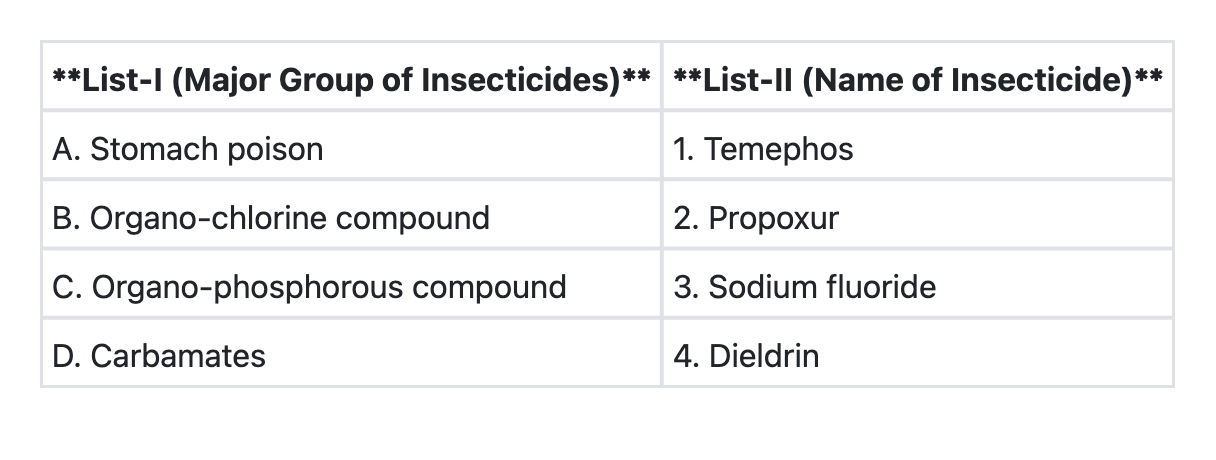
Match List-I with List-II and select the correct answer using the code given below the Lists:
Which one of the following antihypertensive drugs is NOT safe during pregnancy?
A patient has been diagnosed with Primary Open Angle Glaucoma (POAG). On eliciting history, it is observed that the patient is a known case of bronchial asthma. What is the drug of choice for POAG in this patient?
Which of these is not a cardiac poison?
Treatment of choice for acute arsenic poisoning is:
Which nomogram scale is used for aminoglycoside dosage?
Match the following drugs in Column A with their contraindications in Column B. | Column A | Column B | | :-- | :-- | | 1. Morphine | 1. QT prolongation | | 2. Amiodarone | 2. Thromboembolism | | 3. Vigabatrin | 3. Pregnancy | | 4. Estrogen preparations | 4. Head injury |
A child went to temple along with his grandmother. He developed altered sensorium, BP of $150 / 90 \mathrm{~mm} \mathrm{Hg}$, sweating, palpitations, priapism, and mouth secretion all at once. What drug can be given to this patient?
A 35-year-old woman presents to the emergency department after ingesting approximately 50 tablets of acetaminophen 4 hours ago in a suicide attempt. Her acetaminophen level is 200 µg/mL. Which of the following best describes the mechanism of toxicity in this case?
All of the following drugs are used for prophylaxis of migraine except;
Explanation: ***A→4 B→3 C→2 D→1*** - This option correctly matches **Stomach poison** with **Sodium fluoride** (4), **Organochlorine compound** with **Dieldrin** (3), **Organophosphorus compound** with **Temephos** (2), and **Carbamates** with **Propoxur** (1). - **Sodium fluoride** acts as a stomach poison requiring ingestion, **Dieldrin** is a persistent organochlorine insecticide, **Temephos** is an organophosphorus compound used for larval control, and **Propoxur** is a carbamate insecticide for household pest control. *A→4 B→3 C→1 D→2* - This option incorrectly matches **Organophosphorus compound** with **Propoxur** (1), which is actually a **carbamate**, not an organophosphorus compound. - It also incorrectly matches **Carbamates** with **Temephos** (2), which is actually an **organophosphorus** compound, not a carbamate. *A→3 B→4 C→2 D→1* - This option incorrectly matches **Stomach poison** with **Dieldrin** (3), which is an **organochlorine compound**, not a stomach poison. - It also incorrectly matches **Organochlorine compound** with **Sodium fluoride** (4), which functions as a **stomach poison**, not an organochlorine compound. *A→3 B→4 C→1 D→2* - This option creates multiple incorrect matches: **Stomach poison** with **Dieldrin** (3) instead of **Sodium fluoride**, and **Organochlorine compound** with **Sodium fluoride** (4) instead of **Dieldrin**. - It also incorrectly swaps the organophosphorus and carbamate matches, placing **Propoxur** with organophosphorus and **Temephos** with carbamates.
Explanation: ***ACE-inhibitors*** - **ACE inhibitors** (e.g., enalapril, lisinopril) are **contraindicated** in pregnancy due to their association with severe fetal abnormalities, including **renal agenesis**, **oligohydramnios**, and **fetal death** [1], [2]. - They should be discontinued as soon as pregnancy is confirmed or suspected due to their known **teratogenic effects** [1], [2].*Labetalol* - **Labetalol**, a combined alpha- and beta-blocker, is considered one of the **first-line agents** for managing hypertension in pregnancy. - It has a good safety profile for both the mother and the fetus and is commonly used in conditions like **preeclampsia**.*Nifedipine* - **Nifedipine**, a calcium channel blocker, is also a **safe and effective** option for treating hypertension during pregnancy. - It is frequently used for managing **chronic hypertension** and **preeclampsia** due to its rapid onset of action and tolerability.*Alpha-methyl dopa* - **Alpha-methyl dopa** (methyldopa) is considered one of the **safest and most extensively studied** antihypertensive medications for use in pregnancy. - It is often the **first-choice agent** for chronic hypertension during pregnancy due to its long-standing track record of safety for the fetus.
Explanation: ***Latanoprost*** - **Latanoprost** is a **prostaglandin analog** and is considered a **first-line drug of choice** for POAG due to its excellent efficacy and tolerability profile, especially in patients with **bronchial asthma**. - It works by increasing the **uveoscleral outflow** of aqueous humor, thus lowering **intraocular pressure** without causing systemic effects like bronchoconstriction. *Gemeprost* - **Gemeprost** is a **prostaglandin E1 analog** primarily used for **cervical ripening** and **abortion**, not for glaucoma treatment. - It has no role in managing **intraocular pressure** and would be an inappropriate choice for POAG. *Alprostadil* - **Alprostadil** is another **prostaglandin E1 analog** used for **erectile dysfunction** and maintaining **patency of the ductus arteriosus** in neonates. - It does not lower **intraocular pressure** and is not indicated for the treatment of glaucoma. *Carboprost* - **Carboprost** is a **prostaglandin F2α analog** mainly used to **manage postpartum hemorrhage** due to its potent uterotonic effects. - While it is a prostaglandin, it is not used in the treatment of glaucoma and has significant systemic side effects.
Explanation: ***Atropa belladonna*** - This plant primarily contains **atropine** and other **belladonna alkaloids**, which are **anticholinergic** and cause symptoms like dry mouth, dilated pupils, tachycardia, and hallucinations. - While it can cause *tachycardia*, its primary toxic effects are not directly on the cardiac muscle contractility or rhythmicity leading to a **"cardiac poison"** classification (e.g. arrhythmias or heart failure), but rather through autonomic nervous system modulation. *Aconite* - Aconite, derived from the **monkshood plant**, contains **aconitine**, a potent neurotoxin and cardiotoxin. - It causes severe **arrhythmias**, including ventricular fibrillation, which can be rapidly fatal by directly affecting **sodium channels** in myocardial cells. *Cerbera thevetia* - Commonly known as Yellow Oleander, it contains **cardiac glycosides** similar to digoxin. - These glycosides inhibit the **Na+/K+-ATPase pump** in cardiac myocytes, leading to increased intracellular calcium, enhanced contractility, and dose-dependent **arrhythmias** (bradycardia, heart blocks, ventricular arrhythmias). *Nicotiana tabacum* - Tobacco contains **nicotine**, which primarily acts on **nicotinic acetylcholine receptors**. - Acute poisoning can lead to initial stimulation followed by depression of the autonomic ganglia, causing a range of cardiac effects including **tachycardia**, **hypertension**, and **arrhythmias** due to sympathetic nervous system activation.
Explanation: ***Dimercaprol*** - **Dimercaprol** (also known as British Anti-Lewisite, BAL) is a chelating agent used for **acute arsenic poisoning**. [1] - It works by binding to arsenic, forming a stable, non-toxic complex that can be excreted from the body. - Among the given options, **dimercaprol is the correct choice** for treating acute arsenic poisoning. - **Note:** While dimercaprol is effective, newer chelators like **DMSA (succimer)** and **DMPS (unithiol)** are now preferred in modern practice due to better safety profiles and efficacy, though they are not listed in the options. [1] *Ipecac* - **Ipecac syrup** induces vomiting and is generally **contraindicated** in poisonings with corrosives, hydrocarbons, or substances that can cause rapid central nervous system depression. - It is **not effective** for systemic poisonings like arsenic, where absorption has already occurred, and can cause complications like aspiration. - Ipecac is largely obsolete in modern toxicology practice. *Penicillamine* - **Penicillamine** is another chelating agent, primarily used for **copper poisoning** (e.g., Wilson's disease) and sometimes for lead poisoning. - While it has some chelating properties, it is **less effective** than dimercaprol for acute arsenic toxicity and can have more significant side effects. - It is **not the first-line treatment** for arsenic poisoning. *Activated charcoal* - **Activated charcoal** is effective for adsorbing many toxins in the gastrointestinal tract, preventing their absorption. - However, it has **poor affinity for heavy metals** like arsenic and is therefore **not recommended** as the primary treatment for arsenic poisoning. - It may have limited benefit only if given very early after ingestion, but chelation therapy is the definitive treatment.
Explanation: ***Hartford nomogram*** - The **Hartford nomogram** is the standard tool for determining **once-daily (extended-interval) aminoglycoside dosing** based on **creatinine clearance**. - It helps clinicians optimize aminoglycoside therapy by allowing for less frequent dosing while maintaining therapeutic drug levels and minimizing **nephrotoxicity** and **ototoxicity**. - Developed at Hartford Hospital, this nomogram guides dosing intervals (24, 36, or 48 hours) based on a single serum level drawn 6-14 hours post-dose. *Hallstead scale* - The **Hallstead scale** is not a standard nomogram used in clinical practice for drug dosing. - This term does not correspond to a recognized clinical tool for medication management or aminoglycoside therapy. *Salazar scale* - The **Salazar-Corcoran equation** is used for estimating **creatinine clearance in obese patients**, not as a nomogram for aminoglycoside dosing. - While it may be used in the pharmacokinetic assessment before aminoglycoside dosing, it is not a dosing nomogram itself. *Rumack Matthew nomogram* - The **Rumack-Matthew nomogram** is used for assessing the risk of **hepatotoxicity** after an **acetaminophen overdose** by plotting plasma acetaminophen levels against time. - It is not used for aminoglycoside dosage or therapeutic drug monitoring.
Explanation: ***A-4, B-1, C-3, D-2*** - **Morphine** is contraindicated in **head injury** as it can increase intracranial pressure and mask neurological symptoms. - **Amiodarone** is contraindicated in patients with **QT prolongation** due to its risk of inducing more severe arrhythmias like Torsades de Pointes. - **Vigabatrin** is contraindicated during **pregnancy** due to its potential for teratogenicity and adverse effects on fetal development. - **Estrogen preparations** are contraindicated in patients with a history of **thromboembolism** due to their increased risk of blood clot formation. *A-1, B-3, C-2, D-4* - This option incorrectly matches **Morphine** with QT prolongation and **Estrogen preparations** with head injury, which are not their primary contraindications. - It also incorrectly links **Vigabatrin** with thromboembolism and **Amiodarone** with pregnancy. *A-3, B-2, C-4, D-1* - This choice incorrectly associates **Morphine** with pregnancy and **Vigabatrin** with head injury, which are not the most critical or direct contraindications. - It also misaligns **Amiodarone** with thromboembolism and **Estrogen preparations** with QT prolongation. *A-2, B-4, C-1, D-3* - This option incorrectly matches **Morphine** with thromboembolism and **Amiodarone** with head injury, which are not their most significant contraindications. - It also incorrectly links **Vigabatrin** with QT prolongation and **Estrogen preparations** with pregnancy.
Explanation: ***Prazosin*** * This patient's symptoms (altered sensorium, **hypertension**, sweating, palpitations, **priapism**, and increased mouth secretions) are highly suggestive of **scorpion venom poisoning**, specifically from the Indian red scorpion (*Mesobuthus tamulus*). * **Prazosin**, an **alpha-1 adrenergic receptor blocker**, is the drug of choice for treating systemic manifestations of scorpion envenomation. It helps to counteract the excessive catecholamine release and the resulting sympathetic overdrive, thereby reducing hypertension and cardiac dysfunction. *Steroid* * Steroids are **anti-inflammatory agents** and immunosuppressants, primarily used in conditions like allergic reactions, asthma, or autoimmune diseases. * They are **not indicated** for the acute management of venom-induced symptoms such as those seen in scorpion envenomation. *Adrenaline* * **Adrenaline (epinephrine)** is a potent **vasoconstrictor** and **bronchodilator**, primarily used in anaphylaxis, cardiac arrest, or severe asthma. * It would be **contraindicated** in this patient as it would further exacerbate the existing hypertension and sympathetic stimulation caused by the scorpion venom. *ASV* * **ASV (Anti-Snake Venom)** is an antiserum used to neutralize the toxins found in snake venom. * It is **ineffective** against scorpion venom and is therefore not an appropriate treatment in this scenario.
Explanation: ***Depletion of glutathione stores*** - In acetaminophen overdose, the normal metabolic pathways become saturated, leading to the accumulation of a toxic metabolite called **N-acetyl-p-benzoquinone imine (NAPQI)**. - **NAPQI** is normally detoxified by conjugation with **glutathione**, but in overdose, glutathione stores are depleted, allowing NAPQI to bind covalently to hepatocyte macromolecules, causing damage. *Blockade of calcium channels* - This mechanism is characteristic of **calcium channel blocker toxicity**, leading to cardiovascular depression (bradycardia, hypotension) and is not relevant to acetaminophen overdose. - Acetaminophen toxicity primarily affects the liver via a different pathway, not directly interfering with calcium channels. *Direct cellular necrosis* - While acetaminophen overdose ultimately leads to **hepatocellular necrosis**, this is the *result* of the toxicity, not the primary mechanism by which the drug initiates cellular damage. - The necrosis is mediated by the accumulation of the toxic metabolite **NAPQI** and the subsequent oxidative stress and cellular injury, not by direct cellular destruction without prior steps. *Inhibition of cytochrome oxidase* - This mechanism is associated with toxins like **cyanide** and **carbon monoxide**, which impair mitochondrial respiration and cellular energy production. - Acetaminophen toxicity does not directly involve the inhibition of cytochrome oxidase as its primary mechanism of hepatotoxicity.
Explanation: ***Flutamide*** - **Flutamide** is an **antiandrogen** used in the treatment of prostate cancer, not for migraine prophylaxis. - Its mechanism of action involves blocking androgen receptors, which is irrelevant to migraine pathophysiology. *Flunarizine* - **Flunarizine** is a **calcium channel blocker** commonly used for migraine prophylaxis due to its vascular effects. - It helps stabilize neuronal membranes and reduce cerebral vasospasm, preventing migraine attacks. *Imipramine* - **Imipramine** is a **tricyclic antidepressant (TCA)** that can be used off-label for migraine prevention due to its neuromodulatory effects. - It works by affecting neurotransmitter levels, particularly serotonin and norepinephrine, which play a role in migraine pathways. *Propranolol* - **Propranolol** is a **beta-blocker** widely used for migraine prophylaxis, especially in patients with coexisting hypertension or anxiety. - Its mechanism involves modulating adrenergic activity and potentially stabilizing cortical excitability.
Principles of Clinical Pharmacology
Practice Questions
Therapeutic Drug Monitoring
Practice Questions
Drug Toxicity and Overdose
Practice Questions
Antidotes and Their Applications
Practice Questions
Management of Drug Poisoning
Practice Questions
Drug-Induced Liver Injury
Practice Questions
Drug-Induced Kidney Injury
Practice Questions
Drug-Induced Blood Dyscrasias
Practice Questions
Drug-Induced QT Prolongation
Practice Questions
Pharmacovigilance
Practice Questions
Get full access to all questions, explanations, and performance tracking.
Start For Free