Toxic shock syndrome occurs after one of the following vaccinations :
Misoprostol can be used in obstetric practice by the following routes except:
Which of the following local anaesthetics causes irreversible cardiac arrest if it is given intravenously ?
Which one of the following is an absolute contraindication for administration of killed vaccine?
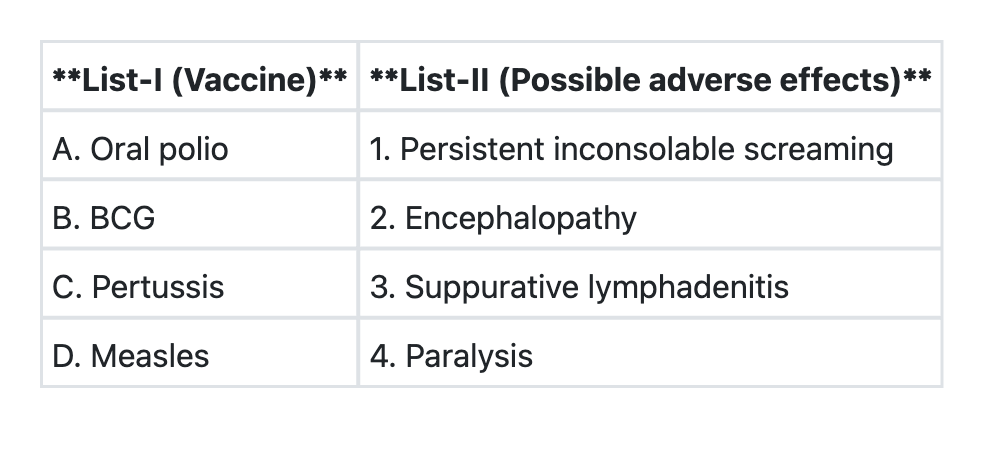
Match List-I with List-II and select the correct answer using the code given below the Lists:
Intramuscular injection of iron dextran is given by ‘Z’ technique to:
Absolute contraindication to combined oral contraceptive is:
Which of the following drugs should be avoided in the first-line ART regimens because of its well recognized metabolic toxicities ?
Which of the following statements regarding the composition of common crystalloid solutions is correct ?
Absolute contraindication for the use of OCPs is:
Explanation: ***DPT*** - Toxic shock syndrome has been **extremely rarely reported in isolated case reports following DPT** (diphtheria, pertussis, tetanus) vaccination, though it is **not a recognized or established complication** in standard medical literature. - The association is controversial and based on very limited data. Any potential link may be related to coincidental bacterial infection rather than a direct vaccine effect. - Among the options listed, this has the most (though minimal) reported association with **TSS-like reactions** in historical case reports. *Measles vaccine* - The measles vaccine is a **live attenuated vaccine** and does not cause toxic shock syndrome. - Its adverse effects are usually related to a mild form of the disease or allergic reactions, not **bacterial toxin-mediated illnesses like TSS**. *BCG vaccine* - The BCG (Bacille Calmette-Guérin) vaccine is used against tuberculosis and is a **live attenuated vaccine**. - Adverse effects are commonly local reactions or disseminated BCG disease in immunocompromised individuals, not **toxic shock syndrome**. *Recombinant DNA Vaccine against Hepatitis B* - Recombinant DNA vaccines, like the Hepatitis B vaccine, are highly purified and contain **no live pathogens or bacterial toxins**. - They are associated with very few severe adverse events, none of which include **toxic shock syndrome**.
Explanation: ***Intravenous*** - Misoprostol is **not used intravenously** in obstetric practice due to safety concerns - IV administration could lead to **rapid, uncontrolled systemic effects** including severe adverse events like **cardiovascular collapse** and anaphylactoid reactions - The drug formulation is not intended for IV use, and its rapid absorption via this route would pose significant maternal risk - All approved obstetric uses employ **oral, sublingual, vaginal, or buccal routes** *Vaginal* - Vaginal administration is commonly used in obstetrics for **cervical ripening** and **labor induction** - Also used for **management of miscarriage** and **postpartum hemorrhage** - Allows for **gradual absorption** with local effect on the cervix and uterus *Sub-lingual* - Sublingual misoprostol is effectively absorbed through the **oral mucosa** - Used for **labor induction** and **management of postpartum hemorrhage** - Offers **rapid onset of action** and bypasses first-pass metabolism *Oral* - Oral administration is used for **medical abortion**, **miscarriage management**, and **labor induction** - Also approved for prevention of **NSAID-induced gastric ulcers** (non-obstetric indication) - Absorption is slower with lower peak concentrations compared to sublingual or vaginal routes
Explanation: ***Bupivacaine*** - Bupivacaine is known for its **cardiotoxicity**, which can lead to severe and often irreversible **cardiac arrest** if inadvertently administered intravenously. - This is due to its high potency, slow dissociation from cardiac sodium channels, and increased lipid solubility, leading to prolonged cardiac depression. *Lignocaine* - While lignocaine (lidocaine) can cause cardiac toxicity in overdose, it is generally considered less cardiotoxic than bupivacaine, and cardiac arrest is more readily reversible. - It is commonly used intravenously as an antiarrhythmic, indicating a safer cardiac profile at therapeutic doses. *Cocaine* - Cocaine is a vasoconstrictor and stimulant; its primary cardiovascular effects are **tachycardia**, hypertension, and arrhythmias due to inhibition of norepinephrine reuptake, rather than direct myocardial depression leading to irreversible cardiac arrest from intravenous injection in the same manner as bupivacaine. - Cocaine toxicity can cause myocardial ischemia and infarction, but not the same profound, irreversible cardiac depression seen with bupivacaine. *Prilocaine* - Prilocaine is associated with **methemoglobinemia** as a dose-dependent side effect, especially in large doses, due to its metabolite o-toluidine. - While it can cause cardiovascular depression at very high doses, it does not have the same potent and often irreversible direct negative inotropic effects on the heart as bupivacaine.
Explanation: ***Severe reaction to a previous dose*** * A **severe allergic reaction** (e.g., **anaphylaxis**) to a previous dose of any vaccine or its components is an **absolute contraindication** to further doses of that vaccine. * This is due to the potential for a life-threatening anaphylactic response upon re-exposure to the allergen. *Hodgkin's disease* * While Hodgkin's disease is a **malignancy** that can affect the immune system, it is generally considered a **precaution** or a reason to defer live vaccines, not an absolute contraindication for killed vaccines. * **Killed vaccines** are generally safe in immunocompromised patients, though their efficacy may be reduced. *Pregnancy* * **Pregnancy** is a contraindication for certain **live attenuated vaccines** (e.g., MMR, varicella) due to the theoretical risk of fetal infection. * However, most **killed vaccines** (e.g., inactivated influenza, tetanus, diphtheria, acellular pertussis) are **safe and often recommended** during pregnancy for maternal and fetal protection. *Immunodeficiency* * **Immunodeficiency** (e.g., HIV/AIDS, chemotherapy) is primarily a contraindication for **live attenuated vaccines**, as these can cause disseminated infection in immunocompromised individuals. * **Killed vaccines** are generally safe in immunocompromised individuals, although the **immune response may be suboptimal**, and repeat doses or higher doses may be necessary.
Explanation: ***A→4 B→3 C→1 D→2*** - **Oral polio vaccine (OPV)** is a live attenuated vaccine, and a rare but serious adverse effect is vaccine-associated paralytic poliomyelitis (VAPP), which manifests as **paralysis**. - **BCG vaccine** (Bacillus Calmette-Guérin) is used against tuberculosis. A known adverse effect, particularly in immunocompromised individuals, is **suppurative lymphadenitis**, where regional lymph nodes become inflamed and may form abscesses. - **Pertussis vaccine** (whole-cell DTP) can cause reactions such as persistent inconsolable screaming, high fever, and, very rarely, encephalopathy. **Persistent inconsolable screaming** is a recognized adverse reaction to the pertussis component. - **Measles vaccine** is a live attenuated vaccine. While generally safe, rare severe adverse effects include **encephalopathy** (or encephalitis). *A→3 B→4 C→1 D→2* - This option incorrectly associates oral polio vaccine with suppurative lymphadenitis and BCG with paralysis, contradicting established vaccine adverse effects. - Oral polio has a risk of paralysis, not lymphadenitis, whereas BCG can cause lymphadenitis. *A→2 B→1 C→4 D→3* - This option incorrectly links oral polio to encephalopathy and BCG to persistent inconsolable screaming. - Encephalopathy is associated with measles or pertussis, and persistent screaming with pertussis, not oral polio or BCG. *A→1 B→2 C→3 D→4* - This option incorrectly attributes persistent inconsolable screaming to oral polio and encephalopathy to BCG. - Paralysis is a known complication of oral polio, and suppurative lymphadenitis is a key adverse effect of BCG.
Explanation: ***Reduce the staining*** - The **Z-track technique** creates a staggered path that prevents the dark iron solution from leaking back into the subcutaneous tissue, which can cause **permanent skin discoloration or staining**. - This method seals the medication deep in the muscle, preventing its reflux along the needle track. *Increase the iron absorption* - The Z-track technique is primarily about preventing **leakage and staining**, not enhancing the absorption rate of the iron. - Iron absorption is largely determined by factors like the patient's iron deficiency status and the form of iron administered, not the injection technique. *Alleviate the pain* - While proper injection technique can minimize discomfort, the Z-track method's primary purpose is not pain reduction but rather **preventing reflux** and associated staining. - Pain during injection is often related to the volume, viscosity, and acidity of the medication, as well as the injection site. *Decrease the incidence of infection* - Standard aseptic techniques, not the Z-track method itself, are crucial for **preventing infection** during intramuscular injections. - The Z-track technique does not inherently reduce the risk of infection beyond what is achieved with good sterile practice.
Explanation: ***History of thrombo-embolism*** - A history of **thromboembolism** (e.g., DVT, pulmonary embolism) is an **absolute contraindication** to combined oral contraceptives (COCs) due to the increased risk of further thrombotic events associated with estrogen. - COCs, particularly their estrogen component, can increase levels of clotting factors and decrease natural anticoagulants, significantly raising the risk of **venous thromboembolism (VTE)**. *History of gallbladder disease* - A history of **gallbladder disease** is generally considered a **relative contraindication** rather than an absolute one for COCs. - While COCs may exacerbate pre-existing gallbladder conditions or increase the risk of gallstone formation in some individuals, it doesn't preclude their use in all cases. *History of GDM* - A history of **gestational diabetes mellitus (GDM)** is a **relative contraindication** or caution for COC use, particularly in women with additional risk factors for diabetes. - While COCs can affect glucose tolerance, they are not absolutely contraindicated unless the woman has developed overt diabetes or has poorly controlled metabolic issues. *History of previous two caesarean section* - A history of previous **two cesarean sections** is **not a contraindication** to combined oral contraceptive use. - This obstetric history does not impact the metabolic or thrombotic risks associated with COCs, and thus, does not directly interact with their safety profile.
Explanation: ***Stavudine (d4T)*** - **Stavudine** is a **nucleoside reverse transcriptase inhibitor (NRTI)** that is well-known for its significant **metabolic toxicities**, including **lipoatrophy**, peripheral neuropathy, and lactic acidosis [1]. - Due to these severe side effects, it is no longer recommended for first-line ART regimens and its use is generally avoided. *Tenofovir (TDF)* - While Tenofovir (TDF) can cause **renal toxicity** and **bone mineral density loss** [2], it is generally considered a safer option than stavudine regarding severe metabolic toxicities like lipoatrophy. - TDF is commonly used in first-line ART regimens, often in combination with other drugs. *Zidovudine (AZT)* - **Zidovudine** is associated with side effects such as **bone marrow suppression** (leading to anemia and neutropenia), myopathy, and gastrointestinal upset, but not typically the severe metabolic toxicities seen with stavudine. - It is still used in some ART regimens, particularly for prevention of mother-to-child transmission. *Lamivudine (3TC)* - **Lamivudine** is generally well-tolerated with a favorable side effect profile, primarily mild gastrointestinal symptoms, and is rarely associated with significant metabolic toxicities. - It is a cornerstone drug in many first-line ART regimens due to its efficacy and safety.
Explanation: ***Normal saline contains 154 mEq/L of Na+*** - Normal saline (0.9% NaCl) contains **154 mEq/L of both Na+ and Cl-**, making this statement factually correct. - This makes normal saline **hypernatremic and hyperchloremic** compared to plasma (which has ~140 mEq/L Na+ and ~103 mEq/L Cl-). - Normal saline is useful for correcting **hyponatremia** and for significant volume expansion, but large volumes can cause **hyperchloremic metabolic acidosis**. *Hartmann's solution contains 140 mEq/L of Na+* - Hartmann's solution (Lactated Ringer's) actually contains approximately **130 mEq/L of Na+**, not 140 mEq/L. - The sodium content is designed to be closer to that of **plasma**, making it a more physiologically balanced solution. *Hartmann's solution contains 120 mEq/L of Cl-* - Hartmann's solution contains approximately **109-110 mEq/L of Cl-**, not 120 mEq/L. - This **lower chloride content** compared to normal saline, along with the presence of lactate (28 mEq/L), contributes to a reduced risk of hyperchloremic metabolic acidosis. - The lactate is metabolized to bicarbonate, providing a mild alkalinizing effect. *Normal saline contains 140 mEq/L of Cl-* - Normal saline contains **154 mEq/L of Cl-**, not 140 mEq/L. - Its high chloride content can lead to **hyperchloremic metabolic acidosis** with large-volume administration.
Explanation: ***Thromboembolism*** - A **current or past history of thromboembolism** (e.g., DVT, pulmonary embolism) is an **absolute contraindication (WHO MEC Category 4)** for combined oral contraceptive pills (OCPs) due to the significantly increased risk of recurrent thrombotic events. - Exogenous **estrogen** in OCPs increases the synthesis of clotting factors (II, VII, IX, X, fibrinogen) and decreases anticoagulant proteins (protein S, antithrombin), thereby promoting a hypercoagulable state. - Even a remote history of VTE makes OCPs absolutely contraindicated. *Diabetes* - Diabetes **with vascular complications** (retinopathy, nephropathy, neuropathy) or diabetes of >20 years duration is a contraindication (WHO MEC Category 3/4). - However, **uncomplicated diabetes without vascular disease** is not an absolute contraindication for OCPs. - Among the options listed, thromboembolism is the clearest absolute contraindication. *Epilepsy* - Epilepsy itself is **not a contraindication** for OCPs (WHO MEC Category 1). - However, some **enzyme-inducing antiepileptic drugs** (phenytoin, carbamazepine, phenobarbital, topiramate) can reduce OCP efficacy by increasing hepatic metabolism of contraceptive hormones. - In such cases, higher-dose OCPs, alternative methods, or non-enzyme-inducing AEDs should be considered. *Hypertension* - **Severe or uncontrolled hypertension** (≥160/100 mmHg) or hypertension with vascular disease is an absolute contraindication (WHO MEC Category 4). - **Adequately controlled and monitored hypertension** is a relative contraindication (WHO MEC Category 3), not an absolute one. - Among the given options, thromboembolism represents a clearer and more universally accepted absolute contraindication.
Principles of Clinical Pharmacology
Practice Questions
Therapeutic Drug Monitoring
Practice Questions
Drug Toxicity and Overdose
Practice Questions
Antidotes and Their Applications
Practice Questions
Management of Drug Poisoning
Practice Questions
Drug-Induced Liver Injury
Practice Questions
Drug-Induced Kidney Injury
Practice Questions
Drug-Induced Blood Dyscrasias
Practice Questions
Drug-Induced QT Prolongation
Practice Questions
Pharmacovigilance
Practice Questions
Get full access to all questions, explanations, and performance tracking.
Start For Free