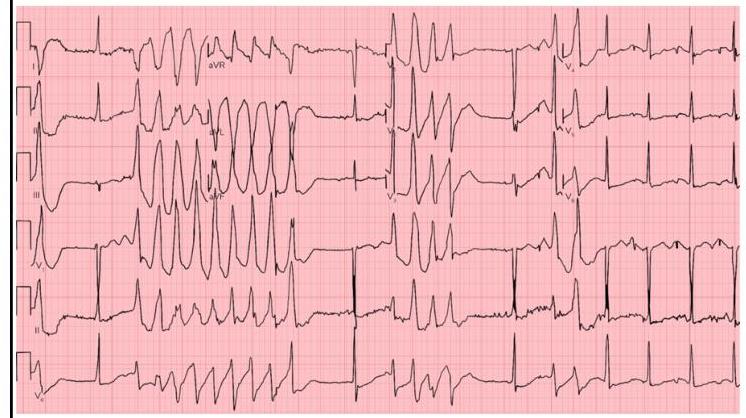
Identify the ECG given below?

A patient with hypertension on Metoprolol, Verapamil was given. This will result in?
Which antipsychotic has highest risk of QTc prolongation?
Features of Torsade de pointes include which of the following?
Match the following drugs in Column A with their contraindications in Column B. | Column A | Column B | | :-- | :-- | | 1. Morphine | 1. QT prolongation | | 2. Amiodarone | 2. Thromboembolism | | 3. Vigabatrin | 3. Pregnancy | | 4. Estrogen preparations | 4. Head injury |
QT shortening is associated with which electrolyte imbalance?
Which of the following anti-epileptic drugs has the highest teratogenic potential?
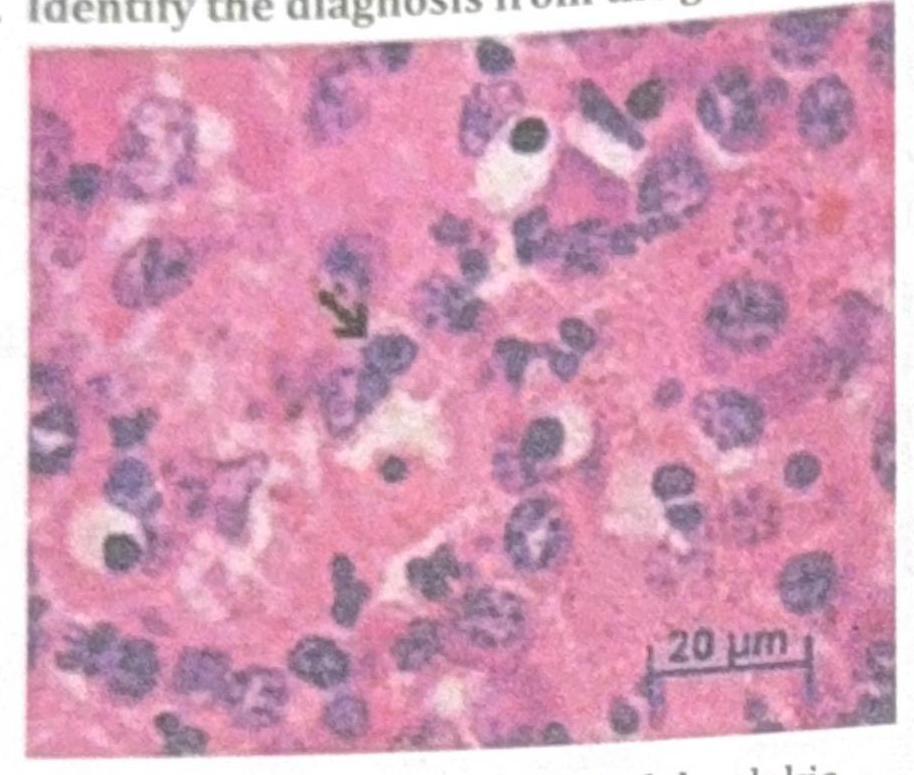
Identify the diagnosis from the given image
Alkaline diuresis in drug poisoning is not done in?
Which one of the following antihypertensive drugs is NOT safe during pregnancy?
Explanation: ***Torsades de pointes*** - The ECG shows a polymorphic ventricular tachycardia where the **QRS complexes appear to twist around the baseline**, a classic feature of Torsades de pointes. - This condition is often associated with **QT prolongation**, which is evident in some of the strips preceding the tachyarrhythmia. *Viral myocarditis* - While viral myocarditis can lead to various ECG abnormalities, it typically doesn't present with this specific **polymorphic ventricular tachycardia** morphology. - Common ECG findings in myocarditis include non-specific ST-T wave changes, sinus tachycardia, or conduction blocks, rather than the characteristic "twisting" pattern seen here. *Cardiac tamponade* - Cardiac tamponade is characterized by **electrical alternans** (alternating QRS amplitude), low voltage, and sinus tachycardia on ECG. - It does not cause a polymorphic ventricular tachycardia with the appearance of QRS complexes twisting around the baseline. *Pericarditis* - Pericarditis typically presents with **diffuse ST-segment elevation** (often concave up) and PR-segment depression. - It does not manifest as a polymorphic ventricular tachycardia like Torsades de pointes.
Explanation: ***Bradycardia with AV Block*** - Both **Metoprolol** (a beta-blocker) and **Verapamil** (a non-dihydropyridine calcium channel blocker) suppress **AV nodal conduction** and decrease heart rate. - Their combined use has an additive effect, significantly increasing the risk of profound **bradycardia**, **AV block**, and even **asystole**. *Atrial fibrillation* - This is an **arrhythmia** characterized by disorganized electrical activity in the atria, not a direct consequence of this drug combination. - While these drugs *treat* atrial fibrillation by controlling ventricular rate, they do not induce it. *Torsades de pointes* - This is a polymorphic **ventricular tachycardia** associated with **QT prolongation** from certain antiarrhythmics or other medications. - Neither Metoprolol nor Verapamil are known to cause significant QT prolongation that would lead to Torsades de pointes. *Tachycardia* - This combination of **negative chronotropic** (heart rate lowering) drugs is highly unlikely to cause tachycardia due to their direct actions on the heart's electrical system. - These drugs are specifically used to *reduce* heart rate and blood pressure.
Explanation: ***Ziprasidone*** - **Ziprasidone** is known to have the highest risk of **QTc prolongation** among the commonly used atypical antipsychotics. - This effect is dose-dependent and necessitates careful monitoring, especially in patients with pre-existing cardiac conditions or those on other QTc-prolonging medications. *Risperidone* - While **risperidone** can cause **QTc prolongation**, its risk is generally considered to be lower than that of ziprasidone. - It also carries a significant risk of **hyperprolactinemia** and **extrapyramidal symptoms (EPS)**, which are important distinguishing features. *Olanzapine* - **Olanzapine** has a relatively low risk of **QTc prolongation** compared to ziprasidone. - Its primary concerns include substantial **weight gain** and **metabolic syndrome**, which are less prominent with ziprasidone. *Aripiprazole* - **Aripiprazole** is generally associated with a very low risk of **QTc prolongation** and is often considered a safer choice in this regard. - It is known for its unique partial agonist activity at dopamine D2 and serotonin 5-HT1A receptors, and antagonist activity at 5-HT2A receptors, leading to a different side effect profile.
Explanation: ***Prolonged QTc interval*** - **Torsade de pointes** (TdP) is a polymorphic ventricular tachycardia characterized by a twisting of the QRS complex around the isoelectric line [1]. - It is almost invariably associated with a **prolonged QTc interval**, which can be congenital or acquired due to drugs or electrolyte imbalances [1],[4]. *Wide QRS complex* - While TdP does involve **wide QRS complexes**, this is a general characteristic of most ventricular tachycardias and not specific enough to define Torsade de pointes [2]. - The distinctive feature of TdP is the **polymorphic nature** of the wide QRS complexes and their characteristic "twisting" pattern, which is rooted in the underlying repolarization abnormality [1]. *Short QRS complex* - A **short QRS complex** is characteristic of supraventricular arrhythmias and is not seen in ventricular tachycardias like Torsade de pointes [3]. - Ventricular activation originates in the ventricles, leading to a **wider QRS** due to slower, aberrant conduction [2]. *Short QTc interval* - A **short QTc interval** is linked to conditions like short QT syndrome, which can also cause arrhythmias but is not responsible for Torsade de pointes. - TdP exclusively occurs in the setting of **prolonged ventricular repolarization**, reflected by a long QTc [1],[4].
Explanation: ***A-4, B-1, C-3, D-2*** - **Morphine** is contraindicated in **head injury** as it can increase intracranial pressure and mask neurological symptoms. - **Amiodarone** is contraindicated in patients with **QT prolongation** due to its risk of inducing more severe arrhythmias like Torsades de Pointes. - **Vigabatrin** is contraindicated during **pregnancy** due to its potential for teratogenicity and adverse effects on fetal development. - **Estrogen preparations** are contraindicated in patients with a history of **thromboembolism** due to their increased risk of blood clot formation. *A-1, B-3, C-2, D-4* - This option incorrectly matches **Morphine** with QT prolongation and **Estrogen preparations** with head injury, which are not their primary contraindications. - It also incorrectly links **Vigabatrin** with thromboembolism and **Amiodarone** with pregnancy. *A-3, B-2, C-4, D-1* - This choice incorrectly associates **Morphine** with pregnancy and **Vigabatrin** with head injury, which are not the most critical or direct contraindications. - It also misaligns **Amiodarone** with thromboembolism and **Estrogen preparations** with QT prolongation. *A-2, B-4, C-1, D-3* - This option incorrectly matches **Morphine** with thromboembolism and **Amiodarone** with head injury, which are not their most significant contraindications. - It also incorrectly links **Vigabatrin** with QT prolongation and **Estrogen preparations** with pregnancy.
Explanation: ***Hypercalcemia*** - **Elevated calcium levels** lead to a shortened **plateau phase of the cardiac action potential**, which manifests as a **shortened QT interval** on an ECG. - This imbalance increases the risk of ventricular arrhythmias, although profound shortening can lead to **QRS widening** with further increase in calcium. *Hypokalemia* - **Low potassium** levels typically cause **QT prolongation**, usually due to prominent U waves and T wave flattening. - It does not cause QT shortening; instead, it is associated with an **increased risk of Torsades de Pointes**. *Hypocalcemia* - **Low calcium** levels cause **QT prolongation** by lengthening the **plateau phase of the cardiac action potential**, increasing the duration of ventricular repolarization. - ECG findings include prolonged ST segment and can increase the risk of arrhythmias, including Torsades de Pointes. *Hyperkalemia* - **High potassium** levels primarily cause **peaked T waves**, a **widened QRS complex**, and a **prolonged PR interval**, potentially leading to asystole or ventricular fibrillation. - It does not cause QT shortening; instead, severe hyperkalemia can lead to **loss of P waves** and a **sine wave pattern**.
Explanation: ***Correct: Valproate*** - **Valproate has the highest teratogenic potential** among all anti-epileptic drugs, with a **10-20% risk of major congenital malformations** - **Neural tube defects** (spina bifida) occur in **1-2% of exposed pregnancies**, which is 10-20 times higher than the general population - Other significant risks include **cardiac malformations, craniofacial abnormalities**, and **neurodevelopmental disorders** (autism spectrum disorder, reduced IQ) - **Fetal valproate syndrome** is a recognized clinical entity - Current guidelines strongly recommend **avoiding valproate in women of childbearing potential** unless no alternatives exist *Incorrect: Carbamazepine* - Has teratogenic risks but significantly **lower than valproate** (2-5% risk of major malformations) - Associated with **neural tube defects** (0.5-1% risk, lower than valproate) - Considered a safer alternative when valproate must be avoided *Incorrect: Phenytoin* - Causes **fetal hydantoin syndrome** with characteristic features: craniofacial anomalies, nail/digital hypoplasia, growth restriction, and developmental delay - Teratogenic risk is **moderate** (approximately 5-10% risk of major malformations) - Risk is significant but **lower than valproate** *Incorrect: Lamotrigine* - Considered **one of the safest anti-epileptic drugs** during pregnancy - Low teratogenic risk with **major malformation rate of 2-3%** (close to baseline population risk) - Slight increased risk of **oral clefts** at higher doses - **Preferred choice** for women of childbearing potential requiring anti-epileptic therapy
Explanation: ***Malakoplakia*** - The image displays characteristic **Michaelis-Gutmann bodies**, which are concentrically laminated calcified inclusions found within macrophages (**Von Hansemann cells**). These are pathognomic for malakoplakia. - **Von Hansemann cells** are large, foamy macrophages with abundant cytoplasm, also visible in the image, mixed with lymphocytes and plasma cells. *TB* - Tuberculosis (TB) typically presents with **granulomatous inflammation** characterized by caseating necrosis, epithelioid macrophages, Langhans giant cells, and lymphocytes [2]. These features are not apparent in the image. - While TB can involve macrophages, the distinct Michaelis-Gutmann bodies seen here are not a feature of tuberculous granulomas [1]. *BCC* - Basal cell carcinoma (BCC) is a malignant epithelial tumor characterized by nests of basaloid cells with peripheral palisading, clear clefts, and often stromal retraction. This biopsy shows inflammatory cells and calcified inclusions, not epithelial malignancy. - BCC would show atypical epithelial cells and features of a neoplastic process, which are distinctly different from the inflammatory infiltrate and inclusion bodies in the image. *Drug induced lesion* - Drug-induced lesions are highly variable and context-dependent, but they do not typically present with the specific histopathological features of Michaelis-Gutmann bodies within macrophages. - The image depicts a specific and recognizable inflammatory pattern with unique inclusions, which points to a distinct disease entity rather than a non-specific drug reaction. **References:** [1] Cross SS. Underwood's Pathology: A Clinical Approach. 6th ed. (Basic Pathology) introduces the student to key general principles of pathology, both as a medical science and as a clinical activity with a vital role in patient care. Part 2 (Disease Mechanisms) provides fundamental knowledge about the cellular and molecular processes involved in diseases, providing the rationale for their treatment. Part 3 (Systematic Pathology) deals in detail with specific diseases, with emphasis on the clinically important aspects., pp. 198-200. [2] Kumar V, Abbas AK, et al.. Robbins and Cotran Pathologic Basis of Disease. 9th ed. Infectious Diseases, p. 360.
Explanation: ***Morphine*** - **Morphine** is an **alkaline drug**, so its elimination is actually enhanced by **acidification of the urine**, not alkalinization. - Alkaline diuresis would decrease the ionization of morphine in the renal tubules, leading to **increased reabsorption** and reduced excretion. *Aspirin* - **Aspirin (acetylsalicylic acid)** is an **acidic drug**, and **alkaline diuresis** is effective in increasing its excretion by trapping the ionized form in the renal tubules. - This process prevents reabsorption and promotes clearance, which is a standard treatment for aspirin overdose. *Methotrexate* - **Methotrexate** is a **weak organic acid**, and **alkaline diuresis** is crucial in reducing its toxicity, especially in high-dose therapy. - By increasing urine pH, the renal elimination of methotrexate is significantly enhanced, preventing kidney damage and systemic accumulation. *Phenobarbitone* - **Phenobarbitone** is a **weak acid**, and **alkaline diuresis** is a well-established method to increase its renal excretion in cases of overdose. - Alkalinization of the urine promotes the ionization of phenobarbitone, reducing its reabsorption by the renal tubules and accelerating its elimination.
Explanation: ***ACE-inhibitors*** - **ACE inhibitors** (e.g., enalapril, lisinopril) are **contraindicated** in pregnancy due to their association with severe fetal abnormalities, including **renal agenesis**, **oligohydramnios**, and **fetal death** [1], [2]. - They should be discontinued as soon as pregnancy is confirmed or suspected due to their known **teratogenic effects** [1], [2].*Labetalol* - **Labetalol**, a combined alpha- and beta-blocker, is considered one of the **first-line agents** for managing hypertension in pregnancy. - It has a good safety profile for both the mother and the fetus and is commonly used in conditions like **preeclampsia**.*Nifedipine* - **Nifedipine**, a calcium channel blocker, is also a **safe and effective** option for treating hypertension during pregnancy. - It is frequently used for managing **chronic hypertension** and **preeclampsia** due to its rapid onset of action and tolerability.*Alpha-methyl dopa* - **Alpha-methyl dopa** (methyldopa) is considered one of the **safest and most extensively studied** antihypertensive medications for use in pregnancy. - It is often the **first-choice agent** for chronic hypertension during pregnancy due to its long-standing track record of safety for the fetus.
Get full access to all questions, explanations, and performance tracking.
Start For Free