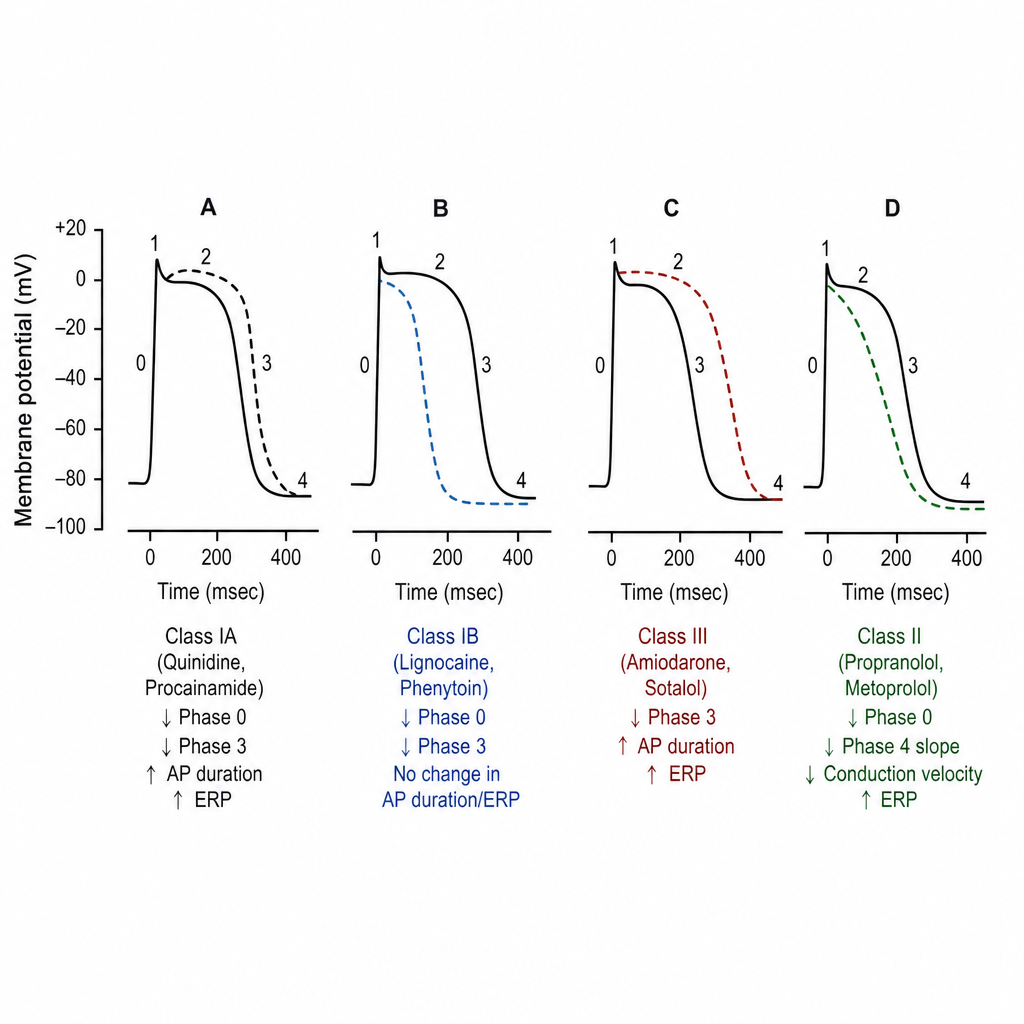
Digoxin can accumulate to toxic levels in patients with?
In terms of the ability of drugs like digoxin to increase cardiac contractility, what is their primary action on cardiac cells?
Dopamine given in acute CHF does NOT act on which of the following receptors?
Which of the following drugs is NOT used in the management of pulmonary hypertension?
All of the following antihypertensive drugs increase plasma renin activity except?
Digibind is used to:
All of the following drugs are used in the management of acute myocardial infarction except?
All of the following are true regarding rabeprazole except:
What is the primary route of administration for iloprost in the management of pulmonary hypertension?
All of the following ACE inhibitors are prodrugs and are activated by esterases in the liver except?
Explanation: **Explanation:** The primary mechanism for the elimination of **Digoxin** is renal excretion. Approximately 60-80% of the drug is excreted unchanged in the urine via glomerular filtration and tubular secretion (mediated by P-glycoprotein). 1. **Why Renal Insufficiency is Correct:** Since Digoxin has a narrow therapeutic index (0.5–2 ng/mL) and is primarily cleared by the kidneys, any decrease in the Glomerular Filtration Rate (GFR) significantly increases its half-life (normally 36–40 hours). In patients with renal failure, the drug accumulates rapidly, leading to life-threatening digitalis toxicity. 2. **Why Other Options are Incorrect:** Digoxin undergoes minimal hepatic metabolism. Therefore, conditions like **Chronic Hepatitis** or **Advanced Cirrhosis** do not significantly alter its clearance. Similarly, **Chronic Pancreatitis** affects exocrine/endocrine functions of the pancreas but has no physiological role in the pharmacokinetics of Digoxin. **High-Yield Clinical Pearls for NEET-PG:** * **Hypokalemia:** This is the most important predisposing factor for Digoxin toxicity because K+ and Digoxin compete for the same binding site on the Na+/K+-ATPase pump. * **Drug Interactions:** Drugs like **Quinidine, Verapamil, and Amiodarone** reduce the renal clearance of Digoxin and can precipitate toxicity. * **ECG Findings:** The earliest sign of toxicity is often PVCs; the most characteristic sign is "Reverse Tick" ST-segment depression; the most specific arrhythmia is **Atrial Tachycardia with AV block**. * **Antidote:** Digoxin-specific antibody fragments (**DigiFab/Digibind**).
Explanation: **Explanation:** The primary mechanism of action of **Digoxin** (a cardiac glycoside) is the reversible inhibition of the **Na⁺/K⁺-ATPase pump** located on the sarcolemma of cardiac myocytes [1]. 1. **Why Option D is Correct:** By inhibiting the Na⁺/K⁺-ATPase pump, digoxin causes an increase in intracellular sodium ($Na^+$). This rise in intracellular $Na^+$ reduces the concentration gradient that drives the **Na⁺/Ca²⁺ exchanger (NCX)** [3]. Consequently, less calcium is extruded from the cell, and more calcium is sequestered into the Sarcoplasmic Reticulum (SR) via the SERCA pump. During subsequent depolarizations, a greater amount of calcium is released from the SR, leading to increased myofibril shortening and **positive inotropy**. 2. **Why other options are incorrect:** * **Option A:** Activation of adenylyl cyclase increases cAMP, which is the mechanism for **Beta-agonists** (like Dobutamine). * **Option B:** Inactivation of Na⁺ channels is the mechanism of **Class I Antiarrhythmics** (like Lidocaine), which decreases excitability rather than increasing contractility. * **Option C:** Activation of slow $Ca^{2+}$ channels (L-type) is associated with catecholamines and sympathetic stimulation, not the direct action of digoxin. **High-Yield Clinical Pearls for NEET-PG:** * **Electrolyte sensitivity:** **Hypokalemia** predisposes to digoxin toxicity because $K^+$ and digoxin compete for the same binding site on the Na⁺/K⁺-ATPase pump [3]. This occurs because elevated extracellular K+ levels can cause dephosphorylation of the ATPase alpha subunit, reducing glycoside binding [2]. * **ECG Changes:** The classic sign of digoxin effect is the **"Reverse Tick"** or "Sagging" ST-segment depression (Salvador Dali mustache sign). * **Therapeutic Window:** Digoxin has a narrow therapeutic index (0.5–2 ng/mL). * **Antidote:** Digoxin-specific antibody fragments (**DigiFab**).
Explanation: **Explanation:** The pharmacological action of Dopamine is uniquely **dose-dependent**. To understand why Alpha-1 receptors are the correct answer in the context of acute Congestive Heart Failure (CHF), we must look at the therapeutic goals and dose ranges: 1. **Low Dose (0.5–2 µg/kg/min):** Acts primarily on **D1 receptors** (Option B) located in the renal, mesenteric, and coronary beds. This causes vasodilation and increases renal blood flow (Option A), promoting diuresis. 2. **Intermediate Dose (2–10 µg/kg/min):** Acts primarily on **Beta-1 receptors** (Option C). This increases myocardial contractility (positive inotropy) and cardiac output, which is the primary therapeutic goal in acute CHF. 3. **High Dose (>10 µg/kg/min):** Acts on **Alpha-1 receptors** (Option D), causing systemic vasoconstriction. **Why Alpha-1 is the correct answer:** In the management of acute CHF, the goal is to improve cardiac output and reduce afterload. Activating Alpha-1 receptors causes peripheral vasoconstriction, which increases afterload and myocardial oxygen demand, potentially worsening heart failure. Therefore, Dopamine is titrated to "inotropic doses" (Beta-1) and not "pressor doses" (Alpha-1) in this specific clinical setting. **Clinical Pearls for NEET-PG:** * **Dopamine vs. Dobutamine:** Dobutamine is often preferred in CHF because it has more prominent Beta-1 effects and lacks the Alpha-1 mediated vasoconstriction seen with high-dose Dopamine. * **Fenoldopam:** A selective D1 agonist used in hypertensive emergencies to maintain renal perfusion. * **Renal Dose Myth:** Recent evidence suggests the "renal dose" of dopamine does not significantly improve outcomes in acute renal failure, though it remains a high-yield exam concept.
Explanation: ### Explanation The management of Pulmonary Arterial Hypertension (PAH) focuses on reducing pulmonary vascular resistance through specific pathways: the **Nitric Oxide pathway**, the **Endothelin pathway**, and the **Prostacyclin pathway**. **Why Alpha Blockers are NOT used:** Alpha-blockers (like Prazosin) act primarily on peripheral $\alpha_1$ receptors to cause systemic vasodilation. They do not have a selective or significant effect on the pulmonary vasculature. Using them in PAH can lead to systemic hypotension without effectively lowering pulmonary artery pressure, potentially worsening the patient's hemodynamic status. **Analysis of Other Options:** * **Calcium Channel Blockers (CCBs):** High-dose CCBs (e.g., Nifedipine, Diltiazem, Amlodipine) are the first-line treatment for a small subset of patients who show a positive response during **Vasoreactivity Testing** (usually with inhaled Nitric Oxide). * **Endothelin Receptor Antagonists (ERAs):** Drugs like **Bosentan** (non-selective), **Ambrisentan**, and **Macitentan** (selective $ET_A$) block the potent vasoconstrictor effects of endothelin-1, which is elevated in PAH. * **Prostacyclins:** PAH is characterized by a deficiency of prostacyclin ($PGI_2$). Synthetic analogs like **Epoprostenol** (IV), **Treprostinil**, and **Iloprost** act as potent pulmonary vasodilators and inhibitors of platelet aggregation. **High-Yield Clinical Pearls for NEET-PG:** * **Drug of Choice:** For PAH, the specific choice depends on the functional class, but **Sildenafil** (PDE-5 inhibitor) is frequently used. * **Bosentan Side Effect:** It is known for **hepatotoxicity** (requires monthly LFTs) and is highly **teratogenic**. * **Riociguat:** A Soluble Guanylate Cyclase (sGC) stimulator used in PAH and chronic thromboembolic pulmonary hypertension (CTEPH). * **Selexipag:** An oral selective $IP$ prostacyclin receptor agonist.
Explanation: **Explanation:** The regulation of **Plasma Renin Activity (PRA)** is primarily governed by the sympathetic nervous system (via $\beta_1$ receptors on juxtaglomerular cells), renal baroreceptors, and feedback loops involving Angiotensin II. **1. Why Clonidine is the correct answer:** Clonidine is a **centrally acting $\alpha_2$ agonist**. It stimulates $\alpha_2$ receptors in the nucleus tractus solitarius, leading to a decrease in sympathetic outflow from the brain. This reduction in sympathetic tone results in **decreased stimulation of $\beta_1$ receptors** in the kidney, thereby **inhibiting renin release**. Consequently, Clonidine (along with Methyldopa) decreases PRA. **2. Why the other options are incorrect:** * **Hydralazine (Vasodilator):** Causes significant peripheral vasodilation, leading to a drop in blood pressure. This triggers a potent **reflex sympathetic activation**, which stimulates $\beta_1$ receptors to increase renin release. * **Nifedipine (Calcium Channel Blocker):** Similar to other dihydropyridines, it causes vasodilation and a subsequent **reflex increase in sympathetic activity**, which raises PRA. * **Captopril (ACE Inhibitor):** By blocking the conversion of Angiotensin I to Angiotensin II, it removes the **negative feedback** that Angiotensin II normally exerts on renin release. This leads to a compensatory (reactive) increase in PRA. **High-Yield Clinical Pearls for NEET-PG:** * **Drugs that Decrease PRA:** $\beta$-blockers (e.g., Propranolol), Centrally acting drugs (Clonidine, Methyldopa), and Direct Renin Inhibitors (Aliskiren—though Aliskiren decreases *activity*, it actually increases renin *concentration*). * **Drugs that Increase PRA:** Diuretics, ACE inhibitors, ARBs, CCBs, and direct vasodilators. * **Clonidine Withdrawal:** Abrupt cessation can lead to a **rebound hypertensive crisis** due to a sudden surge in catecholamines.
Explanation: **Explanation:** **Correct Answer: C. Treat Digoxin toxicity** **Mechanism of Action:** Digibind (Digoxin Immune Fab) consists of antigen-binding fragments (Fab) derived from specific antidigoxin antibodies produced in sheep. It acts as a **specific antidote** for life-threatening digoxin toxicity. When administered intravenously, these fragments bind to free digoxin molecules in the extracellular space with high affinity, forming a complex that is pharmacologically inactive and subsequently excreted by the kidneys. This creates a concentration gradient that pulls digoxin away from its binding sites on the Na+/K+ ATPase pump, reversing toxic effects like life-threatening arrhythmias [1] and hyperkalemia. **Analysis of Incorrect Options:** * **Option A & B:** Digibind neutralizes digoxin; it does not potentiate its action or decrease its metabolism. In fact, it effectively terminates the drug's action. * **Option D:** "Rapid digitalization" refers to the administration of loading doses of digoxin to achieve therapeutic levels quickly. Digibind would counteract this process. **High-Yield Clinical Pearls for NEET-PG:** * **Indications for Digibind:** Severe hyperkalemia (K+ > 5.0 mEq/L), life-threatening arrhythmias (VFib, V-Tach) [1], or ingestion of >10 mg in adults (>4 mg in children). * **Monitoring:** After administering Digibind, **total** serum digoxin levels will appear falsely elevated (as the assay measures both free and bound digoxin); therefore, serum levels are not useful for monitoring for at least 1-2 weeks [1]. * **Electrolytes:** Digoxin toxicity is predisposed by **Hypokalemia**, but severe acute toxicity itself causes **Hyperkalemia** (due to inhibition of Na+/K+ ATPase). Digibind helps reverse this hyperkalemia.
Explanation: Explanation: The management of Acute Myocardial Infarction (AMI) focuses on restoring coronary blood flow and reducing myocardial oxygen demand. Calcium Channel Blockers (CCBs), specifically short-acting dihydropyridines like Nifedipine, are generally avoided in the acute phase of MI. They can cause reflex tachycardia and peripheral vasodilation, which may worsen myocardial ischemia and increase mortality. While non-dihydropyridines (Verapamil/Diltiazem) may be used in specific cases (e.g., persistent ischemia where beta-blockers are contraindicated), they are not standard first-line therapy.Analysis of Incorrect Options: * Tissue Plasminogen Activator (tPA): A thrombolytic agent (e.g., Alteplase) used in STEMI to dissolve the occluding thrombus and achieve reperfusion when primary PCI is not immediately available [1]. * Intravenous Beta Blockers: These reduce heart rate, contractility, and blood pressure, thereby decreasing myocardial oxygen demand. They help limit infarct size and reduce the risk of ventricular arrhythmias. * Acetylsalicylic Acid (Aspirin): A cornerstone of treatment. It inhibits platelet aggregation by irreversibly inhibiting COX-1, preventing further thrombus propagation [2]. Clinical Pearls for NEET-PG: * MONA regimen: Standard initial care includes Morphine, Oxygen (if hypoxic), Nitrates, and Aspirin. * Beta-blockers are contraindicated in MI if the patient has signs of heart failure, low output state, or risk of cardiogenic shock. * Nifedipine (short-acting) is specifically contraindicated in AMI due to the risk of "coronary steal" and reflex tachycardia. * ACE Inhibitors should be started within 24 hours to prevent ventricular remodeling.
Explanation: **Explanation:** The question contains a slight typographical error in the drug name; it refers to **Ranolazine**, a novel anti-anginal agent (Rabeprazole is a Proton Pump Inhibitor). **1. Why Option A is the Correct Answer (The "Except"):** Ranolazine is unique because it provides anti-anginal efficacy **without significantly affecting heart rate or blood pressure.** Unlike nitrates, beta-blockers, or calcium channel blockers, ranolazine does not cause hypotension. Therefore, the statement "It causes hypotension" is false. **2. Analysis of Other Options:** * **Option B:** Ranolazine is approved as a **first-line treatment** for chronic stable angina (often used when other drugs are contraindicated or as add-on therapy). * **Option C:** A significant high-yield property of Ranolazine is its ability to **reduce HbA1c levels**, thereby improving glycemic control in diabetic patients with angina. * **Option D:** Ranolazine has a slow onset of action and works by inhibiting the **late inward sodium current ($I_{Na}$)** in the myocardium. This prevents calcium overload but does not provide immediate vasodilation; hence, it is **not indicated for acute attacks.** **3. NEET-PG High-Yield Pearls:** * **Mechanism of Action:** Inhibits late $I_{Na}$ current $\rightarrow$ decreases intracellular $Ca^{2+}$ $\rightarrow$ improves myocardial relaxation and reduces wall tension. * **ECG Change:** It can cause **QT interval prolongation** (though it rarely leads to Torsades de Pointes). * **Metabolism:** It is metabolized by **CYP3A4**; therefore, inhibitors like ketoconazole or clarithromycin are contraindicated. * **Clinical Advantage:** Ideal for patients who have low baseline blood pressure or heart rate where traditional anti-anginals cannot be up-titrated.
Explanation: **Explanation:** **Iloprost** is a synthetic analogue of **Prostacyclin (PGI2)**. In the management of pulmonary arterial hypertension (PAH), the primary and most common route of administration is **Inhalation** (Option A). **Why Inhalation is Correct:** Administering iloprost via a nebulizer allows for **pulmonary selectivity**. By delivering the drug directly to the alveolar space, it causes localized vasodilation in the pulmonary vascular bed. This reduces pulmonary vascular resistance while minimizing systemic side effects like hypotension. It also improves "ventilation-perfusion matching" because the drug only reaches well-ventilated areas of the lung. **Analysis of Incorrect Options:** * **B. Intravenous:** While iloprost can be given IV (primarily in Europe for peripheral vascular disease), it is not the primary route for PAH due to the high risk of systemic hypotension and the requirement for a central venous catheter. (Note: *Epoprostenol* is the prostacyclin typically given via continuous IV infusion for PAH). * **C. Oral:** Iloprost has poor oral bioavailability. For oral prostacyclin therapy, **Selexipag** (a receptor agonist) or **Beraprost** are used instead. * **D. Subcutaneous:** This route is specifically associated with **Treprostinil**, not iloprost. **NEET-PG High-Yield Pearls:** * **Mechanism of Action:** Increases intracellular cAMP, leading to potent vasodilation and inhibition of platelet aggregation. * **Half-life:** Iloprost has a very short half-life (approx. 20–30 minutes), requiring frequent dosing (6–9 inhalations per day). * **Drug of Choice:** For PAH, the first-line oral agents are usually Endothelin receptor antagonists (e.g., **Bosentan**) or PDE-5 inhibitors (e.g., **Sildenafil**). Prostacyclins are typically reserved for more severe functional classes (NYHA Class III/IV).
Explanation: **Explanation:** Most Angiotensin-Converting Enzyme (ACE) inhibitors are formulated as **prodrugs** to improve their oral bioavailability. These drugs are inactive in their original form and must undergo hydrolysis by **hepatic esterases** to be converted into their active "–at" metabolites (e.g., Enalapril to Enalaprilat). **Why Captopril is the Correct Answer:** **Captopril** and **Lisinopril** are the two primary exceptions to this rule. They are **not prodrugs**; they are active molecules upon ingestion and do not require hepatic metabolism for activation. This makes them particularly useful in patients with severe liver dysfunction, as their therapeutic effect is not dependent on hepatic esterase activity. **Analysis of Incorrect Options:** * **Ramipril:** A common prodrug converted to its active form, *Ramiprilat*. It is highly lipophilic and widely used for its cardioprotective benefits. * **Perindopril:** A long-acting prodrug converted to *Perindoprilat*. It is frequently used in the management of stable coronary artery disease. * **Spirapril:** A prodrug converted to *Spiraprilat*. It is unique because it is eliminated equally by both renal and biliary routes, making it safer in patients with renal impairment. **High-Yield NEET-PG Pearls:** 1. **The "Pril" Rule:** All ACE inhibitors are prodrugs **EXCEPT Captopril and Lisinopril.** 2. **Excretion:** Most ACE inhibitors are excreted renally. **Fosinopril** and **Spirapril** are notable for having significant compensatory biliary excretion, making them safer in renal failure. 3. **Lisinopril** is the only ACE inhibitor that is not highly protein-bound and is excreted unchanged in the urine. 4. **Side Effects:** Remember the mnemonic **CAPTOPRIL** (Cough, Angioedema, Proteinuria, Taste changes, Orthostatic hypotension, Pregnancy contraindication, Renal artery stenosis contraindication, Increased Potassium, Leukopenia).
Antihypertensive Agents
Practice Questions
Drugs for Heart Failure
Practice Questions
Antiarrhythmic Drugs
Practice Questions
Antianginal Agents
Practice Questions
Lipid-Lowering Drugs
Practice Questions
Anticoagulants and Antiplatelet Drugs
Practice Questions
Thrombolytic Agents
Practice Questions
Drugs Used in Pulmonary Hypertension
Practice Questions
Drugs Used in Shock
Practice Questions
Cardiovascular Effects of Non-Cardiovascular Drugs
Practice Questions
Get full access to all questions, explanations, and performance tracking.
Start For Free