Herceptin (Trastuzumab) is an immunotherapeutic agent used in the treatment of:
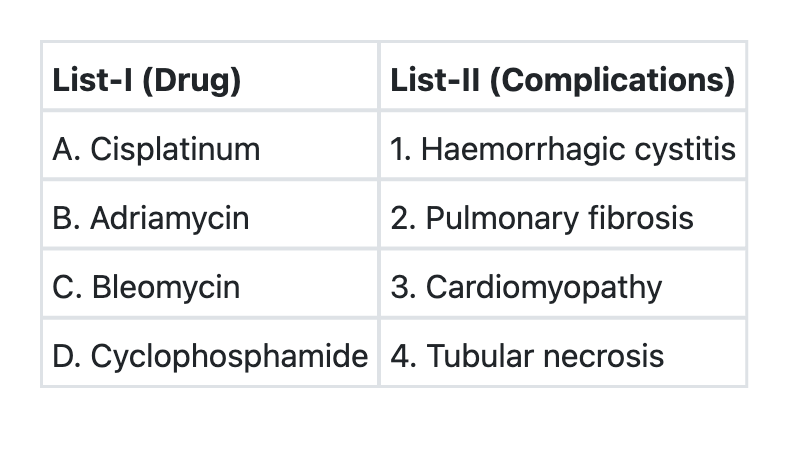
Match List-I with List-II and select the correct answer using the code given below the Lists:
Which of the following are the vaccines for prevention of cervical cancer? 1. Cervarix 2. Gardasil 3. T-dap 4. Influenza Select the correct answer using the code given below:
All of the following are hormonal agents used in treatment of cancer EXCEPT:
Match the following drugs with the targets of their actions: Drugs: A. Trastuzumab B. Infliximab C. Sirolimus D. Imatinib Targets: 1. BCR-ABL tyrosine kinase 2. mTOR 3. TNF alpha 4. HER2/neu
A lady who had undergone mastectomy for breast cancer is being treated with tamoxifen. How long should it be stopped before she can conceive?
Which among the following drugs is the new FDA approved immune checkpoint inhibitor for endometrial carcinoma?
Osimertinib is used in NSCLC with which mutation?
What is the treatment for HER-2 positive trastuzumab resistant breast cancer?
A 52-year-old female patient presents with HER-2 positive breast cancer that has become resistant to trastuzumab treatment. The oncologist is considering the next line of treatment for the patient. Which of the following options would be the most appropriate choice?
Explanation: ***Carcinoma breast*** - **Herceptin (Trastuzumab)** is a monoclonal antibody that targets the **HER2 receptor**, which is overexpressed in a significant subset of breast cancers. - Its use is specifically indicated for **HER2-positive breast cancer**, where it helps to inhibit cancer cell growth and proliferation. *Carcinoma rectum* - Treatment for **colorectal cancer** (including rectal carcinoma) typically involves surgery, chemotherapy (e.g., 5-fluorouracil), and radiation, with targeted therapies like cetuximab or bevacizumab for specific mutations. - **HER2 overexpression** is rare in colorectal cancer and Trastuzumab is not a standard treatment. *Ovarian malignancy* - Treatment for **ovarian cancer** usually involves surgery and platinum-based chemotherapy (e.g., carboplatin, paclitaxel), and sometimes bevacizumab. - While HER2 can be expressed in some ovarian cancers, it is not a primary therapeutic target, and **Trastuzumab is not routinely used** for this malignancy. *Carcinoma prostate* - **Prostate cancer** treatment primarily involves hormone therapy, radiation, chemotherapy (e.g., docetaxel), and targeted agents for specific mutations (e.g., PARP inhibitors). - HER2 is not a significant driver of prostate cancer growth, and **Trastuzumab is not indicated** for its treatment.
Explanation: ***A→3 B→4 C→1 D→2*** - This option correctly matches each anticancer drug to its characteristic adverse effect: **Cisplatinum (A)** with **tubular necrosis (3)**, **Adriamycin (B)** with **cardiomyopathy (4)**, **Bleomycin (C)** with **pulmonary fibrosis (1)**, and **Cyclophosphamide (D)** with **haemorrhagic cystitis (2)**. - These drug-toxicity associations are clinically important for monitoring and managing patients on chemotherapy. *A→3 B→4 C→2 D→1* - This option incorrectly matches Bleomycin with haemorrhagic cystitis (should be pulmonary fibrosis) and Cyclophosphamide with pulmonary fibrosis (should be haemorrhagic cystitis). - While Cisplatinum and Adriamycin are correctly paired, the last two associations are reversed. *A→4 B→3 C→2 D→1* - This option incorrectly matches Cisplatinum with cardiomyopathy (should be tubular necrosis) and Adriamycin with tubular necrosis (should be cardiomyopathy). - Additionally, Bleomycin and Cyclophosphamide complications are also incorrectly paired. *A→4 B→3 C→1 D→2* - This option incorrectly swaps the complications for Cisplatinum and Adriamycin: Cisplatinum is matched with cardiomyopathy (should be tubular necrosis) and Adriamycin with tubular necrosis (should be cardiomyopathy). - While Bleomycin and Cyclophosphamide are correctly paired with their respective complications, the first two associations are incorrect.
Explanation: ***Option A: 1 and 2 (Cervarix and Gardasil)*** - Both are **HPV vaccines** that prevent cervical cancer by targeting oncogenic human papillomavirus types - **Cervarix**: Bivalent vaccine protecting against HPV-16 and HPV-18 (responsible for ~70% of cervical cancers) - **Gardasil**: Quadrivalent vaccine (Gardasil-4) protecting against HPV-6, 11, 16, and 18; Nonavalent version (Gardasil-9) covers additional high-risk HPV types (31, 33, 45, 52, 58) - **Clinical significance**: Persistent HPV infection is the primary cause of cervical cancer; vaccination is primary prevention *Option B: 1 and 3* - While Cervarix is correct, **T-dap vaccine** (tetanus, diphtheria, acellular pertussis) is a bacterial vaccine with no role in cervical cancer prevention - T-dap targets entirely different pathogens and has no effect on HPV infection *Option C: 2 and 3* - Gardasil is correct for cervical cancer prevention, but **T-dap** is unrelated to HPV or cervical cancer - Mixing a correct HPV vaccine with an unrelated bacterial vaccine makes this option incorrect *Option D: 2 and 4* - Gardasil is correct, but **influenza vaccine** targets influenza virus to prevent seasonal flu, not HPV-related malignancies - Influenza vaccine has no protective effect against cervical cancer
Explanation: ***Irinotecan*** - **Irinotecan** is a **chemotherapeutic agent** that acts as a **topoisomerase I inhibitor**, interfering with DNA replication and repair. - It works through a **cytotoxic mechanism** directly killing cancer cells, rather than modulating hormonal pathways. *Cabergoline* - **Cabergoline** is a **dopamine agonist** primarily used to treat **prolactinomas**, which are prolactin-producing pituitary tumors. - While it treats a tumor, its mechanism is **hormonal modulation** by reducing prolactin secretion, not direct cytotoxicity. *Anastrozole* - **Anastrozole** is an **aromatase inhibitor** used in estrogen receptor-positive breast cancer. - It works by **blocking the conversion of androgens to estrogens**, thereby reducing estrogen levels that fuel cancer growth. *Leuprolide* - **Leuprolide** is a **GnRH agonist** used in prostate cancer, breast cancer, and other hormone-sensitive conditions. - It initially stimulates, then continuously downregulates, the **pituitary gland's production of LH and FSH**, leading to reduced testosterone or estrogen levels.
Explanation: ***Correct Answer: A-4, B-3, C-2, D-1*** - **Trastuzumab** (Herceptin) is a **monoclonal antibody** that targets the **HER2/neu receptor (4)** [1], [2], commonly overexpressed in certain breast cancers and gastric cancers. - **Infliximab** is another **monoclonal antibody** that specifically targets and neutralizes **TNF-alpha (3)**, an inflammatory cytokine, making it useful in treating autoimmune diseases like rheumatoid arthritis and Crohn's disease. - **Sirolimus** is an **immunosuppressant** drug that inhibits the mammalian target of rapamycin (**mTOR (2)**), a protein kinase involved in cell growth and proliferation, used in transplant medicine and as an anticancer agent. - **Imatinib** is a **tyrosine kinase inhibitor** that primarily targets the **BCR-ABL fusion protein (1)** [1], [2], which is characteristic of chronic myeloid leukemia. *Incorrect: A-2, B-3, C-1, D-4* - This option incorrectly matches Trastuzumab with mTOR and Sirolimus with BCR-ABL, which are not their primary targets. - Trastuzumab targets HER2/neu [1], [2], and Sirolimus targets mTOR. *Incorrect: A-3, B-4, C-2, D-1* - This option incorrectly matches Trastuzumab with TNF-alpha and Infliximab with HER2/neu. - Infliximab targets TNF-alpha, and Trastuzumab targets HER2/neu [1], [2]. *Incorrect: A-4, B-3, C-1, D-2* - This option incorrectly matches Sirolimus with BCR-ABL and Imatinib with mTOR. - Sirolimus inhibits mTOR, and Imatinib inhibits BCR-ABL [1], [2].
Explanation: ***3 months*** - Tamoxifen has a long half-life, and it can remain in the body for up to several weeks after the last dose. A washout period of **at least 3 months** is recommended to minimize exposure of a developing fetus to the drug. - Exposure to tamoxifen during pregnancy is associated with potential risks such as **birth defects** and impaired fetal development due to its anti-estrogenic effects disrupting hormonal balance. *No need to stop* - This is incorrect because tamoxifen is **teratogenic**, meaning it can cause birth defects if taken during pregnancy. - Continuing tamoxifen during pregnancy would expose the fetus to serious risks, necessitating a planned discontinuation before conception. *Can be stopped and conceived soon after stopping* - This is incorrect because tamoxifen has a relatively **long half-life**, meaning it takes time for the drug to be completely eliminated from the body. - A washout period is necessary to ensure the drug levels are low enough to prevent fetal exposure and potential harm. *1 month* - A 1-month washout period is generally considered **insufficient** given tamoxifen's pharmacokinetic profile. - This shorter period does not adequately account for the drug's long half-life, increasing the risk of fetal exposure and potential complications.
Explanation: **Pembrolizumab** * **Pembrolizumab** (Keytruda), a **PD-1 inhibitor**, received accelerated FDA approval for patients with **advanced endometrial carcinoma** that is mismatch repair deficient (dMMR) or microsatellite instability-high (MSI-H), and has progressed following prior systemic therapy or is not a candidate for curative surgery or radiation. * This approval was based on data from the KEYNOTE-158 study, demonstrating **durable responses** in these specific subsets of endometrial cancer, highlighting its role in precision oncology. *Ipilimumab* * **Ipilimumab** (Yervoy) is a **CTLA-4 inhibitor** primarily approved for the treatment of **melanoma** and renal cell carcinoma, often in combination with nivolumab. * While it is an immune checkpoint inhibitor, its primary indications and specific FDA approvals do not include **endometrial carcinoma**. *Trastuzumab* * **Trastuzumab** (Herceptin) is a **monoclonal antibody** that targets the **HER2 protein**, commonly used in the treatment of **HER2-positive breast cancer** and certain types of gastric cancer. * It is not an immune checkpoint inhibitor and its mechanism of action is distinct from blocking immune checkpoints like PD-1 or CTLA-4. *Nivolumab* * **Nivolumab** (Opdivo) is a **PD-1 inhibitor** with broad FDA approvals for various cancers, including melanoma, non-small cell lung cancer, renal cell carcinoma, classical Hodgkin lymphoma, and others. * While a potent immune checkpoint inhibitor, **pembrolizumab** received the specific accelerated approval for advanced endometrial carcinoma in the context described, making it the most direct answer for the "new FDA approved" status in this specific indication.
Explanation: ***T790M mutation*** - **Osimertinib** is a third-generation **EGFR tyrosine kinase inhibitor (TKI)** specifically designed to overcome resistance to earlier generation EGFR TKIs. - The **T790M mutation** in the EGFR gene is the most common mechanism of acquired resistance to first and second-generation EGFR TKIs in non-small cell lung cancer (NSCLC). *L858R mutation* - The **L858R mutation** is an activating **EGFR mutation** typically sensitive to first and second-generation EGFR TKIs. - While patients with **L858R** may eventually develop resistance, **osimertinib** is primarily used in the setting of acquired resistance, often mediated by **T790M**. *M790T mutation* - This is not a recognized common or clinically significant activating or resistance mutation in the **EGFR gene** for NSCLC. - The correct resistance mutation that **osimertinib** targets is **T790M**, not **M790T**. *T890M mutation* - This is a typographical error for the clinically relevant **T790M mutation**. - The number sequence is critical for identifying specific amino acid substitutions in gene mutations.
Explanation: ***Lapatinib*** - Lapatinib is a **dual tyrosine kinase inhibitor** that targets both **HER-2** and **epidermal growth factor receptor (EGFR)**, acting as a **small molecule inhibitor** that binds to the intracellular domain of these receptors. - Unlike trastuzumab (a monoclonal antibody targeting the extracellular domain), Lapatinib's **intracellular mechanism of action** allows it to overcome common mechanisms of trastuzumab resistance, such as receptor truncation or masking of the extracellular epitope. - It is specifically approved for the treatment of **HER-2 positive metastatic breast cancer** in combination with capecitabine after progression on trastuzumab-containing regimens. *Sorafenib* - Sorafenib is a **multi-kinase inhibitor** primarily targeting RAF, VEGFR, and PDGFR, and is used in renal cell carcinoma and hepatocellular carcinoma. - It does not specifically target HER-2 and is **not indicated** for HER-2 positive trastuzumab-resistant breast cancer. *Vemurafenib* - Vemurafenib is a **BRAF inhibitor** used for treating BRAF V600E mutation-positive melanoma. - This drug has no direct indications or demonstrated efficacy for **HER-2 positive breast cancer** and does not address trastuzumab resistance mechanisms. *Erlotinib* - Erlotinib is an **EGFR tyrosine kinase inhibitor** primarily used for non-small cell lung cancer with activating EGFR mutations. - While it targets EGFR, it does **not effectively target HER-2** and lacks the dual inhibition necessary to overcome trastuzumab resistance in HER-2 positive breast cancer.
Explanation: ***Lapatinib*** - Lapatinib is an oral **dual tyrosine kinase inhibitor** that targets both **HER2** and **EGFR** receptors, specifically approved for **trastuzumab-resistant HER2-positive breast cancer**. - Unlike trastuzumab (a monoclonal antibody that binds the extracellular domain), lapatinib inhibits the **intracellular tyrosine kinase domain** of HER2, providing an **alternative mechanism** to overcome resistance. - Often used in combination with capecitabine for patients who have progressed on trastuzumab-containing regimens. - **Clinical evidence**: The EGF100151 trial demonstrated efficacy in trastuzumab-refractory disease. *Vemurafenib* - Vemurafenib is a **BRAF V600E/K inhibitor** used primarily for **metastatic melanoma** with BRAF mutations. - It has **no activity against HER2** and is not indicated for breast cancer. - Would not provide benefit in this clinical scenario. *Erlotinib* - Erlotinib is a selective **EGFR tyrosine kinase inhibitor** used for **EGFR-mutant non-small cell lung cancer** and **pancreatic cancer** (with gemcitabine). - While it inhibits EGFR (which lapatinib also targets), erlotinib has **insufficient HER2 inhibition** to be effective in HER2-driven breast cancer. - Not approved or effective for trastuzumab-resistant HER2-positive breast cancer. *Sorafenib* - Sorafenib is a **multi-kinase inhibitor** targeting **RAF kinases, VEGFR-2/3, and PDGFR-β**, approved for **hepatocellular carcinoma, renal cell carcinoma, and thyroid cancer**. - It does **not specifically target HER2** signaling and has no established role in HER2-positive breast cancer. - Would not address the mechanism of disease in this patient.
Principles of Cancer Chemotherapy
Practice Questions
Alkylating Agents
Practice Questions
Antimetabolites
Practice Questions
Antitumor Antibiotics
Practice Questions
Plant Alkaloids
Practice Questions
Topoisomerase Inhibitors
Practice Questions
Hormonal Agents
Practice Questions
Targeted Therapy
Practice Questions
Immunotherapy
Practice Questions
Management of Chemotherapy Side Effects
Practice Questions
Get full access to all questions, explanations, and performance tracking.
Start For Free