A healthcare worker develops fever, night sweats, and cough. Sputum shows acid-fast bacilli. What is the next diagnostic test?
Why is a regimen of four drugs recommended for a TB patient on the first visit?
A patient presents with hemoptysis, weight loss, and fatigue. Chest X-ray shows cavitary lesions in the upper lobes. What is the most likely diagnosis?
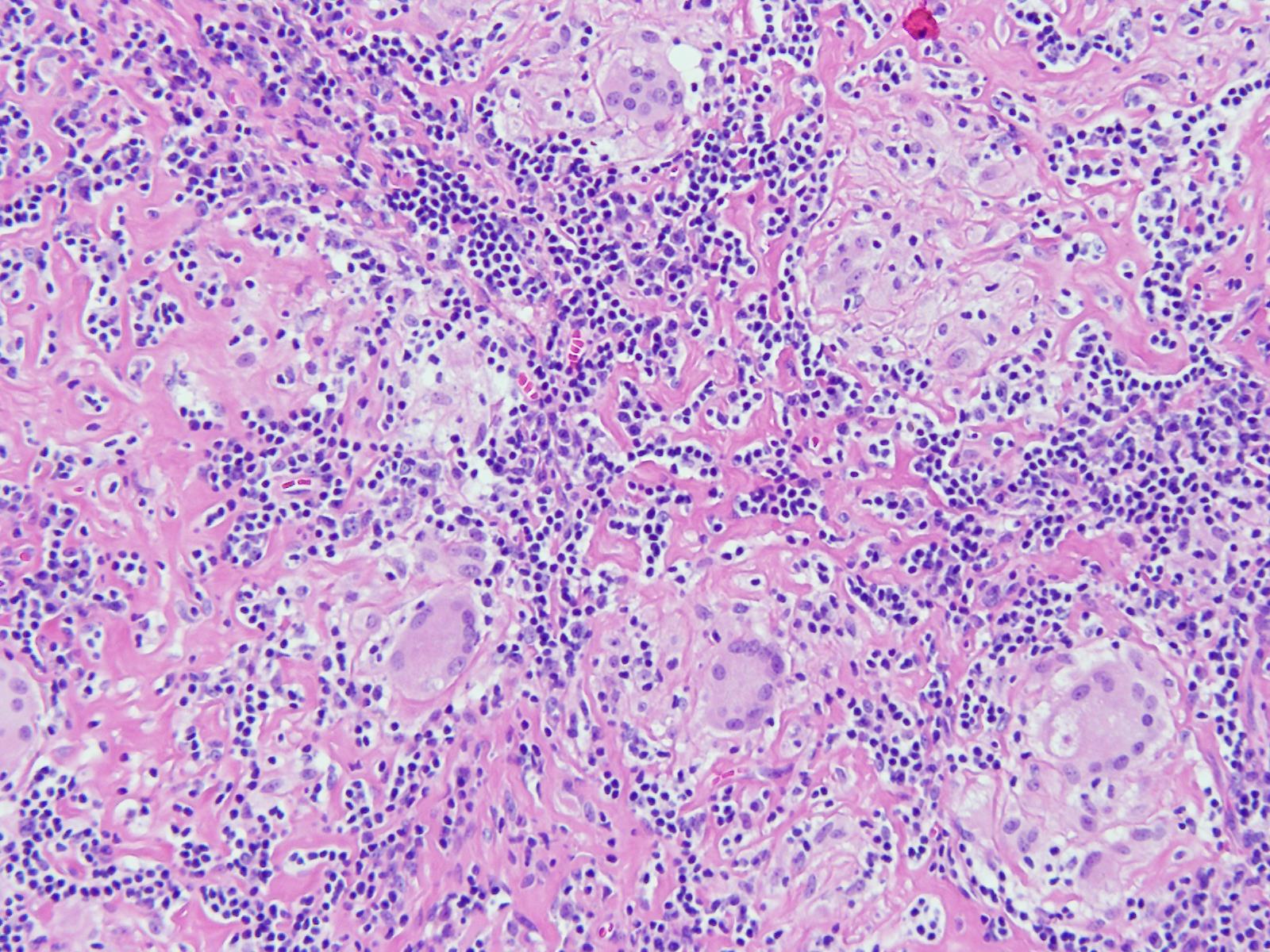
An 11-year-old boy presented with a cough for 15 days. On examination, he was found to have cervical lymphadenopathy. Lymph node biopsy showed the following findings. What could be the diagnosis?
An asymptomatic infant with a history of TB exposure, is 3 months old and had taken 3 months of chemoprophylaxis, what is to be done next?
A poverty-stricken mother suffering from active tuberculosis delivers a baby. Which one of the following would be the most appropriate advice in her case?
A child with acute respiratory distress showing hyperinflation of the unilateral lung in X-ray is due to –
Stridor in an infant is most commonly due to:
Most dangerous sign in lower respiratory tract infection (LRTI) in children is:
A child with recent onset of upper respiratory tract infection after 2 days presents with acute onset of breathlessness, cough, and fever. Which of the following treatments is contraindicated?
Explanation: ***NAAT for TB*** - Nucleic Acid Amplification Tests (**NAAT**) rapidly confirm the presence of **Mycobacterium tuberculosis** DNA or RNA, crucial after an **acid-fast bacilli (AFB) smear** is positive [1]. - This test offers high sensitivity and specificity and can also detect **drug resistance**, guiding immediate treatment decisions [1]. *Gram stain* - A **Gram stain** is not appropriate for **Mycobacterium tuberculosis** because these bacteria have a unique cell wall that makes them **acid-fast**, not readily stained by the Gram method. - The initial finding of **acid-fast bacilli** already indicates a general type of organism, making a Gram stain redundant and uninformative for TB. *Serology for TB* - **Serological tests for TB** (detecting antibodies to M. tuberculosis) are generally **not recommended** for the diagnosis of active pulmonary TB due to their **poor sensitivity and specificity**. - They have limited utility in diagnosing active disease and are not endorsed by major health organizations for this purpose. *Sputum culture* - **Sputum culture** is the **gold standard** for confirming TB diagnosis and for **drug susceptibility testing**, but it is a **slow process** (taking several weeks) [2]. - While essential for definitive diagnosis and resistance profiling, it is not the **"next" rapid diagnostic test** required given the positive AFB smear.
Explanation: ***To prevent emergence of drug-resistant strains*** - Using a **four-drug regimen** at the initial stage significantly reduces the likelihood of **Mycobacterium tuberculosis** developing resistance to any single drug. - This strategy ensures that even if a small number of bacteria are naturally resistant to one drug, the other drugs will still be effective in killing them, preventing the proliferation of **resistant strains**. *To minimize treatment duration* - While a multi-drug regimen is effective, its primary goal is not to minimize treatment duration but rather to ensure **eradication of the infection** and prevent resistance. - Treatment duration is determined by the need to kill both actively multiplying and dormant bacteria, which typically takes several months even with multiple drugs. *To reduce bacterial load effectively* - Reducing bacterial load is certainly a goal of TB treatment, but the use of four drugs is specifically aimed at achieving this while simultaneously preventing **drug resistance**. - A single effective drug could reduce bacterial load, but it would quickly lead to the emergence of resistant bacteria, making the long-term goal of **cure** impossible. *None of the options* - This option is incorrect because the primary reason for a **four-drug regimen** in TB treatment is indeed to prevent the emergence of **drug-resistant strains**.
Explanation: ### Tuberculosis - The combination of **hemoptysis**, **weight loss**, and **fatigue** is highly suggestive of active pulmonary tuberculosis [1, 2]. - **Cavitary lesions** in the **upper lobes** on chest X-ray are a classic radiographic finding for post-primary (reactivation) tuberculosis [3]. ### Lung abscess - While it can cause **hemoptysis** and **fatigue**, weight loss is less prominent unless chronic, and abscesses are typically solitary and may be located anywhere in the lung, not exclusively upper lobes [1]. - Lung abscesses are often associated with **fever**, **purulent sputum**, and a history of **aspiration**, which are not mentioned. ### Pulmonary embolism - Symptoms usually include **acute dyspnea**, **chest pain**, and sometimes **hemoptysis**, but **weight loss** and **fatigue** are not typical chronic symptoms [1]. - Chest X-rays in pulmonary embolism usually show **normal findings** or **non-specific changes** like a Westermark sign or Hampton hump, not cavitations. ### Bronchiectasis - Characterized by **chronic cough with copious purulent sputum** and recurrent infections, leading to **dilated bronchi**. - While **hemoptysis** can occur due to bronchial artery erosion, **weight loss** is less common, and chest X-rays typically show **"tram-track" opacities** or **cystic changes**, not cavitations as the primary finding [1].
Explanation: ***Tuberculosis*** - The image likely displays **granulomatous inflammation** with **caseous necrosis**, which is highly characteristic of **tuberculosis**, especially in someone presenting with a persistent cough and lymphadenopathy. - The presence of **cervical lymphadenopathy** along with a **cough** for 15 days in an 11-year-old boy points towards extrapulmonary tuberculosis or primary tuberculosis infection affecting the mediastinal lymph nodes with cervical involvement. *Leprosy* - While leprosy also causes granulomas, it typically manifests as skin lesions and nerve involvement, and lymphadenopathy is less common or specific as the primary initial presentation. - The granulomas in leprosy are often **epithelioid** with **foamy histiocytes** and numerous acid-fast bacilli, which are not explicitly described or obvious in the provided context for a definitive diagnosis without special stains. *Sarcoidosis* - Sarcoidosis involves **non-caseating granulomas**, meaning there is no central necrosis, which is a key differentiating feature from the caseating necrosis often seen in tuberculosis. - Although sarcoidosis can cause lymphadenopathy and cough, the microscopic features in the image, particularly if showing necrosis, would argue against sarcoidosis. *Syphilis* - Syphilis can cause lymphadenopathy (especially in secondary syphilis), but the characteristic histological finding is usually a **plasma cell-rich infiltrate** with **endarteritis obliterans**, not typically prominent granulomas with caseous necrosis. - Clinical presentation with cough and chronic lymphadenopathy in an 11-year-old would also make syphilis a less likely primary consideration without other suggestive signs.
Explanation: ***Tuberculin test, then decide*** - A **tuberculin skin test (TST)** or **IGRA** should be performed after completing the initial chemoprophylaxis period to determine if the infant has developed **latent TB infection (LTBI)**. - According to **IAP guidelines**, if TST is **negative**, complete a total of **6 months of prophylaxis** and then administer **BCG vaccine**. - If TST is **positive**, it indicates LTBI and the infant should complete the full course of treatment as per standard protocols. - The decision to continue, modify, or stop treatment depends on **TST results** and **clinical evaluation**. *Immunise with BCG and stop prophylaxis* - **BCG vaccination** should not be given during or immediately after stopping prophylaxis without first performing a **TST**. - In TB-endemic areas, BCG is ideally given at birth, but if delayed due to TB exposure, it should only be given after **ruling out infection** with a negative TST. - Stopping prophylaxis prematurely without assessment can increase the risk of developing **active TB**. *Continue prophylaxis for 3 months* - While the standard duration of prophylaxis is **6 months total**, blindly continuing for another 3 months without TST assessment is not the most appropriate next step. - The decision to continue should be based on **TST results** performed at this juncture, not arbitrary time extension. - Prolonged unnecessary prophylaxis can lead to **drug toxicity** and **poor compliance**. *Test sputum, then decide* - An **asymptomatic infant** is unlikely to produce sputum, making this test impractical and inappropriate. - Sputum testing is used for diagnosing **active pulmonary TB**, which is not suspected in this asymptomatic child. - Sputum testing is invasive and reserved for children with **clinical symptoms** suggestive of active disease such as persistent cough, fever, or weight loss.
Explanation: ***Breast feeding and isoniazid administration*** - **Breastfeeding** is safe and encouraged for infants of mothers with active tuberculosis, as the benefits of breast milk (nutrition, antibodies) outweigh the minimal risk of TB transmission through milk. - **Isoniazid (INH) chemoprophylaxis** for the infant provides additional protection in high-risk exposure settings, particularly when the mother has active pulmonary TB and close contact is inevitable. - This approach represents a conservative strategy prioritizing immediate chemoprophylaxis in a poverty-stricken setting where follow-up may be challenging. *Breast feeding and BCG immunization* - **Breastfeeding** is beneficial and appropriate. - **BCG immunization** at birth is the current standard recommendation per WHO and IAP guidelines for infants born to TB-positive mothers. - However, in settings with very high exposure risk and uncertain follow-up, some protocols additionally recommend INH prophylaxis, making the first option more comprehensive for this specific scenario. *Expressed breast milk and BCG immunization* - Expressing breast milk offers no significant additional protection against TB transmission compared to direct breastfeeding. - Direct breastfeeding has additional benefits for mother-infant bonding and is not contraindicated in maternal TB. - While **BCG immunization** is appropriate, this option unnecessarily complicates feeding. *Stop feeds and isoniazid administration* - **Stopping breastfeeding** is not indicated and would deprive the infant of essential nutrition and passive immunity. - Breastfeeding is not contraindicated in maternal tuberculosis. - While **isoniazid administration** may be appropriate, cessation of feeding is an incorrect recommendation.
Explanation: ***Foreign body aspiration*** - A **foreign body** partially obstructing a bronchus acts as a **one-way valve**, allowing air to enter the lung on inspiration but trapping it on expiration, leading to **hyperinflation** of the distal lung. - This is a common cause of acute respiratory distress and unilateral lung hyperinflation in children, as they frequently aspirate small objects. *Staphylococcal bronchopneumonia* - This typically presents with **consolidation** and **infiltrates** on chest X-ray, rather than hyperinflation. - While it can cause respiratory distress, it does not characteristically lead to **unilateral hyperinflation** as its primary X-ray finding. *Congenital lobar emphysema* - This causes **progressive hyperinflation of a single lobe** (typically upper or middle lobe), not the entire lung, due to abnormal bronchial cartilage or extrinsic compression. - While it can present acutely in infancy, the X-ray shows **lobar** hyperinflation with mediastinal shift, distinct from the **whole lung** hyperinflation seen with foreign body aspiration. *Aspiration pneumonia* - Aspiration pneumonia is caused by inhaling gastric contents or other substances, leading to **inflammation and infection** of the lung parenchyma. - It typically presents with **infiltrates**, **consolidation**, or **abscess formation** on X-ray, not unilateral hyperinflation.
Explanation: ***Laryngomalacia*** - **Laryngomalacia** is the most common cause of **congenital inspiratory stridor** in infants, resulting from supraglottic laryngeal structures collapsing inward during inspiration. - The stridor is typically **worse when crying, feeding, or lying supine** and usually improves spontaneously by 12-18 months of age. *Foreign body aspiration* - While foreign body aspiration can cause **acute stridor**, it is an event-specific occurrence, not a persistent condition from birth, and often presents with **sudden onset choking and respiratory distress**. - Its incidence is higher in **toddlers and older children** who are mobile and exploring their environment, rather than infants. *Diphtheria* - **Diphtheria** is a rare cause of stridor due to widespread vaccination and is characterized by a **"bull neck"** and a **pseudomembrane in the pharynx**, which is distinct from the typical presentation of laryngomalacia. - The stridor associated with Diphtheria is typically progressive and can lead to severe **respiratory obstruction and systemic toxicity**. *Acute epiglottitis* - **Acute epiglottitis** typically presents with sudden onset of **high fever, dysphagia, drooling, and muffled voice** in older children, rather than stridor from birth in an infant. - Due to **Hib vaccine**, acute epiglottitis is now very rare and its stridor is usually rapidly progressive and life-threatening.
Explanation: ***Grunting*** - **Grunting** is an expiratory sound produced by partial closure of the glottis to maintain positive end-expiratory pressure (PEEP), indicating **severe respiratory distress** and **impending respiratory failure**. - This compensatory mechanism suggests significant **alveolar collapse** or **pulmonary edema** and is a **critical danger sign** requiring immediate intervention in children with LRTI. - According to WHO and IMNCI guidelines, grunting is classified as a **danger sign** warranting urgent referral and management. *Incorrect: Chest retraction* - **Chest retractions** occur when the intercostal muscles, suprasternal, or subcostal areas pull inward during inspiration due to increased negative intrathoracic pressure. - Although it is a sign of respiratory distress indicating increased work of breathing, it is less dire than grunting, which signifies a more critical phase of respiratory failure. *Incorrect: Tachypnea* - **Tachypnea** (increased respiratory rate) is an early and common sign of LRTI in children, as the body attempts to compensate for hypoxemia or increased metabolic demand. - While concerning, it is often an initial response and, by itself, is not as immediately life-threatening as grunting, which suggests severe impairment of gas exchange. *Incorrect: Abdominal breathing* - **Abdominal breathing** (or diaphragmatic breathing) is a normal compensatory mechanism in infants and young children during respiratory distress. - While it indicates increased work of breathing, it is not as dangerous as grunting, which signifies a more advanced stage of respiratory compromise.
Explanation: ***Morphine (CONTRAINDICATED)*** - Morphine is a **potent respiratory depressant** and is **absolutely contraindicated** in a child with acute breathlessness and respiratory infection. - It suppresses the respiratory drive, worsening hypoxia and potentially leading to **respiratory failure**. - The sedative effects mask crucial clinical signs of deteriorating respiratory status, delaying life-saving interventions. - **Opioids should never be used** in acute respiratory distress in children. *Antipyretics (NOT contraindicated)* - **Paracetamol** or **ibuprofen** are safe and appropriate for fever management in children with respiratory infections. - They improve patient comfort without adversely affecting respiratory function. - Fever reduction helps decrease metabolic demand and oxygen consumption. *Antibiotics (NOT contraindicated)* - Indicated when **bacterial pneumonia** or bacterial superinfection complicates the viral URI. - Choice depends on clinical assessment, chest X-ray findings, and laboratory markers (elevated WBC, CRP). - Common organisms include *Streptococcus pneumoniae* and *Haemophilus influenzae*. *O2 inhalation (NOT contraindicated)* - **Essential treatment** for hypoxia (SpO2 <92-94%) in acute respiratory distress. - Delivered via nasal prongs, face mask, or high-flow nasal cannula depending on severity. - Oxygen therapy is a **life-saving intervention** and should never be withheld.
Get full access to all questions, explanations, and performance tracking.
Start For Free