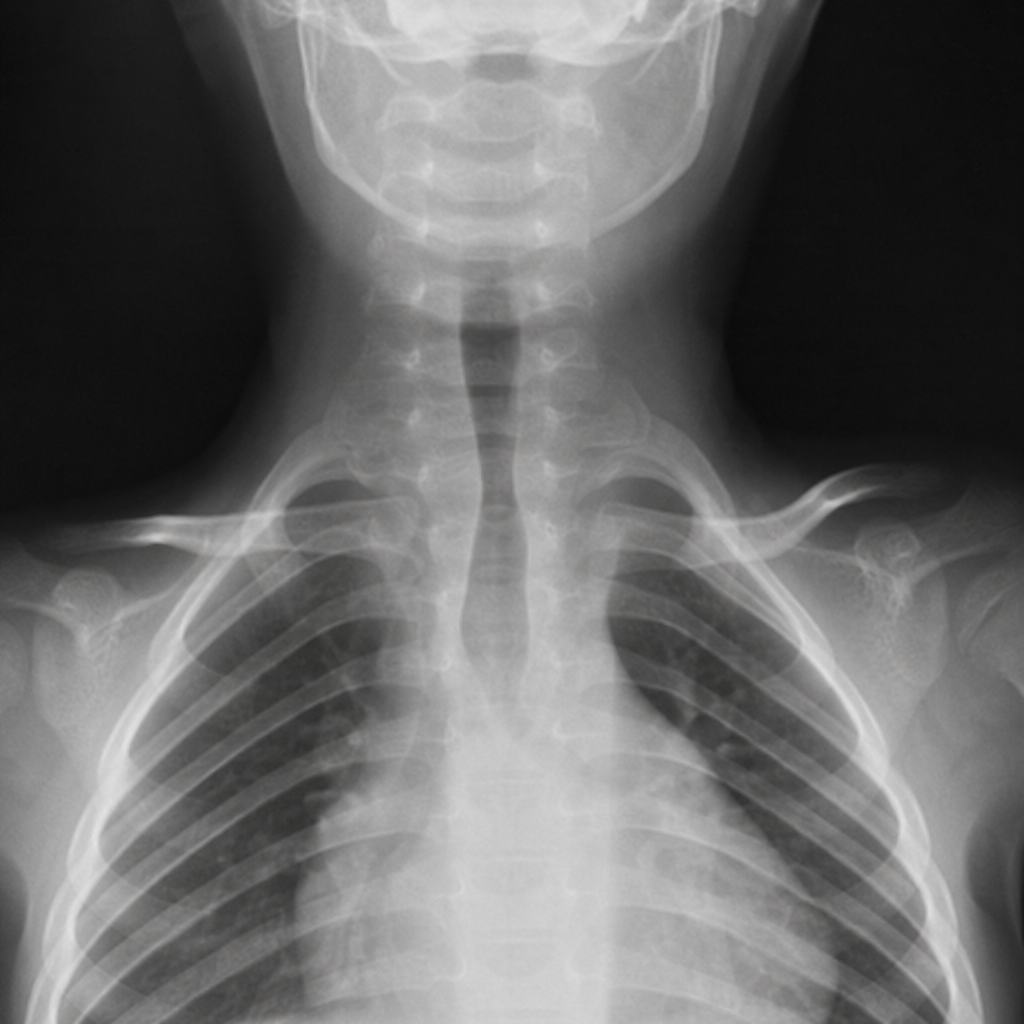
A 6-month-old baby presents with loud, noisy breathing since birth, particularly noticeable when feeding in a supine position. The birth history is otherwise unremarkable. What is the recommended management for this condition?
Which of the following is not true about idiopathic pulmonary hemosiderosis?
Fast breathing in a child less than 2 months is defined as a respiratory rate more than what value?
How does a child's respiratory physiology differ from that of an adult?
A neonate presents with respiratory distress, enlargement of the left upper lobe of the lung, and mediastinal shift towards the right. What is the most likely diagnosis?
What is the most common cause of bronchiolitis in a 4-month-old infant presenting with respiratory distress?
All of the following statements about cystic fibrosis (CF) are true EXCEPT:
What is the most likely cause of acute onset of cough, stridor, and dyspnea in a child?
Which of the following is the most likely diagnosis in a child presenting with increased cough at night?
A 17-year-old male complains of recurrent episodes of cough, wheezing, and shortness of breath, particularly at night, for the last 3 days. His sibling has a history of similar symptoms. A skin test with pollen produces an immediate wheal and flare. What is the most appropriate initial treatment?
Explanation: ### Explanation **Diagnosis: Laryngomalacia** The clinical presentation describes **Laryngomalacia**, the most common cause of congenital stridor in infants. It is characterized by an inspiratory "crowing" sound (stridor) caused by the collapse of supraglottic structures (e.g., omega-shaped epiglottis) during inspiration. The stridor typically worsens when the infant is **supine**, crying, or feeding, and improves when prone. **Why Reassurance is Correct:** In more than 90% of cases, laryngomalacia is a self-limiting condition. The stridor usually peaks at 6 months and resolves spontaneously by 18–24 months as the airway cartilage matures and strengthens. Unless there is evidence of "danger signs" (failure to thrive, cyanosis, or severe respiratory distress), the standard management is **conservative observation and reassurance** to the parents. **Why Other Options are Incorrect:** * **A. 3rd generation cephalosporins:** These are used for bacterial infections like Epiglottitis. Laryngomalacia is a structural/developmental anomaly, not an infection. * **B. Heimlich’s maneuver:** This is an emergency intervention for acute foreign body airway obstruction, which would present with sudden onset choking, not a chronic sound present since birth. * **D. Single dose of Dexamethasone:** Steroids are the mainstay for **Croup (Laryngotracheobronchitis)** to reduce subglottic edema. They have no role in treating the structural collapse seen in laryngomalacia. **High-Yield Clinical Pearls for NEET-PG:** * **Most common cause of inspiratory stridor in neonates:** Laryngomalacia. * **Classic finding on laryngoscopy:** "Omega-shaped" (Ω) epiglottis with short aryepiglottic folds. * **Definitive Diagnosis:** Flexible fiberoptic laryngoscopy (showing inward collapse of supraglottic tissues). * **Surgical Indication:** If severe (cor pulmonale, apnea, or poor weight gain), the procedure of choice is **Supraglottoplasty**.
Explanation: **Idiopathic Pulmonary Hemosiderosis (IPH)** is a rare condition characterized by the triad of iron deficiency anemia, hemoptysis, and transient pulmonary infiltrates. It results from recurrent episodes of diffuse alveolar hemorrhage (DAH). ### **Explanation of Options** * **B. Eosinopenia (Correct):** This is the incorrect statement regarding IPH. In fact, **peripheral eosinophilia** is observed in approximately 10–20% of cases during the acute phase of the disease. Eosinopenia is not a feature of IPH. * **A. Iron Deficiency Anemia:** This is a hallmark feature. Recurrent bleeding into the alveoli traps iron in the form of hemosiderin within alveolar macrophages. Since this iron cannot be recycled back into the systemic circulation, it leads to microcytic hypochromic anemia. * **C. Increased Bilirubin:** During an acute episode of pulmonary hemorrhage, the breakdown of extravasated red blood cells in the lungs leads to the release of heme. This results in elevated levels of **indirect (unconjugated) bilirubin**, mimicking a hemolytic picture. * **D. Increased Reticulocyte Count:** The body attempts to compensate for the blood loss and subsequent anemia by increasing erythropoiesis, leading to a high reticulocyte count. ### **NEET-PG High-Yield Pearls** * **Diagnosis:** The gold standard for diagnosis is a **lung biopsy**, but the presence of **hemosiderin-laden macrophages** (siderophages) in gastric aspirate or bronchoalveolar lavage (BAL) is highly suggestive. * **Chest X-ray:** Shows transient, patchy perihilar infiltrates during acute episodes; chronic cases show interstitial fibrosis (honeycombing). * **Heiner Syndrome:** A specific variant of IPH associated with **hypersensitivity to cow's milk**. * **Treatment:** Acute episodes are managed with corticosteroids; immunosuppressants (like Azathioprine) are used for maintenance.
Explanation: **Explanation:** The definition of **fast breathing** is a critical component of the **IMNCI (Integrated Management of Neonatal and Childhood Illness)** guidelines used to diagnose pneumonia and respiratory distress in pediatric patients. The respiratory rate (RR) thresholds are age-dependent because baseline respiratory rates naturally decrease as a child matures. **Why Option C is Correct:** For a child **less than 2 months of age**, the threshold for fast breathing is **≥ 60 breaths per minute**. At this age, the chest wall is highly compliant and the metabolic demand is high, leading to a faster baseline rate. A rate of 60 or more is a sensitive indicator of lower respiratory tract involvement or sepsis. **Analysis of Incorrect Options:** * **Option A (40 bpm):** This is the threshold for fast breathing in children aged **12 months to 5 years**. * **Option B (50 bpm):** This is the threshold for fast breathing in infants aged **2 months to 12 months**. * **Option D (70 bpm):** While this indicates significant respiratory distress, it is not the standardized IMNCI cutoff for defining "fast breathing" in any age group. **High-Yield Clinical Pearls for NEET-PG:** 1. **Counting Rule:** To accurately diagnose fast breathing, the child must be calm (not crying or feeding), and the RR must be counted for a **full 60 seconds**. 2. **Young Infants (<2 months):** If the first count is 60 or more, IMNCI protocol requires a **second count**. Fast breathing is confirmed only if both counts are ≥ 60 bpm. 3. **Danger Signs:** In children <2 months, fast breathing is categorized as **"Very Severe Disease,"** requiring immediate injectable antibiotics and urgent referral. 4. **Chest Indrawing:** In this age group, mild chest indrawing is normal; only **severe chest indrawing** is considered a clinical red flag.
Explanation: **Explanation:** The pediatric respiratory system is not merely a miniature version of the adult system; it possesses distinct anatomical and physiological characteristics. **Why "Smaller Airways" is Correct:** The most critical anatomical difference is the **smaller diameter of the airways**. According to **Poiseuille’s Law**, resistance to airflow is inversely proportional to the fourth power of the radius ($R \propto 1/r^4$). In an infant, even 1 mm of mucosal edema significantly reduces the cross-sectional area and increases airway resistance exponentially compared to an adult. Furthermore, the pediatric airway is more compliant due to less cartilage support, making it prone to dynamic collapse. **Analysis of Incorrect Options:** * **B. Increased oxygen demand:** While children do have a higher metabolic rate and oxygen consumption ($6\text{–}8 \text{ mL/kg/min}$ vs. $3\text{–}4 \text{ mL/kg/min}$ in adults), this is a metabolic demand rather than a primary structural/physiological "difference in respiratory mechanics" in the context of this classic comparison. * **C. Decreased tidal volume:** On a **per kilogram basis**, tidal volume is relatively constant across ages ($6\text{–}8 \text{ mL/kg}$). * **D. Decreased residual volume:** Children actually have a lower **Functional Residual Capacity (FRC)** relative to their oxygen demand, but their closing volume is higher, leading to earlier airway closure. **High-Yield Clinical Pearls for NEET-PG:** * **Narrowest part of the airway:** In children <8 years, it is the **Cricoid cartilage** (funnel-shaped larynx), whereas in adults, it is the Glottis (cylindrical). * **Diaphragm:** Children have fewer **Type I (slow-twitch, fatigue-resistant) muscle fibers** in their diaphragm (25% in newborns vs. 50% in adults), making them prone to early respiratory failure. * **Compliance:** Infants have high chest wall compliance but low lung compliance.
Explanation: **Explanation:** The clinical presentation of respiratory distress, localized hyperinflation of a single lobe (most commonly the **left upper lobe**), and a contralateral mediastinal shift in a neonate is classic for **Congenital Lobar Emphysema (CLE)**. **1. Why it is correct:** CLE is a developmental anomaly characterized by overdistension of one or more pulmonary lobes due to a "ball-valve" mechanism. This occurs because of partial airway obstruction (often due to deficient bronchial cartilage or extrinsic compression), allowing air to enter during inspiration but preventing it from exiting during expiration. The resulting hyperinflation causes mass effect, compressing the adjacent lung and shifting the mediastinum to the opposite side, leading to acute respiratory distress. **2. Why other options are incorrect:** * **Alpha-1 Antitrypsin Deficiency:** Typically presents in adults as panacinar emphysema or in neonates as cholestatic jaundice/liver disease; it does not cause localized lobar hyperinflation in the neonatal period. * **Pneumonia:** Usually presents with opacification (consolidation) on X-ray rather than hyperlucency and enlargement. While it can cause distress, it rarely causes a massive mediastinal shift unless a large parapneumonic effusion is present. * **Cystic Fibrosis:** Generally presents later with meconium ileus or recurrent infections and bronchiectasis. It causes generalized lung involvement rather than isolated lobar emphysema. **Clinical Pearls for NEET-PG:** * **Most common site:** Left Upper Lobe (40-50%) > Right Middle Lobe (30%) > Right Upper Lobe (20%). * **Radiology:** Hyperlucent, overdistended lobe with loss of vascular markings and mediastinal shift. * **Management:** Surgical lobectomy is the treatment of choice for symptomatic cases. * **Differential:** Must be distinguished from **Congenital Pulmonary Airway Malformation (CPAM)**, which usually appears cystic/multiloculated on imaging.
Explanation: **Explanation:** **Bronchiolitis** is a clinical syndrome of small airway inflammation typically occurring in children under 2 years of age. It is characterized by a viral prodrome followed by increased respiratory effort, wheezing, and crackles. **Why Respiratory Syncytial Virus (RSV) is correct:** RSV is the most common cause of bronchiolitis worldwide, accounting for approximately **50–80% of all cases**. It typically occurs in seasonal outbreaks (winter and early spring). In a 4-month-old infant, the small caliber of the bronchioles makes them highly susceptible to obstruction from the mucosal edema and cellular debris caused by RSV infection. **Analysis of Incorrect Options:** * **Measles (Option A):** While measles can cause severe pneumonia (Hecht’s giant cell pneumonia), it is not a primary cause of bronchiolitis. It typically presents with the classic triad of cough, coryza, and conjunctivitis, along with Koplik spots and a maculopapular rash. * **Influenza (Option B):** Influenza viruses can cause bronchiolitis, but they more commonly present with systemic symptoms (fever, myalgia) or pneumonia. They are less frequent causes compared to RSV. * **Parainfluenza virus (Option D):** This is the most common cause of **Croup (Laryngotracheobronchitis)**, characterized by a barking cough and inspiratory stridor, rather than the lower airway wheezing seen in bronchiolitis. **NEET-PG High-Yield Pearls:** * **Diagnosis:** Primarily clinical. Chest X-ray usually shows hyperinflation and flattened diaphragm. * **Most common cause:** RSV (followed by Rhinovirus). * **Treatment:** Supportive care (hydration and oxygenation) is the mainstay. Routine use of bronchodilators, steroids, or antibiotics is **not** recommended. * **Prophylaxis:** **Palivizumab** (a monoclonal antibody against RSV F protein) is indicated for high-risk infants (e.g., preterm or congenital heart disease).
Explanation: **Explanation:** The correct answer is **C** because it is a technically incomplete statement in a clinical diagnostic context. While elevated sweat chloride is the hallmark of Cystic Fibrosis (CF), a single high concentration is **not diagnostic on its own**. Diagnosis requires a sweat chloride level **≥60 mmol/L on two separate occasions**, or one positive test combined with the identification of two CF-causing mutations or a characteristic transepithelial nasal potential difference. **Analysis of other options:** * **Option A (True):** CF causes **exocrine pancreatic insufficiency** in 85-90% of patients. This leads to malabsorption of fats and proteins, resulting in steatorrhea (foul-smelling, bulky, oily diarrhea) and failure to thrive. * **Option B (True):** These are the classic triad of pathogens in CF. *S. aureus* and *H. influenzae* typically colonize the lungs in early childhood, while *Pseudomonas aeruginosa* becomes the dominant pathogen in adolescence and adulthood, leading to progressive lung damage. * **Option C (False/Except):** As explained, the diagnosis requires specific thresholds and repeatability. * **Option D (True):** Chronic rhinosinusitis and **nasal polyposis** are extremely common (up to 90% of patients) due to thick secretions obstructing the paranasal sinuses. **High-Yield Clinical Pearls for NEET-PG:** * **Genetics:** Autosomal Recessive; mutation in the **CFTR gene** on **Chromosome 7** (most common: **ΔF508**). * **Newborn Presentation:** Meconium ileus is the earliest manifestation (seen in 15-20%). * **Infertility:** 95% of males are infertile due to **Congenital Bilateral Absence of the Vas Deferens (CBAVD)**. * **Screening:** Immunoreactive Trypsinogen (IRT) is used in newborn screening.
Explanation: **Explanation:** The clinical triad of **acute onset** cough, stridor, and dyspnea in a child is the classic presentation of **Foreign Body Aspiration (FBA)**. In pediatric patients, the sudden nature of symptoms (the "penetration syndrome") is the most critical diagnostic clue. Stridor indicates an upper airway or tracheal obstruction, while wheezing or decreased breath sounds usually suggest a bronchial location. **Why the other options are incorrect:** * **Acute Asthma:** While it presents with cough and dyspnea, it typically manifests as **expiratory wheezing** rather than inspiratory stridor. It is usually preceded by triggers or a known history of atopy and is rarely as instantaneous as FBA. * **Aspiration Pneumonitis:** This involves the inhalation of gastric contents or liquids. While it causes respiratory distress, it usually presents with fever, rales, and signs of inflammation over hours, rather than the sudden mechanical obstruction seen with a solid foreign body. * **Primary Complex (Tuberculosis):** This is a chronic infection. It presents with a persistent cough, low-grade fever, and weight loss over weeks or months, not with acute stridor and sudden dyspnea. **High-Yield Clinical Pearls for NEET-PG:** * **Most common site:** Right main bronchus (due to it being wider, shorter, and more vertical). * **Most common age group:** 1–3 years (toddlers). * **Gold Standard Diagnosis & Management:** Rigid Bronchoscopy (both diagnostic and therapeutic). * **Radiology:** The most common finding is **obstructive emphysema** (air trapping) on expiratory films; however, a normal X-ray does not rule out FBA if clinical suspicion is high.
Explanation: **Explanation:** **Asthma** is the most likely diagnosis because **nocturnal cough** is a hallmark clinical feature of the disease. The worsening of symptoms at night (and early morning) occurs due to the circadian rhythm of the body, which leads to a natural dip in endogenous cortisol levels, increased vagal tone (causing bronchoconstriction), and decreased airway caliber. In pediatric practice, a chronic, dry, irritating cough that occurs exclusively or predominantly at night is often considered "Cough Variant Asthma" until proven otherwise. **Analysis of Incorrect Options:** * **Pneumonia:** Typically presents with high-grade fever, productive cough, tachypnea, and localized chest signs (crepitations/dullness). The cough is persistent throughout the day rather than specifically nocturnal. * **Bronchiolitis:** Primarily affects infants (<2 years) and presents with acute onset wheezing, respiratory distress, and signs of viral prodrome (rhinorrhea). It is an acute inflammatory process, not a chronic nocturnal pattern. * **Laryngomalacia:** The most common cause of congenital stridor. It presents with **inspiratory stridor** that typically worsens when the infant is supine or crying, but it is characterized by noisy breathing rather than an isolated nocturnal cough. **NEET-PG High-Yield Pearls:** * **Diagnosis:** Asthma is a clinical diagnosis; however, in children >5 years, Spirometry (showing reversibility with bronchodilators >12% improvement in FEV1) is the gold standard. * **Cough Variant Asthma:** A phenotype where cough is the only symptom; it responds well to inhaled corticosteroids (ICS). * **Rule of Thumb:** Any child with recurrent "bronchitis" or nocturnal cough should be evaluated for Asthma.
Explanation: ### Explanation **Diagnosis: Acute Exacerbation of Bronchial Asthma** The clinical presentation of recurrent cough, wheezing, and nocturnal dyspnea, combined with a positive family history and evidence of atopy (positive skin test for pollen), strongly points toward **Bronchial Asthma**. The immediate wheal and flare reaction indicates a Type I Hypersensitivity reaction. **Why Bronchodilators are the Correct Choice:** In an acute symptomatic episode (exacerbation), the primary goal is to reverse **bronchoconstriction**. Short-acting beta-2 agonists (SABA), such as Salbutamol, are the first-line "reliever" medications. They act rapidly on the smooth muscles of the airways to provide immediate symptomatic relief. **Analysis of Incorrect Options:** * **B. Steroids:** While inhaled corticosteroids (ICS) are the mainstay for long-term *maintenance* and control of airway inflammation, they do not provide immediate relief during an acute episode. Systemic steroids are used in severe cases but are secondary to bronchodilators in the initial management. * **C. Antibiotics:** Asthma is an inflammatory condition, not an infectious one. Antibiotics are only indicated if there is clear evidence of a secondary bacterial infection (e.g., fever, purulent sputum). * **D. Cough suppressants:** These are generally contraindicated in asthma as they can lead to the retention of secretions and worsening of airway obstruction. **NEET-PG High-Yield Pearls:** * **Gold Standard for Diagnosis:** Spirometry showing reversible airway obstruction (increase in FEV1 >12% and >200ml after bronchodilator inhalation). * **Pathology:** Characterized by Curschmann spirals (mucus plugs) and Charcot-Leyden crystals (eosinophil breakdown products) in sputum. * **Drug of Choice (Acute):** Inhaled SABA (Salbutamol). * **Drug of Choice (Chronic/Maintenance):** Inhaled Corticosteroids (ICS).
Upper Respiratory Tract Infections
Practice Questions
Lower Respiratory Tract Infections
Practice Questions
Asthma Management
Practice Questions
Cystic Fibrosis
Practice Questions
Bronchiolitis
Practice Questions
Foreign Body Aspiration
Practice Questions
Sleep-Disordered Breathing
Practice Questions
Congenital Lung Malformations
Practice Questions
Pleural Diseases
Practice Questions
Tuberculosis in Children
Practice Questions
Chronic Lung Disease in Premature Infants
Practice Questions
Pulmonary Function Testing
Practice Questions
Get full access to all questions, explanations, and performance tracking.
Start For Free