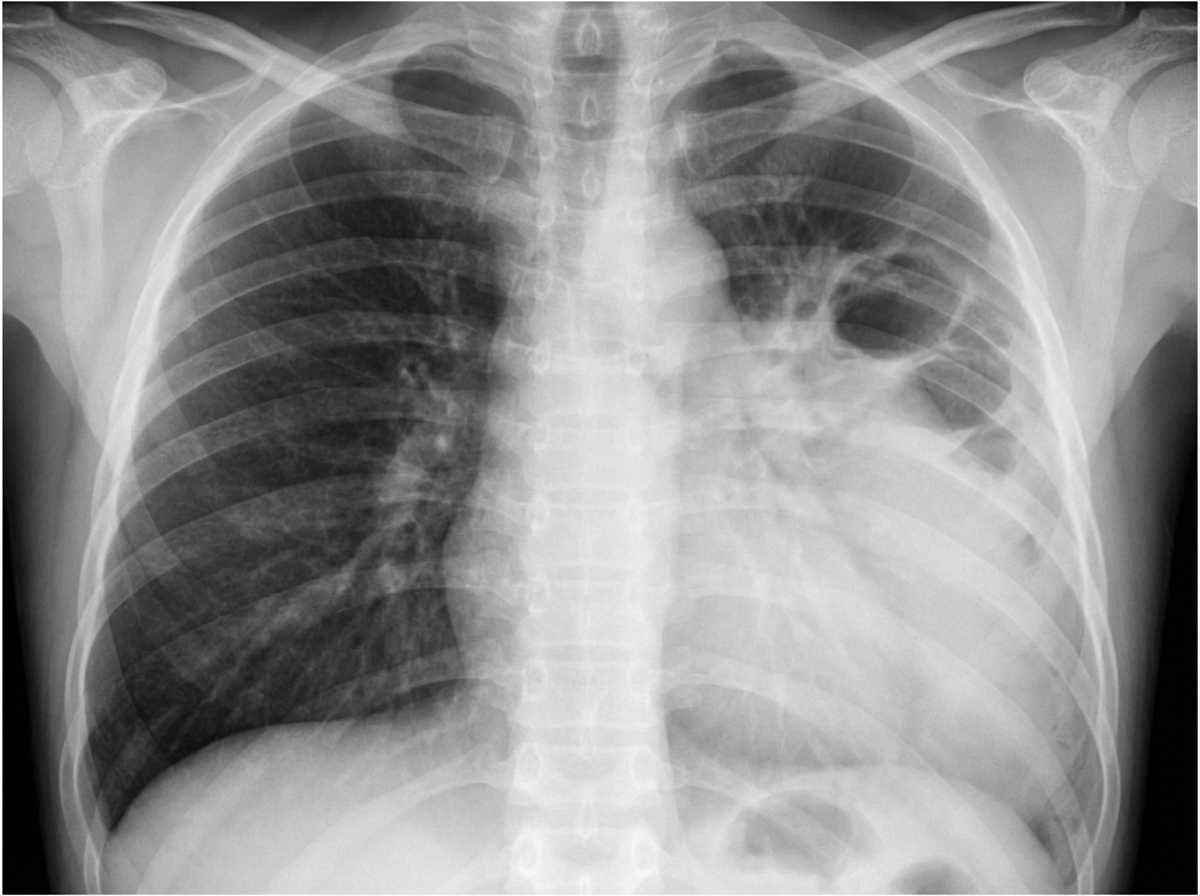
A 2-year-old boy presented to the ER with stridor, hoarseness of breath, and difficulty in swallowing. The patient also has a history of recurrent chest infections for which he was frequently hospitalized. Upper GI endoscopy was normal. Chest x-ray findings are pending. What is the most likely diagnosis?
What is the most common cause of viral pneumonia in infants?
A 14-year-old boy presents with headache, fever, and cough for 2 days. Sputum is scant and non-purulent, and Gram stain reveals many white cells but no organisms. With which medication should treatment be initiated?
Which of the following is the investigation of choice for Congenital Lobar Emphysema?
A 4-year-old asthmatic child presents with inability to speak, rapid shallow breathing, and pulsus paradoxus. Arterial blood gas analysis reveals respiratory acidosis. What is the next best step in managing this patient?
A 13-year-old patient with sickle-cell anemia presents with respiratory distress and an infiltrate on chest radiograph. Laboratory findings include: hemoglobin 5 g/dL; hematocrit 16%; white blood cell count 30,000/mL; and arterial blood gases (room air) pH 7.1, PO2 35 mm Hg, and PaCO2 28 mm Hg. These values indicate which of the following?
A 5-year-old boy presents with a 3-day history of cough and fever. On physical examination, his temperature is 39.6°C, respiratory rate is 48 breaths per minute, and there are decreased breath sounds on the right side. His chest x-ray reveals findings consistent with pneumonia. What is the most common causative organism associated with this condition?
Kartagener's syndrome includes all of the following, except:
Which of the following respiratory rates is considered abnormal in the specified age groups?
Which of the following are features of bronchiolitis?
Explanation: ### Explanation **Correct Option: D. Dysphagia lusoria** **Understanding the Diagnosis:** Dysphagia lusoria is a clinical condition where swallowing is impaired due to an **aberrant right subclavian artery (ARSA)**. Instead of arising from the brachiocephalic trunk, the artery arises directly from the aortic arch and travels behind the esophagus to reach the right arm. This creates an extrinsic compression on the posterior esophagus. In this clinical scenario: 1. **Stridor and Hoarseness:** These occur because the vascular anomaly can also compress the trachea or involve the recurrent laryngeal nerve. 2. **Difficulty in Swallowing:** This is the hallmark "lusoria" (meaning "freak of nature") symptom due to esophageal compression. 3. **Recurrent Chest Infections:** Compression of the airway leads to poor clearance of secretions and recurrent pneumonia, a classic pediatric presentation of vascular rings/anomalies. 4. **Normal Endoscopy:** Since the compression is **extrinsic** (outside the esophageal wall), the internal mucosa appears normal, which helps rule out primary esophageal motility disorders. **Why Incorrect Options are Wrong:** * **A, B, & C (Achalasia, Nutcracker Esophagus, Diffuse Esophageal Spasm):** These are primary **esophageal motility disorders**. While they cause dysphagia, they typically do not present with stridor or recurrent chest infections. Furthermore, manometry would be abnormal, and in Achalasia, endoscopy often shows a dilated esophagus with retained food. **NEET-PG High-Yield Pearls:** * **Gold Standard Investigation:** CT Angiography or MRI is used to visualize the vascular anatomy. * **Barium Swallow Finding:** Shows a characteristic **posterior indentation** on the esophagus. * **Most Common Vascular Ring:** Double Aortic Arch (causes both tracheal and esophageal compression). * **Most Common Vascular Anomaly:** Aberrant Right Subclavian Artery (often asymptomatic but causes Dysphagia Lusoria when symptomatic).
Explanation: **Explanation:** **1. Why Respiratory Syncytial Virus (RSV) is Correct:** RSV is the leading cause of lower respiratory tract infections (LRTI) in infants and young children worldwide. It is the most common cause of both **bronchiolitis** and **viral pneumonia** in children under the age of one. The virus causes inflammation of the small airways and necrosis of the respiratory epithelium, leading to airway obstruction and characteristic wheezing. In the context of NEET-PG, RSV is the "default" answer for most viral respiratory emergencies in infancy. **2. Analysis of Incorrect Options:** * **A. Rhinovirus:** While it is the most common cause of the "common cold" (upper respiratory infection) across all age groups, it is a less frequent cause of primary pneumonia compared to RSV in infants. * **C. Reovirus:** These are generally associated with mild upper respiratory symptoms or gastrointestinal issues (e.g., Rotavirus) but are rarely implicated as a primary cause of pneumonia. * **D. Cytomegalovirus (CMV):** CMV pneumonia typically occurs in **immunocompromised** patients (e.g., post-transplant) or as part of a congenital infection. It is not a common cause of community-acquired pneumonia in immunocompetent infants. **3. Clinical Pearls for NEET-PG:** * **Seasonality:** RSV outbreaks typically occur in winter and early spring. * **Diagnosis:** The gold standard is PCR, but Rapid Antigen Detection Tests (RADT) are commonly used in clinical practice. * **Radiology:** Chest X-rays in viral pneumonia typically show **hyperinflation** and bilateral patchy infiltrates (interstitial pattern) rather than lobar consolidation. * **Treatment:** Management is primarily supportive (oxygen, hydration). **Palivizumab** (a monoclonal antibody) is used for prophylaxis in high-risk preterm infants.
Explanation: ### Explanation The clinical presentation of a 14-year-old with a subacute onset of headache, fever, and a non-productive cough, combined with a Gram stain showing inflammatory cells (WBCs) but **no visible organisms**, is classic for **Atypical Pneumonia**. In school-aged children and adolescents, the most common cause of atypical pneumonia is ***Mycoplasma pneumoniae***. Because *Mycoplasma* lacks a cell wall, it does not take up Gram stain and is inherently resistant to beta-lactam antibiotics. **Macrolides** (like Erythromycin, Azithromycin, or Clarithromycin) are the first-line treatment as they inhibit bacterial protein synthesis by binding to the 50S ribosomal subunit. **Analysis of Options:** * **B. Erythromycin (Correct):** It is the drug of choice for *Mycoplasma pneumoniae* and *Chlamydia pneumoniae*, covering the most likely pathogens in this age group and clinical scenario. * **A. Cefazolin:** A first-generation cephalosporin that targets the bacterial cell wall. It is ineffective against *Mycoplasma* (which lacks a cell wall) and is generally used for Gram-positive skin infections or surgical prophylaxis. * **C. Amikacin:** An aminoglycoside primarily used for aerobic Gram-negative bacilli (e.g., *Pseudomonas*). It has no activity against atypical pathogens. * **D. Trovafloxacin:** A fluoroquinolone that was withdrawn from the market due to severe hepatotoxicity. While some quinolones (like Levofloxacin) cover atypicals, they are generally avoided as first-line therapy in children unless macrolide resistance is suspected. **High-Yield Pearls for NEET-PG:** * **"Walking Pneumonia":** A common term for *Mycoplasma* pneumonia because the patient often looks clinically better than their X-ray suggests (dissociation between clinical signs and radiological findings). * **Diagnosis:** Cold agglutinin titer ≥ 1:64 is a traditional bedside test, though PCR is now the gold standard. * **Complications:** Look for extrapulmonary manifestations like **Erythema Multiforme**, Stevens-Johnson Syndrome, or hemolytic anemia (due to cold agglutinins).
Explanation: **Explanation:** **Congenital Lobar Emphysema (CLE)** is a developmental anomaly characterized by over-inflation of one or more pulmonary lobes (most commonly the Left Upper Lobe) due to a "check-valve" mechanism that allows air entry but prevents its exit. **Why Helical CT is the Investigation of Choice:** While a Chest X-ray is the initial screening tool (showing a hyperlucent lobe with mediastinal shift), **Helical CT (Computed Tomography)** is the investigation of choice. It provides superior anatomical detail, confirming the diagnosis by showing the hyperinflated lobe and attenuated vascularity. Crucially, it helps exclude extrinsic causes of airway compression (like vascular rings or bronchogenic cysts) and assesses the status of the remaining lung parenchyma, which is essential for surgical planning. **Analysis of Incorrect Options:** * **A. Bronchography:** This is an obsolete technique involving the injection of contrast into the bronchi. It has been replaced by CT due to its invasive nature and risk of respiratory distress. * **C. MRI:** While useful for vascular anomalies, it is inferior to CT for evaluating lung parenchyma and is not the primary diagnostic modality for CLE. * **D. Bronchoscopy:** This is primarily used to rule out *intrinsic* obstructions like mucus plugs or foreign bodies. It is not the definitive diagnostic tool for the structural hyperinflation seen in CLE. **High-Yield Clinical Pearls for NEET-PG:** * **Most common site:** Left Upper Lobe (40-50%) > Right Middle Lobe (30%) > Right Upper Lobe (20%). * **Clinical Presentation:** Usually presents in the neonatal period or early infancy with progressive respiratory distress. * **Management:** Surgical lobectomy is the definitive treatment for symptomatic cases. * **Key X-ray finding:** Hyperlucent lobe with herniation to the opposite side and depression of the ipsilateral diaphragm.
Explanation: **Explanation:** The clinical presentation describes **Status Asthmaticus** with "Life-Threatening" features. The presence of **respiratory acidosis** on ABG in an acute asthma attack is an ominous sign. Normally, a patient in respiratory distress should have respiratory alkalosis due to hyperventilation. A normal or high $PaCO_2$ (leading to acidosis) indicates **respiratory muscle fatigue** and impending respiratory failure. **Why Option A is correct:** Urgent endotracheal intubation and mechanical ventilation are indicated when there are signs of exhaustion, altered sensorium, or "silent chest," and specifically when ABG shows a rising $PaCO_2$ (acidosis). The inability to speak and pulsus paradoxus further confirm the severity of the airway obstruction and the need for definitive airway management. **Why other options are incorrect:** * **Option B:** Hyperbaric oxygen is used for carbon monoxide poisoning or decompression sickness, not for asthma. * **Option C:** While MDIs and steroids are standard for mild-to-moderate asthma, they are insufficient and too slow for a patient in respiratory failure. * **Option D:** Subcutaneous terbutaline may be used in severe cases, but aminophylline is no longer a first-line drug due to its narrow therapeutic index. Neither addresses the immediate need for ventilatory support in the presence of acidosis. **NEET-PG High-Yield Pearls:** * **The "Silent Chest":** A dangerous sign in asthma where airflow is so limited that wheezing disappears. * **ABG Progression:** Early asthma = Respiratory Alkalosis (low $CO_2$). Late/Severe asthma = Respiratory Acidosis (high $CO_2$). * **Pulsus Paradoxus:** Defined as a drop in systolic BP >10 mmHg during inspiration; it correlates with the severity of airway obstruction.
Explanation: ### Explanation This question tests the interpretation of arterial blood gases (ABG) in the context of **Acute Chest Syndrome (ACS)**, a life-threatening complication of sickle cell anemia. **1. Analysis of the Correct Answer (A):** * **Acidemia:** The pH is **7.1** (Normal: 7.35–7.45), indicating a state of acidemia. * **Metabolic Acidosis:** In sickle cell crisis, tissue ischemia and severe anemia (Hb 5 g/dL) lead to anaerobic metabolism and lactic acid production. This is reflected by the low pH. * **Respiratory Alkalosis:** The $PaCO_2$ is **28 mm Hg** (Normal: 35–45 mm Hg). The patient is hyperventilating due to respiratory distress and hypoxia, "blowing off" $CO_2$. Since the $PaCO_2$ is low while the pH is also low, this represents a secondary respiratory compensation (alkalosis) for the primary metabolic acidosis. * **Hypoxia:** The $PO_2$ is **35 mm Hg** (Normal: 80–100 mm Hg), indicating severe hypoxemia. **2. Why Other Options are Incorrect:** * **Option B:** Incorrect because the pH is <7.35 (acidemia, not alkalemia) and $PaCO_2$ is low (not respiratory acidosis). * **Option C:** The patient is **hyperventilating** (low $PaCO_2$), not hypoventilating. Hypoventilation would cause $CO_2$ retention. * **Option D:** Metabolic compensation for respiratory alkalosis involves the kidneys excreting bicarbonate, which takes 48–72 hours. This is an acute presentation of ACS. **Clinical Pearls for NEET-PG:** * **Acute Chest Syndrome (ACS):** Defined as a new pulmonary infiltrate on X-ray plus fever, cough, chest pain, or hypoxia. It is the leading cause of death in sickle cell patients. * **Management:** Includes oxygen, IV fluids (cautiously), analgesics, antibiotics (covering *S. pneumoniae* and *Mycoplasma*), and **exchange transfusion** if $PO_2 < 60$ mm Hg. * **Rule of Thumb:** If pH and $PaCO_2$ move in the **same** direction, it is a primary metabolic disorder with respiratory compensation.
Explanation: **Explanation:** The clinical presentation of high-grade fever (39.6°C), tachypnea (RR 48/min), and localized decreased breath sounds in a 5-year-old is highly suggestive of **Community-Acquired Pneumonia (CAP)**. **Why Staphylococcus aureus is the correct answer:** While *Streptococcus pneumoniae* is the most common cause of bacterial pneumonia across all pediatric age groups, among the options provided, **Staphylococcus aureus** is a significant and virulent pathogen. In the context of NEET-PG questions, if *S. pneumoniae* is absent from the options, *S. aureus* is the preferred choice, especially when the presentation implies a more severe or rapidly progressive course. *S. aureus* is notorious for causing necrotizing pneumonia, lung abscesses, and empyema (which explains the decreased breath sounds). **Analysis of Incorrect Options:** * **A. Haemophilus influenzae:** Since the introduction of the Hib vaccine, the incidence of *H. influenzae* type b pneumonia has drastically declined. It is now a less common cause than *S. aureus*. * **C. Escherichia coli:** This is a common cause of pneumonia in **neonates** (0-2 months) due to vertical transmission during birth, but it is rare in a 5-year-old child. * **D. Neisseria meningitidis:** While it can cause respiratory symptoms during systemic meningococcemia, it is an extremely rare cause of primary focal pneumonia. **NEET-PG High-Yield Pearls:** * **Most common cause overall (all ages):** *Streptococcus pneumoniae*. * **Most common cause in Neonates:** Group B Streptococcus (GBS) and *E. coli*. * **Atypical Pneumonia (School-age):** *Mycoplasma pneumoniae* (look for "walking pneumonia" or bullous myringitis). * **Staphylococcal Pneumonia Hallmark:** Look for **pneumatoceles** (thin-walled air cysts), empyema, or pyopneumothorax on X-ray. * **Post-Viral Pneumonia:** *S. aureus* is the classic secondary invader following an Influenza infection.
Explanation: **Explanation:** Kartagener’s syndrome is a subset of **Primary Ciliary Dyskinesia (PCD)**, an autosomal recessive disorder characterized by structural or functional defects in the cilia. The classic triad of Kartagener’s syndrome includes **Situs inversus, Bronchiectasis, and Sinusitis.** **Why Cystic Fibrosis (Option D) is the correct answer:** Cystic Fibrosis is a distinct genetic disorder caused by mutations in the **CFTR gene**, leading to thick, viscous secretions. While both Kartagener’s and Cystic Fibrosis present with recurrent respiratory infections and bronchiectasis, they have different underlying etiologies. Cystic Fibrosis is not a component of Kartagener’s syndrome; rather, it is a major differential diagnosis. **Analysis of Incorrect Options:** * **Situs inversus (Option A):** Present in approximately 50% of patients with PCD. It occurs due to the failure of embryonic nodal cilia to coordinate the left-right orientation of internal organs. * **Bronchiectasis (Option B):** Chronic ciliary immotility leads to impaired mucociliary clearance, resulting in recurrent pulmonary infections and permanent dilation of the bronchi. * **Sinusitis (Option C):** Defective cilia in the paranasal sinuses prevent the drainage of mucus, leading to chronic inflammation and infection. **High-Yield Clinical Pearls for NEET-PG:** * **The Defect:** Most commonly due to the absence of **Dynein arms** (inner or outer) in the microtubular structure of cilia (9+2 arrangement). * **Infertility:** Males are often infertile due to immotile spermatozoa (flagellar defect), while females may have reduced fertility due to affected cilia in the fallopian tubes. * **Screening:** The **Saccharin test** (measures mucociliary clearance time) or exhaled **Nasal Nitric Oxide (nNO)** levels (characteristically low in PCD). * **Confining the Diagnosis:** Electron microscopy of ciliary biopsy or genetic testing is the gold standard.
Explanation: This question tests the fundamental knowledge of the **WHO Integrated Management of Neonatal and Childhood Illness (IMNCI)** criteria for identifying fast breathing, which is a key clinical sign for diagnosing pneumonia in resource-limited settings. ### **Explanation of the Correct Option** According to IMNCI guidelines, **fast breathing** (tachypnea) is defined based on age-specific thresholds. For a child aged **2 months to 12 months**, the cutoff for fast breathing is a respiratory rate **≥ 50 breaths per minute**. Therefore, a rate > 50/min is considered abnormal and indicative of potential pneumonia. ### **Analysis of Incorrect Options** * **Option A:** In the 2–12 month age group, a rate of 40/min is considered normal. The threshold for abnormality only begins at 50/min. * **Option C:** For children aged **1 year to 5 years**, fast breathing is defined as a respiratory rate **≥ 40 breaths per minute**. A rate of 30/min is well within the normal physiological range for this age group. * **Option D:** For young infants **less than 2 months** of age, the threshold for fast breathing is **≥ 60 breaths per minute**. A rate of 50/min is considered normal in a newborn or young infant. ### **High-Yield Clinical Pearls for NEET-PG** * **IMNCI Cut-offs for Fast Breathing:** * < 2 months: **≥ 60/min** * 2 months to 12 months: **≥ 50/min** * 12 months to 5 years: **≥ 40/min** * **Measurement Protocol:** The respiratory rate must be counted for a **full 60 seconds** when the child is calm and not crying. * **Pneumonia Classification:** Under WHO/IMNCI, "Pneumonia" is classified by fast breathing alone, while "Severe Pneumonia" is characterized by the presence of **chest indrawing** or any general danger signs (inability to feed, lethargy, convulsions).
Explanation: **Explanation:** **Bronchiolitis** is the most common lower respiratory tract infection in infants (typically <2 years old), characterized by inflammation, edema, and necrosis of the epithelial cells lining the small airways. **1. Why Option A is Correct:** The most common etiological agent for bronchiolitis is **Respiratory Syncytial Virus (RSV)**, accounting for approximately 70–80% of cases. Other causes include parainfluenza, adenovirus, and rhinovirus. The virus leads to direct injury of the bronchiolar epithelium, causing airway obstruction. **2. Analysis of Incorrect Options:** * **Option B (Wheeze is present):** While wheezing is a hallmark clinical feature of bronchiolitis, the question likely asks for the most definitive or defining feature. In many exam patterns, if multiple clinical features are present, the primary causative agent (RSV) is prioritized as the "best" answer. *Note: In clinical practice, wheezing is almost always present.* * **Option C (Pulmonary edema):** This is not a feature of bronchiolitis. The pathology is limited to airway inflammation and mucus plugging, not fluid extravasation into the alveoli. * **Option D (Immunocompromised hosts):** Bronchiolitis primarily affects **healthy infants**. While immunocompromised children are at risk for more severe disease, it is not a defining feature of the condition itself. **Clinical Pearls for NEET-PG:** * **Peak Age:** 2 to 6 months. * **Clinical Presentation:** Starts with a viral prodrome (coryza, fever), followed by respiratory distress, tachypnea, and **expiratory wheeze/crackles**. * **Radiology:** Hyperinflation of lungs and flattening of the diaphragm. * **Treatment:** Primarily supportive (hydration and oxygen). **Nebulized Adrenaline** or hypertonic saline may be used, but routine use of steroids and antibiotics is contraindicated. * **Prophylaxis:** **Palivizumab** (monoclonal antibody against RSV) is indicated for high-risk infants (preterm, congenital heart disease).
Upper Respiratory Tract Infections
Practice Questions
Lower Respiratory Tract Infections
Practice Questions
Asthma Management
Practice Questions
Cystic Fibrosis
Practice Questions
Bronchiolitis
Practice Questions
Foreign Body Aspiration
Practice Questions
Sleep-Disordered Breathing
Practice Questions
Congenital Lung Malformations
Practice Questions
Pleural Diseases
Practice Questions
Tuberculosis in Children
Practice Questions
Chronic Lung Disease in Premature Infants
Practice Questions
Pulmonary Function Testing
Practice Questions
Get full access to all questions, explanations, and performance tracking.
Start For Free