A 3-month-old baby presents with fever and respiratory rate of 60/min. The baby is irritable but feeding well. There is no stridor, no chest indrawing, and no convulsions. What is the diagnosis?
A 6-month-old female infant is brought to the physician with a 2-day history of severe cough, wheezing, and respiratory distress. Physical examination shows rhinitis, mild cyanosis, and fever. Which of the following is the most likely etiology of this child's pulmonary infection?
A child with acute respiratory distress showing hyperinflation of the unilateral lung in X-ray is due to –
Stridor in an infant is most commonly due to:
A 5-year old boy while having dinner suddenly becomes aphonic and is brought to the casualty with the complaint of respiratory distress. Immediate management should be:
A child is brought to the paediatric OPD with fever of 24 hours duration. History reveals 3 episodes of chest infection and passage of foul smelling stools. The most probable diagnosis is-
A month old HIV positive child following an upper respiratory infection developed sudden onset of breathlessness. The chest x-ray shows hyperinflation. The O2 saturation was greater than 90%. What is the most appropriate antiviral therapy among the given options?
A 3 month old infant presents with a 3 day history of fever, cough, and poor feeding. On examination, the baby appears ill and has a temperature of 102 F and a respiratory rate of 32. A chest x-ray film showed bilateral patchy infiltrates in the lungs. Which of the following is the most likely etiologic agent?
A 24 month child, with a weight of 11 kg, has RR of 38 / min, chest indrawing, cough and fever. Management according to IMNCI?
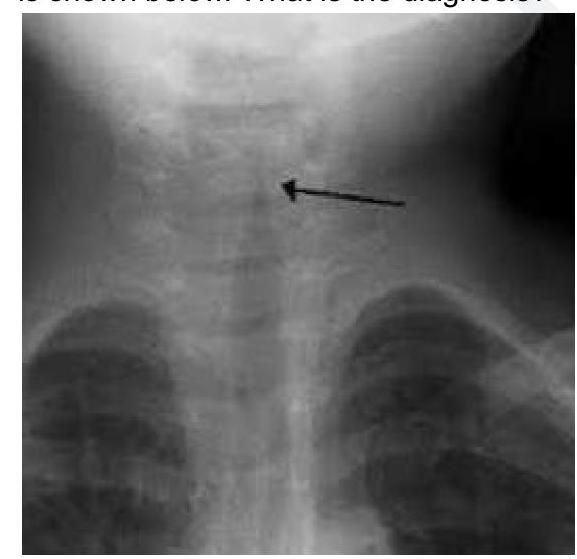
A 2 year child presented with low grade fever and stridor. What is the likely diagnosis?
Explanation: ***Pneumonia*** - A respiratory rate of 60 breaths per minute in a 3-month-old infant meets the **WHO criteria for fast breathing**, which is the primary indicator for diagnosing **pneumonia** in this age group. - The absence of chest indrawing, stridor, or convulsions means this falls under **pneumonia**, not **severe** or **very severe pneumonia**. *Very severe pneumonia* - This would be diagnosed if there were **danger signs** such as inability to feed, lethargy, or convulsions, which are explicitly stated as absent. - Presence of **stridor** in a calm child or **severe malnutrition** would also suggest very severe pneumonia, none of which are mentioned. *Severe pneumonia* - This classification requires the presence of **chest indrawing** or **stridor** in a child, which are noted as absent in the clinical presentation. - While the child has fast breathing, the lack of additional severe signs distinguishes it from severe pneumonia. *No Pneumonia* - The presence of **fast breathing** (respiratory rate of 60 in a 3-month-old) is a clear sign of respiratory distress indicating **pneumonia**, according to WHO guidelines. - If the child had a normal respiratory rate and no other signs of respiratory illness, this option might be considered.
Explanation: ***Respiratory syncytial virus*** - **Respiratory syncytial virus (RSV)** is the most common cause of **bronchiolitis** in infants and young children, characterized by cough, wheezing, and respiratory distress. - The age of the patient (6-month-old infant) and the clinical presentation, including rhinitis, cyanosis, and fever, are highly consistent with an RSV infection. *Cytomegalovirus* - **Cytomegalovirus (CMV)** infection primarily affects immunocompromised individuals or can cause congenital infections. - While CMV can cause respiratory symptoms, it typically manifests as **pneumonitis** in infants, often without the prominent wheezing seen in this case. *Parainfluenza virus* - **Parainfluenza virus (PIV)** is a common cause of **croup** (laryngotracheobronchitis) in infants and young children, characterized by a barking cough and stridor. - While PIV can rarely cause bronchiolitis, the typical presentation described, especially with prominent wheezing, is less characteristic of PIV compared to RSV. *Adenovirus* - **Adenovirus** can cause a variety of respiratory illnesses, including pneumonia, bronchitis, and pharyngitis. - While adenovirus can cause severe respiratory infections in infants, RSV is more frequently associated with the specific constellation of severe cough, wheezing, and respiratory distress in this age group.
Explanation: ***Foreign body aspiration*** - A **foreign body** partially obstructing a bronchus acts as a **one-way valve**, allowing air to enter the lung on inspiration but trapping it on expiration, leading to **hyperinflation** of the distal lung. - This is a common cause of acute respiratory distress and unilateral lung hyperinflation in children, as they frequently aspirate small objects. *Staphylococcal bronchopneumonia* - This typically presents with **consolidation** and **infiltrates** on chest X-ray, rather than hyperinflation. - While it can cause respiratory distress, it does not characteristically lead to **unilateral hyperinflation** as its primary X-ray finding. *Congenital lobar emphysema* - This causes **progressive hyperinflation of a single lobe** (typically upper or middle lobe), not the entire lung, due to abnormal bronchial cartilage or extrinsic compression. - While it can present acutely in infancy, the X-ray shows **lobar** hyperinflation with mediastinal shift, distinct from the **whole lung** hyperinflation seen with foreign body aspiration. *Aspiration pneumonia* - Aspiration pneumonia is caused by inhaling gastric contents or other substances, leading to **inflammation and infection** of the lung parenchyma. - It typically presents with **infiltrates**, **consolidation**, or **abscess formation** on X-ray, not unilateral hyperinflation.
Explanation: ***Laryngomalacia*** - **Laryngomalacia** is the most common cause of **congenital inspiratory stridor** in infants, resulting from supraglottic laryngeal structures collapsing inward during inspiration. - The stridor is typically **worse when crying, feeding, or lying supine** and usually improves spontaneously by 12-18 months of age. *Foreign body aspiration* - While foreign body aspiration can cause **acute stridor**, it is an event-specific occurrence, not a persistent condition from birth, and often presents with **sudden onset choking and respiratory distress**. - Its incidence is higher in **toddlers and older children** who are mobile and exploring their environment, rather than infants. *Diphtheria* - **Diphtheria** is a rare cause of stridor due to widespread vaccination and is characterized by a **"bull neck"** and a **pseudomembrane in the pharynx**, which is distinct from the typical presentation of laryngomalacia. - The stridor associated with Diphtheria is typically progressive and can lead to severe **respiratory obstruction and systemic toxicity**. *Acute epiglottitis* - **Acute epiglottitis** typically presents with sudden onset of **high fever, dysphagia, drooling, and muffled voice** in older children, rather than stridor from birth in an infant. - Due to **Hib vaccine**, acute epiglottitis is now very rare and its stridor is usually rapidly progressive and life-threatening.
Explanation: ***Heimlich maneuver*** - The sudden onset of **aphonia** and **respiratory distress** during dinner indicates **foreign body airway obstruction** (FBAO). - The **Heimlich maneuver** is the immediate, life-saving intervention for conscious individuals with complete airway obstruction. *Emergency tracheostomy* - This is an invasive surgical procedure performed when other methods to clear the airway have failed or are not possible due to severe obstruction or trauma. - It is not the **first-line intervention** for a conscious child with FBAO. *Humidified oxygen* - While supportive of respiratory function, humidified oxygen alone will not resolve an **acute foreign body obstruction** causing aphonia and severe distress. - It does not address the underlying mechanical blockage of the airway. *Cricothyroidotomy* - This is an emergency procedure to establish an airway, typically used in adults when other methods of intubation or airway clearance have failed. - It is generally **contraindicated in children under 12** due to the risk of damaging the cricoid cartilage, which is a major part of the child's airway.
Explanation: ***Cystic Fibrosis*** - Recurrent **chest infections** and **foul-smelling stools** (due to pancreatic insufficiency leading to malabsorption) are classic hallmarks of cystic fibrosis. - This genetic disorder primarily affects the **lungs** and **digestive system**, leading to thick, sticky mucus. *Crigler-Najjar Syndrome* - This syndrome is a rare genetic disorder characterized by severe **unconjugated hyperbilirubinemia**, leading to **jaundice** and potential neurological damage. - It does not typically present with recurrent chest infections or foul-smelling stools. *Maple Syrup urine Disease* - This is an **amino acid metabolism disorder** leading to the accumulation of branched-chain amino acids, characterized by a distinctive "maple syrup" odor in the urine. - It presents with neurological symptoms, feeding difficulties, and developmental delay, not primarily chest infections and foul-smelling stools. *Bilirubin Conjugation Defect* - This refers to conditions like Gilbert's syndrome or Crigler-Najjar syndrome, which cause varying degrees of **unconjugated hyperbilirubinemia** and **jaundice**. - It does not explain the recurrent respiratory infections or malabsorption symptoms like foul-smelling stools.
Explanation: **Ribavirin** - The clinical presentation of a 1-month-old HIV-positive infant with sudden breathlessness, hyperinflation on chest X-ray, and oxygen saturation >90%, following an URI, is highly suggestive of **Respiratory Syncytial Virus (RSV) bronchiolitis**. - **Ribavirin** is an antiviral drug that was historically used for severe RSV infection, especially in high-risk infants like those who are immunocompromised. - **Note:** Current guidelines emphasize supportive care as primary treatment; ribavirin use is now controversial due to limited efficacy and toxicity concerns. *IV Ganciclovir* - **Ganciclovir** is primarily used for the treatment of **Cytomegalovirus (CMV)** infections, which typically present differently than the acute bronchiolitis described. - CMV pneumonitis often manifests with diffuse interstitial infiltrates and may be accompanied by other systemic CMV manifestations. *Cotrimoxazole* - **Cotrimoxazole (trimethoprim-sulfamethoxazole)** is the drug of choice for prophylaxis and treatment of **Pneumocystis jirovecii pneumonia (PJP)**. - While PJP is common in HIV-positive infants, the acute onset, hyperinflation, and O2 saturation >90% are less typical for severe PJP, and cotrimoxazole is an antibiotic, not an antiviral. *Nebulized Acyclovir* - **Acyclovir** is an antiviral agent used to treat **herpes simplex virus (HSV)** and **varicella-zoster virus (VZV)** infections. - Respiratory involvement with HSV or VZV in an infant would present with different clinical features and radiological findings than those described.
Explanation: ***Respiratory syncytial virus*** - **Respiratory syncytial virus (RSV)** is the most common cause of **bronchiolitis** and **pneumonia** in infants, particularly those under 6 months. - The presentation of fever, cough, poor feeding, respiratory distress (high respiratory rate), and bilateral patchy infiltrates on chest X-ray are highly characteristic of severe RSV infection in a **3-month-old infant**. *Parainfluenza type 1* - **Parainfluenza type 1 (PIV-1)** is primarily associated with **croup** (laryngotracheobronchitis) in infants and young children, characterized by a **barking cough** and stridor. - While it can cause lower respiratory tract infections, severe pneumonia with bilateral patchy infiltrates and prominent respiratory distress is less typical than with RSV. *Influenza type A* - **Influenza type A** can cause severe respiratory illness in infants, but it is typically more common in older children and adults. - While it can present with fever, cough, and pneumonia, RSV is a more frequent cause of severe lower respiratory tract disease in this specific age group (**3-month-old infant**). *Coronavirus* - While some coronaviruses (e.g., **SARS-CoV-2**) can cause severe respiratory illness in infants, they are generally less common causes of typical infant bronchiolitis or pneumonia compared to RSV. - The pattern of a 3-month-old with fever, cough, respiratory distress, and patchy infiltrates is most strongly associated with RSV in the absence of specific epidemiological factors pointing to another coronavirus.
Explanation: ***Give antibiotics*** - The child presents with **chest indrawing** along with cough and fever, which according to **IMNCI guidelines** classifies as **pneumonia**. - Note: RR of 38/min is **within normal limits** for a 24-month-old child (fast breathing threshold is ≥40/min for 12-59 months age group). - The diagnosis of pneumonia is based on the presence of **chest indrawing**, not fast breathing in this case. - According to **IMNCI**, pneumonia (without danger signs) should be treated with **oral antibiotics** (amoxicillin 250 mg twice daily for 5 days) at the primary care level. - The child should be followed up in 2 days and the mother advised on when to return immediately. *Refer to a higher-level health facility for further management.* - Referral is indicated for **severe pneumonia**, which requires presence of any **general danger sign** (inability to drink/breastfeed, persistent vomiting, convulsions, lethargy/unconsciousness, or stridor in calm child). - This child has **pneumonia** (not severe), so outpatient treatment with oral antibiotics is appropriate. *Monitor at home without medical treatment.* - This would be inappropriate as the child has **pneumonia** requiring antibiotic treatment. - Untreated pneumonia can rapidly progress to severe disease and is a **leading cause of child mortality** in developing countries. *Provide symptomatic treatment with antipyretics only.* - While antipyretics (paracetamol) can be given for fever, they do not treat the underlying **bacterial infection**. - Antibiotics are essential to treat pneumonia and prevent complications and mortality.
Explanation: ***Acute Laryngotracheobronchitis*** - The combination of **low-grade fever** and **stridor** in a 2-year-old child strongly suggests **croup**, which is medically known as acute laryngotracheobronchitis. - Croup is characterized by **inflammation** of the larynx, trachea, and bronchi, often presenting with a **barking cough** and inspiratory stridor. The X-ray image would show the characteristic **steeple sign**. *Acute Bacterial Tracheitis* - This is a more severe bacterial infection that can present with stridor but typically shows **higher fever**, **toxic appearance**, and rapid clinical deterioration. - Unlike croup, bacterial tracheitis patients appear **more ill** and may have **purulent secretions** requiring more aggressive management. *Acute Epiglottitis* - A serious condition characterized by **rapid onset of high fever**, **dysphagia**, drooling, and a **"tripod" position**, which are not indicated by the given symptoms. - The stridor in epiglottitis is typically quieter and may indicate more severe airway obstruction compared to the characteristic stridor of croup. *Foreign Body aspiration* - While foreign body aspiration can cause stridor, it is typically an **acute event** with a sudden onset of choking, coughing, and respiratory distress. - There is no mention of a choking episode or sudden onset, and a low-grade fever is less typical for an uncomplicated foreign body aspiration.
Upper Respiratory Tract Infections
Practice Questions
Lower Respiratory Tract Infections
Practice Questions
Asthma Management
Practice Questions
Cystic Fibrosis
Practice Questions
Bronchiolitis
Practice Questions
Foreign Body Aspiration
Practice Questions
Sleep-Disordered Breathing
Practice Questions
Congenital Lung Malformations
Practice Questions
Pleural Diseases
Practice Questions
Tuberculosis in Children
Practice Questions
Chronic Lung Disease in Premature Infants
Practice Questions
Pulmonary Function Testing
Practice Questions
Get full access to all questions, explanations, and performance tracking.
Start For Free