Which of the following is NOT a common cause of stridor?
Which of the following statements is not true regarding spasmodic croup?
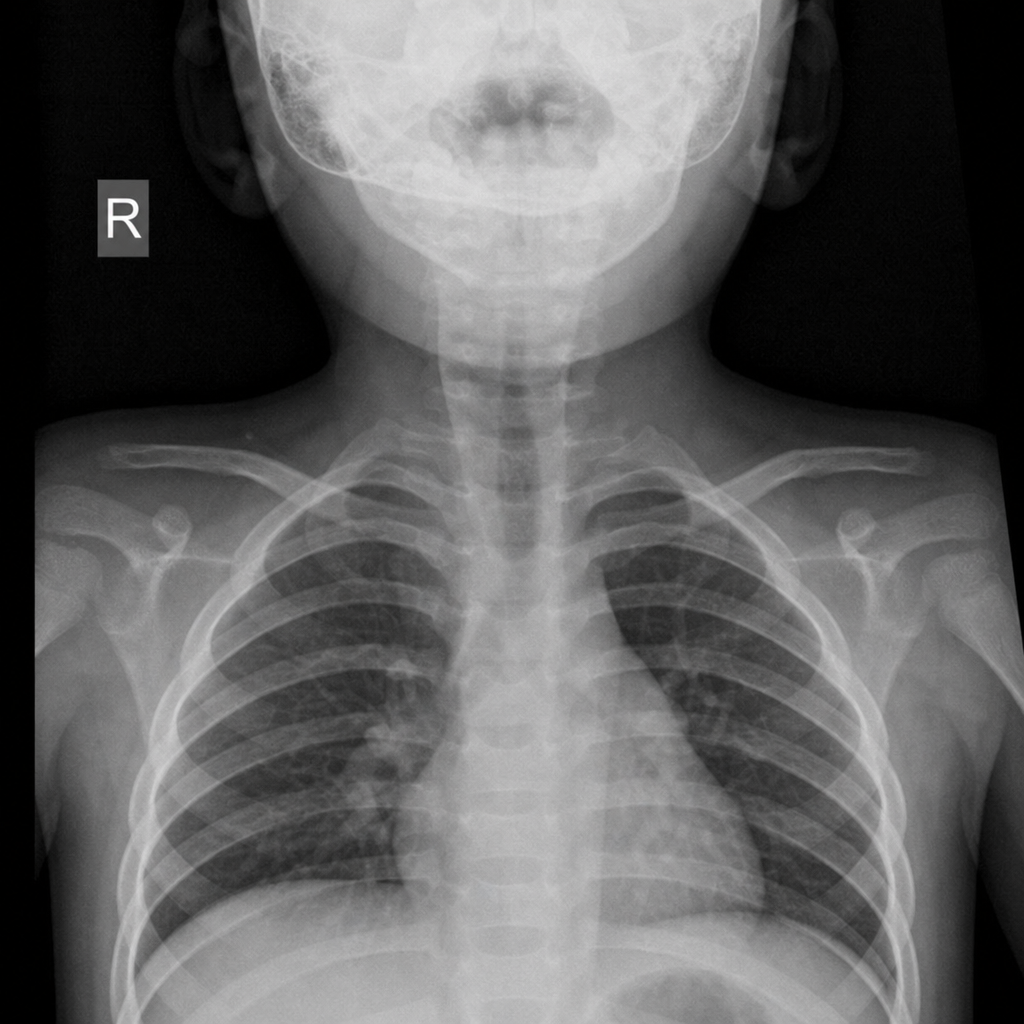
A neonate born at 34 weeks gestation with premature rupture of membranes undergoes a chest X-ray. Which of the following is LEAST likely to be considered in the differential diagnosis of the findings on the chest X-ray?

A 10-year-old child presents with a history of chronic sinusitis, multiple nasal polyps, recurrent chest infections, and malabsorption syndrome. Which one of the following tests would be useful for diagnosis?
Which of the following are seen in Bronchiolitis?
Which of the following is NOT a feature of childhood asthma?
What is the most common organism associated with cystic fibrosis?
The sudden appearance of pneumothorax in a child suffering from pneumonia points to which etiology?
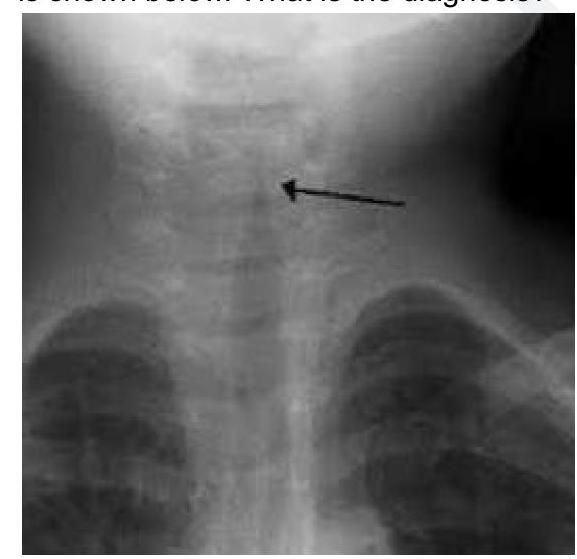
"Steeple sign" is seen in which of the following conditions?
The second phase of bronchial asthma can be prevented by which of the following classes of drugs?
Explanation: **Explanation:** Stridor is a high-pitched, predominantly inspiratory sound produced by turbulent airflow through a partially obstructed upper airway (larynx or trachea). **Why Atrophic Laryngitis is the correct answer:** Atrophic laryngitis is a chronic condition characterized by the atrophy of the laryngeal mucosa and crust formation. While it causes hoarseness of voice and a dry cough, it **does not typically cause significant airway narrowing** or acute obstruction. Therefore, it is not a recognized cause of stridor. **Analysis of Incorrect Options:** * **Foreign body in larynx and trachea:** This is a common cause of **acute stridor** in toddlers. A lodged object creates mechanical obstruction, leading to sudden-onset respiratory distress and inspiratory or biphasic stridor. * **Laryngomalacia:** This is the **most common congenital cause** of stridor in infants. It occurs due to an inward collapse of supraglottic structures (like the epiglottis) during inspiration, resulting in a characteristic "crowing" sound that worsens when the infant is supine. * **Multiple papillomas of larynx:** Also known as Juvenile Recurrent Respiratory Papillomatosis (caused by HPV 6 and 11), these benign growths physically obstruct the glottic opening, leading to progressive hoarseness and stridor. **NEET-PG High-Yield Pearls:** * **Most common cause of inspiratory stridor in neonates:** Laryngomalacia. * **Most common cause of acute stridor (6 months – 3 years):** Laryngotracheobronchitis (Croup). * **Biphasic stridor** usually indicates a lesion at the **subglottic** or tracheal level. * **Expiratory stridor (wheeze)** usually indicates obstruction in the **lower airways** (bronchi).
Explanation: ### Explanation: Spasmodic Croup **Spasmodic Croup** (also known as "Midnight Croup") is a clinical variant of croup characterized by sudden-onset respiratory distress, primarily occurring at night. **1. Why Option A is the Correct Answer (The "Not True" Statement):** Unlike Acute Laryngotracheobronchitis (Viral Croup), which is preceded by a prodrome of fever, coryza, and sore throat, **Spasmodic Croup is non-inflammatory and non-infectious.** It is believed to have an allergic or psychological component. Therefore, a **history of fever is typically absent**, and the child appears perfectly healthy during the day before the episode. **2. Analysis of Other Options:** * **Option B (Metallic Cough):** This is a classic feature. The sudden subglottic edema causes a characteristic "barking" or metallic cough, often accompanied by inspiratory stridor. * **Option C (Pale and Edematous Larynx):** On direct laryngoscopy, the laryngeal mucosa in spasmodic croup appears pale, watery, and edematous. This contrasts with viral croup, where the mucosa is typically erythematous (red) and inflamed. * **Option D (Occurs at Night):** This is a hallmark of the condition. The child typically wakes up suddenly at night with respiratory distress, which often resolves rapidly with exposure to cool night air or humidified steam. ### NEET-PG High-Yield Pearls: * **Age Group:** Most common between 1–3 years of age. * **Recurrence:** Spasmodic croup has a high tendency to recur (recurrent croup). * **Management:** Most cases are self-limiting. Management includes reassurance and humidification. Severe cases may require a single dose of corticosteroids (Dexamethasone). * **Key Differentiator:** If the question mentions **fever and toxicity**, think **Viral Croup** or **Bacterial Tracheitis**. If the child is **afebrile** and the episode is **sudden/nocturnal**, think **Spasmodic Croup**.
Explanation: ***Ventricular septal defect*** - **VSD** primarily causes **cardiomegaly** and **pulmonary plethora** on chest X-ray, not the typical respiratory distress patterns expected in a premature neonate. - The chest X-ray findings in this clinical scenario would more likely show **pulmonary parenchymal changes** rather than cardiac abnormalities. *Congenital pneumonia* - **Premature rupture of membranes (PROM)** significantly increases the risk of **ascending bacterial infection** leading to congenital pneumonia. - Chest X-ray typically shows **bilateral infiltrates**, **consolidation**, or **reticulogranular opacities** similar to other neonatal lung diseases. *Hyaline membrane disease* - **Prematurity at 34 weeks** places this neonate at high risk for **surfactant deficiency** causing hyaline membrane disease (respiratory distress syndrome). - Classic chest X-ray findings include **reticulogranular opacities**, **air bronchograms**, and **low lung volumes**. *Congenital alveolar proteinosis* - Presents with **bilateral pulmonary infiltrates** and **reticulogranular pattern** on chest X-ray, mimicking other neonatal respiratory conditions. - Can cause **respiratory distress** in neonates and appears radiographically similar to **hyaline membrane disease** or **congenital pneumonia**.
Explanation: ### Explanation The clinical presentation of **chronic sinusitis, nasal polyps, recurrent respiratory infections, and malabsorption** (suggestive of pancreatic insufficiency) is a classic triad for **Cystic Fibrosis (CF)**. **Why Sweat Chloride is the Correct Answer:** Cystic Fibrosis is an autosomal recessive disorder caused by a mutation in the **CFTR gene** (Chromosome 7). This defect leads to thick, viscid secretions in the lungs and pancreas, and impaired reabsorption of chloride in sweat ducts. The **Pilocarpine Iontophoresis Sweat Chloride Test** remains the gold standard for diagnosis. A chloride concentration **>60 mmol/L** on two separate occasions is diagnostic of CF. **Analysis of Incorrect Options:** * **A. Total IgE estimation:** While IgE is elevated in Allergic Bronchopulmonary Aspergillosis (ABPA)—a common complication of CF—it is not a diagnostic test for the primary disease itself. * **B. ESR:** This is a non-specific marker of inflammation and does not aid in the definitive diagnosis of a genetic multisystem disorder. * **C. ACE Levels:** Elevated serum Angiotensin-Converting Enzyme (ACE) levels are characteristic of **Sarcoidosis**, which typically presents in adults with bilateral hilar lymphadenopathy, not childhood malabsorption. **High-Yield Clinical Pearls for NEET-PG:** * **Nasal Polyps in Children:** Always rule out Cystic Fibrosis. * **Most Common Mutation:** ΔF508. * **Earliest Manifestation:** Meconium ileus (seen in 15-20% of newborns). * **Common Pathogens:** *Staphylococcus aureus* (early childhood) and *Pseudomonas aeruginosa* (most common cause of chronic infection in older children). * **Infertility:** 95% of males are infertile due to Congenital Bilateral Absence of the Vas Deferens (CBAVD).
Explanation: **Explanation:** **Bronchiolitis** is an acute viral infection of the lower respiratory tract, primarily affecting the small airways (bronchioles). It is the most common cause of wheezing in infants. **1. Why Option D is Correct:** The management of bronchiolitis is primarily **supportive/symptomatic**. Since the etiology is viral, antibiotics are not indicated. The mainstay of treatment includes maintaining hydration, nasal suctioning for secretions, and supplemental oxygen if saturation drops below 90-92%. Routine use of bronchodilators, steroids, or chest physiotherapy is generally not recommended by current AAP guidelines. **2. Why Other Options are Incorrect:** * **Option A:** Bronchiolitis typically affects children **under 2 years of age**, with a peak incidence between **2 to 6 months**. It is rare in children older than 2 years due to the increased diameter of their airways. * **Option B:** The most common causative agent is **Respiratory Syncytial Virus (RSV)** (approx. 75% of cases). Other causes include Rhinovirus, Parainfluenza, and Adenovirus. *Streptococcus pneumoniae* is a common cause of bacterial pneumonia, not bronchiolitis. * **Option C:** While Chest X-ray (CXR) often shows hyperinflation and patchy atelectasis, it is **not routinely recommended** for diagnosis. Diagnosis is primarily **clinical**. CXR is reserved for severe cases or to rule out secondary bacterial pneumonia. **High-Yield Clinical Pearls for NEET-PG:** * **Most common cause:** RSV. * **Clinical presentation:** Starts as a viral URI (coryza), progressing to lower respiratory signs like tachypnea, wheezing, and subcostal retractions. * **Modified Wood’s Clinical Score:** Used to assess the severity of bronchiolitis. * **Prophylaxis:** **Palivizumab** (monoclonal antibody against RSV) is indicated for high-risk infants (preterm, congenital heart disease). * **Risk Factor:** Lack of breastfeeding and exposure to cigarette smoke.
Explanation: **Explanation:** Childhood asthma is a chronic inflammatory airway disease characterized by reversible airway obstruction, bronchial hyperresponsiveness, and an underlying allergic (atopic) predisposition. **Why "Raised IgG level" is the correct answer (NOT a feature):** Asthma is primarily a **Type I Hypersensitivity reaction** mediated by **IgE antibodies**, not IgG. In atopic children, exposure to allergens triggers Th2-cell activation, leading to the production of specific IgE that binds to mast cells. Upon re-exposure, degranulation occurs. While IgG is the most abundant antibody in systemic infections, it is not a diagnostic marker or a characteristic feature of the asthmatic inflammatory cascade. **Analysis of other options:** * **History of atopic dermatitis:** This is a key component of the **"Atopic March."** Children with asthma often have a personal or family history of other allergic conditions like eczema (atopic dermatitis) or allergic rhinitis. * **Improves with age:** Many children with mild-to-moderate asthma experience significant clinical improvement or "outgrow" their symptoms during puberty as airway caliber increases, though bronchial hyperreactivity may persist subclinically. * **Absence of wheezing after exercise:** While exercise-induced bronchoconstriction (EIB) is common, it is **not mandatory** for a diagnosis. A child can have asthma triggered solely by viral infections or allergens without exhibiting post-exercise wheezing. **NEET-PG High-Yield Pearls:** * **Diagnosis:** Primarily clinical; Spirometry (in children >5 years) shows reversibility (FEV1 increase >12%). * **Asthma Predictive Index (API):** Used to predict if a wheezing toddler will develop persistent asthma. Major criteria include parental asthma or patient eczema. * **Drug of Choice:** Inhaled Corticosteroids (ICS) are the most effective long-term controllers.
Explanation: **Explanation:** In patients with **Cystic Fibrosis (CF)**, the respiratory tract is predisposed to chronic bacterial colonization due to thick, inspissated mucus. **Pseudomonas aeruginosa** is the most common pathogen overall, particularly in adolescents and adults. While *Staphylococcus aureus* is the most common organism in early childhood, *Pseudomonas* eventually colonizes the majority of patients. Initially, the infection involves **non-mucoid** strains; however, over time, these transition into **mucoid** phenotypes (producing alginate), which are associated with biofilm formation, increased antibiotic resistance, and a more rapid decline in pulmonary function. **Analysis of Options:** * **A. Pseudomonas aeruginosa (non-mucoid):** Correct. It is the hallmark pathogen of CF lung disease. * **B. Burkholderia cepacia:** While highly significant in CF, it is less common than *Pseudomonas*. It is associated with "Cepacia syndrome" (rapid clinical deterioration) and is often a contraindication for lung transplantation. * **C & D. Pleisomonas and Aeromonas:** These are primarily water-borne Gram-negative rods associated with gastroenteritis or wound infections and are not typical pathogens in Cystic Fibrosis. **Clinical Pearls for NEET-PG:** * **Most common organism (Overall/Adults):** *Pseudomonas aeruginosa*. * **Most common organism (Infants/Children):** *Staphylococcus aureus*. * **Most common cause of death in CF:** Respiratory failure due to chronic infection. * **Diagnostic Gold Standard:** Sweat Chloride Test (>60 mEq/L). * **Genetics:** Autosomal Recessive; mutation in the **CFTR gene** on **Chromosome 7** (most common mutation: **ΔF508**).
Explanation: **Explanation:** The correct answer is **Staphylococci (Option A)**. **Underlying Medical Concept:** *Staphylococcus aureus* is a highly pyogenic and tissue-destructive organism. It produces specific toxins and enzymes (such as hyaluronidase and panton-valentine leukocidin) that lead to **necrosis of the pulmonary parenchyma**. This necrosis often results in the formation of **pneumatoceles** (thin-walled, air-filled cysts). When these subpleural pneumatoceles rupture into the pleural space, they cause a sudden **pneumothorax** or pyopneumothorax. This rapid progression from consolidation to cavitation and pleural complications is a hallmark of Staphylococcal pneumonia in children. **Analysis of Incorrect Options:** * **B. Streptococci:** *Streptococcus pneumoniae* is the most common cause of community-acquired pneumonia in children. While it frequently causes large pleural effusions or empyema, it is typically non-necrotizing and rarely causes pneumatoceles or sudden pneumothorax. * **C. Mycoplasma:** This causes "Atypical Pneumonia," characterized by interstitial infiltrates and constitutional symptoms. It does not cause tissue destruction or pneumothorax. * **D. Klebsiella:** While *Klebsiella* can cause necrotizing pneumonia and lung abscesses (classically the "bulging fissure sign"), it is a much rarer cause of pneumonia in the pediatric age group compared to Staphylococci and is more commonly seen in chronic alcoholics or diabetic adults. **High-Yield Clinical Pearls for NEET-PG:** * **Staphylococcal Pneumonia:** Look for keywords like "pneumatoceles," "pyopneumothorax," and "rapid radiological progression." * **Most common complication:** Empyema is frequently associated with Staph pneumonia. * **Treatment:** Cloxacillin or Vancomycin (if MRSA is suspected). * **Age group:** It is particularly common in infants under 1 year of age.
Explanation: **Explanation:** The **"Steeple sign"** (also known as the wine bottle sign) is a classic radiological finding seen on an **Anteroposterior (AP) view of the neck X-ray**. It represents the subglottic narrowing caused by edema and inflammation in **Croup** (Laryngotracheobronchitis). The narrowing of the subglottic airway gives the appearance of a tapered church steeple. **Why the other options are incorrect:** * **Acute Epiglottitis:** Characterized by the **"Thumb sign"** on a **Lateral neck X-ray**, representing a swollen, enlarged epiglottis. It is a medical emergency caused typically by *H. influenzae* type B. * **Laryngomalacia:** The most common cause of congenital stridor. Diagnosis is clinical (inspiratory stridor worsening when supine) and confirmed via laryngoscopy showing "omega-shaped" epiglottis; X-rays are usually unremarkable. * **Quinsy (Peritonsillar Abscess):** Presents with a "hot potato voice," uvular deviation to the opposite side, and trismus. Imaging (CT or Ultrasound) would show a localized collection in the peritonsillar space, not subglottic narrowing. **High-Yield Clinical Pearls for NEET-PG:** * **Croup Etiology:** Most commonly caused by **Parainfluenza virus Type 1**. * **Clinical Triad:** Barking cough (seal-like), inspiratory stridor, and hoarseness. * **Management:** Nebulized adrenaline (for immediate relief of stridor) and Dexamethasone (mainstay of treatment). * **Westley Croup Score** is used to assess severity. * **Distinction:** Unlike Epiglottitis, children with Croup usually do *not* have high fever, drooling, or a toxic appearance.
Explanation: **Explanation:** Bronchial asthma is characterized by a **biphasic response**. Understanding the pathophysiology of these phases is crucial for selecting the appropriate pharmacological intervention. 1. **Early Phase (Immediate):** Occurs within minutes of allergen exposure. It is primarily driven by IgE-mediated mast cell degranulation, leading to the release of histamine and leukotrienes. This results in acute bronchoconstriction and edema. 2. **Late Phase (Second Phase):** Occurs 4–8 hours later. It is characterized by **chronic inflammation**, recruitment of inflammatory cells (eosinophils, T-lymphocytes), and airway hyperresponsiveness. **Why Corticosteroids are correct:** Corticosteroids are potent anti-inflammatory agents. They inhibit the recruitment and activation of inflammatory cells, reduce cytokine production, and decrease mucosal edema. Because the second phase is fundamentally an **inflammatory process**, corticosteroids are the only class among the options that can prevent it. **Why other options are incorrect:** * **Beta-2 agonists (e.g., Salbutamol):** These are potent bronchodilators. They are highly effective at reversing the early phase (bronchospasm) but have no significant anti-inflammatory effect and thus do not prevent the late-phase reaction. * **Xanthine derivatives (e.g., Theophylline):** These act via phosphodiesterase inhibition and adenosine antagonism to cause bronchodilation. They are less effective than steroids in preventing the late-phase inflammatory response. * **Anticholinergics (e.g., Ipratropium):** These block muscarinic receptors to reduce vagal-mediated bronchoconstriction. They do not address the underlying cellular inflammation of the second phase. **NEET-PG High-Yield Pearls:** * **Drug of choice for acute asthma:** Inhaled Beta-2 agonists (SABA). * **Most effective long-term control therapy:** Inhaled Corticosteroids (ICS). * **Mast cell stabilizers (Cromolyn):** Can prevent both phases if given *prophylactically*, but they are not used for acute reversal. * **Steroid mechanism:** They upregulate Beta-2 receptors, making them useful in preventing tachyphylaxis to Beta-agonists.
Upper Respiratory Tract Infections
Practice Questions
Lower Respiratory Tract Infections
Practice Questions
Asthma Management
Practice Questions
Cystic Fibrosis
Practice Questions
Bronchiolitis
Practice Questions
Foreign Body Aspiration
Practice Questions
Sleep-Disordered Breathing
Practice Questions
Congenital Lung Malformations
Practice Questions
Pleural Diseases
Practice Questions
Tuberculosis in Children
Practice Questions
Chronic Lung Disease in Premature Infants
Practice Questions
Pulmonary Function Testing
Practice Questions
Get full access to all questions, explanations, and performance tracking.
Start For Free