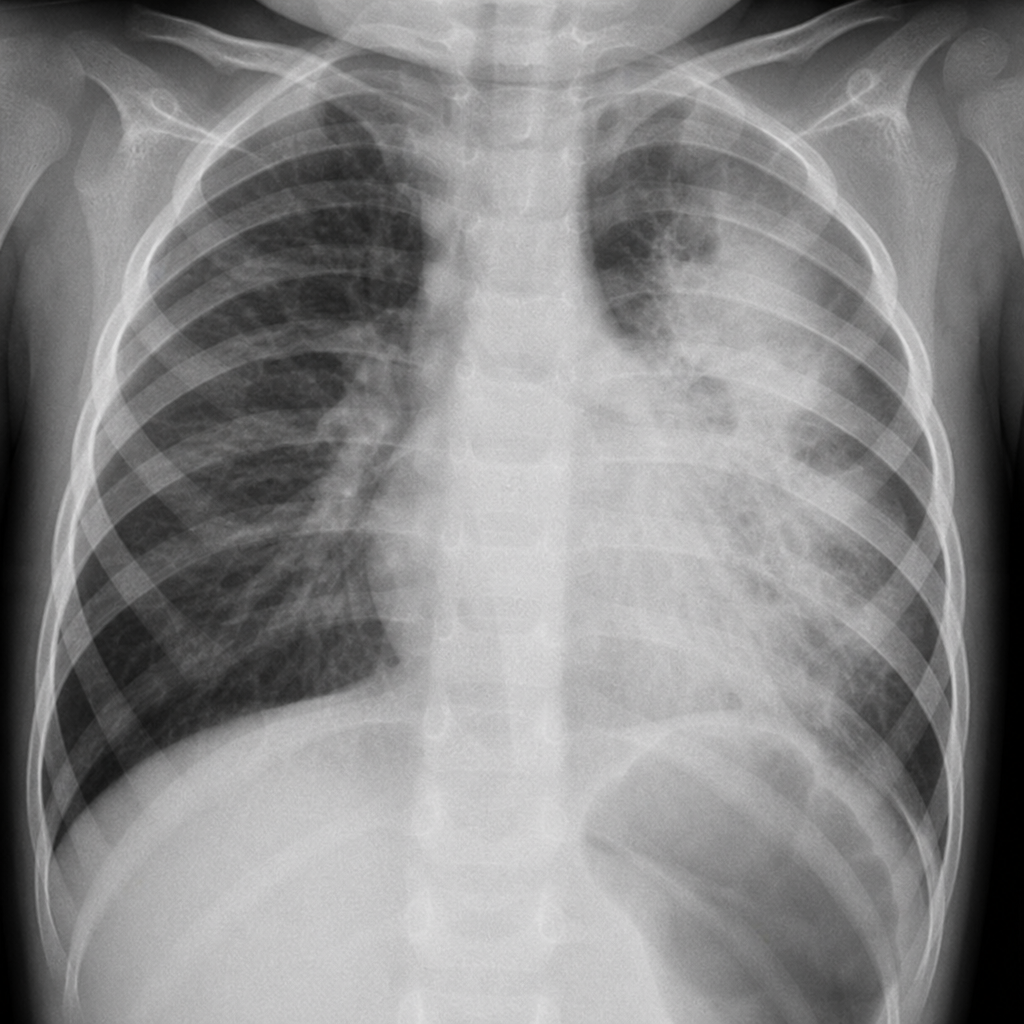
Which of the following is the most common organism causing bronchiolitis?
A 6-week-old baby presents with cough and cold for the past 3 days. The respiratory rate is 48/min. On examination, the patient is febrile with wheezing but no chest indrawing. Which of the following statements is not true?
What is the most common cause of pulmonary infection in cystic fibrosis?
A healthy 10-year-old boy presents with fever, cough, and lower respiratory symptoms of 5 days duration. Auscultatory findings are consistent with pneumonia. What is the first-line drug for this condition?
What is the most likely cause of bronchiolitis in a 6-month-old infant?
An infant born 3 hours previously to a mother with poorly controlled insulin-dependent gestational diabetes presents with abnormal breathing. Examination reveals cyanosis, irregular and labored breathing, decreased breath sounds on the right side, and decreased tone in the right arm. A stat portable chest radiograph is normal. Which of the following studies is most likely to confirm the diagnosis?
What is the most confirmatory sign of successful endotracheal intubation?
A 3-year-old child presents to a primary health center with fever, chest indrawing, and a respiratory rate of 38 per minute. What is the next step in management?
What is true about cystic fibrosis?
A 4-year-old child presents to the emergency department with respiratory difficulty and noisy breathing. On examination, X-ray shows thumb sign. What is the most probable diagnosis?
Explanation: **Explanation:** **Bronchiolitis** is an acute inflammatory disease of the lower respiratory tract, primarily affecting infants under 2 years of age. It is characterized by inflammation, edema, and necrosis of epithelial cells lining the small airways (bronchioles), leading to increased mucus production and bronchospasm. **Why RSV is the correct answer:** **Respiratory Syncytial Virus (RSV)** is the most common cause of bronchiolitis worldwide, accounting for approximately **50–80%** of all cases. It typically occurs in seasonal outbreaks (winter and early spring). The virus causes syncytia formation in the airway epithelium, leading to the classic clinical triad of wheezing, tachypnea, and chest retractions. **Why the other options are incorrect:** * **Rhinovirus:** This is the second most common cause of bronchiolitis. While it is a frequent cause of the common cold and asthma exacerbations, it lags behind RSV in primary bronchiolitis incidence. * **Adenovirus:** Though it can cause bronchiolitis, it is more notorious for causing **Bronchiolitis Obliterans**, a severe, chronic obstructive lung disease following a necrotizing pneumonia. * **Influenza virus:** While it causes significant respiratory morbidity in children, it more commonly presents as a systemic febrile illness or pneumonia rather than isolated bronchiolitis. **High-Yield Clinical Pearls for NEET-PG:** * **Most common age group:** 2 to 6 months. * **Diagnosis:** Primarily clinical. Routine chest X-rays are not recommended unless complications are suspected. * **Treatment:** Mostly supportive (hydration and oxygenation). **Nebulized Adrenaline** may be tried, but routine use of steroids or antibiotics is discouraged. * **Prophylaxis:** **Palivizumab** (a monoclonal antibody against RSV F-protein) is indicated for high-risk infants (e.g., preterm or congenital heart disease). * **Risk Factor:** Lack of breastfeeding and exposure to cigarette smoke.
Explanation: ### Explanation The core of this question lies in the **WHO Integrated Management of Neonatal and Childhood Illness (IMNCI)** guidelines for classifying respiratory infections. **1. Why "The child has pneumonia" is NOT true:** According to WHO/IMNCI criteria for a child aged 2 months to 5 years, pneumonia is defined by **fast breathing** or **chest indrawing**. For a child aged **2 months to 12 months**, the cutoff for fast breathing is **≥ 50 breaths/min**. In this case, the 6-week-old (1.5 months) infant has a respiratory rate of **48/min**, which is **normal** (the cutoff for infants < 2 months is ≥ 60/min). Since there is no fast breathing and no chest indrawing, the child is classified as having a **"No Pneumonia" (Cough or Cold)**. **2. Analysis of other options:** * **Antibiotics are not required:** True. Since the diagnosis is a simple cough/cold (likely viral bronchiolitis or URTI), antibiotics are not indicated. * **Wheezing should be treated:** True. Wheezing in an infant indicates airway obstruction (often Bronchiolitis). Supportive care or a trial of bronchodilators is appropriate. * **Fever should be treated:** True. Symptomatic management of fever (e.g., Paracetamol) is standard care to ensure the infant's comfort and hydration. **Clinical Pearls for NEET-PG:** * **IMNCI Respiratory Rate Cutoffs:** * < 2 months: ≥ 60/min (Fast breathing) * 2–12 months: ≥ 50/min * 12 months–5 years: ≥ 40/min * **Classification Tip:** If a child has wheeze but no fast breathing/chest indrawing, it is managed as "No Pneumonia." If wheeze is present with fast breathing, treat with a bronchodilator first; if fast breathing persists after 3 doses, then classify as pneumonia.
Explanation: **Explanation:** In Cystic Fibrosis (CF), the defective CFTR protein leads to thick, dehydrated mucus that impairs mucociliary clearance, creating a niche for chronic bacterial colonization. **Why Pseudomonas aeruginosa is the correct answer:** While several pathogens colonize the CF lung, **Pseudomonas aeruginosa** is the **most common cause of chronic pulmonary infection overall**, particularly in adolescents and adults. By age 18, approximately 60-80% of CF patients are colonized. Its ability to form biofilms (mucoid phenotype) makes it extremely difficult to eradicate, leading to progressive bronchiectasis and respiratory failure, which is the leading cause of mortality in CF. **Analysis of Incorrect Options:** * **B. Staphylococcus aureus:** This is the most common organism isolated from the respiratory tract of **infants and young children** with CF. However, as patients age, Pseudomonas becomes the dominant pathogen. * **C. Burkholderia cepacia:** Though less common, it is highly virulent and associated with a rapid decline in lung function ("Cepacia syndrome"). It is often a contraindication for lung transplantation. * **D. Nontuberculous mycobacteria (NTM):** These (e.g., *M. avium* complex) are increasingly recognized in CF patients but are far less prevalent than Pseudomonas. **High-Yield Clinical Pearls for NEET-PG:** * **Age-wise prevalence:** *S. aureus* (Early childhood) → *P. aeruginosa* (Adulthood). * **Drug of Choice for Pseudomonas:** Piperacillin-Tazobactam, Ceftazidime, or Ciprofloxacin. Inhaled Tobramycin is used for chronic suppression. * **Pancreatic Insufficiency:** Present in 85% of CF patients; requires fat-soluble vitamin (A, D, E, K) supplementation. * **Newborn Screening:** Measurement of Immunoreactive Trypsinogen (IRT).
Explanation: **Explanation:** The clinical presentation of fever, cough, and signs of pneumonia in a 10-year-old typically suggests Community-Acquired Pneumonia (CAP). However, based on the provided options and the designated correct answer, this question specifically tests the management of **severe systemic fungal infections** or **Mucormycosis**, where **Liposomal Amphotericin B** is the gold standard. **1. Why Liposomal Amphotericin B is Correct:** Liposomal Amphotericin B is a polyene antifungal that binds to ergosterol in the fungal cell membrane, creating pores and causing cell death. It is the first-line treatment for invasive fungal pneumonia (like Mucormycosis or severe Aspergillosis) and systemic fungal infections. The liposomal formulation is preferred over the conventional deoxycholate form due to significantly **reduced nephrotoxicity** and better penetration into lung tissue. **2. Why Other Options are Incorrect:** * **Terbinafine:** An allylamine used primarily for dermatophytoses (skin/nail infections). It is not used for systemic respiratory infections. * **Voriconazole:** The drug of choice for invasive Aspergillosis, but it is ineffective against Mucormycosis. * **Itraconazole:** Used for Histoplasmosis or Blastomycosis, but it lacks the potency required for acute, severe systemic fungal pneumonia compared to Amphotericin B. **Clinical Pearls for NEET-PG:** * **Drug of Choice (DOC):** Liposomal Amphotericin B is the DOC for Mucormycosis, Visceral Leishmaniasis (Kala-azar), and Cryptococcal meningitis. * **Side Effects:** Monitor for hypokalemia and nephrotoxicity ("Ampho-terrible"). * **Pediatric CAP:** In a standard bacterial context (not fungal), the DOC for a 10-year-old would typically be Amoxicillin or Azithromycin (if atypical). Always correlate the options with the suspected pathogen.
Explanation: **Explanation:** **Bronchiolitis** is the most common lower respiratory tract infection in infants (typically <2 years of age), characterized by inflammation, edema, and necrosis of the epithelial cells lining the small airways. **Why Respiratory Syncytial Virus (RSV) is correct:** RSV is the leading cause of bronchiolitis worldwide, accounting for approximately **50–80% of all cases**. It typically occurs in seasonal outbreaks (winter and early spring). In a 6-month-old infant presenting with rhinorrhea, cough, wheezing, and increased work of breathing, RSV is statistically the most probable etiology. **Why the other options are incorrect:** * **Measles virus (A):** While measles can cause pneumonia (Hecht’s giant cell pneumonia), it is not a primary cause of bronchiolitis and typically presents with high fever, maculopapular rash, and Koplik spots. * **Mumps virus (B):** Mumps primarily involves the parotid glands and CNS; it does not typically cause lower respiratory tract disease like bronchiolitis. * **Parainfluenza virus (D):** This is the most common cause of **Croup (Laryngotracheobronchitis)**, characterized by a barking cough and inspiratory stridor, rather than the expiratory wheeze seen in bronchiolitis. **High-Yield Clinical Pearls for NEET-PG:** * **Diagnosis:** Primarily clinical. Chest X-ray may show hyperinflation and patchy atelectasis but is not routinely required. * **Treatment:** Management is mainly **supportive** (hydration and oxygenation). Routine use of bronchodilators, steroids, or antibiotics is **not** recommended. * **Prophylaxis:** **Palivizumab** (a monoclonal antibody against RSV F-protein) is indicated for high-risk infants (e.g., prematurity, congenital heart disease). * **Risk Factor:** Exposure to cigarette smoke and lack of breastfeeding are significant risk factors.
Explanation: **Explanation:** The clinical presentation points toward **Phrenic Nerve Palsy**, a birth injury often associated with macrosomia and difficult deliveries (common in infants of diabetic mothers). The combination of respiratory distress (cyanosis, labored breathing), unilateral decreased breath sounds, and ipsilateral **Erb’s palsy** (decreased tone in the right arm) is classic. 1. **Why Chest Ultrasound is correct:** In phrenic nerve palsy, the affected side of the diaphragm is paralyzed. While a chest X-ray may show an elevated hemidiaphragm, it can often appear normal in the early hours or if the infant is on positive pressure. **Chest Ultrasound (or fluoroscopy)** is the gold standard for confirmation as it demonstrates **paradoxical diaphragmatic movement** (the affected side moves upward during inspiration while the healthy side moves downward). 2. **Why other options are incorrect:** * **Nasal wash:** Used for bronchiolitis (RSV); however, the focal lung findings and associated arm weakness make a viral etiology unlikely. * **Fiberoptic bronchoscopy:** Used for internal airway obstructions (e.g., laryngomalacia). It cannot evaluate diaphragmatic excursion. * **Chest CT:** Provides detailed anatomy but is unnecessary, involves high radiation, and does not show the dynamic movement of the diaphragm as effectively as ultrasound. **Clinical Pearls for NEET-PG:** * **Association:** 80-90% of phrenic nerve palsies are associated with **ipsilateral Brachial Plexus injury** (C3-C5 roots). * **Management:** Most cases are managed conservatively with positioning (affected side down); surgical plication is reserved for refractory cases. * **Differential:** Always differentiate from **Congenital Diaphragmatic Hernia (CDH)**; however, CDH typically shows a scaphoid abdomen and bowel loops on X-ray.
Explanation: **Explanation:** The gold standard and most confirmatory sign of successful endotracheal intubation is the **detection of end-tidal CO2 (EtCO2) via capnography**. This relies on the physiological principle that CO2 is produced by cellular metabolism and exhaled by the lungs. Since the esophagus does not contain CO2, a persistent waveform or color change (in colorimetric devices) over several breaths confirms that the tube is positioned within the trachea. **Analysis of Options:** * **Option A & B (Symmetric chest rise & Bilateral breath sounds):** These are clinical signs used for initial assessment. However, they are **not confirmatory** because breath sounds can be transmitted from the stomach during esophageal intubation, and chest rise can occur if air is forced into the esophagus. * **Option C (Exhaled air on spirometry):** While spirometry measures volumes, it does not differentiate between air returning from the lungs versus air returning from a distended stomach. **High-Yield Clinical Pearls for NEET-PG:** * **Gold Standard:** Capnography (EtCO2) is the most reliable method in patients with spontaneous circulation. * **Direct Visualization:** Seeing the ETT pass through the vocal cords via laryngoscopy is the most definitive *visual* confirmation. * **False Negatives:** In cases of **cardiac arrest** or severe pulmonary embolism, EtCO2 may be absent or very low despite correct placement due to lack of pulmonary blood flow. * **Chest X-ray:** Used to confirm the **depth** of the tube (ideally 2-3 cm above the carina), not to confirm tracheal vs. esophageal placement in an emergency.
Explanation: ### Explanation This question tests your knowledge of the **WHO Integrated Management of Neonatal and Childhood Illness (IMNCI)** guidelines for the classification and management of pneumonia. **1. Why Option D is Correct:** According to IMNCI guidelines, the presence of **chest indrawing** in a child aged 2 months to 5 years classifies the condition as **"Severe Pneumonia or Very Severe Disease."** * **Clinical Finding:** While the respiratory rate (38 bpm) is normal for a 3-year-old (cutoff for fast breathing is ≥40 bpm), the presence of **chest indrawing** is a "red flag" indicating severe respiratory distress. * **Management:** Severe pneumonia requires urgent hospitalization. The protocol dictates administering the **first dose of an appropriate antibiotic** (usually parenteral Ampicillin or Benzylpenicillin) and **referring urgently** to a higher center to prevent mortality during transit. **2. Why Other Options are Incorrect:** * **Option A:** Antipyretics only treat the symptom (fever) and ignore the life-threatening respiratory distress. * **Option B:** Chest indrawing is a sign of severity. Oral antibiotics and home follow-up are reserved for "Pneumonia" (fast breathing without chest indrawing). * **Option C:** While referral is necessary, the IMNCI protocol emphasizes giving the **first dose of antibiotics before referral** to stabilize the patient. **3. High-Yield Clinical Pearls for NEET-PG:** * **IMNCI Cut-offs for Fast Breathing:** * < 2 months: ≥ 60 bpm * 2–12 months: ≥ 50 bpm * 12 months–5 years: ≥ 40 bpm * **Classification Summary:** * **No Pneumonia:** Cough/cold, no fast breathing, no chest indrawing. (Home care). * **Pneumonia:** Fast breathing present. (Oral Amoxicillin for 5 days). * **Severe Pneumonia:** Chest indrawing OR any General Danger Sign (inability to drink, lethargy, convulsions, persistent vomiting). (IV Antibiotics + Urgent Referral).
Explanation: ### Explanation **Correct Option: D. It is caused by a genetic defect on chromosome 7.** Cystic Fibrosis (CF) is an **autosomal recessive** disorder caused by a mutation in the **CFTR (Cystic Fibrosis Transmembrane Conductance Regulator)** gene. This gene is located on the **long arm of chromosome 7 (7q31.2)**. The most common mutation is the deletion of phenylalanine at position 508 (**ΔF508**). The defect leads to abnormal chloride transport, resulting in thick, viscid secretions in the lungs, pancreas, and intestines. **Analysis of Incorrect Options:** * **A. Nasal polyposis is absent:** This is incorrect. Nasal polyposis is a common clinical feature of CF (occurring in ~25% of patients). In the pediatric population, the presence of nasal polyps should always raise suspicion for Cystic Fibrosis. * **B. Sweat chloride levels > 30 mmol/L are diagnostic:** This is incorrect. For a definitive diagnosis, sweat chloride levels must be **≥ 60 mmol/L** on two separate occasions. Levels between 30–59 mmol/L are considered intermediate/borderline and require further genetic testing. * **C. Staphylococcus is the most common pathogen in adults:** This is incorrect. While *Staphylococcus aureus* is the most common pathogen in **infants and young children**, ***Pseudomonas aeruginosa*** becomes the predominant pathogen in **adults** and is associated with a decline in lung function. **High-Yield Clinical Pearls for NEET-PG:** * **Meconium Ileus:** The earliest clinical manifestation of CF (seen in 15-20% of newborns). * **Infertility:** 95% of males are infertile due to **Congenital Bilateral Absence of Vas Deferens (CBAVD)**; females have reduced fertility due to thick cervical mucus. * **Vitamin Deficiencies:** Malabsorption of fat-soluble vitamins (A, D, E, K) occurs due to pancreatic insufficiency. * **Screening:** Immunoreactive Trypsinogen (IRT) is used for newborn screening.
Explanation: **Explanation:** The clinical presentation of a 4-year-old with acute respiratory distress and the classic **"Thumb sign"** on a lateral neck X-ray is pathognomonic for **Acute Epiglottitis**. **1. Why Epiglottitis is correct:** Epiglottitis is a life-threatening inflammation of the epiglottis, most commonly caused by *Haemophilus influenzae* type b (Hib). On a lateral neck radiograph, the normally thin epiglottis appears swollen and rounded, resembling the shape of a human thumb (Thumb sign). Clinically, it presents with the "4 Ds": Drooling, Dysphagia, Dysphonia, and Distressed inspiratory efforts (Stridor). **2. Why other options are incorrect:** * **Croup (Laryngotracheobronchitis):** Characterized by a "barking cough" and a **"Steeple sign"** (subglottic narrowing) on an anteroposterior (AP) X-ray, not a thumb sign. * **Recurrent Papillomatosis:** Caused by HPV 6 and 11, this presents with chronic, progressive hoarseness and wart-like growths on laryngoscopy, rather than acute epiglottic swelling. * **Tonsillitis:** Presents with sore throat and enlarged palatine tonsils. While it causes dysphagia, it does not produce the "thumb sign" on imaging or acute life-threatening airway obstruction typical of epiglottitis. **High-Yield NEET-PG Pearls:** * **Positioning:** Children often assume the **"Tripod position"** (leaning forward on hands) to maintain the airway. * **Management:** The priority is **airway stabilization** (intubation/tracheostomy) in a controlled environment. **Never** use a tongue depressor to examine the throat, as it can trigger fatal laryngospasm. * **Incidence:** Has significantly decreased due to the **Hib vaccine**.
Upper Respiratory Tract Infections
Practice Questions
Lower Respiratory Tract Infections
Practice Questions
Asthma Management
Practice Questions
Cystic Fibrosis
Practice Questions
Bronchiolitis
Practice Questions
Foreign Body Aspiration
Practice Questions
Sleep-Disordered Breathing
Practice Questions
Congenital Lung Malformations
Practice Questions
Pleural Diseases
Practice Questions
Tuberculosis in Children
Practice Questions
Chronic Lung Disease in Premature Infants
Practice Questions
Pulmonary Function Testing
Practice Questions
Get full access to all questions, explanations, and performance tracking.
Start For Free