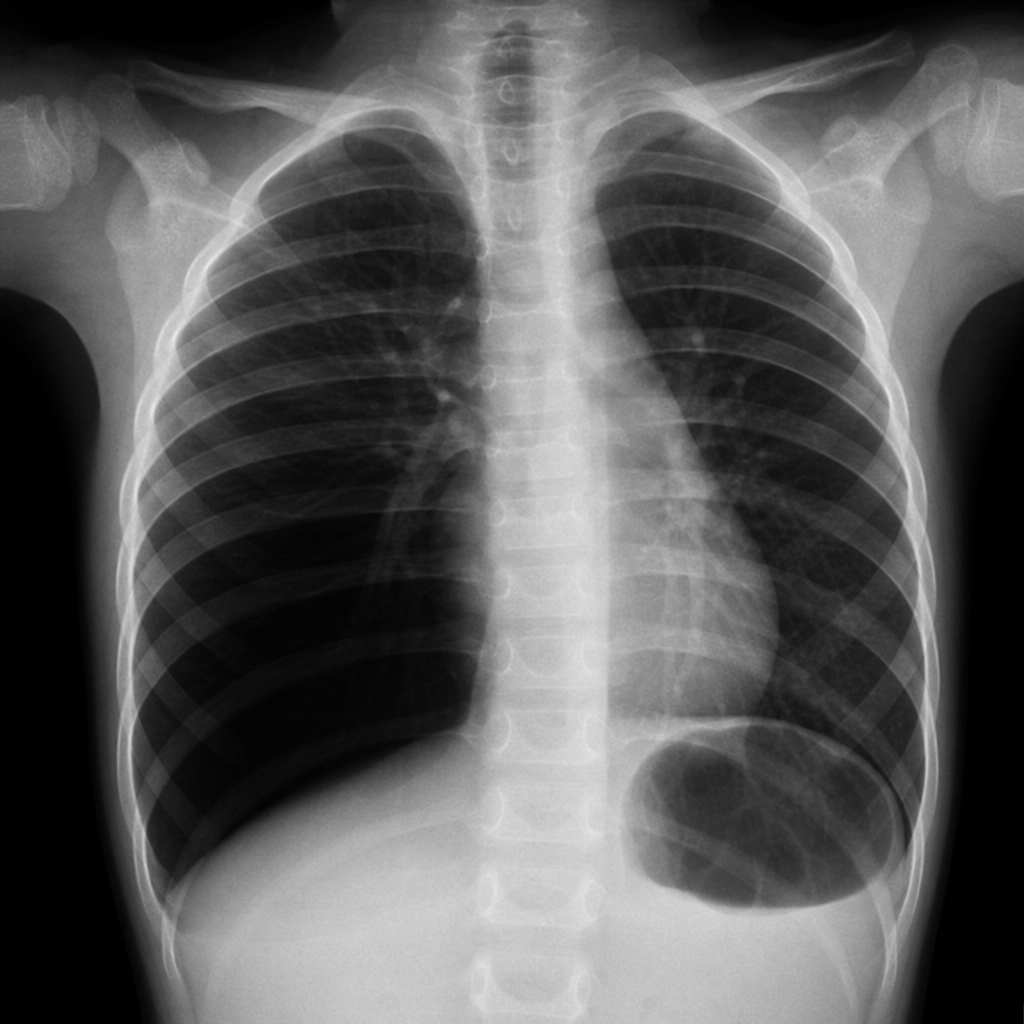
A 7-year-old child presents with a non-productive cough and mild stridor for the past 6 months. While improving on oral antibiotics, the child suddenly develops wheezing, productive cough, and mild fever. X-ray shows hyperlucency and PFTs show an obstructive curve. What is the most probable diagnosis?
A 3-year-old female child developed fever, cough, and respiratory distress. Chest X-ray shows consolidation in the right lower lobe. She improved with antibiotics, but on follow-up at 8 weeks, increasing consolidation was noted in the right lower lobe. What would be your next investigation?
A 7.5-month-old child presents with cough and mild stridor, initially treated with oral antibiotics with some improvement. Later, the child developed wheeze, productive cough, and mild fever. Radiographic findings show hyperlucency, and pulmonary function tests reveal an obstructive pattern. What is the most probable diagnosis?
Which antibody is used in the treatment of RSV infection?
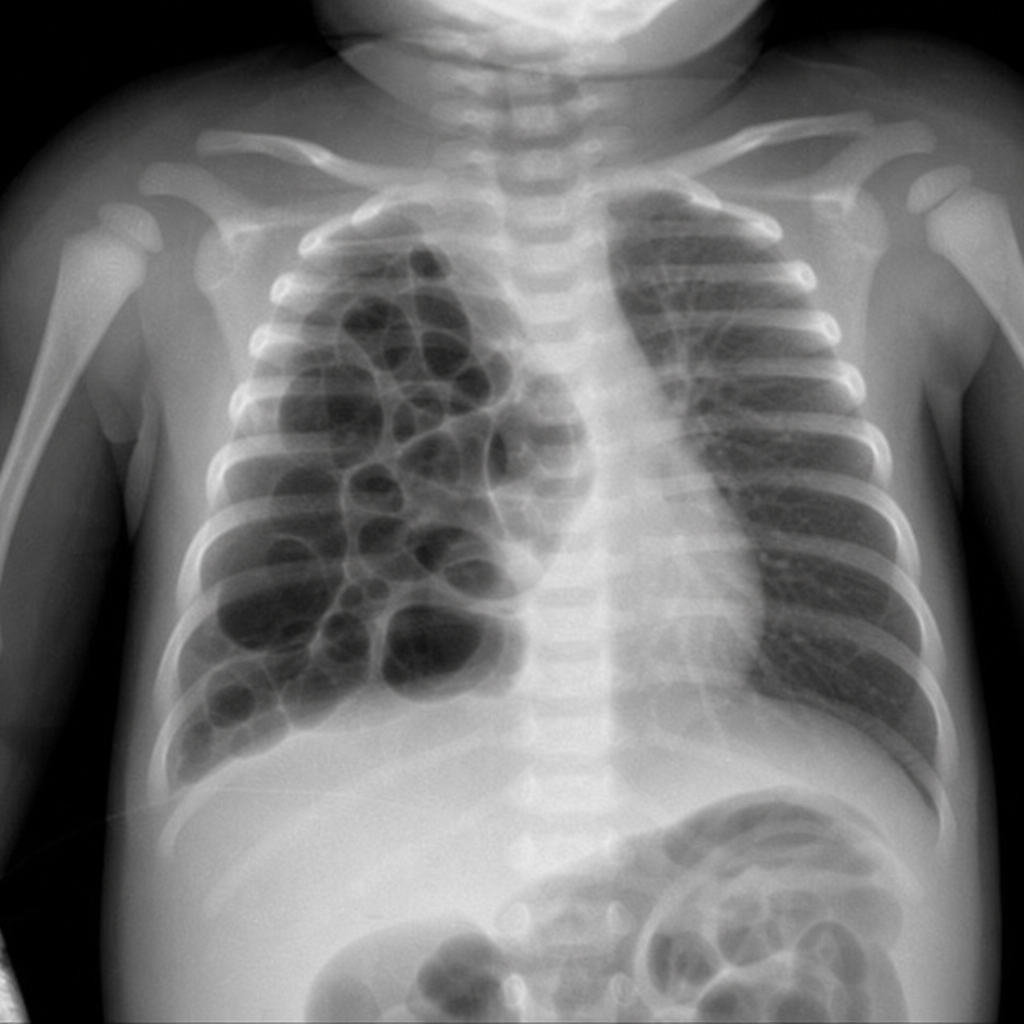
A 4-year-old child presents with a history of chronic left lower lobe pneumonitis. On contrast bronchography, the area involved with the pneumonitis does not fill, whereas the surrounding area does fill. What is the most likely diagnosis?
What is the most common causative agent of bronchiolitis?
A child presents with a running nose and breathlessness, with a positive family history. What is the most likely diagnosis?
Kartagener syndrome includes all of the following except?
A 10-year-old boy receives an injection of pollen extract. Shortly after, he develops nausea, a strange feeling in his chest, facial flushing, and a muffled, strained voice. What is the immediate priority in managing this patient's suspected anaphylaxis?
Which of the following is NOT an inhaled corticosteroid used in the management of bronchial asthma?
Explanation: **Explanation:** **Bronchiolitis Obliterans (BO)** is a chronic obstructive lung disease resulting from an insult to the lower respiratory tract, leading to inflammation and fibrosis of the small airways (bronchioles). 1. **Why it is correct:** The clinical presentation is classic for BO. It typically follows an acute insult (often viral like Adenovirus or Mycoplasma). The key features here are the **chronic nature** (6 months), the **obstructive pattern** on PFTs, and **hyperlucency** on X-ray (representing air trapping due to small airway obstruction). The sudden worsening with productive cough and fever suggests a secondary infection on a background of damaged airways. 2. **Why the other options are incorrect:** * **Post-viral syndrome:** Usually presents as a transient cough or airway hyper-reactivity that resolves within weeks, not a progressive 6-month obstructive disease with radiological changes. * **Follicular Bronchitis:** This is a lymphoproliferative disorder often associated with immunodeficiency or connective tissue diseases. While it causes obstruction, it typically presents with diffuse nodules on CT rather than simple hyperlucency. * **Pulmonary Alveolar Microlithiasis:** A rare genetic disorder characterized by calcium phosphate deposits in alveoli. The X-ray would show a pathognomonic "sandstorm" appearance (diffuse fine opacities), not hyperlucency. **Clinical Pearls for NEET-PG:** * **Gold Standard Diagnosis:** Lung biopsy (shows partial or complete occlusion of the lumen by fibrosis). * **Radiology:** "Mosaic perfusion" on HRCT is the most characteristic finding. * **Common Trigger:** Adenovirus (serotypes 3, 7, 21) is the most common cause of post-infectious BO in children. * **PFT:** Fixed airway obstruction that does not respond significantly to bronchodilators.
Explanation: ### Explanation The clinical presentation describes **persistent or non-resolving pneumonia**. In a pediatric patient, if a focal consolidation fails to resolve radiographically within 4–8 weeks despite clinical improvement or worsening, the primary concern is an underlying structural abnormality or localized obstruction. **Why CT Scan of the Chest is the Correct Answer:** A Contrast-Enhanced CT (CECT) chest is the gold standard for evaluating persistent pneumonia. It provides superior anatomical detail to differentiate between: 1. **Congenital Malformations:** Such as Congenital Pulmonary Airway Malformation (CPAM) or Bronchopulmonary Sequestration (which often presents as recurrent infections in the same lobe). 2. **Complications:** Such as a lung abscess or loculated empyema. 3. **Anatomical Obstruction:** Identifying extrinsic compression (e.g., lymphadenopathy) or intrinsic masses. **Analysis of Incorrect Options:** * **A. Bronchoscopy:** While useful for identifying foreign bodies or performing Bronchoalveolar Lavage (BAL), it is usually the *second* step after a CT scan has localized the lesion or suggested an endobronchial obstruction. * **B. Bacterial culture of the nasopharynx:** Nasopharyngeal cultures have poor correlation with the actual causative organism of lower respiratory tract infections and are not useful in chronic/persistent cases. * **D. Allergen sensitivity test:** This is used for diagnosing asthma or allergic rhinitis, which typically present with wheezing and diffuse patterns, not persistent focal lobar consolidation. **Clinical Pearls for NEET-PG:** * **Definition:** Persistent pneumonia is defined as symptoms and radiologic findings lasting >1 month despite antibiotic therapy. * **Common Causes:** In children, always rule out **Foreign Body Aspiration** (most common cause of localized persistent collapse/infection) and **Cystic Fibrosis** (if bilateral). * **Sequestration:** If the CT shows an anomalous systemic arterial supply (usually from the aorta) to the consolidated lung segment, the diagnosis is Intralobar Sequestration.
Explanation: ### **Explanation** **Correct Option: A. Bronchiolitis Obliterans (BO)** Bronchiolitis Obliterans is a chronic obstructive lung disease following a severe lower respiratory tract insult (most commonly **Adenovirus**, but also Mycoplasma or RSV). * **Clinical Progression:** The classic history involves an initial acute episode (cough, stridor, fever) that seems to improve but is followed by persistent or progressive symptoms like **wheezing, productive cough, and exercise intolerance**. * **Pathophysiology:** Inflammation leads to fibrosis and narrowing of the small airways (bronchioles). * **Radiology:** Characteristically shows **hyperlucency** (due to air trapping/constrictive bronchiolitis) and a "mosaic perfusion" pattern. * **PFT:** Reveals a fixed **obstructive pattern** that does not respond to bronchodilators. --- ### **Why Other Options are Incorrect:** * **B. Post-viral syndrome:** This is a broad term for lingering symptoms after an infection. It does not typically present with fixed obstructive PFTs or significant hyperlucency on X-ray. * **C. Follicular bronchitis:** This is a lymphoid hyperplasia of the bronchus-associated lymphoid tissue (BALT). It is usually associated with immunodeficiency or connective tissue diseases and typically presents with a nodular pattern on CT, not isolated hyperlucency. * **D. Pulmonary alveolar microlithiasis:** A rare genetic disorder characterized by the accumulation of calcium phosphate (microliths) in the alveoli. The classic X-ray finding is a **"sandstorm" appearance** (diffuse fine opacities), not hyperlucency. --- ### **NEET-PG High-Yield Pearls:** * **Gold Standard Diagnosis:** Lung biopsy (shows partial or complete occlusion of the lumen by fibrous tissue). * **Most Common Viral Cause:** Adenovirus (Serotypes 3, 7, and 21). * **Radiological Sign:** Look for the **"Mosaic Pattern"** on HRCT (areas of air trapping interspersed with normal lung). * **Swyer-James-MacLeod Syndrome:** A radiological variant of BO where one lung or lobe appears hyperlucent and small due to childhood bronchiolitis.
Explanation: **Explanation:** **Palivizumab** is a humanized monoclonal antibody directed against the **F (fusion) protein** of the Respiratory Syncytial Virus (RSV). By binding to this protein, the antibody prevents the virus from fusing with the host cell membrane, thereby inhibiting viral entry and replication. It is primarily used as **immunoprophylaxis** in high-risk infants (e.g., preterm infants, those with bronchopulmonary dysplasia or congenital heart disease) to prevent severe lower respiratory tract infections. **Analysis of Incorrect Options:** * **Omalizumab:** An anti-IgE antibody used in the management of severe persistent allergic asthma and chronic idiopathic urticaria. * **Rituximab:** A chimeric monoclonal antibody against **CD20** found on B-cells, used in lymphomas, leukemias, and autoimmune conditions like Rheumatoid Arthritis. * **Daclizumab:** An IL-2 receptor (CD25) antagonist previously used in multiple sclerosis and organ transplant rejection (now largely withdrawn). **High-Yield Clinical Pearls for NEET-PG:** * **Route & Frequency:** Palivizumab is administered via **intramuscular injection** once a month during the RSV season (typically 5 doses). * **Indication:** It is for *prevention*, not for the treatment of active RSV infection. * **Ribavirin:** While Palivizumab is for prophylaxis, **nebulized Ribavirin** is the antiviral agent used for the *treatment* of severe RSV in immunocompromised patients. * **Diagnosis:** The gold standard for RSV diagnosis is PCR, though Rapid Antigen Detection Tests (RADT) are commonly used in clinical settings.
Explanation: ### Explanation **Correct Answer: B. Pulmonary Sequestration** **Medical Concept:** Pulmonary sequestration is a congenital anomaly characterized by a non-functioning mass of lung tissue that lacks normal communication with the tracheobronchial tree and receives its arterial blood supply from the **systemic circulation** (usually the thoracic or abdominal aorta) rather than the pulmonary arteries. In this clinical scenario, the **contrast bronchography** finding is diagnostic: because the sequestered segment does not communicate with the normal bronchial tree, the contrast material cannot enter the lesion, leading to a "non-filling" defect. Chronic or recurrent pneumonia in the same anatomical location (classically the **left lower lobe**) is the hallmark presentation of intralobar sequestration. **Why Other Options are Incorrect:** * **A. Asthma:** This is a reversible obstructive airway disease. While it causes wheezing and cough, it does not present as a localized anatomical non-filling defect on bronchography or chronic focal pneumonitis. * **C. Cystic Fibrosis:** This typically presents with diffuse, bilateral bronchiectasis and multisystem involvement (pancreatic insufficiency). It would not cause a localized failure of contrast filling in a single lobe. * **D. Bronchopulmonary Dysplasia (BPD):** This is a chronic lung disease seen in premature infants who required mechanical ventilation/oxygen. It presents with diffuse interstitial changes, not a localized sequestered mass. **NEET-PG High-Yield Pearls:** * **Most Common Site:** Left lower lobe (posterior basal segment). * **Types:** * *Intralobar (75%):* Located within the normal visceral pleura; presents later in childhood with recurrent infections. * *Extralobar (25%):* Has its own pleural investment; often associated with other congenital anomalies (e.g., diaphragmatic hernia). * **Gold Standard Investigation:** CT Angiography (to visualize the systemic arterial supply). * **Treatment:** Surgical resection (Lobectomy).
Explanation: **Explanation:** **1. Why RSV is the Correct Answer:** Bronchiolitis is an acute inflammatory disease of the lower respiratory tract, primarily affecting infants under 2 years of age. **Respiratory Syncytial Virus (RSV)** is the most common causative agent, responsible for approximately **50–80%** of all cases. It typically occurs in seasonal outbreaks (winter and early spring). The virus causes inflammation, edema, and necrosis of the epithelial cells lining the small airways (bronchioles), leading to air trapping and hyperinflation. **2. Analysis of Incorrect Options:** * **Adenovirus:** While it can cause bronchiolitis, it is less common than RSV. However, Adenovirus is notorious for causing a severe form called **Bronchiolitis Obliterans**, which leads to chronic airway obstruction. * **Herpesvirus:** This family of viruses (like HSV or CMV) does not typically cause bronchiolitis in immunocompetent infants; it is more associated with systemic infections or pneumonia in neonates and the immunocompromised. * **Influenza virus:** While a common cause of respiratory distress and viral pneumonia, it is a less frequent cause of the specific clinical syndrome of bronchiolitis compared to RSV and Parainfluenza. **3. NEET-PG Clinical Pearls:** * **Most common age group:** 2–6 months. * **Clinical Hallmark:** Wheezing, tachypnea, and chest retractions following a viral prodrome (coryza). * **X-ray findings:** Hyperinflation of lungs and flattened diaphragm. * **Treatment:** Primarily supportive (oxygenation and hydration). Routine use of bronchodilators, steroids, or antibiotics is **not** recommended. * **Prophylaxis:** **Palivizumab** (a monoclonal antibody) is used for high-risk infants (e.g., preterm or congenital heart disease).
Explanation: **Explanation:** The clinical presentation of breathlessness associated with upper respiratory symptoms (running nose) and a **positive family history** strongly points towards **Bronchial Asthma**. **1. Why Bronchial Asthma is correct:** Asthma is a chronic inflammatory airway disease characterized by reversible airway obstruction. In pediatric cases, it is frequently triggered by viral upper respiratory infections (the "running nose"). The most significant diagnostic clue here is the **positive family history** of atopy or asthma, which reflects the genetic predisposition (Type I Hypersensitivity) central to the diagnosis. Recurrent episodes of wheezing and breathlessness triggered by common colds are hallmark features. **2. Why other options are incorrect:** * **Bronchiolitis:** While it presents with a runny nose and breathlessness (wheezing), it typically occurs in infants (<2 years old), most commonly due to RSV. It is an acute, first-time episode and is not typically associated with a strong family history of asthma. * **Viral Pneumonia:** This usually presents with high-grade fever, prominent cough, and toxic appearance. While it causes breathlessness, the absence of a "wheeze" and the lack of correlation with family history make it less likely than asthma in this scenario. **Clinical Pearls for NEET-PG:** * **Diagnosis:** In children >5 years, Spirometry showing reversibility (>12% improvement in FEV1) is the gold standard. * **Risk Factors:** The **Asthma Predictive Index (API)** is used to predict if a wheezing child will develop persistent asthma. A major criterion is a parental history of asthma. * **Management:** Inhaled Corticosteroids (ICS) are the most effective long-term preventive medications. * **Rule of Thumb:** "All that wheezes is not asthma, but recurrent wheeze with atopy usually is."
Explanation: **Explanation:** Kartagener syndrome is a subset of **Primary Ciliary Dyskinesia (PCD)**, an autosomal recessive disorder characterized by structural or functional defects in the cilia. The syndrome is classically defined by a **clinical triad**: 1. **Situs Inversus (including Dextrocardia):** Due to the failure of ciliary movement during embryonic development, which is necessary for normal organ lateralization. 2. **Bronchiectasis:** Chronic impairment of mucociliary clearance leads to recurrent pulmonary infections and permanent airway dilation. 3. **Chronic Sinusitis:** Defective cilia in the paranasal sinuses result in chronic inflammation and infection. **Why Dysphagia is the Correct Answer:** Dysphagia (difficulty swallowing) is not a feature of Kartagener syndrome. It is typically associated with esophageal motility disorders, neurological conditions, or structural obstructions, none of which are primary features of ciliary dysfunction. **Analysis of Incorrect Options:** * **Bronchiectasis:** A hallmark feature caused by stagnant mucus and recurrent lower respiratory tract infections. * **Sinusitis:** Part of the classic triad; patients often present with chronic nasal discharge and polyps from early childhood. * **Dextrocardia:** Present in approximately 50% of patients with PCD (completing the Kartagener triad). **High-Yield Clinical Pearls for NEET-PG:** * **Pathophysiology:** Most commonly due to a deficiency of **dynein arms** (inner or outer) in the microtubule doublets of the cilia (9+2 arrangement). * **Infertility:** A common association; males are infertile due to immotile spermatozoa (tail is a modified cilium), and females may have reduced fertility due to defective cilia in the fallopian tubes. * **Screening:** The **Saccharin test** (delayed transit time) or measuring **low exhaled Nasal Nitric Oxide (nNO)** levels. * **Gold Standard Diagnosis:** Electron microscopy of ciliary biopsy or genetic testing.
Explanation: ### Explanation **Correct Option: A. Prepare for endotracheal intubation** The patient is presenting with **anaphylaxis** following allergen exposure (pollen extract). The critical clinical finding here is the **"muffled, strained voice,"** which indicates impending **upper airway obstruction** due to laryngeal edema. In the management of anaphylaxis, the "ABC" (Airway, Breathing, Circulation) protocol is paramount. While epinephrine is the drug of choice for systemic symptoms, the immediate priority when there are signs of airway compromise (stridor, hoarseness, or muffled voice) is to **secure the airway**. Early intubation is vital because progressive edema can rapidly make the procedure difficult or impossible, necessitating a surgical airway. **Why other options are incorrect:** * **B. Administer intramuscular diphenhydramine:** Antihistamines are second-line treatments. They help with cutaneous symptoms (urticaria, itching) but do not treat life-threatening airway obstruction or hypotension. * **C. Administer oxygen:** While oxygen is supportive, it does not bypass the mechanical obstruction caused by laryngeal edema. * **D. Administer subcutaneous epinephrine 1:1000:** Epinephrine is the first-line pharmacological treatment, but the **Intramuscular (IM)** route in the anterolateral thigh is preferred over the subcutaneous route due to faster and more reliable absorption. More importantly, in the presence of acute airway distress, securing the airway (Option A) takes clinical precedence. **Clinical Pearls for NEET-PG:** * **Drug of Choice for Anaphylaxis:** Epinephrine (Adrenaline) 1:1000. * **Route & Dose:** IM (0.01 mg/kg, max 0.5 mg in adults, 0.3 mg in children). * **Biphasic Reaction:** Symptoms can recur 1–72 hours after initial resolution; patients should be monitored for at least 4–6 hours. * **Refractory Cases:** If the patient is on **Beta-blockers**, anaphylaxis may be resistant to epinephrine; the antidote is **Glucagon**.
Explanation: ### Explanation **Correct Answer: D. Dexamethasone** **Why Dexamethasone is the correct answer:** Dexamethasone is a potent, long-acting corticosteroid primarily administered **systemically** (oral or parenteral). In the management of pediatric respiratory conditions, it is the drug of choice for **Croup (Laryngotracheobronchitis)** due to its long half-life. However, it is not used as an **inhaled** corticosteroid (ICS) for asthma because it lacks the necessary pharmacokinetic properties—such as high topical potency and low systemic absorption—required for effective and safe delivery via a Metered-Dose Inhaler (MDI) or nebulizer in chronic asthma management. **Why the other options are incorrect:** * **A. Beclomethasone:** One of the most commonly used first-generation ICS. It is a prodrug activated in the lungs, used for long-term control of persistent asthma. * **B. Budesonide:** A high-potency ICS with a high first-pass metabolism, making it very safe for pediatric use. It is the only ICS available as a solution for nebulization in children. * **C. Fluticasone:** A second-generation ICS known for its high receptor affinity and minimal systemic bioavailability, making it highly effective for preventing asthma exacerbations. **High-Yield Clinical Pearls for NEET-PG:** * **Drug of Choice (DOC):** ICS are the most effective long-term preventive (controller) medications for bronchial asthma. * **Side Effects:** The most common local side effects of ICS are **oropharyngeal candidiasis** (thrush) and dysphonia. These can be minimized by using a spacer and rinsing the mouth after inhalation. * **Ciclesonide:** Another high-yield ICS; it is a "soft drug" activated only by bronchial esterases, further reducing systemic side effects. * **Systemic Steroids in Asthma:** Oral prednisolone or IV hydrocortisone are reserved for **acute severe asthma** (Status Asthmaticus), not for routine daily inhalation.
Upper Respiratory Tract Infections
Practice Questions
Lower Respiratory Tract Infections
Practice Questions
Asthma Management
Practice Questions
Cystic Fibrosis
Practice Questions
Bronchiolitis
Practice Questions
Foreign Body Aspiration
Practice Questions
Sleep-Disordered Breathing
Practice Questions
Congenital Lung Malformations
Practice Questions
Pleural Diseases
Practice Questions
Tuberculosis in Children
Practice Questions
Chronic Lung Disease in Premature Infants
Practice Questions
Pulmonary Function Testing
Practice Questions
Get full access to all questions, explanations, and performance tracking.
Start For Free