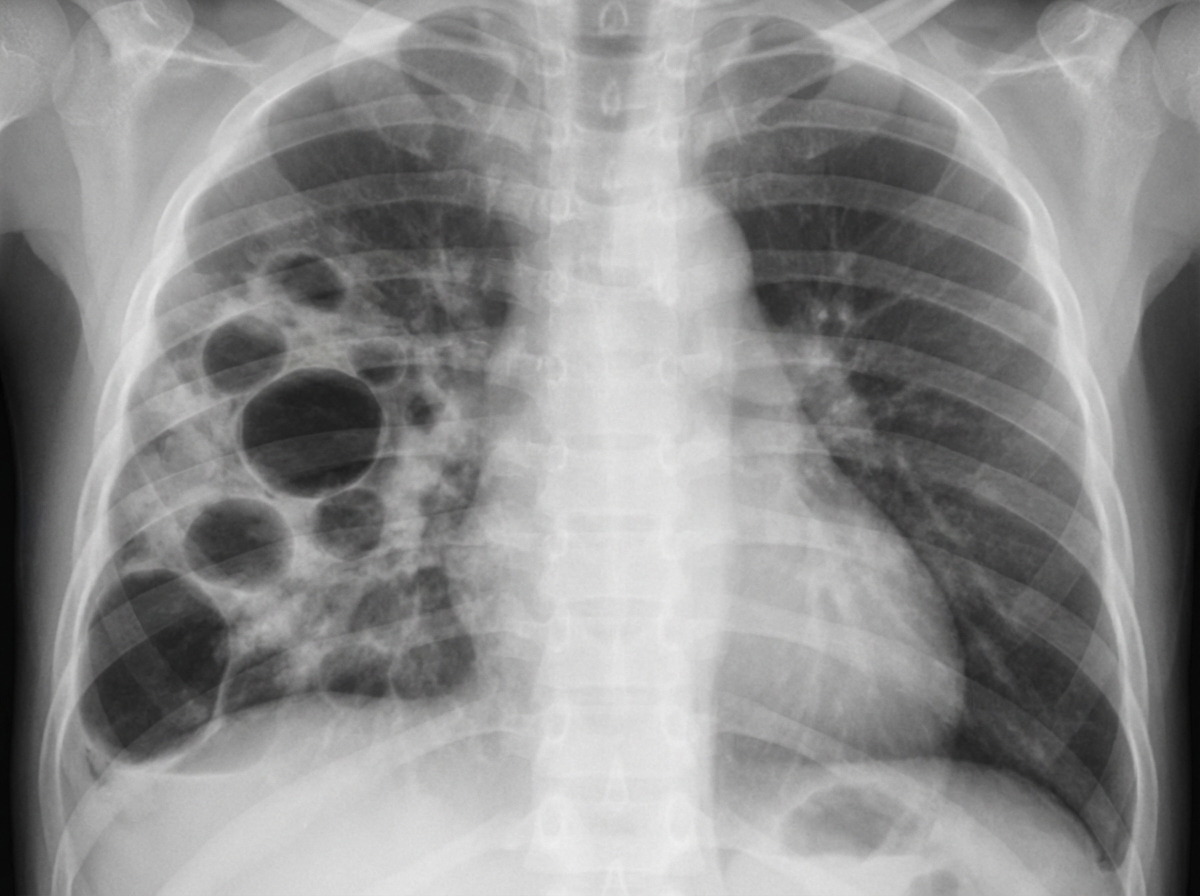
A child presents with fever, stridor, and barking cough. An X-ray is provided below. Which of the following is true about the patient?

Which of the following is FALSE regarding cystic fibrosis?
Which of the following are features of cystic fibrosis?
Which one of the following values is not a feature of acute severe asthma?
Which of the following findings are true about bronchiolitis in children?
In a child with a suspected foreign body in the lung, what is the next best step in management?
A young boy developed respiratory distress. On examination, the chest X-ray showed hyperinflation of one lung. Which of the following is the most possible diagnosis?
A 3-week-old male infant, born to a primiparous mother, presents with noisy breathing. The child is afebrile, sleeping and feeding well, and has a normal clinical examination. What is the recommended management protocol?
Which of the following childhood disorders is associated with an omega-shaped epiglottis?
What is the most common contributory factor to respiratory failure in patients with cystic fibrosis?
Explanation: ***Symptoms are predominantly caused by involvement of the subglottis.*** - The **barking cough** and **stridor** are characteristic of **croup**, which primarily affects the **subglottic area** causing narrowing below the vocal cords. - The **steeple sign** on X-ray (narrowing of the subglottic airway) confirms subglottic involvement typical of croup. *Antibiotics should be started immediately.* - Croup is typically caused by **viral infections** (most commonly **parainfluenza virus**), making antibiotics ineffective. - Treatment focuses on **supportive care**, **corticosteroids**, and **cool mist therapy** rather than antibiotics. *The X-ray is showing the thumb sign.* - The **thumb sign** is characteristic of **epiglottitis**, showing an enlarged epiglottis on lateral neck X-ray. - Croup shows the **steeple sign** (subglottic narrowing), not the thumb sign. *The condition is caused by H. influenzae b.* - **H. influenzae type b** is the classic cause of **epiglottitis**, not croup. - Croup is predominantly caused by **viral pathogens**, especially **parainfluenza viruses** types 1 and 3.
Explanation: In the context of this question, the statement **"It is associated with chromosome 7"** is marked as the "correct" answer because the question asks for the **FALSE** statement. However, there is a technical nuance here: Cystic Fibrosis (CF) **is** actually associated with chromosome 7. In standard medical examinations, if this option is intended to be the false one, it usually implies a specific error in the chromosome number (e.g., if the option had said chromosome 11) or a typo in the question's construction. ### **Detailed Explanation** 1. **Why Option C is the "False" Statement (Contextual Analysis):** Cystic Fibrosis is caused by a mutation in the **CFTR gene** located on the long arm of **Chromosome 7 (7q31.2)**. Since the question asks for the false statement and labels C as correct, it suggests a potential error in the question stem or a distractor. In NEET-PG, always verify the chromosome number: **Chromosome 7** is the definitive location. 2. **Analysis of Other Options:** * **Option A (CFTR gene):** True. The *Cystic Fibrosis Transmembrane Conductance Regulator* gene codes for a chloride channel. The most common mutation is **ΔF508**. * **Option B (Autosomal Recessive):** True. CF is the most common life-limiting autosomal recessive condition in Caucasians. * **Option D (Recurrent Infections):** True. Defective chloride transport leads to thick, viscid secretions. This causes bronchiectasis and recurrent infections, typically with *Staphylococcus aureus* (early childhood) and *Pseudomonas aeruginosa* (later life). ### **High-Yield Clinical Pearls for NEET-PG** * **Diagnosis:** Sweat Chloride Test is the gold standard (**>60 mEq/L** on two occasions). * **Gastrointestinal:** Meconium ileus (earliest manifestation), pancreatic insufficiency (leading to steatorrhea and Vitamin A, D, E, K deficiency). * **Infertility:** 95% of males are infertile due to **Congenital Bilateral Absence of Vas Deferens (CBAVD)**. * **Screening:** Immunoreactive Trypsinogen (IRT) is used in newborn screening.
Explanation: **Explanation:** **Cystic Fibrosis (CF)** is a multisystem genetic disorder caused by a mutation in the **CFTR gene**. 1. **Why Option A is Correct:** In patients with CF, the **lungs are histologically and functionally normal at birth**. The respiratory pathology is not congenital but acquired. It begins shortly after birth due to defective chloride transport, leading to dehydrated, viscid endobronchial secretions. This results in a cycle of airway obstruction, chronic inflammation, and recurrent infections (typically by *S. aureus* and *P. aeruginosa*), eventually leading to bronchiectasis. 2. **Why Other Options are Incorrect:** * **Option B (Abnormal sweat chloride):** While this is a hallmark feature of CF (Chloride >60 mEq/L), the question asks for "features," and in the context of standard NEET-PG patterns, Option A is the specific developmental fact often tested. (Note: If this were a multiple-choice question where B is also true, A remains the classic "pathological" starting point). * **Option C & D:** CF follows an **Autosomal Recessive** inheritance pattern (not dominant). The defect is located on the long arm of **Chromosome 7** (not Chromosome 11). The most common mutation is **ΔF508**. **High-Yield Clinical Pearls for NEET-PG:** * **Earliest Manifestation:** Meconium ileus (seen in 15-20% of newborns). * **Gold Standard Diagnosis:** Sweat Chloride test (Pilocarpine Iontophoresis). * **Infertility:** 95% of males are infertile due to **Congenital Bilateral Absence of Vas Deferens (CBAVD)**; females have decreased fertility due to thick cervical mucus. * **Pancreas:** Exocrine insufficiency leads to malabsorption and steatorrhea. * **Vitamin Deficiencies:** Deficiency of fat-soluble vitamins (A, D, E, K) is common.
Explanation: **Explanation:** The classification of asthma severity is a high-yield topic for NEET-PG. To identify the correct answer, one must distinguish between **Moderate** and **Acute Severe Asthma** (Status Asthmaticus). **1. Why Option B is the correct answer:** In **Acute Severe Asthma**, the Peak Expiratory Flow (PEF) is significantly reduced, typically **less than 50%** of the predicted or best value. A PEF of 60–70% is characteristic of a **Moderate Exacerbation**. Therefore, this value is "not a feature" of the severe category. **2. Analysis of Incorrect Options (Features of Severe Asthma):** * **Heart rate > 110/min (Option A):** Tachycardia is a physiological response to respiratory distress, hypoxia, and increased work of breathing. In children, the threshold varies by age, but >110 bpm is a standard marker for severity in adults and older children. * **Pulsus Paradoxus (Option C):** This refers to an exaggerated fall in systolic BP (>10 mmHg) during inspiration. In severe asthma, massive negative intrathoracic pressure is required to breathe, which impacts cardiac filling and output. Its presence signifies significant airway obstruction. * **PaO2 < 8 kPa (Option D):** 8 kPa is approximately **60 mmHg**. Hypoxemia (PaO2 < 60 mmHg) without cyanosis is a hallmark of severe asthma. If the PaO2 drops further or PaCO2 begins to rise (normalizing or increasing), it indicates impending respiratory failure. **Clinical Pearls for NEET-PG:** * **Silent Chest:** The most ominous sign in asthma; it indicates such little air movement that wheezing disappears. * **Normal PaCO2:** In an acute attack, a patient should be hyperventilating (low PaCO2). A "normal" PaCO2 (40 mmHg) in a struggling asthmatic is a sign of muscle fatigue and **impending respiratory failure**. * **Life-threatening features:** PEF < 33%, SpO2 < 92%, silent chest, cyanosis, exhaustion, or hypotension.
Explanation: **Explanation:** Bronchiolitis is the most common lower respiratory tract infection in infants (typically <2 years). The correct answer reflects the classic triad of its etiology, clinical presentation, and long-term sequelae. 1. **Etiology:** **Respiratory Syncytial Virus (RSV)** is the most common causative agent (responsible for ~70-80% of cases). 2. **Pathophysiology & Radiology:** The disease involves inflammation and edema of the small airways (bronchioles), leading to air trapping. This manifests clinically as a barrel-shaped chest and radiologically as **hyperinflation** with flattened diaphragms. 3. **Long-term Sequelae:** Epidemiological studies have consistently shown a strong association between severe RSV bronchiolitis in infancy and the development of **recurrent wheezing and bronchial asthma** later in childhood. **Analysis of Incorrect Options:** * **Option B:** Incorrect because **pleural effusion** is not a feature of bronchiolitis; it typically suggests bacterial pneumonia or empyema. * **Option D:** While technically true, it is **incomplete**. In NEET-PG, when two options are factually correct, the more comprehensive one (including the prognostic link to asthma) is the preferred answer. **High-Yield Clinical Pearls for NEET-PG:** * **Most common age group:** 2 to 6 months. * **Clinical Triad:** Coryza/fever followed by paroxysmal cough, wheezing, and respiratory distress (retractions). * **Diagnosis:** Primarily clinical; routine X-rays are not required unless complications are suspected. * **Treatment:** Supportive care (hydration and oxygenation) is the mainstay. Routine use of bronchodilators, steroids, or antibiotics is **not** recommended. * **Prophylaxis:** **Palivizumab** (monoclonal antibody against RSV) is used for high-risk infants (e.g., preterm, congenital heart disease).
Explanation: **Explanation:** The definitive management for a suspected tracheobronchial foreign body (FB) in a child is **Rigid Bronchoscopy**. In pediatric practice, this is considered the "gold standard" because it serves both a diagnostic and therapeutic purpose. Unlike flexible scopes, the rigid bronchoscope provides a stable airway, allows for superior visualization, and has a wider lumen to accommodate various grasping forceps for FB removal. **Analysis of Options:** * **Chest X-ray (Option B):** While often the first investigation performed, a normal X-ray does not rule out a foreign body (most are radiolucent). If clinical suspicion is high (e.g., sudden onset choking, unilateral wheeze), the patient must proceed to bronchoscopy regardless of imaging results. * **Flexible Endoscopy (Option C):** While useful for visualizing the distal airways, it is generally avoided for FB removal in children because it cannot protect the airway as effectively as a rigid scope and lacks the mechanical strength to extract sharp or bulky objects. * **Direct Laryngoscopy (Option D):** This is only useful if the foreign body is lodged in the supraglottic area or larynx. It does not allow for the evaluation of the tracheobronchial tree. **NEET-PG High-Yield Pearls:** * **Most common site:** Right main bronchus (due to it being wider, shorter, and more vertical). * **Most common age:** 1–3 years. * **Classic Triad:** Sudden onset coughing/choking, wheezing, and diminished breath sounds. * **X-ray findings:** Obstructive emphysema (most common), atelectasis, or a mediastinal shift away from the affected side. * **Gold Standard:** Rigid bronchoscopy under general anesthesia.
Explanation: ### Explanation The correct answer is **Foreign body aspiration (FBA)**. **Why it is correct:** In pediatric patients, foreign body aspiration often acts as a **"ball-valve" mechanism**. During inspiration, the airways dilate, allowing air to pass the obstruction. However, during expiration, the airways narrow, causing the foreign body to completely occlude the lumen. This results in air-trapping and subsequent **obstructive hyperinflation** of the affected lung. While Congenital Lobar Emphysema (CLE) also causes hyperinflation, FBA is statistically the most common cause of sudden-onset respiratory distress with unilateral hyperinflation in a previously healthy child. **Why the other options are incorrect:** * **Congenital Lobar Emphysema (CLE):** While it presents with hyperinflation, it is typically diagnosed in the **neonatal period or early infancy** (usually <6 months) due to cartilage deficiency. The question implies a "young boy," suggesting an older age group where FBA is more prevalent. * **Atelectasis:** This involves the collapse of lung tissue, which would show **opacity and volume loss** (mediastinal shift toward the lesion) on X-ray, rather than hyperinflation. * **Bronchiectasis:** This is a chronic condition characterized by permanent dilation of bronchi. X-ray findings typically show "tram-track" opacities or cystic changes, not acute unilateral hyperinflation. **Clinical Pearls for NEET-PG:** * **Gold Standard Diagnosis/Management:** Rigid Bronchoscopy (for both diagnosis and removal). * **Classic Triad:** Sudden onset of coughing, wheezing, and diminished breath sounds (though only present in ~50% of cases). * **Radiology:** If the X-ray is inconclusive, perform **expiratory films** or lateral decubitus films; the affected lung will fail to collapse.
Explanation: ### Explanation **Diagnosis: Physiological Snuffles (Neonatal Rhinitis)** The clinical presentation of a 3-week-old infant with noisy breathing but who is otherwise healthy (feeding well, sleeping well, afebrile, and normal examination) is characteristic of **Physiological Snuffles**. This occurs due to the narrow nasal passages in neonates, which can easily be obstructed by normal mucus secretions or milk regurgitation. Since the infant is thriving and has no signs of respiratory distress, no aggressive intervention is required. **Why Option B is Correct:** Management is conservative. **Reassurance** is the mainstay as the condition is self-limiting and improves as the nasal passages grow. **Saline nasal drops** help liquefy any dried secretions, facilitating their clearance and easing the noisy breathing. **Why Other Options are Incorrect:** * **Option A (IV Antibiotics):** There is no evidence of infection (the child is afebrile and feeding well). Unnecessary antibiotics contribute to resistance and disrupt the neonatal microbiome. * **Option C (Racemic Epinephrine):** This is used for upper airway obstruction like Croup (Laryngotracheobronchitis), which typically presents with a barking cough and inspiratory stridor in older infants. * **Option D (Chest X-ray):** A chest X-ray is not indicated in a child with a normal clinical examination and no signs of lower respiratory tract disease (no tachypnea, retractions, or grunting). **NEET-PG High-Yield Pearls:** * **Obligate Nasal Breathers:** Infants are obligate nasal breathers until about 4–6 months of age; hence, even minor nasal congestion sounds loud. * **Laryngomalacia:** The most common cause of *persistent* congenital stridor. It presents with inspiratory stridor that worsens when supine or crying but improves when prone. * **Red Flags:** If noisy breathing is associated with poor feeding, weight loss, or cyanosis, investigate for structural anomalies (e.g., Choanal atresia) or infections.
Explanation: **Explanation:** **Laryngomalacia** is the most common congenital anomaly of the larynx and the leading cause of congenital stridor in infants. It is characterized by an abnormal softening of the supraglottic structures, which collapse inward during inspiration. The classic endoscopic finding is an **"omega-shaped" (Ω) epiglottis**, caused by the lateral folds of the epiglottis curling inward. This is often accompanied by short aryepiglottic folds and redundant arytenoid mucosa. **Analysis of Incorrect Options:** * **Epiglottitis:** This is an acute bacterial infection (typically *H. influenzae* type B) characterized by a "cherry-red," swollen epiglottis. On a lateral neck X-ray, it presents with the **"Thumb sign,"** not an omega shape. * **Subglottic Stenosis:** This involves narrowing of the airway below the vocal cords. It is characterized by the **"Steeple sign"** (subglottic narrowing) on an AP X-ray and is often associated with prolonged intubation. * **Choanal Atresia:** This is a congenital blockage of the posterior nasal passage. It presents with cyclical cyanosis (relieved by crying) and is diagnosed by the inability to pass a catheter through the nose. **Clinical Pearls for NEET-PG:** * **Clinical Presentation:** Inspiratory stridor that worsens when the infant is supine, crying, or feeding, and improves when prone. * **Diagnosis:** Flexible fiberoptic laryngoscopy is the gold standard (shows collapse of supraglottic tissues). * **Management:** Most cases are self-limiting and resolve by 18–24 months. Severe cases (causing failure to thrive or cor pulmonale) require **supraglottoplasty**.
Explanation: **Explanation:** **Cystic Fibrosis (CF)** is an autosomal recessive disorder caused by a mutation in the **CFTR gene**, leading to thick, viscid secretions. The primary cause of morbidity and mortality (respiratory failure) in CF is progressive bronchiectasis and obstructive lung disease driven by chronic endobronchial infections. **Why Pseudomonas is the correct answer:** While *Staphylococcus aureus* is the most common pathogen in early childhood, **Pseudomonas aeruginosa** becomes the dominant pathogen by late childhood and adolescence. Chronic colonization with *Pseudomonas* leads to a rapid decline in FEV1, frequent pulmonary exacerbations, and permanent structural damage (bronchiectasis). Its ability to form **biofilms** makes it nearly impossible to eradicate, eventually leading to respiratory failure and death in the majority of patients. **Analysis of Incorrect Options:** * **A. Haemophilus influenzae:** This is a common early colonizer in CF infants, but it is typically transient and does not contribute to end-stage respiratory failure as significantly as *Pseudomonas*. * **C. Associated heart failure:** While **Cor Pulmonale** (right-sided heart failure) can occur due to chronic pulmonary hypertension in CF, it is a *consequence* of chronic lung destruction, not the primary contributory factor to the respiratory failure itself. * **D. Hypokalemia:** CF patients are prone to electrolyte imbalances (like metabolic alkalosis/hypochloremia) due to sweat losses, but this does not directly cause chronic respiratory failure. **High-Yield Clinical Pearls for NEET-PG:** * **Most common cause of death in CF:** Respiratory failure (95%). * **Most common organism (Infancy):** *Staphylococcus aureus*. * **Most common organism (Adults/Overall mortality):** *Pseudomonas aeruginosa*. * **Indicator of poor prognosis:** Colonization with *Burkholderia cepacia* (Cepacia syndrome). * **Gold Standard Diagnosis:** Sweat Chloride Test (>60 mEq/L).
Upper Respiratory Tract Infections
Practice Questions
Lower Respiratory Tract Infections
Practice Questions
Asthma Management
Practice Questions
Cystic Fibrosis
Practice Questions
Bronchiolitis
Practice Questions
Foreign Body Aspiration
Practice Questions
Sleep-Disordered Breathing
Practice Questions
Congenital Lung Malformations
Practice Questions
Pleural Diseases
Practice Questions
Tuberculosis in Children
Practice Questions
Chronic Lung Disease in Premature Infants
Practice Questions
Pulmonary Function Testing
Practice Questions
Get full access to all questions, explanations, and performance tracking.
Start For Free