What is the most characteristic feature of congenital hypertrophic pyloric stenosis?
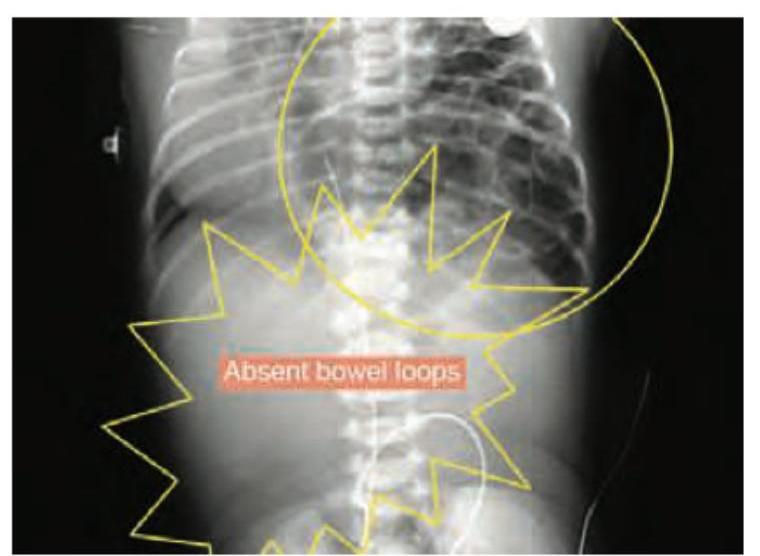
Which one of the following findings is most suggestive of neonatal small bowel obstruction?
A newborn, within a few hours of birth, develops bile-stained vomiting and epigastric distention. On examination, the abdomen is scaphoid with visible peristalsis in the upper abdomen. Per-rectal examination shows no stool in the rectum. X-ray of the abdomen shows air trapped in the stomach and proximal duodenum. What is the treatment of choice in this case?
Which metabolic abnormality is seen in congenital hypertrophic pyloric stenosis?
All of the following are true about cystic hygroma EXCEPT?
In early acute pulpal abscess of children, what is the first radiographic evidence?
A neonate continuously regurgitates all feeds and is continuously drooling saliva. Which of the following is the most probable diagnosis?
Which of the following statements is FALSE regarding rectal prolapse in children?
A child presented with severe respiratory distress two days after birth. On examination, he was observed to have a scaphoid abdomen and decreased breath sounds on the left side. He was managed by prompt endotracheal intubation. After ET tube placement, the maximal cardiac impulse shifted further to the right side. What should be the next step in management?
A child has swallowed a button battery, and radiological imaging shows it is located in the stomach. What is the next step in management?
Explanation: **Explanation:** **Congenital Hypertrophic Pyloric Stenosis (CHPS)** is characterized by hypertrophy and hyperplasia of the muscular layers of the pylorus, leading to gastric outlet obstruction. **Why Option D is Correct:** The "pyloric tumor" is an olive-shaped mass representing the hypertrophied pylorus. It is **best felt during feeding** because, at this time, the abdominal wall muscles are relaxed, and the stomach is distended, pushing the pylorus against the anterior abdominal wall. Additionally, visible gastric peristalsis (left to right) is often seen during feeding, immediately preceding non-bilious projectile vomiting. **Analysis of Incorrect Options:** * **Option A:** While chronic cases can lead to dehydration and weight loss, patients are typically **not marasmic** at presentation. They are usually healthy infants who begin vomiting between 3–6 weeks of life. * **Option B:** Patients have a **voracious appetite** (hungry vomiter). They eagerly want to re-feed immediately after vomiting, unlike in systemic illnesses where anorexia is common. * **Option C:** CHPS shows a strong male predilection (Male:Female ratio of **4:1**) and most commonly affects the **first-born male child**. **High-Yield Clinical Pearls for NEET-PG:** * **Metabolic Abnormality:** Hypochloremic, hypokalemic, metabolic alkalosis with **paradoxical aciduria** (classic exam favorite). * **Diagnosis:** Ultrasound is the gold standard (Pyloric muscle thickness >4mm, length >14mm). * **Radiology Sign:** "String sign" or "Beak sign" on Barium swallow. * **Treatment:** Initial management is resuscitation with 0.45% or 0.9% NS with Potassium; definitive surgery is **Ramstedt’s Pyloromyotomy**.
Explanation: **Explanation:** In neonates, **bilious (green) vomiting** is considered a surgical emergency until proven otherwise. It is the hallmark sign of **neonatal small bowel obstruction (SBO)**. Anatomically, the presence of bile indicates that the obstruction is distal to the **Ampulla of Vater** (where the common bile duct enters the second part of the duodenum). While non-bilious vomiting can occur in proximal obstructions (like pyloric stenosis), green-stained emesis strongly suggests a mechanical blockage in the small intestine, such as malrotation with midgut volvulus, atresia, or meconium ileus. **Analysis of Incorrect Options:** * **Generalized abdominal distension:** While common in distal obstructions (like Hirschsprung’s or ileal atresia), it is often **absent** in proximal (high) small bowel obstructions (e.g., duodenal atresia), where only the epigastrium may be full. * **Failure to pass meconium:** 95% of healthy neonates pass meconium within 24 hours. While its absence is seen in SBO, it is more classically associated with **large bowel** issues like Hirschsprung’s disease or anorectal malformations. * **Refusal of feeds:** This is a highly **non-specific** finding in neonates and can be seen in sepsis, metabolic disorders, or prematurity, making it an unreliable indicator of mechanical obstruction. **High-Yield Clinical Pearls for NEET-PG:** * **Gold Standard Investigation:** An **Erect X-ray abdomen** is the initial investigation of choice to look for air-fluid levels or specific signs like the "Double Bubble" (Duodenal Atresia). * **Rule of Thumb:** Any neonate with bilious vomiting requires an immediate **Upper GI Contrast Study** to rule out Malrotation/Volvulus. * **Target Sign:** On ultrasound, this suggests Intussusception (though more common in infants 6–18 months).
Explanation: ### Explanation The clinical presentation of **bilious vomiting**, epigastric distention with a **scaphoid abdomen**, and an X-ray showing the classic **"Double Bubble" sign** (air in the stomach and proximal duodenum) is pathognomonic for **Duodenal Atresia**. **Why Duodenoduodenostomy is Correct:** Duodenal atresia is a complete congenital obstruction of the duodenum. Once the patient is stabilized (nasogastric decompression and IV fluids), the definitive surgical treatment is a **Duodenoduodenostomy** (specifically the **Kimura "Diamond-shaped" anastomosis**). This procedure bypasses the atretic segment to restore bowel continuity. **Why Other Options are Incorrect:** * **Ramstedt Pyloromyotomy:** This is the treatment for Congenital Hypertrophic Pyloric Stenosis (CHPS). CHPS presents with *non-bilious* projectile vomiting and a palpable olive-shaped mass, typically at 3–6 weeks of age, not at birth. * **Conservative Management:** Duodenal atresia is a mechanical obstruction; it cannot be managed conservatively and is fatal without surgical intervention. * **Barium/Air Enema:** These are diagnostic and therapeutic modalities for **Intussusception** or **Sigmoid Volvulus**. While a contrast enema may be used to rule out associated malrotation, it does not treat duodenal atresia. **High-Yield Clinical Pearls for NEET-PG:** * **Association:** Approximately 30% of infants with duodenal atresia have **Down Syndrome (Trisomy 21)**. * **Prenatal Finding:** Often associated with **maternal polyhydramnios** due to the fetus's inability to swallow and absorb amniotic fluid. * **X-ray Sign:** The "Double Bubble" sign is the hallmark. If distal gas is present on X-ray, consider **Duodenal Stenosis** or **Malrotation with Midgut Volvulus** instead of complete atresia. * **Vomiting:** Bilious vomiting in a neonate is a surgical emergency until proven otherwise.
Explanation: ### Explanation In Congenital Hypertrophic Pyloric Stenosis (CHPS), the hallmark metabolic derangement is **Hypochloremic, Hypokalemic, Metabolic Alkalosis with Paradoxical Aciduria.** **Why Metabolic Alkalosis is Correct:** The primary event is persistent, non-bilious projectile vomiting. Gastric juice is rich in **Hydrogen (H+)** and **Chloride (Cl-)** ions. Loss of H+ directly leads to metabolic alkalosis. As the body attempts to compensate, the kidneys initially excrete bicarbonate (HCO3-) along with Sodium (Na+). However, as dehydration sets in, the body prioritizes volume expansion via the Renin-Angiotensin-Aldosterone System (RAAS). Aldosterone acts on the distal tubule to reabsorb Na+ in exchange for H+ and K+. This "late phase" results in the excretion of acidic urine despite systemic alkalosis (**Paradoxical Aciduria**) and worsening hypokalemia. **Why Other Options are Incorrect:** * **Metabolic Acidosis:** This occurs in conditions with loss of base (e.g., diarrhea) or accumulation of acids (e.g., sepsis, shock). In CHPS, the loss is purely acidic gastric content. * **Respiratory Acidosis/Alkalosis:** These are primary disorders of ventilation (CO2 retention or washout). While a compensatory respiratory drive may slightly increase CO2 to offset alkalosis, the primary pathology is metabolic. **High-Yield Clinical Pearls for NEET-PG:** * **Classic Presentation:** 3–6 week old male infant with non-bilious projectile vomiting and a palpable "olive-shaped" mass in the epigastrium. * **Ultrasound Criteria:** Pyloric muscle thickness **>3 mm** and pyloric channel length **>14 mm**. * **Management Priority:** CHPS is a **medical emergency, not a surgical one.** Always correct dehydration and electrolyte imbalances (Normal Saline + KCl) before proceeding to **Ramstedt’s Myotomy**. * **Barium Swallow Sign:** "String sign" or "Beak sign."
Explanation: **Explanation:** Cystic hygroma (Cystic Lymphangioma) is a benign congenital malformation of the lymphatic system. **1. Why Option A is the Correct Answer (The Exception):** While aspiration of a cystic hygroma typically yields **clear, straw-colored fluid** (serous fluid), it is **not diagnostic**. Aspiration is primarily used for temporary decompression or to rule out other pathologies, but it carries a high risk of infection and hemorrhage. The diagnosis is primarily **clinical** (soft, painless, brilliantly transilluminant mass) and confirmed by **Ultrasonography (USG)**, which shows a multiloculated cystic mass with internal septations. **2. Analysis of Other Options:** * **Option B:** Approximately **50-60%** of cases are present at birth, and nearly 90% manifest by the age of 2 years. * **Option C:** The most common site (75-80%) is the **posterior triangle of the neck** (cervical region). It can also occur in the axilla, mediastinum, and groin. * **Option D:** The embryological basis is the **sequestration of lymphatic tissue** from the primitive jugular lymph sacs, which fail to communicate with the main lymphatic system. **NEET-PG High-Yield Pearls:** * **Clinical Sign:** It is **brilliantly transilluminant** because it contains clear fluid and has thin walls. * **Association:** Frequently associated with chromosomal anomalies like **Turner Syndrome** (45, XO), Down Syndrome, and Noonan Syndrome. * **Complications:** Sudden increase in size usually indicates **intracystic hemorrhage** or infection. * **Treatment of Choice:** Surgical excision is the gold standard. For unresectable cases, **Sclerotherapy** (using OK-432 or Bleomycin) is an effective alternative.
Explanation: **Explanation:** The correct answer is **A. No change**. In the early stages of an **acute pulpal abscess**, the inflammatory process is confined primarily to the soft tissue of the dental pulp. Radiographic changes in bone (such as radiolucency or destruction) require a significant amount of mineral loss—typically **30% to 50% of the bone mineral content** must be resorbed before it becomes visible on a conventional radiograph. Because the onset of an acute abscess is rapid, there has not been sufficient time for the inflammatory exudate to cause detectable cortical or trabecular bone destruction. **Analysis of Incorrect Options:** * **B. Destruction of lamina dura:** This is an early sign of periapical pathology, but it occurs *after* the initial acute phase once the infection spreads to the periapical tissues. * **C. Widening of the periodontal ligament (PDL):** This is often the *first detectable* radiographic sign of periapical involvement, but it follows the initial "no change" stage of a strictly pulpal abscess. * **D. Rarefaction of alveolar bone:** This indicates a more chronic process or a well-established infection (periapical granuloma or cyst) where significant bone resorption has occurred. **NEET-PG High-Yield Pearls:** * **Clinical vs. Radiographic:** In pediatric patients, clinical symptoms (pain, swelling, sensitivity to percussion) almost always precede radiographic evidence in acute infections. * **Primary vs. Permanent:** In primary teeth, the first signs of bone destruction usually appear in the **inter-radicular (furcation) area** rather than the periapical area, due to the presence of accessory canals in the pulpal floor. * **Rule of Thumb:** If a patient presents with acute, severe dental pain but the radiograph is normal, the diagnosis is likely **Acute Pulpitis** or an **Early Acute Abscess**.
Explanation: ### Explanation **Correct Option: C. Tracheo-esophageal fistula (TEF)** The clinical presentation of a neonate with **continuous drooling of saliva** and **immediate regurgitation** of feeds is the classic "textbook" triad for **Esophageal Atresia (EA) with or without Tracheo-esophageal Fistula (TEF)**. * **Pathophysiology:** In EA, the esophagus ends in a blind pouch. Since the neonate cannot swallow saliva, it accumulates in the proximal pouch and overflows, leading to excessive drooling (frothing at the mouth). Any attempt at feeding results in immediate regurgitation and potential aspiration (coughing, choking, cyanosis). * **Diagnosis:** The most immediate bedside test is the inability to pass a stiff, radio-opaque nasogastric (NG) tube into the stomach (it coils in the upper pouch on X-ray). **Why Incorrect Options are Wrong:** * **A. Normal phenomenon:** While mild "spitting up" (GERD) is common in neonates, continuous drooling and total inability to tolerate any feed are always pathological. * **B. Congenital Hypertrophic Pyloric Stenosis (CHPS):** This typically presents at **3–6 weeks of age** (not at birth) with non-bilious, projectile vomiting. Drooling is not a feature. * **D. Hirschsprung Disease:** This is a lower intestinal obstruction presenting with delayed passage of meconium (>48 hours), abdominal distension, and bilious vomiting, rather than proximal esophageal symptoms. **High-Yield Clinical Pearls for NEET-PG:** * **Most Common Type:** Type C (Esophageal Atresia with Distal TEF) – occurs in ~85% of cases. * **Antenatal Clue:** Maternal **polyhydramnios** (fetus cannot swallow amniotic fluid). * **Associated Anomalies:** Always screen for **VACTERL** association (Vertebral, Anal, Cardiac, TEF, Renal, Limb anomalies). The most common associated anomaly is **Cardiac** (VSD). * **Gas Pattern:** Presence of air in the stomach on X-ray indicates a distal fistula; a "gasless abdomen" indicates isolated Esophageal Atresia.
Explanation: ### Explanation **1. Why Option C is the Correct Answer (The False Statement):** In pediatric practice, surgical intervention is rarely the first line of management. When surgery is indicated (for refractory cases), the procedure of choice is usually **Thiersch’s stitch** (anal encirclement) or **injection sclerotherapy** (using 5% phenol in almond oil). **Mesh rectopexy** is a major abdominal surgery commonly performed in adults; it is avoided in children due to the risk of pelvic fibrosis, interference with growth, and the high rate of spontaneous resolution of the condition. **2. Analysis of Other Options:** * **Option A (True):** Rectal prolapse in children is often triggered by increased intra-abdominal pressure. Common predisposing factors include **chronic diarrhea**, **constipation**, and **worm infestations** (like *Trichuris trichiura*), which cause tenesmus and straining. * **Option B (True):** The vast majority of pediatric cases are self-limiting. Management focuses on treating the underlying cause (e.g., deworming, stool softeners) and manual reduction. Most children outgrow the condition by age 4 as the sacral curve develops. * **Option D (True):** In children, the prolapse is typically **mucosal (partial)** rather than full-thickness (procidentia). This is due to the lack of a sacral curve and the vertical orientation of the rectum in early childhood. **3. Clinical Pearls for NEET-PG:** * **Most common age:** 1–3 years. * **Cystic Fibrosis:** Any child with recurrent rectal prolapse and no obvious cause should be screened for Cystic Fibrosis via a **Sweat Chloride Test**. * **Whipworm Association:** *Trichuris trichiura* is the classic parasitic cause of rectal prolapse in tropical regions. * **Anatomy:** The straight, vertical position of the rectum and the lack of support from the levator ani muscles in toddlers are the primary anatomical predispositions.
Explanation: ### Explanation The clinical presentation of severe respiratory distress, a **scaphoid abdomen**, and decreased breath sounds on the left side is a classic triad for **Congenital Diaphragmatic Hernia (CDH)**, most commonly the Bochdalek type (left-sided). **Why Option C is Correct:** In CDH, abdominal viscera herniate into the thoracic cavity, compressing the lungs. When the child is intubated or cries, air enters the gastrointestinal tract. This causes the herniated bowel loops to distend, further compressing the ipsilateral lung and shifting the mediastinum (maximal cardiac impulse) to the opposite side, worsening respiratory failure. **Nasogastric (NG) tube insertion** is a critical emergency step to decompress the stomach and bowel, reducing thoracic volume occupancy and improving lung expansion. **Analysis of Incorrect Options:** * **Option A & D:** While a Chest X-ray is the gold standard for diagnosis (showing air-filled bowel loops in the thorax), the clinical deterioration after intubation (further mediastinal shift) indicates an acute tension effect. Immediate decompression via NG tube takes priority over imaging to stabilize the patient. * **Option B:** CDH is no longer considered a surgical emergency. Modern management focuses on **medical stabilization** (ventilation, managing pulmonary hypertension) before surgery. Operating on an unstable neonate with high pulmonary vascular resistance increases mortality. **Clinical Pearls for NEET-PG:** * **Most common site:** Posterolateral (Bochdalek hernia), usually on the **left side** (85%). * **Management Priority:** Secure airway (Intubation) → Decompress GI tract (NG tube) → Stabilize pulmonary hypertension → Delayed surgery (24–48 hours later). * **Contraindication:** **Bag-and-mask ventilation** is strictly contraindicated as it forces air into the stomach, worsening lung compression. * **Prognostic Factor:** The degree of **pulmonary hypoplasia** and persistent pulmonary hypertension (PPHN) determines survival.
Explanation: **Explanation:** The management of button battery ingestion is a critical pediatric emergency due to the risk of liquefactive necrosis and electrochemical burns. **Why Option A is Correct:** While many foreign bodies in the stomach can be observed, a **button battery in the stomach** is an exception if the child is symptomatic or if the battery is large (>20mm). However, current guidelines (NASPGHAN) increasingly favor **urgent endoscopic retrieval** even in asymptomatic cases if the battery remains in the stomach, to prevent gastric mucosal injury and potential perforation. If the battery is in the **esophagus**, it is a surgical emergency requiring immediate removal within 2 hours. **Why Other Options are Incorrect:** * **Option B:** Open laparotomy is overly invasive and reserved only for complications like perforation or obstruction that cannot be managed endoscopically. * **Option C:** Emetics (like Ipecac) are strictly contraindicated in foreign body ingestion as they increase the risk of aspiration and esophageal injury. * **Option D:** Observation is generally reserved for small, blunt objects. For button batteries, "watchful waiting" is risky because the moist environment of the stomach can complete the circuit, leading to rapid tissue damage. **High-Yield Clinical Pearls for NEET-PG:** * **The "Double Contour" Sign:** On X-ray (AP view), a button battery shows a circular shadow with an inner rim, distinguishing it from a coin. * **Mechanism of Injury:** Not leakage of chemicals, but the generation of an **electrical current** that creates hydroxide ions, leading to **alkaline (liquefactive) necrosis**. * **Emergency Pre-hospital Care:** If ingestion occurred within 12 hours and the child is >1 year old, giving **Honey** (10ml every 10 mins) can coat the battery and delay injury until reaching the hospital.
Surgical Conditions of the Newborn
Practice Questions
Congenital Diaphragmatic Hernia
Practice Questions
Esophageal Atresia and Tracheoesophageal Fistula
Practice Questions
Intestinal Atresia and Stenosis
Practice Questions
Malrotation and Volvulus
Practice Questions
Hirschsprung's Disease
Practice Questions
Anorectal Malformations
Practice Questions
Biliary Atresia
Practice Questions
Abdominal Wall Defects
Practice Questions
Inguinal Hernia and Hydrocele
Practice Questions
Intussusception
Practice Questions
Appendicitis in Children
Practice Questions
Get full access to all questions, explanations, and performance tracking.
Start For Free