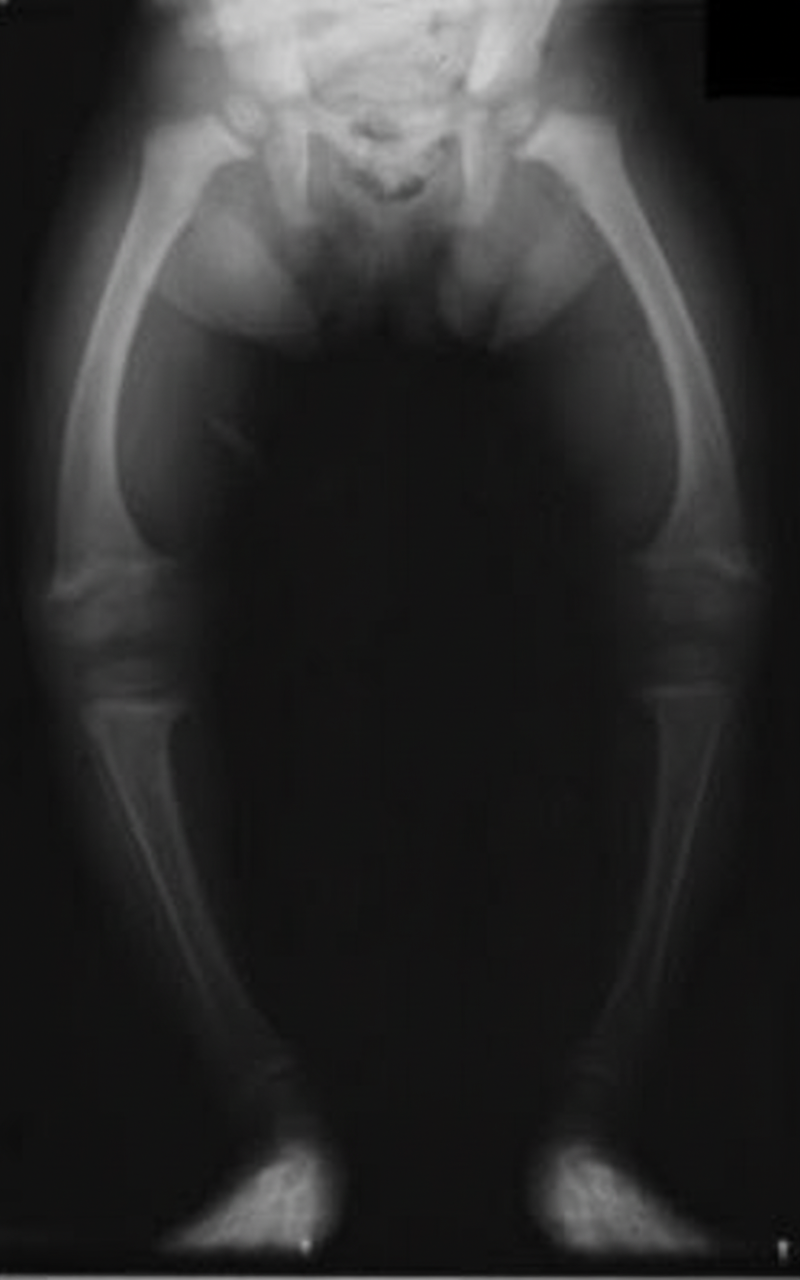
Which of the following is the best method for monitoring the treatment and resolution of vitamin D deficiency?
When can a severely malnourished child be safely discharged from the hospital?
Which of the following is NOT a radiologic sign of scurvy?
Which component of breast milk decreases the risk of retinitis pigmentosa?
Which of the following is NOT seen in kwashiorkor?
Apart from diarrhea, oral rehydration solution has been employed in:
Severe Acute Malnutrition is defined as:
A mother brings her 3-year-old child to the clinic with complaints of not feeding well. The Mid-arm circumference of the child is measured using Shakir's tape and found to be 12 cm. Under which category does this child fall?
Which of the following statements regarding the management of severe acute malnutrition (SAM) is false?
Which of the following are characteristic features of Vitamin D deficiency rickets?
Explanation: In the management of Vitamin D deficiency (Rickets), monitoring biochemical markers is essential to track recovery and avoid toxicity. **Why Serum Calcium is the Correct Answer:** Serum calcium is the most critical parameter for monitoring the **initial response** and **safety** of treatment. In Vitamin D deficiency, secondary hyperparathyroidism often maintains calcium at the lower end of normal. Once treatment begins, there is a risk of "hungry bone syndrome" where rapid mineralization causes a transient drop in calcium. Conversely, excessive supplementation can lead to hypercalcemia. Therefore, normalizing and stabilizing serum calcium is the primary clinical goal to ensure the resolution of the metabolic derangement. **Analysis of Incorrect Options:** * **B. Serum Phosphate:** While phosphate levels rise during healing as the secondary hyperparathyroidism resolves, it is less sensitive than calcium for monitoring the immediate safety and metabolic stability of the patient. * **C. Serum Vitamin D (25-OHD):** While 25-OHD is the best **diagnostic** test to confirm deficiency, it is not the best for monitoring resolution. Levels can rise rapidly after a "Stoss" dose without reflecting actual bone healing or physiological stabilization. * **D. Serum Parathormone (PTH):** PTH levels do decrease as Vitamin D status improves, but PTH is technically difficult to assay and more expensive, making it a secondary marker rather than the standard for routine monitoring. **NEET-PG High-Yield Pearls:** * **Best Diagnostic Marker:** Serum 25-hydroxyvitamin D [25(OH)D]. * **Earliest Radiological Sign of Healing:** Appearance of the **line of preparatory calcification** at the zone of provisional calcification. * **Earliest Biochemical Change in Rickets:** Decrease in serum Phosphorus (due to PTH-induced phosphaturia). * **Most Sensitive Biochemical Marker of Rickets:** Elevated **Serum Alkaline Phosphatase (ALP)**; it is also an excellent marker for long-term healing.
Explanation: ### Explanation Management of Severe Acute Malnutrition (SAM) is divided into two phases: **Stabilization** (in-patient) and **Rehabilitation** (out-patient/community-based). **Why Option C is Correct:** The primary goal of hospitalizing a child with SAM is to manage life-threatening complications (hypoglycemia, hypothermia, electrolyte imbalance, and infection). According to WHO and IAP guidelines, a child is ready to transition from the stabilization phase to the rehabilitation phase (and subsequent discharge) once the **appetite has returned**, **edema has resolved**, and the child shows **consistent weight gain** on F-100 or ready-to-use therapeutic food (RUTF). These signs indicate that the metabolic processes have stabilized and the "recovery" phase has begun. **Why Other Options are Incorrect:** * **Options A, B, and D:** Attaining "ideal" weight-for-height, height-for-age (stunting), or weight-for-age (underweight) are long-term nutritional goals. Achieving these parameters can take months of sustained nutritional support. Keeping a child hospitalized until they reach these targets is impractical, increases the risk of nosocomial infections, and is not cost-effective. **High-Yield Clinical Pearls for NEET-PG:** * **Criteria for SAM:** Weight-for-height/length < -3 SD, MUAC < 11.5 cm, or presence of bilateral pitting edema. * **Refeeding Syndrome:** The most dangerous complication during early nutritional transition; watch for **Hypophosphatemia**, Hypokalemia, and Hypomagnesemia. * **Feeding Protocol:** Start with **F-75** (75 kcal/100ml) for stabilization and transition to **F-100** (100 kcal/100ml) for catch-up growth. * **Target Weight Gain:** In the rehabilitation phase, a weight gain of **>10 g/kg/day** is considered "Good."
Explanation: The correct answer is **B. Cupping and fraying**, as these are the hallmark radiologic features of **Rickets**, not Scurvy. ### **Medical Concept** Scurvy is caused by Vitamin C deficiency, which leads to defective collagen synthesis. This results in fragile capillary walls (leading to subperiosteal hemorrhages) and a failure of osteoid formation. While the calcification of the cartilaginous matrix continues, the body cannot convert it into bone, leading to specific radiologic findings. ### **Analysis of Options** * **Cupping and fraying (Option B):** These occur in Rickets due to the failure of mineralization of the osteoid, leading to an accumulation of non-rigid cartilage that expands under pressure. * **White line in metaphysis (Option A):** Also known as the **Fraenkel line**, this represents a zone of well-calcified cartilage (provisional calcification) that appears dense because it is not being converted into bone. * **Ground glass appearance (Option C):** This refers to the thinning of the bone cortex and loss of trabecular detail, making the bones appear transparent or "glassy." * **Zone of rarefaction (Option D):** Also known as the **Trummerfeld zone** or the "scurvy line," this is a lucent (dark) band located just proximal to the Fraenkel line, representing a site of microfractures and deficient bone formation. ### **High-Yield NEET-PG Pearls for Scurvy** * **Wimberger’s Sign:** A sharp, dense sclerotic ring around the epiphyseal centers of ossification. * **Pelkan Spur:** Lateral bony outgrowths (osteophytes) at the metaphysis due to healing of subperiosteal hemorrhages. * **Clinical Triad:** Gum bleeding, petechiae/ecchymosis, and painful "pseudoparalysis" (child assumes the **Frog-leg position** due to subperiosteal pain). * **Key Difference:** Rickets affects the **growth plate (mineralization)**; Scurvy affects the **osteoid (collagen matrix)**.
Explanation: **Explanation:** **Docosahexaenoic acid (DHA)** is the correct answer because it is a long-chain polyunsaturated fatty acid (LC-PUFA) that serves as a critical structural component of the **retinal photoreceptors** and the gray matter of the brain. In the retina, DHA is highly concentrated in the rod outer segments, where it influences rhodopsin activation and visual signaling. Studies have shown that DHA supplementation or its presence in breast milk supports retinal development and may mitigate the progression of degenerative retinal conditions like **retinitis pigmentosa** by maintaining the integrity of photoreceptor membranes. **Analysis of Incorrect Options:** * **Vitamin A:** While essential for the formation of rhodopsin and preventing night blindness (xerophthalmia), it is not the specific structural component of breast milk primarily linked to the reduced risk of retinitis pigmentosa in this context. * **Vitamin B12:** This is crucial for DNA synthesis and myelin formation. Deficiency leads to megaloblastic anemia and subacute combined degeneration of the cord, but it does not have a direct structural role in retinal pigment epithelium. * **Taurine:** Though taurine is an amino acid found in high concentrations in the retina and breast milk (essential for preterm infants), DHA is the more definitive structural lipid associated with this specific protective benefit. **High-Yield Clinical Pearls for NEET-PG:** * **Breast Milk vs. Cow Milk:** Breast milk contains DHA and Arachidonic Acid (ARA), which are absent in unmodified cow's milk. * **Preterm Infants:** They are at high risk for DHA deficiency because the majority of DHA transfer occurs during the **third trimester**. * **Visual Acuity:** DHA is the most important nutrient for the development of visual acuity and cognitive function in the first two years of life.
Explanation: **Explanation:** The hallmark of **Kwashiorkor** is a severe deficiency of dietary protein despite adequate or near-adequate caloric intake. This leads to a state of **hypoalbuminemia** (decreased serum albumin), which reduces plasma oncotic pressure, resulting in the characteristic generalized edema (anasarca). Therefore, **Increased albumin** is incorrect and is the right answer to this "NOT" question. **Analysis of Options:** * **Apathy:** Children with Kwashiorkor typically exhibit significant mental changes, including extreme irritability, lethargy, and **apathy** (lack of interest/emotion). * **Flaky paint dermatosis:** This is a pathognomonic skin finding in Kwashiorkor. It involves hyperpigmentation and thickening of the skin, which then cracks and peels off, resembling "flaky paint" or "crazy paving," leaving behind pale, friable skin. * **Poor appetite:** Unlike Marasmus (where the child is usually ravenous), children with Kwashiorkor often suffer from **anorexia** (poor appetite), making nutritional rehabilitation more challenging. **High-Yield Clinical Pearls for NEET-PG:** * **Edema:** The essential diagnostic feature of Kwashiorkor; it starts in the lower extremities and can progress to the face ("Moon facies"). * **Hair Changes:** "Flag sign" (alternating bands of pigmented and depigmented hair) and "sparse/easy to pluck" hair are common. * **Fatty Liver:** Hepatomegaly occurs due to decreased synthesis of apolipoproteins, leading to fat accumulation in the liver. * **Marasmus vs. Kwashiorkor:** Marasmus is "balanced" starvation (calorie + protein deficiency) characterized by severe wasting ("skin and bones") and a "monkey-like" facies.
Explanation: **Explanation:** The primary objective of **Oral Rehydration Solution (ORS)** is to replace fluid and electrolyte deficits through the glucose-coupled sodium transport mechanism in the small intestine. While its most common use is in diarrhea, its utility extends to other conditions involving dehydration and electrolyte imbalance. **Why the correct answer is D:** * **Severe Vomiting:** Contrary to traditional belief, ORS can be used in vomiting. Small, frequent sips (5-10 ml every 5 minutes) are often tolerated and can prevent the need for IV fluids. It helps correct the metabolic alkalosis and dehydration associated with gastric loss. * **Heat Stroke/Exhaustion:** Heat-related illnesses involve significant loss of water and sodium through sweat. ORS is an ideal, readily available rehydration fluid to restore intravascular volume and electrolyte balance in non-comatose patients. **Analysis of Incorrect Options:** * **A & C:** While both are correct individually, option D is the most comprehensive choice as it encompasses both clinical scenarios where ORS is indicated. * **B (Burn cases):** In major burns, there is a massive shift of fluid from the intravascular to the interstitial space (third-spacing) and significant evaporative loss. This requires precise, large-volume resuscitation using **Intravenous Crystalloids** (e.g., Ringer’s Lactate) via the Parkland Formula. Oral rehydration is insufficient for the acute phase of major burns. **High-Yield Clinical Pearls for NEET-PG:** * **WHO Reduced Osmolarity ORS:** Total osmolarity is **245 mOsm/L** (Sodium: 75 mmol/L, Glucose: 75 mmol/L). * **Mechanism:** It utilizes the **SGLT-1 receptor**, which remains functional even in secretory diarrheas like Cholera. * **Contraindications for ORS:** Paralytic ileus, malabsorption (monosaccharide intolerance), severe shock, and altered sensorium (risk of aspiration). * **Re-feeding:** In pediatric diarrhea, breastfeeding should never be stopped; complementary feeding should resume as soon as dehydration is corrected.
Explanation: **Explanation:** Severe Acute Malnutrition (SAM) is a life-threatening condition defined by the WHO and UNICEF based on specific anthropometric and clinical criteria. For children aged 6–59 months, SAM is diagnosed if **any one** of the following is present: 1. **Weight-for-Height (W/H) Z-score < -3 SD** (Severe wasting). 2. **Mid-Upper Arm Circumference (MUAC) < 11.5 cm**. 3. **Presence of bilateral pitting edema** (Nutritional edema). **Why Option C is correct:** The presence of bilateral pitting edema (bipedal edema) is a pathognomonic clinical sign of **kwashiorkor**. Regardless of weight or height measurements, its presence automatically classifies a child as having SAM because it indicates severe metabolic derangement and a high risk of mortality. **Analysis of Incorrect Options:** * **Option A:** Weight/Height < -2 SD defines *Moderate* Acute Malnutrition (MAM). SAM requires a cut-off of < -3 SD. * **Option B:** MUAC < 12.5 cm is the cut-off for MAM. For SAM, the cut-off is more stringent at < 11.5 cm. * **Option D:** Weight/Age < -3 SD defines *Severe Underweight*. While important, it is not used to define SAM because it does not differentiate between acute wasting and chronic stunting. **High-Yield Clinical Pearls for NEET-PG:** * **SAM Management:** Divided into two phases: **Stabilization** (using F-75 diet to treat hypoglycemia, hypothermia, and infections) and **Rehabilitation** (using F-100 or RUTF). * **Appetite Test:** This is the most important factor in deciding whether a child with SAM needs inpatient care or can be managed at an Outpatient Therapeutic Program (OTP). * **Target MUAC for discharge:** ≥ 12.5 cm for at least two consecutive weeks.
Explanation: ### Explanation The Mid-Upper Arm Circumference (MUAC) is a rapid screening tool used to assess the nutritional status of children aged **6 months to 5 years**. It is measured using **Shakir’s Tape**, which is color-coded to simplify field assessment. **Why the correct answer is right:** According to Shakir’s Tape classification: * **Green (>13.5 cm):** Normal nutrition. * **Yellow (12.5 – 13.5 cm):** Borderline malnutrition (Under-nutrition/At risk). * **Red (<12.5 cm):** Severe malnutrition (Severe Acute Malnutrition - SAM). In this case, the child’s MUAC is **12 cm**, which falls into the **Yellow zone**, indicating **Borderline malnutrition**. **Analysis of incorrect options:** * **A. Normal nutrition:** This would require a measurement **>13.5 cm** (Green zone). * **B. Severe malnutrition:** This is diagnosed when the MUAC is **<12.5 cm** (Red zone). While 12 cm is technically less than 12.5, in the context of Shakir's specific tape zones, 12.5–13.5 cm is the standard range for "Borderline." * **D. Very severe malnutrition:** This is not a standard category on Shakir’s tape; however, a MUAC **<11.5 cm** is the WHO criteria for identifying Severe Acute Malnutrition (SAM) requiring urgent intervention. **High-Yield Pearls for NEET-PG:** * **Age Group:** MUAC is relatively constant between 1–5 years because as fat decreases, muscle mass increases. * **WHO Criteria for SAM:** MUAC **<11.5 cm**, Weight-for-Height **<-3 SD**, or presence of **Bilateral Pitting Edema**. * **Shakir’s Tape Colors:** Remember the "Traffic Light" system: Green (Go/Safe), Yellow (Caution/Borderline), Red (Stop/Danger).
Explanation: ### Explanation The management of **Severe Acute Malnutrition (SAM)** follows specific WHO and IAP protocols based on the presence of medical complications and appetite. **1. Why Option D is the Correct (False) Statement:** The decision to transfer a child from inpatient (Stabilization Center) to outpatient care (NRC/Home) is **not** based on specific Mid-Upper Arm Circumference (MUAC) values. Instead, it is based on **clinical stability**: the resolution of medical complications, the return of appetite (passing the "Appetite Test"), and the reduction of edema. MUAC is used for initial screening and diagnosis, but it is not a dynamic indicator for step-down care. **2. Analysis of Other Options:** * **Option A (True):** SAM with **pitting edema (+++)** or "bilateral pitting edema" is a sign of metabolic instability and requires mandatory hospitalization to manage electrolyte imbalances and prevent refeeding syndrome. * **Option B & C (False Statements in Question Context):** These options are actually **incorrect clinical practices** but are listed as "true" statements regarding management protocols in the context of this MCQ's logic. According to WHO guidelines: * SAM with a **good appetite** and no complications can be managed in **Outpatient Therapeutic Programs (OTP)**. * SAM with a **poor appetite** (failing the appetite test) is a red flag for underlying infection or metabolic derangement and **must be hospitalized**. **Clinical Pearls for NEET-PG:** * **Criteria for SAM:** MUAC <11.5 cm, Weight-for-Height Z-score < -3SD, or presence of bilateral pitting edema. * **Appetite Test:** The single most important criterion to decide between inpatient and outpatient management. * **Refeeding Syndrome:** Characterized by hypophosphatemia, hypokalemia, and hypomagnesemia. * **Target Weight Gain:** In the rehabilitation phase, a weight gain of **>10 g/kg/day** is considered good.
Explanation: **Explanation:** Vitamin D deficiency rickets is a metabolic bone disease characterized by defective mineralization of the osteoid matrix at the growth plates. **Why "Widened Anterior Fontanel" is correct:** In rickets, there is a failure of ossification of the skull bones. This leads to **craniotabes** (softening of skull bones) and a delay in the closure of the fontanels. A widened anterior fontanel, along with frontal bossing (due to excess osteoid production), are classic early skeletal markers of the disease. **Analysis of Incorrect Options:** * **A. Increased forehead sweating:** While often mentioned in older textbooks as a sign of "early rickets," it is a non-specific symptom and not a diagnostic "characteristic feature" compared to skeletal changes. * **B. Characteristically decreased calcium:** In early stages of Vitamin D deficiency, serum calcium may be low. However, secondary hyperparathyroidism quickly normalizes calcium levels by mobilizing it from bones. Therefore, **calcium is often normal or only mildly low**, whereas phosphorus is characteristically decreased. * **D. Increased alkaline phosphatase:** While Serum ALP is indeed **elevated** in rickets (and is the earliest biochemical marker), the question asks for the most characteristic feature among the choices. In many NEET-PG patterns, if multiple biochemical and clinical signs are present, specific skeletal deformities like the widened fontanel or rachitic rosary are prioritized as "characteristic" clinical findings. *Note: If this were a "Multiple Correct" type, D would also be true, but in single-best-response, skeletal hallmarks are key.* **High-Yield Clinical Pearls for NEET-PG:** 1. **Earliest Sign:** Craniotabes (disappears after 1 year of age). 2. **Earliest Radiographic Sign:** Cupping and splaying of the distal ends of the radius and ulna. 3. **Biochemical Profile:** ↓ Serum Phosphate, ↑ ALP, ↑ PTH, and Normal/Low Serum Calcium. 4. **Harrison’s Fact:** The "Rachitic Rosary" in rickets is due to expansion of the osteochondral junction (felt as beads), whereas in Scurvy, it is due to subluxation of the sternum (sharp/angular).
Breastfeeding
Practice Questions
Infant Formula Feeding
Practice Questions
Complementary Feeding
Practice Questions
Nutritional Requirements by Age
Practice Questions
Malnutrition and Failure to Thrive
Practice Questions
Obesity in Children
Practice Questions
Vitamin Deficiencies
Practice Questions
Mineral Deficiencies
Practice Questions
Food Allergies and Intolerances
Practice Questions
Nutritional Management of Chronic Diseases
Practice Questions
Eating Disorders
Practice Questions
Parenteral and Enteral Nutrition
Practice Questions
Get full access to all questions, explanations, and performance tracking.
Start For Free