Which classification of malnutrition is independent of the child's weight?
Which of the following are acute complications of Protein-Energy Malnutrition (PEM)?
Which of the following is NOT a feature of rickets in an infant?
The bifidus factor present in breast milk protects against which of the following pathogens?
A mother expresses concern about her newborn's "colic" and asks if switching from breast milk to goat's milk is a suitable alternative. What is the primary concern regarding the use of goat's milk compared to breast milk or cow's milk for infant nutrition?
Which of the following statements about the Gomez classification is true?
Human colostrum has a relatively higher concentration of all of the following except?
Which of the following is NOT true about Wilson disease?
Breast milk fully meets the nutritional requirements of the infant in the first few months of life. All of the following are true about breast milk, EXCEPT:
What is the hair abnormality observed in a child with severe malnutrition?
Explanation: **Explanation:** The **McLaren Classification** is unique because it relies primarily on **clinical signs and serum albumin levels** rather than anthropometric weight measurements to assess the severity of Protein-Energy Malnutrition (PEM). It uses a scoring system (0–15) where points are assigned for clinical features like edema (6 points), dermatosis (4 points), hair changes (2 points), and hepatomegaly (1 point). Because it focuses on the clinical phenotype (Marasmus vs. Kwashiorkor) and biochemical markers, it can be calculated even when an accurate weight is unavailable. **Analysis of Incorrect Options:** * **Gomez Classification:** The earliest classification, based entirely on **Weight-for-Age**. It defines malnutrition as a percentage of the expected weight for a specific age (e.g., Grade III is <60% of expected weight). * **Waterlow Classification:** Focuses on **Weight-for-Height** (Wasting) and **Height-for-Age** (Stunting). It is used to differentiate between acute and chronic malnutrition but remains dependent on weight. * **WHO Classification:** The current gold standard, which uses Z-scores for **Weight-for-Height** (to define Severe Acute Malnutrition), **Weight-for-Age** (Underweight), and **Height-for-Age** (Stunting). **High-Yield Clinical Pearls for NEET-PG:** * **Wellcome Trust Classification:** Uses both **Weight-for-Age** and the presence/absence of **edema** to categorize Marasmus, Kwashiorkor, and Marasmic-Kwashiorkor. * **IAP Classification:** The most commonly used in India for community surveys; it is based on **Weight-for-Age**. * **Stunting (Height-for-Age):** Reflects **chronic** (past) malnutrition. * **Wasting (Weight-for-Height):** Reflects **acute** (recent) malnutrition and is the best indicator of mortality risk.
Explanation: **Explanation:** In children with severe Protein-Energy Malnutrition (PEM), particularly Marasmus and Kwashiorkor, the body undergoes "reductive adaptation." This metabolic slowdown makes them highly susceptible to life-threatening acute complications. 1. **Hypoglycemia:** Malnourished children have depleted glycogen stores and impaired gluconeogenesis. Blood glucose levels below 54 mg/dL are common and often asymptomatic, requiring immediate management. 2. **Hypothermia:** Due to the loss of subcutaneous fat (insulation) and a low basal metabolic rate, these children cannot generate or retain heat effectively. Axillary temperatures below 35°C are a medical emergency. 3. **Hypokalemia:** Total body potassium is always depleted in PEM due to muscle wasting and chronic diarrhea. While serum levels might appear normal due to intracellular shifts, a functional deficit exists, contributing to cardiac arrhythmias and paralytic ileus. **Analysis of Options:** * **Option A & B:** These are partially correct but incomplete. PEM management protocols (WHO) emphasize the "Triad of Death": Hypoglycemia, Hypothermia, and Infection/Electrolyte imbalance (specifically Hypokalemia). * **Option D:** This is incorrect because PEM is associated with **Hypomagnesemia**, not hypermagnesemia. Magnesium is a co-factor for the Na-K-ATPase pump; its deficiency often makes hypokalemia resistant to treatment. **High-Yield Clinical Pearls for NEET-PG:** * **The 10 Steps of WHO Management:** The first three steps in the stabilization phase (Days 1-2) are treating Hypoglycemia, Hypothermia, and Dehydration. * **Silent Infections:** Malnourished children often do not develop fever due to an impaired inflammatory response; hypothermia is often the only sign of underlying sepsis. * **Reeding Syndrome:** Beware of starting high-calorie feeds too early, which can lead to a dangerous drop in Phosphorus, Magnesium, and Potassium.
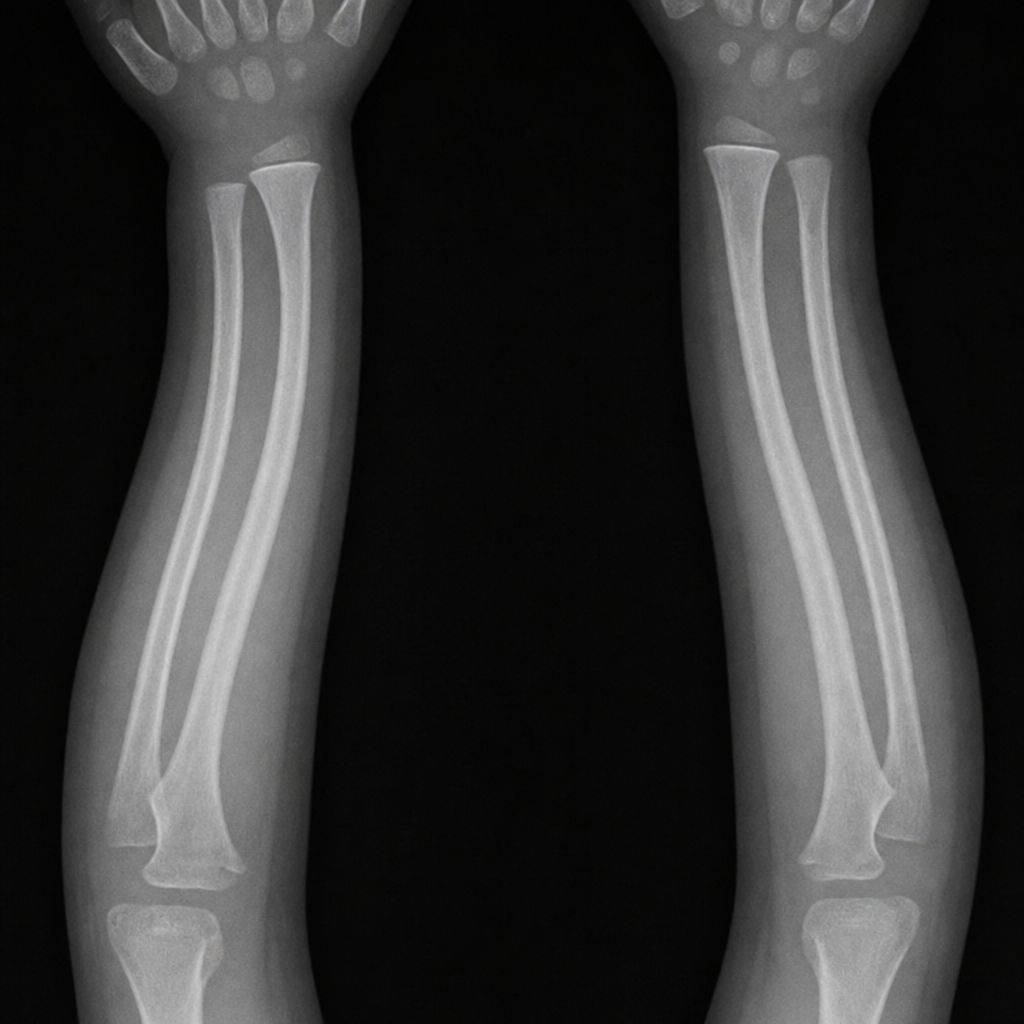
Explanation: **Explanation:** The correct answer is **D. Bow legs**. The clinical presentation of rickets varies significantly depending on the age of the child and the specific bones undergoing the most rapid growth at that time. **Why "Bow legs" is the correct answer:** In an **infant** (typically under 6 months to 1 year), the child is not yet weight-bearing. Bowing of the legs (genu varum) occurs due to the effect of gravity and weight-bearing on softened long bones. Therefore, bow legs are a characteristic feature of rickets in **toddlers and older children** who have started walking, rather than in non-ambulatory infants. **Analysis of Incorrect Options:** * **A. Craniotabes:** This is the **earliest** sign of rickets, seen in infants under 6 months. It refers to the softening of the skull bones (ping-pong ball sensation on pressure), typically affecting the occipital and parietal bones. * **B. Widened fontanels:** Rickets causes a delay in the mineralization of the skull and the closure of sutures, leading to persistently large anterior fontanels and "frontal bossing." * **C. Rachitic rosary:** This is a classic early sign caused by the expansion of the osteochondral junctions of the ribs. It is palpable and sometimes visible in infants as they grow. **NEET-PG High-Yield Pearls:** * **Earliest sign of Rickets:** Craniotabes. * **Earliest radiological sign:** Rarefaction of the zone of provisional calcification (followed by cupping, splaying, and fraying of the metaphysis). * **Best site for X-ray:** Wrist (distal radius and ulna). * **Biochemical hallmark:** Increased Serum Alkaline Phosphatase (ALP) is the most sensitive marker for disease activity. * **Harrison’s Sulcus:** A horizontal groove along the lower border of the thorax corresponding to the costal insertion of the diaphragm, seen in chronic rickets.
Explanation: **Explanation:** The **Bifidus factor** is a critical carbohydrate (nitrogen-containing sugar) found in breast milk that promotes the growth of *Lactobacillus bifidus* in the infant's gastrointestinal tract. These beneficial bacteria ferment lactose, producing acetic and lactic acids. This process lowers the intestinal pH (making it more acidic), which inhibits the growth of pathogenic organisms, most notably **Salmonella**, *Shigella*, and *Escherichia coli*. **Analysis of Options:** * **Salmonella (Correct):** The acidic environment created by the Bifidus factor is highly effective at preventing the colonization and proliferation of Gram-negative enteric pathogens like Salmonella. * **Enteroamoeba histolytica & Giardia lamblia (Incorrect):** While breast milk contains secretory IgA and lactoferrin which provide some protection against parasites, the specific mechanism of the Bifidus factor is targeted toward bacterial flora regulation rather than protozoal infections. * **Vibrio cholerae (Incorrect):** While breast milk offers general protection against diarrheal diseases, the classic association for the Bifidus factor in pediatric literature and competitive exams is its protective role against invasive enteric bacteria like Salmonella. **High-Yield Clinical Pearls for NEET-PG:** * **Lactoferrin:** An iron-binding protein in breast milk that inhibits iron-dependent bacteria (e.g., *E. coli*, *Staphylococcus*). * **Lysozyme:** Present in higher concentrations in human milk than bovine milk; it destroys bacterial cell walls. * **Secretory IgA:** The most abundant immunoglobulin in breast milk; it provides mucosal immunity by preventing pathogen attachment to the gut wall. * **Macrophages:** The most common cell type found in colostrum.
Explanation: **Explanation:** The primary concern with using goat's milk as a substitute for breast milk or infant formula is its **critically low folate (Vitamin B9) content**. Goat's milk contains significantly less folate than both human breast milk and cow's milk. If an infant is fed exclusively on goat's milk without supplementation, they are at a high risk of developing **Megaloblastic Anemia**. Additionally, goat's milk is deficient in Vitamin B12 and Vitamin D. **Analysis of Options:** * **Option A (Incorrect):** The caloric density of goat’s milk is roughly 70 kcal/100ml, which is comparable to breast milk and cow’s milk. It is not considered "insufficient" in calories. * **Option C & D (Incorrect):** Goat's milk actually has a higher protein content (casein and whey) than human milk. However, this is a disadvantage; the high protein and mineral concentration (high renal solute load) can stress a newborn's immature kidneys and lead to dehydration. **High-Yield Clinical Pearls for NEET-PG:** * **Megaloblastic Anemia:** Always suspect goat's milk ingestion in a pediatric case presenting with macrocytic anemia. * **Renal Solute Load:** Goat's milk has a higher renal solute load than human milk, increasing the risk of metabolic acidosis and azotemia. * **Allergenicity:** Contrary to popular myth, goat's milk is **not** a safe alternative for infants with Cow's Milk Protein Allergy (CMPA) due to high cross-reactivity between the proteins. * **Brucellosis:** Unpasteurized goat's milk is a common vector for *Brucella* species.
Explanation: The **Gomez Classification** is a historical anthropometric tool used to assess the severity of Protein-Energy Malnutrition (PEM) in children. It is primarily based on the **Weight-for-Age** parameter compared to the 50th percentile (median) of the reference population. ### **Explanation of Options:** * **Correct Answer (B):** The classification calculates the percentage of expected weight for a specific age. The formula used is: *(Observed weight / Weight of a normal child of the same age) × 100*. * **Option A is incorrect:** Gomez classification does not account for height (stunting). Classifications based on height/length are the Waterlow classification or the WHO Z-score system. * **Option C is incorrect:** According to Gomez, a weight between **75–90%** of the median is classified as **Grade I (Mild)** malnutrition. The range 60–74% is Grade II (Moderate), and <60% is Grade III (Severe). * **Option D is incorrect:** While it assesses nutritional status, it lacks prognostic value regarding mortality or the need for hospitalization. The **IAP (Indian Academy of Pediatrics) classification** or **WHO Z-scores** are preferred in clinical settings for better prognostic accuracy. ### **High-Yield Clinical Pearls for NEET-PG:** * **Gomez Grades:** * >90%: Normal * 75–90%: Grade I (Mild) * 60–74%: Grade II (Moderate) * <60%: Grade III (Severe) * **Limitation:** It does not differentiate between acute malnutrition (wasting) and chronic malnutrition (stunting), nor does it consider the presence of edema (Kwashiorkor). * **Comparison:** The **IAP Classification** also uses weight-for-age but uses different cut-offs (Grade I: 71-80%, Grade II: 61-70%, Grade III: 51-60%, Grade IV: <50%).
Explanation: ### Explanation The correct answer is **B. Fat**. **Understanding the Concept:** Human milk changes in composition during the first few weeks postpartum to meet the evolving needs of the neonate. **Colostrum** (secreted during the first 2–4 days) is a thick, yellowish fluid designed primarily for **immunological protection** and growth rather than high caloric density. Compared to mature milk, colostrum is richer in proteins, minerals, and fat-soluble vitamins, but it is **lower in fat, lactose, and water-soluble vitamins.** **Analysis of Options:** * **A. Protein:** Colostrum contains significantly higher protein (approx. 2.3 g/dL) compared to mature milk (approx. 0.9–1.1 g/dL). This includes high concentrations of lactoferrin and casein. * **B. Fat (Correct):** The fat content in colostrum is lower (approx. 2 g/dL) than in mature milk (approx. 3.5–4.5 g/dL). Mature milk has higher lipid content to provide the necessary calories for rapid weight gain. * **C. IgA:** Colostrum is exceptionally rich in secretory IgA, providing the newborn with passive mucosal immunity against enteric and respiratory pathogens. * **D. Sodium:** Colostrum has higher concentrations of electrolytes, including sodium, potassium, and chloride, to support the neonate’s physiological needs in the first few days of life. **NEET-PG High-Yield Pearls:** * **Caloric Value:** Colostrum provides ~67 kcal/100 ml, whereas mature milk provides ~70–75 kcal/100 ml. * **Vitamin Content:** Colostrum is richer in **Vitamin A, K, E, and D** compared to mature milk. * **Transition:** Milk produced from day 5 to 2 weeks is "transitional milk," and after 2 weeks, it is "mature milk." * **Specific Gravity:** Colostrum has a higher specific gravity (1.040–1.060) than mature milk.
Explanation: **Explanation:** Wilson Disease (Hepatolenticular Degeneration) is an autosomal recessive disorder caused by a mutation in the **ATP7B gene** on chromosome 13. This defect impairs biliary copper excretion and the incorporation of copper into ceruloplasmin. **Why Option D is the Correct Answer:** In Wilson disease, there is a failure to incorporate copper into apoceruloplasmin. This leads to the secretion of an unstable protein that is rapidly degraded, resulting in **decreased (low) serum ceruloplasmin levels** (<20 mg/dL). Therefore, "Elevated serum ceruloplasmin" is the false statement. **Analysis of Incorrect Options:** * **A. Hepatomegaly:** This is a common early presentation, especially in children. Excess copper accumulates first in the liver, causing hepatitis, cirrhosis, or acute liver failure. * **B. Kayser-Fleischer (KF) rings:** These are golden-brown deposits of copper in the **Descemet membrane** of the cornea. They are present in 95% of patients with neurological symptoms. * **C. Elevated serum copper levels:** While *total* serum copper is usually low (due to low ceruloplasmin), the **free (non-ceruloplasmin bound) serum copper** is elevated, leading to tissue deposition. (Note: In many exam contexts, "elevated copper" refers to the free fraction or increased 24-hour urinary copper excretion). **High-Yield Clinical Pearls for NEET-PG:** * **Screening Test:** Serum ceruloplasmin (decreased). * **Gold Standard Diagnosis:** Liver biopsy (increased copper content >250 μg/g dry weight). * **Neurological Features:** Basal ganglia involvement leading to tremors, dystonia, and "wing-beating" tremors. * **Psychiatric Features:** Personality changes or psychosis may be the initial presentation. * **Treatment:** Chelating agents like **D-Penicillamine** (first-line) or Trientine; Zinc is used for maintenance as it inhibits intestinal copper absorption.
Explanation: **Explanation:** Breast milk is the gold standard for infant nutrition. Understanding its composition and production kinetics is high-yield for NEET-PG. **Why Option A is the Correct Answer (The Exception):** Breast milk production (output) typically peaks at **5 to 6 months** postpartum, coinciding with the period just before complementary feeding is introduced. The average daily output is approximately **450–600 ml** at 1 month, reaching a maximum of about **700–800 ml** by 6 months. By 12 months, while breastfeeding may continue, the total volume produced significantly declines as the infant transitions to solids. **Analysis of Other Options:** * **Option B (Iron Absorption):** Although breast milk has a low iron concentration (0.3–0.5 mg/L), its **bioavailability is exceptionally high**. The coefficient of iron absorption is approximately **50–70%**, compared to only 5–10% in cow's milk. This is due to the presence of lactose and Vitamin C, which facilitate absorption. * **Option C (Calcium Utilization):** Breast milk has a lower absolute calcium content than cow's milk, but the **Calcium-to-Phosphorus ratio (2:1)** is ideal. This ensures superior absorption and utilization, preventing hypocalcemic tetany, which is more common with cow's milk (ratio 1.2:1). * **Option D (Reference Protein):** Breast milk protein (specifically **Lactalbumin**) is considered the "Reference Protein" because it contains all essential amino acids in the perfect proportions required for human growth, with nearly 100% biological value. **High-Yield Clinical Pearls for NEET-PG:** * **Whey-to-Casein Ratio:** Breast milk is **60:40** (easy to digest), while cow's milk is **20:80**. * **Immunoglobulins:** **IgA** (specifically secretory IgA) is the most abundant immunoglobulin in breast milk. * **Deficiencies:** Breast milk is notoriously **deficient in Vitamin K and Vitamin D**. It also lacks sufficient iron for infants older than 6 months. * **Energy Content:** Provides approximately **67 kcal/100 ml**.
Explanation: **Explanation:** The correct answer is **Flag sign (Option B)**. This is a classic clinical finding in children with severe acute malnutrition, specifically **Kwashiorkor**. **1. Why it is correct:** The "Flag sign" (or *signo de la bandera*) refers to alternating horizontal bands of light and dark color in the hair. This occurs due to intermittent periods of protein-energy malnutrition. During periods of protein deficiency, the hair grows with reduced melanin (hypochromia/light color); when the child receives adequate nutrition, the hair grows with normal pigmentation (dark color). This creates a striped appearance resembling a flag. **2. Why other options are incorrect:** * **Light dark sign (Option A):** This is a descriptive term but not a recognized medical eponym or clinical sign in pediatric nutrition. * **Hair sign (Option C):** This is too vague. While hair changes (thinness, sparseness, easy pluckability) are common in malnutrition, the specific banded pattern is termed the Flag sign. * **Colour sign (Option D):** This is not a standard medical term used to describe nutritional hair changes. **3. NEET-PG High-Yield Pearls:** * **Kwashiorkor vs. Marasmus:** Flag sign is characteristic of Kwashiorkor (protein deficiency) rather than Marasmus (total calorie deficiency). * **Hair Texture:** In Kwashiorkor, hair becomes thin, dry, brittle, and "easy to pluck" without pain. * **Other Skin Findings:** Look for "Flaky paint dermatosis" (crazy-pavement dermatosis), which is also pathognomonic for Kwashiorkor. * **Edema:** The presence of bilateral pitting edema is the hallmark that distinguishes Kwashiorkor from Marasmus.
Breastfeeding
Practice Questions
Infant Formula Feeding
Practice Questions
Complementary Feeding
Practice Questions
Nutritional Requirements by Age
Practice Questions
Malnutrition and Failure to Thrive
Practice Questions
Obesity in Children
Practice Questions
Vitamin Deficiencies
Practice Questions
Mineral Deficiencies
Practice Questions
Food Allergies and Intolerances
Practice Questions
Nutritional Management of Chronic Diseases
Practice Questions
Eating Disorders
Practice Questions
Parenteral and Enteral Nutrition
Practice Questions
Get full access to all questions, explanations, and performance tracking.
Start For Free