Which factor is associated with a good prognosis in Wilms' tumor?
Which of the following is associated with a good prognosis in Acute Lymphoblastic Leukemia (ALL)?
Which of the following conditions is associated with the highest risk of Wilm's tumor?
The likely diagnosis in a child with limb pain and pancytopenia is?
In children, at what age is lymphoma predominantly seen?
Paraneoplastic opsoclonus myoclonus syndrome is most commonly associated with which malignancy in children?
Which among the following is the most common tumor associated with neurofibromatosis in children?
Hutchinson's secondaries in the skull are due to tumors in:
Which one is the best prognostic factor for ALL?
A 2-year-old child presents with discharge, seborrheic dermatitis, polyuria, and hepatosplenomegaly. Which of the following is the most likely diagnosis?
Explanation: ### Explanation **Correct Answer: B. Presence of aniridia** In Wilms' tumor (Nephroblastoma), the association with **Aniridia** (absence of the iris) is a classic component of the **WAGR syndrome** (Wilms tumor, Aniridia, Genitourinary anomalies, and Range of developmental delays). The medical reasoning behind this being a "good prognosis" factor is **surveillance**. Children born with sporadic aniridia are known to be at a high risk (approx. 33%) of developing Wilms' tumor. Consequently, these patients undergo rigorous **screening with serial renal ultrasounds** every 3 months. This leads to the detection of the tumor at a much earlier, localized stage compared to the general population, resulting in better clinical outcomes. **Analysis of Incorrect Options:** * **A. Age 2-5 years:** This is the peak age of incidence for Wilms' tumor, but it is not a prognostic marker. In fact, age **<2 years** is generally associated with a better prognosis. * **C. Unilateral disease:** While bilateral disease (Stage V) is more complex, "unilateral disease" is the standard presentation and does not inherently signify a "good" prognosis compared to specific screening-detected cases. * **D. Stage I disease:** While Stage I has a better prognosis than Stage IV, the question asks for a specific *associated factor*. In the context of NEET-PG, the "Aniridia" association is a high-yield concept specifically linked to early detection benefits. **High-Yield Clinical Pearls for NEET-PG:** * **Most Important Prognostic Factor:** The **Histology** (Favorable vs. Unfavorable/Anaplastic) is the single most important predictor of survival. * **WAGR Syndrome:** Associated with a microdeletion on chromosome **11p13** (WT1 gene). * **Beckwith-Wiedemann Syndrome:** Associated with **11p15** (WT2 gene), macroglossia, and hemihypertrophy. * **Common Presentation:** Asymptomatic abdominal mass that **does not cross the midline** (unlike Neuroblastoma).
Explanation: **Explanation:** Acute Lymphoblastic Leukemia (ALL) is the most common pediatric malignancy, and its prognosis is heavily influenced by cytogenetic and clinical factors. **Why Hyperdiploidy is Correct:** Hyperdiploidy (defined as >50 chromosomes per cell) is one of the most significant **favorable prognostic markers** in pediatric ALL. It is associated with an excellent response to chemotherapy, likely due to the increased sensitivity of hyperdiploid blasts to methotrexate and apoptosis. Specifically, trisomies of chromosomes 4, 10, and 17 are linked to superior outcomes. **Analysis of Incorrect Options:** * **Hypodiploidy:** Defined as <44 chromosomes, this is a **poor prognostic factor** associated with high rates of treatment failure and early relapse. * **T-cell ALL:** Traditionally carries a **worse prognosis** compared to B-cell ALL. It often presents with a high white blood cell (WBC) count and a mediastinal mass, requiring more intensive therapy. * **Philadelphia Chromosome [t(9;22)]:** This translocation (BCR-ABL1) is a **very poor prognostic marker**. While prognosis has improved with the addition of Tyrosine Kinase Inhibitors (e.g., Imatinib), it remains a high-risk feature. **High-Yield Clinical Pearls for NEET-PG:** * **Favorable Prognosis:** Age 1–9 years, WBC count <50,000/µL, Hyperdiploidy, and t(12;21) [ETV6-RUNX1]. * **Unfavorable Prognosis:** Age <1 year or >10 years, WBC count >50,000/µL, Hypodiploidy, t(9;22), and t(4;11) [KMT2A rearrangement]. * **Most common subtype:** Pre-B cell ALL (CD10/CALLA positive) generally has a better prognosis than T-cell or mature B-cell (Burkitt-type) ALL.
Explanation: **Explanation:** The risk of developing Wilms tumor (nephroblastoma) varies significantly among associated genetic syndromes. The correct answer is **Denys-Drash Syndrome (DDS)** because it carries the highest cumulative risk, exceeding **90%**. **1. Why Denys-Drash Syndrome is Correct:** DDS is characterized by the triad of progressive renal failure (mesangial sclerosis), male pseudohermaphroditism, and Wilms tumor. It is caused by a point mutation in the **WT1 gene** (11p13). Due to the extremely high risk (>90%), prophylactic nephrectomy is often considered once renal failure progresses. **2. Analysis of Incorrect Options:** * **WAGR Syndrome:** (Wilms tumor, Aniridia, Genitourinary anomalies, and intellectual disability/Retardation). This is caused by a microdeletion at 11p13 involving both *WT1* and *PAX6* genes. The risk of Wilms tumor is approximately **30-50%**. * **Beckwith-Wiedemann Syndrome (BWS):** An overgrowth disorder (macroglossia, hemihypertrophy, omphalocele) linked to the **WT2 gene** (11p15.5). While it is the most common overgrowth syndrome associated with Wilms, the actual risk of developing the tumor is relatively lower, at approximately **5-10%**. **3. High-Yield Clinical Pearls for NEET-PG:** * **Most common presentation:** Asymptomatic abdominal mass that does **not** cross the midline (unlike Neuroblastoma). * **Staging:** Wilms tumor is staged surgically (Post-nephrectomy). * **Metastasis:** The most common site for distant metastasis is the **Lungs**. * **Screening Protocol:** For children with these syndromes, abdominal ultrasound is recommended every 3 months until age 7-8 to ensure early detection.
Explanation: **Explanation:** The combination of **limb pain** and **pancytopenia** in a child is a classic presentation of **Acute Lymphocytic Leukaemia (ALL)**. 1. **Why ALL is correct:** In pediatric ALL, the bone marrow is infiltrated by malignant lymphoblasts (myelophthisis), leading to the failure of normal hematopoiesis, which manifests as **pancytopenia** (anemia, leukopenia, and thrombocytopenia). The **limb pain** (often bone or joint pain) occurs due to the expansion of the marrow cavity by leukemic cells or direct subperiosteal infiltration. Bone pain is a distinguishing feature that often leads to a misdiagnosis of orthopedic or rheumatologic conditions. 2. **Why other options are incorrect:** * **Aplastic Anaemia:** While it presents with pancytopenia, it typically does **not** cause bone or limb pain, as the marrow is hypocellular (empty) rather than infiltrated. * **Rheumatic Fever:** Presents with migratory polyarthritis (joint pain), but it is an inflammatory condition and does not cause pancytopenia. * **Rheumatoid Arthritis (JIA):** Causes chronic joint pain and swelling. While it may show anemia of chronic disease or leukocytosis, it does not present with true pancytopenia. **Clinical Pearls for NEET-PG:** * **Most common** childhood malignancy: ALL. * **Peak age:** 2–5 years. * **Initial Investigation:** Peripheral smear (may show blasts). * **Confirmatory Investigation:** Bone marrow aspiration (>20% blasts). * **Prognostic Marker:** Hyperdiploidy and t(12;21) carry a good prognosis; hypodiploidy and t(9;22) carry a poor prognosis. * **Note:** If a child has "growing pains" that occur at night or are associated with abnormal blood counts, always rule out leukemia.
Explanation: **Explanation:** The incidence of pediatric malignancies follows a distinct age-related pattern. While **Leukemia** is the most common childhood cancer overall, **Lymphomas** (both Hodgkin and Non-Hodgkin) show a significant increase in incidence as a child grows older, peaking in adolescence and young adulthood. **1. Why "Greater than 14 years" is correct:** Lymphomas are relatively rare in infants and toddlers. The incidence rises sharply after the age of 10. Specifically, **Hodgkin Lymphoma (HL)** follows a bimodal age distribution, with the first peak occurring in the late teens and early 20s. By the age of 14 and above, lymphomas become one of the most predominant forms of cancer, surpassing the early-childhood peaks of embryonal tumors. **2. Why the other options are incorrect:** * **Less than 1 year (D):** This period is dominated by **Neuroblastoma** and other congenital tumors. Lymphoma is extremely rare in infants. * **Less than 4 years (A):** This age group is the peak for **Acute Lymphoblastic Leukemia (ALL)** and embryonal "blastemas" like **Wilms tumor** and **Retinoblastoma**. * **Less than 14 years (B):** While lymphomas do occur in this range (particularly Non-Hodgkin Lymphoma in the 5–10 age group), they do not reach their "predominant" frequency until the adolescent transition (14+ years). **Clinical Pearls for NEET-PG:** * **Most common childhood cancer overall:** Leukemia (specifically ALL). * **Most common solid tumor in children:** Brain tumors (CNS tumors). * **Most common extracranial solid tumor:** Neuroblastoma. * **Hodgkin Lymphoma:** Characterized by **Reed-Sternberg cells** (owl-eye appearance) and often presents with painless cervical lymphadenopathy and "B symptoms" (fever, night sweats, weight loss).
Explanation: **Explanation:** **Opsoclonus-Myoclonus Syndrome (OMS)**, also known as "Dancing Eyes-Dancing Feet Syndrome," is a rare neurological disorder characterized by rapid, involuntary, multivectorial eye movements (opsoclonus), brief muscle jerks (myoclonus), and cerebellar ataxia. **Why Neuroblastoma is the Correct Answer:** In the pediatric population, OMS is most commonly a **paraneoplastic syndrome** associated with **Neuroblastoma**. It occurs in approximately 2–3% of neuroblastoma cases. The underlying mechanism is immune-mediated; the body produces antibodies against the tumor cells that cross-react with cerebellar and brainstem neurons. Interestingly, neuroblastomas associated with OMS are typically low-stage (localized), have favorable biology (non-amplified N-myc), and carry a better oncological prognosis, although neurological sequelae may persist. **Why Other Options are Incorrect:** * **Hepatoblastoma & Hepatocellular Carcinoma:** These are primary liver tumors. While they can cause paraneoplastic syndromes (like precocious puberty due to hCG secretion or thrombocytosis), they are not associated with OMS. * **Lymphoma:** While lymphomas can cause various paraneoplastic neurological syndromes in adults (like limbic encephalitis), they are not the primary association for OMS in children. **NEET-PG High-Yield Pearls:** * **Investigation of Choice:** If a child presents with OMS, the immediate next step is a workup for Neuroblastoma (CT/MRI of the abdomen/chest and urinary VMA/HVA levels). * **Prognosis:** "OMS = Better survival, but poor functional outcome" (due to long-term developmental and behavioral issues). * **Adult Association:** In adults, OMS is most commonly associated with **Small Cell Lung Cancer (SCLC)** or Breast Cancer.
Explanation: **Explanation:** **Neurofibromatosis Type 1 (NF1)** is caused by a mutation in the *NF1* gene on chromosome 17, which encodes **neurofibromin**. This protein acts as a tumor suppressor by functioning as a GTPase-activating protein (GAP) that negatively regulates the **RAS signaling pathway**. **1. Why Juvenile Myelomonocytic Leukemia (JMML) is correct:** In NF1, the loss of neurofibromin leads to constitutive activation of RAS. This biochemical defect is the hallmark of JMML, a rare and aggressive clonal myeloproliferative disorder of childhood. Children with NF1 have a **200 to 500-fold increased risk** of developing JMML compared to the general population. It is the most characteristic and strongly associated hematologic malignancy in this patient group. **2. Why the other options are incorrect:** * **Acute Lymphoblastic Leukemia (ALL):** While ALL is the most common childhood leukemia overall, it does not have a specific syndromic association with NF1. * **Acute Monocytic Leukemia (AML-M5) & Acute Myeloid Leukemia (AML):** Although children with NF1 have a slightly higher risk of developing various myeloid malignancies, the association is not as specific or statistically significant as the link with JMML. **Clinical Pearls for NEET-PG:** * **Diagnostic Triad of JMML:** Splenomegaly, lymphadenopathy, and skin rashes (often resembling xanthomas). * **Laboratory Hallmark:** Elevated fetal hemoglobin (HbF) for age and hypersensitivity of myeloid progenitors to Granulocyte-Macrophage Colony-Stimulating Factor (GM-CSF). * **Other NF1-associated tumors:** Optic pathway gliomas (most common CNS tumor), Pheochromocytoma, and Malignant Peripheral Nerve Sheath Tumors (MPNST). * **Genetics:** NF1 is Autosomal Dominant; 50% of cases are *de novo* mutations.
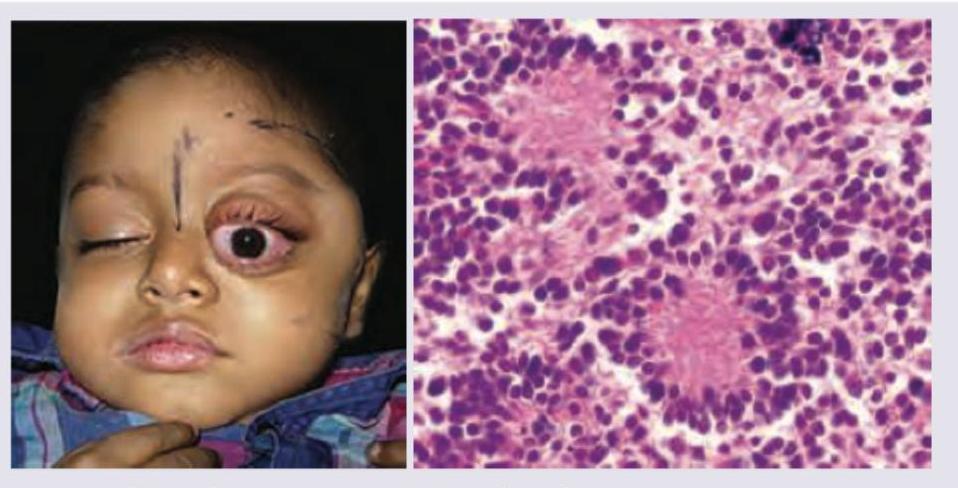
Explanation: **Explanation:** **Hutchinson’s secondaries** refer to the characteristic pattern of metastatic spread of **Neuroblastoma** to the skull and orbit. Neuroblastoma is the most common extracranial solid tumor in children, and in approximately 50% of cases, it originates in the **Adrenal Medulla** (derived from neural crest cells). 1. **Why Adrenals are correct:** Neuroblastoma frequently metastasizes to the bone, particularly the skull and orbital bones. This presentation, known as **Hutchinson’s syndrome**, is characterized by proptosis (bulging eyes) and periorbital ecchymosis ("Raccoon eyes" or "Panda eyes") due to retro-orbital deposits. Since the adrenal gland is the primary site for these tumors in the pediatric population, it is the source of these secondaries. 2. **Why other options are incorrect:** * **Lungs and Breast:** While these are common primary sites for bone metastasis in adults, they are extremely rare causes of pediatric skull secondaries. * **Liver:** While Neuroblastoma can spread to the liver (known as **Pepper’s syndrome**, common in infants/Stage 4S), this specific pattern involves hepatomegaly rather than skull deposits. **High-Yield Clinical Pearls for NEET-PG:** * **Pepper’s Syndrome:** Massive liver involvement in Neuroblastoma (usually Stage 4S). * **Smith’s Syndrome:** Metastasis to the skin (Blueberry muffin nodules). * **Diagnosis:** Elevated urinary catecholamines (VMA and HVA) and "Rosettes" (Homer-Wright rosettes) on histopathology. * **Imaging:** Calcification is a hallmark feature of Neuroblastoma on CT/X-ray (unlike Wilms' tumor).
Explanation: **Explanation:** In Acute Lymphoblastic Leukemia (ALL), while several factors help in initial risk stratification, the **Response to Treatment** (specifically early response) is considered the **single most important independent prognostic factor**. 1. **Why "Response to Treatment" is correct:** The speed at which leukemic blasts are cleared from the peripheral blood (by day 8) and the bone marrow (by day 15 or 29) reflects the inherent chemosensitivity of the disease. Modern protocols use **Minimal Residual Disease (MRD)** monitoring via flow cytometry or PCR at the end of induction. Patients who achieve MRD negativity have significantly higher event-free survival rates, regardless of their initial presenting features. 2. **Analysis of Incorrect Options:** * **Hyperdiploidy (Option A):** This is a **favorable genetic marker** (specifically >50 chromosomes), but it is a static baseline feature. Dynamic response to therapy carries more weight in predicting relapse. * **Organomegaly (Option B):** Massive hepatosplenomegaly or lymphadenopathy indicates a high tumor burden and is a poor prognostic sign, but it is less predictive than biological or therapeutic markers. * **TLC > 50,000/mL (Option C):** A high Total Leukocyte Count at presentation is a major criteria for "High Risk" ALL (NCI criteria), but many patients with high TLC still achieve long-term remission if they respond rapidly to induction chemotherapy. **High-Yield Clinical Pearls for NEET-PG:** * **Age & WBC:** Best prognosis is seen in ages **1–9 years** with a **WBC < 50,000/µL**. * **Cytogenetics:** * *Good Prognosis:* t(12;21) [ETV6-RUNX1], Hyperdiploidy. * *Poor Prognosis:* t(9;22) [Philadelphia chromosome], t(4;11) [MLL rearrangement], Hypodiploidy. * **Immunophenotype:** Early pre-B cell ALL has a better prognosis than T-cell ALL or mature B-cell ALL. * **CNS Involvement:** Presence of blasts in CSF at diagnosis is a poor prognostic indicator.
Explanation: **Explanation:** The clinical presentation described is a classic triad (Hand-Schüller-Christian disease variant) of **Langerhans Cell Histiocytosis (LCH)**. LCH is a proliferative disorder of myeloid dendritic cells that can infiltrate multiple organ systems. **Why Option C is correct:** * **Skin:** Seborrheic dermatitis-like rash (scaly, erythematous papules), especially in the diaper area or scalp, is a hallmark of LCH. * **Ear:** Chronic ear discharge (otitis media/externa) unresponsive to antibiotics often indicates infiltration of the mastoid or external auditory canal. * **Polyuria:** This signifies **Diabetes Insipidus (DI)**, caused by infiltration of the posterior pituitary/hypothalamic axis. DI is the most common endocrine abnormality in LCH. * **Hepatosplenomegaly:** Indicates multisystem involvement (high-risk LCH), often associated with bone marrow involvement and a poorer prognosis. **Why other options are incorrect:** * **Leukemia (A):** While it causes hepatosplenomegaly and bone pain, it typically presents with pallor, bruising (thrombocytopenia), and fever. It does not cause seborrheic dermatitis or DI. * **Lymphoma (B):** Usually presents with painless lymphadenopathy and systemic "B" symptoms (fever, weight loss). It rarely involves the skin in this specific pattern or causes DI. * **Germ Cell Tumor (D):** While some intracranial germ cell tumors can cause DI, they do not present with seborrheic dermatitis, chronic ear discharge, or hepatosplenomegaly. **High-Yield Clinical Pearls for NEET-PG:** * **Pathology:** Look for **Birbeck granules** (tennis-racket shaped) on Electron Microscopy. * **Markers:** Positive for **CD1a, S100, and CD207 (Langerin)**. * **Radiology:** "Punched-out" lytic bone lesions (especially in the skull). * **Treatment:** Prednisolone and Vinblastine are the standard first-line therapies for multisystem LCH.
Leukemias
Practice Questions
Lymphomas
Practice Questions
CNS Tumors
Practice Questions
Neuroblastoma
Practice Questions
Wilms Tumor
Practice Questions
Rhabdomyosarcoma
Practice Questions
Bone Tumors
Practice Questions
Retinoblastoma
Practice Questions
Histiocytosis Syndromes
Practice Questions
Principles of Pediatric Chemotherapy
Practice Questions
Hematopoietic Stem Cell Transplantation
Practice Questions
Late Effects of Cancer Treatment
Practice Questions
Get full access to all questions, explanations, and performance tracking.
Start For Free