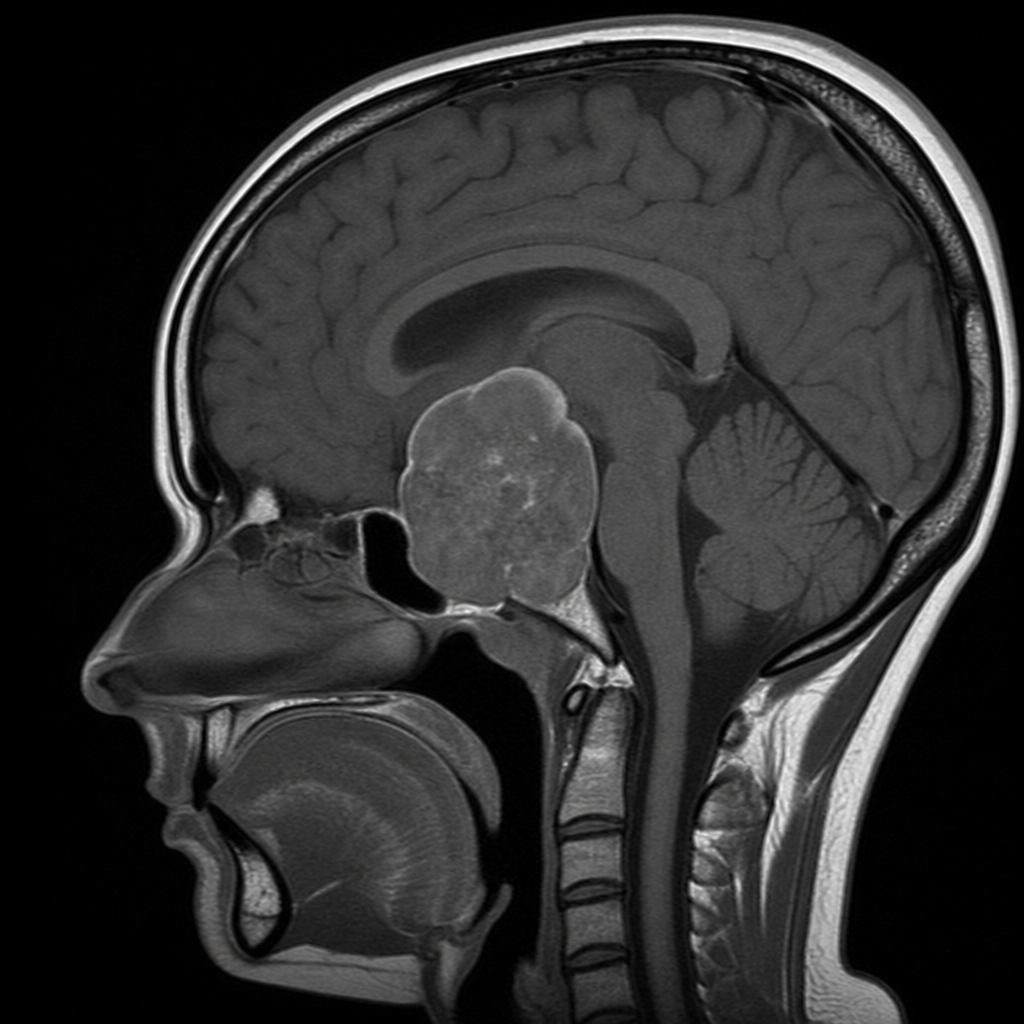
All are true about the presentation of Wilms tumor, except?
What is the most common subtype of acute lymphoblastic leukemia (ALL) in children?
Which of the following is NOT a favorable prognostic marker in pediatric acute lymphoblastic leukemia (ALL)?
A 9-year-old boy presents with fever, feeling unwell, and easy bruising on his legs. On examination, he is pale, with a blood pressure of 100/60 mm Hg, pulse of 100/min, and a temperature of 37.8°C. His lungs are clear, his abdomen is soft with a palpable spleen, and there are petechiae and bruises on his legs. His CBC reveals a hemoglobin of 8.5 g/dL, WBC of 17,000/mL, and platelets of 30,000/mL. A blood film reveals neutropenia and leukemic lymphoblasts. What is the most appropriate initial diagnostic test to confirm the diagnosis?
Which of the following is a definite marker for hepatoblastoma?
All of the statements regarding Wilm's tumor are true EXCEPT:
What is the most common leukemia in children with Down syndrome less than 3 years old?
All of the following are conditions associated with Wilm's tumor, except?
All of the following are good prognostic factors for childhood ALL except?
What is the most important determinant of prognosis in Wilms tumor?
Explanation: **Explanation:** Wilms tumor (Nephroblastoma) is the most common primary renal malignancy in children. The correct answer is **D** because bilateral involvement is **uncommon**, occurring in only **5–7%** of cases. Most Wilms tumors are sporadic and unilateral. **Breakdown of Options:** * **Option A (Painless mass):** This is the most common presentation. It typically manifests as a smooth, firm, abdominal mass that rarely crosses the midline. It is usually discovered incidentally by parents during bathing or dressing. * **Option B (Fever):** Fever is a documented constitutional symptom in about 20% of cases, often due to tumor necrosis or hemorrhage within the tumor. * **Option C (Can present in infancy):** While the peak incidence is between **2 to 5 years** of age, Wilms tumor can occur in infancy. However, if a renal mass is found in a neonate (under 3 months), Congenital Mesoblastic Nephroma is more likely. **High-Yield Clinical Pearls for NEET-PG:** * **WAGR Syndrome:** Wilms tumor, Aniridia, Genitourinary anomalies, and intellectual disability (formerly Retardation). Associated with **WT1** gene deletion on Chromosome 11p13. * **Beckwith-Wiedemann Syndrome:** Macroglossia, organomegaly, and hemihypertrophy. Associated with **WT2** gene on Chromosome 11p15. * **Hypertension:** Seen in 25% of cases due to increased renin production or renal artery compression. * **Management Tip:** Avoid vigorous palpation of the abdomen to prevent rupture of the tumor capsule and subsequent peritoneal seeding.
Explanation: **Explanation:** Acute Lymphoblastic Leukemia (ALL) is the most common pediatric malignancy. It is classified based on the lineage and maturity of the malignant lymphoblasts. **1. Why Pre-B cell ALL is Correct:** Approximately **80–85%** of all pediatric ALL cases are of **B-cell lineage**. Within this group, the **Early Pre-B (Pro-B)** and **Pre-B cell** subtypes are the most frequent. These cells are characterized by the expression of CD19, CD20, and CD10 (Common ALL Antigen or CALLA). The high prevalence of these immature B-cell precursors in the bone marrow during childhood development explains why this subtype is the most common. **2. Why Incorrect Options are Wrong:** * **Mature B cell ALL (Burkitt-type):** This accounts for only **2–3%** of cases. It is characterized by surface immunoglobulin expression and specific translocations like t(8;14). * **Pre-T cell ALL:** This accounts for about **12–15%** of cases. It typically presents in older adolescent males with a high white cell count and a mediastinal mass. * **Mature T cell ALL:** This is a rare subtype and significantly less common than the precursor (Pre-T) stage. **Clinical Pearls for NEET-PG:** * **Peak Age:** 2 to 5 years. * **Best Prognostic Marker:** Hyperdiploidy (>50 chromosomes) and t(12;21) [ETV6-RUNX1]. * **Poor Prognostic Marker:** Hypodiploidy and t(9;22) [Philadelphia Chromosome]. * **Common Site of Relapse:** Central Nervous System (CNS) and Testes (sanctuary sites). * **Immunophenotype:** CD10 (CALLA) positivity is a marker for a better prognosis compared to CD10 negative cases.
Explanation: **Explanation:** In pediatric Acute Lymphoblastic Leukemia (ALL), prognosis is determined by age, initial white blood cell (WBC) count, and cytogenetic abnormalities. **1. Why Hypodiploidy is the Correct Answer:** **Hypodiploidy** (defined as <45 chromosomes) is a **poor prognostic marker**. It is associated with a high risk of treatment failure and relapse. In contrast, **hyperdiploidy** (>50 chromosomes) is a favorable prognostic factor. **2. Analysis of Incorrect Options (Favorable Markers):** * **Age (2–10 years):** This is the "golden age" for ALL prognosis. Children diagnosed between ages 1 and 10 have significantly better outcomes than infants (<1 year) or adolescents (>10 years). * **Low WBC count:** An initial WBC count of **<50,000/µL** (specifically in B-ALL) is a strong indicator of a favorable prognosis. High tumor burden at presentation (WBC >50,000) suggests a more aggressive disease. * **t(12;21):** Also known as the *TEL-AML1* (ETV6-RUNX1) fusion, this is the most common translocation in childhood B-ALL and is associated with an **excellent prognosis** and high cure rates. **Clinical Pearls for NEET-PG:** * **Most common childhood cancer:** ALL. * **Best Prognosis Cytogenetics:** t(12;21) and Hyperdiploidy. * **Worst Prognosis Cytogenetics:** t(9;22) [Philadelphia chromosome/BCR-ABL1], t(4;11) [MLL rearrangement], and Hypodiploidy. * **Early Response:** The most important independent prognostic factor today is the **Minimal Residual Disease (MRD)** status at the end of induction therapy.
Explanation: **Explanation:** The clinical presentation of fever, pallor (anemia), petechiae/bruising (thrombocytopenia), and splenomegaly in a child, combined with the presence of **lymphoblasts** on a peripheral smear, is highly suggestive of **Acute Lymphoblastic Leukemia (ALL)**—the most common pediatric malignancy. 1. **Why Bone Marrow Aspirate and Biopsy is correct:** While a peripheral smear provides a clue, the definitive diagnosis of leukemia requires a bone marrow examination. According to standard diagnostic criteria, the presence of **≥20% blasts** in the bone marrow is required to confirm the diagnosis. The aspirate also allows for essential ancillary testing, including **immunophenotyping (flow cytometry)** to differentiate B-cell from T-cell ALL, and **cytogenetics** (e.g., t(12;21)), which are critical for risk stratification and treatment planning. 2. **Why other options are incorrect:** * **Monospot test:** Used for Infectious Mononucleosis (EBV). While it presents with fever and splenomegaly, it would show atypical lymphocytes, not lymphoblasts, and would not explain the severe cytopenias (anemia/thrombocytopenia). * **CT scan of the abdomen:** May confirm splenomegaly but cannot diagnose the underlying hematological malignancy. * **Chest X-ray:** Useful to check for a mediastinal mass (common in T-cell ALL), but it is a staging/supportive tool, not a primary diagnostic test for leukemia. **High-Yield Clinical Pearls for NEET-PG:** * **Most common childhood leukemia:** ALL (Peak age: 2–5 years). * **Best prognostic factor:** Age (1–9 years) and low initial WBC count (<50,000/µL). * **Commonest cytogenetic abnormality (Good prognosis):** t(12;21) / *ETV6-RUNX1*. * **Poor prognosis:** t(9;22) / Philadelphia chromosome (more common in adults). * **Sanctuary sites:** Testes and CNS (require specific prophylactic therapy).
Explanation: **Explanation:** **Hepatoblastoma** is the most common primary liver tumor in children, typically occurring before the age of 3. The definitive biochemical marker for this malignancy is **Alpha-fetoprotein (AFP)**. 1. **Why AFP is correct:** AFP is a glycoprotein normally produced by the fetal liver and yolk sac. In hepatoblastoma, serum AFP levels are significantly elevated (often >100,000 ng/mL) in over 90% of cases. It serves three critical roles: **diagnosis**, monitoring **response to therapy**, and detecting **recurrence**. A very low AFP at diagnosis (<100 ng/mL) is actually a poor prognostic sign, as it indicates a more aggressive, undifferentiated tumor subtype (small cell undifferentiated). 2. **Why other options are incorrect:** * **LDH:** A non-specific marker of cell turnover. While elevated in many pediatric malignancies (like neuroblastoma or lymphoma), it lacks the specificity required for a diagnosis of hepatoblastoma. * **HCG:** While some hepatoblastomas can secrete HCG (leading to precocious puberty), it is not a universal or definitive marker. It is more classically associated with germ cell tumors. * **Alkaline Phosphatase:** This is a marker of biliary obstruction or bone turnover; it is not specific to the pathogenesis of hepatoblastoma. **High-Yield Clinical Pearls for NEET-PG:** * **Associated Conditions:** Hepatoblastoma is strongly linked with **Beckwith-Wiedemann Syndrome** and **Familial Adenomatous Polyposis (FAP)**. * **Radiology:** Look for a large, solitary mass in the right lobe of the liver with "sunburst" calcifications on CT. * **Treatment:** The mainstay is neoadjuvant chemotherapy followed by surgical resection. * **Differential:** In an older child (>5 years) with a liver mass and normal AFP, consider **Hepatocellular Carcinoma (HCC)** or **Mesenchymal Hamartoma**.
Explanation: **Explanation:** Wilms tumor (Nephroblastoma) is the most common primary renal malignancy in children. Understanding its clinical profile is crucial for NEET-PG. **1. Why Option A is the correct answer (The False Statement):** Wilms tumor is primarily a disease of early childhood. The median age at diagnosis is **3 to 4 years**. Approximately 80% of cases present before the age of 5. Presenting *after* 5 years of age is uncommon, making this statement false. **2. Analysis of Incorrect Options (True Statements):** * **Option B (Hematuria):** While an asymptomatic abdominal mass is the most common sign, **microscopic hematuria** occurs in about 25–33% of patients due to tumor invasion of the renal pelvis. * **Option C (Abdominal Mass):** The classic presentation is a **smooth, firm, and unilateral abdominal mass** that rarely crosses the midline (unlike Neuroblastoma). It is often discovered incidentally by parents during bathing. * **Option D (Metastasis):** The **lungs** are the most common site of hematogenous metastasis, followed by the liver. **Clinical Pearls for NEET-PG:** * **WAGR Syndrome:** Wilms tumor, Aniridia, Genitourinary anomalies, and intellectual disability (formerly Retardation). Associated with **WT1 gene** deletion on Chromosome 11p13. * **Beckwith-Wiedemann Syndrome:** Characterized by macroglossia, omphalocele, and hemihypertrophy; associated with **WT2 gene** on Chromosome 11p15. * **Management:** Treatment usually involves a combination of nephrectomy and chemotherapy. It has an excellent prognosis with survival rates exceeding 90% for localized disease. * **Rule of Thumb:** If a renal mass crosses the midline and shows calcification on X-ray, think **Neuroblastoma**; if it is smooth and confined to one side, think **Wilms tumor**.
Explanation: Children with Down syndrome (Trisomy 21) have a significantly increased risk (10–20 fold) of developing leukemia. The specific type of leukemia is highly dependent on the child's age. **Explanation of the Correct Answer:** In children with Down syndrome **under the age of 3 years**, the most common leukemia is **Acute Myeloid Leukemia (AML)**, specifically the **M7 subtype (Acute Megakaryoblastic Leukemia)**. This is often preceded by a unique condition called Transient Myeloproliferative Disorder (TMD). The pathogenesis is linked to a somatic mutation in the **GATA1 gene**, which is almost pathognomonic for Down syndrome-related megakaryocytic proliferation. Interestingly, children with Down syndrome and AML-M7 have a much better prognosis and higher sensitivity to chemotherapy (cytarabine) compared to non-Down syndrome children. **Analysis of Incorrect Options:** * **Option A (ALL):** While ALL is the most common leukemia in the general pediatric population and is also more common in Down syndrome patients **overall**, it typically presents in children **older than 3 years**. * **Option B (AML-M5):** Acute Monocytic Leukemia is a subtype of AML but is not specifically associated with the unique genetic predisposition of Down syndrome. * **Option C (Hodgkin Lymphoma):** This is a solid tumor of the lymphoid system. While Down syndrome increases the risk of leukemia, it does not significantly increase the risk of Hodgkin lymphoma. **High-Yield Clinical Pearls for NEET-PG:** * **Age < 3 years:** AML-M7 is most common. * **Age > 3 years:** ALL is most common. * **Genetic Marker:** GATA1 mutation (specific to DS-AML and TMD). * **Transient Myeloproliferative Disorder (TMD):** Occurs in newborns with Down syndrome; usually resolves spontaneously but predisposes to AML-M7 later. * **Prognosis:** DS-AML has a superior cure rate compared to sporadic AML.
Explanation: **Explanation:** Wilms tumor (Nephroblastoma) is the most common primary renal malignancy in children. It is frequently associated with specific congenital malformations and overgrowth syndromes due to mutations in the **WT1** (Chromosome 11p13) or **WT2** (11p15) genes. **Why Polycystic Kidney is the Correct Answer:** Polycystic kidney disease (PKD) is a genetic disorder characterized by the growth of numerous cysts in the kidneys. While it can lead to renal failure, it is **not** a recognized syndromic association or a precursor to Wilms tumor. **Analysis of Incorrect Options:** * **Aniridia:** This is the absence of the iris. It is a hallmark component of the **WAGR Syndrome** (Wilms tumor, Aniridia, Genitourinary anomalies, and intellectual disability/Range of developmental delays), caused by a microdeletion at 11p13. * **Gonadal Dysgenesis:** This refers to the atypical development of the gonads. It is a key feature of **Denys-Drash Syndrome**, which consists of a triad of Wilms tumor, pseudohermaphroditism (gonadal dysgenesis), and early-onset nephropathy. * **Hemihypertrophy:** This is the asymmetric overgrowth of one side of the body. It is strongly associated with **Beckwith-Wiedemann Syndrome (BWS)**, an overgrowth disorder (WT2 mutation) that carries a significantly increased risk for Wilms tumor and hepatoblastoma. **High-Yield Clinical Pearls for NEET-PG:** * **Most common presentation:** Asymptomatic abdominal mass (does not cross the midline). * **WAGR Syndrome:** Associated with *WT1* deletion. * **Beckwith-Wiedemann Syndrome:** Features include macroglossia, omphalocele, and hemihypertrophy. * **Screening:** Children with these associated syndromes require serial abdominal ultrasounds every 3 months until age 7 for early detection. * **Staging:** Unlike Neuroblastoma, Wilms tumor staging is based on surgical findings.
Explanation: In childhood Acute Lymphoblastic Leukemia (ALL), prognosis is determined by age, initial white blood cell (WBC) count, cytogenetics, and response to therapy. **Explanation of the Correct Answer:** **Option A (Female sex)** is the correct answer because, while females historically had a slightly better prognosis than males (due to the absence of testicular relapses), modern risk stratification protocols consider **female sex a neutral factor** rather than a "good prognostic factor." In the context of this question, the other three options are well-established, classic indicators of a favorable outcome, making "Female sex" the least accurate description of a "good prognostic factor" in contemporary oncology. **Explanation of Incorrect Options:** * **B. Hyperdiploidy (>50 chromosomes):** This is one of the strongest indicators of a favorable prognosis. These cells are highly sensitive to methotrexate and apoptosis. * **C. t(12;21) translocation:** Also known as the *TEL-AML1* (ETV6-RUNX1) fusion, this is the most common translocation in childhood ALL and is associated with an excellent long-term cure rate. * **D. Pre-B cell ALL:** This subtype generally carries a better prognosis compared to T-cell ALL or mature B-cell (Burkitt) leukemia. **High-Yield Clinical Pearls for NEET-PG:** * **Age:** 1–9 years is favorable; <1 year (infants) or >10 years is poor. * **WBC Count:** <50,000/µL is favorable; >50,000/µL is poor. * **Cytogenetics (Good):** Hyperdiploidy, t(12;21), Trisomy 4, 10, and 17. * **Cytogenetics (Poor):** Hypodiploidy, t(9;22) [Philadelphia chromosome], t(4;11) [MLL gene rearrangement]. * **CNS Involvement:** Presence of blasts in CSF at diagnosis is a poor prognostic sign.
Explanation: **Explanation:** In Wilms tumor (Nephroblastoma), **Histology** is the single most important prognostic factor. It is broadly categorized into two groups: **Favorable Histology (FH)** and **Unfavorable Histology (UH)**. The presence of **anaplasia** (diffuse or focal) defines unfavorable histology and is strongly associated with resistance to chemotherapy and a higher risk of relapse, regardless of the stage. **Analysis of Options:** * **Option A (Stage of disease):** While staging (NWTS/SIOP criteria) is crucial for determining the intensity of treatment and predicting outcomes, it is secondary to histology. A Stage I tumor with diffuse anaplasia often has a worse prognosis than a Stage III tumor with favorable histology. * **Option B (Loss of heterozygosity of 1p and 16q):** These are specific molecular markers used for risk stratification. While LOH of 1p and 16q is associated with a poorer prognosis in favorable histology tumors, it is not as globally significant as the microscopic appearance (histology) itself. * **Option D (Age):** While younger age (especially <2 years) generally correlates with better outcomes and lower stages, it is not a primary determinant of the biological behavior of the tumor. **High-Yield Clinical Pearls for NEET-PG:** * **Most common presentation:** Asymptomatic abdominal mass (does not cross the midline). * **Associated Syndromes:** WAGR (WT1), Denys-Drash (WT1), and Beckwith-Wiedemann (WT2). * **Most common site of metastasis:** Lungs (Cannon-ball metastasis). * **Triphasic Histology:** Classic Wilms tumor consists of three elements: Blastemal, Stromal, and Epithelial cells. * **Treatment:** Multimodal (Surgery + Chemotherapy +/- Radiotherapy). In the USA (NWTS), surgery is performed first; in Europe (SIOP), pre-operative chemotherapy is preferred.
Leukemias
Practice Questions
Lymphomas
Practice Questions
CNS Tumors
Practice Questions
Neuroblastoma
Practice Questions
Wilms Tumor
Practice Questions
Rhabdomyosarcoma
Practice Questions
Bone Tumors
Practice Questions
Retinoblastoma
Practice Questions
Histiocytosis Syndromes
Practice Questions
Principles of Pediatric Chemotherapy
Practice Questions
Hematopoietic Stem Cell Transplantation
Practice Questions
Late Effects of Cancer Treatment
Practice Questions
Get full access to all questions, explanations, and performance tracking.
Start For Free