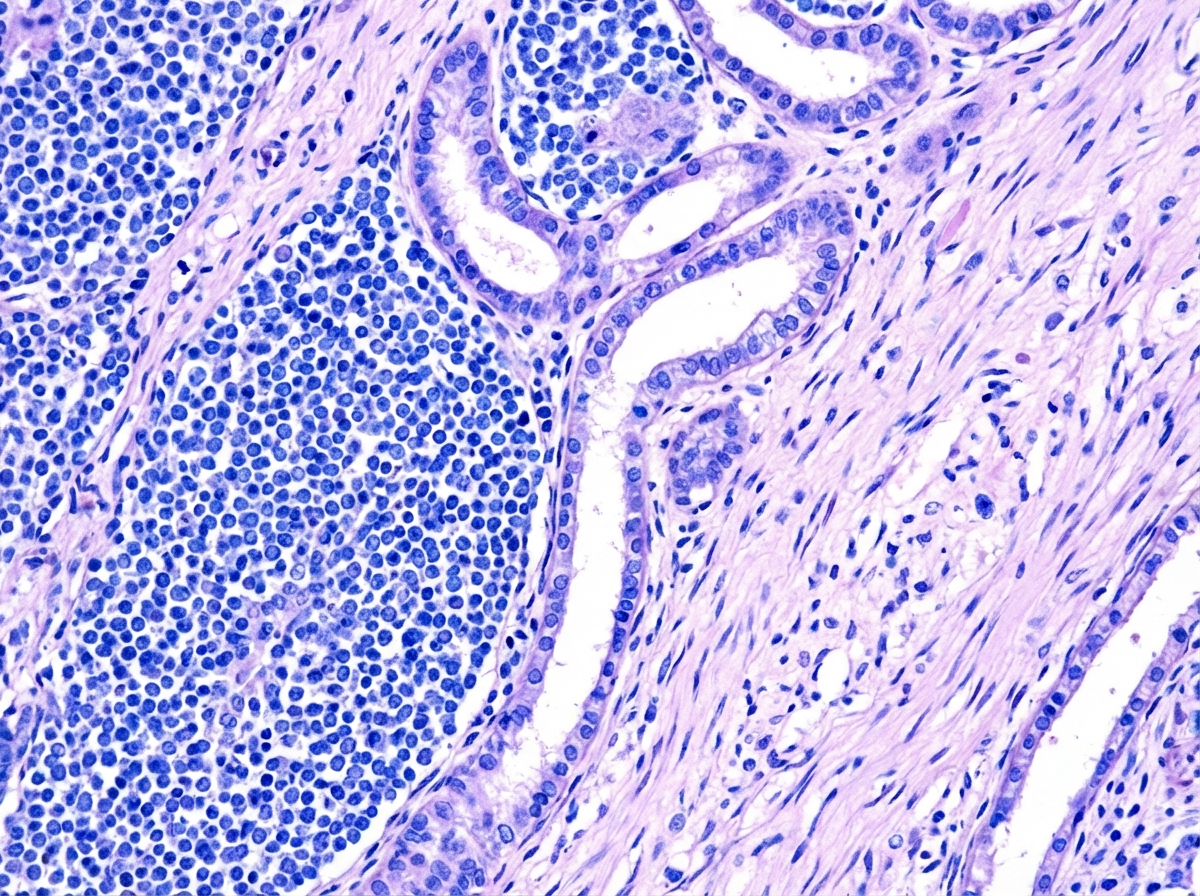
What is the most common malignant neoplasm of infancy?
Wilms' tumor is associated with which of the following conditions?
What is the most common extracranial solid tumor in the pediatric age group?
Which of the following is a poor prognostic factor associated with Acute Lymphoblastic Leukemia (ALL) in children?
Which is the most important prognostic marker in ALL?
WAGR syndrome includes all except?
What is the most common malignancy of the liver in children?
Wilms' tumour is associated with all of the following except?
Opsoclonus is associated with which of the following?
What is the second most common neoplasm seen in children?
Explanation: **Explanation:** **Neuroblastoma** is the most common extracranial solid tumor of childhood and the **most common malignant neoplasm of infancy** (defined as children <1 year of age). It originates from primordial neural crest cells of the sympathetic nervous system, most commonly occurring in the adrenal medulla. Its high incidence in infancy is attributed to its embryonal nature; in fact, many cases are congenital or detected during prenatal screening. **Analysis of Incorrect Options:** * **Malignant Teratoma:** While teratomas are the most common germ cell tumors in neonates (specifically Sacrococcygeal teratoma), the majority are benign at birth. They do not surpass neuroblastoma in overall malignant frequency during infancy. * **Wilms’ Tumor (Nephroblastoma):** This is the most common primary renal tumor in children, but its peak incidence occurs between **2 to 5 years** of age. It is relatively rare in the first year of life. * **Hepatoblastoma:** This is the most common liver malignancy in children, but it is significantly less common overall than neuroblastoma. **High-Yield Clinical Pearls for NEET-PG:** * **Median age of diagnosis:** 19 months (but it remains the #1 malignancy in the <1-year age group). * **Clinical Feature:** Often presents as a hard, irregular abdominal mass that **crosses the midline** (unlike Wilms’ tumor, which usually does not). * **Opsoclonus-Myoclonus Syndrome:** A classic paraneoplastic syndrome associated with neuroblastoma ("dancing eyes, dancing feet"). * **Biomarker:** Elevated urinary catecholamines (VMA and HVA) are found in 90% of cases. * **Prognosis:** Age is a major prognostic factor; infants (<18 months) generally have a much better prognosis, including the possibility of spontaneous regression (Stage 4S).
Explanation: **Explanation:** Wilms' tumor (Nephroblastoma) is the most common primary renal malignancy in children. While it is famously associated with several congenital syndromes, the question asks for a condition **not** typically associated with it, or identifies a distractor in a "except" style format. **Note on the Answer Key:** In standard medical literature, **Bilateral Polycystic Kidney Disease (BPKD)** is **not** a known predisposing factor or associated feature of Wilms' tumor. If the question asks which is associated, Options A, B, and C are all classic features. If the provided key marks D as correct, it implies D is the "odd one out" or the condition **not** associated. * **Hemihypertrophy (Option A):** This is a classic association, often seen in **Beckwith-Wiedemann Syndrome** (macroglossia, omphalocele, hemihypertrophy, and Wilms' tumor). * **Aniridia (Option B):** Absence of the iris is a hallmark of **WAGR Syndrome** (Wilms' tumor, Aniridia, Genitourinary anomalies, and intellectual disability/Range of developmental delays). * **Hypertension (Option C):** Approximately 25% of patients with Wilms' tumor present with hypertension due to increased renin production or compression of the renal artery by the tumor mass. * **Bilateral Polycystic Kidney Disease (Option D):** This is a genetic ciliopathy and is not part of the oncogenic pathways (WT1/WT2 mutations) that lead to Wilms' tumor. **High-Yield Clinical Pearls for NEET-PG:** 1. **WAGR Syndrome:** Associated with deletions on chromosome **11p13** (WT1 gene). 2. **Beckwith-Wiedemann Syndrome:** Associated with mutations on chromosome **11p15.5** (WT2 gene). 3. **Denys-Drash Syndrome:** Characterized by the triad of Wilms' tumor, pseudohermaphroditism, and early-onset nephropathy (glomerulosclerosis). 4. **Clinical Presentation:** Most common presentation is an **asymptomatic, firm, smooth abdominal mass** that does not cross the midline (unlike Neuroblastoma).
Explanation: **Explanation:** **Neuroblastoma** is the most common extracranial solid tumor in children. It originates from primordial neural crest cells of the sympathetic nervous system, most frequently occurring in the adrenal medulla (approx. 40%) or the sympathetic chain. It is the most common malignancy in infants (<1 year old). **Analysis of Options:** * **Neuroblastoma (Correct):** While Leukemia is the most common childhood cancer overall, and Brain Tumors are the most common solid tumors, Neuroblastoma holds the title for the most common **extracranial** solid tumor. * **Juvenile Pilocytic Astrocytoma:** This is a common pediatric brain tumor. However, it is **intracranial**, excluding it from this category. * **Chloroma (Granulocytic Sarcoma):** This is an extramedullary collection of leukemia cells (often associated with AML). It is not a primary solid tumor. * **Retinoblastoma:** This is the most common primary intraocular tumor in children, but its overall incidence is lower than that of neuroblastoma. **High-Yield Clinical Pearls for NEET-PG:** * **Median Age:** 2 years. * **Clinical Feature:** A firm, irregular, non-tender abdominal mass that **crosses the midline** (unlike Wilms tumor, which usually does not). * **Biomarkers:** Elevated urinary catecholamines (VMA and HVA). * **Opsoclonus-Myoclonus Syndrome:** A classic paraneoplastic syndrome ("dancing eyes, dancing feet") associated with neuroblastoma. * **Prognostic Marker:** **N-myc (MYCN) amplification** is the most important indicator of poor prognosis. * **Homer-Wright Rosettes:** Characteristic finding on histopathology.
Explanation: **Explanation:** In pediatric Acute Lymphoblastic Leukemia (ALL), prognosis is determined by risk stratification based on clinical and biological features. **Why Testicular Involvement is Correct:** The testes and the Central Nervous System (CNS) are considered **"sanctuary sites."** The blood-testis barrier prevents many standard chemotherapeutic agents from reaching therapeutic concentrations in these tissues. Therefore, testicular involvement at diagnosis indicates a higher tumor burden and a significant risk for relapse, placing the patient in a **high-risk (poor prognosis)** category. **Analysis of Incorrect Options:** * **A. Total Leukocyte Count (TLC):** A TLC < 50,000/mm³ is generally a favorable prognostic factor. The range provided (4,000–100,000) includes many patients with a good prognosis. A TLC > 50,000/mm³ is the traditional cutoff for high-risk. * **B. Age:** The "age peak" for the best prognosis is **1 to 9 years**. While infants (<1 year) have a very poor prognosis, children aged 1–2 years generally fall within a more favorable risk group compared to adolescents or infants. * **D. Presence of blasts in peripheral smear:** This is a diagnostic feature of leukemia, not a prognostic one. Nearly all ALL patients present with circulating blasts. **High-Yield Clinical Pearls for NEET-PG:** * **Best Prognostic Age:** 1–9 years. * **Best Prognostic TLC:** < 50,000/mm³. * **Cytogenetics (Good Prognosis):** Hyperdiploidy (>50 chromosomes), t(12;21) [TEL-AML1]. * **Cytogenetics (Poor Prognosis):** Hypodiploidy (<44 chromosomes), t(9;22) [Philadelphia chromosome], t(4;11) [MLL rearrangement]. * **Immunophenotype:** Early pre-B cell has a better prognosis than T-cell ALL. * **Rapid Response:** Achieving remission within 14–28 days of induction therapy is the strongest predictor of a favorable outcome.
Explanation: **Explanation:** In Acute Lymphoblastic Leukemia (ALL), the **response to initial induction chemotherapy** (specifically the clearance of blasts from peripheral blood by day 8 or bone marrow by day 15/29) is considered the **most important independent prognostic factor**. This is measured via **Minimal Residual Disease (MRD)** monitoring. A rapid reduction in leukemic burden indicates high chemosensitivity and a lower risk of relapse, overriding many baseline clinical features. **Analysis of Options:** * **A. Leukocyte count >50,000:** This is a significant baseline risk stratifier. A WBC count >50,000/µL at presentation is a marker for "High Risk" ALL, but it is secondary to the dynamic response to treatment. * **B. Hyperploidy:** Cytogenetics play a major role in prognosis. Hyperploidy (>50 chromosomes) and the t(12;21) translocation are **favorable** genetic markers, whereas the Philadelphia chromosome t(9;22) is unfavorable. However, these are static markers compared to the dynamic treatment response. * **C. Response to treatment:** Correct. It integrates the biological sensitivity of the tumor and the host's pharmacogenetics, making it the strongest predictor of long-term survival. * **D. Organomegaly:** Massive hepatosplenomegaly or mediastinal masses indicate a higher tumor burden but are considered minor prognostic factors compared to age, WBC count, and cytogenetics. **High-Yield Clinical Pearls for NEET-PG:** * **Age:** Best prognosis is between **1–9 years**. Age <1 year (infants) or >10 years carries a poorer prognosis. * **Immunophenotype:** Early Pre-B cell ALL has a better prognosis than T-cell ALL. * **CNS Involvement:** Presence of blasts in CSF at diagnosis is a poor prognostic sign. * **Most common childhood malignancy:** ALL (Peak incidence: 2–5 years).
Explanation: **Explanation:** WAGR syndrome is a rare genetic contiguous gene deletion syndrome caused by the microdeletion of chromosome **11p13**. This specific region contains the **WT1** (Wilms Tumor 1) gene and the **PAX6** gene, which are responsible for the clinical manifestations of the syndrome. The acronym **WAGR** stands for: * **W – Wilms tumor:** Approximately 45-50% of affected children develop this nephroblastoma. * **A – Aniridia:** The absence of the iris (due to *PAX6* deletion), often the first sign noted at birth. * **G – Genitourinary anomalies:** Including cryptorchidism, hypospadias, or ambiguous genitalia. * **R – Range of developmental delays:** Formerly referred to as Mental Retardation. **Why Option C is correct:** **Anorectal malformations** are not a component of WAGR syndrome. They are more commonly associated with the **VACTERL** association (Vertebral, Anal atresia, Cardiac, Tracheo-Esophageal, Renal, Limb defects) or Currarino syndrome. **Why other options are incorrect:** * **Wilms tumor (A):** A core component; these patients require frequent renal ultrasounds for early screening. * **Mental Retardation (B):** Now termed intellectual disability, it is a classic feature of the syndrome. * **Genital anomalies (D):** These occur due to the involvement of the *WT1* gene, which is essential for normal urogenital development. **High-Yield Clinical Pearls for NEET-PG:** * **Genetics:** Microdeletion of **11p13**. * **WAGRO Syndrome:** If the deletion extends to include the *BDNF* gene, patients also present with **O**besity. * **Denys-Drash Syndrome:** Another *WT1* related disorder characterized by Wilms tumor, pseudohermaphroditism, and early-onset nephrotic syndrome (diffuse mesangial sclerosis). * **Beckwith-Wiedemann Syndrome:** Associated with Wilms tumor but involves chromosome **11p15** (WT2).
Explanation: **Explanation:** **Hepatoblastoma** is the most common primary liver malignancy in children, accounting for approximately 50% of all pediatric liver tumors. It typically presents in infants and toddlers, with the majority of cases diagnosed before the age of 3 years. The tumor originates from primitive epithelial cells (blasts) and is strongly associated with prematurity, low birth weight, and genetic syndromes like **Beckwith-Wiedemann Syndrome** and **Familial Adenomatous Polyposis (FAP)**. **Analysis of Options:** * **Hepatocellular Carcinoma (HCC):** While it is the most common primary liver cancer in adults, it is the second most common in children. It usually occurs in older children (10–15 years) and is often associated with underlying chronic liver diseases like Hepatitis B or Tyrosinemia. * **Lymphoma:** While the liver can be involved in systemic lymphoma (secondary involvement), primary hepatic lymphoma is extremely rare in the pediatric population. * **None of the above:** Incorrect, as Hepatoblastoma is the established leading primary malignancy. **High-Yield Clinical Pearls for NEET-PG:** * **Tumor Marker:** Serum **Alpha-fetoprotein (AFP)** is elevated in >90% of cases and is used for both diagnosis and monitoring treatment response. * **Imaging:** Ultrasound is the initial screening tool, but CT/MRI is required for Pre-treatment Extent of Disease (PRETEXT) staging. * **Pathology:** Look for "fetal" or "embryonal" epithelial cells on histology. * **Treatment:** A combination of neoadjuvant chemotherapy and surgical resection. It is a highly vascular tumor; hence, complete resection is the goal.
Explanation: **Explanation:** Wilms’ tumor (Nephroblastoma) is the most common primary renal malignancy in children. It is frequently associated with specific congenital malformation syndromes due to genetic mutations on chromosome 11 (WT1 and WT2 genes). **Why Polycystic Kidney Disease (PKD) is the correct answer:** PKD is a genetic disorder characterized by the growth of numerous cysts in the kidneys, but it is **not** a recognized syndromic association or a precursor to Wilms’ tumor. While both involve the kidneys, their underlying pathophysiology and genetic origins (PKD1/PKD2 vs. WT1/WT2) are distinct. **Analysis of Incorrect Options:** * **Aniridia:** This is the absence of the iris. It is a key component of the **WAGR syndrome** (Wilms’ tumor, Aniridia, Genitourinary anomalies, and intellectual disability/Range of developmental delays), caused by a microdeletion on chromosome 11p13. * **Beckwith-Wiedemann Syndrome (BWS):** A classic overgrowth syndrome (macroglossia, omphalocele, organomegaly) associated with Wilms’ tumor due to mutations at the 11p15.5 locus (WT2). * **Hemihypertrophy:** This refers to the asymmetric overgrowth of one side of the body. It is a common clinical finding in children with BWS and is a known high-risk marker for the development of Wilms’ tumor. **NEET-PG High-Yield Pearls:** 1. **Denys-Drash Syndrome:** Characterized by the triad of Wilms’ tumor, male pseudohermaphroditism, and early-onset renal failure (mesangial sclerosis). 2. **Screening:** Children with associated syndromes (BWS, WAGR, or isolated hemihypertrophy) require screening with abdominal ultrasound every 3 months until age 7. 3. **Most common presentation:** A painless, palpable abdominal mass that typically does not cross the midline (unlike Neuroblastoma). 4. **Metastasis:** The most common site of distant spread is the **Lungs**.
Explanation: **Explanation:** **Opsoclonus-Myoclonus-Ataxia Syndrome (OMS)**, also known as "Dancing Eye-Dancing Feet Syndrome," is a classic paraneoplastic manifestation most commonly associated with **Neuroblastoma** in the pediatric population. 1. **Why Neuroblastoma is correct:** Neuroblastoma is an embryonal tumor of the sympathetic nervous system. In approximately 2–3% of cases, the body produces antibodies against the tumor cells that cross-react with cerebellar Purkinje cells. This immune-mediated process results in **opsoclonus** (rapid, involuntary, multivectorial eye movements), **myoclonus** (brief muscle jerks), and **ataxia**. Interestingly, patients with neuroblastoma who present with OMS often have a more favorable prognosis, as the tumor is typically localized and low-stage. 2. **Why the other options are incorrect:** * **Nephroblastoma (Wilms Tumor):** This is the most common renal tumor in children. It typically presents as an asymptomatic abdominal mass and is associated with syndromes like WAGR or Denys-Drash, but not with opsoclonus. * **Retinoblastoma:** This is a primary intraocular tumor. While it involves the visual system (presenting with leukocoria or strabismus), it does not trigger the paraneoplastic cerebellar response seen in OMS. * **Hypernephroma (Renal Cell Carcinoma):** This is primarily an adult malignancy. While it can cause paraneoplastic syndromes (like erythrocytosis or hypercalcemia), it is not associated with opsoclonus. **High-Yield Clinical Pearls for NEET-PG:** * **Neuroblastoma Markers:** Elevated urinary catecholamines (VMA and HVA) and Neuron-Specific Enolase (NSE). * **Imaging:** Look for "stippled calcification" on X-ray/CT and encasement of major vessels (unlike Wilms, which displaces them). * **N-myc Amplification:** The most important poor prognostic genetic marker. * **Homer-Wright Rosettes:** The characteristic histopathological finding.
Explanation: **Explanation:** In pediatric oncology, the frequency of malignancies follows a specific hierarchy that is frequently tested in NEET-PG. **1. Why Brain Tumors are the Correct Answer:** Leukemia (specifically ALL) is the most common pediatric malignancy overall. **Brain tumors** (Central Nervous System tumors) represent approximately 20–25% of all childhood cancers, making them the **second most common** neoplasm in children and the **most common solid tumor** in the pediatric age group. In children, the majority of these tumors are infratentorial (e.g., Medulloblastoma, Pilocytic Astrocytoma). **2. Analysis of Incorrect Options:** * **A. Lymphoma:** This is the **third** most common pediatric malignancy. It includes both Hodgkin and Non-Hodgkin Lymphoma. * **D. Neuroblastoma:** This is the most common **extracranial** solid tumor in children and the most common malignancy in **infants** (<1 year old). Overall, it ranks fourth. * **C. Wilm’s Tumor (Nephroblastoma):** This is the most common primary renal tumor in children, but it ranks lower in overall frequency compared to the options above. **3. NEET-PG High-Yield Pearls:** * **Most common overall:** Leukemia (ALL). * **Most common solid tumor:** Brain Tumors. * **Most common extracranial solid tumor:** Neuroblastoma. * **Most common malignant bone tumor:** Osteosarcoma (Ewing’s is second). * **Most common soft tissue sarcoma:** Rhabdomyosarcoma. * **Rule of Thumb for Brain Tumors:** In adults, they are mostly supratentorial; in children (after age 1), they are mostly **infratentorial** (posterior fossa).
Explanation: **Explanation:** **Medulloblastoma** is the most common malignant brain tumor in children and the most frequent tumor found in the **posterior fossa**. It typically arises from the roof of the fourth ventricle (vermis), leading to early obstructive hydrocephalus and signs of increased intracranial tension (headache, vomiting, papilledema). On imaging, it appears as a solid, enhancing midline mass. **Analysis of Options:** * **A. Astrocytoma:** Specifically, Juvenile Pilocytic Astrocytoma (JPA) is the most common *overall* pediatric brain tumor. While it frequently occurs in the posterior fossa (cerebellum), it is often cystic with an enhancing mural nodule. In many competitive exams, if the question asks for the "most common posterior fossa tumor," Medulloblastoma is the preferred answer due to its classic midline presentation and high malignancy rate. * **C. Craniopharyngioma:** These are suprasellar (above the sella turcica) tumors, not posterior fossa tumors. They typically present with visual field defects (bitemporal hemianopia) and endocrine dysfunction. * **D. Meningioma:** These are common in adults but extremely rare in the pediatric population. **High-Yield Clinical Pearls for NEET-PG:** * **Histology:** Look for **Homer-Wright rosettes** and small round blue cells (primitive neuroectodermal cells). * **Spread:** Medulloblastoma has a high propensity for **CSF seeding** ("drop metastasis" to the spinal cord); hence, neuraxis imaging (MRI spine) is mandatory. * **Genetics:** Associated with **Turcot Syndrome** (APC gene) and Gorlin Syndrome. * **Location Rule:** In children, 70% of brain tumors are **infratentorial** (posterior fossa); in adults, 70% are supratentorial.
Explanation: **Explanation:** **Sacrococcygeal Teratoma (SCT)** is the most common tumor of the fetus and the newborn, occurring in approximately 1 in 35,000 to 40,000 live births. These tumors arise from the **totipotent cells of the primitive streak** (Hensen’s node) and contain elements from all three germ layers. They are more common in females (4:1 ratio) and are usually benign at birth, though the risk of malignancy increases significantly if not resected early. **Analysis of Incorrect Options:** * **Neuroblastoma:** This is the most common **extracranial solid tumor of childhood** and the most common malignancy in infants, but it is less frequent than SCT in the immediate neonatal period. * **Wilm’s Tumor (Nephroblastoma):** This is the most common renal tumor in children, but its peak incidence is between **2 to 5 years of age**. It is extremely rare in newborns (where Congenital Mesoblastic Nephroma is more common). * **Leukemia:** While it is the most common childhood cancer overall, it is not the most common tumor in the neonatal period. Congenital leukemia is rare and often associated with Down Syndrome (Transient Myeloproliferative Disorder). **High-Yield Clinical Pearls for NEET-PG:** * **Altman Classification:** Used for SCT; Type I is entirely external, while Type IV is entirely internal (presacral). * **Diagnosis:** Often suggested by increased **Alpha-fetoprotein (AFP)** levels and confirmed via prenatal ultrasound. * **Management:** Surgical excision including the **coccyx** is mandatory to prevent recurrence. * **Complication:** Large SCTs can cause **high-output cardiac failure** in the fetus due to "vascular steal."
Explanation: **Explanation:** **Wilms' Tumor (Nephroblastoma)** is the most common primary renal malignancy in children, accounting for approximately 95% of all pediatric kidney tumors. It typically presents as an asymptomatic, firm, smooth abdominal mass that does not cross the midline, usually in children aged 2 to 5 years. Pathologically, it is an embryonal tumor derived from the metanephros, characterized by a classic triphasic histology: blastemal, stromal, and epithelial cells. **Analysis of Incorrect Options:** * **Neuroblastoma:** While this is the most common extracranial solid tumor in children, it arises from the adrenal medulla or sympathetic chain, not the kidney parenchyma. Clinically, it presents as an irregular, nodular mass that often crosses the midline. * **Polycystic Kidney Disease (PKD):** This is a genetic disorder characterized by multiple cysts, not a neoplastic tumor. While it causes renal enlargement, it is benign in terms of oncogenesis. * **Renal Cell Carcinoma (RCC):** This is the most common kidney cancer in adults but is extremely rare in young children, typically occurring in adolescents or older populations. **High-Yield Clinical Pearls for NEET-PG:** * **Associated Syndromes:** WAGR syndrome (Wilms, Aniridia, Genitourinary anomalies, Retardation), Denys-Drash syndrome, and Beckwith-Wiedemann syndrome. * **Genetics:** Associated with mutations in the **WT1 gene** (Chromosome 11p13). * **Clinical Caution:** Avoid vigorous palpation of the abdomen in suspected cases to prevent rupture of the tumor capsule and subsequent peritoneal seeding. * **Most Common Site of Metastasis:** The lungs.
Explanation: In childhood Acute Lymphoblastic Leukemia (ALL), prognosis is determined by age, initial white blood cell (WBC) count, cytogenetics, and immunophenotype. **Explanation of the Correct Answer:** **Option C (Pre-B cell ALL)** is the correct answer because it is considered an **intermediate** prognostic factor. In the classification of ALL immunophenotypes, **Early Pre-B (Common ALL)**—which is CD10 (CALLA) positive—carries the **best** prognosis. In contrast, "Pre-B cell ALL" (characterized by cytoplasmic immunoglobulin) and "Mature B-cell ALL" (surface Ig positive/Burkitt type) have traditionally been associated with a poorer prognosis compared to the Early Pre-B subtype. **Explanation of Incorrect Options:** * **A. Hyperdiploidy:** Defined as >50 chromosomes per cell, this is a **strong positive prognostic factor**. It is associated with increased sensitivity of leukemic blasts to chemotherapy (antimetabolites). * **B. Female sex:** Historically, girls have a better prognosis than boys. Boys have a higher risk of late relapses, partly due to the testes acting as a "pharmacological sanctuary" where chemotherapy penetration is poor. **High-Yield Clinical Pearls for NEET-PG:** * **Age & WBC Count:** The "Standard Risk" (best prognosis) group includes children aged **1–9 years** with a WBC count **<50,000/µL**. * **Cytogenetics:** * **Good Prognosis:** t(12;21) [ETV6-RUNX1], Hyperdiploidy. * **Poor Prognosis:** t(9;22) [Philadelphia chromosome], t(4;11) [MLL rearrangement], Hypodiploidy (<44 chromosomes). * **Minimal Residual Disease (MRD):** Currently the most important predictor of treatment outcome; measured after the induction phase.
Explanation: **Explanation:** The correct answer is **Opsoclonus**. This is because Opsoclonus-Myoclonus-Ataxia syndrome (also known as "Dancing Eyes-Dancing Feet" syndrome) is a classic paraneoplastic manifestation of **Neuroblastoma**, not Wilms tumor. **Analysis of Options:** * **Opsoclonus (Correct Answer):** As mentioned, this is associated with Neuroblastoma. It is an autoimmune-mediated response against neural tissue triggered by the tumor. * **Aniridia:** This is a key component of the **WAGR syndrome** (Wilms tumor, Aniridia, Genitourinary anomalies, and intellectual disability/Range of developmental delays). It is caused by a microdeletion on chromosome 11p13 involving the *WT1* and *PAX6* genes. * **Horse-shoe kidney:** Children with renal fusion anomalies like horse-shoe kidneys have a significantly increased risk (approximately 2-fold) of developing Wilms tumor. * **Hemihypertrophy:** This is a hallmark feature of **Beckwith-Wiedemann Syndrome (BWS)**, an overgrowth disorder linked to chromosome 11p15. BWS is one of the most common syndromic associations with Wilms tumor. **High-Yield Clinical Pearls for NEET-PG:** 1. **Wilms Tumor (Nephroblastoma):** The most common primary renal tumor of childhood. It typically presents as a smooth, firm abdominal mass that **does not cross the midline** (unlike Neuroblastoma). 2. **Denys-Drash Syndrome:** Characterized by the triad of Wilms tumor, male pseudohermaphroditism, and early-onset renal failure (diffuse mesangial sclerosis). 3. **Genetics:** Associated with mutations in the *WT1* gene (11p13) and *WT2* gene (11p15). 4. **Staging:** Unlike many other tumors, Wilms tumor staging is primarily based on surgical evaluation and pathological findings.
Explanation: **Explanation:** The most likely diagnosis is **Mesoblastic Nephroma** (Congenital Mesoblastic Nephroma). The key clinical clue here is the **age of the patient (neonate)**. **1. Why Mesoblastic Nephroma is correct:** Mesoblastic nephroma is the **most common renal tumor found in the newborn period** (neonates <3 months). It is a benign spindle-cell tumor that typically presents as a large, firm, palpable flank mass. On ultrasound, it classically appears as a solid, hypoechoic mass, sometimes showing a "concentric ring" or "whorled" appearance. It is often considered the benign neonatal counterpart of Wilms' tumor. **2. Why other options are incorrect:** * **Wilms' Tumor (Nephroblastoma):** While it is the most common renal malignancy in children, it is **extremely rare in the neonatal period**. The peak incidence is between 2–5 years of age. * **Neuroblastoma:** This is the most common extracranial solid tumor of infancy. However, it typically arises from the **adrenal gland** (suprarenal) rather than the kidney itself. While it can displace the kidney, the primary mass is extra-renal. * **Adenoma:** Renal adenomas are rare in the pediatric population and are typically incidental findings in adults. **High-Yield Clinical Pearls for NEET-PG:** * **Most common neonatal renal mass:** Multicystic Dysplastic Kidney (MCDK) – Non-neoplastic. * **Most common neonatal renal *tumor*:** Mesoblastic Nephroma – Neoplastic. * **Treatment of choice for Mesoblastic Nephroma:** Radical nephrectomy (chemotherapy is usually not required). * **Association:** Mesoblastic nephroma is frequently associated with **polyhydramnios** during pregnancy. * **Wilms’ Tumor vs. Neuroblastoma:** Wilms' tumor usually does *not* cross the midline and has a smooth surface, whereas Neuroblastoma often crosses the midline and has an irregular surface.
Explanation: **Explanation:** Wilm’s tumor (Nephroblastoma) is the most common primary renal tumor of childhood. Approximately 10% of cases are associated with specific congenital malformation syndromes, primarily linked to mutations or deletions on chromosome **11p13 (WT1 gene)** or **11p15 (WT2 gene)**. **Why Arthrogryposis multiplex congenita is the correct answer:** Arthrogryposis multiplex congenita (AMC) refers to the development of multiple joint contractures present at birth. It is typically caused by fetal akinesia (decreased fetal movement) due to muscular, neurological, or connective tissue disorders. It has **no established clinical or genetic association** with Wilm’s tumor. **Analysis of Incorrect Options:** * **Aniridia:** This is the absence of the iris. It is a key component of the **WAGR Syndrome** (Wilm’s tumor, Aniridia, Genitourinary anomalies, and intellectual disability/Range of developmental delays), caused by a microdeletion at 11p13. * **Male pseudohermaphroditism:** This is seen in **Denys-Drash Syndrome**, characterized by the triad of progressive renal disease (mesangial sclerosis), male pseudohermaphroditism (gonadal dysgenesis), and a high risk (90%) of Wilm’s tumor. * **Hemihypertrophy:** This refers to the overgrowth of one side of the body. It is a classic feature of **Beckwith-Wiedemann Syndrome (BWS)**, an overgrowth disorder (11p15) that carries an increased risk for Wilm’s tumor and hepatoblastoma. **High-Yield Clinical Pearls for NEET-PG:** 1. **WAGR Syndrome:** Deletion of *WT1* and *PAX6* genes. 2. **Beckwith-Wiedemann Syndrome:** Features include macroglossia, omphalocele, hemihypertrophy, and visceromegaly. 3. **Screening:** Children with these syndromes require abdominal ultrasounds every 3 months until age 7 for early detection of Wilm’s tumor. 4. **Most common presentation:** A painless, smooth, firm abdominal mass that rarely crosses the midline.
Explanation: **Explanation:** The association between chromosomal abnormalities and pediatric malignancies is a high-yield topic for NEET-PG. The correct answer is **Marfan’s syndrome**, as it is a connective tissue disorder caused by a mutation in the *FBN1* gene (fibrillin-1) and is **not** associated with a predisposition to hematological malignancies. **Why the other options are incorrect:** * **Down’s Syndrome (Trisomy 21):** This is the most significant risk factor. Children with Down’s syndrome have a 10–20 fold increased risk of leukemia. Specifically, they are prone to **Acute Megakaryoblastic Leukemia (AML-M7)** before age 3 and **ALL** after age 3. * **Klinefelter’s Syndrome (47, XXY):** This condition is associated with an increased risk of both **ALL** and extragonadal germ cell tumors (mediastinal). * **Turner’s Syndrome (45, XO):** While the risk is lower than in Down’s syndrome, studies have shown a statistically significant increased predisposition to **acute leukemias** and certain solid tumors (like neuroblastoma) in these patients. **Clinical Pearls for NEET-PG:** 1. **DNA Repair Defects:** Conditions like **Fanconi Anemia**, **Ataxia-Telangiectasia**, and **Bloom Syndrome** carry the highest risks for developing AML and ALL due to chromosomal instability. 2. **Transient Myeloproliferative Disorder (TMD):** Unique to neonates with Down’s syndrome; it often resolves spontaneously but increases the risk of future AML. 3. **Neurofibromatosis Type 1:** Strongly associated with **Juvenile Myelomonocytic Leukemia (JMML)**. 4. **Li-Fraumeni Syndrome:** Caused by *TP53* mutations; associated with "SBLA" syndrome (Sarcoma, Breast cancer, Leukemia, Adrenal cortical carcinoma).
Explanation: ### Explanation **Langerhans Cell Histiocytosis (LCH)** is a rare proliferative disorder of dendritic cells. The clinical presentation in this case is a classic "textbook" description of **Multisystem LCH** (formerly known as Letterer-Siwe disease), which typically affects children under age 2. **Why Option C is Correct:** The diagnosis is based on the involvement of multiple systems: * **Skin:** Seborrheic dermatitis-like rash (often involving the scalp, diaper area, and trunk) is a hallmark. * **Ear:** Chronic ear discharge (Otorrhea) is common due to infiltration of the mastoid bone or external auditory canal. * **Endocrine:** Polyuria indicates **Diabetes Insipidus (DI)**, caused by infiltration of the posterior pituitary/hypothalamic axis. DI is the most common endocrine abnormality in LCH. * **Reticuloendothelial System:** Hepatosplenomegaly and lymphadenopathy signify systemic involvement and carry a poorer prognosis. **Why Other Options are Incorrect:** * **Leukemia:** While it can cause hepatosplenomegaly, it typically presents with bone pain, pallor, and petechiae rather than seborrheic dermatitis and polyuria. * **Lymphoma:** Usually presents with painless lymphadenopathy and constitutional symptoms (fever, weight loss). It does not typically cause chronic ear discharge or DI. * **Germ Cell Tumor:** While these can occur in the CNS and cause DI, they do not explain the combination of skin rash, ear discharge, and hepatosplenomegaly. **High-Yield Clinical Pearls for NEET-PG:** * **Pathognomonic finding:** **Birbeck granules** on Electron Microscopy (described as "tennis racket" shaped). * **Immunohistochemistry (IHC) markers:** Positive for **CD1a, S100, and CD207 (Langerin)**. * **Radiology:** "Punched-out" lytic lesions in the skull. * **Hand-Schüller-Christian triad:** Exophthalmos, Diabetes Insipidus, and lytic bone lesions.
Explanation: **Explanation:** The long-term management of pediatric CNS tumors is complex because the developing brain is highly susceptible to the toxic effects of both the tumor and its treatment (surgery, radiation, and chemotherapy). **Why Option D is the correct answer:** Neuropsychological effects are **highly dependent** on the radiation dose and the volume of the brain irradiated. There is a well-established dose-response relationship: higher doses of Cranial Irradiation (CRI) are associated with more significant declines in IQ and cognitive function. Furthermore, the **age at treatment** is a critical factor; younger children (especially those <3 years) suffer more severe deficits because their brains are undergoing rapid myelination and synaptogenesis. **Analysis of Incorrect Options:** * **A. Reduced IQ and learning difficulties:** These are the most common late effects. Survivors often experience "cognitive stalling," where they fail to gain new skills at an age-appropriate rate, leading to deficits in processing speed and executive function. * **B. Endocrine dysfunction:** Radiation to the hypothalamic-pituitary axis frequently causes Growth Hormone (GH) deficiency, followed by hypothyroidism and precocious or delayed puberty. * **C. Musculoskeletal problems:** Spinal radiation can lead to vertebral body dysplasia, resulting in short sitting height or scoliosis. Additionally, GH deficiency contributes to short stature. **High-Yield Clinical Pearls for NEET-PG:** * **Most common pediatric CNS tumor:** Astrocytoma (Overall); Medulloblastoma (Most common malignant). * **Radiation sparing:** In children <3 years, clinicians often use intensive chemotherapy to delay or avoid CRI to prevent devastating neurocognitive outcomes. * **Somnolence Syndrome:** A transient late effect occurring 4–8 weeks after CRI, characterized by extreme lethargy.
Explanation: **Explanation:** **Wilms’ Tumor (Nephroblastoma)** is the most common primary renal malignancy in children, typically occurring between the ages of 2 and 5 years. 1. **Why Abdominal Mass is Correct:** The hallmark presentation of Wilms’ tumor is a **painless, asymptomatic abdominal mass**. In approximately 80–90% of cases, the mass is discovered incidentally by a parent while bathing or dressing the child or during a routine physical examination. Characteristically, the mass is firm, smooth, and **does not cross the midline** (unlike Neuroblastoma, which often does). 2. **Why Other Options are Incorrect:** * **Fever:** While fever can occur due to tumor necrosis, it is present in only about 20% of cases and is rarely the primary complaint. * **Hematuria:** Microscopic hematuria is seen in about 25% of patients, but gross hematuria is uncommon (less than 10%). It usually indicates invasion of the renal pelvis. * **Urinary Tract Infection (UTI):** While a large tumor might cause stasis or compression leading to a UTI, it is a secondary complication rather than a classic presenting feature. **Clinical Pearls for NEET-PG:** * **Most common associated sign:** Hypertension (seen in ~25% of cases due to increased renin production). * **WAGR Syndrome:** Wilms’ tumor, Aniridia, Genitourinary anomalies, and intellectual disability (formerly Retardation). * **Beckwith-Wiedemann Syndrome:** Macroglossia, organomegaly, and hemihypertrophy; these children require screening ultrasounds for Wilms’ tumor. * **Management Tip:** Avoid vigorous palpation of the abdomen to prevent rupture of the tumor capsule and subsequent peritoneal seeding.
Explanation: **Explanation:** **Wilms' Tumour (Nephroblastoma)** is the most common primary renal malignancy in children. The correct answer is Wilms' tumour because it is uniquely associated with several well-defined congenital malformation syndromes due to genetic mutations on chromosome 11. 1. **WAGR Syndrome:** This stands for **W**ilms' tumour, **A**niridia (absence of the iris), **G**enitourinary anomalies, and mental **R**etardation. It is caused by a microdeletion at 11p13 (WT1 and PAX6 genes). 2. **Beckwith-Wiedemann Syndrome:** Characterized by **hemihypertrophy** (asymmetric overgrowth of one side of the body), macroglossia, and organomegaly. It involves the WT2 gene at 11p15.5. **Analysis of Incorrect Options:** * **A. Neuroblastoma:** While it is the most common extracranial solid tumor in children, it typically presents with a calcified abdominal mass crossing the midline, opsoclonus-myoclonus syndrome, or "blueberry muffin" skin nodules, but not aniridia or hemihypertrophy. * **C. Non-Hodgkin’s Lymphoma:** Usually presents with painless lymphadenopathy or abdominal pain (intussusception) in children; it has no association with these congenital anomalies. * **D. Germ Cell Tumour:** These arise from pluripotent stem cells (e.g., Teratomas) and are not linked to the specific genetic deletions causing aniridia or hemihypertrophy. **High-Yield Clinical Pearls for NEET-PG:** * **Denys-Drash Syndrome:** Another association with Wilms' tumour featuring male pseudohermaphroditism and early-onset renal failure (mesangial sclerosis). * **Clinical Presentation:** A smooth, firm abdominal mass that **does not cross the midline** (unlike Neuroblastoma). * **Most common site of metastasis:** Lungs (presents as "cannonball" appearance on X-ray). * **Staging:** Based on surgical evaluation (NWTS staging).
Explanation: **Explanation:** The key to solving this question lies in the site of metastasis. **Clear Cell Sarcoma of the Kidney (CCSK)** is classically known as the **"Bone-Seeking Tumor"** of the kidney. While it accounts for only 4–5% of pediatric renal tumors, it is the most common renal malignancy to metastasize to the **bone**. **Why the correct answer is right:** * **Clear Cell Sarcoma (Option C):** This is a highly malignant non-Wilms renal tumor. The presentation of a renal mass associated with **osteolytic bone lesions** in a child is a classic "textbook" description of CCSK. It has a high propensity for recurrence and carries a worse prognosis than Wilms tumor. **Why other options are incorrect:** * **Wilms Tumor (Option A):** The most common renal tumor in children. However, it typically metastasizes to the **lungs** (85%) and liver. Bone metastasis in Wilms tumor is extremely rare. * **Renal Cell Carcinoma (Option B):** Rare in young children (more common in adolescents). While it can spread to bones, it is not the primary association in a 7-year-old presenting with this classic triad. * **Rhabdoid Tumor (Option D):** An extremely aggressive tumor usually seen in infants (<2 years). It is characteristically associated with **CNS tumors** (posterior fossa/rhabdoid tumors) rather than isolated bone metastasis. **High-Yield Pearls for NEET-PG:** 1. **Wilms Tumor:** Most common; spreads to Lungs. 2. **Clear Cell Sarcoma:** "Bone-seeking tumor"; spreads to Bone. 3. **Rhabdoid Tumor:** Most aggressive; associated with Brain tumors (ATRT). 4. **Mesoblastic Nephroma:** Most common renal tumor in the neonatal period (congenital). 5. **WAGR Syndrome:** Wilms, Aniridia, Genitourinary anomalies, Retardation (WT1 mutation).
Explanation: ### Explanation **Correct Option: A. Acute Lymphoblastic Leukemia (ALL)** Acute Lymphoblastic Leukemia is the most common pediatric malignancy. This clinical presentation is classic for **T-cell ALL**, which typically affects older children and adolescents (unlike B-cell ALL). * **Bone Marrow Failure:** Pallor (anemia), recurrent infections (leukopenia/dysfunctional WBCs), and conjunctival hemorrhage (thrombocytopenia) reflect marrow infiltration. * **Extramedullary Involvement:** Splenomegaly and joint pain (due to leukemic infiltration of the periosteum) are common. * **Mediastinal Mass:** A hallmark of T-cell ALL is a **thymic mass**, which leads to respiratory distress or Superior Vena Cava (SVC) syndrome. **Why Other Options are Incorrect:** * **B. Chronic Myeloid Leukemia (CML):** Rare in children. It typically presents with massive splenomegaly but lacks the acute onset of bone marrow failure and mediastinal masses seen here. * **C. Pulmonary Metastasis:** While it could cause respiratory distress, it does not explain the systemic triad of anemia, thrombocytopenia, and splenomegaly. * **D. Sjogren Syndrome:** An autoimmune condition characterized by dry eyes and mouth; it does not present with acute bone marrow failure or a mediastinal mass in a 6-year-old. **NEET-PG High-Yield Pearls:** * **Most common subtype of ALL:** B-cell ALL (CD10/CALLA positive). * **T-cell ALL Presentation:** Often presents as a "Teenager with a Thymic mass" and high WBC count. * **Good Prognostic Factors:** Age 1–9 years, low initial WBC count (<50,000/µL), hyperdiploidy, and t(12;21). * **Poor Prognostic Factors:** Age <1 or >10 years, high WBC count, hypodiploidy, and t(9;22) (Philadelphia chromosome). * **Common sites of relapse:** Central Nervous System (CNS) and Testes (blood-organ barriers).
Explanation: **Explanation:** The clinical presentation of a 4-year-old child with an abdominal mass, fever, and specific CT findings of **crescent-shaped, peripheral calcifications** is classic for **Neuroblastoma**. Neuroblastoma is the most common extracranial solid tumor of childhood, typically arising from the adrenal medulla or sympathetic chain. **Why VCD is correct:** The standard chemotherapy backbone for Neuroblastoma involves a combination of **Vincristine, Cyclophosphamide, and Doxorubicin (VCD)**. In high-risk cases, this is often intensified with Etoposide and Cisplatin. These agents target the rapidly dividing neural crest cells characteristic of the tumor. **Why the other options are incorrect:** * **FOLFOX (Folinic acid, Fluorouracil, Oxaliplatin):** Primarily used for colorectal cancer and other gastrointestinal malignancies; not used in pediatric embryonal tumors. * **ECF (Epirubicin, Cisplatin, Fluorouracil):** A regimen typically indicated for gastric and esophageal carcinomas. * **CAF (Cyclophosphamide, Adriamycin/Doxorubicin, Fluorouracil):** Historically used in the treatment of breast cancer. **Clinical Pearls for NEET-PG:** * **Calcification Pattern:** While Neuroblastoma shows **stippled/peripheral** calcifications, Wilms' tumor (the main differential) rarely calcifies. * **Vessel Involvement:** Neuroblastoma **encases** major vessels (e.g., Aorta), whereas Wilms' tumor **displaces** them. * **Markers:** Elevated urinary catecholamines (VMA and HVA) are diagnostic in 90% of cases. * **Prognosis:** **N-myc amplification** is the most important poor prognostic genetic marker. * **Opsoclonus-Myoclonus Syndrome:** A high-yield paraneoplastic syndrome associated with Neuroblastoma ("dancing eyes, dancing feet").
Explanation: **Explanation:** The most common liver tumor in children is the **Infantile Hemangioma**. It is important to distinguish between "benign tumors" and "malignant tumors" in pediatric hepatology. While **Hepatoblastoma** is the most common *malignant* liver tumor in children, **Hemangiomas** are the most common *overall* (benign) liver tumors. * **Correct Option (A): Hemangioma:** These are benign vascular tumors. They often present in the first six months of life and may be associated with cutaneous hemangiomas. While many are asymptomatic and undergo spontaneous involution, large lesions can lead to high-output congestive heart failure due to arteriovenous shunting or Kasabach-Merritt syndrome (consumptive coagulopathy). **Why other options are incorrect:** * **B. Non-parasitic cyst:** These are generally congenital (simple cysts) and are much less common than vascular tumors in the pediatric population. * **C. Adenoma:** Hepatic adenomas are rare in children and are typically associated with specific conditions like Glycogen Storage Disease (Type I) or long-term steroid use. * **D. Focal Nodular Hyperplasia (FNH):** This is the second most common benign liver tumor in children, characterized by a "central stellate scar" on imaging, but it occurs less frequently than hemangiomas. **High-Yield Clinical Pearls for NEET-PG:** * **Most common primary malignant liver tumor:** Hepatoblastoma (associated with Beckwith-Wiedemann syndrome and FAP). * **Most common liver malignancy overall:** Metastatic disease (commonly from Neuroblastoma). * **Tumor Marker:** Elevated **Alpha-fetoprotein (AFP)** is a hallmark of Hepatoblastoma. * **Imaging:** Infantile hemangiomas typically show peripheral puddling and centripetal enhancement on contrast CT/MRI.
Explanation: **Explanation:** Wilms’ tumor (Nephroblastoma) is the most common primary renal malignancy in children. The prognosis is determined by several factors, including age, histopathology, and stage at presentation. **Why Option B is Correct:** Age is a significant independent prognostic factor. Children diagnosed at an **age less than 1 year** (specifically infants) generally have a better prognosis. This is often because tumors in this age group are more likely to be associated with favorable histology or may represent **Congenital Mesoblastic Nephroma**, a distinct renal tumor of infancy that is usually benign and carries an excellent prognosis after surgical resection. **Why Other Options are Incorrect:** * **Option A (2-5 years):** This is the peak age of incidence for Wilms’ tumor (median age is 3.5 years). While many children in this group are cured, the prognosis is statistically better in those under 1 year of age. * **Options C & D (Gender):** Gender does not significantly influence the prognosis of Wilms’ tumor. While there is a very slight female preponderance in some registries, it is not a recognized prognostic marker for treatment outcomes. **High-Yield Clinical Pearls for NEET-PG:** * **Most Important Prognostic Factor:** The **histological subtype** is the single most important predictor of outcome. "Favorable histology" (absence of anaplasia) has a survival rate >90%, while "Unfavorable histology" (diffuse anaplasia, clear cell sarcoma, or rhabdoid tumor) carries a poor prognosis. * **Molecular Marker:** Loss of heterozygosity (LOH) at chromosomes **1p and 16q** is associated with a poorer prognosis and higher relapse rates. * **Clinical Presentation:** Usually presents as an asymptomatic, smooth, firm abdominal mass that **does not cross the midline** (unlike Neuroblastoma). * **Associated Syndromes:** WAGR (Wilms, Aniridia, Genitourinary anomalies, Retardation), Denys-Drash, and Beckwith-Wiedemann Syndrome.
Explanation: **Explanation:** Hyperleukocytosis (WBC count >100,000/µL) is a medical emergency in leukemia, particularly in AML, due to the risk of **leukostasis** and **Tumor Lysis Syndrome (TLS)**. **Why Option D is the correct answer:** Immediate induction chemotherapy is **not** recommended as the very first step. Rapidly killing a massive burden of leukemic cells can trigger catastrophic TLS, leading to severe hyperkalemia, hyperuricemia, and acute kidney injury. The priority is to stabilize the patient, reduce blood viscosity, and manage metabolic derangements *before* starting intensive chemotherapy. In some cases, low-dose cytoreduction (e.g., Hydroxyurea) or leukapheresis may be used to gradually lower the cell count first. **Why the other options are incorrect:** * **A. Intravenous fluids:** Aggressive hydration (2–3 times maintenance) is the cornerstone of management to improve renal perfusion and promote the excretion of uric acid and phosphates. * **B. Allopurinol:** This is essential to prevent hyperuricemia by inhibiting xanthine oxidase, thereby protecting the kidneys from urate nephropathy. * **C. Urine alkalization:** Historically used (via sodium bicarbonate) to increase the solubility of uric acid. While its routine use is now debated (as it may promote calcium-phosphate precipitation), it remains a standard initial strategy in many protocols for managing hyperleukocytosis. **Clinical Pearls for NEET-PG:** * **Leukostasis** is more common in **AML** than ALL because myeloid blasts are larger and less deformable than lymphoblasts. * **Rasburicase** (recombinant urate oxidase) is the preferred agent over allopurinol if TLS is already established or if the patient is at very high risk. * **Avoid Packed RBC transfusions** in hyperleukocytosis unless absolutely necessary, as they further increase blood viscosity and worsen leukostasis.
Explanation: **Explanation:** Neuroblastoma is the most common extracranial solid tumor of childhood. Its prognosis is highly dependent on the biological and molecular characteristics of the tumor cells. **Why Triploidy is Correct:** The DNA index (ploidy) is a significant prognostic marker in infants. **Hyperdiploidy** (specifically **triploidy**) is associated with a **favorable prognosis**. These tumors tend to be more differentiated, respond better to chemotherapy, and are often seen in younger children (Stage 4S), where spontaneous regression can occur. **Analysis of Incorrect Options:** * **A. Diploidy:** A DNA index of 1 (diploid) is associated with a **poor prognosis**. It often correlates with more aggressive tumor behavior and genetic instability. * **B. N-myc amplification:** This is the **most important poor prognostic factor** in neuroblastoma. Found on chromosome 2p, amplification (>10 copies) signifies rapid tumor progression and resistance to standard therapy, regardless of the clinical stage. * **C. Loss of 11q:** Segmental chromosomal aberrations, such as the loss of 11q or 1p, are markers of **unfavorable prognosis** and are typically seen in high-risk, non-amplified N-myc cases. **High-Yield Clinical Pearls for NEET-PG:** * **Age:** The most important clinical prognostic factor; age **<18 months** has a better prognosis. * **Shimada Classification:** Histopathological grading where "Favorable Histology" (FH) includes well-differentiated tumors with a low Mitosis-Karyorrhexis Index (MKI). * **Stage 4S (Special):** Occurs in infants <1 year with localized primary tumor but dissemination limited to liver, skin, and bone marrow (excluding cortical bone). It has an excellent prognosis. * **Urinary Markers:** Elevated VMA (Vanillylmandelic acid) and HVA (Homovanillic acid) are diagnostic.
Explanation: **Explanation:** The association between genetic syndromes and pediatric malignancies is a high-yield topic in NEET-PG. The correct answer is **Marfan’s syndrome**, as it is a connective tissue disorder caused by mutations in the *FBN1* gene (fibrillin-1). While it involves skeletal, ocular, and cardiovascular systems (e.g., aortic dissection), it does **not** involve chromosomal instability or hematopoietic dysregulation that predisposes to malignancy. **Analysis of Options:** * **Down’s Syndrome (Trisomy 21):** This has the strongest association. Children have a 10–20 fold increased risk of leukemia. Specifically, they are prone to **AMKL (Acute Megakaryoblastic Leukemia - M7)** before age 3 and **ALL (Acute Lymphoblastic Leukemia)** after age 3. * **Klinefelter’s Syndrome (47, XXY):** Patients have an increased risk of **extragonadal germ cell tumors** (mediastinal) and a slightly higher risk of breast cancer and acute leukemia compared to the general population. * **Turner’s Syndrome (45, X):** While primarily associated with dysgenetic gonads and gonadoblastoma, there is a documented, albeit lower, increased risk of acute leukemia and neuroblastoma. **High-Yield Clinical Pearls for NEET-PG:** 1. **Fanconi Anemia:** The most common inherited cause of bone marrow failure; carries a massive risk for **AML**. 2. **Bloom Syndrome & Ataxia-Telangiectasia:** DNA repair defect syndromes that significantly increase the risk of both ALL and AML. 3. **Li-Fraumeni Syndrome:** Mutation in *TP53*; associated with "SBLA" syndrome (Sarcoma, Breast, Leukemia, Adrenal gland cancer). 4. **Noonan Syndrome:** Specifically associated with **Juvenile Myelomonocytic Leukemia (JMML)**.
Explanation: **Explanation:** Wilms tumor (Nephroblastoma) is the most common primary renal tumor of childhood. Its pathogenesis is strongly linked to mutations in the **WT1 gene** (Chromosome 11p13) and the **WT2 gene** (Chromosome 11p15). **Why Option B is correct:** **Opsoclonus-myoclonus-ataxia syndrome (OMS)**, also known as "Dancing Eye-Dancing Feet" syndrome, is a paraneoplastic manifestation most classically associated with **Neuroblastoma**, not Wilms tumor. It is characterized by rapid, involuntary eye movements, muscle jerks, and cerebellar ataxia. **Why the other options are incorrect:** * **WAGR Syndrome (Option A):** A microdeletion at 11p13 involving the *WT1* and *PAX6* genes. It consists of **W**ilms tumor, **A**niridia, **G**enitourinary anomalies, and mental **R**etardation. * **Denys-Drash Syndrome (Option B):** Caused by point mutations in the *WT1* gene. It presents with a triad of early-onset nephropathy (diffuse mesangial sclerosis), male pseudohermaphroditism, and a high risk (>90%) of Wilms tumor. * **Beckwith-Wiedemann Syndrome (Option D):** An imprinting disorder at the *WT2* locus (11p15). Clinical features include macrosomia, macroglossia, omphalocele, and hemihyperplasia. These patients have an increased risk of Wilms tumor and hepatoblastoma. **High-Yield Clinical Pearls for NEET-PG:** 1. **Most common presentation:** Asymptomatic abdominal mass that does not cross the midline (unlike Neuroblastoma). 2. **Staging:** Wilms tumor is staged surgically (NWTS Staging), whereas Neuroblastoma uses the INSS system. 3. **WAGR vs. Denys-Drash:** Both involve *WT1*, but WAGR is a deletion (includes *PAX6*—hence aniridia), while Denys-Drash is a missense mutation. 4. **Perilobar Nephrogenic Rests:** These are precursor lesions found in the kidneys of children with Wilms tumor, especially in bilateral cases.
Explanation: **Explanation:** **Rhabdomyosarcoma (RMS)** is the most common soft tissue sarcoma in children, with the **orbit** being the most frequent site (25% of cases). The **Embryonal** subtype, as seen in this 8-year-old, carries a relatively favorable prognosis compared to the alveolar subtype. 1. **Why Option D is Correct:** The management of orbital RMS is unique because it is highly sensitive to both chemotherapy and radiotherapy. The standard of care is a **multimodal approach**. Since the orbit is a "favorable site," the goal is to achieve cure while preserving the eye and vision. Treatment typically begins with a biopsy followed by **combination chemotherapy** (VAC regimen: Vincristine, Actinomycin-D, and Cyclophosphamide) and **local radiotherapy** to control the primary tumor. 2. **Why Other Options are Incorrect:** * **Option A:** Chemotherapy alone is insufficient for local control; radiation is almost always required in orbital RMS to prevent recurrence. * **Option B:** Wide local excision is often impossible in the orbit without causing significant functional or cosmetic morbidity. * **Option C:** Enucleation (removal of the eye) or exenteration was the historical treatment but is now obsolete. It is only reserved for rare cases of tumor recurrence that fail conservative management. **High-Yield Clinical Pearls for NEET-PG:** * **Most common site of RMS:** Orbit (best prognosis). * **Most common subtype in children:** Embryonal (better prognosis). * **Most common subtype in adolescents/extremities:** Alveolar (worse prognosis; associated with t(2;13) or t(1;13) translocations). * **Characteristic presentation:** Rapidly progressive, painless proptosis. * **Staging:** Orbital RMS is always considered **Stage 1** (Favorable site) regardless of size, provided there are no distant metastases.
Explanation: **Explanation:** The clinical presentation described is a classic manifestation of **Langerhans Cell Histiocytosis (LCH)**, historically known as **Histiocytosis X**. **Why Option A is Correct:** LCH is characterized by the abnormal proliferation of Langerhans cells. The "classic triad" (Hand-Schüller-Christian disease variant) includes **exophthalmos, diabetes insipidus, and lytic bone lesions**. * **Skin:** Seborrheic dermatitis-like rash (often involving the scalp and diaper area) is a hallmark. * **Ears:** Chronic ear discharge (otitis media/externa) unresponsive to antibiotics is a high-yield sign due to infiltration of the mastoid bone. * **Systemic involvement:** Hepatomegaly, splenomegaly, and failure to thrive indicate multisystem involvement, which carries a poorer prognosis. **Why the other options are incorrect:** * **Wegener's Granulomatosis (GPA):** While it involves sinusitis and ear issues, it typically presents in adults with pulmonary nodules and glomerulonephritis (c-ANCA positive), not seborrheic dermatitis or exophthalmos in a child. * **Retinoblastoma:** Presents with leukocoria (white pupillary reflex) and strabismus. While it can cause proptosis, it does not present with seborrheic dermatitis or hepatosplenomegaly. * **Chediak-Higashi Syndrome:** Characterized by partial albinism, recurrent pyogenic infections, and giant cytoplasmic granules in neutrophils, but not lytic bone lesions or chronic seborrheic dermatitis. **Clinical Pearls for NEET-PG:** * **Gold Standard Diagnosis:** Biopsy showing **Birbeck granules** (tennis-racket shaped) on electron microscopy. * **Immunohistochemistry:** Positive for **CD1a, S-100, and CD207 (Langerin)**. * **Bone Lesions:** Most commonly involve the skull, appearing as "punched-out" lytic lesions.
Explanation: Children with Down syndrome (Trisomy 21) have a significantly increased risk (10–20 fold) of developing leukemia. The relationship between Down syndrome and leukemia is unique and age-dependent. **Explanation of the Correct Answer:** **Acute Megakaryoblastic Leukemia (AMKL/AML-M7)** is the most common subtype of Acute Myeloid Leukemia (AML) in children with Down syndrome, especially those under the age of 3. These patients often harbor a mutation in the **GATA1 gene**. Interestingly, children with Down syndrome and AMKL have a much better prognosis and higher sensitivity to chemotherapy (specifically Cytarabine) compared to non-Down syndrome children with the same subtype. **Analysis of Incorrect Options:** * **A. T-cell Acute Lymphoblastic Leukemia:** While ALL is common in children generally, Down syndrome patients are more predisposed to B-cell lineage ALL, not T-cell. * **B. Burkitt Leukemia (L3 ALL):** This is a mature B-cell neoplasm associated with c-myc translocation; it does not have a specific increased prevalence in Down syndrome. * **C. Acute Promyelocytic Leukemia (APL/AML-M3):** Characterized by the t(15;17) translocation, this subtype is not specifically associated with Trisomy 21. **High-Yield Clinical Pearls for NEET-PG:** * **Age Factor:** In Down syndrome, **AML (specifically M7)** is more common in the first 3 years of life. After age 3, **ALL** becomes more common than AML, but AMKL remains the most characteristic "high-yield" association. * **TMD:** Down syndrome neonates may present with **Transient Myeloproliferative Disorder (TMD)**, a self-limiting "leukemoid" condition that resolves spontaneously but increases the risk of developing AMKL later. * **GATA1 Mutation:** This is the hallmark molecular finding in both TMD and AMKL in Down syndrome.
Explanation: **Explanation:** In Acute Lymphoblastic Leukemia (ALL), the **bone marrow** is the most common site of relapse, occurring in approximately 70-80% of cases. Relapse is defined as the reappearance of lymphoblasts at any site after achieving complete remission. Bone marrow involvement can occur in isolation or concurrently with extramedullary sites. **Analysis of Options:** * **A. Bone marrow (Correct):** It remains the primary site of leukemic cell proliferation. Early relapses (within 36 months of diagnosis) carry a poorer prognosis compared to late relapses. * **B. Liver:** While hepatomegaly is a common finding at initial diagnosis due to leukemic infiltration, the liver is not a primary site for isolated relapse. * **C. Testes:** The testes and the Central Nervous System (CNS) are considered **"sanctuary sites"** because the blood-testis and blood-brain barriers limit the penetration of standard systemic chemotherapy. While the testes are the most common site of *extramedullary* relapse in males, they are less common than bone marrow relapse overall. * **D. Lung:** Pulmonary involvement is rare in ALL and is almost never the primary site of relapse. **High-Yield Clinical Pearls for NEET-PG:** * **CNS Relapse:** Presents with signs of increased intracranial pressure (headache, vomiting, papilledema). It is the second most common extramedullary site after the testes. * **Testicular Relapse:** Typically presents as painless, firm, unilateral or bilateral testicular enlargement. * **Prognostic Factor:** The **time to relapse** is the most significant prognostic factor; the longer the initial remission, the better the outcome after relapse. * **Sanctuary Sites:** Always remember that CNS and Testes require specific directed therapy (like intrathecal chemo or radiation) because systemic drugs don't reach them effectively.
Explanation: **Explanation:** **Neuroblastoma** is the most common extracranial solid tumor of childhood. It originates from primordial neural crest cells of the sympathetic nervous system. While brain tumors are the most common solid tumors overall, among non-CNS (extracranial) solid tumors, Neuroblastoma holds the highest incidence, accounting for approximately 7-10% of all childhood cancers. **Analysis of Options:** * **Neuroblastoma (Correct):** It most commonly arises from the adrenal medulla (40%) or the paraspinal sympathetic ganglia. It is the most common solid tumor in infants (<1 year). * **Nephroblastoma (Wilms Tumor):** This is the most common primary **renal** tumor in children, but it is less frequent than Neuroblastoma overall. It typically presents as an asymptomatic abdominal mass that does not cross the midline. * **Mesoblastic Nephroma:** This is the most common renal tumor found in the **neonatal period** (first month of life). It is generally benign and treated with surgical excision. * **Rhabdomyosarcoma:** This is the most common **soft tissue sarcoma** in children, but its overall incidence is lower than that of Neuroblastoma and Wilms tumor. **High-Yield Clinical Pearls for NEET-PG:** * **Most common childhood cancer:** Leukemia (ALL). * **Most common solid tumor overall:** Brain tumors (e.g., Medulloblastoma/Astrocytoma). * **Most common extracranial solid tumor:** Neuroblastoma. * **Key Diagnostic Marker:** Elevated urinary catecholamines (VMA and HVA) are seen in 90% of Neuroblastoma cases. * **Prognostic Marker:** *N-myc* amplification is the most important poor prognostic factor in Neuroblastoma. * **Clinical Sign:** "Dancing eyes, dancing feet" (Opsoclonus-myoclonus syndrome) is a classic paraneoplastic association with Neuroblastoma.
Explanation: **Explanation:** The correct answer is **Acute lymphoblastic leukemia (ALL) in children**. **Why it is correct:** Pediatric ALL is one of the greatest success stories in modern oncology. In the 1960s, the survival rate was less than 10%. Today, with the advent of risk-stratified multi-agent chemotherapy (including induction, consolidation, and long-term maintenance), the 5-year survival rate exceeds **90%**. This dramatic improvement is attributed to optimized protocols, CNS prophylaxis, and better supportive care. **Why the other options are incorrect:** * **Glioblastoma multiforme (GBM):** This remains one of the most aggressive and lethal primary brain tumors. Despite surgery, radiation, and chemotherapy (Temozolomide), the median survival is still only 12–15 months. * **Esophageal carcinoma:** Often diagnosed at an advanced stage, it carries a poor prognosis. Even with multimodal therapy (chemoradiation and surgery), the 5-year survival rate remains relatively low (approx. 20%). * **Cholangiocarcinoma:** This biliary tract cancer is notoriously difficult to treat and often resistant to chemotherapy. It has a very high mortality rate, with 5-year survival rates typically under 10% for unresectable cases. **High-Yield Clinical Pearls for NEET-PG:** * **Most common childhood malignancy:** ALL (Peak age: 2–5 years). * **Best Prognostic Factors in ALL:** Age 1–9 years, low initial WBC count (<50,000/µL), hyperdiploidy (>50 chromosomes), and the presence of *TEL-AML1* (t(12;21)) translocation. * **Poor Prognostic Factors:** Age <1 or >10 years, hypodiploidy, and the Philadelphia chromosome (t(9;22)). * **L-asparaginase:** A key drug in ALL protocols; watch for side effects like pancreatitis and thrombosis.
Explanation: **Explanation:** **Wilms' Tumour (Nephroblastoma)** is the most common primary renal malignancy in children. The correct answer is Wilms' tumour because it is uniquely associated with several well-defined genetic syndromes and congenital anomalies. 1. **WAGR Syndrome:** This is a microdeletion syndrome involving the **WT1 gene** on chromosome 11p13. It is characterized by **W**ilms' tumour, **A**niridia (absence of the iris), **G**enitourinary anomalies, and mental **R**etardation. 2. **Beckwith-Wiedemann Syndrome (BWS):** This is an overgrowth disorder involving the **WT2 gene** on chromosome 11p15. Clinical features include **hemihypertrophy** (asymmetric overgrowth of one side of the body), macroglossia, and organomegaly. Children with BWS have a significantly increased risk of developing Wilms' tumour and hepatoblastoma. **Analysis of Incorrect Options:** * **A. Neuroblastoma:** While it is the most common extracranial solid tumor in children, it typically presents with a calcified abdominal mass crossing the midline, opsoclonus-myoclonus syndrome, or periorbital ecchymosis ("raccoon eyes"), but not aniridia or hemihypertrophy. * **C. Non-Hodgkin's Lymphoma:** Usually presents with painless lymphadenopathy, mediastinal masses, or abdominal pain (intussusception in Burkitt’s), without specific congenital structural anomalies. * **D. Germ Cell Tumour:** These arise from pluripotent stem cells (e.g., Sacrococcygeal teratoma) and do not share the genetic association with 11p deletions or overgrowth syndromes. **High-Yield Clinical Pearls for NEET-PG:** * **Most common presentation:** A smooth, firm abdominal mass that **does not cross the midline**. * **Denys-Drash Syndrome:** Characterized by Wilms' tumour, male pseudohermaphroditism, and early-onset renal failure (nephropathy). * **Staging:** Unlike many tumors, Wilms' is staged based on both surgical and pathological findings. * **Metastasis:** The most common site of distant spread is the **Lungs**.
Explanation: **Explanation:** The correct answer is **C. ALL in children**. Acute Lymphoblastic Leukemia (ALL) is the hallmark success story of modern pediatric oncology. In the 1960s, the survival rate for childhood ALL was less than 10%. Today, with risk-stratified multi-agent chemotherapy, CNS prophylaxis, and improved supportive care, the 5-year survival rate exceeds **90%**. This dramatic shift represents one of the most significant advancements in cancer management. **Analysis of Options:** * **A. Glioblastoma Multiforme (GBM):** This remains one of the most aggressive and lethal primary brain tumors. Despite surgery, radiotherapy, and temozolomide, the prognosis remains poor, with a median survival of only 12–15 months. * **B. Esophageal Carcinoma:** While surgical techniques and neoadjuvant chemoradiotherapy have improved, the 5-year survival rate remains relatively low (approx. 20%), as it is often diagnosed at an advanced stage. * **D. Cholangiocarcinoma:** This biliary tract cancer is highly resistant to chemotherapy and often presents late. It carries a dismal prognosis unless complete surgical resection (which is rarely possible) is achieved. **High-Yield Clinical Pearls for NEET-PG:** * **Most common childhood malignancy:** ALL (Peak age: 2–5 years). * **Good Prognostic Factors in ALL:** Age 1–9 years, low initial WBC count (<50,000/µL), Hyperdiploidy (>50 chromosomes), and the presence of **t(12;21)**. * **Poor Prognostic Factors:** Age <1 or >10 years, high WBC count, Hypodiploidy, and the **Philadelphia chromosome t(9;22)**. * **L-Asparaginase:** A key drug in ALL protocols; watch for side effects like pancreatitis and thrombosis.
Explanation: **Explanation:** The clinical presentation of a **2-year-old child** with a **solid abdominal mass** and **hemihypertrophy** (longer right arm and leg) is a classic description of **Wilms' tumor** (also known as Nephroblastoma). **1. Why Wilms' Tumor is Correct:** Wilms' tumor is the most common primary renal malignancy in children. It typically presents as an asymptomatic, smooth, firm abdominal mass that does not cross the midline. A key diagnostic clue in this question is the presence of **hemihypertrophy**, which is part of several overgrowth syndromes associated with Wilms' tumor, most notably the **WAGR syndrome** (Wilms, Aniridia, Genitourinary anomalies, Retardation) and **Beckwith-Wiedemann Syndrome (BWS)**. **2. Why other options are incorrect:** * **Neuroblastoma:** While it is the most common extracranial solid tumor in children, it usually presents as an irregular, nodular mass that **crosses the midline**. It is associated with opsoclonus-myoclonus or periorbital ecchymosis (raccoon eyes), not hemihypertrophy. * **Angiomyolipoma:** This is a benign renal tumor often associated with **Tuberous Sclerosis**. It is rare in a 2-year-old and does not cause hemihypertrophy. * **Nephroblastoma:** Technically, Nephroblastoma is the synonymous medical term for Wilms' tumor. However, in standard medical examinations, when both terms are provided, "Wilms' tumor" is the preferred clinical eponym used in the context of syndromic associations like hemihypertrophy. *(Note: In most standard exams, A and D would not be provided together as they are synonyms; here, A is the designated answer).* **High-Yield Clinical Pearls for NEET-PG:** * **Most common site of metastasis:** Lungs (via hematogenous spread). * **Staging:** Based on surgical findings (unlike Neuroblastoma, which is staged clinically). * **Microscopy:** Characterized by a **triphasic pattern** (Blastemal, Stromal, and Epithelial cells). * **Genetics:** Associated with mutations in the **WT1 gene** (Chromosome 11p13).
Explanation: **Explanation:** The distribution of pediatric malignancies differs significantly from adult oncology. In children, the most common types of cancer are hematological malignancies followed by solid tumors of the central nervous system. 1. **Why Option A is Correct:** * **Acute Lymphoblastic Leukemia (ALL):** This is the most common malignancy in children, accounting for approximately 25–30% of all pediatric cancer cases. Its peak incidence occurs between 2 and 5 years of age. * **Brain Tumors:** These are the most common **solid tumors** in children and the second most common malignancy overall (approx. 20%). Common types include medulloblastoma and astrocytoma. Together, ALL and Brain tumors represent nearly half of all childhood cancer diagnoses. 2. **Analysis of Incorrect Options:** * **Options B & C (Chronic Lymphoblastic Leukemia - CLL):** CLL is almost exclusively a disease of the elderly (median age >70 years). It is virtually non-existent in the pediatric population. * **Option D (Wilms’ Tumor):** While Wilms’ tumor (nephroblastoma) is the most common primary renal tumor in children, its overall incidence is significantly lower (approx. 5–6%) compared to brain tumors. **NEET-PG High-Yield Pearls:** * **Most common childhood cancer:** Acute Lymphoblastic Leukemia (ALL). * **Most common solid tumor:** Brain tumors (Infratentorial tumors are more common in children than adults). * **Most common extracranial solid tumor:** Neuroblastoma (often presents with an abdominal mass that crosses the midline). * **Most common renal tumor:** Wilms’ tumor (typically does *not* cross the midline). * **Most common intraocular tumor:** Retinoblastoma (associated with the RB1 gene).
Explanation: **Explanation:** In childhood Acute Lymphoblastic Leukemia (ALL), prognosis is determined by age, initial white blood cell (WBC) count, cytogenetics, and immunophenotype. **Why "Pre-B cell ALL" is the correct answer:** While ALL is generally categorized into B-cell and T-cell lineages, the **Early Pre-B cell (Common ALL)** subtype—which expresses the **CD10 (CALLA)** antigen—is associated with the best prognosis. In contrast, "Pre-B cell ALL" (characterized by cytoplasmic immunoglobulin) and "Mature B-cell ALL" (Burkitt-type) carry a relatively poorer prognosis compared to the Early Pre-B subtype. Therefore, among the options provided, it is the least "good" prognostic factor. **Analysis of Incorrect Options:** * **Hyperdiploidy (Option A):** Having >50 chromosomes per cell is a classic **favorable** prognostic factor. * **Female Sex (Option B):** Girls generally have a better prognosis than boys. Boys have a higher risk of late relapses, partly due to potential sanctuary sites like the testes. * **t(12;21) translocation (Option D):** Also known as the *TEL-AML1* fusion, this is the most common translocation in childhood ALL and is associated with an **excellent** prognosis. **High-Yield Clinical Pearls for NEET-PG:** * **Age:** 1–9 years is favorable; <1 year (infants) or >10 years is unfavorable. * **WBC Count:** <50,000/µL at presentation is favorable. * **Bad Prognostic Cytogenetics:** t(9;22) [Philadelphia chromosome], t(4;11), and Hypodiploidy (<44 chromosomes). * **Best Prognostic Marker:** Rapid response to initial induction chemotherapy (Minimal Residual Disease - MRD negativity).
Explanation: **Explanation:** The correct answer is **Hodgkin’s Lymphoma (HL)**. The decision to perform a cerebrospinal fluid (CSF) examination in pediatric oncology is based on the propensity of the malignancy to involve the Central Nervous System (CNS). **1. Why Hodgkin’s Lymphoma is the correct answer:** Hodgkin’s Lymphoma is primarily a disease of the lymph nodes and rarely involves the CNS at the time of diagnosis or during relapse. Because CNS involvement is extremely uncommon, routine lumbar puncture for CSF cytology is not part of the standard staging or diagnostic workup for HL. **2. Why the other options are incorrect:** * **ALL (Acute Lymphoblastic Leukemia):** CNS involvement is common in ALL. CSF examination is mandatory at diagnosis for staging (CNS-1, 2, or 3) and for the administration of intrathecal chemotherapy, which is a cornerstone of treatment. * **AML (Acute Myeloid Leukemia):** While less frequent than in ALL, CNS involvement occurs in approximately 5-10% of pediatric AML cases (especially the monocytic subtypes M4 and M5). Routine CSF analysis is required at diagnosis. * **Non-Hodgkin’s Lymphoma (NHL):** Pediatric NHL (such as Burkitt lymphoma or Lymphoblastic lymphoma) is highly aggressive and has a high predilection for CNS spread. Staging always includes a CSF examination. **Clinical Pearls for NEET-PG:** * **CNS Sanctuary Sites:** The CNS and testes are considered "sanctuary sites" in leukemias because systemic chemotherapy often fails to reach therapeutic concentrations there due to the blood-brain barrier. * **L-Asparaginase:** While used in ALL, it does not cross the BBB; hence, direct intrathecal therapy (Methotrexate, Cytarabine, Hydrocortisone) is vital. * **Staging:** Remember that while HL uses the **Ann Arbor Staging**, pediatric NHL often uses the **St. Jude (Murphy) Staging System**, where any CNS involvement automatically classifies the disease as Stage IV.
Explanation: **Explanation:** **Wilms Tumor (Nephroblastoma)** is the most common primary renal tumor and the **most common abdominal tumor** in children. It typically presents as a large, smooth, firm, and asymptomatic abdominal mass that rarely crosses the midline. It usually occurs in children between 2 and 5 years of age. **Analysis of Options:** * **Neuroblastoma (Option A):** This is the most common **extracranial solid tumor** in children and the most common abdominal tumor in **infants** (<1 year). Unlike Wilms tumor, neuroblastoma is often irregular, calcified, and frequently **crosses the midline** because it arises from the adrenal medulla or sympathetic chain. * **Renal Cell Carcinoma (Option C):** RCC is extremely rare in children and is primarily a tumor of adults (typically seen in the 6th–7th decades). * **Teratoma (Option D):** While sacrococcygeal teratomas are the most common germ cell tumors in neonates, they are not the most common abdominal tumors across the pediatric age group. **High-Yield Clinical Pearls for NEET-PG:** * **Classic Presentation:** A healthy-looking child with an incidental abdominal mass found by a parent during bathing. * **Associated Syndromes:** WAGR syndrome (Wilms, Aniridia, Genitourinary anomalies, Retardation), Beckwith-Wiedemann Syndrome (macroglossia, hemihypertrophy, omphalocele), and Denys-Drash Syndrome. * **Genetics:** Associated with the **WT1 gene** on Chromosome 11p13. * **Metastasis:** The most common site of distant spread is the **Lungs** (presents as "cannonball" appearance on X-ray). * **Management Tip:** Avoid vigorous palpation of the mass to prevent rupture and peritoneal seeding.
Explanation: **Explanation:** **Neuroblastoma** is the most common extracranial solid tumor of childhood, arising from primordial neural crest cells. It is notorious for its aggressive nature and early hematogenous spread. Approximately 70% of patients present with metastatic disease at the time of diagnosis. The most frequent sites of metastasis are the **bone marrow (70%)**, cortical bone, liver, and non-regional lymph nodes. In fact, bone marrow aspiration and biopsy are mandatory components of the staging workup for Neuroblastoma. **Analysis of Incorrect Options:** * **Wilms’ Tumor (Nephroblastoma):** This is the most common renal tumor in children. Unlike Neuroblastoma, it primarily spreads via direct extension or the bloodstream to the **lungs** (most common site of metastasis). Bone marrow involvement is extremely rare. * **Adrenal Gland Tumors:** While Neuroblastoma often originates in the adrenal medulla, other adrenal tumors (like Adrenal Cortical Carcinoma) are rare in children and do not typically show the same predilection for bone marrow metastasis. * **Granulosa Cell Tumor:** This is a sex cord-stromal tumor of the ovary. While it can occur in juveniles, it usually presents with precocious puberty and remains localized to the pelvis/abdomen; bone marrow spread is not a characteristic feature. **High-Yield Clinical Pearls for NEET-PG:** * **Homer-Wright Rosettes:** Characteristic histological finding in Neuroblastoma. * **Opsoclonus-Myoclonus Syndrome:** A classic paraneoplastic syndrome associated with Neuroblastoma ("dancing eyes, dancing feet"). * **Urinary Markers:** Elevated VMA (Vanillylmandelic acid) and HVA (Homovanillic acid) are diagnostic. * **N-myc Amplification:** The most important prognostic factor; its presence indicates a poor prognosis. * **Pepper Syndrome:** Massive hepatomegaly due to metastasis (usually in infants).
Explanation: This question tests the ability to differentiate between the two most common abdominal malignancies in children: **Neuroblastoma** and **Wilms Tumor (Nephroblastoma)**. ### **Why "Age Group" is the Correct Answer** The question asks for the feature that is **NOT** a point of difference (i.e., a similarity). Both Neuroblastoma and Wilms tumor primarily affect the same pediatric age group, typically occurring between **1 to 5 years of age**. While the median age for Neuroblastoma is slightly younger (~2 years) compared to Wilms (~3 years), they are clinically considered to overlap significantly in their age of presentation, making "Age Group" the least reliable factor to distinguish between them. ### **Why the Other Options are Points of Difference** * **A. Calcification:** Highly characteristic of Neuroblastoma (seen in >80% on X-ray/CT). It is rare in Wilms tumor (<10-15%). * **B. Relation to Vessels:** Neuroblastoma is notorious for **encasing and displacing** major vessels like the Aorta and IVC. In contrast, Wilms tumor typically **pushes** vessels aside without encasing them (though it may invade the renal vein/IVC). * **D. Bone Metastasis:** Neuroblastoma frequently metastasizes to the bone and bone marrow (e.g., "Hutchinson’s syndrome"). Wilms tumor rarely spreads to the bone; its most common site of distant metastasis is the **lung**. ### **High-Yield Clinical Pearls for NEET-PG** | Feature | Neuroblastoma | Wilms Tumor | | :--- | :--- | :--- | | **Origin** | Neural Crest (Adrenal medulla/Sympathetic chain) | Metanephric blastema (Kidney) | | **Mass** | Irregular, nodular, **crosses the midline** | Smooth, spherical, **rarely crosses midline** | | **Urinary Markers** | Elevated VMA and HVA | Absent | | **Systemic Features** | Child appears sick, fever, weight loss | Child often appears healthy/asymptomatic | | **Key Association** | N-myc amplification (poor prognosis) | WAGR syndrome, Beckwith-Wiedemann |
Explanation: **Explanation:** Neuroblastoma is the most common extracranial solid tumor of childhood, arising from primordial neural crest cells that normally form the adrenal medulla and the sympathetic nervous system. **Why Adrenal Medulla is correct:** The most frequent primary site for neuroblastoma is the **adrenal medulla (approximately 40-50% of cases)**. This is because the adrenal medulla contains the highest concentration of chromaffin cells derived from the neural crest. When considering the entire abdomen (adrenal plus non-adrenal sites), it accounts for nearly 65-75% of all primary tumors. **Analysis of Incorrect Options:** * **A. Posterior mediastinum:** This is the second most common site (approx. 15-20%). While it is the most common site for neuroblastoma in infants, it is not the most common site overall across all pediatric age groups. * **C. Paravertebral sympathetic chain:** While the tumor can arise from any sympathetic ganglion (including the abdominal, thoracic, or cervical chains), these sites are statistically less frequent than the adrenal gland itself. * **D. Skull:** The skull is a common site for **metastasis** (often presenting as "raccoon eyes" due to orbital infiltration), but it is almost never the primary site of origin. **High-Yield Clinical Pearls for NEET-PG:** * **Age:** Most common in children <2 years; median age of diagnosis is 19 months. * **Markers:** Elevated urinary catecholamines (VMA and HVA) are found in 90% of cases. * **Genetics:** **N-myc amplification** is the most important poor prognostic indicator. * **Staging:** The International Neuroblastoma Risk Group Staging System (INRGSS) uses image-defined risk factors (IDRFs). * **Homer-Wright Rosettes:** Characteristic histopathological finding (pseudorosettes).
Explanation: Children with Down syndrome (Trisomy 21) have a unique predisposition to leukemia, characterized by distinct clinical behaviors and treatment responses. **Explanation of the Correct Answer (C):** While children with Down syndrome have a 10–20 fold increased risk of developing leukemia, they exhibit an **exquisitely high sensitivity to chemotherapy**, particularly Cytarabine (Ara-C). In cases of Acute Myeloid Leukemia (AML)—specifically the **M7 subtype (Acute Megakaryoblastic Leukemia)**—patients have significantly better event-free survival and overall prognosis compared to non-Down syndrome children, provided they are treated with reduced-intensity protocols to minimize toxicity. **Analysis of Incorrect Options:** * **Option A:** Incorrect. The risk of both ALL and AML is significantly **higher** (about 10–20 times) than in the general population. * **Option B:** Incorrect. While the *relative* risk of AML is higher in Down syndrome than in the general population, **ALL remains the most common** type of leukemia in these children overall (similar to the general pediatric population). The exception is in children under the age of 3, where AML (M7) is more frequent. * **Option D:** Incorrect. Children with Down syndrome are highly susceptible to **methotrexate-induced gastrointestinal toxicity and myelosuppression**. Therefore, methotrexate doses must be **reduced**, not increased. **High-Yield Clinical Pearls for NEET-PG:** * **TAM (Transient Abnormal Myelopoiesis):** A "pseudo-leukemia" seen in neonates with Down syndrome; it usually resolves spontaneously but predisposes them to AML later. * **GATA1 Mutation:** Characteristically associated with both TAM and AML-M7 in Down syndrome. * **Age Factor:** AML is more common in Down syndrome children <3 years old; ALL is more common in those >3 years old.
Explanation: In Pediatric Acute Lymphoblastic Leukemia (ALL), prognosis is determined by age, initial white blood cell (WBC) count, cytogenetics, and early response to therapy. **Explanation of the Correct Answer:** * **Age > 10 years (Option C):** The "Age-WBC" criteria (NCI/Rome criteria) define the standard risk group as children aged **1 to 9.99 years** with a WBC count < 50,000/µL. Children **older than 10 years** or infants (< 1 year) have a significantly higher risk of relapse and a poorer prognosis. Therefore, Age > 10 is a poor prognostic factor. **Analysis of Incorrect Options:** * **Hyperdiploidy (Option A):** Defined as >50 chromosomes per cell. This is a **favorable** prognostic marker associated with high sensitivity to chemotherapy (especially methotrexate and steroids). * **WBC count < 5000 (Option B):** A low initial WBC count (specifically < 50,000/µL) is one of the strongest indicators of a **good prognosis**. High tumor burden (WBC > 50,000) correlates with poor outcomes. * **T (12;21) translocation (Option D):** Also known as the *TEL-AML1* (ETV6-RUNX1) fusion, this is the most common translocation in childhood B-ALL and carries an **excellent prognosis**. **High-Yield Clinical Pearls for NEET-PG:** * **Best Prognosis Cytogenetics:** Hyperdiploidy (>50 chromosomes), t(12;21), and trisomies of chromosomes 4, 10, and 17. * **Worst Prognosis Cytogenetics:** Hypodiploidy (<44 chromosomes), t(9;22) [Philadelphia chromosome], and t(4;11) [KMT2A rearrangement]. * **Most Important Prognostic Factor:** The **minimal residual disease (MRD)** at the end of induction therapy (Day 28) is currently the most sensitive predictor of long-term outcome.
Explanation: **Explanation:** Wilms’ tumor (Nephroblastoma) is the most common primary renal malignancy in children. The classic clinical presentation is characterized by a specific **triad of symptoms**: 1. **Abdominal Mass:** The most common presenting feature (found in >90% of cases). It is typically large, smooth, firm, and rarely crosses the midline. 2. **Abdominal Pain:** Present in approximately 30–40% of patients, often due to rapid tumor expansion or subcapsular hemorrhage. 3. **Hematuria:** Seen in about 25% of cases (usually microscopic), resulting from tumor invasion into the renal pelvis. **Why Fever is the correct answer:** While fever can occur in Wilms’ tumor (often due to tumor necrosis or associated urinary tract infections), it is **not** considered a component of the classic diagnostic triad. Fever is a non-specific systemic symptom rather than a hallmark clinical sign of the disease. **Analysis of Incorrect Options:** * **Abdominal Mass (B):** This is the hallmark of Wilms’ tumor. It is usually discovered incidentally by parents while bathing or dressing the child. * **Hematuria (A) and Pain (D):** These complete the triad. Their presence alongside a flank mass strongly suggests a renal origin. **High-Yield Clinical Pearls for NEET-PG:** * **Hypertension:** Present in 25% of cases due to increased Renin production (Goldblatt kidney mechanism). * **WAGR Syndrome:** Wilms’ tumor, Aniridia, Genitourinary anomalies, and intellectual disability (Range of mental retardation). Associated with **WT1 gene** deletion on chromosome 11p13. * **Beckwith-Wiedemann Syndrome:** Associated with **WT2 gene** (11p15), macroglossia, hemihypertrophy, and omphalocele. * **Management Tip:** Avoid vigorous palpation of the abdomen to prevent rupture of the tumor capsule and subsequent peritoneal seeding.
Explanation: **Explanation:** Acute Lymphoblastic Leukemia (ALL) is the most common pediatric malignancy, characterized by the uncontrolled proliferation of immature lymphoid cells (blasts) in the bone marrow. **1. Why "All of the Above" is correct:** The clinical presentation of ALL is primarily driven by **bone marrow failure** due to the overcrowding of normal hematopoietic stem cells by leukemic blasts. This leads to: * **Anemia (Option A):** Reduced red blood cell production results in pallor, fatigue, and lethargy. This is a hallmark finding in over 80% of cases. * **Leukopenia (Option B):** While the total WBC count can be high (due to circulating blasts), there is a functional **neutropenia** (low mature white cells), making patients prone to infections and fever. * **Hepatomegaly (Option C):** Leukemic cells frequently infiltrate extramedullary sites. Hepatosplenomegaly and generalized lymphadenopathy are common physical findings due to this systemic infiltration. **2. Clinical Pearls for NEET-PG:** * **Thrombocytopenia:** Also a common feature, leading to petechiae, purpura, and epistaxis. * **Bone Pain:** Occurs in 25% of cases due to marrow expansion; it can often mimic juvenile idiopathic arthritis. * **Diagnosis:** Bone marrow aspiration showing **>20% blasts** is the gold standard. * **Morphology:** L1 (small, uniform blasts) is the most common FAB subtype in children; L3 (Burkitt-type) has the worst prognosis. * **Prognostic Factors:** Age (1–9 years) and low initial WBC count (<50,000/µL) are favorable indicators. The presence of the **t(12;21) translocation** (TEL-AML1) carries a good prognosis, whereas **t(9;22)** (Philadelphia chromosome) carries a poor prognosis.
Explanation: In Pediatric Acute Lymphoblastic Leukemia (ALL), prognosis is determined by age, initial white blood cell (WBC) count, and cytogenetic markers. ### **Explanation of the Correct Answer** **A. Presence of mediastinal mass:** This is a poor prognostic indicator because it is strongly associated with **T-cell ALL**. T-cell ALL typically presents in older children (adolescents), often with high WBC counts and bulky disease (mediastinal masses), and has a higher risk of early relapse compared to the more common B-cell precursor ALL. ### **Explanation of Incorrect Options** * **B. Age between 1 and 10 years:** This is the **optimal age group** for a good prognosis. Children younger than 1 year (infants) or older than 10 years have a significantly worse prognosis. * **C. Hyperploidy (>50 chromosomes):** This is a **favorable** cytogenetic marker. It is associated with high sensitivity to chemotherapy (especially methotrexate and steroids). Conversely, hypoploidy (<44 chromosomes) is a poor prognostic sign. * **D. WBC count <50,000/mm³:** A low initial WBC count is a **favorable** indicator. A WBC count >50,000/mm³ at diagnosis is considered high-risk. ### **High-Yield Clinical Pearls for NEET-PG** * **Most common childhood cancer:** ALL (Peak incidence: 2–5 years). * **Best Prognostic Factors:** Age 1–10 years, WBC <50,000, Hyperploidy, and the presence of **t(12;21)** (TEL-AML1). * **Worst Prognostic Factors:** Age <1 or >10, WBC >50,000, **t(9;22)** (Philadelphia chromosome), and **t(4;11)** (MLL rearrangement). * **Most important predictor of outcome:** The **Minimal Residual Disease (MRD)** response to initial induction chemotherapy.
Explanation: **Explanation:** **Down’s Syndrome (Trisomy 21)** is the correct answer because children with this chromosomal abnormality have a significantly increased risk (approximately 10–20 fold) of developing both acute and chronic leukemias compared to the general population. While Down’s syndrome is most famously associated with **Acute Megakaryoblastic Leukemia (AML-M7)** and **Transient Myeloproliferative Disorder (TMD)** in neonates, it also predisposes children to **Chronic Myeloid Leukemia (CML)** and Acute Lymphoblastic Leukemia (ALL). The genetic instability and hematopoietic dysregulation inherent in Trisomy 21 facilitate these neoplastic transformations. **Analysis of Incorrect Options:** * **Klinefelter’s Syndrome (47, XXY):** Primarily associated with an increased risk of extragonadal germ cell tumors (especially mediastinal) and breast cancer, but not specifically linked to CML. * **Marfan’s Syndrome:** A connective tissue disorder caused by mutations in the FBN1 gene. It presents with skeletal, ocular, and cardiovascular issues (e.g., aortic dissection) but has no established association with leukemia. * **Turner’s Syndrome (45, XO):** Associated with an increased risk of gonadoblastoma (if Y-chromosome material is present) and certain solid tumors, but not CML. **High-Yield Clinical Pearls for NEET-PG:** * **AML-M7:** Down’s syndrome is the strongest risk factor for Acute Megakaryoblastic Leukemia in children under 3 years. * **TMD (Leukemoid Reaction):** Occurs in 10% of neonates with Down’s syndrome; it often resolves spontaneously but carries a risk of future AML. * **GATA1 Mutation:** This somatic mutation is a hallmark of both TMD and AML-M7 in children with Down’s syndrome. * **CML Presentation:** In children, CML accounts for <3% of all childhood leukemias and typically presents with the Philadelphia chromosome t(9;22).
Explanation: **Explanation:** Wilms' tumor (Nephroblastoma) is the most common primary renal malignancy in children. The correct answer is **Lungs** because Wilms' tumor primarily spreads via the **hematogenous route**. Once the tumor cells enter the renal vein and the inferior vena cava, the first major capillary bed they encounter is in the pulmonary circulation, making the lungs the most frequent site of distant metastasis (seen in approximately 10-15% of patients at diagnosis). **Analysis of Options:** * **Lungs (Correct):** The primary site of distant spread. Pulmonary metastases typically appear as "cannonball" lesions on imaging. * **Liver:** This is the second most common site of distant metastasis. It occurs via hematogenous spread or direct extension. * **Bones & Brain:** These are **extremely rare** sites for classic Wilms' tumor. If a pediatric renal tumor metastasizes to the bone, clinicians should strongly suspect **Clear Cell Sarcoma of the Kidney (CCSK)**, often nicknamed the "Bone-metastasizing renal tumor." If it spreads to the brain, **Rhabdoid Tumor of the Kidney** is a more likely diagnosis. **High-Yield NEET-PG Pearls:** 1. **Staging:** Unlike many other tumors, Wilms' staging is based on both surgical and pathological findings. 2. **WAGR Syndrome:** Associated with *WT1* gene deletion (Wilms tumor, Aniridia, Genitourinary anomalies, and intellectual disability/Retardation). 3. **Beckwith-Wiedemann Syndrome:** Associated with *WT2* gene; presents with macroglossia, omphalocele, and hemihypertrophy. 4. **Clinical Presentation:** Most commonly presents as a painless, smooth abdominal mass that **does not cross the midline** (unlike Neuroblastoma).
Explanation: In Pediatric Acute Lymphoblastic Leukemia (ALL), the two most important clinical predictors of prognosis are **Age** and **Initial White Blood Cell (WBC) count**. **Explanation of the Correct Option:** * **Age between 1 and 10 years:** This is the "favorable age group." Children diagnosed within this window have significantly higher cure rates (exceeding 90%) compared to infants (<1 year) or adolescents (>10 years), who often present with more aggressive biological subtypes. **Explanation of Incorrect Options:** * **TLC > 1 lac (100,000/mm³):** This is a **poor** prognostic factor. A high tumor burden at presentation (TLC > 50,000/mm³) indicates a higher risk of relapse and central nervous system involvement. * **Presence of petechiae:** This is a clinical sign of thrombocytopenia, which is a common presenting feature of ALL. It does not serve as an independent prognostic marker for long-term survival. * **Translocation t(9:22):** Also known as the **Philadelphia chromosome**, this is a **very poor** prognostic factor. It is associated with resistance to standard chemotherapy and requires targeted therapy (e.g., Imatinib). **High-Yield Clinical Pearls for NEET-PG:** * **Best Prognostic Factors:** Age 1–10 years, TLC < 50,000/mm³, Hyperdiploidy (>50 chromosomes), and the presence of **t(12;21)** (TEL-AML1). * **Worst Prognostic Factors:** Age <1 or >10 years, TLC > 50,000/mm³, Hypodiploidy, and **t(9;22)** or **t(4;11)**. * **Most Important Response Marker:** Minimal Residual Disease (MRD) at the end of induction therapy is currently the strongest predictor of overall outcome.
Explanation: **Explanation:** The correct answer is **D. Seminoma**. **1. Why Seminoma is the correct answer:** Seminoma is a germ cell tumor of the testis that typically occurs in young to middle-aged adults (peak incidence between **25 and 45 years**). It is extremely rare in the pediatric population. In children, the most common malignant germ cell tumor of the testis is the **Yolk Sac Tumor** (Endodermal Sinus Tumor), which usually presents before the age of 3. **2. Analysis of incorrect options:** * **A. Neuroblastoma:** This is the most common extracranial solid tumor of childhood. It arises from the neural crest cells of the sympathetic nervous system. About 90% of cases are diagnosed before age 5. * **B. Retinoblastoma:** This is the most common primary intraocular malignancy in children. It typically presents before age 3 with leukocoria (white pupillary reflex). It is associated with the RB1 tumor suppressor gene. * **C. Hepatoblastoma:** This is the most common primary liver tumor in children, usually occurring within the first 3 years of life. It is associated with Beckwith-Wiedemann syndrome and Familial Adenomatous Polyposis (FAP). **3. Clinical Pearls for NEET-PG:** * **Small Round Blue Cell Tumors:** Remember the mnemonic "NB-RMS-E-L" (Neuroblastoma, Rhabdomyosarcoma, Ewing’s sarcoma, Lymphoma/Leukemia, and Retinoblastoma) as these are classic pediatric malignancies. * **Tumor Markers:** * Hepatoblastoma/Yolk Sac Tumor: **Alpha-fetoprotein (AFP)**. * Neuroblastoma: **VMA/HVA** in urine. * **Age Factor:** If a question asks about a "Blastoma," it is almost always a pediatric tumor. Seminomas and Carcinomas are generally adult-onset malignancies.
Explanation: ### **Explanation** The correct answer is **Neuroblastoma (Option A)**. #### **Why Neuroblastoma is the Correct Answer** In pediatric oncology, certain cases of Neuroblastoma—specifically **Stage 4S (Special)**—are unique because they can undergo **spontaneous regression** without any aggressive intervention. Stage 4S occurs in infants (<12 months) where the tumor is localized but has spread limited to the liver, skin, and/or bone marrow (less than 10% involvement). Because these tumors often differentiate into benign forms or disappear on their own, a "watch and wait" approach is frequently adopted unless life-threatening symptoms (like respiratory distress from hepatomegaly) occur. #### **Why Other Options are Incorrect** * **Burkitt’s Lymphoma (Option B):** This is one of the fastest-growing human tumors with a doubling time of ~24 hours. It carries a massive risk of **Tumor Lysis Syndrome (TLS)** and requires immediate stabilization and chemotherapy. * **T-cell Lymphoblastic Leukemia (Option C):** Often presents with a large mediastinal mass, leading to **Superior Vena Cava (SVC) syndrome** or airway obstruction. It is a medical emergency requiring prompt treatment. * **Acute Myeloid Leukemia (AML) (Option D):** AML is associated with severe cytopenias, life-threatening infections, and coagulopathies (especially DIC in the M3 subtype). Immediate induction therapy is mandatory. #### **High-Yield Clinical Pearls for NEET-PG** * **Stage 4S Neuroblastoma:** Defined by age <1 year, localized primary, and metastasis limited to **S**kin, **S**panned liver, and **S**canty bone marrow. * **Tumor Marker:** Elevated urinary catecholamines (VMA/HVA) are seen in 90% of neuroblastomas. * **Opsoclonus-Myoclonus Syndrome:** A paraneoplastic syndrome ("dancing eyes, dancing feet") associated with favorable-prognosis neuroblastoma. * **N-myc Amplification:** The most important poor prognostic genetic marker in neuroblastoma.
Explanation: **Explanation:** In pediatric oncology, the frequency of malignancies follows a specific hierarchy that is frequently tested in NEET-PG. **1. Why Brain Tumors are correct:** Leukemia (specifically Acute Lymphoblastic Leukemia) is the most common malignancy in children, accounting for approximately 30% of all cases. **Brain tumors** (Central Nervous System tumors) are the **second most common** overall and the **most common solid tumor** in children, representing about 20-25% of pediatric cancers. In the pediatric population, the majority of these are infratentorial (e.g., Medulloblastoma, Pilocytic Astrocytoma). **2. Analysis of Incorrect Options:** * **A. Lymphoma:** This is the **third** most common pediatric malignancy. It includes Hodgkin and Non-Hodgkin lymphomas. * **D. Neuroblastoma:** This is the most common **extracranial** solid tumor in children and the most common malignancy in **infants** (<1 year old). Overall, it ranks fourth. * **C. Wilms’ Tumor (Nephroblastoma):** This is the most common primary renal tumor in children, but it is less frequent than neuroblastoma and lymphomas in the overall ranking. **High-Yield Clinical Pearls for NEET-PG:** * **Most common childhood cancer:** Leukemia (ALL). * **Most common solid tumor:** Brain tumor. * **Most common infratentorial tumor:** Juvenile Pilocytic Astrocytoma (most common overall) or Medulloblastoma (most common malignant). * **Most common extracranial solid tumor:** Neuroblastoma. * **Most common malignancy in infants:** Neuroblastoma. * **Most common bone tumor:** Osteosarcoma (followed by Ewing sarcoma).
Explanation: **Explanation:** Langerhans Cell Histiocytosis (LCH) is a rare proliferative disorder of myeloid dendritic cells. The correct answer is **D** because LCH is classically associated with **Exophthalmos (Proptosis)**, not enophthalmos. This occurs due to retro-orbital infiltration or bony destruction of the orbit. **Analysis of Options:** * **Option A (Peak incidence < 3 years):** This is **true**. While LCH can occur at any age, the peak incidence is between 1–3 years. Multi-system involvement is more common in infants, whereas single-system bone disease is more common in older children. * **Option B (Radiosensitive):** This is **true**. LCH lesions are highly sensitive to low-dose radiotherapy. While surgery or observation is preferred for solitary bone lesions, radiotherapy is an effective salvage treatment for lesions in critical areas (e.g., optic nerve compression). * **Option C (Letterer-Siwe disease):** This is **true**. LCH was historically categorized into three clinical syndromes: 1. **Letterer-Siwe disease:** Acute disseminated/diffuse form (infants; poor prognosis). 2. **Hand-Schüller-Christian disease:** Chronic disseminated triad of diabetes insipidus, exophthalmos, and bone lesions. 3. **Eosinophilic Granuloma:** Solitary or few bone lesions. **High-Yield Clinical Pearls for NEET-PG:** * **Pathognomonic Marker:** **Birbeck granules** (tennis-racket shaped) seen on Electron Microscopy. * **Immunohistochemistry (IHC):** Positive for **CD1a, CD207 (Langerin)**, and S100. * **Radiology:** "Punched-out" lytic lesions in the skull without a sclerotic rim. * **Commonest Site:** Bone (Skull is the most frequent site). * **Endocrine Association:** Central Diabetes Insipidus is the most common permanent endocrine complication.
Explanation: ### Explanation The clinical presentation of a 7-year-old boy with bone pain, hepatosplenomegaly, lymphadenopathy, and pancytopenia (anemia, thrombocytopenia) is classic for **Acute Lymphoblastic Leukemia (ALL)**, the most common pediatric malignancy. The bone marrow biopsy showing "scant, agranular cytoplasm and delicate chromatin" confirms the presence of lymphoblasts (L1/L2 morphology). **1. Why Option A is Correct:** * **Phenotype:** Approximately 75-80% of childhood ALL cases are of the **Early pre-B cell** lineage, which characteristically expresses **CD19**, CD10 (CALLA), and TdT. * **Karyotype:** **Hyperdiploidy** (>50 chromosomes) is the most common cytogenetic abnormality in pediatric B-ALL and is a **favorable prognostic factor**, correlating with the "complete remission" mentioned in the stem. * **Age:** The peak incidence is between 2–5 years, fitting this pediatric profile. **2. Why Other Options are Incorrect:** * **Option B:** While CD20 can be expressed in later stages of B-cell maturation, **t(9;22)** (Philadelphia chromosome) is associated with a **poor prognosis** and is more common in adults or a small subset of high-risk pediatric cases. * **Option C:** **CD5** is a T-cell marker (also found in B-CLL). ALL with T-cell markers usually presents with a mediastinal mass and higher WBC counts. * **Option D:** **CD23 and 11q deletion** are characteristic markers for **Chronic Lymphocytic Leukemia (CLL)**, which is a disease of the elderly and virtually never seen in a 7-year-old. **Clinical Pearls for NEET-PG:** * **Most common childhood cancer:** ALL. * **Good Prognosis Factors:** Age 1–9 years, WBC <50,000/µL, Hyperdiploidy, t(12;21). * **Poor Prognosis Factors:** Age <1 or >10 years, WBC >50,000/µL, Hypodiploidy, t(9;22), t(4;11). * **Common sites of relapse:** Testes and CNS (due to the blood-brain/blood-testis barrier).
Explanation: **Explanation:** The clinical presentation of a 4-year-old with petechiae, bruising, and a high leukocyte count (55,000/µL) with immature cells strongly suggests **Acute Lymphoblastic Leukemia (ALL)**, the most common pediatric malignancy. **Why Lymphoblasts are correct:** The diagnosis is confirmed by the specific cytochemical and immunophenotypic profile: * **TdT (Terminal Deoxynucleotidyl Transferase):** A hallmark marker for immature lymphocytes (both B and T cells). It is absent in myeloid cells. * **PAS (Periodic Acid-Schiff):** Characteristically shows "block-like" positivity in lymphoblasts. * **Acid Phosphatase:** Strong focal positivity in the perinuclear area is highly suggestive of **T-cell ALL**. * **MPO (Myeloperoxidase):** Negative results rule out myeloid lineage. * **Morphology:** Small, homogeneous cells with immature chromatin and indistinct nucleoli are characteristic of the **L1 subtype** (FAB classification), common in childhood ALL. **Why other options are incorrect:** * **Myeloblasts:** Would be **MPO positive** and TdT negative. They typically show Auer rods and more prominent nucleoli. * **Monoblasts:** Characteristically show **Non-specific Esterase (NSE)** positivity and are MPO negative or weakly positive. * **Megakaryoblasts:** Associated with AML-M7; they are usually negative for PAS and TdT but positive for platelet markers like CD41/CD61. **High-Yield Pearls for NEET-PG:** 1. **Most common childhood cancer:** ALL (Peak age: 2–5 years). 2. **Best Prognostic Factor:** Age 1–10 years and WBC count <50,000. 3. **Cytogenetics:** t(12;21) has a good prognosis; t(9;22) or Philadelphia chromosome has a poor prognosis. 4. **Common sites of relapse:** Testes and CNS (due to the blood-brain/blood-testis barrier).
Explanation: **Explanation:** The key to solving this question lies in the site of metastasis. **Clear Cell Sarcoma of the Kidney (CCSK)** is classically known as the **"Bone-Staining Tumor"** because of its unique propensity to metastasize to the bones—a feature rarely seen in other pediatric renal tumors. 1. **Why Option C is correct:** CCSK is the second most common malignant renal tumor in children. Unlike Wilms tumor, which primarily spreads to the lungs, CCSK has a high rate of skeletal metastasis (up to 15%). The presentation of a renal mass associated with bone pain and radiographic lytic lesions in a child is a classic "textbook" description of CCSK. 2. **Why other options are incorrect:** * **Wilms Tumor (Option A):** While it is the most common renal tumor in children, it typically metastasizes to the **lungs** (85%) and liver. Bone metastasis is extremely rare in favorable histology Wilms. * **Renal Cell Carcinoma (Option B):** RCC is rare in children (usually seen in adolescents) and typically presents with the triad of hematuria, flank pain, and a palpable mass, but it is not the most likely diagnosis in a 7-year-old with bone-only metastasis. * **Rhabdoid Tumor (Option D):** This is a highly aggressive tumor of infancy (usually <2 years old). It is characteristically associated with **Central Nervous System (CNS) tumors** (posterior fossa/rhabdoid tumors), not isolated bone metastasis. **High-Yield Clinical Pearls for NEET-PG:** * **CCSK:** Most common site of metastasis = **Bone**. * **Wilms Tumor:** Most common site of metastasis = **Lung**. * **Rhabdoid Tumor:** Associated with **Brain tumors** and carries the worst prognosis. * **Mesoblastic Nephroma:** Most common renal tumor in the **neonatal period** (benign). * **WAGR Syndrome:** Wilms tumor, Aniridia, Genitourinary anomalies, and Intellectual disability (Growth Retardation).
Explanation: **Explanation:** Wilms tumor (Nephroblastoma) is the most common primary renal malignancy in children. The correct answer is **D** because the peak incidence of Wilms tumor occurs between **2 and 5 years of age**. It is relatively uncommon in infants under the age of 1 year (where Mesoblastic Nephroma is more frequent). **Analysis of Options:** * **Option A (Aniridia):** This is a classic association. Wilms tumor is a component of the **WAGR syndrome** (Wilms tumor, Aniridia, Genitourinary anomalies, and intellectual disability/Range of developmental delays). * **Option B (Beckwith-Wiedemann Syndrome):** This is an overgrowth disorder characterized by macroglossia, omphalocele, and hemihypertrophy. These patients have a significantly increased risk of embryonal tumors, specifically Wilms tumor and hepatoblastoma. * **Option C (WT1/WT2 deletion):** The molecular pathogenesis involves the **WT1 gene** (located on chromosome 11p13) and the **WT2 gene** (located on chromosome 11p15). Deletions or mutations in these regions are central to the development of the tumor. **High-Yield Clinical Pearls for NEET-PG:** * **Presentation:** Most commonly presents as an asymptomatic, smooth, firm **abdominal mass that does not cross the midline** (unlike Neuroblastoma). * **Histology:** Characterized by a "triphasic" pattern consisting of blastemal, stromal, and epithelial cells. * **Denys-Drash Syndrome:** Associated with WT1 mutations, characterized by Wilms tumor, early-onset nephropathy, and male pseudohermaphroditism. * **Metastasis:** The most common site of distant spread is the **lungs**. * **Prognosis:** Generally excellent, with survival rates exceeding 90% for localized disease. Anaplasia is the most important unfavorable prognostic factor.
Explanation: In Acute Myeloid Leukemia (AML), prognosis is determined by cytogenetics, molecular markers, and clinical associations. **Explanation of the Correct Answer:** **C. Acute megakaryoblastic leukemia (AML-M7):** This subtype is generally associated with a **poor prognosis** in the general pediatric population. It often presents with extensive bone marrow fibrosis and carries a high risk of induction failure and relapse. While it has a unique favorable outcome specifically when associated with Down Syndrome, in a general context, it is considered a high-risk subtype. **Explanation of Incorrect Options:** * **A. Age less than 2 years:** In pediatric AML, younger age (specifically infants and toddlers) often correlates with better treatment response and overall survival compared to adolescents, provided high-risk cytogenetics (like KMT2A rearrangements) are absent. * **B. Acute promyelocytic leukemia (APL/M3):** Characterized by the t(15;17) translocation, APL has an **excellent prognosis** due to its high sensitivity to All-trans retinoic acid (ATRA) and arsenic trioxide, leading to high cure rates. * **D. Associated with Down syndrome:** Children with Down Syndrome (DS) and AML (specifically M7) have significantly **better outcomes** than non-DS children. They are highly sensitive to low-dose Cytarabine and have superior event-free survival. **High-Yield Clinical Pearls for NEET-PG:** * **Best Prognostic Factor:** t(15;17) [APL], t(8;21), and inv(16). * **Worst Prognostic Factor:** Monosomy 7, 5q deletion, and FLT3-ITD mutations. * **Down Syndrome Association:** DS children are predisposed to **Transient Myeloproliferative Disorder (TMD)** in the neonatal period and **AML-M7** before age 5. * **Chloroma (Granulocytic Sarcoma):** An extramedullary collection of leukemia cells, often seen in AML-M2 and M4.
Explanation: **Explanation:** The correct answer is **Astrocytoma** (specifically Juvenile Pilocytic Astrocytoma). **1. Why Astrocytoma is correct:** In the pediatric population, brain tumors are the most common solid tumors. While **Medulloblastoma** is the most common *malignant* brain tumor in children, **Astrocytoma** (specifically the low-grade Pilocytic Astrocytoma) is the most common pediatric brain tumor overall and the most common tumor of the posterior fossa. These typically arise in the cerebellum and are characterized histologically by Rosenthal fibers and a "cyst with a mural nodule" appearance on imaging. **2. Why the other options are incorrect:** * **Medulloblastoma:** This is the second most common posterior fossa tumor. It is a highly malignant (WHO Grade IV) primitive neuroectodermal tumor (PNET) arising from the roof of the fourth ventricle. It is the most common *malignant* brain tumor, but less frequent than astrocytomas. * **Glioblastoma multiforme (GBM):** This is the most common primary malignant brain tumor in *adults*. It is rare in children and typically occurs in the supratentorial compartment rather than the posterior fossa. * **Meningioma:** These are common benign tumors in adults (especially females) but are extremely rare in children. **High-Yield Clinical Pearls for NEET-PG:** * **Location Rule:** In children, 60-70% of brain tumors are **infratentorial** (posterior fossa). In adults, the majority are **supratentorial**. * **Imaging:** Pilocytic Astrocytoma typically presents as a large cystic lesion with an enhancing mural nodule in the cerebellum. * **Medulloblastoma:** Often causes obstructive hydrocephalus (drop metastases to the spinal cord are common). * **Ependymoma:** The third most common posterior fossa tumor; it typically arises from the floor of the fourth ventricle and may show "calcification" on CT.
Explanation: The clinical presentation described—short stature, low IQ (intellectual disability), pulmonary area murmur (pulmonic stenosis), and lymphedema—is classic for **Noonan Syndrome**. ### 1. Why Juvenile Myelomonocytic Leukemia (JMML) is Correct Noonan Syndrome is an autosomal dominant "RASopathy" caused by mutations in the RAS-MAPK signaling pathway (most commonly the **PTPN11 gene**). Children with Noonan Syndrome have a significantly increased risk (estimated 8-fold) of developing hematologic malignancies, specifically **Juvenile Myelomonocytic Leukemia (JMML)**. JMML is a rare, aggressive clonal hematopoietic disorder of childhood characterized by the proliferation of monocytic cells. ### 2. Why Other Options are Incorrect * **Retinoblastoma:** Associated with the **RB1 gene** mutation on chromosome 13. It presents with leukocoria and is not linked to the phenotypic features of Noonan Syndrome. * **Hepatocellular Carcinoma:** While associated with metabolic conditions like tyrosinemia or Alagille syndrome, it is not a characteristic complication of Noonan Syndrome. * **Germ Cell Tumors:** These are associated with **Klinefelter Syndrome (47, XXY)**, particularly mediastinal germ cell tumors, rather than Noonan Syndrome. ### 3. Clinical Pearls for NEET-PG * **Noonan Syndrome Phenotype:** Often called "Male Turner Syndrome" (though it affects both sexes) due to shared features like webbed neck, cubitus valgus, and short stature. * **Cardiac Findings:** The most common lesion is **Valvular Pulmonic Stenosis** (hence the pulmonary area murmur), followed by Hypertrophic Cardiomyopathy (HCM). * **Genetic Key:** **PTPN11 mutation** is found in ~50% of cases and is specifically linked to the increased risk of JMML. * **Lymphedema:** Can manifest as dorsal pedal edema in infancy or generalized lymphangiectasia.
Explanation: **Explanation:** The correct answer is **D. Seminoma**. **1. Why Seminoma is the correct answer:** Seminoma is a germ cell tumor of the testis that typically occurs in young to middle-aged adults (peak incidence between **25 and 45 years**). It is extremely rare in the prepubertal pediatric population. In children, the most common malignant germ cell tumor of the testis is the **Yolk Sac Tumor** (Endodermal Sinus Tumor), not Seminoma. **2. Why the other options are incorrect:** * **A. Neuroblastoma:** This is the most common extracranial solid tumor of childhood. It arises from the neural crest cells of the sympathetic nervous system, most commonly in the adrenal medulla. It typically presents in children under 5 years of age. * **B. Retinoblastoma:** This is the most common primary intraocular malignancy of childhood. It is caused by a mutation in the *RB1* gene and usually presents before age 3 with leukocoria (white pupillary reflex). * **C. Hepatoblastoma:** This is the most common primary liver tumor in children, usually occurring in infants and toddlers (median age of 18 months). It is associated with conditions like Beckwith-Wiedemann syndrome and FAP. **Clinical Pearls for NEET-PG:** * **Rule of "Blastomas":** Tumors ending in "-blastoma" (Neuroblastoma, Retinoblastoma, Nephroblastoma/Wilms, Hepatoblastoma) are embryonic in origin and are characteristic of the **pediatric** age group. * **Tumor Markers:** * Hepatoblastoma/Yolk Sac Tumor: **AFP** (Alpha-fetoprotein) * Neuroblastoma: **VMA/HVA** (Urinary catecholamines) * **Most common childhood cancer:** Acute Lymphoblastic Leukemia (ALL). * **Most common childhood solid tumor:** Brain tumors (overall); Neuroblastoma (extracranial).
Explanation: **Explanation:** **Neuroblastoma** is the most common extracranial solid tumor of childhood and the **most common malignant neoplasm of infancy** (children <1 year of age). It originates from primordial neural crest cells of the sympathetic nervous system, most frequently occurring in the adrenal medulla (approx. 40%) or the paraspinal sympathetic ganglia. Its high incidence in infancy is attributed to its embryonal nature; in fact, many cases are congenital or detected during prenatal screening. **Analysis of Incorrect Options:** * **Malignant Teratoma:** While teratomas are the most common germ cell tumors in neonates (specifically Sacrococcygeal teratoma), the majority are benign at birth. * **Wilms’ Tumor (Nephroblastoma):** This is the most common primary renal tumor in children, but its peak incidence occurs between **2 to 5 years** of age. It is rare in the neonatal period and infancy compared to neuroblastoma. * **Hepatoblastoma:** This is the most common primary liver tumor in children, but it is significantly less common overall than neuroblastoma. **High-Yield Clinical Pearls for NEET-PG:** * **Age Factor:** If the question asks for the most common malignancy in *children overall*, the answer is **Leukemia (ALL)**. If it specifies *solid* tumor in children, it is **Brain Tumors**. If it specifies *infancy*, it is **Neuroblastoma**. * **Biomarkers:** Elevated urinary catecholamines (**VMA and HVA**) are diagnostic in 90% of cases. * **N-myc Amplification:** This is the most important prognostic genetic marker; amplification correlates with poor prognosis. * **Opsoclonus-Myoclonus Syndrome:** A classic paraneoplastic "dancing eyes, dancing feet" presentation associated with neuroblastoma. * **Homer-Wright Rosettes:** The characteristic histopathological finding.
Explanation: **Explanation:** The clinical presentation of a **cystic cerebellar tumor** (likely Hemangioblastoma) and a **retinal vascular tumor** (Retinal Angioma) in a young child is classic for **Von Hippel-Lindau (VHL) syndrome**. VHL is an autosomal dominant neurocutaneous syndrome caused by a mutation in the *VHL* tumor suppressor gene on **chromosome 3p**. This condition predisposes patients to a specific constellation of benign and malignant tumors. The most significant long-term risk for these patients is the development of **Bilateral Renal Cell Carcinoma (RCC)**, specifically the clear cell subtype, which occurs in approximately 70% of affected individuals by age 60 and is a leading cause of mortality. **Analysis of Incorrect Options:** * **Option A:** Berry aneurysms are associated with **Autosomal Dominant Polycystic Kidney Disease (ADPKD)**, not VHL. * **Option C:** Cancers of the peripheral nerves (e.g., Malignant Peripheral Nerve Sheath Tumors) are associated with **Neurofibromatosis Type 1 (NF1)**. * **Option D:** Decreased GABA and acetylcholine in the striatum describes the pathophysiology of **Huntington’s Disease**, an autosomal dominant trinucleotide repeat disorder. **High-Yield Clinical Pearls for NEET-PG:** * **VHL Components:** Hemangioblastomas (Cerebellum/Spine/Retina), Pheochromocytoma, Renal Cell Carcinoma (Clear cell), and Pancreatic cysts/neuroendocrine tumors. * **Genetics:** VHL gene on **Chromosome 3** (Mnemonic: VHL has 3 letters). * **Screening:** Annual ophthalmologic exams and periodic abdominal imaging (MRI/CT) are essential for early detection of RCC and Pheochromocytoma.
Explanation: **Explanation:** Acute Lymphoblastic Leukemia (ALL) is the most common pediatric malignancy, and its prognosis is heavily influenced by age, initial white blood cell (WBC) count, and cytogenetic markers. **Why Hyperdiploidy is Correct:** Hyperdiploidy (defined as >50 chromosomes per cell) is one of the most significant **favorable** prognostic factors in ALL. It is associated with an excellent response to chemotherapy and high cure rates. Another key favorable genetic marker is the **t(12;21) [ETV6-RUNX1]** translocation. **Analysis of Incorrect Options:** * **Age > 10 years:** The "favorable age window" for ALL is **1 to 9 years**. Children younger than 1 year (infants) or older than 10 years (adolescents) are classified as high-risk and have a poorer prognosis. * **MLL gene rearrangements:** Rearrangements of the *Mixed Lineage Leukemia* (MLL) gene on chromosome 11q23 (often seen in infants) are associated with a **very poor** prognosis and aggressive disease. * **t(1;19) translocation:** This translocation (E2A-PBX1) is typically associated with a **poor** prognosis and is frequently seen in the pre-B cell subtype of ALL. **High-Yield Clinical Pearls for NEET-PG:** * **Best Prognostic Factors:** Age 1–9 years, WBC count <50,000/µL, Hyperdiploidy, and t(12;21). * **Worst Prognostic Factors:** Age <1 or >10, WBC count >50,000/µL, Hypodiploidy (<44 chromosomes), t(9;22) [Philadelphia chromosome], and t(4;11). * **Immunophenotype:** Early pre-B cell ALL has a better prognosis than T-cell ALL or mature B-cell ALL. * **Minimal Residual Disease (MRD):** The most important predictor of outcome *after* starting treatment is the MRD at the end of induction therapy.
Explanation: **Explanation:** **Blueberry muffin lesions** are a classic clinical sign characterized by multiple, non-tender, firm, blue-to-purple subcutaneous nodules. These represent **extramedullary hematopoiesis** or **cutaneous metastases**. 1. **Why Neuroblastoma is correct:** In neonates, Neuroblastoma (specifically Stage 4S) frequently metastasizes to the skin, liver, and bone marrow. The "blueberry muffin" appearance is a hallmark of these cutaneous metastases. It is the most common extracranial solid tumor of childhood. 2. **Why other options are incorrect:** * **Pheochromocytoma:** A catecholamine-secreting tumor of the adrenal medulla in adults; it presents with hypertension, palpitations, and diaphoresis, not cutaneous nodules. * **Adrenal Incidentaloma:** An asymptomatic adrenal mass found incidentally on imaging; it is a radiological finding rather than a specific clinical syndrome. * **Medullary Thyroid Cancer:** Associated with MEN 2A/2B syndromes; it presents as a thyroid mass and does not typically cause neonatal skin lesions. **Clinical Pearls for NEET-PG:** * **Differential Diagnosis for Blueberry Muffin Baby:** * **TORCH Infections:** Most commonly **Rubella** (due to extramedullary hematopoiesis), CMV, and Toxoplasmosis. * **Hematologic Malignancies:** Congenital Leukemia (especially AML). * **Neuroblastoma (Stage 4S):** The "S" stands for Special; it occurs in infants <12 months and often has a favorable prognosis despite metastases to skin/liver. * **Neuroblastoma Marker:** Elevated urinary catecholamines (VMA and HVA) and N-myc amplification (poor prognosis). * **Homer-Wright Rosettes:** The characteristic histopathological finding in Neuroblastoma.
Explanation: **Explanation:** **Medulloblastoma** is the correct answer. The **Chang Staging System** (originally proposed in 1969) is the classic staging criteria used for medulloblastoma, the most common malignant brain tumor in children. It is based on two parameters: 1. **T (Tumor) stage:** Evaluates the size and local invasiveness of the primary tumor into the fourth ventricle and brainstem. 2. **M (Metastasis) stage:** Evaluates the spread of the tumor within the cerebrospinal fluid (CSF) pathways (e.g., M1 for microscopic tumor cells in CSF, M3 for "drop metastases" in the spine). **Analysis of Incorrect Options:** * **Retinoblastoma:** Primarily uses the **Reese-Ellsworth** classification (for intraocular prognosis) or the **International Classification of Retinoblastoma (ICRB)**. * **Ewing’s Sarcoma:** Does not have a specific named eponymous staging system like Chang; it is staged based on whether the disease is **Localized or Metastatic**. * **Rhabdomyosarcoma:** Uses a combination of the **TNM Staging System** (pretreatment) and the **Intergroup Rhabdomyosarcoma Study (IRS) Clinical Grouping System** (post-surgical). **High-Yield Clinical Pearls for NEET-PG:** * **Location:** Medulloblastoma typically arises from the **roof of the 4th ventricle** (vermis). * **Histology:** Characterized by **Homer-Wright rosettes** and small round blue cells. * **Risk Stratification:** Modern management combines Chang staging with **molecular subgroups** (WNT, SHH, Group 3, and Group 4), which are now the strongest predictors of prognosis. * **Zuckerguss:** A term used to describe the "icing-like" appearance of linear enhancement on the surface of the brain/cord due to leptomeningeal spread in medulloblastoma.
Explanation: ### Explanation The clinical presentation of a 5-year-old child with **pancytopenia** (anemia, thrombocytopenia, and a normal/low TLC), constitutional symptoms (fever, malaise), bone pain, and **hepatosplenomegaly** is highly suggestive of **Acute Lymphoblastic Leukemia (ALL)**, the most common pediatric malignancy. **Why Bone Marrow Biopsy is the Correct Answer:** In a child presenting with signs of bone marrow failure (bruising, bleeding, fatigue) and organomegaly, the definitive diagnostic step is a **Bone Marrow Aspiration and Biopsy**. This is required to demonstrate the presence of **lymphoblasts**. According to the WHO criteria, a diagnosis of acute leukemia requires **≥20% blasts** in the marrow. It also allows for further essential testing like flow cytometry (immunophenotyping) and cytogenetics, which are crucial for classification and prognosis. **Why Other Options are Incorrect:** * **A & D (Serum Haptoglobin & Reticulocyte Count):** These are investigations for **hemolytic anemia**. While the patient is anemic, hemolysis does not explain the thrombocytopenia, bone pain, or lymphadenopathy. * **C (Antiplatelet Antibody Assay):** This is used in the workup of Immune Thrombocytopenic Purpura (ITP). However, ITP typically presents with isolated thrombocytopenia and **no** hepatosplenomegaly or systemic symptoms. **Clinical Pearls for NEET-PG:** * **Most common pediatric cancer:** Acute Lymphoblastic Leukemia (ALL). * **Peak age:** 2–5 years. * **Commonest subtype:** L1 (FAB classification) or B-cell lineage (Immunophenotype). * **Prognostic markers:** Hyperdiploidy and t(12;21) carry a **good prognosis**, while the Philadelphia chromosome t(9;22) and hypodiploidy carry a **poor prognosis**. * **Sanctuary sites:** The CNS and Testes are common sites of relapse in ALL.
Explanation: **Explanation:** Neuroblastoma is the most common extracranial solid tumor of childhood, arising from primordial neural crest cells of the sympathetic nervous system. * **Mild Hypertension (Option A):** Approximately 90% of neuroblastomas produce catecholamines (VMA and HVA). While the classic "paroxysmal" hypertension seen in pheochromocytoma is rare, mild to moderate hypertension occurs in about 25% of cases due to catecholamine excess or renal artery compression (Goldblatt kidney mechanism). * **Spontaneous Regression (Option B):** Neuroblastoma is unique in oncology for its high rate of spontaneous regression, particularly in **Stage 4S** (S for Special). This occurs mostly in infants under one year of age, where the tumor may undergo complete resolution or mature into a benign ganglioneuroma without aggressive therapy. * **Commonest tumor of the adrenal medulla (Option C):** The adrenal gland is the most common primary site (approx. 40%). In the pediatric population, neuroblastoma is the most common tumor of the adrenal medulla, whereas pheochromocytoma is more common in adults. **Clinical Pearls for NEET-PG:** * **Opsoclonus-Myoclonus Syndrome:** A classic paraneoplastic syndrome ("dancing eyes, dancing feet") associated with favorable-prognosis neuroblastoma. * **Homer-Wright Rosettes:** The characteristic histopathological finding (pseudorosettes). * **N-myc Amplification:** The most important poor prognostic genetic marker. * **Diagnosis:** Elevated urinary catecholamines (VMA/HVA) and MIBG scan (highly sensitive for localization). * **Differentiating from Wilms Tumor:** Neuroblastoma often **crosses the midline**, is calcified on X-ray/CT, and presents with an irregular, "knobby" mass.
Explanation: In Pediatric Acute Lymphoblastic Leukemia (ALL), prognostic factors are critical for risk stratification and treatment planning. **Explanation of the Correct Answer:** **Option A (Child below 1 year of age)** is actually a **poor prognostic factor**, not a favorable one. In the context of this specific question (where Option A is marked as correct), it is important to note that infants (<1 year) have a significantly higher incidence of the **MLL gene rearrangement (t(11;q23))**, which is associated with aggressive disease, CNS involvement, and poor response to chemotherapy. *(Note: In standard medical literature, Options B, C, and D are all favorable factors. If this question asks for a "favorable" factor, Option A is technically the "except" or the outlier.)* **Analysis of Other Options (Favorable Factors):** * **Option B (Low initial WBC count):** A low white blood cell count (typically <50,000/µL for B-ALL) is one of the strongest indicators of a favorable prognosis. * **Option C (Hyperdiploidy):** The presence of >50 chromosomes per cell is associated with high sensitivity to chemotherapy and excellent cure rates. * **Option D (t(12;21) translocation):** Also known as the *TEL-AML1* (ETV6-RUNX1) fusion, this is the most common genetic abnormality in childhood B-ALL and carries a very favorable prognosis. **High-Yield Clinical Pearls for NEET-PG:** * **Age:** 1–9 years is favorable; <1 year or >10 years is unfavorable. * **Gender:** Females generally have a better prognosis than males. * **Cytogenetics:** Favorable = t(12;21), Hyperdiploidy; Unfavorable = t(9;22) [Philadelphia chromosome], t(4;11), Hypodiploidy. * **Response to Treatment:** The most important independent prognostic factor is the **Minimal Residual Disease (MRD)** at the end of induction therapy.
Explanation: **Explanation:** **Neuroblastoma** is the most common extracranial solid tumor of childhood and the **most common intra-abdominal tumor** overall in children. It originates from primordial neural crest cells of the sympathetic nervous system, most frequently occurring in the adrenal medulla (approx. 40%). While it can occur at any age, the median age of diagnosis is 19 months, making it the predominant abdominal malignancy in the 2–5 year age group. **Analysis of Options:** * **Wilms’ Tumor (Nephroblastoma):** This is the most common *renal* tumor in children. While it also peaks between 2 and 5 years, it is statistically less frequent than neuroblastoma when considering all intra-abdominal sites. A key clinical differentiator is that Wilms’ tumor usually presents as a smooth mass that **does not cross the midline**, whereas neuroblastoma is often irregular and **crosses the midline**. * **Hepatoblastoma:** This is the most common primary liver tumor in children, but it is significantly rarer than neuroblastoma and typically presents earlier (usually before age 3). * **Lymphoma:** While abdominal (Burkitt) lymphoma occurs in children, it is less common than the primary solid organ tumors mentioned above and often presents with acute bowel symptoms (intussusception). **High-Yield Clinical Pearls for NEET-PG:** * **Biomarker:** Elevated urinary catecholamines (VMA and HVA) are found in 90% of neuroblastoma cases. * **Opsoclonus-Myoclonus Syndrome:** A classic paraneoplastic syndrome associated with neuroblastoma ("dancing eyes, dancing feet"). * **Homer-Wright Rosettes:** The characteristic histopathological finding. * **N-myc Amplification:** The most important prognostic factor (indicates poor prognosis). * **Staging:** Look for "Pepper Syndrome" (massive liver involvement in infants) and "Blueberry Muffin" skin nodules.
Explanation: ### Explanation **Neuroblastoma** is the correct answer because it is the most common **extracranial** solid tumor of childhood. It originates from primordial neural crest cells of the sympathetic nervous system, most commonly occurring in the adrenal medulla (approx. 40%) or the paraspinal sympathetic ganglia. While brain tumors are the most common solid tumors overall in children, neuroblastoma holds the title for the most common solid tumor outside the cranium. **Analysis of Incorrect Options:** * **Wilms' Tumor (Nephroblastoma):** This is the most common primary **renal** tumor in children, but it ranks second to neuroblastoma in the frequency of extracranial solid tumors. * **Thymoma:** These are extremely rare in the pediatric population; mediastinal masses in children are more likely to be lymphomas or germ cell tumors. * **Osteosarcoma:** This is the most common primary **malignant bone tumor** in children and adolescents, typically occurring during the adolescent growth spurt, but its overall incidence is lower than neuroblastoma. **High-Yield Clinical Pearls for NEET-PG:** * **Age Factor:** Neuroblastoma is the most common tumor diagnosed in **infancy** (median age of diagnosis is 19 months). * **Clinical Sign:** Often presents as a firm, irregular, nodular abdominal mass that **crosses the midline** (unlike Wilms' tumor, which is usually smooth and rarely crosses the midline). * **Biomarkers:** Elevated urinary catecholamines (VMA and HVA) are found in 90% of cases. * **Opsoclonus-Myoclonus Syndrome:** A classic paraneoplastic syndrome ("dancing eyes, dancing feet") associated with neuroblastoma. * **Homer-Wright Rosettes:** The characteristic histopathological finding.
Explanation: **Explanation:** Neuroblastoma is the most common extracranial solid tumor of childhood, arising from primordial neural crest cells. While the primary tumor is most commonly found in the adrenal medulla, neuroblastoma is notorious for being **highly metastatic** at the time of diagnosis (seen in approximately 60-70% of cases). **Why Option A is Correct:** Neuroblastoma has a unique predilection for metastasizing to the **bones and bone marrow**. Specifically, it frequently involves the **skull and orbits**. When the tumor involves the skull, it causes characteristic **punched-out lytic lesions**. As these lesions grow, they increase intracranial pressure and infiltrate the cranial sutures, leading to **suture diastasis** (widening of the sutures). This is a classic radiological and clinical hallmark of metastatic neuroblastoma. **Why Other Options are Incorrect:** * **B. Lung metastasis:** Unlike Wilms tumor (where the lung is the most common site of spread), neuroblastoma rarely involves the lungs. * **C. Renal invasion:** Neuroblastoma is an extra-renal tumor. While it may displace the kidney (causing the "drooping lily" sign), it rarely invades the renal parenchyma. * **D. Secondaries in the brain:** Metastasis to the brain parenchyma is extremely rare in neuroblastoma; it typically involves the skull bones and the meningeal surfaces instead. **High-Yield Clinical Pearls for NEET-PG:** * **Opsoclonus-Myoclonus Syndrome:** A paraneoplastic syndrome ("dancing eyes, dancing feet") associated with favorable prognosis. * **Hutchinson’s Syndrome:** Orbital metastasis leading to proptosis and periorbital ecchymosis (**"Raccoon eyes"**). * **Pepper Syndrome:** Massive hepatomegaly due to liver metastasis (common in Stage 4S). * **Diagnosis:** Elevated urinary catecholamines (VMA and HVA) and **N-myc amplification** (the most important poor prognostic factor).
Explanation: **Explanation:** The correct answer is **Neuroblastoma**. In pediatric oncology, it is crucial to distinguish between hematological and solid malignancies. While **Leukemia** is the most common childhood cancer overall, **Neuroblastoma** is the most common **extracranial solid tumor** of childhood. It originates from primordial neural crest cells of the sympathetic nervous system, most frequently occurring in the adrenal medulla (approx. 40%) or the paraspinal sympathetic ganglia. **Analysis of Options:** * **Neuroblastoma (Correct):** It accounts for roughly 7-10% of all pediatric cancers and is the most common solid tumor in infants. * **Ganglioneuroma:** This is the benign, fully differentiated end of the neuroblastic tumor spectrum. While related to neuroblastoma, it is far less common. * **Retinoblastoma:** This is the most common primary intraocular tumor in children, but its overall incidence is lower than neuroblastoma and Wilms tumor. * **Wilms Tumor (Nephroblastoma):** This is the most common primary **renal** tumor in children. While highly common, it ranks second to neuroblastoma among extracranial solid tumors. **High-Yield Clinical Pearls for NEET-PG:** 1. **Age Factor:** Neuroblastoma is the most common malignancy in the **neonatal period**. 2. **Clinical Sign:** It typically presents as a firm, irregular abdominal mass that **crosses the midline** (unlike Wilms tumor, which usually does not cross the midline). 3. **Biomarkers:** Elevated urinary catecholamines (**VMA and HVA**) are found in 90% of cases. 4. **Opsoclonus-Myoclonus Syndrome:** A classic paraneoplastic syndrome associated with neuroblastoma ("dancing eyes, dancing feet"). 5. **N-myc Amplification:** The most important poor prognostic genetic marker.
Explanation: **Explanation:** The clinical presentation of a renal mass in a 5-year-old child most likely points to **Wilms Tumor (Nephroblastoma)**, which is the most common primary renal malignancy in children. **Why Option D is the Correct Answer (False Statement):** Increased urine **Vanillylmandelic Acid (VMA)** and Homovanillic Acid (HVA) levels are characteristic markers for **Neuroblastoma**, not Wilms tumor. Neuroblastoma arises from neural crest cells (sympathetic chain or adrenal medulla) and produces catecholamines. Wilms tumor is a renal parenchymal tumor and does not typically produce these metabolites. **Analysis of Incorrect Options (True Statements for Wilms Tumor):** * **A. Triphasic histology:** This is the classic pathological hallmark of Wilms tumor, consisting of three components: **Blastemal, Stromal, and Epithelial** cells. * **B. Risk of WAGR syndrome:** Wilms tumor is associated with several genetic syndromes. **WAGR** stands for **W**ilms tumor, **A**niridia, **G**enitourinary anomalies, and mental **R**etardation (associated with WT1 gene deletion on chromosome 11p13). * **C. Bilateral involvement:** While most cases are unilateral, approximately **5-7%** of children present with synchronous or metachronous bilateral Wilms tumor (Stage V). **High-Yield Clinical Pearls for NEET-PG:** * **Most common presentation:** Asymptomatic, firm, smooth abdominal mass that **does not cross the midline** (unlike Neuroblastoma). * **Beckwith-Wiedemann Syndrome:** Another major association (WT2 gene) featuring macroglossia, hemihypertrophy, and omphalocele. * **Investigation of choice:** Contrast-Enhanced CT (CECT) abdomen. * **Most important prognostic factor:** Histology (Favorable vs. Anaplastic). * **Common site of metastasis:** Lungs (presents as "cannonball" appearance on X-ray).
Explanation: **Explanation:** **Infantile Hemangioma** is the correct answer as it is the most common benign tumor of infancy, affecting approximately 4–5% of all infants. These are vascular tumors characterized by a rapid proliferative phase (usually in the first few months of life) followed by a slow spontaneous involution phase (the "50% by age 5, 90% by age 9" rule). **Analysis of Options:** * **A. Lymphangioma:** These are congenital malformations of the lymphatic system (e.g., cystic hygroma). While common in the neck region of infants, their overall incidence is significantly lower than hemangiomas. * **B. Rhabdomyoma:** This is the most common primary **cardiac** tumor in infants and children, often associated with Tuberous Sclerosis. It is not the most common tumor overall. * **C. Hemangioma (Correct):** As noted, these are the most frequent neoplasms of childhood. * **D. Lipoma:** These are common benign soft tissue tumors in adults but are relatively rare in the neonatal and infantile periods. **High-Yield Clinical Pearls for NEET-PG:** * **Most common benign tumor of infancy:** Hemangioma. * **Most common malignant extracranial solid tumor of childhood:** Neuroblastoma. * **Most common childhood malignancy overall:** Acute Lymphoblastic Leukemia (ALL). * **Management:** Most hemangiomas require observation only. However, if they obstruct vision (amblyopia) or the airway, the first-line medical treatment is **Oral Propranolol**. * **Kasabach-Merritt Syndrome:** This is associated with *Tufted Angioma* or *Kaposiform Hemangioendothelioma*, NOT typical infantile hemangiomas. It involves profound thrombocytopenia due to platelet trapping.
Explanation: **Explanation:** Primary lung malignancies are exceedingly rare in the pediatric population, accounting for less than 1% of all childhood tumors. **1. Why Bronchial Adenoma is Correct:** Among primary lung tumors in children, **Bronchial Adenoma** (specifically **Carcinoid tumors**) is the most common. These are low-grade malignant epithelial tumors arising from the bronchial mucosa. They typically present with symptoms of bronchial obstruction, such as persistent cough, localized wheezing, or recurrent pneumonia in the same lobe. **2. Analysis of Incorrect Options:** * **Metastasis (Option A):** While metastatic lesions (from Osteosarcoma, Wilms tumor, or Ewing sarcoma) are the **most common cause of a lung mass** in children, the question specifically asks for the most common **primary** lung cancer. * **Adenocarcinoma (Option C):** This is the most common primary lung cancer in adults but is extremely rare in children. * **Pulmonary Blastoma (Option D):** This is a rare, highly aggressive primary lung tumor of childhood containing mesenchymal and epithelial elements. While it is a classic pediatric lung tumor, its incidence is much lower than that of bronchial adenomas. **3. NEET-PG High-Yield Pearls:** * **Most common lung tumor in children:** Metastasis (Secondary). * **Most common primary lung tumor in children:** Bronchial Adenoma (Carcinoid is the most frequent subtype). * **Most common malignant primary lung tumor:** Bronchial Carcinoid. * **Pleuropulmonary Blastoma (PPB):** Associated with the **DICER1** gene mutation; it is a mesenchymal tumor of childhood, often presenting as a cystic or solid lung mass. * **Clinical Presentation:** Any child with "unresolved pneumonia" or "monophonic wheeze" that does not respond to standard therapy should be evaluated for an endobronchial lesion like a carcinoid tumor.
Explanation: In Acute Lymphoblastic Leukemia (ALL), prognosis is determined by age, initial white blood cell (WBC) count, cytogenetics, and response to therapy. ### **Explanation of the Correct Answer** **C. Age > 10 years:** This is a **poor** prognostic factor. The "age peak" for a favorable prognosis is between **1 and 9 years**. Children younger than 1 year (infants) often have MLL gene rearrangements, and children older than 10 years (including adolescents) tend to have a higher incidence of high-risk genetic features and T-cell ALL, leading to a worse outcome. ### **Analysis of Incorrect Options (Good Prognostic Factors)** * **A. Hyperdiploidy:** Defined as >50 chromosomes per cell. This is one of the most favorable cytogenetic markers in B-ALL, associated with excellent response to chemotherapy. * **B. WBC count < 50,000/µL:** A low tumor burden at presentation is a strong positive predictor. For B-ALL, a WBC count < 50,000/µL is considered "standard risk," while > 50,000/µL is "high risk." (Note: The option mentions < 5,000, which falls well within the favorable range). * **D. T(12;21) translocation:** Also known as the *TEL-AML1* (ETV6-RUNX1) fusion. This is the most common translocation in childhood B-ALL and carries an **excellent** prognosis. ### **High-Yield Clinical Pearls for NEET-PG** * **Best Prognosis:** Age 1–9 years, WBC < 50,000, Hyperdiploidy, and t(12;21). * **Worst Prognosis:** Age < 1 or > 10 years, WBC > 50,000, Hypodiploidy (< 44 chromosomes), and **t(9;22)** (Philadelphia chromosome/BCR-ABL1). * **Most Important Predictor:** The most significant prognostic factor today is the **Minimal Residual Disease (MRD)** status after the induction phase of chemotherapy. * **Immunophenotype:** Early Pre-B cell ALL has a better prognosis than T-cell ALL or mature B-cell (Burkitt-type) ALL.
Explanation: **Explanation:** Wilms tumor (Nephroblastoma) is the most common primary renal malignancy in children. It is frequently associated with specific congenital malformation syndromes due to genetic mutations on chromosome 11 (WT1 and WT2 genes). **Why Cataract is the correct answer:** Cataract is **not** a recognized component of Wilms tumor-associated syndromes. While ocular abnormalities like aniridia are classic, cataracts are typically associated with other pediatric conditions (e.g., congenital rubella, galactosemia, or Lowe syndrome) rather than nephroblastoma. **Analysis of Incorrect Options:** * **Aniridia (Option A):** This is the absence of the iris. It is a hallmark of **WAGR syndrome** (Wilms tumor, Aniridia, Genitourinary anomalies, and mental Retardation). * **Genitourinary abnormalities (Option B):** These include cryptorchidism, hypospadias, or gonadal dysgenesis, commonly seen in both **WAGR** and **Denys-Drash syndrome**. * **Hemihypertrophy (Option D):** This refers to the overgrowth of one side of the body. It is a key feature of **Beckwith-Wiedemann Syndrome (BWS)**, a macrosomic overgrowth disorder with a high predisposition to Wilms tumor. **Clinical Pearls for NEET-PG:** * **WAGR Syndrome:** Caused by a microdeletion at **11p13** (WT1 gene). * **Denys-Drash Syndrome:** Characterized by the triad of Wilms tumor, pseudohermaphroditism, and early-onset renal failure (mesangial sclerosis). * **Beckwith-Wiedemann Syndrome:** Associated with **11p15** (WT2 gene), macroglossia, omphalocele, and hemihypertrophy. * **Screening:** Children with these syndromes require serial abdominal ultrasounds every 3 months until age 7-8 for early detection of Wilms tumor.
Explanation: **Explanation:** Juvenile Myelomonocytic Leukemia (JMML) is a unique, aggressive clonal hematopoietic stem cell disorder of childhood that overlaps features of both myelodysplastic and myeloproliferative syndromes. **1. Why Option C is the Correct Answer:** The **bcr/abl fusion gene** (Philadelphia chromosome) is the hallmark of **Chronic Myeloid Leukemia (CML)**. By definition, JMML is a **bcr/abl negative** disease. The presence of this translocation excludes a diagnosis of JMML and confirms a diagnosis of CML (which is rare in children). JMML is instead characterized by mutations in the RAS pathway (PTPN11, NF1, NRAS, KRAS, or CBL). **2. Analysis of Incorrect Options:** * **Option A (Monocytosis):** Absolute monocytosis (>1 x 10⁹/L) is a mandatory diagnostic criterion for JMML. * **Option B (Increased HbF):** Elevated Hemoglobin F for age is a classic "major" diagnostic criterion. It reflects the "juvenile" or fetal-like nature of the malignant clone. * **Option D (GM-CSF Hypersensitivity):** This is a pathognomonic laboratory finding. Myeloid progenitors in JMML show spontaneous proliferation and exquisite sensitivity to Granulocyte-Macrophage Colony-Stimulating Factor (GM-CSF) in vitro. **Clinical Pearls for NEET-PG:** * **Age Group:** Usually occurs in children <2 years of age. * **Clinical Features:** Hepatosplenomegaly, lymphadenopathy, and skin rashes (xanthomas or café-au-lait spots, especially if associated with Neurofibromatosis type 1). * **Diagnostic Clue:** Absence of the Philadelphia chromosome is essential to differentiate it from pediatric CML. * **Treatment:** Hematopoietic stem cell transplant (HSCT) is the only curative treatment.
Explanation: **Explanation:** Wilms' tumor (Nephroblastoma) is the most common renal malignancy in children, typically presenting between ages 2 and 5. It is strongly associated with specific genetic syndromes and congenital anomalies, but **Bilateral Polycystic Kidney Disease (BPKD)** is not one of them. BPKD is a distinct genetic ciliopathy and does not predispose patients to Wilms' tumor. **Why the other options are associated with Wilms' tumor:** * **Hemihypertrophy (Option A):** This is the asymmetric overgrowth of one side of the body. it is a hallmark feature of **Beckwith-Wiedemann Syndrome (BWS)**, which carries a significantly increased risk of Wilms' tumor, hepatoblastoma, and neuroblastoma. * **Aniridia (Option B):** The absence of the iris is a key component of the **WAGR Syndrome** (Wilms' tumor, Aniridia, Genitourinary anomalies, and intellectual disability/Range of developmental delays). This is caused by a microdeletion on chromosome 11p13 involving the *WT1* and *PAX6* genes. * **Hypertension (Option C):** This is a common clinical finding in Wilms' tumor (occurring in ~25% of cases). It is caused by increased **renin production** due to renal ischemia (tumor compressing the renal artery) or direct renin secretion by the tumor cells. **High-Yield Clinical Pearls for NEET-PG:** * **Genetic Locus:** Chromosome **11p13** (*WT1* gene) and **11p15** (*WT2* gene). * **Classic Presentation:** A large, smooth, firm **abdominal mass that does not cross the midline** (unlike Neuroblastoma). * **Denys-Drash Syndrome:** Characterized by the triad of Wilms' tumor, male pseudohermaphroditism, and early-onset renal failure (mesangial sclerosis). * **Staging:** Unlike many other tumors, Wilms' tumor staging is based on both surgical and pathological findings.
Explanation: **Explanation:** **1. Why Down Syndrome is Correct:** Children with Down syndrome (Trisomy 21) have a significantly increased risk (approximately 10–20 fold) of developing leukemia compared to the general population. While Down syndrome is most classically associated with **Acute Megakaryoblastic Leukemia (AMKL/M7)** and **Transient Myeloproliferative Disorder (TMD)** in neonates, it also predisposes children to both Acute Lymphoblastic Leukemia (ALL) and **Chronic Myeloid Leukemia (CML)**. The genetic instability and overexpression of genes on chromosome 21 (such as *GATA1* mutations in myeloid lineages) create a pro-leukemogenic environment. **2. Why Other Options are Incorrect:** * **Klinefelter Syndrome (47, XXY):** While associated with an increased risk of germ cell tumors (specifically mediastinal) and breast cancer, it is not a primary risk factor for CML. * **Turner Syndrome (45, XO):** This syndrome is associated with an increased risk of gonadoblastoma (if Y-chromosome material is present) and certain solid tumors, but not specifically CML. * **Marranos Syndrome:** This is not a recognized genetic syndrome associated with hematological malignancies. (Note: Marfan syndrome is a connective tissue disorder with no established link to CML). **3. NEET-PG High-Yield Clinical Pearls:** * **Most common leukemia in Down Syndrome:** ALL (overall), but the *relative* risk increase is highest for AML (specifically M7). * **TMD (Transient Myeloproliferative Disorder):** Occurs in 10% of newborns with Down syndrome; it often resolves spontaneously but carries a risk of future AML. * **CML Hallmark:** The Philadelphia chromosome **t(9;22)** resulting in the *BCR-ABL1* fusion gene. In pediatrics, CML accounts for only 2-3% of all childhood leukemias. * **Other Syndromes linked to Leukemia:** Fanconi Anemia, Bloom Syndrome, and Ataxia-Telangiectasia.
Explanation: **Explanation:** The clinical presentation of a toddler with the triad of **seborrheic dermatitis-like rash**, **ear discharge**, and **diabetes insipidus (polyuria)** is classic for **Langerhans Cell Histiocytosis (LCH)**, specifically the multisystem variant (formerly known as Letterer-Siwe disease or Hand-Schüller-Christian syndrome). **1. Why Langerhans Cell Histiocytosis (LCH) is correct:** LCH is a clonal proliferation of bone marrow-derived Langerhans cells. It typically presents in children aged 1–3 years. * **Skin:** Scaly, seborrheic dermatitis-like rash (often on the scalp or diaper area) is a hallmark. * **Ear:** Chronic ear discharge (refractory otitis media) occurs due to infiltration of the mastoid bone. * **Endocrine:** Infiltration of the posterior pituitary leads to **Diabetes Insipidus**, causing polyuria and polydipsia. * **Visceral:** Hepatosplenomegaly and lymphadenopathy indicate multisystem involvement, which carries a poorer prognosis. **2. Why the other options are incorrect:** * **Leukemia:** While it causes hepatosplenomegaly and bone pain, it does not typically present with chronic ear discharge or diabetes insipidus. * **Lymphoma:** Primarily presents with painless lymphadenopathy and B-symptoms (fever, weight loss). It rarely causes seborrheic-like rashes or polyuria. * **Germ Cell Tumor:** These may cause polyuria if located in the suprasellar region, but they do not explain the diffuse skin rash, ear discharge, or hepatosplenomegaly. **Clinical Pearls for NEET-PG:** * **Pathology:** Characteristic **Birbeck granules** (tennis-racket shaped) on electron microscopy. * **Immunohistochemistry (IHC):** Positive for **CD1a, S100, and CD207 (Langerin)**. * **Radiology:** "Punched-out" lytic lesions in the skull. * **Hand-Schüller-Christian Triad:** Lytic bone lesions, exophthalmos, and diabetes insipidus.
Explanation: **Explanation:** Hyperleukocytosis (defined as a WBC count >100,000/mm³) is a medical emergency in AML due to the high risk of **leukostasis** and **Tumor Lysis Syndrome (TLS)**. **Why "Immediate induction chemotherapy" is the correct (except) answer:** While treating the underlying leukemia is the ultimate goal, starting full-dose induction chemotherapy immediately in a patient with hyperleukocytosis is contraindicated. Rapid cell lysis can trigger catastrophic **Tumor Lysis Syndrome**, worsening metabolic derangements and causing acute kidney injury. The priority is to stabilize the patient, reduce blood viscosity, and manage metabolic risks *before* starting intensive chemotherapy. **Analysis of other options:** * **IV Fluids (Hyperhydration):** Essential to improve rheology (reduce viscosity) and promote the excretion of uric acid and phosphates. * **Allopurinol:** Crucial for preventing hyperuricemia by inhibiting xanthine oxidase, thereby protecting renal function from the effects of cell turnover. * **Alkalinization:** Historically used to increase the solubility of uric acid in urine (though its use is now debated and often replaced by Rasburicase, it remains a standard textbook management step for preventing urate nephropathy). **Clinical Pearls for NEET-PG:** 1. **Leukostasis** is more common in **AML** than ALL because myeloblasts are larger and less deformable than lymphoblasts. 2. **Symptoms of Leukostasis:** Primarily involve the CNS (altered sensorium, stroke) and Lungs (dyspnea, hypoxia). 3. **Exchange Transfusion/Leukapheresis:** May be considered if symptomatic leukostasis is present to rapidly reduce the blast count. 4. **Avoid Diuretics:** Unless the patient is fluid overloaded, as dehydration worsens blood viscosity. 5. **Avoid Platelet Transfusions:** Unless there is active bleeding, as it can increase "sludging" and worsen leukostasis.
Explanation: In Acute Lymphoblastic Leukemia (ALL), prognosis is determined by age, initial white blood cell (WBC) count, cytogenetics, and early response to therapy. **Why Option A is the Correct Answer:** Age is a critical prognostic factor. The **"Age Peak"** for a good prognosis is between **1 and 9 years**. Infants (age **<1 year**) have a very poor prognosis because they often present with high WBC counts, CNS involvement, and a high frequency of the **t(4;11)** translocation (KMT2A/MLL rearrangement), which is resistant to standard chemotherapy. Conversely, adolescents (>10 years) also carry a poorer prognosis compared to the 1–9 age group. **Analysis of Incorrect Options:** * **B. Low blast counts:** A low initial WBC count (<50,000/µL) is one of the strongest indicators of a favorable outcome. High tumor burden at presentation correlates with a higher risk of relapse. * **C. Hyperdiploidy:** Defined as >50 chromosomes per cell, this is a classic **good prognostic marker**. These cells are particularly sensitive to methotrexate and apoptosis. * **D. Presence of 12;21 translocation:** Also known as the *TEL-AML1* (ETV6-RUNX1) fusion, this is the most common genetic rearrangement in childhood B-ALL and is associated with an **excellent prognosis**. **High-Yield Clinical Pearls for NEET-PG:** * **Best Prognosis:** Age 1–9 years, WBC <50,000, Hyperdiploidy, t(12;21), and rapid response to induction therapy (MRD negative by day 28). * **Worst Prognosis:** Age <1 or >10, WBC >50,000, Hypodiploidy, t(9;22) [Philadelphia chromosome], and t(4;11). * **Most common subtype:** L1 (FAB classification) is the most common in children and has a better prognosis than L2 or L3.
Explanation: ### Explanation **Neuroblastoma** is the correct answer because it is the most common extracranial solid tumor of childhood and the most frequent cause of a **posterior mediastinal mass** in children. These tumors arise from primordial neural crest cells of the sympathetic nervous system. In the thorax, they typically originate from the paravertebral sympathetic chain, which is anatomically located in the posterior mediastinum. **Analysis of Options:** * **Neuroblastoma (D):** Approximately 90% of pediatric mediastinal masses are neurogenic in origin, with Neuroblastoma, Ganglioneuroblastoma, and Ganglioneuroma being the primary types. * **Rhabdomyoma (A):** This is the most common primary cardiac tumor in children (often associated with Tuberous Sclerosis), not a primary mediastinal mass. * **Duplicated cyst of the esophagus (B):** While these occur in the middle or posterior mediastinum, they are much less common than neurogenic tumors. * **Thymoma (C):** This is a classic **anterior** mediastinal mass. While common in adults (often associated with Myasthenia Gravis), it is extremely rare in the pediatric population. **High-Yield Clinical Pearls for NEET-PG:** * **Mediastinal Compartments:** Remember the "4 T’s" for **Anterior** Mediastinum: **T**hymus (Thymoma/Hyperplasia), **T**errible Lymphoma, **T**eratoma (Germ cell tumors), and **T**hyroid. * **Neuroblastoma Markers:** Elevated urinary catecholamines (VMA/HVA) and N-myc amplification (poor prognostic factor). * **Imaging:** "Dumbbell-shaped" tumors extending into the spinal canal are characteristic of neurogenic tumors in the posterior mediastinum. * **Opsoclonus-Myoclonus Syndrome:** A high-yield paraneoplastic syndrome associated with Neuroblastoma ("Dancing eyes, dancing feet").
Explanation: **Explanation:** The clinical presentation of abdominal distension (hepatosplenomegaly), bone pain, and cytopenias (pallor, bruising) in a child, combined with the classic histopathology, points to **Gaucher Disease**, the most common lysosomal storage disorder. The "distended phagocytic cell with fibrillary cytoplasm" (often described as **"wrinkled tissue paper"** appearance) is the pathognomonic **Gaucher cell**. These are macrophages laden with glucocerebroside due to a deficiency of the enzyme **glucocerebrosidase**. The intense PAS positivity confirms the presence of complex carbohydrates/glycolipids. **Why the correct answer is right:** * **Option C (Enzyme Replacement Therapy - ERT):** This is the **gold standard** and primary management for Gaucher Disease Type 1 (the non-neuronopathic form). Recombinant enzymes (e.g., **Imiglucerase**) are administered intravenously to bypass the genetic defect, effectively reducing organomegaly and improving hematological parameters. **Why other options are incorrect:** * **Option A:** Hematopoietic stem cell transplantation (HSCT) is generally reserved for severe cases or those with neurological involvement (Type 2/3) where ERT is less effective, but it is not the first-line strategy. * **Option B:** Substrate Reduction Therapy (e.g., Miglustat) is an alternative for adults who cannot tolerate ERT, but it is not the primary treatment of choice in children. * **Option D:** Gene therapy is currently under investigation and is not yet the standard clinical management strategy. **NEET-PG High-Yield Pearls:** * **Enzyme Deficient:** Glucocerebrosidase (Acid β-glucosidase). * **Accumulated Substrate:** Glucocerebroside. * **Radiology:** Look for the **"Erlenmeyer flask deformity"** of the distal femur. * **Biomarker:** Elevated serum **Chitotriosidase** levels are used to monitor disease activity and response to therapy.
Explanation: **Explanation:** **Nephroblastoma (Wilms Tumor)** is the most common primary renal malignancy in children, typically presenting between **2 and 5 years of age**. The classic clinical presentation is a large, smooth, firm, and asymptomatic abdominal mass that rarely crosses the midline. It arises from embryonic nephrogenic rests. In the context of a 3-year-old with a renal mass, Wilms tumor is the "must-know" diagnosis for NEET-PG. **Analysis of Incorrect Options:** * **A. Cortical adenoma:** These are small, benign epithelial tumors often found incidentally in adults. They are extremely rare in the pediatric population. * **B. Hemangioma:** While vascular tumors can occur in various organs, primary renal hemangiomas are rare and do not typically present as a large, solid abdominal mass in a toddler. * **D. Oncocytoma:** This is a benign renal epithelial tumor that occurs almost exclusively in older adults (6th–7th decade). It is virtually unheard of in a 3-year-old. **High-Yield Clinical Pearls for NEET-PG:** * **WAGR Syndrome:** Wilms tumor, Aniridia, Genitourinary anomalies, and intellectual disability (formerly Retardation). Associated with **WT1 gene** deletion on Chromosome 11p13. * **Beckwith-Wiedemann Syndrome:** Macroglossia, organomegaly, and hemihypertrophy; associated with **WT2 gene** on Chromosome 11p15. * **Histology:** Characterized by a **triphasic pattern** (blastemal, stromal, and epithelial cells). * **Management Tip:** Avoid vigorous palpation of the abdomen to prevent rupture of the tumor capsule and subsequent peritoneal seeding.
Explanation: **Explanation:** **1. Why Papillary Carcinoma is Correct:** Papillary Thyroid Carcinoma (PTC) is the most common pediatric thyroid malignancy, accounting for approximately **80–90%** of all cases. In children, it often presents as a painless, firm thyroid nodule or cervical lymphadenopathy. A key medical concept for NEET-PG is that while PTC in children is often more aggressive at presentation (higher rates of lymph node and pulmonary metastasis) compared to adults, the overall **prognosis remains excellent** with high survival rates. **2. Why the Other Options are Incorrect:** * **Follicular Carcinoma:** This is the second most common type but is significantly less frequent than PTC in the pediatric population. It typically spreads hematogenously (to bones/lungs) rather than via lymphatics. * **Medullary Carcinoma:** This arises from parafollicular C-cells. While rare, in children it is almost always associated with genetic syndromes like **MEN 2A or 2B**. * **Thyroid Lymphoma:** Extremely rare in children; it is more commonly seen in elderly patients, often arising in the background of Hashimoto’s thyroiditis. **3. Clinical Pearls for NEET-PG:** * **Risk Factor:** Prior **ionizing radiation** exposure to the head and neck is the most significant risk factor for pediatric PTC (e.g., survivors of childhood Hodgkin lymphoma). * **Histology:** Look for **Orphan Annie eye nuclei** (cleared-out chromatin) and **Psammoma bodies** (laminated calcifications). * **Genetics:** *RET/PTC* rearrangements are common in pediatric papillary carcinoma, whereas *BRAF* mutations are more frequent in adults. * **Management:** Total thyroidectomy followed by Radioactive Iodine (RAI) ablation is the standard of care.
Explanation: **Explanation:** The correct answer is **Strawberry angioma** (also known as Infantile Hemangioma). **1. Why Strawberry Angioma is correct:** Strawberry angiomas are the most common benign tumors of infancy. They follow a classic triphasic clinical course: * **Proliferation Phase:** Rapid growth during the first 6–12 months of life. * **Quiescent Phase:** Growth stabilizes. * **Involution Phase:** **Spontaneous regression** occurs over several years. A useful clinical "rule of thumb" is that 50% resolve by age 5, 70% by age 7, and 90% by age 9. Because of this natural history, most cases require only observation ("masterly inactivity") unless they obstruct vision or the airway. **2. Why the other options are incorrect:** * **Cavernous hemangioma:** Unlike strawberry angiomas (which are capillary), cavernous hemangiomas involve deeper, larger vascular channels. They are usually permanent and **do not undergo spontaneous regression**; they may even enlarge over time. * **Nevus flammeus (Port-wine stain):** This is a capillary malformation present at birth. It is **permanent** and does not regress. In fact, it tends to grow proportionately with the child, may darken (to a deep purple), and can become thickened or nodular in adulthood. **Clinical Pearls for NEET-PG:** * **Kasabach-Merritt Syndrome:** A high-yield complication where a rapidly growing vascular tumor (usually tufted angioma or kaposiform hemangioendothelioma) causes consumptive coagulopathy and thrombocytopenia. * **PHACE Syndrome:** Associated with large facial infantile hemangiomas (Posterior fossa malformations, Hemangiomas, Arterial anomalies, Cardiac defects, Eye anomalies). * **Treatment:** If treatment is required (e.g., for visual obstruction), **Propranolol** (oral beta-blocker) is now the first-line medical therapy, replacing systemic corticosteroids.
Explanation: ### Explanation **Correct Answer: D. Opsoclonus** The correct answer is **Opsoclonus** because it is a classic paraneoplastic manifestation of **Neuroblastoma**, not Wilms tumor. Opsoclonus-myoclonus-ataxia syndrome (often called "dancing eyes, dancing feet" syndrome) occurs in approximately 2-3% of neuroblastoma cases and is caused by an autoimmune cross-reactivity against cerebellar Purkinje cells. #### Analysis of Incorrect Options: * **A. Aniridia:** This is the absence of the iris. It is a key component of the **WAGR syndrome** (Wilms tumor, Aniridia, Genitourinary anomalies, and intellectual disability/Range of developmental delays), associated with a microdeletion on chromosome 11p13 (WT1 gene). * **B. Horse-shoe kidney:** Children with renal fusion anomalies, particularly horse-shoe kidneys, have a significantly increased risk (approximately 2-fold) of developing Wilms tumor compared to the general population. * **C. Hemihypertrophy:** This refers to the asymmetric overgrowth of one side of the body. It is a hallmark feature of **Beckwith-Wiedemann Syndrome (BWS)**, a leading overgrowth syndrome associated with an increased risk of Wilms tumor (WT2 gene mutation on 11p15.5). #### High-Yield Clinical Pearls for NEET-PG: * **Wilms Tumor (Nephroblastoma):** The most common primary renal tumor of childhood. It typically presents as a **painless, smooth abdominal mass** that does not cross the midline. * **Neuroblastoma:** In contrast, this presents as an **irregular, nodular mass** that **often crosses the midline** and may present with systemic symptoms (fever, bone pain) or Opsoclonus-myoclonus. * **Screening:** Children with predisposing syndromes (WAGR, BWS, Hemihypertrophy) should undergo abdominal ultrasound screening every 3 months until age 7-8 to detect Wilms tumor early.
Explanation: ### Explanation **Tumor Lysis Syndrome (TLS)** is an oncologic emergency caused by the massive lysis of malignant cells, leading to the release of intracellular contents into the bloodstream. This is most common in high-grade lymphoreticular malignancies (like Burkitt lymphoma or ALL) following the initiation of chemotherapy. **Why Option B is Correct:** The diagnosis of TLS is based on the **Cairo-Bishop Definition**, which identifies four hallmark metabolic derangements. When cells burst, they release: 1. **Potassium:** Leading to **Hyperkalemia** (risk of arrhythmias). 2. **Phosphate:** Leading to **Hyperphosphatemia**. 3. **Uric Acid:** (Metabolite of nucleic acids) Leading to **Hyperuricemia** and acute kidney injury. 4. **Calcium:** High phosphate binds to calcium, leading to **Secondary Hypocalcemia** (risk of tetany/seizures). Monitoring **Urea and Creatinine** is essential to assess renal function, as the precipitation of uric acid and calcium-phosphate crystals in renal tubules can cause acute kidney injury (AKI). **Why Other Options are Incorrect:** * **Option A & D:** **Chloride and Sodium** are extracellular electrolytes. Their levels are not primary diagnostic markers for the intracellular release seen in TLS. * **Option C:** While **Magnesium** levels can fluctuate in critically ill patients, it is not a defining component of the Cairo-Bishop criteria for TLS, whereas **Phosphate** is the critical missing element in this option. **NEET-PG High-Yield Pearls:** * **Cairo-Bishop Criteria:** Requires $\geq 2$ metabolic abnormalities (Uric acid >8, Potassium >6, Phosphate >4.5, or Calcium <7) occurring within 3 days before or 7 days after chemotherapy. * **Prophylaxis:** Aggressive hydration is the most important step. * **Drug of Choice:** **Allopurinol** (prevents new uric acid formation) or **Rasburicase** (recombinant urate oxidase that breaks down existing uric acid). * **First sign:** Hyperkalemia is often the earliest laboratory abnormality.
Explanation: **Explanation:** The clinical triad of **proptosis**, **skeletal limb secondaries**, and **sutural separation** in a pediatric patient is a classic presentation of metastatic **Neuroblastoma** (Stage M). 1. **Why Neuroblastoma is correct:** Neuroblastoma is the most common extracranial solid tumor of childhood, arising from neural crest cells. It has a high propensity for hematogenous spread to the bone and bone marrow. * **Proptosis:** Metastasis to the retro-orbital bones leads to "raccoon eyes" (periorbital ecchymosis) and proptosis. * **Skeletal Secondaries:** It frequently involves the long bones, causing pain and limping. * **Sutural Separation:** Metastasis to the skull bones and meninges increases intracranial pressure, which, in a child with open or non-fused sutures, leads to sutural diastasis (separation). 2. **Why other options are incorrect:** * **Medulloblastoma:** This is a primary CNS tumor of the posterior fossa. While it can spread via CSF (drop metastasis), systemic bony metastasis and proptosis are extremely rare. * **Retinoblastoma:** While it causes leukocoria (white reflex) and can cause proptosis if it invades the orbit locally, it does not typically present with widespread skeletal limb secondaries and sutural separation as the primary systemic feature. **Clinical Pearls for NEET-PG:** * **Most common site:** Adrenal medulla. * **Tumor Marker:** Elevated urinary VMA (Vanillylmandelic acid) and HVA (Homovanillic acid). * **Histology:** Homer-Wright rosettes. * **Opsoclonus-Myoclonus Syndrome:** A high-yield paraneoplastic syndrome associated with neuroblastoma ("dancing eyes, dancing feet"). * **N-myc amplification:** The most important poor prognostic factor.
Explanation: **Explanation:** **Rhabdomyosarcoma (RMS)** is the correct answer because it is the most common soft tissue sarcoma in children, accounting for approximately 50% of all pediatric soft tissue sarcomas. The **head and neck** region is the most frequent primary site (about 35-40% of cases), with the orbit and the facial soft tissues being common locations. It originates from primitive mesenchymal cells committed to skeletal muscle lineage. In children, the **Embryonal subtype** is the most frequent histological variant found in the facial region. **Analysis of Incorrect Options:** * **B & C (Squamous Cell and Basal Cell Carcinoma):** These are common skin malignancies in adults, typically associated with chronic UV exposure. They are extremely rare in the pediatric population, usually occurring only in the context of genetic predispositions like Xeroderma Pigmentosum. * **D (Mixed Parotid Tumor/Pleomorphic Adenoma):** While this is the most common salivary gland tumor, salivary gland tumors themselves are rare in children compared to mesenchymal tumors like RMS. **NEET-PG High-Yield Pearls:** * **Most common site for RMS:** Head and Neck (Orbit is the single most common sub-site). * **Histology:** Look for "Rhabdomyoblasts" or "Strap cells" on microscopy. * **Tumor Markers:** Desmin, Myogenin, and MyoD1 are highly specific. * **Genetics:** Alveolar RMS (worse prognosis) is associated with **t(2;13)** or **t(1;13)** translocations involving the PAX3/7-FOXO1 genes. * **Age Distribution:** Bimodal peaks at 2–6 years and 15–19 years.
Explanation: ### Explanation The clinical presentation of **fever, pallor, and petechiae** represents the classic triad of **pancytopenia** (anemia, leukopenia/neutropenia, and thrombocytopenia). In a pediatric patient, this triad combined with **organomegaly** (splenomegaly) is highly suggestive of **Acute Leukemia**, most commonly Acute Lymphoblastic Leukemia (ALL). #### Why Acute Leukemia is Correct: In leukemia, the bone marrow is infiltrated by malignant blast cells, leading to "bone marrow failure." This results in: * **Anemia:** Causing pallor and fatigue. * **Thrombocytopenia:** Causing petechiae and mucosal bleeding. * **Neutropenia:** Leading to recurrent or persistent fever/infections. * **Extramedullary involvement:** Unlike aplastic anemia, leukemia often presents with **splenomegaly, hepatomegaly, or lymphadenopathy** due to the infiltration of malignant cells into these tissues. #### Why Other Options are Incorrect: * **B. Idiopathic Thrombocytopenic Purpura (ITP):** Typically presents with isolated thrombocytopenia (petechiae/bruising) following a viral illness. Crucially, there is **no splenomegaly** and no anemia or fever. * **C. Hypersplenism:** While it can cause cytopenias, it is usually secondary to portal hypertension or storage disorders. The acute febrile presentation and systemic symptoms in a child point more strongly toward malignancy. * **D. Aplastic Anemia:** This also presents with pancytopenia (pallor, fever, petechiae). However, **splenomegaly is characteristically absent** in aplastic anemia. Its presence strongly favors a proliferative process like leukemia. #### NEET-PG High-Yield Pearls: * **Most common childhood cancer:** Acute Lymphoblastic Leukemia (ALL). * **Best initial test:** Peripheral blood smear (may show blasts). * **Confirmatory test:** Bone marrow aspiration and biopsy (>20% blasts). * **Prognostic Marker:** The presence of the Philadelphia chromosome $t(9;22)$ in ALL signifies a poor prognosis. * **Key Distinction:** Pancytopenia + Splenomegaly = Leukemia; Pancytopenia + No Splenomegaly = Aplastic Anemia.
Explanation: **Explanation:** **Medulloblastoma** is the most common malignant brain tumor in children, arising from the embryonal cells in the posterior fossa. The **Chang Staging System** is the classic classification used to stage this tumor based on two parameters: 1. **T (Tumor) Stage:** Based on the size and local invasiveness of the primary tumor (T1 to T4). 2. **M (Metastasis) Stage:** Based on the presence of cerebrospinal fluid (CSF) seeding or extraneural spread (M0 to M4). *Note: M1 indicates microscopic tumor cells in CSF, while M2/M3 indicate gross nodular seeding in the brain or spine.* **Why the other options are incorrect:** * **Retinoblastoma:** Primarily staged using the **International Classification of Retinoblastoma (ICRB)** for intraocular disease and the **Reese-Ellsworth** system (historically used for predicting vision preservation). * **Rhabdomyosarcoma:** Utilizes the **IRS (Intergroup Rhabdomyosarcoma Study)** grouping system, which is based on the extent of surgical resection, combined with a TNM-based clinical staging system. * **Ewing's Sarcoma:** Does not have a specific named staging system like Chang; it is generally classified as **Localized** or **Metastatic** based on imaging and biopsy. **High-Yield Clinical Pearls for NEET-PG:** * **Homer-Wright Rosettes:** A classic histopathological finding in Medulloblastoma (also seen in Neuroblastoma). * **Drop Metastasis:** Medulloblastoma is notorious for spreading via CSF to the spinal cord; hence, "craniospinal axis" imaging is mandatory. * **Molecular Subgroups:** Modern classification now includes four groups: **WNT** (best prognosis), **SHH**, **Group 3** (worst prognosis), and **Group 4**. * **Zuckerkandl's criteria** is sometimes confused with staging, but it refers to the location of extra-adrenal pheochromocytoma.
Explanation: **Explanation** Wilms’ tumor (Nephroblastoma) is the most common primary renal malignancy in children. It is frequently associated with specific congenital anomalies and genetic syndromes, but **Bilateral Polycystic Kidney Disease (BPKD)** is not one of them. BPKD is a distinct genetic disorder (ARPKD/ADPKD) characterized by cyst formation and does not predispose patients to Wilms’ tumor. **Why the other options are associated with Wilms’ tumor:** * **Hemihypertrophy (Option A):** This is the asymmetric overgrowth of one side of the body. It is a classic feature of **Beckwith-Wiedemann Syndrome (BWS)**, which carries a significantly increased risk for Wilms’ tumor, hepatoblastoma, and neuroblastoma. * **Aniridia (Option B):** The absence of the iris is a hallmark of **WAGR Syndrome** (Wilms’ tumor, Aniridia, Genitourinary anomalies, and intellectual disability/Range of developmental delays). This results from a microdeletion on chromosome 11p13 involving the *WT1* and *PAX6* genes. * **Hypertension (Option C):** Up to 25% of patients with Wilms’ tumor present with hypertension. This occurs due to increased **renin production** by the tumor cells or compression of the renal artery by the tumor mass (Goldblatt phenomenon). **High-Yield Clinical Pearls for NEET-PG:** 1. **WAGR Syndrome:** Deletion of *WT1* gene (11p13). 2. **Denys-Drash Syndrome:** Characterized by the triad of Wilms’ tumor, male pseudohermaphroditism, and early-onset renal failure (mesangial sclerosis). 3. **Beckwith-Wiedemann Syndrome:** Associated with *WT2* gene (11p15), macroglossia, omphalocele, and hemihypertrophy. 4. **Clinical Presentation:** Most common presentation is an **asymptomatic, smooth, firm abdominal mass** that does not cross the midline (unlike Neuroblastoma). 5. **Metastasis:** The most common site of distant metastasis is the **Lungs**.
Explanation: In Acute Lymphoblastic Leukemia (ALL), prognosis is determined by several clinical and biological factors. **Explanation of the Correct Answer:** **Age** is a critical independent prognostic factor. The "favorable" age group is **1 to 9 years**. * **Infants (<1 year):** Often associated with *KMT2A (MLL)* gene rearrangements and have a very poor prognosis. * **Adolescents and Older Children (≥10 years):** Tend to have a higher incidence of T-cell ALL and unfavorable cytogenetics (like Philadelphia chromosome), leading to a poorer prognosis compared to the 1–9 age group. **Analysis of Incorrect Options:** * **TLC 4000-10,000:** This is a normal Total Leukocyte Count. In ALL, a **high TLC (>50,000/µL)** at presentation is a poor prognostic indicator. A low or normal count is generally considered a favorable feature. * **Presence of testicular involvement:** While Extramedullary Disease (EMD) like CNS or testicular involvement requires specific management (e.g., radiation or intensified chemo), it is **not** considered a primary poor prognostic indicator in modern risk stratification compared to age and initial TLC. * **Presence of blasts in peripheral smear:** This is a diagnostic feature of leukemia, not a prognostic one. The *clearance* of these blasts (Minimal Residual Disease - MRD) after induction therapy is a prognostic marker, but their mere presence at diagnosis is expected. **High-Yield Clinical Pearls for NEET-PG:** * **Best Prognostic Factor:** Rapid response to initial therapy (MRD negativity by day 28). * **Favorable Cytogenetics:** Hyperdiploidy (>50 chromosomes), t(12;21) *ETV6-RUNX1*. * **Unfavorable Cytogenetics:** Hypodiploidy (<44 chromosomes), t(9;22) *BCR-ABL1* (Philadelphia +ve), t(4;11). * **Immunophenotype:** Early Pre-B cell ALL has a better prognosis than T-cell ALL or Mature B-cell ALL.
Explanation: **Explanation:** **Acute Lymphoblastic Leukemia (ALL)** is the most common childhood malignancy. The diagnosis and classification of ALL rely heavily on immunophenotyping of the blast cells. **Why CALLA is the correct answer:** The **Common Acute Lymphoblastic Leukemia Antigen (CALLA)**, also known as **CD10**, is a cell surface neutral endopeptidase. It is the most characteristic marker for the most common subtype of childhood ALL (Pre-B cell ALL). Approximately 70-80% of childhood ALL cases are "CALLA positive." Its presence is a significant diagnostic marker and was historically associated with a better prognosis compared to CALLA-negative cases. **Analysis of Incorrect Options:** * **A. Surface antigens:** While blast cells do possess surface antigens (like CD19, CD20, or CD3), this is a generic term. The question asks for a *characteristic* feature; CALLA (CD10) is the specific, high-yield antigen associated with the "common" type of ALL. * **C. Antibodies to white blood cells:** Blast cells do not contain or produce antibodies against other WBCs. This is not a feature of leukemogenesis. * **D. Thrombocytopenia:** While thrombocytopenia is a common *clinical finding* in ALL due to bone marrow infiltration (crowding out), it is a systemic hematological consequence, not a component *contained within* the blast cells themselves. **NEET-PG High-Yield Pearls:** * **Most common subtype:** L1 (FAB classification) is the most common in children; L2 is more common in adults. * **Immunophenotype:** B-cell ALL (CD19, CD20, CD10/CALLA) is more common than T-cell ALL (CD2, CD3, CD5, CD7). * **Good Prognosis Markers:** Age 1–9 years, low initial WBC count (<50,000), hyperdiploidy (>50 chromosomes), and the **t(12;21)** translocation. * **Poor Prognosis Markers:** Age <1 or >10 years, high WBC count, and the **t(9;22)** Philadelphia chromosome.
Explanation: **Explanation:** The association of **Aniridia** (absence of the iris) and **Wilms tumor** (nephroblastoma) is a classic clinical correlation seen in **WAGR Syndrome**. This syndrome is a contiguous gene deletion syndrome involving the **WT1** and **PAX6** genes located on chromosome **11p13**. * **WAGR Syndrome Components:** * **W:** Wilms Tumor (due to *WT1* deletion) * **A:** Aniridia (due to *PAX6* deletion) * **G:** Genitourinary anomalies (e.g., cryptorchidism, hypospadias) * **R:** Range of developmental delays (Intellectual disability) **Why other options are incorrect:** * **Neuroblastoma:** This is the most common extracranial solid tumor in children, typically arising from the adrenal medulla. While it can present with "raccoon eyes" (periorbital ecchymosis) or Opsoclonus-Myoclonus syndrome, it is not associated with aniridia. * **Non-Hodgkin’s Lymphoma:** Presents primarily with lymphadenopathy, mediastinal masses, or abdominal masses (Burkitt’s). It has no genetic link to aniridia. * **Germ Cell Tumors:** These arise from pluripotent stem cells (e.g., Teratomas, Yolk sac tumors). While they can occur in the retroperitoneum, they do not feature the specific genetic deletions seen in WAGR syndrome. **High-Yield Clinical Pearls for NEET-PG:** 1. **Denys-Drash Syndrome:** Wilms tumor + Male pseudohermaphroditism + Early-onset renal failure (diffuse mesangial sclerosis). 2. **Beckwith-Wiedemann Syndrome:** Wilms tumor + Macroglossia + Omphalocele + Hemihypertrophy (linked to *WT2* gene at 11p15.5). 3. **Screening:** Children with sporadic aniridia have a 30% risk of developing Wilms tumor and require serial abdominal ultrasounds every 3 months until age 7.
Explanation: **Explanation:** The clinical presentation of a child with a **mediastinal mass, splenic mass (splenomegaly), and signs of bone marrow failure** (pallor indicating anemia, recurrent infections indicating functional neutropenia) is highly characteristic of **Acute Lymphoblastic Leukemia (ALL)**, specifically the **T-cell subtype**. 1. **Why ALL is correct:** ALL is the most common pediatric malignancy. T-cell ALL (approx. 15% of cases) typically presents in adolescent males with a **mediastinal (thymic) mass**, which can cause superior vena cava syndrome or respiratory distress. The "red eyes" mentioned are a classic sign of **conjunctival suffusion/injection**, often seen in SVC syndrome due to venous congestion from the mediastinal mass. Splenomegaly and marrow failure (pallor/infections) are hallmarks of leukemic infiltration. 2. **Why other options are incorrect:** * **Chronic Myeloid Leukemia (CML):** Rare in children; typically presents with massive splenomegaly but lacks a primary mediastinal mass or acute marrow failure signs. * **Graft versus Host Disease (GVHD):** Occurs post-transplant; presents with skin rash, diarrhea, and jaundice, not localized mediastinal/splenic masses. * **Pulmonary Metastasis:** While it can cause respiratory symptoms, it does not explain the systemic bone marrow failure (pallor/infections) or the primary splenic involvement seen in this age group. **Clinical Pearls for NEET-PG:** * **T-ALL mnemonic:** **T**eenagers, **T**hymic mass, **T**-cell markers (CD2, CD3, CD7). * **Most common subtype:** B-cell ALL (CD10/CALLA positive) is more common than T-cell ALL. * **Good Prognosis:** Age 1–9 years, low WBC count (<50,000), hyperdiploidy, and t(12;21). * **Poor Prognosis:** Age <1 or >10 years, high WBC count, and t(9;22) Philadelphia chromosome.
Explanation: **Explanation:** The association between chromosomal abnormalities and pediatric malignancies is a high-yield topic in NEET-PG. The correct answer is **Marfan’s syndrome**, as it is a connective tissue disorder caused by a mutation in the **FBN1 gene** (fibrillin-1) on chromosome 15. While it involves skeletal, ocular, and cardiovascular systems (e.g., aortic dissection), it does not inherently predispose the bone marrow to leukemogenesis. **Analysis of Options:** * **Down’s Syndrome (Trisomy 21):** This has the strongest association. These children have a 10–20 fold increased risk of leukemia. Specifically, they are prone to **Acute Megakaryoblastic Leukemia (AMKL/M7)** before age 3 and ALL after age 3. * **Klinefelter’s Syndrome (47, XXY):** This is associated with an increased risk of **extragonadal germ cell tumors** (mediastinal) and a slightly higher risk of acute leukemia and breast cancer. * **Turner’s Syndrome (45, XO):** While less common than in Down’s, patients with Turner’s syndrome have a statistically significant increased risk of developing both acute lymphoblastic and myeloid leukemias compared to the general population. **Clinical Pearls for NEET-PG:** * **DNA Repair Defects:** Conditions like **Fanconi Anemia**, Bloom Syndrome, and Ataxia-Telangiectasia carry the highest risks for AML. * **Transient Myeloproliferative Disorder (TMD):** A unique "pre-leukemic" state seen almost exclusively in neonates with Down’s syndrome, often involving GATA1 mutations. * **Neurofibromatosis Type 1:** Strongly associated with **Juvenile Myelomonocytic Leukemia (JMML)**.
Explanation: **Explanation:** In pediatric oncology, the frequency of malignancies follows a specific hierarchy that is frequently tested in NEET-PG. **1. Why Brain Tumors are the Correct Answer:** Leukemia (specifically Acute Lymphoblastic Leukemia) is the most common malignancy in children, accounting for approximately 30% of all cases. **Brain tumors (Central Nervous System tumors)** are the **second most common** pediatric neoplasm and the most common **solid** tumor in children, representing about 20-25% of cases. In the pediatric population, the majority of brain tumors are infratentorial (e.g., Medulloblastoma, Juvenile Pilocytic Astrocytoma), unlike in adults where supratentorial tumors predominate. **2. Analysis of Incorrect Options:** * **A. Lymphoma:** This is the third most common pediatric malignancy. It includes both Hodgkin and Non-Hodgkin lymphomas. * **D. Neuroblastoma:** This is the most common **extracranial** solid tumor in children and the most common malignancy in infants (under 1 year of age). * **C. Wilm’s Tumor (Nephroblastoma):** While it is the most common primary renal tumor in children, it ranks lower in overall frequency compared to the options above. **High-Yield Clinical Pearls for NEET-PG:** * **Most common childhood cancer:** Leukemia (ALL). * **Most common solid tumor:** Brain tumor. * **Most common infratentorial tumor:** Juvenile Pilocytic Astrocytoma (overall) or Medulloblastoma (malignant). * **Most common extracranial solid tumor:** Neuroblastoma. * **Most common neonatal malignancy:** Neuroblastoma. * **Most common soft tissue sarcoma:** Rhabdomyosarcoma.
Explanation: In Pediatric Acute Lymphoblastic Leukemia (ALL), prognosis is determined by age, initial tumor burden, and cytogenetic abnormalities. **Explanation of the Correct Answer:** Option **D** is the correct answer because **t(9;22), t(8;14), and t(4;11)** are classic **poor prognostic markers**. * **t(9;22):** The Philadelphia chromosome (BCR-ABL1) is associated with a very poor response to standard chemotherapy. * **t(4;11):** Involves the KMT2A (MLL) gene, typically seen in infant ALL, and carries a dismal prognosis. * **t(8;14):** Characteristic of Mature B-cell (Burkitt) leukemia, which requires aggressive, specific protocols. **Analysis of Incorrect Options (Good Prognostic Factors):** * **A. Age 2–8 years:** This is the "ideal" age window. Infants (<1 year) and adolescents (>10 years) have a significantly worse prognosis. * **B. WBC < 50,000/µL:** A lower initial white cell count indicates a lower total body tumor burden, which correlates with a better outcome. * **C. Hyperdiploidy:** Having >50 chromosomes per cell is one of the strongest indicators of a favorable response to treatment. **High-Yield Clinical Pearls for NEET-PG:** * **Best Prognostic Cytogenetics:** Hyperdiploidy and **t(12;21)** (TEL-AML1). * **Immunophenotype:** Early Pre-B cell ALL has a better prognosis than T-cell or Mature B-cell ALL. * **CNS Involvement:** Presence of blasts in the CSF at diagnosis is a poor prognostic factor. * **Minimal Residual Disease (MRD):** The most important predictor of relapse is the presence of MRD at the end of induction therapy (Day 28).
Explanation: In childhood Acute Lymphoblastic Leukemia (ALL), prognostic factors are categorized based on clinical and cytogenetic features. **Explanation of the Correct Answer:** **Option C (Pre-B cell ALL)** is the correct answer because it is considered an **intermediate** prognostic factor, not a "good" one. In the classification of B-cell lineages, the **Early Pre-B (Common ALL)** subtype (CD10 positive) carries the best prognosis. In contrast, **Pre-B cell ALL** (cytoplasmic immunoglobulin positive) is often associated with the t(1;19) translocation, which historically carried a poorer prognosis, though modern intensive chemotherapy has improved outcomes to an intermediate level. **Analysis of Incorrect Options (Good Prognostic Factors):** * **A. Hyperdiploidy:** Defined as >50 chromosomes per cell. This is one of the strongest indicators of a favorable response to chemotherapy and high cure rates. * **B. Female Sex:** Statistically, girls have a better prognosis than boys. Boys have a higher risk of late relapses, partly due to the testes acting as a "pharmacological sanctuary" where chemotherapy penetration is poor. * **D. t(12;21) Translocation:** Also known as the *TEL-AML1 (ETV6-RUNX1)* fusion, this is the most common genetic abnormality in childhood ALL and is associated with an excellent prognosis. **High-Yield Clinical Pearls for NEET-PG:** * **Age & WBC Count:** The most important clinical prognostic factors. Age **1–9 years** and WBC **<50,000/µL** are favorable. * **Bad Prognostic Factors:** Age <1 or >10 years, WBC >50,000/µL, **Hypodiploidy**, and **t(9;22)** (Philadelphia chromosome/BCR-ABL). * **CNS Involvement:** Presence of blasts in CSF at diagnosis is a poor prognostic sign. * **Rapid Response:** Minimal Residual Disease (MRD) negative status at the end of induction (day 28) is the strongest predictor of long-term survival.
Explanation: **Explanation:** **Wilms’ Tumor (Nephroblastoma)** is the most common primary renal malignancy in children, typically peaking between 2–5 years of age. **Why Option C is the correct (False) statement:** While Wilms’ tumor is most commonly unilateral, it is **not always unilateral**. Approximately **5–10% of cases are bilateral** (synchronous or metachronous). Bilateral involvement is more frequently associated with genetic syndromes such as WAGR (Wilms, Aniridia, Genitourinary anomalies, Range of developmental delays), Denys-Drash, and Beckwith-Wiedemann syndrome. **Analysis of other options:** * **Option A:** The most common clinical presentation is a **painless, smooth, firm abdominal mass** that typically does not cross the midline. * **Option B:** It is indeed the **most common renal neoplasm** in the pediatric age group, accounting for over 90% of childhood kidney tumors. * **Option D:** Wilms’ tumor is highly **chemosensitive and radiosensitive**. Modern multimodal therapy (surgery, chemotherapy, and sometimes radiation) has resulted in a cure rate exceeding 90% for localized disease. **NEET-PG High-Yield Pearls:** * **Genetics:** Associated with mutations in the **WT1 gene** (Chromosome 11p13) and **WT2 gene** (11p15). * **Histology:** Characterized by a **triphasic pattern** consisting of blastemal, stromal, and epithelial cells. * **Prognosis:** The presence of **anaplasia** (unfavorable histology) is the most important predictor of poor outcome. * **Clinical Sign:** Hypertension may occur in 25% of cases due to increased renin production. Always handle the mass gently to avoid rupture and peritoneal seeding.
Explanation: **Explanation:** Langerhans Cell Histiocytosis (LCH) is a proliferative disorder of myeloid dendritic cells. The standard first-line treatment for multisystem LCH involves a combination of **Vinblastine and Prednisolone**. However, patients who fail to respond or relapse (refractory LCH) require salvage therapy. **1. Why Cladribine is correct:** **Cladribine (2-CdA)** is a purine nucleoside analog that is highly effective against histiocytic cells. It induces apoptosis in monocytes and dendritic cells by interfering with DNA synthesis and repair. It is currently considered the gold-standard salvage therapy for refractory LCH, often used alone or in combination with Cytarabine, showing high response rates in bone and skin lesions as well as multisystem disease. **2. Why the other options are incorrect:** * **High-dose Methotrexate:** While used in various pediatric malignancies (like ALL or Osteosarcoma), it is not the primary choice for refractory LCH. * **High-dose Cytarabine (Ara-C):** While Cytarabine is used in combination with Cladribine for high-risk refractory cases, Cladribine remains the specific "drug of choice" identified in standard protocols and NEET-PG patterns for this condition. * **Fludarabine:** This is another purine analog used primarily in chronic lymphocytic leukemia (CLL); it does not have the same established efficacy profile as Cladribine for LCH. **Clinical Pearls for NEET-PG:** * **Pathognomonic finding:** Birbeck granules (tennis-racket shaped) on Electron Microscopy. * **Immunophenotype:** Positive for **CD1a, CD207 (Langerin)**, and S100. * **Common Mutation:** **BRAF V600E** mutation is found in about 50-60% of cases, making BRAF inhibitors (e.g., Vemurafenib) a modern targeted therapy option for refractory cases. * **Hand-Schüller-Christian triad:** Diabetes insipidus, Exophthalmos, and Lytic bone lesions.
Explanation: **Explanation:** **Wilms Tumor (Nephroblastoma)** is the most common primary renal malignancy in children, typically occurring between 2–5 years of age. **Why Option C is the correct answer (The Exception):** Wilms tumor is **not** always unilateral. While approximately 90–95% of cases are unilateral, **5–10% of cases are bilateral** (synchronous or metachronous). Bilateral involvement is more frequently associated with genetic syndromes such as WAGR (Wilms, Aniridia, Genitourinary anomalies, Retardation), Denys-Drash, and Beckwith-Wiedemann syndrome. **Analysis of Incorrect Options:** * **Option A:** An asymptomatic, smooth, firm **abdominal lump** that rarely crosses the midline is the most common clinical presentation. * **Option B:** It is indeed the **most common renal neoplasm** in the pediatric age group, accounting for nearly 95% of all childhood kidney tumors. * **Option D:** Wilms tumor is highly **radiosensitive and chemosensitive**. The prognosis is excellent, with overall survival rates exceeding 90% for localized disease using a combination of surgery and chemotherapy (Vincristine, Dactinomycin). **High-Yield Clinical Pearls for NEET-PG:** * **Genetic Association:** Linked to the **WT1 gene** on chromosome **11p13**. * **Histology:** Classically shows a **triphasic pattern** (Blastemal, Stromal, and Epithelial cells). * **Metastasis:** The **lungs** are the most common site of distant hematogenous spread. * **Clinical Warning:** Avoid vigorous palpation of the abdomen in suspected cases to prevent accidental rupture of the tumor capsule and peritoneal seeding.
Explanation: **Explanation:** The correct answer is **Burkitt’s Lymphoma (Option D)**. In the context of sub-Saharan Africa (including parts of South Africa), the epidemiology of childhood cancer differs significantly from Western countries. While leukemia and CNS tumors are common globally, **Burkitt’s Lymphoma (BL)** is the most common childhood malignancy in equatorial Africa and remains highly prevalent across the southern region. This is primarily due to the high incidence of **Endemic Burkitt’s Lymphoma**, which is strongly associated with **Epstein-Barr Virus (EBV)** and chronic **Malaria** infection. These factors act as co-carcinogens, leading to rapid B-cell proliferation and the characteristic **t(8;14)** chromosomal translocation. **Why other options are incorrect:** * **Neuroblastoma (Option A):** This is the most common extracranial solid tumor in infants globally, but it does not surpass the incidence of Burkitt’s in the African pediatric population. * **Wilms’ Tumor (Option B):** While it is the most common primary renal tumor in children, its overall incidence is lower than that of endemic lymphomas in this specific geographic region. * **Neurofibroma (Option C):** This is a benign nerve sheath tumor associated with Neurofibromatosis Type 1; it is not a common childhood malignancy. **High-Yield Clinical Pearls for NEET-PG:** * **Histology:** Look for the **"Starry Sky Appearance"** (macrophages containing apoptotic debris against a background of small non-cleaved lymphocytes). * **Genetics:** Overexpression of the **c-myc** oncogene due to **t(8;14)**. * **Clinical Presentation:** The **Endemic (African) form** typically presents as a **jaw or facial bone mass**, whereas the Sporadic (Western) form usually presents as an abdominal mass (ileocecal region). * **Growth:** It is one of the fastest-growing human tumors with a very high Ki-67 index (nearly 100%).
Explanation: ### Explanation **Correct Answer: B. Wilms Tumor (Nephroblastoma)** The clinical presentation is a classic description of **Wilms tumor** associated with specific congenital syndromes. Wilms tumor is the most common primary renal malignancy in children, typically presenting as an asymptomatic abdominal mass. The key to this diagnosis lies in the associated anomalies: 1. **WAGR Syndrome:** **W**ilms tumor, **A**niridia (absence of iris), **G**enitourinary anomalies (hypospadias, horseshoe kidney), and mental **R**etardation. This is caused by a microdeletion on chromosome **11p13** (WT1 gene). 2. **Beckwith-Wiedemann Syndrome:** Characterized by **hemihypertrophy**, macroglossia, and organomegaly (linked to chromosome **11p15**). **Why other options are incorrect:** * **Neuroblastoma:** While it also presents as an abdominal mass in toddlers, it typically crosses the midline, is irregular/calcified, and is associated with opsoclonus-myoclonus or periorbital ecchymosis (raccoon eyes), not aniridia or hemihypertrophy. * **Hepatoblastoma:** This is a liver tumor. While associated with Beckwith-Wiedemann, it would present with RUQ mass and elevated Alpha-fetoprotein (AFP), without renal or iris anomalies. * **Rhabdomyosarcoma:** The most common soft tissue sarcoma in children, usually presenting in the head/neck or genitourinary tract (sarcoma botryoides), but not linked to this specific constellation of congenital syndromes. **High-Yield Pearls for NEET-PG:** * **Most common site of metastasis:** Lungs (via hematogenous spread). * **Staging:** Unlike many tumors, Wilms tumor staging is based on **surgical evaluation** and pathological findings. * **Denys-Drash Syndrome:** Triad of Wilms tumor, male pseudohermaphroditism, and early-onset renal failure (mesangial sclerosis). * **Management:** Multimodal (Surgery + Chemotherapy ± Radiotherapy). In North America (NWTSG), nephrectomy is usually the first step.
Explanation: In Acute Lymphoblastic Leukemia (ALL), prognosis is determined by age, initial white cell count, and specific cytogenetic abnormalities. **Explanation of the Correct Answer:** **Option C** is correct because specific chromosomal translocations are the strongest independent predictors of poor outcomes. * **t(9;22):** The Philadelphia chromosome (BCR-ABL1) is associated with a very poor prognosis and requires TKI therapy. * **t(4;11):** Involves the KMT2A (MLL) gene; it is common in infant ALL and carries a high risk of relapse. * **t(1;19):** Involves E2A-PBX1; historically associated with a poor prognosis, particularly with a higher risk of CNS relapse. **Explanation of Incorrect Options:** * **Option A (Age 2–8 years):** This is a **favorable** prognostic factor. The "ideal" age for the best outcome is between 1 and 9 years. Age <1 year (infants) or >10 years (adolescents) indicates a poorer prognosis. * **Option B (TLC < 50,000):** A low initial Total Leukocyte Count (TLC) is a **favorable** sign. A TLC > 50,000/µL at presentation is considered high-risk. * **Option D (Absent blasts in peripheral smear):** The presence or absence of blasts in the smear is not a standard prognostic marker; rather, the **rate of clearance** of blasts (minimal residual disease) after starting induction chemotherapy is the critical prognostic indicator. **High-Yield Clinical Pearls for NEET-PG:** * **Best Prognosis:** Hyperdiploidy (>50 chromosomes) and t(12;21) [TEL-AML1]. * **Worst Prognosis:** Hypodiploidy (<44 chromosomes) and t(9;22). * **Immunophenotype:** Early pre-B cell ALL has a better prognosis than T-cell ALL. * **Gender:** Females generally have a better prognosis than males (due to the risk of testicular relapse in males).
Explanation: ### Explanation **Correct Option: A. Acute Leukemia** The clinical triad of **fever** (due to neutropenia or the disease process), **pallor** (due to anemia), and **petechiae/bleeding** (due to thrombocytopenia) suggests **pancytopenia** or bone marrow infiltration. In a pediatric patient, the presence of **splenomegaly** alongside these symptoms strongly points toward **Acute Leukemia** (most commonly Acute Lymphoblastic Leukemia - ALL). The splenomegaly indicates an infiltrative/extramedullary process, which is a hallmark of leukemia. **Why other options are incorrect:** * **B. Idiopathic Thrombocytopenic Purpura (ITP):** While ITP presents with petechiae, it typically features an isolated low platelet count. Patients are usually otherwise well (no pallor or fever), and **splenomegaly is characteristically absent**. * **C. Hypersplenism:** This involves the premature destruction of blood cells by an enlarged spleen. However, it is usually secondary to portal hypertension or chronic hemolytic anemias. The acute presentation of fever and petechiae in a child is more consistent with a primary bone marrow malignancy. * **D. Aplastic Anemia:** This also presents with pancytopenia (pallor, fever, petechiae). However, **splenomegaly is NOT a feature** of aplastic anemia. Its presence is a key clinical differentiator used to rule out marrow failure in favor of marrow infiltration (leukemia). **Clinical Pearls for NEET-PG:** * **Most common childhood cancer:** Acute Lymphoblastic Leukemia (ALL). * **Peak age for ALL:** 2–5 years. * **Key Differentiator:** If a child has pancytopenia **with** organomegaly (spleen/liver) or lymphadenopathy, think **Leukemia**. If pancytopenia occurs **without** organomegaly, think **Aplastic Anemia**. * **Diagnostic Gold Standard:** Bone marrow aspiration showing >20% blasts.
Explanation: **Explanation:** The clinical combination of **limb pain (bone pain) and pancytopenia** in a child is a classic presentation of **Acute Lymphocytic Leukaemia (ALL)**, the most common pediatric malignancy. 1. **Why ALL is correct:** In ALL, the bone marrow is infiltrated by malignant lymphoblasts (leukemic crowding). This leads to two key features: * **Pancytopenia:** Failure of normal hematopoiesis results in anemia (pallor/fatigue), neutropenia (fever/infections), and thrombocytopenia (petechiae/bleeding). * **Bone/Limb Pain:** Expansion of the marrow cavity by blasts and subperiosteal infiltration causes significant bone pain, often severe enough to cause a limp or refusal to walk. 2. **Why other options are incorrect:** * **Aplastic Anaemia:** While it presents with pancytopenia, it **does not** typically cause bone pain or organomegaly, as there is no hypercellular infiltration of the marrow. * **Rheumatic Fever:** Presents with migratory polyarthritis (joint swelling/redness) rather than deep bone pain, and is not associated with pancytopenia. * **Rheumatoid Arthritis (JIA):** Causes chronic joint inflammation and stiffness. While it may cause anemia of chronic disease, it does not cause true pancytopenia. **High-Yield Clinical Pearls for NEET-PG:** * **Most common age:** 2–5 years. * **Most common subtype:** L1 (FAB classification); Immunophenotype: **cALLA (CD10) positive** has a better prognosis. * **Diagnostic Gold Standard:** Bone marrow aspiration showing **>20% blasts**. * **Prognostic Factor:** The most important prognostic factor is the **initial response to chemotherapy** (minimal residual disease). * **Differential Diagnosis:** Always rule out ALL in a child suspected of "growing pains" or "juvenile arthritis" if systemic signs like fever or low cell counts are present.
Explanation: **Explanation:** **Neuroblastoma** is the most common extracranial solid tumor of childhood. It originates from **primordial neural crest cells**, which are the embryological precursors to the sympathetic nervous system. 1. **Why Adrenal Medulla is Correct:** The adrenal medulla is derived from neural crest cells (specifically chromaffin cells). Because neuroblastoma arises from these sympathetic progenitor cells, the **adrenal medulla** is the most common primary site (approximately 40–50% of cases), followed by the paraspinal sympathetic ganglia. 2. **Why Other Options are Incorrect:** * **Mediastinum:** While the posterior mediastinum is the second most common site for neuroblastoma (arising from thoracic sympathetic chains), it is a *location*, not the *structure of origin*. * **Chest Wall:** Tumors of the chest wall in children are more likely to be Ewing sarcoma (Askin tumor) or rhabdomyosarcoma, not neuroblastoma. * **Peripheral Nerves:** Neuroblastoma specifically involves the *autonomic* (sympathetic) nervous system, not the general peripheral sensory or motor nerves. **High-Yield Clinical Pearls for NEET-PG:** * **Median Age:** 2 years (usually occurs in children <5 years). * **Clinical Feature:** A firm, irregular, **nontender abdominal mass that crosses the midline** (unlike Wilms tumor, which usually does not cross the midline). * **Biomarkers:** Elevated urinary catecholamines (**VMA and HVA**). * **Pathology:** Characterized by **Homer-Wright rosettes** and Small Round Blue Cells. * **Prognostic Marker:** **N-myc amplification** is the most important indicator of poor prognosis. * **Opsoclonus-Myoclonus Syndrome:** A classic paraneoplastic syndrome associated with neuroblastoma ("dancing eyes, dancing feet").
Explanation: **Explanation:** **Rhabdomyosarcoma (RMS)** is the correct answer as it is the most common soft tissue sarcoma in children and adolescents, accounting for approximately 50% of all pediatric soft tissue sarcomas. It originates from primitive mesenchymal cells that are committed to skeletal muscle lineage. * **Why Rhabdomyosarcoma is correct:** It shows a bimodal age distribution (peaks at 2–6 years and in adolescence). The two main histological subtypes are **Embryonal** (most common, better prognosis, often found in the head/neck or genitourinary tract) and **Alveolar** (worse prognosis, associated with t(2;13) or t(1;13) translocations, typically found in the extremities). **Why the other options are incorrect:** * **Lipoma:** This is a benign tumor of mature adipocytes. While common in adults, it is not a malignancy (sarcoma). * **Angiosarcoma:** This is a rare, highly malignant vascular tumor. It is extremely uncommon in children and typically occurs in elderly adults, often following radiation therapy. * **Fibrosarcoma:** While "Congenital Infantile Fibrosarcoma" exists, it is significantly rarer than RMS. It is characterized by the ETV6-NTRK3 gene fusion. **High-Yield Clinical Pearls for NEET-PG:** * **Commonest Site:** Head and Neck (specifically the orbit). * **Sarcoma Botryoides:** A variant of embryonal RMS that presents as a "cluster of grapes" protruding from the vagina or bladder in young girls. * **Diagnostic Marker:** Desmin, Myogenin, and MyoD1 (Immunohistochemistry). * **Staging:** The Intergroup Rhabdomyosarcoma Study (IRS) post-surgical grouping system is used for prognosis.
Explanation: **Explanation:** The correct answer is **Turner Syndrome (45, XO)**. While Turner syndrome is primarily known for physical findings like short stature and webbed neck, it is associated with an increased risk of both **Acute Lymphoblastic Leukemia (ALL)** and **Acute Myeloid Leukemia (AML)**. The underlying mechanism is thought to involve chromosomal instability and the loss of tumor suppressor genes on the X chromosome. **Analysis of Options:** * **Down Syndrome (Trisomy 21):** This is the most common chromosomal disorder associated with leukemia. However, it has a very specific pattern: a 10-20 fold increased risk of ALL and a unique association with **AML-M7 (Acute Megakaryoblastic Leukemia)**, often preceded by Transient Myeloproliferative Disorder (TMD). * **Noonan Syndrome:** This "male version of Turner" is caused by mutations in the RAS-MAPK pathway. It is specifically associated with **Juvenile Myelomonocytic Leukemia (JMML)**, not typically a balanced risk of ALL/AML. * **Klinefelter Syndrome (47, XXY):** This syndrome is primarily associated with an increased risk of **extragonadal germ cell tumors** (specifically mediastinal) and breast cancer, rather than a significant predisposition to childhood leukemias. **High-Yield Clinical Pearls for NEET-PG:** * **Down Syndrome:** Under age 3, AML (M7) is more common; over age 3, ALL is more common. * **Fanconi Anemia:** Highest risk for **AML** and squamous cell carcinomas. * **Bloom Syndrome & Ataxia-Telangiectasia:** High risk for both ALL and AML due to DNA repair defects. * **Li-Fraumeni Syndrome (p53 mutation):** Associated with ALL, soft tissue sarcomas, and adrenocortical carcinoma.
Explanation: **Explanation:** **Wilms' Tumor (Nephroblastoma)** is the most common primary renal malignancy in children, typically presenting as an asymptomatic abdominal mass. **Why Option D is correct:** Wilms' tumor is highly **radiosensitive** and **chemosensitive**. While surgery (radical nephrectomy) is the primary treatment, radiotherapy is a crucial adjuvant modality, especially for advanced stages (Stage III and IV) or unfavorable histology, to achieve local control and treat pulmonary metastases. **Why other options are incorrect:** * **Option A:** While 90-95% of cases are unilateral, **5-10% are bilateral** (synchronous or metachronous), often associated with genetic syndromes like WAGR or Denys-Drash. * **Option B:** It has an **excellent prognosis**, with overall survival rates exceeding 90% for favorable histology due to its high sensitivity to multimodal therapy. * **Option C:** The most common site of distant metastasis is the **Lungs**, followed by the liver. Bone and brain metastases are rare (unlike Neuroblastoma, which frequently involves bone). **High-Yield Clinical Pearls for NEET-PG:** * **Genetics:** Associated with mutations in the **WT1 gene** (Chromosome 11p13). * **Syndromes:** * **WAGR:** Wilms, Aniridia, Genitourinary anomalies, Retardation. * **Beckwith-Wiedemann:** Macrosomia, Macroglossia, Omphalocele, and Wilms. * **Pathology:** Characterized by a **triphasic morphology** (Blastemal, Stromal, and Epithelial cells). * **Clinical Sign:** Hypertension may occur due to increased renin production. * **Important Contraindication:** Avoid vigorous palpation of the abdomen to prevent tumor rupture and peritoneal seeding.
Explanation: **Explanation:** **Neuroblastoma** is the most common extracranial solid malignant tumor of childhood and the **most common malignancy of infancy** (children under 1 year of age). It originates from primordial neural crest cells of the sympathetic nervous system, most frequently occurring in the adrenal medulla (40%) or the paraspinal sympathetic ganglia. Its high incidence in infancy is a classic NEET-PG fact, often associated with the characteristic "blueberry muffin" skin nodules in neonates. **Analysis of Incorrect Options:** * **Wilms’ Tumor (Nephroblastoma):** While it is the most common primary renal tumor in children, its peak incidence is between **2 to 5 years** of age. It is rare in the neonatal period and infancy compared to neuroblastoma. * **Polycystic Kidney Disease (PKD):** This is a genetic disorder characterized by the growth of numerous cysts in the kidneys. It is a **benign (non-malignant)** structural condition, not a tumor. * **Renal Cell Carcinoma (RCC):** This is primarily a tumor of **adulthood**. It is extremely rare in the pediatric population and almost never seen in infancy. **High-Yield Clinical Pearls for NEET-PG:** * **Most common overall childhood cancer:** Acute Lymphoblastic Leukemia (ALL). * **Most common solid tumor in children:** Brain tumors (e.g., Medulloblastoma). * **Most common extracranial solid tumor:** Neuroblastoma. * **Diagnostic Marker:** Elevated urinary catecholamines (VMA and HVA). * **Homer-Wright Rosettes:** Characteristic histopathological finding in Neuroblastoma. * **Opsoclonus-Myoclonus Syndrome:** A classic paraneoplastic syndrome associated with Neuroblastoma ("Dancing eyes, dancing feet").
Explanation: **Explanation:** Acute Lymphoblastic Leukemia (ALL) is the most common pediatric malignancy. Its management involves a multi-drug chemotherapy regimen divided into phases: Induction, Consolidation, and Maintenance. The goal of the **Induction phase** is to achieve complete remission, and it typically utilizes a combination of the drugs listed in the options. * **Vincristine (Option A):** A vinca alkaloid that inhibits microtubule formation (mitotic inhibitor). It is a backbone of ALL therapy. A high-yield side effect to remember is **peripheral neuropathy** (foot drop/constipation). * **L-asparaginase (Option B):** An enzyme that depletes asparagine. Since leukemic cells cannot synthesize their own asparagine, they undergo apoptosis. Key side effects include **pancreatitis** and **hypofibrinogenemia**. * **Prednisolone (Option C):** Glucocorticoids are lymphocytotoxic and are essential in the initial induction phase to rapidly reduce the blast burden. Since all three agents are standard components of the induction protocol (often referred to as the **VPL protocol**), the correct answer is **All of the above**. **Clinical Pearls for NEET-PG:** * **Maintenance Therapy:** Usually consists of **6-Mercaptopurine (6-MP)** and **Methotrexate**. * **CNS Prophylaxis:** Essential in ALL to prevent relapse; typically involves **Intrathecal Methotrexate**. * **Tumor Lysis Syndrome (TLS):** A common complication during the initiation of treatment; managed with aggressive hydration, Allopurinol, or Rasburicase. * **Prognosis:** The presence of the **Philadelphia chromosome t(9;22)** carries a poor prognosis in ALL, whereas **t(12;21)** carries a favorable prognosis.
Explanation: **Explanation:** In pediatric oncology, the choice of imaging depends on the tumor’s characteristic metastatic pattern. **Neuroblastoma** is the correct answer because it is a "bone-seeking" tumor. Approximately 60–70% of patients present with metastatic disease at diagnosis, frequently involving the cortical bone and bone marrow. A **Technetium-99m (Tc-99m) bone scan** or an **MIBG scan** (more specific) is mandatory to evaluate the extent of skeletal involvement and for staging (International Neuroblastoma Staging System). **Analysis of Options:** * **Wilms’ Tumor (Option A):** This is the most common primary renal tumor in children. It primarily metastasizes to the **lungs** (via hematogenous spread) and liver. Bone metastasis is extremely rare in classic Wilms’ tumor; if bone lesions are present, one should suspect *Clear Cell Sarcoma of the Kidney*. * **Rhabdomyosarcoma (Option C):** While it can spread to bones, the initial staging focuses on local invasion, regional lymph nodes, and lungs. Bone scans are not routinely the primary diagnostic indicator for an abdominal lump in this context. * **PNET (Option D):** Now considered part of the Ewing Sarcoma family, PNET involves bone primarily or as a metastatic site, but in the context of a 4-year-old with an **abdominal lump**, Neuroblastoma is the classic association for mandatory bone surveys. **High-Yield Clinical Pearls for NEET-PG:** * **Neuroblastoma:** Originates from neural crest cells; most common site is the adrenal medulla. Look for **elevated urinary VMA/HVA** and "dancing eyes-dancing feet" (opsoclonus-myoclonus syndrome). * **Wilms’ Tumor:** Associated with WAGR syndrome, Beckwith-Wiedemann syndrome, and Denys-Drash syndrome. It **rarely crosses the midline**, unlike Neuroblastoma. * **Imaging Choice:** MIBG scan is the gold standard for Neuroblastoma, but Tc-99m bone scan is used if MIBG is unavailable or the tumor is non-avid.
Explanation: ### Explanation The presence of an **abdominal mass with calcification** in a 1-year-old child is a classic presentation for pediatric solid tumors. While both Neuroblastoma and Wilms' tumor are common, the key differentiator in this question is the age and the radiological finding. **Why Wilms' Tumor is the Correct Answer:** Wilms' tumor (Nephroblastoma) is the most common renal tumor in children. While calcification is more frequent in Neuroblastoma (85-90%), it occurs in approximately **10-15% of Wilms' tumors**. In the context of NEET-PG questions, if an abdominal mass is specified as the primary finding in a young child, Wilms' tumor is a high-probability diagnosis. *Note: Historically, many examiners use this specific presentation to test the differentiation between renal and extra-renal masses.* **Analysis of Incorrect Options:** * **Neuroblastoma (Option A):** This is the most common extracranial solid tumor in children. It typically presents with **stippled calcification** (90% on CT) and crosses the midline. While a very strong contender, in many standardized formats, Wilms' is favored if the mass is specifically intra-renal. * **Nephronophthisis (Option C):** This is a genetic cystic kidney disease leading to medullary cysts and chronic renal failure. It presents with polyuria and anemia, not a calcified abdominal mass. * **Pheochromocytoma (Option D):** Extremely rare in a 1-year-old. It presents with the classic triad of episodic headache, sweating, and tachycardia due to catecholamine excess. **High-Yield Clinical Pearls for NEET-PG:** * **Wilms' Tumor:** Does **not** usually cross the midline; associated with WAGR syndrome, Denys-Drash, and Beckwith-Wiedemann syndrome. * **Neuroblastoma:** Often crosses the midline; associated with increased urinary VMA/HVA levels and "Dancing eyes-dancing feet" (Opsoclonus-myoclonus) syndrome. * **Calcification Rule:** If calcification is **fine/stippled**, think Neuroblastoma. If it is **chunky/peripheral**, think Wilms' tumor.
Explanation: **Explanation:** The management of Wilms’ tumor (Nephroblastoma) involves a multimodal approach including surgery, chemotherapy, and sometimes radiotherapy. The timing of postoperative radiotherapy is critical for preventing local recurrence. **1. Why "Within 10 days" is correct:** According to the **NWTS (National Wilms Tumor Study)** protocols, if radiotherapy is indicated (typically for Stage III and IV disease), it should ideally be initiated **within 10 days** of surgery. Delays beyond 10 days are associated with a significantly increased risk of local abdominal recurrence and poorer survival outcomes. The goal is to eliminate residual microscopic disease before tumor cell repopulation occurs. **2. Why the other options are incorrect:** * **Within 2 weeks (Option B):** While close to the 10-day mark, clinical studies show that the risk of recurrence begins to rise sharply after the 10th postoperative day. Therefore, 10 days is the strict oncological benchmark. * **Within 2 months (Option C):** This is far too late. By two months, any residual tumor cells would have likely proliferated, rendering the radiotherapy less effective and increasing the risk of metastasis. * **Any time after surgery (Option D):** Radiotherapy is time-sensitive. Indiscriminate timing ignores the biological behavior of the tumor and the necessity of early local control. **3. NEET-PG High-Yield Pearls:** * **Most common presentation:** Asymptomatic abdominal mass (does not cross the midline). * **Staging:** Stage III is defined by residual non-hematogenous tumor confined to the abdomen (e.g., lymph node involvement or peritoneal seeding). * **Radiotherapy Indications:** Generally reserved for Stage III and Stage IV disease with favorable histology, or Stage II-IV with unfavorable (anaplastic) histology. * **Common Site of Metastasis:** Lungs (Canonical "Cannonball" appearance on X-ray, though more common in RCC). * **Associated Syndromes:** WAGR, Denys-Drash, and Beckwith-Wiedemann syndromes.
Explanation: **Explanation:** The clinical presentation of a 1-year-old child with an abdominal mass, bone pain, and systemic symptoms like irritability and flushing strongly points toward **Neuroblastoma**. **Why Neuroblastoma is the correct answer:** Neuroblastoma is the most common extracranial solid tumor of childhood, typically arising from the adrenal medulla or sympathetic chain. It is derived from **neural crest cells**. * **Age:** Most cases occur in children under 2 years. * **Systemic Symptoms:** "Flushing" and "irritability" are classic signs of **catecholamine excess** (VMA/HVA in urine). * **Bone Pain:** This indicates metastasis to the bone or bone marrow (Hutchinson-type), a common feature at presentation. * **Abdominal Mass:** Unlike Wilms' tumor, the mass in neuroblastoma is usually irregular, firm, and **crosses the midline**. **Why other options are incorrect:** * **Wilms' Tumor (Nephroblastoma):** Typically presents in older children (3–4 years). The mass is smooth, firm, and **rarely crosses the midline**. Bone pain and catecholamine-related flushing are not characteristic. * **Acute Lymphoblastic Leukemia (ALL):** While it presents with fever, fatigue, and bone pain, the primary finding is usually lymphadenopathy and hepatosplenomegaly rather than a discrete, large abdominal mass. * **Lymphoma:** Burkitt lymphoma can present as an abdominal mass, but it is more common in older children and does not typically cause catecholamine-mediated flushing. **NEET-PG High-Yield Pearls:** * **Opsoclonus-Myoclonus Syndrome:** A paraneoplastic "dancing eyes, dancing feet" syndrome associated with neuroblastoma. * **Homer-Wright Rosettes:** The characteristic histological finding. * **N-myc Amplification:** The most important prognostic factor (indicates poor prognosis). * **Periorbital Ecchymosis:** Known as "Raccoon eyes," seen due to orbital metastasis.
Explanation: **Explanation:** **Rhabdomyosarcoma (RMS)** is the correct answer as it is the most common soft tissue sarcoma in the pediatric population, accounting for approximately 50% of all soft tissue sarcomas in children and adolescents. It originates from primitive mesenchymal cells that are committed to skeletal muscle lineage. * **Why Rhabdomyosarcoma is correct:** It shows a bimodal age distribution, peaking between ages 2–6 years and again in adolescence. The two main histological subtypes are **Embryonal** (most common, better prognosis, often found in the head/neck or genitourinary tract) and **Alveolar** (worse prognosis, associated with t(2;13) or t(1;13) translocations). * **Why other options are incorrect:** * **Lipoma:** This is a benign fatty tumor. While common in adults, it is not a malignancy (sarcoma). * **Angiosarcoma:** A rare malignant tumor of vascular origin, typically seen in elderly adults, often following radiation or chronic lymphedema. * **Fibrosarcoma:** Though it can occur in infants (Congenital Fibrosarcoma), it is significantly less common than RMS. **High-Yield Clinical Pearls for NEET-PG:** * **Commonest site:** Head and Neck (specifically the orbit). * **Sarcoma Botryoides:** A variant of embryonal RMS found in hollow organs (vagina/bladder) presenting as a "grape-like" mass. * **Diagnostic Marker:** Desmin, Myogenin, and MyoD1 (Immunohistochemistry). * **Staging:** Unlike many tumors, RMS staging utilizes both the TNM system and a "Clinical Grouping" based on the extent of initial surgical resection.
Explanation: In Wilms’ tumor (Nephroblastoma), **Histology** is the single most important determinant of prognosis and the primary factor used to stratify treatment. ### Why Histology is the Correct Answer Wilms’ tumor is histologically classified into two broad categories: **Favorable Histology (FH)** and **Unfavorable Histology (UH)**. * **Favorable Histology:** Characterized by the classic triphasic pattern (blastemal, stromal, and epithelial elements). It carries an excellent prognosis with survival rates exceeding 90%. * **Unfavorable Histology:** Defined by the presence of **Anaplasia** (diffuse or focal). Anaplasia indicates resistance to standard chemotherapy and is the strongest predictor of treatment failure and mortality, regardless of the stage. ### Explanation of Incorrect Options * **Stage of disease (Option A):** While staging (NWTS/COG or SIOP criteria) is crucial for determining the intensity of therapy (e.g., whether to add radiation), it is secondary to histology. A Stage I tumor with diffuse anaplasia often has a worse prognosis than a Stage III tumor with favorable histology. * **Loss of heterozygosity (LOH) of 1p and 16q (Option B):** These are significant molecular markers used for risk stratification in favorable histology tumors. While they indicate a higher risk of relapse, they do not supersede the prognostic weight of anaplastic histology. * **Age (Option D):** While younger age (especially <2 years) generally correlates with better outcomes and specific subtypes like Mesoblastic Nephroma, it is not the primary determinant of overall prognosis. ### High-Yield Clinical Pearls for NEET-PG * **Most common presentation:** Asymptomatic abdominal mass that does not cross the midline (unlike Neuroblastoma). * **WAGR Syndrome:** Wilms’ tumor, Aniridia, Genitourinary anomalies, and intellectual disability (formerly Retardation); associated with **WT1** gene deletion on chromosome 11p13. * **Beckwith-Wiedemann Syndrome:** Macrosomia, Macroglossia, and Omphalocele; associated with **WT2** gene on chromosome 11p15. * **Management:** In the US (NWTS/COG), the approach is primary surgery followed by chemotherapy. In Europe (SIOP), preoperative chemotherapy is preferred to shrink the tumor and prevent intraoperative rupture.
Explanation: ### **Explanation** **Clinical Diagnosis: Neuroblastoma with Opsoclonus-Myoclonus-Ataxia Syndrome (OMS)** The clinical presentation of a 2-year-old with an **abdominal mass** and **periorbital ecchymosis** ("raccoon eyes" due to orbital metastases) is classic for **Neuroblastoma**. The "spontaneous bursts of non-rhythmic conjugate eye movements" (opsoclonus) combined with myoclonus and hypotonia describes **Opsoclonus-Myoclonus-Ataxia Syndrome**, a well-known paraneoplastic manifestation of neuroblastoma. **Why Dinutuximab is Correct:** **Dinutuximab** is a monoclonal antibody that targets **GD2**, a glycolipid highly expressed on the surface of neuroblastoma cells. It is FDA-approved for the treatment of high-risk neuroblastoma in pediatric patients who have achieved at least a partial response to prior first-line multi-agent, multimodality therapy. It works via antibody-dependent cell-mediated cytotoxicity (ADCC). **Analysis of Incorrect Options:** * **A. Ipilimumab:** A CTLA-4 inhibitor used primarily in adult malignancies like melanoma and renal cell carcinoma. * **B. Atezolizumab:** A PD-L1 inhibitor used for various adult cancers (e.g., urothelial carcinoma, NSCLC) but not the standard of care for neuroblastoma. * **D. Olarutumab:** A PDGF receptor-alpha antagonist previously used for soft tissue sarcomas (withdrawn from the market in many regions due to lack of efficacy in Phase 3 trials). **High-Yield Clinical Pearls for NEET-PG:** * **Neuroblastoma:** Most common extracranial solid tumor of childhood; arises from neural crest cells (sympathetic chain or adrenal medulla). * **Biomarkers:** Elevated urinary catecholamines (VMA and HVA). * **Genetic Marker:** **N-myc (MYCN) amplification** is the most important poor prognostic factor. * **Opsoclonus-Myoclonus Syndrome:** Often associated with favorable-prognosis neuroblastomas, but carries significant long-term neurologic morbidity. * **Homer-Wright Rosettes:** Characteristic histopathology finding.
Explanation: In Pediatric Acute Lymphoblastic Leukemia (ALL), prognosis is determined by age, initial white blood cell (WBC) count, and cytogenetic markers. ### **Explanation of the Correct Answer** **A. Presence of mediastinal mass:** This is a poor prognostic indicator. A mediastinal mass is classically associated with **T-cell ALL**, which typically presents in older children (adolescents) with very high WBC counts. T-cell ALL is generally considered higher risk compared to the more common precursor B-cell ALL, requiring more intensive chemotherapy. ### **Explanation of Incorrect Options** * **B. Age between 1 and 10 years:** This is the **optimal age group** for a good prognosis. Children younger than 1 year (infants) or older than 10 years have a significantly worse prognosis. * **C. Hyperploidy (>50 chromosomes):** This is a **favorable** cytogenetic marker. Other favorable markers include the presence of the **t(12;21)** [ETV6-RUNX1] translocation. Conversely, hypodiploidy (<44 chromosomes) and the Philadelphia chromosome [t(9;22)] are poor prognostic markers. * **D. WBC count <50,000/mm³:** A lower initial tumor burden (WBC <50,000) is a **favorable** prognostic sign. A WBC count >50,000/mm³ at diagnosis is a major criteria for "High Risk" stratification. ### **NEET-PG High-Yield Pearls** * **Most Common Childhood Cancer:** ALL (Peak age: 2–5 years). * **Best Prognostic Factors:** Age 1–10 years, WBC <50,000, Hyperploidy, t(12;21), and rapid response to initial induction therapy (minimal residual disease negative). * **Worst Prognostic Factors:** Age <1 or >10, WBC >50,000, Hypodiploidy, t(9;22) [BCR-ABL], and CNS involvement at diagnosis. * **L-asparaginase:** A key drug in ALL treatment; watch for side effects like pancreatitis and thrombosis.
Explanation: **Explanation:** **Rhabdomyosarcoma (RMS)** is the correct answer because it is the most common soft tissue sarcoma in children, accounting for approximately 50% of all pediatric soft tissue sarcomas. The **head and neck** are the most frequent primary sites (approx. 35-40%), with the orbit, nasopharynx, and facial soft tissues being common locations. Unlike adults, where epithelial tumors (carcinomas) are common, pediatric malignancies are predominantly mesenchymal or embryonal in origin. **Analysis of Incorrect Options:** * **B & C (Squamous Cell and Basal Cell Carcinoma):** These are the most common skin cancers in **adults**, typically resulting from cumulative UV damage over decades. They are extremely rare in children unless there is a predisposing genetic condition like Xeroderma Pigmentosum. * **D (Mixed Parotid Tumor/Pleomorphic Adenoma):** While this is the most common benign salivary gland tumor, it is significantly less frequent in the pediatric population compared to RMS and typically presents as a localized parotid swelling rather than a general facial tumor. **Clinical Pearls for NEET-PG:** * **Subtypes:** The **Embryonal** variant is the most common overall (better prognosis), while the **Alveolar** variant is more aggressive and often found in the extremities. * **Common Sites:** Orbit is the most common head and neck site; it presents with rapid-onset proptosis. * **Staging:** RMS is unique as it uses both a "Stage" (TNM) and a "Group" (based on the extent of surgical resection). * **Histology:** Look for **"Rhabdomyoblasts"** or "Strap cells" and immunohistochemistry markers like **Desmin, Myogenin, and Myo-D1**.
Explanation: **Explanation:** Neuroblastoma is a common extracranial solid tumor in children, arising from primordial neural crest cells of the sympathetic nervous system. **Why Cafe-au-lait spots is the correct answer:** Cafe-au-lait spots are hyperpigmented macules typically associated with **Neurofibromatosis Type 1 (NF-1)**, McCune-Albright syndrome, or Tuberous Sclerosis. While NF-1 increases the risk of certain tumors (like optic gliomas or pheochromocytomas), it is not a characteristic clinical feature of neuroblastoma. **Analysis of other options:** * **Proptosis:** This is a classic sign of metastatic neuroblastoma. Retro-orbital metastasis leads to periorbital ecchymosis and proptosis, famously known as **"Raccoon Eyes."** * **Hypertension:** Neuroblastomas are embryonal tumors of the sympathetic chain/adrenal medulla. They often produce catecholamines (VMA/HVA). While not as common as in pheochromocytoma, hypertension can occur due to catecholamine excess or renal artery compression (Goldblatt kidney). * **Hepatomegaly:** Massive liver involvement is a hallmark of **Stage 4S neuroblastoma** (Pepper Syndrome), seen in infants, where the liver is a primary site of metastatic spread. **High-Yield Clinical Pearls for NEET-PG:** * **Opsoclonus-Myoclonus Syndrome:** A paraneoplastic syndrome ("Dancing eyes, dancing feet") highly specific to neuroblastoma. * **Homer-Wright Rosettes:** The characteristic histopathological finding (pseudorosettes). * **N-myc Amplification:** The most important prognostic factor; its presence indicates a poor prognosis. * **Differentiating from Wilms Tumor:** Neuroblastoma often **crosses the midline**, is irregular/nodular, and may show **calcifications** on X-ray/CT, unlike Wilms tumor which is usually smooth and confined to one side.
Explanation: **Explanation:** Prognostic factors in Acute Lymphoblastic Leukemia (ALL) are critical for risk stratification and determining treatment intensity. **Why Hypodiploidy is correct:** Cytogenetics play a major role in prognosis. **Hypodiploidy** (defined as <44 chromosomes) is a well-established **poor prognostic factor**. It is associated with a higher risk of treatment failure and relapse. In contrast, hyperdiploidy (>50 chromosomes) and the presence of the t(12;21) translocation (TEL-AML1) are associated with a favorable prognosis. **Analysis of Incorrect Options:** * **Female sex:** Male sex is actually considered a relatively poorer prognostic factor compared to females, partly due to the risk of sanctuary site relapses (e.g., testicular relapse). * **Leukocyte count < 50,000/µL:** A low initial White Blood Cell (WBC) count (<50,000/µL) is a **favorable** prognostic factor. A high WBC count (≥50,000/µL) at presentation indicates a high tumor burden and poor prognosis. * **Age greater than 1 year:** The "age peak" for a favorable prognosis is between **1 and 10 years**. Infants (<1 year) and adolescents/adults (>10 years) have a significantly poorer prognosis. **High-Yield Clinical Pearls for NEET-PG:** * **Most common childhood cancer:** ALL (specifically B-cell ALL). * **Best Prognosis:** Age 1–10 years, WBC <50,000, Female, Hyperdiploidy, t(12;21). * **Worst Prognosis:** Age <1 or >10 years, WBC >50,000, Male, **Hypodiploidy**, t(9;22) [Philadelphia chromosome], and t(4;11). * **Minimal Residual Disease (MRD):** Currently the most important independent predictor of treatment outcome. Presence of MRD at the end of induction therapy signifies a poor prognosis.
Explanation: **Explanation:** **Hepatoblastoma** is the most common primary liver tumor in children, typically occurring before the age of 3. **Why Alpha-fetoprotein (AFP) is correct:** AFP is the most important diagnostic and prognostic marker for hepatoblastoma. It is significantly elevated (often >100,000 ng/mL) in approximately **90% of cases**. In clinical practice, AFP levels are used not only for initial diagnosis but also to monitor response to chemotherapy, evaluate the success of surgical resection, and detect early recurrence. A very low AFP at diagnosis (under 100 ng/mL) is actually associated with a poorer prognosis (Small Cell Undifferentiated variant). **Why the other options are incorrect:** * **LDH (Lactate Dehydrogenase):** While LDH can be elevated in various pediatric malignancies (like neuroblastoma or lymphoma) due to high cell turnover, it is non-specific and not a diagnostic marker for hepatoblastoma. * **hCG (human Chorionic Gonadotropin):** hCG can be elevated in a small subset of hepatoblastomas that contain syncytiotrophoblastic cells (leading to precocious puberty), but it is not a definitive or universal marker. * **Alkaline Phosphatase:** This is a marker of cholestasis or bone turnover. While it may be non-specifically elevated in liver tumors, it lacks the sensitivity and specificity required for diagnosis. **High-Yield Clinical Pearls for NEET-PG:** * **Associated Conditions:** Hepatoblastoma is strongly linked with **Beckwith-Wiedemann Syndrome** and **Familial Adenomatous Polyposis (FAP)**. * **Radiology:** Characterized by a "sunburst" calcification pattern on X-ray/CT in some cases. * **Pre-term Risk:** There is a known association between very low birth weight (<1500g) and an increased risk of hepatoblastoma. * **Treatment:** Neoadjuvant chemotherapy followed by surgical resection is the standard of care.
Explanation: **Explanation:** Neuroblastoma is the most common extracranial solid tumor of childhood. It originates from **primordial neural crest cells** that normally give rise to the **sympathetic ganglia** and the **adrenal medulla**. **1. Why Option D is Correct:** The distribution of neuroblastoma follows the sympathetic chain. The most common primary sites are: * **Adrenal Medulla (approx. 40%):** The most frequent site of origin. * **Paraspinal Sympathetic Ganglia:** This includes the **posterior mediastinum** (the most common site in the thorax) and the **peripheral sympathetic nerves**. * **Note on Terminology:** While neuroblastoma occurs in the retroperitoneum, it specifically arises from the sympathetic chain or adrenal gland. **Lymph nodes** are common sites for *metastasis*, but they are not the site of *origin*. **2. Analysis of Incorrect Options:** * **Option A & B:** These incorrectly categorize the posterior mediastinum or adrenal glands as false sites of origin. The posterior mediastinum is a classic location for thoracic neuroblastomas. * **Option C:** This option labels lymph nodes as false (correct) but incorrectly groups the paraveebral retroperitoneum as a primary site of origin in a way that contradicts the specific sympathetic nerve origin highlighted in the standard NEET-PG curriculum. **High-Yield Clinical Pearls for NEET-PG:** * **Median Age:** 2 years (90% diagnosed before age 5). * **Biomarkers:** Elevated urinary catecholamines (**VMA and HVA**) are found in 90% of cases. * **Genetic Marker:** **N-myc (MYCN) amplification** is the most important poor prognostic factor. * **Clinical Sign:** "Dancing eyes, dancing feet" (**Opsoclonus-myoclonus syndrome**) is a classic paraneoplastic presentation. * **Staging:** **Stage 4S** is a unique category in infants with a high rate of spontaneous regression.
Explanation: **Explanation:** The clinical presentation of **hemihypertrophy** (asymmetric overgrowth) and **aniridia** (absence of the iris) in a child strongly suggests **WAGR Syndrome**. This is a microdeletion syndrome involving chromosome **11p13**, affecting the *WT1* (Wilms tumor suppressor) and *PAX6* (ocular development) genes. 1. **Why Wilms Tumor is correct:** The acronym **WAGR** stands for **W**ilms tumor, **A**niridia, **G**enitourinary anomalies, and **R**ange of developmental delays (Intellectual disability). Hemihypertrophy is a classic phenotypic association with Wilms tumor, often seen in WAGR or Beckwith-Wiedemann Syndrome. Due to the deletion of the *WT1* gene, these children have a 40–50% lifetime risk of developing Wilms tumor. 2. **Why other options are incorrect:** * **Deafness:** Not a component of WAGR or common Wilms-associated syndromes. (Associated with syndromes like Alport or Waardenburg). * **Seizures:** While intellectual disability is part of WAGR, epilepsy is not a primary or defining feature. * **Congestive Heart Failure:** Not typically associated with Wilms tumor unless as a rare complication of chemotherapy (e.g., Doxorubicin) or severe hypertension. **High-Yield Clinical Pearls for NEET-PG:** * **WAGR Syndrome:** Deletion of **11p13** (*WT1* and *PAX6*). * **Beckwith-Wiedemann Syndrome (BWS):** Characterized by macroglossia, omphalocele, and hemihypertrophy; involves **11p15** (*IGF-2*). * **Denys-Drash Syndrome:** Triad of Wilms tumor, pseudohermaphroditism, and early-onset renal failure (nephropathy). * **Screening:** Children with hemihypertrophy or WAGR require abdominal ultrasounds every 3 months until age 7–8 to screen for Wilms tumor.
Explanation: **Explanation:** **Neuroblastoma** is the correct answer because it is classically associated with **Opsoclonus-Myoclonus-Ataxia Syndrome (OMS)**, also known as "Dancing Eyes, Dancing Feet" syndrome. This is a **paraneoplastic syndrome** caused by an autoimmune cross-reactivity where antibodies directed against the tumor cells mistakenly attack the cerebellum and brainstem. * **Opsoclonus:** Rapid, involuntary, multivectorial (horizontal and vertical), unpredictable eye movements. * **Myoclonus:** Brief, shock-like muscle jerks. * **Ataxia:** Lack of voluntary coordination of muscle movements. **Analysis of Incorrect Options:** * **B. Nephroblastoma (Wilms Tumor):** This is the most common renal tumor in children. It is associated with syndromes like WAGR, Denys-Drash, and Beckwith-Wiedemann, but not with opsoclonus. * **C. Retinoblastoma:** This is a primary intraocular tumor. While it affects the eyes (leukocoria or strabismus), it does not cause the neurological paraneoplastic phenomenon of opsoclonus. * **D. Hypernephroma (Renal Cell Carcinoma):** This is primarily an adult renal malignancy. While it has many paraneoplastic manifestations (e.g., erythrocytosis, hypercalcemia), opsoclonus is not one of them. **High-Yield Clinical Pearls for NEET-PG:** * **Most common site:** Adrenal medulla (derived from neural crest cells). * **Biomarkers:** Elevated urinary catecholamines (VMA and HVA). * **Staging:** N-myc amplification is the most important poor prognostic factor. * **Homer-Wright Rosettes:** Characteristic histopathology finding. * **OMS Prognosis:** Interestingly, neuroblastomas associated with Opsoclonus-Myoclonus often have a **better prognosis** and are usually low-stage (favorable) tumors.
Explanation: **Explanation:** Testicular tumors in children differ significantly from those in adults regarding histopathology and clinical behavior. **Why Seminoma is the correct answer:** Seminomas are the most common type of testicular germ cell tumor (GCT) in **adults**, typically occurring between the ages of 15 and 35. However, they are **extremely rare in the prepubertal pediatric population**. In children, germ cell tumors are usually non-seminomatous. **Analysis of Incorrect Options:** * **Teratoma:** This is one of the most common testicular tumors in infants and young children. Unlike adult teratomas, prepubertal teratomas usually follow a **benign** clinical course. * **Interstitial Cell Tumor (Leydig Cell Tumor):** While rare overall, these are the most common sex cord-stromal tumors in children. They often present with **precocious puberty** due to androgen production, making them a classic pediatric board topic. **High-Yield Clinical Pearls for NEET-PG:** * **Most common testicular tumor in children:** Yolk Sac Tumor (Endodermal Sinus Tumor). It is associated with elevated **Alpha-Fetoprotein (AFP)** levels and the presence of **Schiller-Duval bodies** on histology. * **Most common benign testicular tumor in children:** Teratoma. * **Bimodal distribution:** Testicular tumors show peaks in infancy (mostly Yolk Sac and Teratoma) and post-puberty (mostly Seminomas and Mixed GCTs). * **Key distinction:** Prepubertal germ cell tumors are generally not associated with *Testicular Carcinoma in Situ* (GCNIS), whereas adult tumors are.
Explanation: **Explanation:** The core concept in pediatric neuro-oncology is the **avoidance of craniospinal irradiation (CSI) in children under 3 years of age.** **Why Option D is the Correct (Irrational) Choice:** In a 1.5-year-old child, the developing brain is highly sensitive to radiation. Radiotherapy to the craniospinal axis at this age leads to devastating long-term sequelae, including severe neurocognitive deficits, endocrine dysfunction (growth hormone deficiency), and secondary malignancies. Therefore, the standard of care for medulloblastoma in infants is maximal safe resection followed by intensive chemotherapy to delay or eliminate the need for radiotherapy. **Analysis of Incorrect Options:** * **Option A:** Subtotal excision is often preferred over gross total resection if the tumor is adherent to vital structures like the brainstem (colliculus) to prevent permanent neurological deficits. * **Option B:** Obstructive hydrocephalus is a common complication of posterior fossa tumors. A VP shunt or an External Ventricular Drain (EVD) is a standard palliative or preoperative measure to stabilize intracranial pressure. * **Option C:** Chemotherapy (using agents like Vincristine, Cisplatin, or CCNU) is the primary adjuvant treatment modality for medulloblastoma in children <3 years to avoid the toxic effects of radiation. **High-Yield Clinical Pearls for NEET-PG:** * **Medulloblastoma:** Most common malignant brain tumor in children; arises from the roof of the 4th ventricle (vermis). * **Homer-Wright Rosettes:** Classic histopathological finding. * **Drop Metastasis:** Medulloblastoma has a high propensity for CSF seeding; hence, the entire neuraxis must be imaged (MRI Spine). * **Age Cut-off:** Always look for the age in the stem. If the patient is **<3 years old**, radiotherapy is generally contraindicated.
Explanation: **Explanation:** **Wilms Tumor (Nephroblastoma)** is the most common primary renal malignancy in children, typically peaking between 2–5 years of age. On ultrasonography (USG), it characteristically appears as a large, well-circumscribed, solid **hypoechoic** or heterogeneously echogenic mass arising from the renal parenchyma. The presence of a "claw sign" (normal kidney tissue stretched around the tumor) often confirms its intra-renal origin. **Analysis of Options:** * **Neuroblastoma (Option A):** While also a common pediatric abdominal mass, it is typically **suprarenal** (adrenal origin). On USG, it is often more heterogeneous with irregular borders and frequently shows **stippled calcifications**, which are less common in Wilms tumor. * **Teratoma (Option B):** These are germ cell tumors that typically present as complex masses with mixed echogenicity, containing fat, fluid, and dense calcifications (bone/teeth), rather than a uniform hypoechoic solid appearance. * **Renal Cell Carcinoma (Option D):** Extremely rare in the 3-year-old age group; it typically occurs in adolescents or adults. **High-Yield Clinical Pearls for NEET-PG:** * **Presentation:** Usually an asymptomatic, smooth, firm abdominal mass that **does not cross the midline** (unlike Neuroblastoma, which often crosses the midline). * **WAGR Syndrome:** Wilms tumor, Aniridia, Genitourinary anomalies, and intellectual disability (formerly Retardation). * **Beckwith-Wiedemann Syndrome:** Associated with Wilms tumor, macroglossia, and hemihypertrophy. * **Staging:** Unlike many cancers, Wilms tumor staging is primarily **surgical** (based on findings during nephrectomy). * **Metastasis:** The most common site for distant spread is the **Lungs** (cannonball metastasis).
Explanation: **Explanation:** The correct answer is **Wilm’s tumour (Nephroblastoma)**. This is the most common primary renal malignancy in children. The association between Wilm's tumour and congenital anomalies is a high-yield concept for NEET-PG. **Why Wilm’s Tumour is correct:** Wilm’s tumour is frequently associated with specific genetic syndromes involving the **WT1 gene** (Chromosome 11p13). * **WAGR Syndrome:** This acronym stands for **W**ilm’s tumour, **A**niridia (absence of the iris), **G**enitourinary anomalies, and mental **R**etardation. * **Beckwith-Wiedemann Syndrome:** Characterized by **Hemihypertrophy** (asymmetric overgrowth of one side of the body), macroglossia, and organomegaly. Children with these conditions require regular ultrasound screening for early detection of Wilm's tumour. **Why other options are incorrect:** * **Neuroblastoma:** While it is the most common extracranial solid tumor in children, it is associated with opsoclonus-myoclonus syndrome ("dancing eyes, dancing feet") and periorbital ecchymosis (raccoon eyes), not aniridia or hemihypertrophy. * **Non-Hodgkin’s Lymphoma:** Typically presents with painless lymphadenopathy or abdominal masses (Burkitt’s) but lacks specific associations with congenital structural malformations like aniridia. * **Germ Cell Tumours:** These arise from pluripotent stem cells (e.g., Teratomas) and are not linked to the WT1 gene mutations or the aforementioned syndromes. **Clinical Pearls for NEET-PG:** * **Most common presentation:** A large, smooth, firm, **flank mass** that typically does **not** cross the midline (unlike Neuroblastoma). * **Denys-Drash Syndrome:** Another association involving Wilm’s tumour, male pseudohermaphroditism, and early-onset renal failure (nephropathy). * **Staging:** Wilm's tumour is staged surgically (post-nephrectomy), whereas most other pediatric tumors are staged clinically.
Explanation: **Explanation:** Wilms tumor (Nephroblastoma) is the most common primary renal malignancy in children. The correct answer is **D** because bilateral involvement is **uncommon**, occurring in only **5–7%** of cases. Most Wilms tumors are sporadic and unilateral. **Breakdown of Options:** * **Option A (Painless mass):** This is the most common presentation. It typically manifests as a smooth, firm, abdominal mass that rarely crosses the midline. It is usually discovered incidentally by parents during bathing or dressing. * **Option B (Fever):** Fever is a documented constitutional symptom in about 20% of cases, often due to tumor necrosis or hemorrhage within the tumor. * **Option C (Can present in infancy):** While the peak incidence is between **2 to 5 years** of age, Wilms tumor can occur in infancy. However, if a renal mass is found in a neonate (under 3 months), Congenital Mesoblastic Nephroma is more likely. **High-Yield Clinical Pearls for NEET-PG:** * **WAGR Syndrome:** Wilms tumor, Aniridia, Genitourinary anomalies, and intellectual disability (formerly Retardation). Associated with **WT1** gene deletion on Chromosome 11p13. * **Beckwith-Wiedemann Syndrome:** Macroglossia, organomegaly, and hemihypertrophy. Associated with **WT2** gene on Chromosome 11p15. * **Hypertension:** Seen in 25% of cases due to increased renin production or renal artery compression. * **Management Tip:** Avoid vigorous palpation of the abdomen to prevent rupture of the tumor capsule and subsequent peritoneal seeding.
Explanation: **Explanation:** In Pediatric Acute Lymphoblastic Leukemia (ALL), prognosis is determined by age, initial white blood cell (WBC) count, cytogenetics, and early response to therapy. **Why Option B is Correct:** Cytogenetic abnormalities are the most significant independent prognostic factors. * **t(9;22)**, also known as the **Philadelphia chromosome (BCR-ABL1)**, is associated with a very poor prognosis and often requires aggressive treatment or Tyrosine Kinase Inhibitors (TKIs). * **t(4;11)** involves the **MLL (KMT2A) gene** rearrangement, typically seen in infant ALL, and carries a high risk of treatment failure and CNS involvement. **Why Other Options are Incorrect:** * **A. Hyperdiploidy:** Defined as >50 chromosomes per cell, this is a **favorable** prognostic factor associated with high sensitivity to chemotherapy. * **C. 2-8 years of Age:** This is the "golden age" for ALL prognosis. The best outcomes are seen in children aged **1 to 9 years**. Age <1 year (infants) or >10 years (adolescents) indicates a poorer prognosis. * **D. WBC count < 50,000:** A low initial tumor burden (WBC <50,000/µL for B-ALL) is a **favorable** prognostic indicator. A WBC count >50,000/µL is considered high-risk. **High-Yield Clinical Pearls for NEET-PG:** * **Best Prognosis:** Hyperdiploidy, t(12;21) [TEL-AML1], age 1-9 years, and rapid response to induction therapy (MRD negative). * **Worst Prognosis:** Hypodiploidy (<44 chromosomes), t(9;22), t(4;11), and slow early response to treatment. * **Commonest Subtype:** Pre-B cell ALL (CD10/CALLA positive) generally has a better prognosis than T-cell ALL.
Explanation: **Explanation:** Hyperleukocytosis (defined as a WBC count >100,000/mm³) is a medical emergency in AML due to the risk of **leukostasis**, which can lead to pulmonary distress, intracranial hemorrhage, and Tumor Lysis Syndrome (TLS). **Why "Immediate induction chemotherapy" is the correct answer (EXCEPT):** While reducing the blast count is the ultimate goal, starting full-dose induction chemotherapy immediately in a patient with hyperleukocytosis is dangerous. Rapid cell lysis can trigger catastrophic **Tumor Lysis Syndrome** and worsen disseminated intravascular coagulation (DIC). The priority is to stabilize the patient, provide aggressive hydration, and gradually reduce the tumor burden (cytoreduction) using hydroxyurea or leukapheresis before starting formal induction. **Analysis of Incorrect Options:** * **A. Intravenous fluid administration:** This is the cornerstone of management. Aggressive hydration (2–4 times maintenance) helps decrease blood viscosity and promotes the excretion of uric acid and phosphates. * **B. Allopurinol:** Essential to prevent uric acid nephropathy, a major component of TLS that occurs during the breakdown of a high number of white blood cells. * **C. Urinary alkalinization:** Historically used to increase the solubility of uric acid (maintaining urine pH >7.0). While its use is now debated (due to the risk of calcium-phosphate precipitation), it remains a standard textbook management strategy for hyperleukocytosis. **Clinical Pearls for NEET-PG:** * **Leukostasis** is more common in AML than ALL because myeloid blasts are larger and less deformable than lymphoblasts. * **Avoid Red Blood Cell Transfusions:** In hyperleukocytosis, RBC transfusions can further increase blood viscosity and precipitate a leukostatic crisis. * **Target:** The goal of initial therapy is to reduce the WBC count by 50% within 12–24 hours.
Explanation: **Explanation:** Acute Lymphoblastic Leukemia (ALL) is the most common pediatric malignancy. It is classified based on the lineage and maturity of the malignant lymphoblasts. **1. Why Pre-B cell ALL is Correct:** Approximately **80–85%** of all pediatric ALL cases are of **B-cell lineage**. Within this group, the **Early Pre-B (Pro-B)** and **Pre-B cell** subtypes are the most frequent. These cells are characterized by the expression of CD19, CD20, and CD10 (Common ALL Antigen or CALLA). The high prevalence of these immature B-cell precursors in the bone marrow during childhood development explains why this subtype is the most common. **2. Why Incorrect Options are Wrong:** * **Mature B cell ALL (Burkitt-type):** This accounts for only **2–3%** of cases. It is characterized by surface immunoglobulin expression and specific translocations like t(8;14). * **Pre-T cell ALL:** This accounts for about **12–15%** of cases. It typically presents in older adolescent males with a high white cell count and a mediastinal mass. * **Mature T cell ALL:** This is a rare subtype and significantly less common than the precursor (Pre-T) stage. **Clinical Pearls for NEET-PG:** * **Peak Age:** 2 to 5 years. * **Best Prognostic Marker:** Hyperdiploidy (>50 chromosomes) and t(12;21) [ETV6-RUNX1]. * **Poor Prognostic Marker:** Hypodiploidy and t(9;22) [Philadelphia Chromosome]. * **Common Site of Relapse:** Central Nervous System (CNS) and Testes (sanctuary sites). * **Immunophenotype:** CD10 (CALLA) positivity is a marker for a better prognosis compared to CD10 negative cases.
Explanation: **Explanation:** In pediatric Acute Lymphoblastic Leukemia (ALL), prognosis is determined by age, initial white blood cell (WBC) count, and cytogenetic abnormalities. **1. Why Hypodiploidy is the Correct Answer:** **Hypodiploidy** (defined as <45 chromosomes) is a **poor prognostic marker**. It is associated with a high risk of treatment failure and relapse. In contrast, **hyperdiploidy** (>50 chromosomes) is a favorable prognostic factor. **2. Analysis of Incorrect Options (Favorable Markers):** * **Age (2–10 years):** This is the "golden age" for ALL prognosis. Children diagnosed between ages 1 and 10 have significantly better outcomes than infants (<1 year) or adolescents (>10 years). * **Low WBC count:** An initial WBC count of **<50,000/µL** (specifically in B-ALL) is a strong indicator of a favorable prognosis. High tumor burden at presentation (WBC >50,000) suggests a more aggressive disease. * **t(12;21):** Also known as the *TEL-AML1* (ETV6-RUNX1) fusion, this is the most common translocation in childhood B-ALL and is associated with an **excellent prognosis** and high cure rates. **Clinical Pearls for NEET-PG:** * **Most common childhood cancer:** ALL. * **Best Prognosis Cytogenetics:** t(12;21) and Hyperdiploidy. * **Worst Prognosis Cytogenetics:** t(9;22) [Philadelphia chromosome/BCR-ABL1], t(4;11) [MLL rearrangement], and Hypodiploidy. * **Early Response:** The most important independent prognostic factor today is the **Minimal Residual Disease (MRD)** status at the end of induction therapy.
Explanation: **Explanation:** The clinical presentation of fever, pallor (anemia), petechiae/bruising (thrombocytopenia), and splenomegaly in a child, combined with the presence of **lymphoblasts** on a peripheral smear, is highly suggestive of **Acute Lymphoblastic Leukemia (ALL)**—the most common pediatric malignancy. 1. **Why Bone Marrow Aspirate and Biopsy is correct:** While a peripheral smear provides a clue, the definitive diagnosis of leukemia requires a bone marrow examination. According to standard diagnostic criteria, the presence of **≥20% blasts** in the bone marrow is required to confirm the diagnosis. The aspirate also allows for essential ancillary testing, including **immunophenotyping (flow cytometry)** to differentiate B-cell from T-cell ALL, and **cytogenetics** (e.g., t(12;21)), which are critical for risk stratification and treatment planning. 2. **Why other options are incorrect:** * **Monospot test:** Used for Infectious Mononucleosis (EBV). While it presents with fever and splenomegaly, it would show atypical lymphocytes, not lymphoblasts, and would not explain the severe cytopenias (anemia/thrombocytopenia). * **CT scan of the abdomen:** May confirm splenomegaly but cannot diagnose the underlying hematological malignancy. * **Chest X-ray:** Useful to check for a mediastinal mass (common in T-cell ALL), but it is a staging/supportive tool, not a primary diagnostic test for leukemia. **High-Yield Clinical Pearls for NEET-PG:** * **Most common childhood leukemia:** ALL (Peak age: 2–5 years). * **Best prognostic factor:** Age (1–9 years) and low initial WBC count (<50,000/µL). * **Commonest cytogenetic abnormality (Good prognosis):** t(12;21) / *ETV6-RUNX1*. * **Poor prognosis:** t(9;22) / Philadelphia chromosome (more common in adults). * **Sanctuary sites:** Testes and CNS (require specific prophylactic therapy).
Explanation: **Explanation:** **Hepatoblastoma** is the most common primary liver tumor in children, typically occurring before the age of 3. The definitive biochemical marker for this malignancy is **Alpha-fetoprotein (AFP)**. 1. **Why AFP is correct:** AFP is a glycoprotein normally produced by the fetal liver and yolk sac. In hepatoblastoma, serum AFP levels are significantly elevated (often >100,000 ng/mL) in over 90% of cases. It serves three critical roles: **diagnosis**, monitoring **response to therapy**, and detecting **recurrence**. A very low AFP at diagnosis (<100 ng/mL) is actually a poor prognostic sign, as it indicates a more aggressive, undifferentiated tumor subtype (small cell undifferentiated). 2. **Why other options are incorrect:** * **LDH:** A non-specific marker of cell turnover. While elevated in many pediatric malignancies (like neuroblastoma or lymphoma), it lacks the specificity required for a diagnosis of hepatoblastoma. * **HCG:** While some hepatoblastomas can secrete HCG (leading to precocious puberty), it is not a universal or definitive marker. It is more classically associated with germ cell tumors. * **Alkaline Phosphatase:** This is a marker of biliary obstruction or bone turnover; it is not specific to the pathogenesis of hepatoblastoma. **High-Yield Clinical Pearls for NEET-PG:** * **Associated Conditions:** Hepatoblastoma is strongly linked with **Beckwith-Wiedemann Syndrome** and **Familial Adenomatous Polyposis (FAP)**. * **Radiology:** Look for a large, solitary mass in the right lobe of the liver with "sunburst" calcifications on CT. * **Treatment:** The mainstay is neoadjuvant chemotherapy followed by surgical resection. * **Differential:** In an older child (>5 years) with a liver mass and normal AFP, consider **Hepatocellular Carcinoma (HCC)** or **Mesenchymal Hamartoma**.
Explanation: Wilms tumor (Nephroblastoma) is the most common primary renal malignancy in children. It is frequently associated with specific genetic syndromes and congenital anomalies due to mutations in the **WT1** (11p13) or **WT2** (11p15) genes. **Explanation of the Correct Answer:** **C. Polycystic kidney disease (PKD):** This is a genetic disorder characterized by the growth of numerous cysts in the kidneys. While PKD can lead to renal failure or hypertension, it is **not** a known syndromic association or a predisposing factor for Wilms tumor. Wilms tumor is associated with "nephrogenic rests" (persistent embryonic tissue), not cystic dysplastic changes. **Analysis of Incorrect Options:** * **A. Aniridia:** The absence of the iris is a classic component of the **WAGR syndrome** (Wilms tumor, Aniridia, Genitourinary anomalies, and intellectual disability/Range of mental retardation). It is caused by a microdeletion on chromosome 11p13 involving the *PAX6* and *WT1* genes. * **B. Beckwith-Wiedemann syndrome (BWS):** This is an overgrowth syndrome (macroglossia, omphalocele, organomegaly) caused by mutations in the **WT2** gene cluster. Children with BWS have a significantly increased risk of embryonal tumors, most notably Wilms tumor and hepatoblastoma. * **D. Hemi-hypertrophy:** Asymmetric overgrowth of one side of the body is a common clinical finding in children with Wilms tumor, often seen as part of Beckwith-Wiedemann syndrome or as an isolated finding. **NEET-PG Clinical Pearls:** * **WAGR Syndrome:** Deletion of 11p13 (*WT1* gene). * **Denys-Drash Syndrome:** Characterized by the triad of Wilms tumor, male pseudohermaphroditism, and early-onset renal failure (mesangial sclerosis). * **Screening:** Children with associated syndromes (like BWS or isolated hemi-hypertrophy) should undergo screening with **renal ultrasound every 3 months** until age 7 to detect Wilms tumor early. * **Most common presentation:** An asymptomatic, firm, smooth abdominal mass that **does not cross the midline** (unlike Neuroblastoma).
Explanation: In Pediatric Acute Lymphoblastic Leukemia (ALL), prognosis is determined by risk stratification based on age, initial white cell count, and cytogenetics. **Explanation of the Correct Answer:** **Age less than 2 years (specifically <1 year)** is a significant poor prognostic indicator. Infants (<12 months) often present with aggressive disease, a high incidence of the **t(4;11) translocation (KMT2A/MLL gene rearrangement)**, and a higher risk of CNS involvement. While the question lists <2 years, the most critical "high-risk" age groups in ALL are infants (<1 year) and adolescents/adults (>10 years). The "favorable" age window is typically **1 to 9 years**. **Explanation of Incorrect Options:** * **TLC between 4,000 and 10,000/mm³:** This is a normal leukocyte count. A **TLC >50,000/mm³** at presentation is the actual poor prognostic threshold. Low or normal counts are generally favorable. * **Presence of testicular involvement:** While extramedullary disease requires specific management (radiation/intensified chemo), it is no longer considered an independent poor prognostic factor for overall survival in the era of modern intensive chemotherapy. * **Presence of blasts in peripheral smear:** This is a diagnostic feature of leukemia, not a prognostic one. The *percentage* of blasts after starting induction therapy (minimal residual disease) is prognostic, but their mere presence at diagnosis is expected. **High-Yield Clinical Pearls for NEET-PG:** * **Best Prognostic Factors:** Age 1–9 years, TLC <50,000/mm³, Hyperdiploidy (>50 chromosomes), and t(12;21) [ETV6-RUNX1]. * **Worst Prognostic Factors:** Age <1 or >10 years, TLC >50,000/mm³, Hypodiploidy, and **t(9;22) [Philadelphia chromosome]**. * **Most Important Predictor:** The **response to initial therapy** (Minimal Residual Disease - MRD) on day 14 or 28 is the single most important predictor of outcome.
Explanation: **Explanation:** Wilms’ tumor (Nephroblastoma) is the most common primary renal malignancy in children. It is frequently associated with specific congenital malformation syndromes caused by genetic mutations on chromosome 11 (WT1 and WT2 genes). **Why Polycystic Kidney is the Correct Answer:** Polycystic kidney disease (PKD) is a genetic disorder characterized by the growth of numerous cysts in the kidneys. While PKD can lead to renal failure or hypertension, it is **not** part of the recognized syndromic associations of Wilms’ tumor. Wilms’ tumor is associated with **renal dysgenesis** or **nephrogenic rests**, but not typically with polycystic kidneys. **Analysis of Incorrect Options:** * **Aniridia:** This is the absence of the iris. It is a classic component of the **WAGR syndrome** (Wilms’ tumor, Aniridia, Genitourinary anomalies, and Range of developmental delays). * **Mental Retardation:** Also known as intellectual disability, this is the "R" in the **WAGR syndrome**. It occurs due to a microdeletion on chromosome 11p13. * **Hemihypertrophy:** This refers to the overgrowth of one side of the body. It is a hallmark feature of **Beckwith-Wiedemann Syndrome (BWS)**, a macrosomic overgrowth disorder that carries a significantly increased risk for Wilms’ tumor. **High-Yield Clinical Pearls for NEET-PG:** 1. **WAGR Syndrome:** Wilms tumor, Aniridia, Genitourinary anomalies, Retardation (Mental). 2. **Beckwith-Wiedemann Syndrome:** Macroglossia, Omphalocele, Hemihypertrophy, and Wilms tumor. 3. **Denys-Drash Syndrome:** Triad of Wilms tumor, Pseudohermaphroditism, and Early-onset Nephropathy (Glomerular sclerosis). 4. **Most common presentation:** An asymptomatic, firm, smooth abdominal mass that **does not cross the midline** (unlike Neuroblastoma).
Explanation: **Explanation:** Wilms tumor (Nephroblastoma) is the most common primary renal malignancy in children. Understanding its clinical profile is crucial for NEET-PG. **1. Why Option A is the correct answer (The False Statement):** Wilms tumor is primarily a disease of early childhood. The median age at diagnosis is **3 to 4 years**. Approximately 80% of cases present before the age of 5. Presenting *after* 5 years of age is uncommon, making this statement false. **2. Analysis of Incorrect Options (True Statements):** * **Option B (Hematuria):** While an asymptomatic abdominal mass is the most common sign, **microscopic hematuria** occurs in about 25–33% of patients due to tumor invasion of the renal pelvis. * **Option C (Abdominal Mass):** The classic presentation is a **smooth, firm, and unilateral abdominal mass** that rarely crosses the midline (unlike Neuroblastoma). It is often discovered incidentally by parents during bathing. * **Option D (Metastasis):** The **lungs** are the most common site of hematogenous metastasis, followed by the liver. **Clinical Pearls for NEET-PG:** * **WAGR Syndrome:** Wilms tumor, Aniridia, Genitourinary anomalies, and intellectual disability (formerly Retardation). Associated with **WT1 gene** deletion on Chromosome 11p13. * **Beckwith-Wiedemann Syndrome:** Characterized by macroglossia, omphalocele, and hemihypertrophy; associated with **WT2 gene** on Chromosome 11p15. * **Management:** Treatment usually involves a combination of nephrectomy and chemotherapy. It has an excellent prognosis with survival rates exceeding 90% for localized disease. * **Rule of Thumb:** If a renal mass crosses the midline and shows calcification on X-ray, think **Neuroblastoma**; if it is smooth and confined to one side, think **Wilms tumor**.
Explanation: Children with Down syndrome (Trisomy 21) have a significantly increased risk (10–20 fold) of developing leukemia. The specific type of leukemia is highly dependent on the child's age. **Explanation of the Correct Answer:** In children with Down syndrome **under the age of 3 years**, the most common leukemia is **Acute Myeloid Leukemia (AML)**, specifically the **M7 subtype (Acute Megakaryoblastic Leukemia)**. This is often preceded by a unique condition called Transient Myeloproliferative Disorder (TMD). The pathogenesis is linked to a somatic mutation in the **GATA1 gene**, which is almost pathognomonic for Down syndrome-related megakaryocytic proliferation. Interestingly, children with Down syndrome and AML-M7 have a much better prognosis and higher sensitivity to chemotherapy (cytarabine) compared to non-Down syndrome children. **Analysis of Incorrect Options:** * **Option A (ALL):** While ALL is the most common leukemia in the general pediatric population and is also more common in Down syndrome patients **overall**, it typically presents in children **older than 3 years**. * **Option B (AML-M5):** Acute Monocytic Leukemia is a subtype of AML but is not specifically associated with the unique genetic predisposition of Down syndrome. * **Option C (Hodgkin Lymphoma):** This is a solid tumor of the lymphoid system. While Down syndrome increases the risk of leukemia, it does not significantly increase the risk of Hodgkin lymphoma. **High-Yield Clinical Pearls for NEET-PG:** * **Age < 3 years:** AML-M7 is most common. * **Age > 3 years:** ALL is most common. * **Genetic Marker:** GATA1 mutation (specific to DS-AML and TMD). * **Transient Myeloproliferative Disorder (TMD):** Occurs in newborns with Down syndrome; usually resolves spontaneously but predisposes to AML-M7 later. * **Prognosis:** DS-AML has a superior cure rate compared to sporadic AML.
Explanation: **Explanation:** Wilms tumor (Nephroblastoma) is the most common primary renal malignancy in children. It is frequently associated with specific congenital malformations and overgrowth syndromes due to mutations in the **WT1** (Chromosome 11p13) or **WT2** (11p15) genes. **Why Polycystic Kidney is the Correct Answer:** Polycystic kidney disease (PKD) is a genetic disorder characterized by the growth of numerous cysts in the kidneys. While it can lead to renal failure, it is **not** a recognized syndromic association or a precursor to Wilms tumor. **Analysis of Incorrect Options:** * **Aniridia:** This is the absence of the iris. It is a hallmark component of the **WAGR Syndrome** (Wilms tumor, Aniridia, Genitourinary anomalies, and intellectual disability/Range of developmental delays), caused by a microdeletion at 11p13. * **Gonadal Dysgenesis:** This refers to the atypical development of the gonads. It is a key feature of **Denys-Drash Syndrome**, which consists of a triad of Wilms tumor, pseudohermaphroditism (gonadal dysgenesis), and early-onset nephropathy. * **Hemihypertrophy:** This is the asymmetric overgrowth of one side of the body. It is strongly associated with **Beckwith-Wiedemann Syndrome (BWS)**, an overgrowth disorder (WT2 mutation) that carries a significantly increased risk for Wilms tumor and hepatoblastoma. **High-Yield Clinical Pearls for NEET-PG:** * **Most common presentation:** Asymptomatic abdominal mass (does not cross the midline). * **WAGR Syndrome:** Associated with *WT1* deletion. * **Beckwith-Wiedemann Syndrome:** Features include macroglossia, omphalocele, and hemihypertrophy. * **Screening:** Children with these associated syndromes require serial abdominal ultrasounds every 3 months until age 7 for early detection. * **Staging:** Unlike Neuroblastoma, Wilms tumor staging is based on surgical findings.
Explanation: In childhood Acute Lymphoblastic Leukemia (ALL), prognosis is determined by age, initial white blood cell (WBC) count, cytogenetics, and response to therapy. **Explanation of the Correct Answer:** **Option A (Female sex)** is the correct answer because, while females historically had a slightly better prognosis than males (due to the absence of testicular relapses), modern risk stratification protocols consider **female sex a neutral factor** rather than a "good prognostic factor." In the context of this question, the other three options are well-established, classic indicators of a favorable outcome, making "Female sex" the least accurate description of a "good prognostic factor" in contemporary oncology. **Explanation of Incorrect Options:** * **B. Hyperdiploidy (>50 chromosomes):** This is one of the strongest indicators of a favorable prognosis. These cells are highly sensitive to methotrexate and apoptosis. * **C. t(12;21) translocation:** Also known as the *TEL-AML1* (ETV6-RUNX1) fusion, this is the most common translocation in childhood ALL and is associated with an excellent long-term cure rate. * **D. Pre-B cell ALL:** This subtype generally carries a better prognosis compared to T-cell ALL or mature B-cell (Burkitt) leukemia. **High-Yield Clinical Pearls for NEET-PG:** * **Age:** 1–9 years is favorable; <1 year (infants) or >10 years is poor. * **WBC Count:** <50,000/µL is favorable; >50,000/µL is poor. * **Cytogenetics (Good):** Hyperdiploidy, t(12;21), Trisomy 4, 10, and 17. * **Cytogenetics (Poor):** Hypodiploidy, t(9;22) [Philadelphia chromosome], t(4;11) [MLL gene rearrangement]. * **CNS Involvement:** Presence of blasts in CSF at diagnosis is a poor prognostic sign.
Explanation: **Explanation:** In Wilms tumor (Nephroblastoma), **Histology** is the single most important prognostic factor. It is broadly categorized into two groups: **Favorable Histology (FH)** and **Unfavorable Histology (UH)**. The presence of **anaplasia** (diffuse or focal) defines unfavorable histology and is strongly associated with resistance to chemotherapy and a higher risk of relapse, regardless of the stage. **Analysis of Options:** * **Option A (Stage of disease):** While staging (NWTS/SIOP criteria) is crucial for determining the intensity of treatment and predicting outcomes, it is secondary to histology. A Stage I tumor with diffuse anaplasia often has a worse prognosis than a Stage III tumor with favorable histology. * **Option B (Loss of heterozygosity of 1p and 16q):** These are specific molecular markers used for risk stratification. While LOH of 1p and 16q is associated with a poorer prognosis in favorable histology tumors, it is not as globally significant as the microscopic appearance (histology) itself. * **Option D (Age):** While younger age (especially <2 years) generally correlates with better outcomes and lower stages, it is not a primary determinant of the biological behavior of the tumor. **High-Yield Clinical Pearls for NEET-PG:** * **Most common presentation:** Asymptomatic abdominal mass (does not cross the midline). * **Associated Syndromes:** WAGR (WT1), Denys-Drash (WT1), and Beckwith-Wiedemann (WT2). * **Most common site of metastasis:** Lungs (Cannon-ball metastasis). * **Triphasic Histology:** Classic Wilms tumor consists of three elements: Blastemal, Stromal, and Epithelial cells. * **Treatment:** Multimodal (Surgery + Chemotherapy +/- Radiotherapy). In the USA (NWTS), surgery is performed first; in Europe (SIOP), pre-operative chemotherapy is preferred.
Explanation: ### Explanation **Correct Answer: B. Presence of aniridia** In Wilms' tumor (Nephroblastoma), the association with **Aniridia** (absence of the iris) is a classic component of the **WAGR syndrome** (Wilms tumor, Aniridia, Genitourinary anomalies, and Range of developmental delays). The medical reasoning behind this being a "good prognosis" factor is **surveillance**. Children born with sporadic aniridia are known to be at a high risk (approx. 33%) of developing Wilms' tumor. Consequently, these patients undergo rigorous **screening with serial renal ultrasounds** every 3 months. This leads to the detection of the tumor at a much earlier, localized stage compared to the general population, resulting in better clinical outcomes. **Analysis of Incorrect Options:** * **A. Age 2-5 years:** This is the peak age of incidence for Wilms' tumor, but it is not a prognostic marker. In fact, age **<2 years** is generally associated with a better prognosis. * **C. Unilateral disease:** While bilateral disease (Stage V) is more complex, "unilateral disease" is the standard presentation and does not inherently signify a "good" prognosis compared to specific screening-detected cases. * **D. Stage I disease:** While Stage I has a better prognosis than Stage IV, the question asks for a specific *associated factor*. In the context of NEET-PG, the "Aniridia" association is a high-yield concept specifically linked to early detection benefits. **High-Yield Clinical Pearls for NEET-PG:** * **Most Important Prognostic Factor:** The **Histology** (Favorable vs. Unfavorable/Anaplastic) is the single most important predictor of survival. * **WAGR Syndrome:** Associated with a microdeletion on chromosome **11p13** (WT1 gene). * **Beckwith-Wiedemann Syndrome:** Associated with **11p15** (WT2 gene), macroglossia, and hemihypertrophy. * **Common Presentation:** Asymptomatic abdominal mass that **does not cross the midline** (unlike Neuroblastoma).
Explanation: In Pediatric Acute Lymphoblastic Leukemia (ALL), prognosis is determined by age, initial white blood cell (WBC) count, cytogenetics, and immunophenotype. **Explanation of the Correct Answer:** **Option C (Pre-B cell ALL)** is the correct answer because it is considered an **intermediate/standard risk** factor, whereas the other options represent "good" prognostic indicators. In the spectrum of B-cell lineages, the **Early Pre-B phenotype (CD10+ or CALLA+)** carries the best prognosis. Mature B-cell ALL (Burkitt-type) and T-cell ALL generally carry a poorer prognosis compared to Early Pre-B ALL. **Analysis of Incorrect Options:** * **A. Hyperdiploidy (>50 chromosomes):** This is a classic **favorable** prognostic factor. These cells are highly sensitive to chemotherapy, particularly methotrexate and anthracyclines. * **B. Female sex:** Historically and statistically, girls have a **better** prognosis than boys. Boys have a higher risk of late relapses, partly due to the testes acting as a pharmacological sanctuary site. * **D. T(12;21) translocation:** Also known as the *TEL-AML1* (ETV6-RUNX1) fusion, this is the most common chromosomal rearrangement in childhood ALL and is associated with an **excellent** prognosis and high cure rates. **High-Yield Clinical Pearls for NEET-PG:** * **Best Prognostic Age:** 1–9 years (Age <1 year or >10 years is poor). * **WBC Count:** <50,000/µL at presentation is favorable. * **Worst Cytogenetics:** t(9;22) [Philadelphia chromosome] and t(4;11) [MLL rearrangement] indicate a very poor prognosis. * **CNS Involvement:** Presence of blasts in CSF at diagnosis is a poor prognostic sign. * **Minimal Residual Disease (MRD):** Rapid response to induction therapy (measured by MRD at day 28) is currently the most important predictor of long-term outcome.
Explanation: **Explanation:** **Neuroblastoma** is the most common extracranial solid tumor of childhood and the most common tumor diagnosed in infancy. It originates from primordial neural crest cells of the sympathetic nervous system. Approximately 50% of cases arise in the adrenal medulla, while the remainder occur along the sympathetic chain (paraspinal ganglia). It is characterized by the production of catecholamines (detected via urinary VMA/HVA) and a high frequency of early metastasis, particularly to the bone and bone marrow. **Analysis of Incorrect Options:** * **Wilms’ Tumor (Nephroblastoma):** This is the most common primary **renal** tumor in children, but it ranks second to neuroblastoma among extracranial solid tumors. It typically presents as a smooth, painless abdominal mass that rarely crosses the midline. * **Hydronephrosis:** This is a benign structural condition (dilation of the renal pelvis) and not a neoplastic process. It is the most common cause of a palpable abdominal **mass** in neonates, but not a tumor. * **Rhabdomyosarcoma:** This is the most common **soft tissue sarcoma** in children, but its overall incidence is lower than that of neuroblastoma and Wilms’ tumor. **Clinical Pearls for NEET-PG:** * **Most common childhood cancer overall:** Acute Lymphoblastic Leukemia (ALL). * **Most common solid tumor overall:** Brain tumors (Intracranial). * **Neuroblastoma Hallmark:** An irregular, firm abdominal mass that **crosses the midline** (unlike Wilms’). * **Opsoclonus-Myoclonus Syndrome:** A classic paraneoplastic syndrome associated with neuroblastoma ("dancing eyes, dancing feet"). * **Prognostic Marker:** *N-myc* amplification is the most important indicator of poor prognosis.
Explanation: **Explanation:** Acute Lymphoblastic Leukemia (ALL) is the most common pediatric malignancy, and its prognosis is heavily influenced by cytogenetic and clinical factors. **Why Hyperdiploidy is Correct:** Hyperdiploidy (defined as >50 chromosomes per cell) is one of the most significant **favorable prognostic markers** in pediatric ALL. It is associated with an excellent response to chemotherapy, likely due to the increased sensitivity of hyperdiploid blasts to methotrexate and apoptosis. Specifically, trisomies of chromosomes 4, 10, and 17 are linked to superior outcomes. **Analysis of Incorrect Options:** * **Hypodiploidy:** Defined as <44 chromosomes, this is a **poor prognostic factor** associated with high rates of treatment failure and early relapse. * **T-cell ALL:** Traditionally carries a **worse prognosis** compared to B-cell ALL. It often presents with a high white blood cell (WBC) count and a mediastinal mass, requiring more intensive therapy. * **Philadelphia Chromosome [t(9;22)]:** This translocation (BCR-ABL1) is a **very poor prognostic marker**. While prognosis has improved with the addition of Tyrosine Kinase Inhibitors (e.g., Imatinib), it remains a high-risk feature. **High-Yield Clinical Pearls for NEET-PG:** * **Favorable Prognosis:** Age 1–9 years, WBC count <50,000/µL, Hyperdiploidy, and t(12;21) [ETV6-RUNX1]. * **Unfavorable Prognosis:** Age <1 year or >10 years, WBC count >50,000/µL, Hypodiploidy, t(9;22), and t(4;11) [KMT2A rearrangement]. * **Most common subtype:** Pre-B cell ALL (CD10/CALLA positive) generally has a better prognosis than T-cell or mature B-cell (Burkitt-type) ALL.
Explanation: **Explanation:** The risk of developing Wilms tumor (nephroblastoma) varies significantly among associated genetic syndromes. The correct answer is **Denys-Drash Syndrome (DDS)** because it carries the highest cumulative risk, exceeding **90%**. **1. Why Denys-Drash Syndrome is Correct:** DDS is characterized by the triad of progressive renal failure (mesangial sclerosis), male pseudohermaphroditism, and Wilms tumor. It is caused by a point mutation in the **WT1 gene** (11p13). Due to the extremely high risk (>90%), prophylactic nephrectomy is often considered once renal failure progresses. **2. Analysis of Incorrect Options:** * **WAGR Syndrome:** (Wilms tumor, Aniridia, Genitourinary anomalies, and intellectual disability/Retardation). This is caused by a microdeletion at 11p13 involving both *WT1* and *PAX6* genes. The risk of Wilms tumor is approximately **30-50%**. * **Beckwith-Wiedemann Syndrome (BWS):** An overgrowth disorder (macroglossia, hemihypertrophy, omphalocele) linked to the **WT2 gene** (11p15.5). While it is the most common overgrowth syndrome associated with Wilms, the actual risk of developing the tumor is relatively lower, at approximately **5-10%**. **3. High-Yield Clinical Pearls for NEET-PG:** * **Most common presentation:** Asymptomatic abdominal mass that does **not** cross the midline (unlike Neuroblastoma). * **Staging:** Wilms tumor is staged surgically (Post-nephrectomy). * **Metastasis:** The most common site for distant metastasis is the **Lungs**. * **Screening Protocol:** For children with these syndromes, abdominal ultrasound is recommended every 3 months until age 7-8 to ensure early detection.
Explanation: **Explanation:** The correct answer is **Opsoclonus**. This is because **Opsoclonus-Myoclonus-Ataxia Syndrome (OMS)**, often referred to as "dancing eyes, dancing feet," is a classic paraneoplastic manifestation of **Neuroblastoma**, not Wilms' tumor. **Why the other options are associated with Wilms' tumor:** Wilms' tumor (Nephroblastoma) is frequently linked to specific congenital anomalies and overgrowth syndromes due to shared genetic loci (specifically the WT1 and WT2 genes on chromosome 11): * **Aniridia:** Absence of the iris is a key component of the **WAGR syndrome** (Wilms' tumor, Aniridia, Genitourinary anomalies, and intellectual disability/Range of developmental delays). * **Horse-shoe kidney:** Children with renal fusion anomalies like horse-shoe kidneys have a significantly increased risk (approximately 2-fold) of developing Wilms' tumor. * **Hemihypertrophy:** Asymmetric overgrowth of one side of the body is a hallmark of **Beckwith-Wiedemann Syndrome (BWS)**, a major predisposition syndrome for Wilms' tumor. **Clinical Pearls for NEET-PG:** * **Most common presentation:** A painless, smooth, firm abdominal mass that **does not cross the midline** (unlike Neuroblastoma). * **WAGR Syndrome:** Associated with **WT1** gene deletion (11p13). * **Beckwith-Wiedemann Syndrome:** Associated with **WT2** gene mutation (11p15.5); presents with macroglossia, omphalocele, and organomegaly. * **Denys-Drash Syndrome:** Triad of Wilms' tumor, early-onset nephropathy (mesangial sclerosis), and male pseudohermaphroditism. * **Staging:** Unlike many tumors, Wilms' is staged surgically based on post-operative findings.
Explanation: **Explanation:** The combination of **limb pain** and **pancytopenia** in a child is a classic presentation of **Acute Lymphocytic Leukaemia (ALL)**. 1. **Why ALL is correct:** In pediatric ALL, the bone marrow is infiltrated by malignant lymphoblasts (myelophthisis), leading to the failure of normal hematopoiesis, which manifests as **pancytopenia** (anemia, leukopenia, and thrombocytopenia). The **limb pain** (often bone or joint pain) occurs due to the expansion of the marrow cavity by leukemic cells or direct subperiosteal infiltration. Bone pain is a distinguishing feature that often leads to a misdiagnosis of orthopedic or rheumatologic conditions. 2. **Why other options are incorrect:** * **Aplastic Anaemia:** While it presents with pancytopenia, it typically does **not** cause bone or limb pain, as the marrow is hypocellular (empty) rather than infiltrated. * **Rheumatic Fever:** Presents with migratory polyarthritis (joint pain), but it is an inflammatory condition and does not cause pancytopenia. * **Rheumatoid Arthritis (JIA):** Causes chronic joint pain and swelling. While it may show anemia of chronic disease or leukocytosis, it does not present with true pancytopenia. **Clinical Pearls for NEET-PG:** * **Most common** childhood malignancy: ALL. * **Peak age:** 2–5 years. * **Initial Investigation:** Peripheral smear (may show blasts). * **Confirmatory Investigation:** Bone marrow aspiration (>20% blasts). * **Prognostic Marker:** Hyperdiploidy and t(12;21) carry a good prognosis; hypodiploidy and t(9;22) carry a poor prognosis. * **Note:** If a child has "growing pains" that occur at night or are associated with abnormal blood counts, always rule out leukemia.
Explanation: **Explanation:** The incidence of pediatric malignancies follows a distinct age-related pattern. While **Leukemia** is the most common childhood cancer overall, **Lymphomas** (both Hodgkin and Non-Hodgkin) show a significant increase in incidence as a child grows older, peaking in adolescence and young adulthood. **1. Why "Greater than 14 years" is correct:** Lymphomas are relatively rare in infants and toddlers. The incidence rises sharply after the age of 10. Specifically, **Hodgkin Lymphoma (HL)** follows a bimodal age distribution, with the first peak occurring in the late teens and early 20s. By the age of 14 and above, lymphomas become one of the most predominant forms of cancer, surpassing the early-childhood peaks of embryonal tumors. **2. Why the other options are incorrect:** * **Less than 1 year (D):** This period is dominated by **Neuroblastoma** and other congenital tumors. Lymphoma is extremely rare in infants. * **Less than 4 years (A):** This age group is the peak for **Acute Lymphoblastic Leukemia (ALL)** and embryonal "blastemas" like **Wilms tumor** and **Retinoblastoma**. * **Less than 14 years (B):** While lymphomas do occur in this range (particularly Non-Hodgkin Lymphoma in the 5–10 age group), they do not reach their "predominant" frequency until the adolescent transition (14+ years). **Clinical Pearls for NEET-PG:** * **Most common childhood cancer overall:** Leukemia (specifically ALL). * **Most common solid tumor in children:** Brain tumors (CNS tumors). * **Most common extracranial solid tumor:** Neuroblastoma. * **Hodgkin Lymphoma:** Characterized by **Reed-Sternberg cells** (owl-eye appearance) and often presents with painless cervical lymphadenopathy and "B symptoms" (fever, night sweats, weight loss).
Explanation: **Explanation:** **Opsoclonus-Myoclonus Syndrome (OMS)**, also known as "Dancing Eyes-Dancing Feet Syndrome," is a rare neurological disorder characterized by rapid, involuntary, multivectorial eye movements (opsoclonus), brief muscle jerks (myoclonus), and cerebellar ataxia. **Why Neuroblastoma is the Correct Answer:** In the pediatric population, OMS is most commonly a **paraneoplastic syndrome** associated with **Neuroblastoma**. It occurs in approximately 2–3% of neuroblastoma cases. The underlying mechanism is immune-mediated; the body produces antibodies against the tumor cells that cross-react with cerebellar and brainstem neurons. Interestingly, neuroblastomas associated with OMS are typically low-stage (localized), have favorable biology (non-amplified N-myc), and carry a better oncological prognosis, although neurological sequelae may persist. **Why Other Options are Incorrect:** * **Hepatoblastoma & Hepatocellular Carcinoma:** These are primary liver tumors. While they can cause paraneoplastic syndromes (like precocious puberty due to hCG secretion or thrombocytosis), they are not associated with OMS. * **Lymphoma:** While lymphomas can cause various paraneoplastic neurological syndromes in adults (like limbic encephalitis), they are not the primary association for OMS in children. **NEET-PG High-Yield Pearls:** * **Investigation of Choice:** If a child presents with OMS, the immediate next step is a workup for Neuroblastoma (CT/MRI of the abdomen/chest and urinary VMA/HVA levels). * **Prognosis:** "OMS = Better survival, but poor functional outcome" (due to long-term developmental and behavioral issues). * **Adult Association:** In adults, OMS is most commonly associated with **Small Cell Lung Cancer (SCLC)** or Breast Cancer.
Explanation: In Pediatric Acute Lymphoblastic Leukemia (ALL), prognostic factors are critical for risk stratification and treatment planning. **Explanation of the Correct Answer:** **Hyperdiploidy** (defined as >50 chromosomes per cell) is one of the most significant **favorable** genetic markers in ALL. It is associated with an excellent response to chemotherapy and high cure rates. Other favorable genetic markers include the **t(12;21) ETV6-RUNX1** translocation (the most common translocation in childhood ALL) and age between 1–9 years with a low initial white blood cell (WBC) count (<50,000/µL). **Analysis of Incorrect Options:** * **Hypodiploidy (<44 chromosomes):** This is a strong **poor** prognostic indicator associated with early relapse and resistance to standard therapy. * **T-cell ALL:** Historically, T-cell lineage was associated with a worse prognosis compared to B-cell ALL (Early Pre-B). While modern intensive protocols have improved outcomes, it is still generally considered higher risk than standard B-cell ALL. * **Philadelphia Chromosome [t(9;22) BCR-ABL1]:** This is a classic **poor** prognostic marker. It is more common in adults than children and signifies a high risk of treatment failure, often requiring Tyrosine Kinase Inhibitors (TKIs) like Imatinib. **High-Yield Clinical Pearls for NEET-PG:** * **Best Prognosis:** Age 1–9 years, WBC <50,000, Hyperdiploidy, t(12;21). * **Worst Prognosis:** Age <1 or >10 years, WBC >50,000, Hypodiploidy, t(9;22), t(4;11) [MLL gene rearrangement]. * **Most Common Subtype:** L1 (Small uniform cells) is the most common in children; L2 is more common in adults; L3 (Burkitt-type) has the worst morphology. * **CNS/Testis:** These are the two most common sites of extramedullary relapse.
Explanation: In Pediatric Acute Lymphoblastic Leukemia (ALL), prognosis is determined by age, initial white blood cell (WBC) count, cytogenetics, and response to therapy. **Why "Age > 10 years" is the correct answer:** The "favorable" age group for ALL is **1 to 9 years**. Children diagnosed at **age > 10 years** or **infants < 1 year** are classified as high-risk and have a poorer prognosis. This is often due to a higher association with unfavorable cytogenetics (like the Philadelphia chromosome) and a more aggressive disease course in these age groups. **Explanation of Incorrect Options:** * **Hyperdiploidy (Option A):** Defined as >50 chromosomes per cell. This is a **strong positive prognostic factor** associated with excellent treatment response. * **WBC count < 50,000 (Option B):** A low initial tumor burden (WBC < 50,000/µL) is one of the most significant **favorable** indicators. Conversely, WBC > 50,000/µL is a high-risk feature. * **T (12:21) translocation (Option D):** Also known as the *TEL-AML1* (ETV6-RUNX1) fusion, this is the most common translocation in childhood B-ALL and carries an **excellent prognosis**. **High-Yield Clinical Pearls for NEET-PG:** * **Best Prognosis:** Age 1–9 years + WBC < 50,000 + Hyperdiploidy + t(12;21). * **Worst Prognosis:** Infants (<1 year) + WBC > 50,000 + Hypodiploidy (<44 chromosomes) + t(9;22) [Philadelphia chromosome] or t(4;11). * **Most Important Predictor:** The **Minimal Residual Disease (MRD)** status at the end of induction therapy (Day 28) is currently the most powerful predictor of overall outcome. * **Commonest Subtype:** L1 (as per FAB classification) is the most common in children and has a better prognosis than L2 or L3.
Explanation: **Explanation:** **Neurofibromatosis Type 1 (NF1)** is caused by a mutation in the *NF1* gene on chromosome 17, which encodes **neurofibromin**. This protein acts as a tumor suppressor by functioning as a GTPase-activating protein (GAP) that negatively regulates the **RAS signaling pathway**. **1. Why Juvenile Myelomonocytic Leukemia (JMML) is correct:** In NF1, the loss of neurofibromin leads to constitutive activation of RAS. This biochemical defect is the hallmark of JMML, a rare and aggressive clonal myeloproliferative disorder of childhood. Children with NF1 have a **200 to 500-fold increased risk** of developing JMML compared to the general population. It is the most characteristic and strongly associated hematologic malignancy in this patient group. **2. Why the other options are incorrect:** * **Acute Lymphoblastic Leukemia (ALL):** While ALL is the most common childhood leukemia overall, it does not have a specific syndromic association with NF1. * **Acute Monocytic Leukemia (AML-M5) & Acute Myeloid Leukemia (AML):** Although children with NF1 have a slightly higher risk of developing various myeloid malignancies, the association is not as specific or statistically significant as the link with JMML. **Clinical Pearls for NEET-PG:** * **Diagnostic Triad of JMML:** Splenomegaly, lymphadenopathy, and skin rashes (often resembling xanthomas). * **Laboratory Hallmark:** Elevated fetal hemoglobin (HbF) for age and hypersensitivity of myeloid progenitors to Granulocyte-Macrophage Colony-Stimulating Factor (GM-CSF). * **Other NF1-associated tumors:** Optic pathway gliomas (most common CNS tumor), Pheochromocytoma, and Malignant Peripheral Nerve Sheath Tumors (MPNST). * **Genetics:** NF1 is Autosomal Dominant; 50% of cases are *de novo* mutations.
Explanation: **Explanation:** **Hutchinson’s secondaries** refer to the characteristic pattern of metastatic spread of **Neuroblastoma** to the skull and orbit. Neuroblastoma is the most common extracranial solid tumor in children, and in approximately 50% of cases, it originates in the **Adrenal Medulla** (derived from neural crest cells). 1. **Why Adrenals are correct:** Neuroblastoma frequently metastasizes to the bone, particularly the skull and orbital bones. This presentation, known as **Hutchinson’s syndrome**, is characterized by proptosis (bulging eyes) and periorbital ecchymosis ("Raccoon eyes" or "Panda eyes") due to retro-orbital deposits. Since the adrenal gland is the primary site for these tumors in the pediatric population, it is the source of these secondaries. 2. **Why other options are incorrect:** * **Lungs and Breast:** While these are common primary sites for bone metastasis in adults, they are extremely rare causes of pediatric skull secondaries. * **Liver:** While Neuroblastoma can spread to the liver (known as **Pepper’s syndrome**, common in infants/Stage 4S), this specific pattern involves hepatomegaly rather than skull deposits. **High-Yield Clinical Pearls for NEET-PG:** * **Pepper’s Syndrome:** Massive liver involvement in Neuroblastoma (usually Stage 4S). * **Smith’s Syndrome:** Metastasis to the skin (Blueberry muffin nodules). * **Diagnosis:** Elevated urinary catecholamines (VMA and HVA) and "Rosettes" (Homer-Wright rosettes) on histopathology. * **Imaging:** Calcification is a hallmark feature of Neuroblastoma on CT/X-ray (unlike Wilms' tumor).
Explanation: **Explanation:** In Acute Lymphoblastic Leukemia (ALL), while several factors help in initial risk stratification, the **Response to Treatment** (specifically early response) is considered the **single most important independent prognostic factor**. 1. **Why "Response to Treatment" is correct:** The speed at which leukemic blasts are cleared from the peripheral blood (by day 8) and the bone marrow (by day 15 or 29) reflects the inherent chemosensitivity of the disease. Modern protocols use **Minimal Residual Disease (MRD)** monitoring via flow cytometry or PCR at the end of induction. Patients who achieve MRD negativity have significantly higher event-free survival rates, regardless of their initial presenting features. 2. **Analysis of Incorrect Options:** * **Hyperdiploidy (Option A):** This is a **favorable genetic marker** (specifically >50 chromosomes), but it is a static baseline feature. Dynamic response to therapy carries more weight in predicting relapse. * **Organomegaly (Option B):** Massive hepatosplenomegaly or lymphadenopathy indicates a high tumor burden and is a poor prognostic sign, but it is less predictive than biological or therapeutic markers. * **TLC > 50,000/mL (Option C):** A high Total Leukocyte Count at presentation is a major criteria for "High Risk" ALL (NCI criteria), but many patients with high TLC still achieve long-term remission if they respond rapidly to induction chemotherapy. **High-Yield Clinical Pearls for NEET-PG:** * **Age & WBC:** Best prognosis is seen in ages **1–9 years** with a **WBC < 50,000/µL**. * **Cytogenetics:** * *Good Prognosis:* t(12;21) [ETV6-RUNX1], Hyperdiploidy. * *Poor Prognosis:* t(9;22) [Philadelphia chromosome], t(4;11) [MLL rearrangement], Hypodiploidy. * **Immunophenotype:** Early pre-B cell ALL has a better prognosis than T-cell ALL or mature B-cell ALL. * **CNS Involvement:** Presence of blasts in CSF at diagnosis is a poor prognostic indicator.
Explanation: **Explanation:** The clinical presentation described is a classic triad (Hand-Schüller-Christian disease variant) of **Langerhans Cell Histiocytosis (LCH)**. LCH is a proliferative disorder of myeloid dendritic cells that can infiltrate multiple organ systems. **Why Option C is correct:** * **Skin:** Seborrheic dermatitis-like rash (scaly, erythematous papules), especially in the diaper area or scalp, is a hallmark of LCH. * **Ear:** Chronic ear discharge (otitis media/externa) unresponsive to antibiotics often indicates infiltration of the mastoid or external auditory canal. * **Polyuria:** This signifies **Diabetes Insipidus (DI)**, caused by infiltration of the posterior pituitary/hypothalamic axis. DI is the most common endocrine abnormality in LCH. * **Hepatosplenomegaly:** Indicates multisystem involvement (high-risk LCH), often associated with bone marrow involvement and a poorer prognosis. **Why other options are incorrect:** * **Leukemia (A):** While it causes hepatosplenomegaly and bone pain, it typically presents with pallor, bruising (thrombocytopenia), and fever. It does not cause seborrheic dermatitis or DI. * **Lymphoma (B):** Usually presents with painless lymphadenopathy and systemic "B" symptoms (fever, weight loss). It rarely involves the skin in this specific pattern or causes DI. * **Germ Cell Tumor (D):** While some intracranial germ cell tumors can cause DI, they do not present with seborrheic dermatitis, chronic ear discharge, or hepatosplenomegaly. **High-Yield Clinical Pearls for NEET-PG:** * **Pathology:** Look for **Birbeck granules** (tennis-racket shaped) on Electron Microscopy. * **Markers:** Positive for **CD1a, S100, and CD207 (Langerin)**. * **Radiology:** "Punched-out" lytic bone lesions (especially in the skull). * **Treatment:** Prednisolone and Vinblastine are the standard first-line therapies for multisystem LCH.
Explanation: **Explanation:** **Neuroblastoma** is the most common extracranial solid tumor of childhood and the most common tumor found in the **lumbar/retroperitoneal region** in children. It originates from primordial neural crest cells of the sympathetic nervous system. Approximately 65% of neuroblastomas arise in the abdomen, with the adrenal medulla being the most frequent site (40%), followed by the lumbar sympathetic chain. These tumors often present as a firm, irregular, and nodular mass that **crosses the midline**, a key distinguishing feature from Wilms' tumor. **Analysis of Incorrect Options:** * **Dermoid Cyst:** While these can occur in the lumbosacral region (often associated with spinal dysraphism), they are benign congenital anomalies rather than the most common solid neoplastic tumors of this region. * **Wilms' Tumor (Nephroblastoma):** This is the most common primary renal tumor in children. However, it typically presents as a smooth, lateralized flank mass that **does not cross the midline**. Statistically, neuroblastoma is more common in the retroperitoneal space overall. * **Mesenteric Cyst:** These are rare intra-abdominal cystic lesions. They are usually mobile and located within the mesentery of the bowel, not primarily in the lumbar/retroperitoneal space. **High-Yield Clinical Pearls for NEET-PG:** * **Age Factor:** Neuroblastoma is most common in infants and toddlers (median age 2 years), whereas Wilms' tumor peaks slightly later (3–4 years). * **Diagnostic Marker:** Elevated urinary catecholamines (VMA and HVA) are found in 90% of neuroblastoma cases. * **Radiology:** Calcification is common in Neuroblastoma (85% on CT) but rare in Wilms' tumor. * **Opsoclonus-Myoclonus Syndrome:** A classic paraneoplastic syndrome associated with neuroblastoma ("dancing eyes, dancing feet").
Explanation: **Explanation:** **Neuroblastoma** is the most common extracranial solid tumor of childhood and the **most common malignant neoplasm of infancy** (children <1 year of age). It originates from primordial neural crest cells that form the sympathetic nervous system. Approximately 40% of cases are diagnosed in infancy, and the median age of diagnosis is 19 months. **Analysis of Options:** * **Neuroblastoma (Correct):** Its high incidence in the first year of life, including congenital cases, makes it the most frequent malignancy in infants. It commonly arises in the adrenal medulla or paraspinal ganglia. * **Malignant Teratoma:** While Sacrococcygeal teratoma is the most common *tumor* (benign + malignant) of the newborn, the majority are benign at birth. * **Wilms’ Tumor (Nephroblastoma):** This is the most common primary renal tumor in children, but its peak incidence is between **2 to 5 years** of age. It is rare in the neonatal period and infancy compared to neuroblastoma. * **Hepatoblastoma:** This is the most common primary liver tumor in children, but its overall incidence is significantly lower than that of neuroblastoma. **High-Yield Clinical Pearls for NEET-PG:** * **Most common site:** Adrenal medulla. * **Clinical Sign:** A firm, irregular, nodular abdominal mass that **crosses the midline** (unlike Wilms’ tumor, which usually does not). * **Markers:** Elevated urinary catecholamines (VMA and HVA). * **Opsoclonus-Myoclonus Syndrome:** A classic paraneoplastic syndrome associated with neuroblastoma ("dancing eyes, dancing feet"). * **Prognosis:** Age <1 year and **4S stage** are associated with a favorable prognosis, while **N-myc amplification** is a poor prognostic marker.
Explanation: **Explanation:** Juvenile Myelomonocytic Leukemia (JMML), formerly known as Juvenile CML, is a rare and aggressive clonal hematopoietic stem cell disorder of childhood. It is distinct from adult-type Chronic Myeloid Leukemia (CML). **Why Option C is the correct answer (The False Statement):** In JMML, there is a characteristic **elevation of Hemoglobin F (HbF)**, which is often disproportionately high for the child's age. This occurs because the malignant clone exhibits "fetal-like" erythropoiesis. Therefore, the statement "low HbF" is incorrect. Patients typically present with anemia, thrombocytopenia, and significant leukocytosis with monocytosis (>1000/μL). **Analysis of other options:** * **Option A:** Unlike adult CML, JMML is **Philadelphia chromosome (t[9;22]) negative**. It is driven by mutations in the RAS pathway (PTPN11, NF1, NRAS, KRAS, or CBL). * **Option B:** There is a strong clinical association with **Neurofibromatosis Type 1 (NF1)**. Children with NF1 have a 200- to 500-fold increased risk of developing JMML. * **Option C:** JMML is primarily a disease of early childhood, with approximately 75% of cases occurring in children **less than 2 years of age**. **High-Yield Clinical Pearls for NEET-PG:** * **Hallmark finding:** Absolute monocytosis (>1000/μL) and hypersensitivity of myeloid progenitors to Granulocyte-Macrophage Colony-Stimulating Factor (GM-CSF) in vitro. * **Physical Exam:** Massive hepatosplenomegaly and lymphadenopathy are common. * **Skin findings:** Xanthomas and café-au-lait spots (especially if associated with NF1). * **Treatment:** Hematopoietic stem cell transplant (HSCT) is the only curative treatment.
Explanation: **Explanation:** The correct answer is **Pleomorphic rhabdomyosarcoma** because of the specific histological subtype mentioned. Rhabdomyosarcoma (RMS) is the most common soft tissue sarcoma in children; however, it is divided into three main histological types: **Embryonal** (most common in children), **Alveolar** (common in adolescents), and **Pleomorphic**. Pleomorphic RMS occurs almost exclusively in **adults** (usually >45 years) and is exceedingly rare in the pediatric population. **Analysis of Incorrect Options:** * **Wilms’ Tumor (Nephroblastoma):** This is the most common primary renal tumor of childhood, typically presenting between ages 2 and 5. It is a classic "small round blue cell tumor." * **Neuroblastoma:** This is the most common extracranial solid tumor of childhood and the most common tumor in infants. it arises from the primordial neural crest cells of the sympathetic nervous system. * **Retinoblastoma:** This is the most common intraocular tumor of childhood. It is highly high-yield due to its association with the *RB1* gene (Chromosome 13q14) and the clinical sign of leukocoria (white pupillary reflex). **Clinical Pearls for NEET-PG:** * **Most common childhood cancer:** Leukemia (specifically ALL). * **Most common solid tumor:** Brain tumors (e.g., Medulloblastoma, Pilocytic Astrocytoma). * **Rhabdomyosarcoma variants:** Remember the mnemonic **"Younger is Embryonal, Older is Alveolar, Adult is Pleomorphic."** * **Sarcoma botryoides:** A subtype of embryonal RMS that presents as "grape-like" masses in the vagina or bladder of young girls.
Explanation: **Explanation:** The correct answer is **Pleomorphic rhabdomyosarcoma** because of its distinct age-related epidemiology. Rhabdomyosarcoma (RMS) is the most common soft tissue sarcoma in children, but it is divided into histological subtypes that occur in different age groups. 1. **Why Option D is correct:** **Pleomorphic RMS** is a subtype that occurs almost exclusively in **adults** (usually >45 years old). In contrast, the subtypes common in children are **Embryonal RMS** (most common overall, seen in younger children) and **Alveolar RMS** (seen in adolescents). 2. **Why Options A, B, and C are incorrect:** * **Wilms' tumor (Nephroblastoma):** The most common primary renal tumor of childhood, typically presenting between ages 2–5. * **Neuroblastoma:** The most common extracranial solid tumor of childhood, arising from the sympathetic nervous system (adrenal medulla or paraspinal ganglia). * **Retinoblastoma:** The most common intraocular tumor in children, often presenting with leukocoria (white pupillary reflex). **Clinical Pearls for NEET-PG:** * **Most common childhood cancer:** Leukemia (specifically ALL). * **Most common solid tumor:** CNS tumors. * **Most common extracranial solid tumor:** Neuroblastoma. * **Small Round Blue Cell Tumors:** This is a high-yield differential for childhood tumors, including Neuroblastoma, Wilms' tumor, Ewing’s sarcoma, and Embryonal Rhabdomyosarcoma. * **RMS Subtype Locations:** Embryonal RMS often occurs in the head/neck or genitourinary tract; Alveolar RMS is more common in the extremities.
Explanation: In Acute Lymphoblastic Leukemia (ALL), prognosis is determined by age, initial white cell count, and specific cytogenetic abnormalities. **Why Option C is Correct:** Cytogenetics is the most significant independent prognostic factor in ALL. * **t(9;22) (Philadelphia chromosome):** Associated with the BCR-ABL1 fusion gene; it carries a very poor prognosis and requires TKI (Imatinib) therapy. * **t(4;11):** Involves the KMT2A (MLL) gene rearrangement, typically seen in infant ALL, and is associated with a high risk of relapse. * **t(1;19):** Involves the E2A-PBX1 fusion; while outcomes have improved with intensive therapy, it was historically considered a poor prognostic marker. **Why Other Options are Incorrect:** * **Age 2-8 years (Option A):** This is the **favorable** age group. Age <1 year (infants) or >10 years (adolescents) are considered poor prognostic factors. * **TLC < 50,000 (Option B):** A low initial Total Leukocyte Count (especially <50,000/µL in B-ALL) is a **good** prognostic indicator. A TLC >50,000/µL is a high-risk feature. * **Absent blasts (Option D):** The presence or absence of blasts in the peripheral smear does not define prognosis as much as the **Minimal Residual Disease (MRD)** status after the induction phase of chemotherapy. **High-Yield Clinical Pearls for NEET-PG:** * **Best Prognosis:** Hyperdiploidy (>50 chromosomes) and t(12;21) (ETV6-RUNX1). * **Worst Prognosis:** Hypodiploidy (<44 chromosomes) and t(9;22). * **Immunophenotype:** Early Pre-B cell ALL has a better prognosis than T-cell ALL or mature B-cell (Burkitt) ALL. * **Most Important Factor:** The most important predictor of treatment outcome today is the **response to initial therapy (MRD status)** at the end of induction (Day 28).
Explanation: **Explanation:** Wilms’ tumor (Nephroblastoma) is the most common primary renal malignancy in children. It is frequently associated with specific congenital malformation syndromes due to genetic mutations on chromosome 11 (WT1 and WT2 genes). **Why Polycystic Kidney Disease (PKD) is the correct answer:** Polycystic Kidney Disease is a genetic disorder characterized by the growth of numerous cysts in the kidneys. While it involves renal pathology, it is **not** part of the recognized spectrum of syndromes associated with an increased risk of Wilms’ tumor. **Analysis of Incorrect Options:** * **Beckwith-Wiedemann Syndrome (BWS):** A classic overgrowth syndrome (WT2 mutation) characterized by macroglossia, omphalocele, and **hemihypertrophy**. These patients have a significantly high risk for Wilms’ tumor and require serial ultrasound screening. * **Hemihypertrophy:** This refers to the asymmetric overgrowth of one side of the body. It can occur in isolation or as part of BWS and is a well-known clinical marker for increased Wilms’ tumor risk. * **Aniridia:** The absence of the iris is a key component of the **WAGR syndrome** (Wilms’ tumor, Aniridia, Genitourinary anomalies, and intellectual disability/Range of developmental delays), caused by a deletion on chromosome 11p13 involving the WT1 and PAX6 genes. **Clinical Pearls for NEET-PG:** 1. **WAGR Syndrome:** WT1 mutation + PAX6 (Aniridia). 2. **Denys-Drash Syndrome:** WT1 mutation, characterized by the triad of Wilms’ tumor, early-onset nephropathy (mesangial sclerosis), and male pseudohermaphroditism. 3. **Beckwith-Wiedemann Syndrome:** WT2 mutation; look for "big" features (macroglossia, organomegaly). 4. **Screening:** Children with these syndromes should undergo abdominal ultrasound every 3 months until age 7 for early detection.
Explanation: **Explanation:** Wilms tumor (Nephroblastoma) is the most common primary renal malignancy in children. It is frequently associated with specific genetic syndromes and congenital anomalies due to mutations in the **WT1** (Chromosome 11p13) and **WT2** (11p15) genes. **Why Polycystic Kidney Disease (PKD) is the correct answer:** PKD is a genetic disorder characterized by the growth of numerous cysts in the kidneys, but it is **not** a recognized syndromic association or a predisposing factor for Wilms tumor. While both involve the kidneys, their pathophysiological pathways are distinct. **Analysis of Incorrect Options:** * **Aniridia:** This is the absence of the iris. It is a hallmark component of the **WAGR syndrome** (Wilms tumor, Aniridia, Genitourinary anomalies, and intellectual disability/Range of developmental delays), caused by a microdeletion at 11p13. * **Beckwith-Wiedemann Syndrome:** This is an overgrowth disorder (linked to the WT2 gene) characterized by macroglossia, omphalocele, and organomegaly. Children with this syndrome have a significantly increased risk of Wilms tumor and hepatoblastoma. * **Hemi-hypertrophy:** Asymmetric overgrowth of one side of the body can occur in isolation or as part of Beckwith-Wiedemann syndrome. It is a well-documented clinical marker that necessitates screening for Wilms tumor via serial ultrasounds. **High-Yield Clinical Pearls for NEET-PG:** * **Denys-Drash Syndrome:** Characterized by the triad of Wilms tumor, male pseudohermaphroditism, and early-onset renal failure (mesangial sclerosis). * **Screening:** Children with associated syndromes (like BWS or Hemi-hypertrophy) require abdominal ultrasound every 3 months until age 7 for early detection. * **Most common presentation:** A painless, palpable abdominal mass that does not cross the midline (unlike Neuroblastoma).
Explanation: **Explanation:** In pediatric oncology, the distribution of malignancies differs significantly from adults. **Leukemia** is the most common malignancy in children, accounting for approximately **30% of all childhood cancers**. Among leukemias, **Acute Lymphoblastic Leukemia (ALL)** is the most frequent subtype (75-80%), followed by Acute Myeloid Leukemia (AML). **Analysis of Options:** * **Leukemia (Correct):** It is the overall most common childhood cancer. The peak incidence occurs between 2 and 5 years of age. * **Retinoblastoma:** This is the most common **intraocular** tumor in children, but it is relatively rare compared to systemic malignancies. * **Wilms Tumor (Nephroblastoma):** This is the most common **renal** tumor in children, typically presenting as an asymptomatic abdominal mass. * **Neuroblastoma:** This is the most common **extracranial solid tumor** in childhood and the most common malignancy in **infants** (under 1 year of age). **High-Yield Clinical Pearls for NEET-PG:** * **Most common childhood cancer:** Leukemia (specifically ALL). * **Most common solid tumor:** CNS Tumors (Brain tumors). * **Most common extracranial solid tumor:** Neuroblastoma. * **Most common abdominal mass in children:** Hydronephrosis (Benign); Wilms Tumor (Malignant). * **Most common neonatal/infantile malignancy:** Neuroblastoma. * **Most common soft tissue sarcoma:** Rhabdomyosarcoma. * **Most common primary bone tumor:** Osteosarcoma (followed by Ewing sarcoma).
Explanation: **Explanation:** **Tumor Lysis Syndrome (TLS)** is an oncologic emergency caused by the rapid breakdown of malignant cells, leading to the release of intracellular contents into the bloodstream. This typically occurs in high-grade malignancies like Burkitt lymphoma or leukemias following chemotherapy. **Why Option B is Correct:** The diagnosis of TLS (specifically the **Cairo-Bishop Definition**) relies on identifying four metabolic derangements. When cells lyse, they release high concentrations of: 1. **Potassium (K+):** Leading to Hyperkalemia. 2. **Phosphate:** Leading to Hyperphosphatemia. 3. **Uric Acid:** (Metabolized from nucleic acids) leading to Hyperuricemia. 4. **Calcium (Ca2+):** Secondary **Hypocalcemia** occurs because the excess phosphate binds to calcium, forming calcium phosphate crystals. **Urea and Creatinine** are essential to monitor for Acute Kidney Injury (AKI) caused by the precipitation of uric acid and calcium phosphate in the renal tubules. **Why Other Options are Incorrect:** * **Option A & D:** Chloride and Sodium levels are not diagnostic criteria for TLS. While they are part of a routine electrolyte panel, they do not reflect the specific metabolic "burst" seen in cell lysis. * **Option C:** Magnesium is not a primary diagnostic marker for TLS. While electrolyte imbalances can occur, phosphate is the critical intracellular anion that defines the syndrome. **NEET-PG High-Yield Pearls:** * **Cairo-Bishop Criteria:** Laboratory TLS is diagnosed if two or more of the following occur within 3 days before or 7 days after chemotherapy: Uric acid >8 mg/dL, Potassium >6 mEq/L, Phosphate >4.5 mg/dL, or Calcium <7 mg/dL. * **First Sign:** Hyperkalemia is often the earliest sign. * **Management:** Aggressive hydration is the mainstay. **Rasburicase** (recombinant uric oxidase) is the drug of choice for high-risk patients, while **Allopurinol** is used for prophylaxis. * **ECG:** Always monitor for peaked T-waves due to hyperkalemia.
Explanation: **Explanation:** Wilms tumor (Nephroblastoma) is the most common primary renal malignancy in children. The correct answer is **Option C** because Wilms tumor primarily spreads via **direct local invasion** and **hematogenous routes** (most commonly to the lungs), rather than lymphatics. While regional lymph node involvement can occur (seen in ~15% of cases), it is not the primary mode of spread. **Analysis of Options:** * **Option A (True):** The peak incidence is between **2 to 3 years** of age. Approximately 90% of cases are diagnosed before age 5, making it a classic pediatric malignancy. * **Option B (True):** The most common clinical presentation (80-90%) is an **asymptomatic, firm, smooth abdominal mass** that typically does not cross the midline (unlike Neuroblastoma). * **Option D (True):** Wilms tumor is a success story in pediatric oncology. With a multimodal approach (surgery, chemotherapy, and sometimes radiation), the overall cure rate exceeds **90%**. **High-Yield Clinical Pearls for NEET-PG:** 1. **WAGR Syndrome:** Wilms tumor, Aniridia, Genitourinary anomalies, and intellectual disability (formerly Retardation). Associated with **WT1 gene** deletion on Chromosome 11p13. 2. **Beckwith-Wiedemann Syndrome:** Macroglossia, organomegaly, and hemihypertrophy. Associated with **WT2 gene** on Chromosome 11p15. 3. **Diagnosis:** Contrast-enhanced CT (CECT) is the gold standard for staging. 4. **Prognosis:** The most important prognostic factor is **histology** (favorable vs. unfavorable/anaplastic). 5. **Management Tip:** Avoid vigorous palpation of the abdomen to prevent rupture of the tumor capsule and subsequent peritoneal seeding.
Explanation: **Explanation:** The correct answer is **Neuroblastoma**. In pediatric oncology and surgery, it is essential to distinguish between the most common abdominal *mass* and the most common abdominal *malignancy*. **1. Why Neuroblastoma is correct:** Neuroblastoma is the **most common extracranial solid tumor** of childhood and the **most common abdominal mass** overall in the pediatric population. It originates from primordial neural crest cells of the sympathetic nervous system, most frequently occurring in the adrenal medulla (approx. 40%). Clinically, it often presents as a firm, irregular, and nodular mass that **crosses the midline**, distinguishing it from other renal masses. **2. Why other options are incorrect:** * **Hydronephrosis:** While it is the most common cause of a palpable abdominal mass in **neonates** (newborns), it is not the most common cause across the entire pediatric age group. * **Wilms’ Tumor (Nephroblastoma):** This is the most common **primary renal malignancy** in children. Unlike Neuroblastoma, a Wilms' tumor is typically smooth, rarely crosses the midline, and the peak incidence is slightly later (3–4 years). * **Rhabdomyosarcoma:** This is the most common soft tissue sarcoma in children, but it typically involves the head, neck, or genitourinary tract (bladder/prostate) rather than presenting as a primary abdominal mass. **Clinical Pearls for NEET-PG:** * **Crossing the Midline:** Neuroblastoma crosses the midline; Wilms’ tumor usually does not. * **Calcification:** On CT, Neuroblastoma frequently shows stippled calcifications (85%), whereas Wilms’ tumor rarely does. * **Markers:** Elevated urinary catecholamines (VMA and HVA) are diagnostic for Neuroblastoma. * **Opsoclonus-Myoclonus Syndrome:** A high-yield paraneoplastic syndrome associated specifically with Neuroblastoma ("dancing eyes, dancing feet").
Explanation: **Explanation:** The clinical triad of **anemia** (pallor), **thrombocytopenia** (petechiae), and **fever** (due to neutropenia or the disease process itself) in a child strongly suggests bone marrow infiltration. In the pediatric age group, **Acute Leukemia** (specifically Acute Lymphoblastic Leukemia) is the most common malignancy presenting with this "pancytopenia-like" picture. The presence of **splenomegaly** is a crucial differentiator, as it indicates an infiltrative or lymphoproliferative process. **Analysis of Options:** * **Acute Leukemia (Correct):** Characterized by bone marrow failure (pallor, petechiae) and organomegaly (splenomegaly/hepatomegaly) due to the infiltration of leukemic blasts. * **Idiopathic Thrombocytopenic Purpura (ITP):** While it presents with petechiae, children with ITP are typically "otherwise well." It does **not** cause anemia, fever, or splenomegaly. * **Hodgkin’s Lymphoma:** Usually presents with painless lymphadenopathy (often cervical). While it can cause splenomegaly, it rarely presents with acute bone marrow failure (petechiae and pallor) in the early stages. * **Aplastic Anemia:** This presents with pancytopenia (pallor, petechiae, infections), but **splenomegaly is characteristically absent**. The presence of an enlarged spleen in this case effectively rules out isolated aplastic anemia. **Clinical Pearls for NEET-PG:** * **ALL** is the most common pediatric cancer; peak incidence is 2–5 years. * **Bone pain** is a common presenting symptom in 25% of cases due to marrow expansion. * **Differentiating factor:** Splenomegaly + Pancytopenia = Think Leukemia; Pancytopenia without Splenomegaly = Think Aplastic Anemia. * **Diagnosis:** Confirmed by Bone Marrow Aspiration showing >20% blasts.
Explanation: **Explanation:** Neuroblastoma is the most common extracranial solid tumor of childhood, arising from primordial neural crest cells. Understanding its metastatic pattern is crucial for NEET-PG. **1. Why Lymph Nodes are Correct:** In neuroblastoma, the most common route of spread is via the lymphatic system. **Regional lymph nodes** are the most frequent site of metastasis, occurring in approximately 70% of patients with disseminated disease. This is followed closely by the bone marrow and cortical bone. **2. Why the other options are incorrect:** * **Lung (A):** Unlike Wilms tumor (where the lung is the most common site), pulmonary metastasis is **rare** in neuroblastoma, occurring in less than 3% of cases. * **Liver (B):** While the liver is a common site of metastasis, particularly in **Stage 4S** (Special) neuroblastoma in infants (Pepper Syndrome), it is not the most frequent site overall across all age groups. * **Vertebrae (D):** While neuroblastoma frequently metastasizes to the **cortical bone** (especially the skull and orbit, leading to "raccoon eyes"), lymph node involvement remains statistically more prevalent than isolated vertebral metastasis. **High-Yield Clinical Pearls for NEET-PG:** * **Most common site of origin:** Adrenal medulla (followed by the retroperitoneal sympathetic chain). * **Opsoclonus-Myoclonus Syndrome:** A paraneoplastic syndrome associated with favorable prognosis neuroblastoma ("Dancing eyes, dancing feet"). * **Homer-Wright Rosettes:** The characteristic histopathological finding (pseudorosettes). * **Urinary Markers:** Elevated VMA (Vanillylmandelic acid) and HVA (Homovanillic acid). * **N-myc Amplification:** The most important poor prognostic genetic marker.
Explanation: **Explanation:** The clinical presentation of **fever, pallor, and petechiae** represents the classic triad of **pancytopenia** (anemia, leukopenia/dysfunction, and thrombocytopenia). In a pediatric patient, this triad combined with **organomegaly** (splenomegaly) is highly suggestive of **Acute Leukemia**, most commonly Acute Lymphoblastic Leukemia (ALL). 1. **Why Acute Leukemia is correct:** The infiltration of the bone marrow by malignant blast cells leads to "marrow failure," causing anemia (pallor), thrombocytopenia (petechiae), and functional neutropenia (fever/infections). The presence of **splenomegaly** indicates extramedullary involvement, which is a hallmark of leukemia and helps differentiate it from simple marrow failure. 2. **Why other options are incorrect:** * **Idiopathic Thrombocytopenic Purpura (ITP):** Typically presents with isolated petechiae/bruising in a "well-appearing" child. It does **not** cause pallor or splenomegaly. * **Aplastic Anemia:** While it presents with pancytopenia (pallor, fever, petechiae), it is characterized by an "empty" marrow. Therefore, **splenomegaly and lymphadenopathy are characteristically absent.** * **Hypersplenism:** While it can cause cytopenias, it usually presents with a massive spleen and an underlying cause (like portal hypertension), rather than the acute febrile onset seen here. **Clinical Pearls for NEET-PG:** * **Most common childhood cancer:** Acute Lymphoblastic Leukemia (ALL). * **Peak age for ALL:** 2–5 years. * **Key differentiator:** Pancytopenia + Splenomegaly = Leukemia; Pancytopenia + No Splenomegaly = Aplastic Anemia. * **Diagnostic Gold Standard:** Bone marrow aspiration showing >20% blasts.
Explanation: ### Explanation The correct diagnosis is **Langerhans Cell Histiocytosis (LCH)**. LCH is a rare proliferative disorder of bone marrow-derived dendritic cells (Langerhans cells). This case presents the classic "clinical triad" often associated with the **Hand-Schüller-Christian** variant of LCH, though the disease exists on a spectrum. **Why LCH is correct:** * **Seborrheic Dermatitis:** A hallmark sign, often presenting as a persistent, scaly diaper rash or scalp eruption that does not respond to conventional treatment. * **Otorrhea:** Chronic ear discharge occurs due to infiltration of the mastoid bone or external auditory canal. * **Polyuria:** This indicates **Diabetes Insipidus (DI)**, caused by infiltration of the posterior pituitary/hypothalamic axis. * **Hepatosplenomegaly:** Suggests multisystem involvement (formerly known as Letterer-Siwe disease), which carries a poorer prognosis. **Why the other options are incorrect:** * **Leukemia:** While it causes hepatosplenomegaly and bone pain, it typically presents with cytopenias (anemia, bruising) and does not characteristically cause chronic otorrhea or DI. * **Lymphoma:** Primarily presents with painless lymphadenopathy and constitutional "B" symptoms (fever, weight loss). It rarely involves the skin in a seborrheic pattern or causes DI. * **Germ Cell Tumor:** While these can occur in the suprasellar region causing DI, they do not explain the systemic features like seborrheic rash, otorrhea, and hepatosplenomegaly. **NEET-PG High-Yield Pearls:** * **Pathology:** Look for **Birbeck granules** (tennis-racket shaped) on Electron Microscopy. * **Immunohistochemistry (IHC):** Positive for **CD1a, S100, and CD207 (Langerin)**. * **Radiology:** "Punched-out" lytic lesions in the skull. * **Treatment:** Prednisone and Vinblastine are the standard first-line therapies for multisystem LCH.
Explanation: **Explanation:** **1. Why Down Syndrome is Correct:** Down syndrome (Trisomy 21) is the most common chromosomal disorder associated with an increased risk of leukemia. Children with Down syndrome have a **10 to 20-fold increased risk** of developing acute leukemia compared to the general population. * **Neonatal period:** They are uniquely predisposed to **Transient Myeloproliferative Disorder (TMD)** or Transient Abnormal Myelopoiesis. * **Under 3 years:** There is a specific predilection for **Acute Myeloid Leukemia (AML)**, particularly the **M7 subtype (Acute Megakaryoblastic Leukemia)**, often involving GATA1 mutations. * **Over 3 years:** **Acute Lymphoblastic Leukemia (ALL)** becomes more common, similar to the general pediatric population, though the overall risk remains elevated. **2. Why Incorrect Options are Wrong:** * **Lowe’s Syndrome (Oculocerebrorenal syndrome):** An X-linked recessive disorder characterized by hydrophthalmos (glaucoma), cataracts, intellectual disability, and renal Fanconi syndrome. It is not associated with a predisposition to malignancy. * **Fragile-X Syndrome:** The most common cause of inherited intellectual disability (due to CGG repeats in the FMR1 gene). While it presents with macro-orchidism and distinct facial features, it does not increase the risk of leukemia. **3. High-Yield Clinical Pearls for NEET-PG:** * **Other Genetic Predispositions:** Fanconi Anemia, Bloom Syndrome, Ataxia-Telangiectasia, and Li-Fraumeni Syndrome are also high-yield associations with leukemia. * **Prognosis:** Interestingly, children with Down syndrome and AML-M7 often have a **better response to chemotherapy** (specifically Cytarabine) compared to non-Down syndrome patients. * **TMD:** Most cases of Transient Myeloproliferative Disorder in Down syndrome resolve spontaneously but carry a risk of developing true AML later.
Explanation: **Explanation:** Hodgkin’s Lymphoma (HL) is a lymphoid malignancy characterized by the presence of Reed-Sternberg cells. Understanding its clinical behavior is crucial for NEET-PG. **Why Option B is the Correct Answer (The False Statement):** Hepatomegaly is **not** always present in Hodgkin’s Lymphoma. While extranodal involvement (liver, bone marrow, or lungs) can occur, it typically signifies advanced stage disease (Stage IV). In pediatric and adult cases, the most common presentation is painless, firm lymphadenopathy, usually in the cervical or supraclavicular regions. Systemic "B symptoms" (fever, night sweats, weight loss) occur in only about 30% of patients. **Analysis of Other Options:** * **Option A:** HL is characteristically **localized** to a single axial group of nodes (e.g., cervical, mediastinal, or para-aortic) in its early stages, unlike Non-Hodgkin Lymphoma (NHL), which is often widespread at diagnosis. * **Option C:** A hallmark of HL is its **orderly, contiguous spread** along adjacent lymph node chains. This predictability allows for targeted radiation fields. * **Option D:** HL is highly treatable. Even in advanced stages, it can be **cured** using multi-agent chemotherapy (e.g., ABVD or OEPA/COPP protocols) and low-dose involved-field radiotherapy. **Clinical Pearls for NEET-PG:** * **Bimodal Age Distribution:** Peaks at 15–35 years and again after 50 years. * **Reed-Sternberg (RS) Cells:** Described as "Owl’s eye" appearance; typically CD15+ and CD30+ (except in Nodular Lymphocyte Predominant type). * **Most Common Subtype:** Nodular Sclerosis (especially in adolescents/females). * **Best Prognosis:** Lymphocyte Predominant. * **Worst Prognosis:** Lymphocyte Depleted.
Explanation: ### **Explanation** **Diagnosis: Craniopharyngioma** **1. Why the Correct Answer is Right:** Craniopharyngiomas are the most common suprasellar tumors in children. They arise from remnants of **Rathke’s pouch**. The classic presentation involves a triad of: * **Visual Disturbances:** Compression of the optic chiasm leads to **bitemporal hemianopia**. * **Endocrine Dysfunction:** Growth hormone deficiency (short stature) or diabetes insipidus due to hypothalamic-pituitary axis compression. * **Increased Intracranial Pressure:** Headaches and vomiting. On imaging (MRI/CT), these tumors are characteristically **"90% tumors"**: 90% are cystic, 90% show calcification (especially the Adamantinomatous type seen in children), and 90% enhance with contrast. **2. Why the Other Options are Wrong:** * **Pituitary Apoplexy:** This is an acute clinical emergency caused by hemorrhage or infarction of the pituitary gland. It presents with sudden "thunderclap" headache and ophthalmoplegia, rather than the chronic progression seen in this child. * **Nasopharyngeal Fibroma:** This is a benign but aggressive vascular tumor found in the nasopharynx of adolescent males. It presents with recurrent epistaxis and nasal obstruction, not suprasellar neurological signs. * **Hypothalamic Glioma:** While located in the same region, these are typically solid tumors and less likely to show the heavy calcification or cystic components characteristic of craniopharyngiomas. **3. NEET-PG High-Yield Pearls:** * **Bimodal Age Distribution:** Peaks at 5–14 years and 50–75 years. * **Histology:** Two types—**Adamantinomatous** (children; "machine oil" fluid, calcification, wet keratin) and **Papillary** (adults; solid, lacks calcification). * **Imaging Hallmark:** Suprasellar calcification on CT is the most specific diagnostic clue in a pediatric patient. * **Management:** Surgical resection is the primary treatment, often followed by radiotherapy.
Explanation: This question tests your knowledge of prognostic markers in childhood Acute Lymphoblastic Leukemia (ALL). While the options provided contain several favorable factors, the question asks to identify the "exception." However, there is a critical nuance in pediatric oncology: **t(12;21) is actually a very good prognostic factor.** If this question appears in an exam where t(12;21) is marked as the "exception," it is likely due to a comparison of relative risk or a specific classification system (like NCI criteria). ### Explanation of Options: * **t(12;21) [TEL-AML1 / ETV6-RUNX1]:** This is the most common chromosomal translocation in childhood B-ALL. It is associated with an **excellent prognosis** and high cure rates. If the key marks this as the "except," it contradicts standard pediatric literature (Nelson Pediatrics), where it is a hallmark of favorable outcome. * **Hyperdiploidy (>50 chromosomes):** This is a classic **good prognostic factor**. These patients are highly sensitive to chemotherapy (especially methotrexate and steroids). * **Female Sex:** Historically, girls have a **better prognosis** than boys. Boys have a higher risk of late relapses, partly due to the testes acting as a pharmacological sanctuary site. * **Pre-B Cell ALL:** Common ALL (Early Pre-B) generally carries a **better prognosis** compared to T-cell ALL or mature B-cell (Burkitt-type) ALL. ### High-Yield Clinical Pearls for NEET-PG: | **Good Prognosis** | **Poor Prognosis** | | :--- | :--- | | Age: 1–9 years | Age: <1 year or >10 years | | WBC count: <50,000/µL | WBC count: >50,000/µL | | Genetics: Hyperdiploidy, t(12;21) | Genetics: Hypodiploidy, t(9;22) [Philadelphia+], t(4;11) | | Response: Rapid early response (Day 7/14) | Response: Slow response / Minimal Residual Disease (MRD) | **Note for Aspirants:** In standard textbooks, all four options listed are favorable. If forced to choose an "exception" in a clinical scenario, always prioritize **Age** and **WBC count** as the most significant initial predictors.
Explanation: In childhood Acute Lymphoblastic Leukemia (ALL), prognosis is determined by age, initial white blood cell (WBC) count, cytogenetics, and immunophenotype. ### **Analysis of Options** * **t(12;21) translocation (Correct Answer):** This translocation results in the *TEL-AML1* (ETV6-RUNX1) fusion gene. It is actually the **most common** genetic abnormality in childhood B-ALL and is associated with an **excellent prognosis**. The question asks for the "except" factor; however, in standard pediatric oncology, t(12;21) is a **good** prognostic factor. * *Note for NEET-PG:* If this question appears as "Except," it is often a "controversial" or "recall error" question. However, strictly speaking, all options listed (A, B, C, and D) are generally considered **good** prognostic factors. If forced to choose the "least good" or if the question intended to list a poor factor (like t(9;22)), t(12;21) remains clinically favorable. * **Hyperdiploidy (Incorrect):** Defined as >50 chromosomes per cell. This is a classic **good** prognostic factor. * **Female Sex (Incorrect):** Historically, girls have a slightly better prognosis than boys, partly due to the absence of the risk of testicular relapse. * **Pre-B cell ALL (Incorrect):** Common (Early) B-lineage ALL has a significantly better prognosis compared to T-cell ALL or mature B-cell (Burkitt) leukemia. ### **High-Yield Clinical Pearls for NEET-PG** | **Good Prognosis** | **Poor Prognosis** | | :--- | :--- | | Age: 1–9 years | Age: <1 year or >10 years | | WBC: <50,000/µL | WBC: >50,000/µL | | Cytogenetics: **Hyperdiploidy, t(12;21)** | Cytogenetics: **t(9;22) [Philadelphia+], t(4;11)** | | Response: Rapid clearance of blasts | Response: Slow response to induction | | Sex: Female | Sex: Male |
Explanation: **Explanation:** **Wilms Tumor (Nephroblastoma)** is the most common primary renal malignancy in children. The correct answer is **Chromosome 11** because the pathogenesis of Wilms tumor is primarily linked to mutations or deletions in tumor suppressor genes located on this chromosome. * **WT1 Gene (11p13):** Associated with WAGR syndrome and Denys-Drash syndrome. * **WT2 Gene (11p15):** Associated with Beckwith-Wiedemann syndrome. **Analysis of Incorrect Options:** * **Option B (Chromosome 13):** This is the location of the **RB1 gene**. Mutations here are associated with **Retinoblastoma** and Osteosarcoma. * **Option C (Chromosome 18):** Associated with **Edwards Syndrome** (Trisomy 18). While children with certain trisomies have increased cancer risks, it is not the primary locus for Wilms tumor. * **Option D (Chromosome 22):** This is the location of the **NF2 gene** (Neurofibromatosis type 2) and the **SMARCB1 gene** (associated with Malignant Rhabdoid Tumor of the kidney, which is a distinct entity from Wilms tumor). **High-Yield Clinical Pearls for NEET-PG:** 1. **WAGR Syndrome:** **W**ilms tumor, **A**niridia, **G**enitourinary anomalies, and mental **R**etardation (Deletion of 11p13). 2. **Beckwith-Wiedemann Syndrome:** Macroglossia, Organomegaly, Hemi-hypertrophy, and Omphalocele (11p15). 3. **Classic Presentation:** A painless, palpable abdominal mass in a child (usually 2–5 years old) that **does not cross the midline** (unlike Neuroblastoma). 4. **Histology:** Characterized by a **triphasic pattern** (blastemal, stromal, and epithelial cells). 5. **Most common site of metastasis:** Lungs ("Cannon-ball" appearance on X-ray).
Explanation: ***Correct Answer: Treatment is chemotherapy followed by surgery*** This is the **INCORRECT** statement (which makes it the correct answer for this EXCEPT question): - In **COG (Children's Oncology Group) protocol** used in India and US: **Primary treatment is upfront nephrectomy** (surgery first) followed by chemotherapy - SIOP protocol uses preoperative chemotherapy, but this is NOT the standard approach in India/FMGE context - **Surgery-first approach** allows for accurate staging and immediate tumor removal *Incorrect: Most common intra abdominal malignancy in children* - This is **TRUE** - Nephroblastoma (Wilms tumor) is indeed the most common intra-abdominal malignancy in children (peak age 3-4 years) *Incorrect: Early lung mets* - This is **TRUE** - Wilms tumor has propensity for **early hematogenous spread to lungs** - Lungs are the most common site of metastasis - Chest X-ray/CT is mandatory for staging *Incorrect: Hematogenous spread* - This is **TRUE** - Wilms tumor spreads via **hematogenous route** to lungs (most common), liver, and other sites - Unlike neuroblastoma which can spread lymphatically
Explanation: ***Mediastinal lymphadenopathy*** - The CXR shows evidence of **significant widening of the mediastinum**, particularly in the hilar and paratracheal regions, consistent with enlarged lymph nodes. - In a 2-year-old with chronic cough, breathlessness, pallor, and hepatomegaly, a likely underlying cause could be a condition leading to extensive lymphadenopathy, such as **tuberculosis** or **lymphoma**, which can present with these findings. *Atypical pneumonia* - Atypical pneumonia typically presents with **interstitial infiltrates**, not prominent mediastinal widening. - While it can cause cough and breathlessness, it does not usually explain the **pallor** or **hepatomegaly** observed in this patient. *Pneumonia* - Typical bacterial pneumonia usually manifests as **lobar or segmental consolidation** on CXR, which is not seen here. - Although it causes cough and breathlessness, **hepatomegaly** and **pallor** are not primary features of uncomplicated pneumonia. *Mediastinal fibrosis* - Mediastinal fibrosis is a rare condition that involves diffuse scarring of the mediastinal contents, leading to **narrowing of airways or blood vessels**. - It would typically appear as a more **dense, irregular mass** or diffuse haziness with potential calcifications, often resulting in symptoms related to compression, rather than discrete, enlarged lymph node structures.
Explanation: ***Chloroma*** - A rapidly growing orbital mass (often presenting as **proptosis** or periocular swelling) in a child, coupled with **hepatosplenomegaly** and CBC abnormalities (anemia, hyperleukocytosis, thrombocytopenia), are classic features of **acute myeloid leukemia** (AML) presenting as a chloroma. - A chloroma (also known as a **granulocytic sarcoma**) is an extramedullary manifestation of AML, consisting of leukemic cells infiltrating a tissue or organ, which can include the orbit. *Wilms tumor* - This is a common **kidney tumor** in children, typically presenting as an abdominal mass and sometimes hypertension or hematuria. - It does not typically present with orbital swelling or the described hematological abnormalities. *Hepatoblastoma* - This is the most common primary **malignant liver tumor** in children, presenting as an abdominal mass, elevated alpha-fetoprotein, and sometimes precocious puberty. - It does not cause orbital masses or the characteristic bone marrow findings of leukemia. *Non Hodgkin lymphoma* - While pediatric NHL can present with extranodal disease, including orbital involvement, the specific combination of rapidly growing orbital mass, prominent hepatosplenomegaly, and the **hyperleukocytosis with low platelets** usually points more strongly to an acute leukemia with extramedullary involvement, especially given a bone marrow aspiration would be performed to confirm. - In NHL, the bone marrow might be involved, but hyperleukocytosis with a severely deranged blood count (as seen in acute leukemia) is less characteristic as an initial presentation.
Explanation: ***Rhabdomyosarcoma*** - This is a highly malignant tumor originating from **mesenchymal cells** that are committed to skeletal muscle differentiation. It is the **most common soft tissue sarcoma in children**, often presenting as a rapidly growing mass in areas like the head and neck, genitourinary tract, or extremities, but can also occur on the chest wall. - The imaging, particularly the CT scan showing a large, irregularly shaped mass on the anterior chest wall in an 8-year-old, is highly suggestive of a **malignant soft tissue tumor**, with rhabdomyosarcoma being the most probable given the age and presentation. *Fibroadenoma* - This is a **benign tumor of the breast**, typically occurring in adolescent and young adult women. - It is **rare in prepubertal girls** and would be located within breast tissue, not as a superficial chest wall mass as depicted in the image. *Lipoma* - A lipoma is a **benign fatty tumor** that usually presents as a soft, mobile, non-tender subcutaneous mass. - While it can occur on the chest wall, the presented mass appears relatively firm and infiltrative on imaging, and **lipomas are less common in young children** as the cause of such a prominent, rapidly growing anterior chest wall swelling. *Cystosarcoma Phyllodes* - Also known as a **phyllodes tumor**, this is a rare fibroepithelial tumor of the breast, typically found in women between 30 and 50 years of age. - Like fibroadenomas, these tumors are located within the breast and are **extremely rare in children**, making it an unlikely diagnosis for an 8-year-old girl with a chest wall mass.
Explanation: ***Hickman catheter*** - The image clearly displays a **tunneled central venous catheter** with an external segment, consistent with a Hickman catheter. These catheters are used for long-term venous access, crucial for patients undergoing chemotherapy for conditions like acute lymphoblastic leukemia. - Hickman catheters are characterized by a **cuff** that promotes tissue ingrowth, anchoring the catheter and reducing infection risk, and having one or more lumens for infusions, blood draws, and medication administration. *Malecot catheter* - A Malecot catheter is a **self-retaining suprapubic catheter** typically used for bladder drainage, not for long-term venous access and multiple infusions. - Its design features winged tips that expand to hold it in place within an organ, which is distinct from the central venous access device shown. *Cimino-Brescia catheter* - A Cimino-Brescia fistula is an **arteriovenous fistula** created surgically for hemodialysis access, involving the direct connection of an artery and a vein. It is not an external catheter like the one pictured. - This option refers to a vascular access point rather than a catheter, and it's used for **dialysis**, not primarily for chemotherapy administration in the manner shown. *Peripherally inserted centrally catheter* - A peripherally inserted central catheter (PICC) is inserted into a peripheral vein (usually in the arm) and threaded into a central vein. While also a central venous catheter, it does not typically exit the chest wall as depicted. - Although it provides central venous access, the visual representation of the catheter exiting the chest through a subcutaneous tunnel indicates a **tunneled catheter**, not a PICC line typically inserted in the arm.
Explanation: ***Rhabdomyosarcoma*** - This is the most common **primary orbital malignancy in children**, often presenting as a rapidly growing, fleshy periorbital mass, consistent with the 3-year-old girl's symptoms. - The rapid growth (4 weeks) and the description of a **bulbous, fleshy mass** arising from the eyelid are classic presentations of rhabdomyosarcoma. *Retinoblastoma* - This is a malignancy of the retina and typically presents with **leukocoria (white pupillary reflex)**, strabismus, or vision impairment, not usually as an external fleshy mass arising from the eyelid. - While it is a common pediatric eye tumor, its clinical presentation differs significantly from the described external swelling. *Chloroma* - Also known as granulocytic sarcoma, chloroma is an extramedullary manifestation of **acute myeloid leukemia** and would typically be associated with systemic symptoms of leukemia (e.g., anemia, thrombocytopenia, leukocytosis/leukopenia) and abnormal blood counts. - The patient's normal CBC and lack of organomegaly/lymphadenopathy make chloroma less likely. *Orbital metastasis* - While possible, orbital metastases in children are rare and typically arise from **neuroblastoma** or occasionally other primary tumors. - Such metastases usually present with features suggestive of the primary tumor, which are not mentioned here.
Explanation: ***Gain of distal short arm of chromosome 1*** - **Gain of distal short arm of chromosome 1 (1p duplication)** is not a characteristic genetic abnormality associated with neuroblastoma. - Instead, **deletion of the short arm of chromosome 1 (1p deletion)** is a common genetic alteration seen in neuroblastoma, indicating a poorer prognosis. *Dancing eyes and dancing feet* - This refers to **opsoclonus-myoclonus syndrome (OMS)**, a paraneoplastic syndrome associated with neuroblastoma, characterized by rapid, irregular eye movements (opsoclonus) and involuntary muscle jerks (myoclonus). - OMS is one of the classic paraneoplastic manifestations of neuroblastoma, seen in a small percentage of cases, especially those with tumors that spontaneously regress. *Homer Wright pseudo-Rosettes* - **Homer Wright pseudo-rosettes** are a characteristic histological feature of neuroblastoma, consisting of tumor cells arranged concentrically around a central area of neuropil. - This finding on histopathology is highly suggestive of neuroblastoma, a tumor of neural crest origin. *Horner syndrome* - **Horner syndrome** (ptosis, miosis, anhidrosis) can be caused by neuroblastoma arising in the neck or superior mediastinum, which infiltrates or compresses the **sympathetic chain**. - The image shows a child with proptosis and exophthalmos from likely orbital metastases, and another common site for neuroblastoma is the adrenal gland, but also sympathetic ganglia throughout the body.
Explanation: ***Most common stage of neuroblastoma*** - Stage IVs neuroblastoma is typically seen in infants under 1 year of age, but it is **not the most common stage** overall. - While it has distinct features, stage IV (disseminated disease with distant metastases) is generally considered the most common presentation of neuroblastoma at diagnosis across all age groups. *Favorable prognosis* - Stage IVs neuroblastoma generally has a **favorable prognosis** due to its unique biological behavior compared to other advanced stages. - This stage is characterized by **spontaneous regression** in many cases, contributing to better outcomes despite widespread disease. *Can regress spontaneously* - A hallmark of Stage IVs neuroblastoma is the potential for **spontaneous regression**, often without intensive therapy. - This characteristic is attributed to specific biological features of the tumor cells in this subset of patients. *Low dose cyclophosphamide* - For stage IVs neuroblastoma, particularly in symptomatic cases, **low-dose chemotherapy**, such as cyclophosphamide, is often used. - The goal is to manage symptoms and encourage regression rather than aggressive eradication, given the tumor's favorable biology.
Explanation: ***Meconium aspiration syndrome*** - The image shows a **post-term infant** with **peeling skin** and a **greenish-yellow discoloration** of the skin, umbilical cord, and nails, which is characteristic of meconium staining. - This staining is a key indicator of **fetal distress** and meconium passage in utero, often leading to meconium aspiration syndrome. *Infant of diabetic mother* - Infants of diabetic mothers typically present with **macrosomia** (large for gestational age), **ruddy complexion**, and conditions like **hypoglycemia** or **respiratory distress syndrome**, but not meconium staining as seen here. - They also often have **increased fat deposition**, giving them a plump appearance. *Cold stress* - An infant experiencing **cold stress** would typically present with symptoms like **tachypnea**, **hypoglycemia**, **lethargy**, and a **mottled appearance**, but not the characteristic meconium staining or peeling skin shown. - The primary concern in cold stress is heat loss, leading to metabolic derangements. *Hyaline membrane disease* - Hyaline membrane disease, or **respiratory distress syndrome**, primarily affects **premature infants** due to **surfactant deficiency**, leading to severe respiratory difficulty. - While it causes respiratory distress, it does not typically present with the extensive **skin peeling** and **meconium staining** seen in the image.
Explanation: ***Neuroblastoma*** - The image shows **periorbital ecchymosis** and **proptosis** in a child, which are classic signs of orbital metastatic neuroblastoma, often referred to as "raccoon eyes." - The abdominal scar suggests a prior surgery, possibly for removal of the primary tumor, which is typically found in the **adrenal gland** or **sympathetic ganglia**. *Chloroma* - **Chloromas** (also known as granulocytic sarcomas) are extramedullary manifestations of myeloid leukemia, presenting as solid tumors composed of myeloid blast cells. - While they can appear in the orbit and mimic proptosis, the presence of bilateral periorbital ecchymosis ("raccoon eyes") is more characteristic of neuroblastoma metastasis. *Wilms tumor* - **Wilms tumor** is a kidney cancer, typically presenting as an **abdominal mass** and occasionally with hypertension or hematuria. - Ocular manifestations, such as proptosis, are extremely **rare** and do not typically involve periorbital ecchymosis. *Ameloblastoma* - An **ameloblastoma** is a benign but locally aggressive tumor of odontogenic (tooth-forming) origin, primarily affecting the **jawbones**. - It does not metastasize to the orbit and would not present with periorbital swelling or ecchymosis.
Explanation: ***Abdominal mass*** - The most common presentation of **Wilms' tumor** is an **asymptomatic abdominal mass** noticed by parents or during a routine physical examination. - This mass is typically **smooth, firm, unilateral**, and rarely crosses the midline. *Hypertension* - While hypertension can occur in Wilms' tumor due to **renin secretion** or **renal artery compression**, it is not the most common presenting symptom. - It is found in a relatively smaller percentage of patients compared to an abdominal mass. *Haematuria* - **Haematuria** (blood in urine) can occur in Wilms' tumor, particularly if the tumor invades the **collecting system**. - However, it is a less frequent initial symptom compared to the palpable abdominal mass. *Loss of weight* - **Weight loss** is a general symptom that can be associated with various malignancies, but it is not a prominent or initial feature of Wilms' tumor. - Children with Wilms' tumor often appear otherwise healthy at presentation.
Explanation: ***Ultrasound, CT scan with contrast, and CBC*** - This combination allows for comprehensive **assessment of the kidney mass**, its extent, and helps differentiate it from other abdominal masses, while a CBC checks for paraneoplastic anemia or polycythemia. - **Ultrasound** is typically the initial imaging modality due to its non-invasiveness and ability to characterize the mass as solid or cystic, followed by a **CT scan with contrast** for detailed anatomical information and staging. *Ultrasound, CT scan with contrast, CBC, and Bone marrow biopsy* - While ultrasound, CT scan with contrast, and CBC are appropriate, a **bone marrow biopsy** is usually reserved for suspected metastasis or specific types of tumors like neuroblastoma, not as an initial step for a primary renal mass presentation in a 3-year-old child. - The initial focus is on characterizing the renal mass and systemic workup, and bone marrow biopsy would be considered later if there's evidence or high suspicion of metastatic disease to the bone marrow. *Ultrasound and CT scan with contrast* - While these imaging studies are crucial for diagnosing and staging the renal mass, neglecting a **complete blood count (CBC)** would be an oversight. - A CBC can reveal important information such as anemia (common with renal tumors), thrombocytosis, or other hematological abnormalities that might influence treatment decisions or indicate prognosis. *CT scan with contrast and Bone marrow biopsy* - Relying solely on a **CT scan with contrast** as the initial imaging can be less efficient than starting with ultrasound, especially in children, and lacks the preliminary information provided by a CBC. - A **bone marrow biopsy** is not typically part of the initial workup for a suspected Wilms' tumor unless there is specific concern for bone marrow involvement or to rule out a neuroblastoma.
Explanation: ***Wilms tumor*** - **Wilms tumor**, also known as **nephroblastoma**, has one of the best prognoses among childhood malignancies, with a **survival rate exceeding 90%** for localized disease. - Its high curability is attributed to its **chemosensitivity**, surgical resectability, and advancements in multimodal therapy. *Primitive neuroectodermal tumor* - **Primitive neuroectodermal tumors (PNETs)** are highly aggressive and often associated with a **poor prognosis**, particularly when they are large or metastatic. - These tumors arise from neuroectoderm and can occur in the central nervous system (e.g., medulloblastoma) or peripherally, making treatment challenging due to their infiltrative nature. *Neuroblastoma* - **Neuroblastoma** is a common extracranial solid tumor in children, originating from neural crest cells, and its prognosis varies widely based on age, stage, and biological features, but it often has a **guarded prognosis**, especially in older children or with unfavorable genetic markers. - High-risk neuroblastomas frequently exhibit **amplification of the MYCN oncogene** and often require intensive, multi-modal treatment, still leading to significant mortality. *Rhabdomyosarcoma* - **Rhabdomyosarcoma** is a malignant tumor of mesenchymal origin with skeletal muscle differentiation, and its prognosis depends heavily on site, histology (e.g., alveolar vs. embryonal), and resectability, with **overall survival rates lower than Wilms tumor**, especially for unfavorable subtypes or metastatic disease. - Aggressive treatment including chemotherapy, radiation, and surgery is often necessary, but recurrence rates can be high.
Explanation: ***Craniopharyngioma*** - This is the **most common suprasellar tumor in children** and is well-known for its characteristic **calcifications** and cystic components. - It arises from remnants of Rathke's pouch and can cause **endocrine dysfunction** and **visual field defects** due to compression of surrounding structures. *Meningioma* - While meningiomas can occur in the suprasellar region and may calcify, they are **much more common in adults** and are rare in children. - They typically arise from the **meninges** and are often dural-based, which is less consistent with the primary presentation in this context. *Astrocytoma* - Astrocytomas are common brain tumors in children, but they are **less likely to be suprasellar** in origin and **calcifications are not a prominent feature** compared to craniopharyngiomas. - Optic pathway gliomas (a type of astrocytoma) can occur in this region but usually present as solid masses with less overt calcification. *Suprasellar tuberculoma* - Tuberculomas are granulomatous lesions that can occur in the brain, including the suprasellar region, especially in areas with a **high prevalence of tuberculosis**. - While they can calcify, they are **not the most common cause** of suprasellar enlargement with calcification in children globally, and craniopharyngiomas are more prevalent in this context.
Explanation: ***Astrocytoma*** - The image shows a **brainstem lesion**, which is a common location for astrocytomas in children. - **Pilocytic astrocytoma** is the most common brain tumor in children, often presenting in the cerebellum, brainstem, or optic pathways. *DNET (Dysembryoplastic Neuroepithelial Tumor)* - DNETs are typically found in the **temporal lobe** and are associated with a history of seizures. - While benign, their characteristic location and symptoms do not align with a brainstem mass as the primary finding. *Ependymoma* - Ependymomas frequently arise in the **fourth ventricle** in children, often causing hydrocephalus. - Although they can occur in the brainstem, astrocytomas are generally more common in this specific region in pediatric cases. *Medulloblastoma* - Medulloblastomas are nearly always located in the **cerebellum** (infratentorial region) and are known for their aggressive nature and propensity for CSF dissemination. - The lesion shown appears to be within the brainstem, making medulloblastoma less likely given its typical cerebellar location.
Explanation: ***Wilms' tumor*** - **Wilms' tumor**, also known as **nephroblastoma**, is the **most common primary renal tumor** in children. - It is also recognized as the **most frequently diagnosed intra-abdominal solid tumor** in pediatric patients, typically presenting as an asymptomatic abdominal mass. *Neuroblastoma* - **Neuroblastoma** is the **most common extracranial solid tumor** in childhood and the most common cancer in infancy. - While frequently intra-abdominal (arising from the **adrenal gland** or **sympathetic ganglia**), its overall incidence is slightly lower than Wilms' tumor when considering all intra-abdominal solid tumors, particularly renal ones. *Hodgkin lymphoma* - **Hodgkin lymphoma** is a cancer of the lymphatic system, which is a part of the body's immune system. - While it can occur in children and sometimes involve intra-abdominal lymph nodes, it is primarily a **lymphoid malignancy** and is not typically classified as an intra-abdominal **solid organ tumor** in the same manner as Wilms' tumor or neuroblastoma. *Rhabdomyosarcoma* - **Rhabdomyosarcoma** is a malignant tumor of **skeletal muscle origin**, which can occur in various sites, including the head and neck, genitourinary tract, and extremities. - While it can be found in the abdomen (e.g., in the bladder or retroperitoneum), it is far **less common** than Wilms' tumor as an intra-abdominal solid tumor in children.
Explanation: ***Arthrogryposis multiplex congenita*** - This condition involves **multiple joint contractures** at birth and is not typically associated with an increased risk of **Wilms tumor**. Its pathogenesis differs significantly from the genetic mutations linked to Wilms tumor. - While other congenital anomalies can be linked to Wilms tumor, arthrogryposis is not one of the established **syndromic associations**. *Hemihypertrophy* - **Hemihypertrophy**, an overgrowth of one side of the body, is a well-known risk factor for **Wilms tumor**, often seen in syndromes like Beckwith-Wiedemann syndrome. - It suggests underlying genetic aberrations that can predispose to neoplastic growth, including renal tumors. *Aniridia* - **Aniridia**, the complete or partial absence of the iris, is strongly associated with **WAGR syndrome** (Wilms tumor, Aniridia, Genitourinary anomalies, and intellectual disability), increasing the risk of Wilms tumor. - This association is due to deletions or mutations in the **WT1 gene**, located on chromosome 11p13. *Male pseudohermaphrodite* - **Male pseudohermaphroditism**, particularly those involving abnormal genitourinary development (such as Denys-Drash syndrome or Frasier syndrome), is linked to mutations in the **WT1 gene** and carries a significant risk of developing **Wilms tumor**. - These conditions often present with renal abnormalities and are part of the spectrum of disorders associated with Wilms tumor.
Explanation: ***ALL (Acute Lymphoblastic Leukemia)*** - **Acute lymphoblastic leukemia (ALL)** is the **most common childhood malignancy**, accounting for approximately **25-30% of all childhood cancers** and **75-80% of all childhood leukemias**. - It involves the uncontrolled proliferation of **lymphoblasts** in the bone marrow, blood, and other organs. - Peak incidence occurs between **2-5 years of age**. - Presents with features of **bone marrow failure** (anemia, thrombocytopenia, neutropenia), **organomegaly**, and **bone pain**. *AML (Acute Myeloid Leukemia)* - While AML is a significant leukemia, it is the **second most common acute leukemia in children**, accounting for only **15-20% of childhood leukemias**. - More common in adults than children. - Certain subtypes like **acute promyelocytic leukemia (APL)** have unique characteristics and better prognosis with ATRA therapy. *CLL (Chronic Lymphocytic Leukemia)* - **Chronic lymphocytic leukemia (CLL)** is primarily a disease of **older adults** and is **exceedingly rare in children**. - It involves the proliferation of **mature B lymphocytes** and follows an indolent course. - Median age at diagnosis is around 70 years. *CML (Chronic Myeloid Leukemia)* - **Chronic myeloid leukemia (CML)** is uncommon in children, accounting for **less than 5% of childhood leukemias**. - Characterized by the **Philadelphia chromosome (t(9;22))**, resulting in the **BCR-ABL fusion gene**. - Treated with tyrosine kinase inhibitors like imatinib.
Explanation: ***Mostly is infratentorial*** - Brain tumors in children are **predominantly infratentorial**, meaning they occur in the cerebellum, brainstem, and fourth ventricle. - This anatomical distribution accounts for many common pediatric brain tumors like **medulloblastoma** and **pilocytic astrocytoma**. *Is the most common tumor in children* - **Leukemia** is the most common cancer in children, not brain tumors. - Brain tumors are the **second most common** childhood cancer, after leukemia. *Hydrocephalus is rare* - **Hydrocephalus is common** in pediatric brain tumors, especially those in the posterior fossa, due to obstruction of CSF flow. - Tumors located near the **ventricles** or in the posterior fossa frequently block CSF pathways, leading to hydrocephalus and increased intracranial pressure. *Papilledema is rare* - **Papilledema is common** in children with brain tumors, as it is a sign of increased intracranial pressure. - The elevated pressure within the cranium due to tumor growth or hydrocephalus can compress the **optic nerve sheath**, impairing axoplasmic flow and causing optic disc swelling.
Explanation: ***Abdominal lump*** - A **palpable abdominal mass** is the most common presenting sign, often discovered incidentally by a parent during bathing or dressing. - This mass is typically **firm, smooth, and does not cross the midline**. *Hematuria* - While **hematuria** can occur in Wilms' tumor, it is a less frequent presentation compared to an abdominal lump. - It usually indicates involvement of the **renal collecting system** or rupture of the tumor. *Hydronephrosis* - **Hydronephrosis** is the swelling of a kidney due to a build-up of urine and is not a direct presentation of Wilms' tumor itself, though it can occasionally be a secondary radiological finding if the tumor obstructs urinary outflow. - It is more commonly associated with **ureteral obstruction** from other causes. *Pain in abdomen.* - Abdominal pain may occur, especially if the tumor is large, but it is typically a **secondary symptom** and not the primary presenting complaint. - Pain is often due to rapid tumor growth, hemorrhage within the tumor, or compression of surrounding structures.
Explanation: ***Cafe au lait spots*** - **Neuroblastoma** is a **neuroendocrine tumor** derived from **neural crest cells**, often leading to symptoms related to compression or metastasis, but not typically presenting with **cafe au lait spots**. - **Cafe au lait spots** are characteristic of **neurofibromatosis type 1**, a genetic disorder caused by mutations in the **neurofibromin gene (NF1)**, which is distinct from neuroblastoma. *Opsomyoclonus* - **Opsoclonus-myoclonus syndrome (OMS)**, an **autoimmune paraneoplastic syndrome**, is a known presentation of **neuroblastoma**, especially in younger children. - This syndrome is characterized by **rapid, irregular eye movements (opsoclonus)** and **sudden, jerky muscle contractions (myoclonus)**. *Bone pain* - **Neuroblastoma** commonly **metastasizes to bone** and **bone marrow**, particularly in advanced stages, causing significant **bone pain**. - The presence of bone pain often indicates widespread disease and can be a presenting symptom. *Diarrhea* - **Neuroblastoma** can secrete **vasoactive intestinal peptide (VIP)**, leading to **severe, watery diarrhea**. - This syndrome is known as **VIPoma syndrome** and is a potential paraneoplastic manifestation of neuroblastoma, particularly abdominal tumors.
Explanation: ***Hepatoblastoma*** - The presence of an abdominal mass in the right hypochondrium in a 2-year-old child with **Beckwith-Wiedemann syndrome** strongly points to hepatoblastoma. This genetic syndrome is a known risk factor, and **thrombocytosis** and **anemia** are common paraneoplastic manifestations. - While pulmonary hilar nodes are not typical for hepatoblastoma metastasis, this option best fits the constellation of symptoms including syndrome association, age, and hematological abnormalities when considering liver tumors in children. *Fibrolamellar Ca* - **Fibrolamellar carcinoma** is a rare variant of hepatocellular carcinoma that typically affects **adolescents and young adults**, not children as young as 2 years old. - It is not typically associated with Beckwith-Wiedemann syndrome, and the presentation of thrombocytosis and anemia is less characteristic. *Hepatic hemangioma* - **Hepatic hemangiomas** are benign vascular tumors and are often asymptomatic or cause symptoms due to their mass effect, such as hepatomegaly. - They are not associated with Beckwith-Wiedemann syndrome, nor do they typically cause thrombocytosis or anemia, or enlarged hilar nodes. *Hepatocellular Ca* - **Hepatocellular carcinoma** in children is generally associated with **chronic liver disease** or **viral hepatitis**, which is excluded by negative viral markers. - While possible in older children, it is less common than hepatoblastoma in a 2-year-old, especially with the specific presentation of Beckwith-Wiedemann syndrome and the hematological abnormalities.
Explanation: ***Leukemia*** - **Leukemia** is the most common form of cancer in children, accounting for approximately 30% of all childhood cancers. - Among leukemias, **acute lymphoblastic leukemia (ALL)** is the most prevalent type in pediatric patients. *Wilm's tumor* - **Wilms' tumor** (nephroblastoma) is a kidney cancer and is one of the most common solid tumors in children. - While significant, it is less common overall than leukemia. *Lymphoma* - **Lymphoma** is a cancer of the lymphatic system and is the third most common type of cancer in children. - It includes Hodgkin and non-Hodgkin lymphomas. *Neuroblastoma* - **Neuroblastoma** is a cancer that develops from immature nerve cells found in several areas of the body, often in the adrenal glands. - It is one of the most common cancers in infants but is less common overall in the pediatric population compared to leukemia.
Explanation: ***Rhabdomyosarcoma*** - **Rhabdomyosarcoma (RMS)** is the most common soft tissue sarcoma in children and adolescents, and the **most common primary malignant tumor of the urinary bladder in childhood**. - It arises from embryonic mesenchymal cells that have the potential to differentiate into **striated muscle cells**, which are normally not found in the adult bladder. *Squamous cell carcinoma* - **Squamous cell carcinoma** of the bladder is typically associated with chronic irritation, such as from **schistosomiasis** or long-term catheter use, and is rare in childhood. - It accounts for a very **small percentage of bladder cancers globally** and is generally seen in older populations. *Transitional cell carcinoma* - **Transitional cell carcinoma (TCC)**, also known as urothelial carcinoma, is the **most common type of bladder cancer in adults** but is exceedingly rare in children. - When it does occur in children, it often presents as a **low-grade papillary tumor** with a good prognosis, distinct from the aggressive nature of RMS. *Haemangioma* - **Haemangiomas** are benign vascular tumors that can occur in various locations, including the bladder. - While they can cause symptoms like haematuria, they are **benign and not malignant tumors**, and thus not considered the "most common urinary bladder tumour" in the context of malignancies in childhood.
Explanation: ***Age above 10 years*** - **Age older than 10 years** is considered a **poor prognostic indicator** in children with ALL. - This age group is associated with a higher likelihood of refractory disease and relapse. *Caucasians* - **Caucasian ethnicity** is generally associated with a **better prognosis** in ALL compared to some other ethnic groups. - While ethnic disparities exist, being Caucasian is not considered a bad prognostic sign. *WBC count less than 50000* - A **WBC count less than 50,000/µL** at diagnosis is typically considered a **favorable prognostic indicator** in ALL. - **Hyperleukocytosis** (WBC count **greater than 50,000/µL**) at presentation is associated with a higher tumor burden and worse outcome. *Females* - **Female gender** is generally associated with a **better prognosis** in ALL compared to males. - While overall survival rates are high for both sexes, male gender is often considered a slightly less favorable prognostic factor.
Explanation: ***Triphasic pattern with tubule formation, spindle cells, and blastemal elements*** - The presence of a **palpable, non-tender abdominal mass** in a 2-year-old, previously undetected, is highly suggestive of **Wilms tumor (nephroblastoma)**. - Wilms tumor characteristically exhibits a **triphasic histological pattern** consisting of **blastemal**, **stromal (spindle cells)**, and **epithelial (tubule formation)** elements. *Invasive papillary lesions with delicate connective tissue stalk covered with epithelium resembling that lining the bladder.* - This description typically refers to **papillary urothelial carcinoma**, a tumor of the **bladder or urinary tract**, which is rarely seen in young children and presents with hematuria, not primarily an abdominal mass. - The absence of urinary symptoms and the age of the patient make this an unlikely diagnosis for an abdominal mass. *Cords of clear cells with rounded or polygonal shape and abundant clear cytoplasm* - This histological pattern is characteristic of **clear cell renal carcinoma**, an adult kidney malignancy, not a common pediatric abdominal tumor. - While clear cell renal cell carcinoma can present as an abdominal mass, it is exceptionally rare in a 2-year-old child. *Small dark cells embedded in a finely fibrillar matrix with formation of numerous rosettes* - This description is highly suggestive of **neuroblastoma**, a small round blue cell tumor that arises from neural crest cells (e.g., adrenal gland or sympathetic chain). - While **neuroblastoma** is the second most common abdominal mass in children after Wilms tumor, it typically presents with different histological features and may be associated with systemic symptoms like weight loss, fever, or bone pain. - The **triphasic pattern** described in option A is more specific for Wilms tumor.
Explanation: ***90%*** - Elevated **alpha-fetoprotein (AFP)** is a hallmark of hepatoblastoma, found in approximately **90%** of children with the disease. - AFP levels are used for both **diagnosis** and monitoring treatment response in hepatoblastoma. *10%* - This percentage is too low; a vast majority of children with hepatoblastoma present with significantly elevated **AFP**. - Only a very small minority of hepatoblastoma cases (around 10%) are **AFP-negative**. *100%* - While AFP elevation is very common, it is **not universally present** in all cases of hepatoblastoma. - Approximately **10%** of hepatoblastoma cases do not show elevated AFP. *50%* - This percentage is significantly **underestimated** as AFP elevation is a dominant feature in most hepatoblastoma presentations. - Missing the diagnosis in half the cases based on AFP alone would be a **diagnostic challenge**.
Explanation: ***Mesoblastic nephroma*** - This is the **most common renal mesenchymal tumor** in neonates and infants, often presenting as a **solid renal mass** detectable on prenatal ultrasound. - It is typically **benign** and has a favorable prognosis after nephrectomy. *Clear cell sarcoma* - This is a **rare and aggressive renal tumor** in children, typically occurring between 1 and 4 years of age, making prenatal detection less likely. - While it can present as a solid mass, it is not the most common finding in the prenatal period. *Neuroblastoma* - This tumor originates from **neural crest cells** and usually arises in the **adrenal glands** or sympathetic ganglia, not primarily in the kidney parenchyma. - Although it can present as an abdominal mass, it is not a primary renal tumor. *Wilm's tumor* - Also known as **nephroblastoma**, this is the **most common kidney cancer in children**, but it typically presents between the ages of 2 and 5 years. - While it can be detected incidentally, mesoblastic nephroma is the more likely diagnosis for a **prenatal** solid renal mass.
Explanation: ***Neuroblastoma*** - **Neuroblastoma** commonly presents with an **abdominal mass** and can metastasize to bones, causing **bone pain** and systemic symptoms like **fever**. - A large abdominal mass, particularly in the retroperitoneum, can compress the **inferior vena cava (IVC)**, leading to **thrombosis**. *Gastric lymphoma* - **Gastric lymphoma** primarily affects the stomach and is less likely to present with widespread **bone pain** or systemic **fever** in a young child as the initial symptoms. - While an abdominal mass can occur, **IVC thrombosis** due to gastric lymphoma compression is rare in children and less typical than with retroperitoneal tumors. *Wilm's tumour* - **Wilms' tumor** is a common pediatric renal tumor causing an **abdominal mass**, but **bone pain** as a primary presenting symptom or widespread metastases contributing to fever is less typical. - While it can extend into the **renal vein** and **IVC**, significant **IVC thrombosis** leading to systemic symptoms is less common compared to neuroblastoma's broad presentation. *Langerhans cell Histiocytosis* - **Langerhans cell Histiocytosis (LCH)** can cause **bone pain** and **fever** due to bone lesions, and it can involve many organs. - However, a discrete, large **abdominal mass** and **IVC thrombosis** are not characteristic primary presentations of LCH.
Explanation: ***Histiocytosis X*** - **Histiocytosis X**, now known as **Langerhans cell histiocytosis (LCH)**, can present with lytic bone lesions, which may be widespread and "permeating" throughout the skeletal system in children. - The disease involves the proliferation of **Langerhans cells**, and bone involvement is a common manifestation, leading to multiple osteolytic lesions. *Neuroblastoma* - **Neuroblastoma** is a common childhood cancer that frequently metastasizes to bone, leading to lytic lesions; however, it often presents with other symptoms like an abdominal mass, opsoclonus-myoclonus syndrome, or proptosis due to orbital involvement. - While bone metastases can be extensive, the primary tumor is typically extraosseous, originating from neural crest cells. *Metastasis from Wilm's tumour* - **Wilms' tumor** primarily affects the kidney and typically metastasizes to the lungs, liver, and occasionally bone marrow. - While bone metastasis can occur, it's less common than in neuroblastoma and less likely to present as widespread "permeating" osseous lesions throughout all bones, as described. *Metastasis from osteosarcoma* - **Osteosarcoma** is a primary malignant bone tumor, and its metastases usually occur in the lungs. - While it can metastasize to other bones, it generally presents as new, discrete osteoblastic or mixed lesions rather than a widespread permeating pattern across the entire skeletal system.
Explanation: ***Leukemia*** - Leukemia, particularly **acute lymphoblastic leukemia (ALL)**, is the most frequently diagnosed cancer in children under 10 years of age. - It arises from the rapid production of abnormal white blood cells that accumulate in the bone marrow, interfering with the production of normal blood cells. *Neuroblastoma* - While a common solid tumor in childhood, particularly in infants, it accounts for a smaller percentage of all childhood cancers compared to leukemia. - Originates from **neuroblasts** (immature nerve cells), typically in the adrenal glands or sympathetic nervous system. *Wilm's tumor* - This is a common **kidney cancer** in children, usually affecting those aged 3-4 years. - Although significant, its incidence is lower than that of leukemia. *Brain tumor* - Brain and other central nervous system tumors are the **second most common type of cancer in children**, after leukemia. - They encompass various types and can occur at any age during childhood.
Explanation: ***SIOP staging system (Post-chemotherapy)*** - The **SIOP (International Society of Paediatric Oncology)** staging system is unique for Wilms' tumor as it incorporates **preoperative chemotherapy**. - This system stages the tumor *after* initial chemotherapy, allowing assessment of tumor response and better surgical planning. - SIOP protocol is widely used in **Europe and many international centers**. *National Wilms' tumor staging system (NWTS)* - The **NWTS** staging system is based on **surgical findings at the time of initial nephrectomy**. - It does not involve **preoperative chemotherapy** - staging occurs *before* any chemotherapy. - Predominantly used in **North America**. *AJCC TNM* - The **AJCC (American Joint Committee on Cancer) TNM staging system** is a general staging system used for many adult cancers. - While it has broad applicability, it is **not the primary or specific system** used for Wilms' tumor, especially for post-chemotherapy assessment. *Chadwick* - There is **no widely recognized cancer staging system** named Chadwick for Wilms' tumor or other cancers. - This option is **irrelevant** in the context of cancer staging.
Explanation: ***Abdominal mass*** - Wilms tumor, or **nephroblastoma**, is the most common primary renal malignancy in children, and it typically presents as an **asymptomatic, firm, unilateral abdominal mass** in preschool-aged children. - The mass is often discovered incidentally by a parent during bathing or by a physician during a routine check-up, and it can grow quite large before other symptoms develop. *Haematuria* - While **hematuria** can occur in about 20-30% of children with Wilms tumor due to tumor extension into the renal collecting system or rupture, it is not the most common presenting symptom. - The presence of blood in the urine, in isolation, might also suggest other conditions like urinary tract infections or glomerulonephritis. *Intracranial metastasis* - **Metastasis to the brain** is rare at presentation in Wilms tumor, occurring in less than 1% of cases. - The most common sites for metastasis are the **lungs** (about 80-90% of cases) and the liver. *Abdominal pain* - **Abdominal pain** is a less common presenting symptom, occurring in about 30-40% of cases and is often associated with rapid tumor growth, hemorrhage within the tumor, or compression of surrounding structures. - It is typically not the initial symptom that brings the child to medical attention compared to the accidental discovery of a mass.
Explanation: ***Yolk sac tumor*** - This is the most common testicular tumor in children, especially prevalent before the age of 3, and is highly associated with **elevated alpha-fetoprotein (AFP)** levels. - Histologically, it is characterized by the presence of **Schiller-Duval bodies**, which are pathognomonic structures. *Choriocarcinoma* - This tumor is known for producing very high levels of **human chorionic gonadotropin (hCG)**, not AFP, and is rare in pure form in children. - It often metastasizes early and aggressively, typically presenting in older males. *Seminoma* - This is the most common testicular cancer in adult males, typically occurring in the third to fourth decades of life, making it highly unlikely in a 2-year-old. - Seminomas usually present with normal AFP levels, although some may have mildly elevated beta-hCG. *Teratoma* - While teratomas can occur in children, pure teratomas in prepubertal males are typically benign and usually do not cause elevated AFP, unless there are elements of other germ cell tumors such as yolk sac tumor within them. - Teratomas are characterized by the presence of tissues derived from all three germ layers.
Explanation: ***ALL (Acute Lymphoblastic Leukemia)*** - **ALL** is the most common malignancy diagnosed in children, accounting for approximately 25-30% of all childhood cancers. - It arises from **lymphoid progenitor cells** in the **bone marrow** and can rapidly spread to the blood, lymph nodes, spleen, liver, and central nervous system. *Bone tumor* - While bone tumors, such as **osteosarcoma** and **Ewing sarcoma**, do occur in children and adolescents, they are less common than leukemia. - Their incidence peaks in the teenage years, whereas ALL is most common in early childhood. *Retinoblastoma* - **Retinoblastoma** is the most common **intraocular malignancy** of childhood, typically presenting before the age of 5. - Although it's a significant childhood cancer, its overall incidence is much lower than that of ALL. *Wilms tumor* - Also known as **nephroblastoma**, Wilms tumor is the most common **kidney cancer** in children. - It usually presents in children aged 2-5 years but is considerably less frequent than ALL.
Explanation: ***CNS disease at diagnosis*** - The presence of **central nervous system (CNS) disease at diagnosis** in pediatric acute lymphoblastic leukemia (ALL) signifies a more aggressive form of the disease. - This involvement indicates a higher risk of relapse and is associated with a **poorer prognosis**, requiring more intensive treatment strategies. - CNS involvement is classified as a **high-risk feature** in ALL risk stratification protocols. *Hyperdiploidy* - **Hyperdiploidy**, specifically a **DNA index > 1.16** (>50 chromosomes), is considered a **favorable prognostic factor** in pediatric ALL. - It is associated with increased sensitivity to chemotherapy and thus a **better treatment outcome**. - High hyperdiploidy accounts for ~25% of pediatric ALL cases and confers excellent prognosis. *Initial WBC count <50,000/cumm* - An **initial WBC count <50,000/cumm** at diagnosis is a well-established **good prognostic factor** in pediatric ALL. - Lower WBC counts indicate lower tumor burden and are associated with **better treatment response and survival**. - WBC ≥50,000/cumm is classified as high-risk, making values below this threshold favorable. *t(12;21)* - The chromosomal translocation **t(12;21)(p13;q22)**, which results in the **ETV6-RUNX1 (TEL-AML1) fusion gene**, is the most common translocation in pediatric ALL (~25% of cases). - This genetic abnormality is indicative of a **favorable prognosis** with high rates of complete remission and a **reduced risk of relapse**. - It is associated with excellent long-term survival rates in pediatric ALL.
Explanation: **ALL (Acute Lymphoblastic Leukemia)** - **Acute Lymphoblastic Leukemia (ALL)** is the **most common childhood cancer**, and central nervous system (CNS) involvement is a significant concern, requiring prophylactic or therapeutic cranial irradiation. - Cranial irradiation is often used in the treatment of ALL to prevent or treat **CNS relapse**, which can occur due to the ability of leukemic cells to infiltrate the brain and spinal cord. *AML* - **Acute Myeloid Leukemia (AML)** can also involve the central nervous system, but it is less common than in ALL, and the primary treatment strategy may differ. - While cranial irradiation might be used in specific high-risk cases or for CNS relapse in AML, it is **not the most common cause** of cranial irradiation in children compared to ALL. *Small cell lung cancer (rare in children)* - **Small cell lung cancer** is exceedingly **rare in children**, making it an unlikely cause for cranial irradiation in this population. - Even in adults, while CNS metastasis is common, lung cancer itself is not a primary indication for routine *prophylactic* cranial irradiation in children. *Craniopharyngioma* - **Craniopharyngioma** is a type of brain tumor in children that may require surgery and sometimes **radiation therapy**, including focal cranial irradiation. - However, craniopharyngioma is **less common** than ALL, and thus, it does not represent the most frequent reason for cranial irradiation in children overall.
Explanation: ***Acute Lymphoblastic Leukemia (ALL)*** - **ALL** accounts for approximately 25% of all childhood cancers and is the **most common leukemia** in children. - It is characterized by the rapid production of immature white blood cells (lymphoblasts) in the bone marrow, leading to symptoms like **fatigue, fever, and easy bruising**. *Brain tumor* - **Brain tumors** are the **second most common malignancy** in childhood, after leukemia. - While significant, they are not as frequent as ALL in the overall pediatric cancer population. *Neuroblastoma* - **Neuroblastoma** is a cancer of the nerve cells and is one of the most common cancers in **infants** and **young children (under age 5)**. - It arises from **neuroblasts** (immature nerve cells) and often presents as an abdominal mass, but its overall incidence is lower than ALL. *Lymphoma* - **Lymphomas**, including Hodgkin and non-Hodgkin types, are cancers of the lymphatic system and are significant but **less common than ALL** in childhood. - Non-Hodgkin lymphoma is more common in childhood than Hodgkin lymphoma, but both together are still outranked by leukemia.
Explanation: ***Abdominal mass/tumour*** - The most common initial presentation of **Wilms' tumor** is a palpable, asymptomatic **abdominal mass**. This mass is often discovered incidentally by a parent during bathing or dressing the child. - The tumor grows rapidly and can become quite large before other symptoms develop, making the mass the **earliest and most frequent finding** (present in 80-90% of cases at diagnosis). *Hematuria* - While hematuria (blood in urine) can occur in Wilms' tumor, it is a less common symptom, occurring in only **15-25% of cases**. - It results from invasion into the **renal collecting system** and is typically a later finding, not the **first symptom** noticed by caregivers. *Pyrexia* - Fever (pyrexia) is a non-specific symptom that can be associated with various conditions, including malignancy, but it is **not typically the earliest or most frequent initial symptom** of Wilms' tumor. - When present, it often indicates inflammation or systemic effects rather than the primary manifestation. *Respiratory symptoms* - Respiratory symptoms (such as cough, dyspnea, or chest pain) occur due to **pulmonary metastases**, which are present in 10-15% of cases at diagnosis. - These represent **advanced disease** and are late findings, occurring long after the primary abdominal mass would have been detectable. - The lungs are the most common site of metastatic spread in Wilms' tumor.
Explanation: ***Tumor of autonomic nervous system*** - Neuroblastoma is a **malignant tumor** that arises from **neuroblasts**, which are immature nerve cells of the **sympathetic nervous system**. - Its origin from these neural crest cells places it squarely within the **autonomic nervous system** lineage. *Most common site is Adrenal medulla* - While the **adrenal medulla** is a common site, neuroblastoma can originate anywhere along the **sympathetic nervous system chain**, including the neck, chest, and pelvis. - The most common primary site overall is the **abdomen**, which includes the adrenal gland, but also other sympathetic ganglion sites. *Metastasis rarely present* - **Metastasis** is unfortunately very common at diagnosis, with around 50% of patients presenting with widespread disease. - Common sites of metastasis include **bone marrow**, bone, liver, and lymph nodes. *Earliest detected in late childhood* - Neuroblastoma is predominantly a tumor of **infancy and early childhood**, with the majority of diagnoses made before the age of 5. - It is one of the most common solid tumors in **infants**.
Explanation: ***Prognosis is very poor with pulmonary metastases.*** - While pulmonary metastases in hepatoblastoma are a concerning finding and indicate a more advanced stage, complete cure is still possible with **aggressive multimodal treatment**, including chemotherapy and surgical resection of both primary tumor and metastases. - The prognosis is generally **better than in hepatocellular carcinoma** with metastases, as hepatoblastoma is often more responsive to chemotherapy. *Most cases occur in children less than 18 months of age.* - This statement is **true**; hepatoblastoma is the most common primary liver malignancy in children and typically presents before the age of 3, with a median age of diagnosis around 1 year. - About **two-thirds of cases** are diagnosed in children under 2 years old, making early childhood the peak incidence period. *Associated with FAP.* - This statement is **true**; hepatoblastoma has a known association with several genetic syndromes, including **Familial Adenomatous Polyposis (FAP)**, Beckwith-Wiedemann syndrome, and trisomy 18. - Children with FAP have a significantly **increased risk** of developing hepatoblastoma early in life. *Treatment is chemotherapy followed by surgical resection.* - This statement is **true** and describes the standard approach for resectable hepatoblastoma, where **neoadjuvant chemotherapy** is often used to shrink the tumor prior to surgical removal. - Postoperative chemotherapy may also be given depending on the tumor's response and staging to improve outcomes and **prevent recurrence**.
Explanation: ***Neuropsychological sequelae are independent of radiation dose*** - This statement is incorrect; **neuropsychological sequelae** are **highly dependent on the radiation dose** received by the brain, with higher doses generally leading to more severe and frequent cognitive impairments. - The impact of radiation on developing neural tissue is dose-related, affecting **myelination**, **synaptogenesis**, and **neurogenesis**, leading to dose-dependent cognitive deficits. *Musculoskeletal hypoplasia* - **Craniospinal irradiation (CSI)** can lead to musculoskeletal hypoplasia, particularly affecting the **vertebrae** and **long bones**, resulting in **short stature** and **scoliosis**. - Radiation can damage growth plates and bone-forming cells, impairing normal bone development and leading to growth deficiencies. *Neurocognitive dysfunction* - **Radiation to the brain** in children, especially at a young age, can cause significant **neurocognitive dysfunction**, including deficits in **memory**, **attention**, **processing speed**, and **executive functions**. - Damage to **white matter**, particularly secondary to demyelination and vasculopathy, plays a significant role in these cognitive impairments. *Endocrinologic dysfunction* - **CSI** frequently affects the **hypothalamic-pituitary axis**, leading to various **endocrinologic dysfunctions** such as **growth hormone deficiency**, **thyroid dysfunction**, and **gonadal dysfunction**. - The developing endocrine glands and their regulatory centers are particularly sensitive to radiation, impacting hormonal production and regulation.
Explanation: ***Neuroblastoma*** - The combination of a **flank mass** in a 1-year-old child, along with paraneoplastic symptoms like **flushing, diarrhea, and sweating** (due to catecholamine secretion), and **bone pain** (indicating metastatic disease), is highly characteristic of neuroblastoma. - Neuroblastoma is a common extracranial solid tumor of childhood arising from **neural crest cells**, often presenting with abdominal mass and systemic symptoms. *Wilms tumor* - While Wilms tumor also presents as a **flank mass** in young children, it typically does not cause the systemic symptoms of flushing, diarrhea, or sweating, nor significant bone pain from metastasis. - Patients with Wilms tumor often present with **asymptomatic abdominal mass** detected incidentally. *Pheochromocytoma* - **Pheochromocytoma** can cause symptoms like flushing, sweating, and episodic hypertension due to catecholamine release, but it is **rare in children** and typically presents as an adrenal mass, not a flank mass with bone pain. - It usually presents with **hypertension crises**, which are not mentioned here. *Medulloblastoma* - **Medulloblastoma** is a **brain tumor** and would present with neurological symptoms such as headache, vomiting, and ataxia, not a flank mass or systemic symptoms like flushing, diarrhea, and sweating. - It is a **malignant tumor** of the cerebellum and does not cause peripheral masses or bone metastases in this manner.
Explanation: ***ALL*** - **Acute Lymphoblastic Leukemia (ALL)** is the most common cancer in children, accounting for about 1 in 3 childhood cancers. - It primarily affects **lymphoid progenitor cells** and is characterized by rapid progression. *AML* - **Acute Myeloid Leukemia (AML)** is more common in adults and has a lower incidence in children compared to ALL. - It involves the **myeloid lineage** of white blood cells. *CML* - **Chronic Myeloid Leukemia (CML)** is rare in childhood, primarily affecting adults. - It is often associated with the **Philadelphia chromosome (BCR-ABL fusion gene)**. *CLL* - **Chronic Lymphocytic Leukemia (CLL)** is extremely rare in children and predominantly affects older adults. - It is characterized by the accumulation of **mature B lymphocytes**.
Explanation: ***Within 10 days*** - Postoperative radiotherapy for Wilms' tumor should ideally be initiated within **10 days** of surgery to optimize outcomes and minimize the risk of recurrence. - This **early initiation** helps to control potential microscopic residual disease and is associated with improved outcomes. - **Children's Oncology Group (COG)** protocols recommend starting radiotherapy within **10-14 days**, with 10 days being the preferred timeline. *Any time after surgery* - Delaying radiotherapy beyond the recommended 10-14 day window can significantly increase the risk of **disease progression** and **local recurrence**. - The efficacy of radiotherapy is highest when administered promptly after surgical resection. *Within 2 months* - A delay of two months is considered **suboptimal** and significantly exceeds the recommended timeframe. - This extended delay could lead to progression of any residual tumor cells and compromise treatment outcomes. *Within 2 weeks* - While 2 weeks (14 days) falls within the acceptable **10-14 day window** recommended by most protocols, **10 days is preferred** as the most optimal timing. - The distinction is that initiating within 10 days is considered **ideal**, whereas the full 14-day period represents the outer limit of the acceptable timeframe for standard cases.
Explanation: ***Head and neck region*** - The **head and neck region** is the most common site for rhabdomyosarcoma in children, accounting for approximately **35-40% of cases**. - Within the head and neck, common sub-sites include the **orbit**, **parameningeal sites** (nasopharynx, paranasal sinuses, middle ear), and other **non-parameningeal sites**. *Extremities* - Rhabdomyosarcoma can occur in the **extremities**, but it is less common than in the head and neck, typically accounting for about **20% of cases**. - When present in the extremities, it often involves the **proximal portions** of the limbs. *Genitourinary area* - The **genitourinary (GU) tract** is a significant site for rhabdomyosarcoma, particularly the **bladder** and **prostate**, accounting for approximately **20% of cases**. - While common, it is not the *most* common overall site compared to the head and neck. *Trunk* - Rhabdomyosarcoma in the **trunk** (including the chest wall, abdomen, and retroperitoneum) is less frequent, accounting for about **10-15% of cases**. - These tumors can arise from various muscle groups within the trunk, but are collectively less common than head and neck involvement.
Explanation: ***Correct: Option 11*** - The presentation of a **palpable, non-tender abdominal mass** in a 2-year-old child, especially one that has grown since the last visit, is highly suggestive of **Wilms tumor (nephroblastoma)**. - **Wilms tumor** is associated with genetic abnormalities, particularly on **chromosome 11**, involving genes such as **WT1** (11p13) and **WT2** (11p15.5). - These genetic mutations are found in approximately **10-15% of Wilms tumors**, and chromosome 11 abnormalities are the most well-established genetic link to this disease. *Incorrect: Option 15* - While other chromosomal abnormalities can be associated with childhood cancers, **chromosome 15** is not typically implicated in the primary genetic etiology of Wilms tumor. - Specific genetic syndromes linked to chromosome 15 (e.g., Prader-Willi, Angelman syndrome) have distinct phenotypic presentations unrelated to a solitary renal mass. *Incorrect: Option 5* - Abnormalities on **chromosome 5** are not primarily linked to the development of Wilms tumor. - **Cri-du-chat syndrome** (deletion on chromosome 5p) is a known genetic condition associated with chromosome 5 abnormalities, but it presents with distinct craniofacial features and developmental delays, not an abdominal mass. *Incorrect: Option 3* - **Chromosome 3** abnormalities are more commonly associated with certain adult cancers, such as renal cell carcinoma, or other developmental anomalies. - It does not have a direct, well-established link to the pathogenesis of **Wilms tumor** in children.
Explanation: ***Neuroblastoma typically occurs before 5 years of age*** - **Neuroblastoma** is predominantly a malignancy of **early childhood**, with approximately **90% of cases** diagnosed **before the age of 5 years**. - The **median age at diagnosis** is around **17-22 months**, with about **40% occurring in the first year of life**. - It originates from **neuroblasts** in the adrenal medulla or sympathetic ganglia, which are rapidly developing tissues in infants and young children. *AML is the most common malignancy* - **Acute Lymphoblastic Leukemia (ALL)**, not Acute Myeloid Leukemia (AML), is the **most common childhood malignancy**, accounting for about **25-30% of all childhood cancers** and **75-80% of childhood leukemias**. - While AML does occur in children, its incidence is **significantly lower than ALL**. *Wilm's tumour is the commonest* - **Wilms' tumor** (nephroblastoma) is the **most common primary malignant renal tumor** in children, but it is **not the most common childhood malignancy overall**. - **Leukemias** (specifically ALL) are considerably more common than Wilms' tumor. *None of the options* - This option is incorrect because the statement regarding **neuroblastoma** is accurate, making it a true statement. - Therefore, at least one of the options provided is correct.
Explanation: ***Glioma*** - **Gliomas** are the most common type of intracranial tumor in children, accounting for approximately **50-60%** of all pediatric brain tumors. This broad category includes tumors like astrocytomas (e.g., **pilocytic astrocytoma**), ependymomas, and brainstem gliomas. - The most common subtype of glioma in children is the **pilocytic astrocytoma**, which often arises in the cerebellum or optic pathway. - Other common gliomas include **ependymomas** (arising in the ventricular system) and **diffuse brainstem gliomas**. *Meningioma* - **Meningiomas** are tumors arising from the meninges, the membranes surrounding the brain and spinal cord, and are **rare** in children. - These tumors are typically seen in **middle-aged to older adults**, and their occurrence in pediatric populations is uncommon, accounting for less than **2%** of pediatric brain tumors. *Lymphangioma* - A **lymphangioma** is a benign malformation of the lymphatic system, most commonly found in the **head and neck region** (e.g., cystic hygroma), not within the brain parenchyma. - It is a tumor of lymphatic vessels and is **not an intracranial brain tumor** in the typical sense. *Medulloblastoma* - **Medulloblastoma** is the most common **malignant** brain tumor in children and the most common **posterior fossa tumor** in the pediatric population. - However, when considering **all intracranial tumors** (both benign and malignant), **gliomas as a category** are more common overall than medulloblastomas alone. - Medulloblastomas arise from the cerebellum and account for approximately **15-20%** of pediatric brain tumors.
Explanation: ***Langerhans cell histiocytosis*** - This classic presentation involves a constellation of symptoms including **seborrheic dermatitis-like rash**, recurrent ear infections with discharge (due to infiltration of the mastoid bone), hepatosplenomegaly, and **cystic skull lesions**, all highly suggestive of Langerhans cell histiocytosis (LCH). - LCH is a rare disorder characterized by the proliferation of abnormal Langerhans cells, which can affect various organs and systems. *Hemophagocytic lymphohistiocytosis* - While patients with Hemophagocytic Lymphohistiocytosis (HLH) can present with **hepatosplenomegaly** and recurrent infections, they typically have high fevers, cytopenias, and poor clinical condition. - HLH does not typically cause **seborrheic dermatitis-like rashes** or **cystic bone lesions**. *Multiple myeloma* - Multiple myeloma is a **plasma cell malignancy** that predominantly affects older adults and is characterized by bone pain, anemia, renal failure, and hypercalcemia. - It does not present with recurrent ear infections, seborrheic dermatitis, or hepatosplenomegaly in this manner, and is exceedingly rare in infants. *Acute lymphoblastic leukemia (ALL)* - ALL is the most common childhood cancer and can cause **hepatosplenomegaly**, recurrent infections (due to neutropenia), and sometimes bone pain. - However, **seborrheic dermatitis-like rash** and **cystic skull lesions** are not typical features of ALL.
Explanation: ***Mesoblastic nephroma*** - This is the most common **congenital renal tumor** and is often detected antenatally or in the **neonatal period**. - It is typically a **benign tumor** that presents as a solid, well-circumscribed renal mass. *Neuroblastoma* - While it can present as an abdominal mass in infants, **neuroblastoma** usually arises from adrenal glands or sympathetic ganglia, not primarily the kidney itself. - It often shows features of calcification and can be associated with elevated **catecholamines**. *Wilms' tumor* - **Wilms' tumor** is the most common childhood renal malignancy, but it is typically diagnosed in older infants and young children (peak incidence at 2-3 years), less commonly detected definitively on prenatal check-ups. - Prenatal detection of **Wilms' tumor** is rare, and it usually grows rapidly postnatally. *Renal sarcoma* - **Renal sarcoma** is an extremely rare primary renal tumor in children, making it a much less likely diagnosis than mesoblastic nephroma for a prenatal renal mass. - These tumors tend to be aggressive but are statistically much less common in the prenatal period.
Explanation: ***Leukaemia*** - **Leukaemia** is the **most common paediatric malignancy**, accounting for approximately 30% of all childhood cancers. - It involves the uncontrolled proliferation of abnormal white blood cells, primarily in the **bone marrow** and blood. - **Acute lymphoblastic leukaemia (ALL)** is the most common subtype. *CNS tumours* - **CNS tumours** (brain and spinal cord tumours) are the **second most common** paediatric malignancy, accounting for 20-25% of childhood cancers. - Include medulloblastoma, gliomas, and ependymomas. - While common, they are less frequent than leukaemia. *Rhabdomyosarcoma* - **Rhabdomyosarcoma** is a malignant tumour of **mesenchymal origin**, typically affecting skeletal muscle. - While it is the most common soft tissue sarcoma in children, it is not the most common overall childhood malignancy. *Neuroblastoma* - **Neuroblastoma** is a malignant tumour derived from **neural crest cells**, often arising in the adrenal glands or sympathetic nervous system. - It is one of the most common solid extracranial tumours in children but is less common than leukaemia.
Explanation: ***Tumor of autonomic nervous system*** - **Neuroblastoma** is a malignancy that arises from **neuroblasts**, which are immature nerve cells of the **sympathetic nervous system** (part of the autonomic nervous system). - It most commonly originates in the **adrenal medulla** (50% of cases) or other areas along the sympathetic chain in the abdomen, chest, or neck. - This statement is **correct** and represents the fundamental pathophysiology of neuroblastoma. *Metastasis rarely present* - This statement is **incorrect** because neuroblastoma is known for its **high rate of metastasis** at diagnosis. - Approximately **50-60%** of patients present with **metastatic disease** at the time of diagnosis. - Common sites of metastasis include **bone marrow** (most common), bone, liver, and lymph nodes. - Stage 4 disease is more common than localized disease in children over 18 months. *Earliest detected in late childhood* - This statement is **incorrect** as neuroblastoma typically presents in **early childhood**, with a median age of diagnosis around **17-22 months**. - It is one of the most common **solid tumors in infants** and young children, with **90% of cases diagnosed before age 5 years**. - Rarely seen in late childhood or adolescence, making this the opposite of the truth. *All of the options* - This option is **incorrect** because only **one statement** (tumor of autonomic nervous system) is true, rendering "All of the options" false.
Explanation: ***Retinoblastoma*** - Retinoblastoma has one of the **highest cure rates** among childhood cancers, particularly when diagnosed early and confined to the eye, often exceeding 95% with modern treatments. - Treatment strategies for retinoblastoma, such as **enucleation**, **chemotherapy**, **radiation**, and **laser therapy**, are highly effective in eliminating the tumor and preserving vision in many cases. *Wilms Tumor* - Wilms tumor (nephroblastoma) also has a **very high cure rate**, often over 90%, especially in localized cases, due to its responsiveness to surgery and chemotherapy. - While excellent, its overall cure rate is marginally lower than that of early-stage retinoblastoma. *Rhabdomyosarcoma* - Rhabdomyosarcoma is an aggressive soft tissue sarcoma with a **more variable prognosis** depending on the subtype, location, and stage, but generally has a lower cure rate compared to retinoblastoma and Wilms tumor, particularly for advanced or recurrent disease. - The cure rate for rhabdomyosarcoma typically ranges from 60-80% for localized disease but drops significantly for metastatic cases. *All of the options* - This option is incorrect because while all three cancers have relatively good prognoses among pediatric malignancies, **retinoblastoma often boasts the highest cure rate** when detected and treated early. - The cure rates for Wilms tumor and rhabdomyosarcoma, while high, are generally not as consistently superior as that of early-stage retinoblastoma.
Explanation: ***Correct: Nephroblastoma*** - **Wilms' tumor**, or nephroblastoma, is a common pediatric renal malignancy that can be associated with **aniridia** as part of the **WAGR syndrome**. - **WAGR syndrome** is caused by a deletion on chromosome 11p13, which includes the *WT1* gene (responsible for Wilms' tumor) and the *PAX6* gene (responsible for aniridia). - Other features include **Genitourinary anomalies** and intellectual disability (formerly called mental **Retardation**). *Incorrect: Retinoblastoma* - This is a malignancy of the **retina** and is primarily associated with mutations in the **RB1 gene**. - While it affects the eye, it does not typically present with or cause aniridia. *Incorrect: Hepatoblastoma* - This is a rare malignant tumor of the **liver** and is not directly associated with aniridia. - It is sometimes linked to genetic syndromes like **Beckwith-Wiedemann syndrome** or familial adenomatous polyposis. *Incorrect: Medulloblastoma* - This is a malignant **brain tumor** originating in the cerebellum and is not associated with aniridia. - It often presents with symptoms related to increased intracranial pressure like **hydrocephalus** or ataxia.
Explanation: ***Abdominal mass*** - An **abdominal mass** is the most common presenting symptom of Wilms' tumor, often noticed by parents during bathing or dressing. - This mass is typically **smooth, firm**, and usually does not cross the midline. *Loss of weight* - While **weight loss** can occur in malignancy, it is not the most common initial manifestation of Wilms' tumor. - The dominant sign is usually the discovery of an expanding abdominal mass. *Hypertension* - **Hypertension** is observed in a significant percentage of patients with Wilms' tumor (around 25-60%), often due to renin production by the tumor or compression of renal vessels. - However, it is less common than the presence of an abdominal mass and may not be noticed initially. *Haematuria* - **Haematuria (blood in urine)** can occur in Wilms' tumor if the tumor invades the renal collecting system. - It is present in about 15-25% of cases, making it a less frequent initial symptom compared to an abdominal mass.
Explanation: ***Splenomegaly*** - **Splenomegaly is NOT a typical feature of neuroblastoma**, making this the correct answer to this negation question. - Neuroblastoma commonly metastasizes to **bone marrow, liver, lymph nodes, and bones**, but **rarely involves the spleen**. - Unlike lymphomas and leukemias where splenomegaly is common, neuroblastoma's metastatic pattern typically spares the spleen. *Bone involvement* - **Bone metastases are common in neuroblastoma** (60-70% of advanced cases), particularly in stage 4 disease. - Presents with bone pain, pathologic fractures, and lytic lesions on imaging. - Hematogenous dissemination from the neural crest origin allows frequent skeletal involvement. *Diarrhoea* - **Secretory diarrhea occurs in 7-9% of neuroblastoma cases** due to vasoactive intestinal peptide (VIP) secretion. - Presents as severe watery diarrhea with hypokalemia and metabolic acidosis. - Part of the opsoclonus-myoclonus-ataxia syndrome or as an isolated paraneoplastic phenomenon. *Proptosis* - **Orbital metastases cause proptosis and periorbital ecchymoses** ("raccoon eyes"), a classic presentation. - Indicates advanced disease with skull and facial bone involvement. - Seen in approximately 10-15% of cases at presentation, particularly in younger children.
Explanation: ***Lung metastasis is rare and occurs late*** - This statement is **false** primarily because when lung metastases occur, they often present **early (at initial diagnosis)** rather than late. - Approximately **10-15% of patients** have pulmonary metastases at presentation, making the "occurs late" portion incorrect. - While lungs are the **most common site** for distant metastases when they do occur, the overall incidence is relatively low, so calling it "rare" is debatable but the "late" timing is definitively wrong. - The statement's claim about late occurrence contradicts clinical reality where metastatic disease, when present, is typically identified at diagnosis or within the first 2 years. *Most commonly seen < 5 years of age* - This statement is **true** as Wilms tumor has **peak incidence at ages 2-3 years**, with the majority of cases diagnosed before age **5 years**. - It is the most common primary **renal malignancy in children**, predominantly affecting young children. *Most patients recover well with chemotherapy and radiotherapy.* - This statement is **true** as Wilms tumor has an **excellent prognosis** with **overall survival rates exceeding 90%** using multimodal therapy. - Treatment includes **surgery (nephrectomy), chemotherapy**, and **radiotherapy** (in selected cases), resulting in high cure rates even in advanced stages. *Presents as a renal mass.* - This statement is **true** as the typical presentation is an **asymptomatic abdominal mass** discovered incidentally by parents or during routine examination. - The mass is usually **firm, smooth, and non-tender**, representing an **intrarenal tumor** that may cause abdominal distension.
Explanation: ***Perform a complete blood count and blood cultures*** - In febrile neutropenia, **blood cultures** must be drawn immediately to identify the causative organism, and a **complete blood count (CBC)** assesses the degree of **neutropenia** (neutrophil count <500/mm³ or <1000/mm³ with predicted decline). - These investigations should be performed **urgently before initiating antibiotics** to avoid masking the pathogen, though antibiotic administration must follow within 60 minutes (door-to-needle time) as per febrile neutropenia protocols. - This diagnostic workup is the **critical first step** that guides subsequent targeted therapy and risk stratification. *Start broad-spectrum antibiotics empirically* - Empirical **broad-spectrum antibiotics** are indeed essential and should be started within **1 hour** of presentation in febrile neutropenia, but ideally *after* blood cultures are drawn. - The question specifically asks for the **diagnostic assessment step** before antibiotic therapy; starting antibiotics without cultures may compromise pathogen identification. - Standard protocols include anti-pseudomonal beta-lactams (piperacillin-tazobactam, cefepime, or meropenem) as first-line empirical therapy. *Administer antipyretics and observe* - **Antipyretics** may mask fever, which is often the only clinical sign of infection in neutropenic patients, and observation alone is dangerous in this medical emergency. - Febrile neutropenia requires **urgent intervention** within 60 minutes; a "wait and watch" approach can lead to rapid progression to septic shock and death due to profound immunosuppression. *Order a PET scan to rule out metastasis* - **PET scan** is used for staging malignancy or detecting residual disease, not for acute infection workup in febrile neutropenia. - This would cause critical delay in diagnosis and treatment of a potentially life-threatening infection and is completely inappropriate in this emergency scenario.
Explanation: ***Neuroblastoma*** - Characterized by the presence of **small round blue cells** and **high catecholamines**, indicating a **neuroendocrine origin**, typically seen in adrenal masses in children [1]. - The child's age and symptoms align with the **most common extra-cranial solid tumor** in pediatric populations, making neuroblastoma the likely diagnosis [1]. *Wilm's tumor* - Usually presents with a unilateral **renal mass** in children, not typically associated with **hypertension** or elevated catecholamines. - Histologically, it features **triphasic differentiation** and does not show small round blue cells. *Pheochromocytoma* - Generally affects adults more than children and is characterized by **episodic hypertension** and **paroxysmal symptoms** like sweating, not typically an abdominal mass in young children. - While it also shows high catecholamine levels, it lacks the small round blue cell component found in neuroblastoma [1,2]. *Adrenocortical carcinoma* - Less common in children and presents with more **indolent symptoms**, often associated with virilization or Cushing's syndrome due to steroid production [3]. - The biopsy typically shows **dramatic nuclear atypia**, which differs from the small round blue cells seen in neuroblastoma. **References:** [1] Kumar V, Abbas AK, et al.. Robbins and Cotran Pathologic Basis of Disease. 9th ed. Diseases of Infancy and Childhood, pp. 483-486. [2] Cross SS. Underwood's Pathology: A Clinical Approach. 6th ed. Common Clinical Problems From Liver And Biliary System Disease, pp. 419-420. [3] Kumar V, Abbas AK, et al.. Robbins and Cotran Pathologic Basis of Disease. 9th ed. The Endocrine System, pp. 1135-1137.
Explanation: **Wilms tumor** - **Wilms tumor**, also known as **nephroblastoma**, is a common kidney cancer in children, presenting with an **abdominal mass**, abdominal pain, and often **hematuria**. - **Hypertension** can result from tumor compression of renal vasculature or renin production by the tumor itself. *Neuroblastoma* - While also a common pediatric cancer and presenting with an **abdominal mass**, neuroblastoma typically originates from **neural crest cells** in the adrenal medulla or sympathetic ganglia. - Classic symptoms often include **periorbital ecchymosis** (raccoon eyes) due to orbital metastases, and it is less commonly associated with gross hematuria directly from the tumor. *Hepatoblastoma* - **Hepatoblastoma** is a liver cancer in children, manifesting as an abdominal mass in the right upper quadrant. - While it can cause abdominal pain, it is not typically associated with **hematuria** or **hypertension**, as it does not involve the kidneys. *Lymphoma* - **Lymphoma** in children can present with an abdominal mass (e.g., Burkitt lymphoma), but it is a cancer of the lymphatic system. - It would not typically cause **hematuria** unless there was direct renal involvement, and **hypertension** is not a common primary symptom.
Explanation: ***Acute lymphoblastic leukemia*** - The combination of **fever**, **weight loss**, **bone pain**, **anemia**, and **leukocytosis** in a child are classic symptoms of ALL, highly suggestive of bone marrow involvement. - A bone marrow biopsy showing **hypercellularity with blast cells** is the definitive diagnostic finding for ALL, indicating uncontrolled proliferation of immature lymphocytes. *Osteosarcoma* - Osteosarcoma is a **primary bone tumor** that primarily causes localized bone pain and may present with a palpable mass, but it is not typically associated with systemic symptoms like fever, weight loss, or characteristic peripheral blood abnormalities such as leukocytosis and anemia from bone marrow infiltration. - While it can cause bone pain and potential pathologic fractures, it does not typically show diffuse **blast cells in the bone marrow biopsy**. *Langerhans cell histiocytosis* - This condition involves proliferation of **Langerhans cells** and can cause bone lesions and pain, but it is usually associated with **lytic bone lesions** and infiltration of various organs rather than a diffuse **hypercellular marrow with blasts** and marked leukocytosis as the primary presenting feature. - Systemic symptoms like fever and weight loss can occur, but the characteristic bone marrow finding is not blast accumulation. *Neuroblastoma* - **Neuroblastoma** is a solid tumor originating from neural crest cells, often presenting as an **abdominal mass** or with symptoms related to metastatic disease (e.g., bone pain due to metastases). - While it can metastasize to bone marrow and cause bone pain and cytopenias, the bone marrow biopsy would show **small, round blue cells** forming rosettes, not a diffuse infiltration of **blast cells** characteristic of leukemia.
Explanation: ***Chemotherapy (Correct Answer)*** - Given the diagnosis of **acute lymphoblastic leukemia (ALL)**, the primary treatment involves **multi-agent chemotherapy** to eradicate the leukemic blasts and achieve remission. - The combination of **fatigue, pallor, bruising, bone pain, recurrent infections, hepatosplenomegaly, petechiae, pancytopenia, and blasts** are classic signs and symptoms of ALL, necessitating immediate aggressive treatment. - Standard ALL protocols include **induction, consolidation, and maintenance phases** with multiple chemotherapy agents. *Supportive care with steroids (Incorrect)* - While **steroids** (prednisone or dexamethasone) are a component of ALL treatment protocols, they are typically used in conjunction with other chemotherapy agents, not as standalone "supportive care." - Monotherapy with steroids would not be sufficient to achieve remission or cure ALL and would only provide temporary relief of some symptoms. *Surgical intervention (Incorrect)* - **Surgical intervention** is generally not a primary treatment for leukemia, which is a systemic disease affecting the bone marrow and blood. - Surgery might be considered in very rare instances for complications such as a localized mass causing life-threatening compression, but it does not address the underlying systemic malignancy. *Supportive care for anemia (Incorrect)* - **Supportive care for anemia** (e.g., blood transfusions) is often necessary in patients with ALL due to reduced red blood cell production from bone marrow infiltration. - However, treating only the anemia addresses a symptom, not the underlying leukemia, and would not lead to cure or remission.
Explanation: ***Acute Lymphoblastic Leukemia (ALL)*** - **ALL** is the **most common childhood cancer** and remains the most common indication for cranial irradiation in children when it is needed - While modern protocols have **reduced** the use of cranial irradiation due to long-term neurocognitive side effects, it is still indicated in: - **High-risk ALL** (typically 12-18 Gy for CNS prophylaxis) - **CNS relapse** or CNS involvement at diagnosis - **T-cell ALL** with high-risk features - The shift toward **intrathecal chemotherapy** has reduced but not eliminated the need for cranial irradiation in ALL *Craniopharyngioma (a brain tumor)* - Craniopharyngioma is a **relatively rare** pediatric brain tumor (1-2% of all pediatric brain tumors) - Treatment is primarily **surgical resection** with radiation as **adjuvant therapy** in selected cases - Due to its rarity compared to ALL, it is not the most common cause of cranial irradiation in children *Small Cell Lung Cancer (SCLC)* - **SCLC** is primarily a disease of **adult heavy smokers** and is **exceedingly rare** in children - This is essentially not a pediatric disease and would not be a common indication for cranial irradiation in the pediatric population *Acute Myeloid Leukemia (AML)* - **AML** is less common than ALL in children - **CNS prophylaxis** is less frequently required in AML compared to ALL - Treatment primarily involves **intensive chemotherapy** with intrathecal therapy for CNS prophylaxis when needed
Explanation: ***Bilateral retinoblastoma with pineoblastoma*** - **Trilateral retinoblastoma** is a rare and aggressive form of retinoblastoma that occurs when a bilateral retinoblastoma is accompanied by a **pineoblastoma** (a primitive neuroectodermal tumor of the pineal gland). - This condition is typically associated with **hereditary retinoblastoma**, caused by germline mutations in the *RB1* gene. *Bilateral retinoblastoma with medulloblastoma* - While medulloblastoma is another type of **primitive neuroectodermal tumor (PNET)**, the specific combination for trilateral retinoblastoma is with a **pineoblastoma**, not medulloblastoma. - Medulloblastoma is a common pediatric brain tumor, but its co-occurrence with retinoblastoma does not define trilateral retinoblastoma. *Bilateral retinoblastoma with neuroblastoma* - **Neuroblastoma** is a distinct type of childhood cancer that originates from **neural crest cells**, often found in the adrenal glands or sympathetic nervous system. - This combination is not recognized as **trilateral retinoblastoma**, which specifically involves a pineal region tumor. *Bilateral retinoblastoma with ependymoma* - **Ependymoma** is a brain tumor that arises from the **ependymal lining** of the ventricles and spinal cord. - This particular association is not the definition of **trilateral retinoblastoma**, which is specifically linked to a tumor of the pineal gland.
Explanation: ***Acute Lymphoblastic Leukemia*** - **Acute Lymphoblastic Leukemia (ALL)** is the **most common childhood malignancy**, accounting for approximately 25% of all pediatric cancers. - It arises from the uncontrolled proliferation of immature lymphoid cells (lymphoblasts) in the bone marrow and often presents with symptoms like **fatigue**, **fever**, **bleeding**, and **bone pain**. *Acute Myeloid Leukemia* - While **Acute Myeloid Leukemia (AML)** is also a common leukemia in children, it is **less frequent than ALL**, accounting for about 20% of pediatric leukemias. - AML involves the abnormal proliferation of immature myeloid cells and typically presents similar symptoms to ALL, but it tends to affect a **slightly older age group** within childhood. *Neuroblastoma* - **Neuroblastoma** is a common **solid tumor** of childhood, originating from immature nerve cells in the sympathetic nervous system. - It is the **most common extracranial solid tumor** in children but occurs less frequently than ALL overall. *Wilms tumor* - **Wilms tumor**, also known as nephroblastoma, is the **most common primary malignant renal tumor** in children. - Although it is a significant childhood cancer, its incidence is lower than that of ALL.
Explanation: ***Lymphoma*** - **Non-Hodgkin lymphoma (NHL)** is the most common gastrointestinal malignancy in children, with **Burkitt lymphoma** being the predominant subtype. - Typically presents as abdominal masses, intussusception (especially ileocolic), or bowel obstruction. - GI involvement in childhood cancers is most frequently seen with **lymphoproliferative disorders**. *Adenocarcinoma* - **Adenocarcinoma of the gastrointestinal tract** is extremely rare in children and is typically a disease of older adults. - Originates from **glandular cells** and usually requires prolonged exposure to risk factors not present in childhood. *Sarcoma* - While sarcomas can occur in children, they are more common in soft tissues and bone rather than as primary **gastrointestinal malignancies**. - **Gastrointestinal stromal tumors (GISTs)** are a type of sarcoma that can rarely affect the GI tract in children, but are much less common than lymphoma. *Carcinoid* - **Carcinoid tumors** (neuroendocrine tumors) are very rare in children as a primary GI malignancy. - These are typically **slow-growing tumors** more common in adults, often found incidentally.
Explanation: ***Hydration*** - This patient presents with **tumor lysis syndrome (TLS)**, characterized by rapid tumor cell breakdown releasing intracellular contents (uric acid, potassium, phosphate) following chemotherapy. - **Aggressive intravenous hydration** is the **first-line and most critical initial step** in TLS management, aiming to maintain urine output at 2-3 mL/kg/hour to prevent uric acid crystal precipitation in renal tubules. - Even with oliguria present, optimizing intravascular volume and renal perfusion is essential before other interventions can be effective - without adequate hydration, rasburicase-generated allantoin cannot be excreted. - **Hydration forms the foundation** upon which all other TLS therapies depend, making it the priority "next best step." *Probenecid* - **Probenecid** is a uricosuric agent that increases renal uric acid excretion by blocking tubular reabsorption. - It is **contraindicated in tumor lysis syndrome** as it increases uric acid concentration in renal tubules, potentially worsening uric acid nephropathy and crystal formation. *Allopurinol* - **Allopurinol** is a xanthine oxidase inhibitor that prevents new uric acid formation by blocking purine metabolism. - While valuable for **prophylaxis** in high-risk patients before chemotherapy, it **does not reduce existing hyperuricemia** in established TLS. - Less effective than rasburicase for treating active, symptomatic hyperuricemia. *Rasburicase* - **Rasburicase** is a recombinant urate oxidase that rapidly converts uric acid to allantoin (5-10 times more soluble). - Highly effective for **treating established hyperuricemia** in TLS and often used in severe cases. - However, as the "next best step," **hydration must be established first** to ensure adequate renal perfusion and allow excretion of metabolites - rasburicase is typically administered **after or concurrent with** hydration initiation. - In clinical practice, both are often started together, but hydration is the foundational intervention.
Explanation: ***Neuroblastoma*** - **Neuroblastoma** is the most likely diagnosis given the combination of **abdominal mass** (typically from adrenal/retroperitoneal origin), **bone pain from metastases** (bone is the most common site of metastasis in neuroblastoma), and systemic symptoms. - **Bone pain and bone metastases** are highly characteristic of neuroblastoma and occur in approximately 50-60% of cases at presentation. - **Inferior vena cava thrombosis** can occur due to tumor compression or direct extension, and **fever** is a common paraneoplastic symptom. - Peak age: 2-5 years, but can occur at 6 years. *Wilm's tumour* - **Wilm's tumor** typically presents as a unilateral, smooth, firm abdominal mass and can extend into the IVC via the renal vein (in 4-10% of cases). - **KEY DIFFERENTIATOR:** Bone metastases are **extremely rare** in Wilm's tumor (<2% of cases), making **bone pain** a critical feature that strongly favors neuroblastoma over Wilm's tumor. - Wilm's tumor more commonly metastasizes to lungs and liver, not bone. *Langerhans cell Histiocytosis* - **Langerhans cell Histiocytosis** can cause **bone lesions** (lytic skull lesions are classic) and **fever**, but an **abdominal mass** and **IVC thrombosis** are not characteristic presentations. - This condition typically presents with skin rash, lymphadenopathy, diabetes insipidus, or isolated bone lesions—not a primary abdominal mass. *Gastric lymphoma* - **Gastric lymphoma** is rare in young children and primarily affects the stomach with abdominal pain, weight loss, and sometimes a palpable mass. - Does not typically cause widespread **bone pain** or **IVC thrombosis** as primary presenting features. - More common in adolescents and adults rather than young children.
Explanation: ***Carcinoid*** - **Bronchial carcinoid tumors** are the most common primary lung tumors found in children and adolescents, accounting for a significant percentage of pediatric pulmonary neoplasms. - These tumors arise from **neuroendocrine cells** and generally have a low-grade malignant potential. *Small cell carcinoma* - **Small cell lung carcinoma (SCLC)** is strongly associated with smoking and is highly aggressive, almost exclusively occurring in adults. - It is exceedingly rare in children, making it an unlikely diagnosis in this age group. *Adenocarcinoma* - **Adenocarcinoma** is the most common histological type of lung cancer in adults who do not smoke but is still extremely rare in children. - Although it can occur in non-smokers and younger adults, it is not the most likely primary pulmonary tumor in the pediatric population. *Squamous cell carcinoma* - **Squamous cell carcinoma** is primarily linked to extensive smoking history and is predominantly seen in older adult patients. - It is virtually unheard of in children, making it a highly improbable diagnosis.
Explanation: ***Neuroblastoma*** - A retroperitoneal mass displacing the kidney laterally in an infant is highly characteristic of **neuroblastoma**, which originates from neural crest cells in the adrenal gland or sympathetic ganglia. - The key finding is **extrarenal origin** - the mass pushes the kidney aside rather than arising from within it. - Most common extrarenal abdominal mass in children under 2 years. *Wilms' tumor* - This is an **intrarenal mass** that originates within the kidney parenchyma. - Wilms' tumor **expands and distorts the kidney** rather than displacing it laterally from outside. - Most common renal tumor in children (peak age 3-4 years), presenting with abdominal mass, hematuria, and hypertension. *Renal cell carcinoma* - Exceedingly **rare in a 1-year-old child** - primarily an adult malignancy (typically >40 years). - Would be an intrarenal mass, not an extrarenal mass displacing the kidney laterally. *All of the options* - Incorrect because the specific imaging finding of **lateral kidney displacement** indicates an extrarenal origin, which is pathognomonic for neuroblastoma, not the intrarenal tumors listed.
Explanation: ***Hemangioma*** - **Hemangiomas** are the most common **benign vascular tumors** of infancy, characterized by a rapid proliferative phase followed by spontaneous involution. - They are typically present at birth or manifest within the first few weeks of life, growing quickly before regressing over several years. *Lymphangioma* - **Lymphangiomas** are benign malformations of the **lymphatic system**, not the most common benign tumor overall. - While they can be present at birth, their incidence is significantly lower than that of hemangiomas. *Cystic hygroma* - A **cystic hygroma** is a type of **lymphangioma** consisting of multiple cysts, often found in the neck or axilla. - It is a specific type of lymphatic malformation and is not the most common benign tumor of infancy. *Lipoma* - **Lipomas** are benign tumors composed of **adipose tissue** (fat cells) and are common in adults. - They are rare in infancy and childhood, making them an unlikely answer for the most common benign tumor during this period.
Explanation: ***Retinoblastoma*** - This **childhood eye cancer** has an excellent prognosis, with a reported cure rate of **over 95%** when diagnosed early and treated promptly. - Treatment options like **chemotherapy**, **radiation**, **laser therapy**, and **enucleation** contribute to its high survival rate. *Wilm's Tumor* - While **Wilm's tumor** (nephroblastoma) also has a high cure rate in children, typically **around 90%**, it is slightly lower than that of retinoblastoma. - It is a **kidney cancer** primarily affecting children and is highly responsive to treatment. *Rhabdomyosarcoma* - The cure rate for **rhabdomyosarcoma**, a rare and aggressive cancer of the soft tissues, varies significantly based on factors like **tumor location**, **stage**, and **histology**. - Overall survival rates are generally lower than for retinoblastoma and Wilm's tumor, often ranging from **60-70%**. *All of the options* - This option is incorrect because while all three cancers listed have good prognoses, **retinoblastoma** specifically stands out with the highest cure rate among them. - The cure rates for Wilm's tumor and rhabdomyosarcoma, while good, are not as high as that for retinoblastoma.
Explanation: ***Asymptomatic abdominal mass*** - Wilms' tumor often presents as an **abdominal mass** that is discovered incidentally during a routine physical exam or by parents. - The mass is typically **firm, smooth**, and does not cross the midline. *Hematuria* - While hematuria can occur in Wilms' tumor, it is a less common presenting symptom than an asymptomatic abdominal mass. - Its presence usually indicates involvement of the **renal collecting system**. *Abdominal pain* - Abdominal pain can happen with Wilms' tumor, often secondary to **tumor rupture** or rapid growth, but it is not the most common initial presentation. - It may also be associated with other symptoms like **fever** or vomiting. *Headache* - Headache is not a typical initial presentation of Wilms' tumor and would suggest **metastatic disease**, particularly to the brain, which is rare at diagnosis. - Other generalized symptoms like **fatigue** or **malaise** are also less common as initial signs.
Explanation: ***CNS (Central Nervous System)*** - The **central nervous system** is the **most common site of extramedullary relapse** in pediatric acute lymphoblastic leukemia (ALL), accounting for the majority of extramedullary relapses. - CNS is an immunologically privileged sanctuary site where chemotherapy penetration is limited due to the blood-brain barrier. - CNS relapse presents with symptoms like headache, vomiting, cranial nerve palsies, or signs of increased intracranial pressure and requires intrathecal chemotherapy and cranial irradiation. - Prophylactic CNS therapy is a standard component of ALL treatment protocols to prevent CNS relapse. *Testes* - **Testes** are the **second most common** site of extramedullary relapse and the most common **solid organ** site in boys with ALL. - Like the CNS, testes are immunologically privileged sites with limited chemotherapy penetration. - Testicular relapse presents as painless testicular enlargement (unilateral or bilateral) and requires testicular radiation plus systemic therapy intensification. *Liver* - While **hepatic infiltration** can occur in ALL, the liver is not a common site for **isolated extramedullary relapse**. - Hepatic involvement typically indicates widespread systemic disease rather than a primary relapse site. *Lung* - **Pulmonary involvement** in ALL is rare as an isolated extramedullary relapse site. - Lung findings in ALL patients are more commonly due to infection, leukostasis in hyperleukocytosis, or disseminated disease.
Explanation: ***Neuroblastoma*** - **Opsoclonus-myoclonus syndrome (OMS)** is a rare paraneoplastic neurological disorder primarily associated with childhood neuroblastoma. - It is characterized by rapid, irregular eye movements (**opsoclonus**), brief, involuntary muscle jerks (**myoclonus**), ataxia, and irritability. *Wilm's tumor* - Wilms' tumor (nephroblastoma) is a kidney tumor of childhood and is not typically associated with opsoclonus-myoclonus syndrome. - While it is also a pediatric cancer, its paraneoplastic manifestations are different and do not include OMS. *Meningioma* - Meningiomas are typically slow-growing tumors arising from the meninges in adults, and are not associated with opsoclonus-myoclonus. - Paraneoplastic syndromes are rare with meningiomas, and OMS is not one of them. *Cortical tuberculoma* - A cortical tuberculoma is a granulomatous lesion in the brain caused by Mycobacterium tuberculosis, often seen in individuals with tuberculosis. - While it can cause neurological symptoms like seizures, headaches, and focal deficits, it does not cause opsoclonus-myoclonus syndrome.
Explanation: ***Rhabdomyosarcoma*** - **Rhabdomyosarcoma** is the most prevalent soft tissue sarcoma in pediatric populations, accounting for a significant portion of childhood soft tissue malignancies. - It arises from **mesenchymal cells** that fail to differentiate into mature muscle cells and can occur in various sites, including the head and neck, genitourinary tract, and extremities. *Synovial sarcoma* - While it can occur in children and young adults, **synovial sarcoma** is more common in adolescents and young adults, typically affecting the extremities near large joints. - It is not the most common soft tissue sarcoma observed across all pediatric age groups. *Liposarcoma* - **Liposarcoma**, a malignant tumor of adipose tissue, is exceedingly rare in children. - It primarily affects adults, particularly those in middle to older age. *Fibrosarcoma* - **Fibrosarcoma** is a rare malignant tumor of fibroblasts that can occur in children, but it is much less common than rhabdomyosarcoma. - There are different types, and while some variants show up in congenital or infantile forms, overall incidence is low.
Explanation: ***Neuroblastoma*** - **Neuroblastoma** is a common childhood cancer that frequently **metastasizes to bones**, bone marrow, and lymph nodes. - It arises from **neural crest cells** and often presents with symptoms related to bone pain or masses in other sites. *Wilm's tumor* - **Wilm's tumor** (nephroblastoma) is a kidney cancer of childhood that primarily metastasizes to the **lungs** and liver. - While it can, in rare cases, involve bones, it is not the most common site of bone metastasis for childhood tumors. *Rhabdomyosarcoma* - **Rhabdomyosarcoma** is a soft tissue sarcoma that can occur in various body sites, including the head, neck, and genitourinary tract. - While it can metastasize, its most common sites of metastasis include the lungs, lymph nodes, and bone marrow, but **not predominantly bones**. *Granulosa cell tumor of the ovary* - **Granulosa cell tumor** is a rare ovarian tumor that primarily affects girls and young women. - It typically metastasizes locally within the abdomen or to regional lymph nodes, and **does not commonly metastasize to bones**.
Explanation: ***Neuroblastoma*** - This tumor originates from **neural crest cells** of the sympathetic nervous system and commonly produces **catecholamines** (dopamine, norepinephrine), leading to hypertension and sweating. - A **palpable abdominal mass** is a classic presentation in children, often arising from the adrenal medulla or sympathetic ganglia. - **Watery diarrhea** occurs in 10-15% of cases due to excess **vasoactive intestinal peptide (VIP)** production. - The constellation of symptoms (mass + catecholamine excess + VIP-related diarrhea) is **highly characteristic** of neuroblastoma. *Nephroblastoma (Wilms' tumor)* - The most common **renal malignancy** in children, typically presenting as a large, smooth, unilateral abdominal mass. - Usually **asymptomatic** apart from the mass; systemic symptoms like sweating and diarrhea are **not typical**. - Hypertension can occur due to renin secretion or renal compression, but **not from catecholamine excess**. *PCKD (Polycystic kidney disease)* - A **genetic disorder** causing multiple kidney cysts with bilateral kidney enlargement. - May cause hypertension and palpable masses, but **lacks catecholamine-related symptoms** (sweating) and diarrhea. - More commonly presents with renal failure symptoms rather than acute systemic manifestations in young children. *Hepatoblastoma* - The most common **primary liver tumor** in children, presenting as an abdominal mass (typically right upper quadrant). - Usually presents with abdominal distension, weight loss, and elevated **alpha-fetoprotein (AFP)**. - **Does not produce catecholamines** or VIP, so hypertension, sweating, and diarrhea are not characteristic features.
Explanation: ***> 14 years*** - Hodgkin lymphoma in children shows **peak incidence in adolescence**, specifically between **10-19 years of age**, with the highest peak at **15-19 years**. - Among pediatric cases, the predominant age group is **adolescents over 14 years**, making this the correct answer. - It is one of the most common malignancies in the **teenage years** and remains within the pediatric age spectrum (up to 18-21 years). *< 14 years* - While Hodgkin lymphoma can occur between 10-14 years, the **predominant peak** is in the older adolescent age group (15-19 years). - The incidence is **lower** in the 10-14 age range compared to the 15-19 age range. - This makes "> 14 years" the more accurate answer for predominant pediatric occurrence. *< 4 years* - Hodgkin lymphoma is **extremely rare** in children younger than 4 years old. - Other pediatric malignancies like **neuroblastoma** or **acute leukemia** are more commonly seen in this age group. - This age range accounts for a **negligible proportion** of pediatric Hodgkin lymphoma cases. *< 1 year* - Hodgkin lymphoma is **virtually non-existent** in infants under 1 year of age. - **Congenital anomalies**, **neuroblastoma**, or **infantile leukemia** are more common diagnoses in this age group. - There are only rare case reports of Hodgkin lymphoma in infancy.
Explanation: ***Neuroblastoma*** - This is the most likely diagnosis due to the presence of an **abdominal mass** with **calcification** in a 6-month-old child, as neuroblastoma frequently arises from the adrenal medulla and often presents with calcifications. - Neuroblastoma is typically diagnosed in **early childhood** and is known for its tendency to metastasize widely. *Leukemia* - Leukemia is a **hematologic malignancy** that primarily affects the blood and bone marrow, not typically presenting as a solid abdominal mass with calcifications. - While it can manifest with various symptoms, an isolated **calcified abdominal mass** is not a characteristic presentation. *Renal cell carcinoma* - Renal cell carcinoma is a **kidney cancer** that is rare in infants and young children, typically affecting older adults. - Although it can present as a renal mass, **calcification** is less common than in neuroblastoma in this age group, and the primary tumor originates from renal parenchymal cells. *Lymphoma* - Lymphoma is a cancer of the **lymphatic system** and can cause abdominal masses, but these are typically non-calcified lymphadenopathy rather than a mass with distinct calcification. - While it can occur in children, the presence of **calcification near the kidney** is not a hallmark feature of lymphoma in infants.
Explanation: ***Medulloblastoma*** - The combination of **headache, vomiting** (due to increased ICP), **difficulty walking, truncal ataxia**, and **papilledema** in a 5-year-old child strongly suggests a posterior fossa tumor. **Lateral rectus palsy** indicates an abducens nerve (CN VI) compression, common with raised ICP. - The absence of **finger-to-nose ataxia** specifically points away from a primary cerebellar hemispheric lesion, making a vermian tumor like **medulloblastoma** (arising from the cerebellar vermis) a prime candidate for explaining the truncal ataxia. *Dandy-Walker malformation* - This congenital brain malformation involves agenesis or hypoplasia of the **cerebellar vermis**, cystic dilation of the fourth ventricle, and an enlarged posterior fossa. - While it can cause ataxia and hydrocephalus with associated symptoms, it is a congenital condition typically presenting earlier in infancy or with more static neurological deficits rather than the progressive symptoms described. *Syringomyelia* - This condition involves a **fluid-filled cyst (syrinx)** within the spinal cord, leading to symptoms like pain, weakness, and sensory deficits, often in the upper extremities. - It does not typically cause the combination of **headache, vomiting, papilledema**, and **truncal ataxia** observed, as these are primarily signs of increased intracranial pressure and posterior fossa involvement. *Arnold-Chiari malformation type I* - This malformation involves the **downward displacement of cerebellar tonsils** into the foramen magnum, often causing headache, neck pain, and sensory deficits due to brainstem and spinal cord compression. - While it can cause ataxia, it typically presents in adolescence or adulthood and does not usually cause the acute or rapidly progressive signs of **increased intracranial pressure** (papilledema, vomiting, progressive headache) seen in this young child.
Explanation: ***Asymptomatic abdominal mass*** - Wilms' tumor, or **nephroblastoma**, commonly presents as an **abdominal mass** discovered incidentally by a parent or during a routine physical examination. - This mass is typically firm, smooth, and located in the **flank**, and is usually not painful in its early stages. *Haematuria* - While haematuria (blood in the urine) can occur in Wilms' tumor, it is a **less common** initial symptom compared to an abdominal mass. - Its presence often suggests a more advanced stage or involvement of the **pelvic collecting system**. *Abdominal pain* - Abdominal pain may be present in children with Wilms' tumor, but it is **not the most common initial presenting symptom**. - When present, it can indicate rapid tumor growth, hemorrhage, or obstruction, and is usually a **secondary complaint** to the palpable mass. *Headache* - Headache is **not a typical presenting symptom** of Wilms' tumor. - If a headache were present, it would more likely suggest **metastatic disease** involving the brain, which is rare at initial presentation, or an unrelated issue.
Explanation: ***Wilms tumor*** - **Wilms tumor**, also known as **nephroblastoma**, is the most common primary malignant renal tumor of childhood and the most common intra-abdominal solid organ tumor in children. - It typically presents as an asymptomatic abdominal mass, often discovered incidentally. *Neuroblastoma* - **Neuroblastoma** is the most common extracranial solid tumor in childhood and the most common cancer in infancy. - While it frequently occurs in the abdomen (adrenal gland accounts for ~40% of cases), its origin in **neural crest cells** distinguishes it from kidney tumors like Wilms tumor. *Rhabdomyoblastoma* - This term is likely a misspelling or misunderstanding; the correct term for a malignant tumor of skeletal muscle is **rhabdomyosarcoma**. - **Rhabdomyosarcoma** is a common soft tissue sarcoma in children but is not typically classified as the most common intra-abdominal solid organ tumor overall. *Hypernephroma* - **Hypernephroma** is an older term for **renal cell carcinoma (RCC)**. - While RCC is the most common kidney cancer in adults, it is extremely rare in children compared to Wilms tumor.
Explanation: ***Wilms tumor*** - Wilms tumor, or **nephroblastoma**, is the most common type of kidney tumor in children, typically presenting with an **abdominal mass** [2]. - Most patients are diagnosed between the ages of **2 and 5** [3], and it is often associated with syndromic conditions like **WAGR syndrome** [1]. *PCKD* - **Polycystic Kidney Disease (PCKD)** is a genetic disorder that leads to kidney enlargement but is not classified as a tumor. - While it can lead to complications like hypertension, it does not typically present as a **neoplastic mass** in children. *Angioliposarcoma* - This is a rare tumor that occurs primarily in adults, characterized by **fatty tissue** and vascular infiltrations, making it an uncommon kidney tumor in children. - Typically, renal tumors in children are **Wilms tumor** rather than **sarcomas** like angioliposarcoma. *Neuroblastoma* - Neuroblastoma is an **extrarenal tumor** that commonly arises from the adrenal glands or sympathetic nervous tissue [3], rather than directly from the kidney. - It presents with **abdominal masses** but is distinct from kidney tumors, which makes it less relevant in the context of renal tumors in children. **References:** [1] Kumar V, Abbas AK, et al.. Robbins and Cotran Pathologic Basis of Disease. 9th ed. Diseases of Infancy and Childhood, pp. 487-488. [2] Kumar V, Abbas AK, et al.. Robbins and Cotran Pathologic Basis of Disease. 9th ed. Diseases of Infancy and Childhood, pp. 488-490. [3] Kumar V, Abbas AK, et al.. Robbins and Cotran Pathologic Basis of Disease. 9th ed. Diseases of Infancy and Childhood, pp. 483-484.
Explanation: ***Observation*** - Stage 4S neuroblastoma is a **unique subset** affecting infants under 1 year, characterized by spontaneous regression in many cases. - Due to its often self-limiting nature, initial **observation with close monitoring** is the preferred management strategy. *Surgery* - While surgery may be used for symptom control or biopsy, it is **not the primary treatment** of choice for early-stage neuroblastoma or stage 4S, which has a favorable prognosis with observation. - **Complete surgical resection** is often difficult or unnecessary in stage 4S, given the potential for spontaneous regression. *Chemotherapy* - Chemotherapy is typically reserved for **high-risk neuroblastoma** or cases of stage 4S that show progression or fail to regress spontaneously. - It carries significant side effects and is **not indicated as initial therapy** for most stage 4S patients. *Radiotherapy* - Radiotherapy is generally used for **local control** in advanced or recurrent neuroblastoma and to manage painful bone metastases. - It is **not a standard initial treatment** for stage 4S due to its systemic nature and the excellent prognosis with observation.
Explanation: ***Most tumours are below the tentorium*** - In children, approximately 60% of primary brain tumors are **infratentorial**, located in the cerebellum, brainstem, and fourth ventricle. - This predominance of posterior fossa tumors in children contrasts with adults, where **supratentorial tumors** are more common. *Is a rare form of malignancy* - Brain tumors are the **most common solid tumors** in children and the second most common childhood malignancy overall, after leukemia. - While individually rare, as a group, they represent a significant proportion of childhood cancers. *Hemiparesis is the most common presenting feature* - **Hemiparesis** is NOT the most common presentation in pediatric brain tumors. - Most common presentations include **headaches, vomiting, ataxia, and cranial nerve palsies**, reflecting the predominance of **infratentorial tumors**. - Hemiparesis occurs more commonly with supratentorial lesions, which represent the minority of childhood brain tumors. *Papilloedema is infrequent* - **Papilledema**, or swelling of the optic disc due to increased intracranial pressure, is a **frequent finding** in children with brain tumors. - It often develops as a result of tumor mass effect, hydrocephalus, or obstruction of CSF flow.
Explanation: ***Wilms' tumor*** - **Wilms' tumor**, or **nephroblastoma**, is the most common primary renal malignancy in children, typically presenting as an asymptomatic abdominal mass. - The peak incidence is between ages 2 and 5, but it can occur up to 8 years old; a **palpable abdominal mass** is the classic presentation. *Hodgkin's lymphoma* - Hodgkin's lymphoma usually presents with **lymphadenopathy** (enlarged lymph nodes), often in the neck or supraclavicular region, along with systemic symptoms like fever and weight loss. - While it can occur in childhood, an isolated abdominal mass without other typical signs makes it less likely. *Embryonal rhabdomyosarcoma* - **Rhabdomyosarcoma** is a soft tissue sarcoma and can occur in various locations, but an isolated abdominal mass in an 8-year-old is less commonly embryonal rhabdomyosarcoma without other localizing symptoms. - It usually presents with symptoms related to the primary site, such as a painful mass, swelling, or organ dysfunction if it invades structures. *Stage 4 neuroblastoma* - **Neuroblastoma** typically presents in infants and young children, often with an abdominal mass but also with signs of metastasis (e.g., bone pain, periorbital ecchymosis, opsoclonus-myoclonus syndrome). - While it can manifest as an abdominal mass, the "healthy appearing" aspect makes stage 4 less likely, as advanced neuroblastoma often causes systemic symptoms.
Explanation: ***Neuroblastoma*** - **Periorbital ecchymosis** (raccoon eyes) is a **pathognomonic sign** of **neuroblastoma with orbital metastases** - Most common **extracranial solid tumor in children** (median age 18 months) - Originates from **neural crest cells** in the adrenal medulla or sympathetic ganglia - Orbital metastases occur via **hematogenous spread** to periorbital bones, causing hemorrhage and the characteristic "raccoon eyes" appearance - Other metastatic features: **skull bone lesions**, hepatomegaly, and bone marrow infiltration - Elevated **catecholamines** (VMA, HVA in urine) and **N-myc amplification** are key diagnostic markers *Pheochromocytoma* - Arises from **chromaffin cells** of the adrenal medulla - Presents with **episodic hypertension**, headache, palpitations, and diaphoresis due to **catecholamine excess** - Rare in children; when present, often associated with **genetic syndromes** (VHL, MEN 2, NF1) - Does **not metastasize to orbit** or cause periorbital ecchymosis - "Rule of 10s": 10% bilateral, 10% extra-adrenal, 10% malignant *Adrenal incidentaloma* - **Asymptomatic adrenal mass** discovered incidentally on imaging (CT/MRI) done for unrelated reasons - May be non-functional or hormonally active (requires biochemical workup) - Does **not present with clinical symptoms** like periorbital ecchymosis - Management depends on size, imaging characteristics, and hormonal activity *Medullary thyroid cancer* - Arises from **parafollicular C cells** of the thyroid, secreting **calcitonin** - Associated with **MEN 2A/2B** syndromes (along with pheochromocytoma) - Typically presents with **thyroid nodule**, cervical lymphadenopathy - Metastasizes to **lymph nodes, lungs, liver, and bones** but **not characteristically to orbit** - Does not cause periorbital ecchymosis
Leukemias
Practice Questions
Lymphomas
Practice Questions
CNS Tumors
Practice Questions
Neuroblastoma
Practice Questions
Wilms Tumor
Practice Questions
Rhabdomyosarcoma
Practice Questions
Bone Tumors
Practice Questions
Retinoblastoma
Practice Questions
Histiocytosis Syndromes
Practice Questions
Principles of Pediatric Chemotherapy
Practice Questions
Hematopoietic Stem Cell Transplantation
Practice Questions
Late Effects of Cancer Treatment
Practice Questions
Get full access to all questions, explanations, and performance tracking.
Start For Free