Which of the following is NOT a syndrome associated with renal disease?
A 12-year-old boy with a history of deafness and recurrent hematuria presents with chronic kidney disease. The family history reveals the death of his maternal uncle due to a similar condition. A kidney biopsy shows normal light microscopy. What is the probable diagnosis?
An 8-year-old child presents with severe abdominal pain and palpable purpura. There is a history of recent, resolved diarrhea. What is the expected pathological finding in the kidney?
A 5-year-old boy has a history of recurrent urinary tract infections. Urine cultures have grown Escherichia coli, Proteus mirabilis, and Enterococcus. Physical examination shows an abnormal constricted opening of the urethra on the ventral aspect of the penis, 1.5 cm from the tip of the glans penis. He also has a cryptorchid testis on the right and an inguinal hernia on the left. What term best describes the child's penile abnormality?
A feature of renal vasculitis in children is:
Pulmonary hypoplasia with urinary problems is associated with which of the following conditions?
A 10-year-old boy has hypertension. There is no other significant history, and his urinalysis findings are the cause of his hypertension. What is the most likely diagnosis?
A child presented with polyuria, polydipsia, fever, and clinical features of rickets. Slit lamp examination shows specific findings. What is the probable diagnosis?

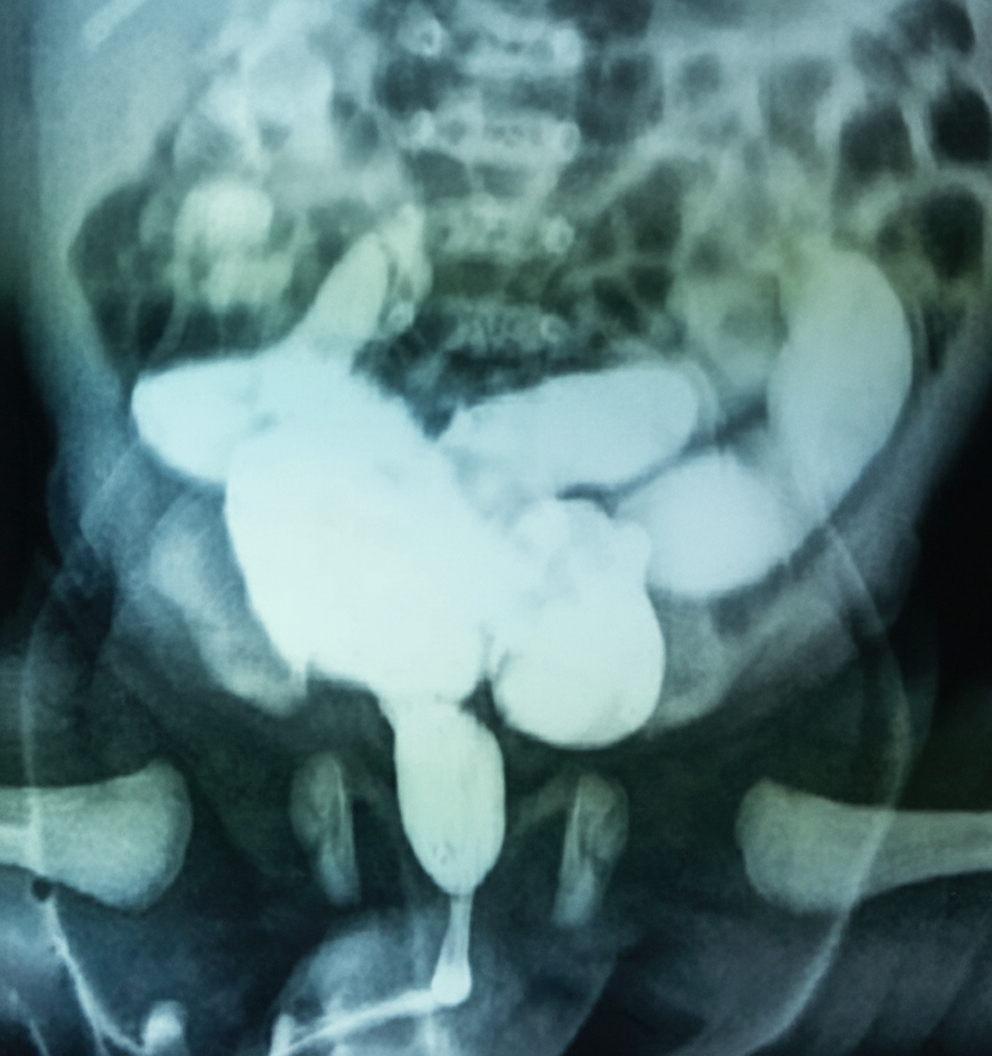
Which of the following is NOT true regarding Prune belly syndrome?
A child with recurrent urinary tract infections is most likely to show which of the following conditions?
Explanation: **Explanation:** The correct answer is **D. Sinding-Larsen-Johansson Syndrome**, as it is an orthopedic condition rather than a renal one. **1. Why Sinding-Larsen-Johansson (SLJ) Syndrome is the correct answer:** SLJ syndrome is a **traction apophysitis** of the inferior pole of the patella. It is an overuse injury seen in active adolescents (similar to Osgood-Schlatter disease), characterized by knee pain and calcification at the patellar tendon attachment. It has no association with the kidneys. **2. Analysis of Incorrect Options (Renal Syndromes):** * **Lowe Syndrome (Oculocerebrorenal Syndrome):** An X-linked recessive disorder characterized by a triad of congenital cataracts, intellectual disability, and **proximal renal tubular acidosis (Fanconi Syndrome)**. * **Denys-Drash Syndrome:** Characterized by the triad of **Wilms tumor**, male pseudohermaphroditism, and early-onset **nephrotic syndrome** (diffuse mesangial sclerosis). It is caused by mutations in the *WT1* gene. * **Alport Syndrome:** A genetic disorder of **Type IV collagen** (COL4A3/4/5) leading to a triad of hereditary nephritis (hematuria/ESRD), sensorineural hearing loss, and ocular abnormalities (anterior lenticonus). **Clinical Pearls for NEET-PG:** * **High-Yield Triad (Alport):** "Can't see, can't pee, can't hear high C." * **WAGR Syndrome:** Another *WT1* related renal condition (Wilms tumor, Aniridia, Genitourinary anomalies, and intellectual disability/Retardation). * **Fanconi Syndrome vs. Fanconi Anemia:** Remember that Lowe syndrome causes Fanconi *Syndrome* (proximal tubule dysfunction), not the hematological Fanconi *Anemia*.
Explanation: ### Explanation **Correct Answer: A. Alport’s Syndrome** Alport’s syndrome is a hereditary type IV collagen disorder (specifically affecting $\alpha$-3, $\alpha$-4, and $\alpha$-5 chains) that leads to the thinning and splitting of the glomerular basement membrane (GBM). * **Clinical Triad:** The classic presentation includes **Hereditary Nephritis** (hematuria progressing to CKD), **Sensorineural Hearing Loss**, and **Ocular abnormalities** (e.g., anterior lenticonus). * **Inheritance:** The most common form is **X-linked dominant** (85%), explaining why the maternal uncle was affected. * **Pathology:** Early in the disease, Light Microscopy (LM) often appears **normal** or shows minimal changes. The diagnosis is confirmed via Electron Microscopy (EM), which shows the characteristic **"Basket-weave appearance"** (irregular thickening and thinning with splitting of the lamina densa). **Why Incorrect Options are Wrong:** * **B. Goodpasture Syndrome:** This is an autoimmune condition caused by anti-GBM antibodies. It presents as pulmonary hemorrhage and rapidly progressive glomerulonephritis (RPGN), not chronic deafness or a family history. * **C. Thin Basement Membrane Disease (Benign Familial Hematuria):** While it presents with familial hematuria and normal LM, it typically has a benign course and does **not** lead to deafness or chronic kidney disease. * **D. Post-streptococcal Glomerulonephritis (PSGN):** This is an acute nephritic syndrome following a throat or skin infection. It is not hereditary and does not cause sensorineural deafness. **High-Yield Clinical Pearls for NEET-PG:** * **Most common ocular finding:** Anterior lenticonus (pathognomonic). * **Electron Microscopy:** The gold standard for diagnosis (Basket-weave pattern). * **Genetic Mutation:** *COL4A5* gene (X-linked) is the most frequently involved. * **Differential:** If a patient has hematuria and deafness but also has **thrombocytopenia** and giant platelets, think of **Fechtner/Epstein syndrome**.
Explanation: ### Explanation The clinical presentation of **palpable purpura** (typically on the buttocks and lower extremities) and **abdominal pain** (colic) in a child is classic for **Henoch-Schönlein Purpura (HSP)**, also known as IgA Vasculitis. HSP is a small-vessel vasculitis that frequently follows an upper respiratory or gastrointestinal infection. **1. Why the Correct Answer is Right:** HSP is pathologically identical to **IgA Nephropathy (Berger’s disease)**, though it presents with systemic involvement. The hallmark of renal involvement in HSP is the deposition of **IgA-dominant immune complexes** within the **mesangium** of the glomeruli. On electron microscopy, these appear as electron-dense deposits in the mesangial region. Immunofluorescence would similarly show granular IgA and C3 deposits. **2. Why the Incorrect Options are Wrong:** * **Option A:** Podocyte effacement is the hallmark of **Minimal Change Disease**, which presents with nephrotic syndrome (massive edema, proteinuria) rather than purpura. * **Option B:** Electron-dense deposits *within* the GBM (ribbon-like) are characteristic of **Type II Membranoproliferative Glomerulonephritis (Dense Deposit Disease)**. * **Option C:** Hypercellular glomeruli with neutrophils (exudative morphology) are typical of **Post-Streptococcal Glomerulonephritis (PSGN)**, which presents with hematuria and hypertension but not palpable purpura. **3. NEET-PG High-Yield Pearls:** * **HSP Tetrad:** Palpable purpura (non-thrombocytopenic), Arthralgia, Abdominal pain (may lead to intussusception), and Renal disease. * **Most common systemic vasculitis** in children. * **Renal Prognosis:** The long-term prognosis of HSP depends entirely on the severity of the renal involvement. * **Biopsy:** If performed, the renal biopsy of HSP is indistinguishable from IgA Nephropathy.
Explanation: ### Explanation **1. Why Hypospadias is Correct:** Hypospadias is a congenital anomaly where the urethral meatus opens on the **ventral (underside)** aspect of the penis, proximal to the normal position at the tip of the glans. It results from the failure of the urethral folds to fuse completely. In this case, the opening 1.5 cm from the tip on the ventral surface is a classic presentation. It is frequently associated with other genitourinary anomalies, such as **cryptorchidism** (undescended testis) and **inguinal hernias**, both of which are present in this patient. **2. Why Incorrect Options are Wrong:** * **Balanitis (A):** This refers to inflammation of the glans penis, usually due to infection (e.g., Candida) or poor hygiene in uncircumcised males. It is an acquired inflammatory condition, not a structural congenital malformation. * **Bowen Disease (B):** This is a form of intraepidermal squamous cell carcinoma (carcinoma in situ). On the penis, it presents as a leukoplakic or erythematous plaque (Erythroplasia of Queyrat) and is extremely rare in children. * **Epispadias (C):** This is a congenital defect where the urethra opens on the **dorsal (top)** aspect of the penis. It is much rarer than hypospadias and is often associated with bladder exstrophy. **3. NEET-PG High-Yield Pearls:** * **Triad of Hypospadias:** Abnormal ventral opening, **Chordee** (ventral curvature of the penis), and a "hooded" prepuce (deficient ventral foreskin). * **Contraindication:** Circumcision is strictly **contraindicated** in these infants because the foreskin is required for future surgical reconstruction (urethroplasty). * **Associations:** Always screen for associated anomalies; the risk of cryptorchidism is ~10%. If both hypospadias and cryptorchidism are present, consider a **Disorder of Sex Development (DSD)**. * **Surgical Timing:** Ideally performed between **6 to 12 months** of age.
Explanation: The most common cause of renal vasculitis in children is **Henoch-Schönlein Purpura (HSP)**, also known as IgA Vasculitis. ### **Explanation of the Correct Answer** **Option A (IgA raised):** HSP is a small-vessel vasculitis characterized by the deposition of **IgA-dominant immune complexes** in the skin, joints, gastrointestinal tract, and renal mesangium. Approximately **50% of patients** with HSP demonstrate elevated serum IgA levels during the acute phase. This makes it a hallmark feature of the most prevalent pediatric renal vasculitis. ### **Why Other Options are Incorrect** * **Option B (Antinuclear antibody):** ANA is the screening marker for **Systemic Lupus Erythematosus (SLE)**. While SLE can cause nephritis, it is categorized as an autoimmune connective tissue disorder rather than a primary systemic vasculitis. * **Option C (Low complement level):** HSP/IgA vasculitis typically presents with **normal complement levels (C3, C4)**. Low complement levels are characteristic of Post-Streptococcal Glomerulonephritis (PSGN), Lupus Nephritis, or Membranoproliferative Glomerulonephritis (MPGN). * **Option D (c-ANCA):** c-ANCA (PR3-ANCA) is specific for **Granulomatosis with Polyangiitis (Wegener's)**. While this is a form of renal vasculitis, it is exceedingly rare in the pediatric population compared to HSP. ### **High-Yield Clinical Pearls for NEET-PG** * **Classic Tetrad of HSP:** Non-thrombocytopenic palpable purpura (mandatory), arthritis/arthralgia, abdominal pain, and renal involvement (HSP Nephritis). * **HSP Nephritis:** Histologically identical to **IgA Nephropathy (Berger’s disease)**; both show mesangial IgA deposits. * **Prognosis:** The long-term prognosis of HSP is determined almost entirely by the severity of **renal involvement**. * **Management:** Most cases are self-limiting; steroids are used for GI symptoms but do not necessarily prevent renal progression.
Explanation: **Explanation:** **Potter’s Syndrome (Option B)** is the correct answer. The underlying medical concept is the **Potter Sequence**, which is initiated by a significant reduction in fetal urine output (due to bilateral renal agenesis, obstructive uropathy, or polycystic kidney disease). This leads to **oligohydramnios** (low amniotic fluid). Since amniotic fluid is essential for the mechanical expansion of the lungs and contains growth factors for alveolar development, its absence results in **Pulmonary Hypoplasia**. The classic "Potter facies" (flattened nose, recessed chin, low-set ears) and limb deformities are caused by intrauterine compression due to the lack of fluid. **Why other options are incorrect:** * **Mobius Syndrome (Option A):** A rare neurological disorder characterized by congenital facial paralysis and impaired eye movement (CN VI and VII palsy); it does not involve renal or pulmonary hypoplasia. * **Patau Syndrome (Option C):** Trisomy 13, characterized by midline defects (holoprosencephaly, cleft lip/palate), polydactyly, and microphthalmia. While renal cysts can occur, it is not primarily defined by the pulmonary-renal sequence. * **WAGR Syndrome (Option D):** A microdeletion syndrome (11p13) consisting of **W**ilms tumor, **A**niridia, **G**enitourinary anomalies, and **R**etardation. It involves the kidneys but does not typically present with neonatal pulmonary hypoplasia. **NEET-PG High-Yield Pearls:** * **Most common cause of Potter Sequence:** Bilateral Renal Agenesis. * **Most common cause of obstructive uropathy leading to Potter's:** Posterior Urethral Valves (PUV) in males. * **Immediate cause of death:** Respiratory failure due to pulmonary hypoplasia, not renal failure.
Explanation: **Explanation:** The most common cause of secondary hypertension in the pediatric age group is **Renal Parenchymal Disease**. Among these, **Chronic Glomerulonephritis (CGN)** is the leading cause of persistent hypertension associated with abnormal urinalysis findings. **1. Why Chronic Glomerulonephritis is correct:** In CGN, the chronic inflammation and scarring of the glomeruli lead to a decrease in the glomerular filtration rate (GFR) and activation of the Renin-Angiotensin-Aldosterone System (RAAS). This results in sodium and water retention, increased peripheral vascular resistance, and subsequent hypertension. Crucially, the question specifies that **urinalysis findings** are the cause; CGN characteristically presents with hematuria, proteinuria, and casts, which directly correlate with the underlying pathology causing the blood pressure elevation. **2. Why other options are incorrect:** * **Polycystic Kidney Disease (PKD):** While PKD causes hypertension, it is a structural/genetic cystic disease. Hypertension often precedes significant urinalysis changes, and the diagnosis is primarily made via imaging (ultrasound) rather than urinalysis. * **Reflux Nephropathy:** This is a result of chronic pyelonephritis due to vesicoureteral reflux. While it causes hypertension, the primary diagnostic markers are radiological (scarring on DMSA scan or reflux on VCUG) rather than specific findings on a routine urinalysis. **Clinical Pearls for NEET-PG:** * **Most common cause of hypertension in children:** Renal parenchymal disease (approx. 70-80%). * **Most common cause of acute hypertension:** Acute Post-Streptococcal Glomerulonephritis (APSGN). * **Gold Standard for diagnosing CGN:** Renal Biopsy. * **Initial Investigation:** Urinalysis and Renal Ultrasound are the first-line steps in evaluating pediatric hypertension.
Explanation: ***Cystinosis*** - Presents with **Fanconi syndrome** causing polyuria, polydipsia, and **rickets** due to **phosphate wasting**, matching the clinical presentation described. - **Pathognomonic slit lamp examination** reveals **corneal cystine crystal deposits**, which are specific findings that confirm the diagnosis. *Alport syndrome* - Associated with **sensorineural hearing loss** and **anterior lenticonus** on slit lamp examination, not cystine crystals. - Does not typically cause **Fanconi syndrome** or the constellation of polyuria, polydipsia, and rickets. *Hypercalcemia* - Can cause **polyuria and polydipsia** through nephrogenic diabetes insipidus, but does not produce **rickets**. - **Slit lamp examination** would be normal, with no specific corneal crystal deposits. *Dent disease* - Can present with **Fanconi syndrome** causing similar urinary symptoms and rickets due to phosphate wasting. - **Slit lamp examination** is typically normal, lacking the **pathognomonic cystine crystal deposits** seen in cystinosis.
Explanation: **Explanation:** Prune Belly Syndrome (also known as **Eagle-Barrett Syndrome**) is a rare congenital anomaly characterized by a classic triad of clinical features. The correct answer is **Macroglossia**, as it is not a component of this syndrome; rather, macroglossia is typically associated with conditions like Beckwith-Wiedemann Syndrome or Congenital Hypothyroidism. **Understanding the Triad (Incorrect Options):** * **Anterior Abdominal Wall Defect (Option C):** There is a deficiency or complete absence of the abdominal wall muscles. This leads to the characteristic "wrinkled" or "prune-like" appearance of the skin over the belly. * **Cryptorchidism (Option D):** Bilateral undescended testes are a hallmark of this syndrome. The testes are usually located intra-abdominally, often near the ureters. * **Urinary Tract Abnormalities (Option B):** Patients exhibit significant **Hydroureteronephrosis** (dilation of ureters and kidneys), often associated with a large, thick-walled bladder (megacystis) and a dilated prostatic urethra. **Clinical Pearls for NEET-PG:** * **Gender Predominance:** It occurs almost exclusively in **males** (95% of cases). * **Associated Features:** It is often linked with pulmonary hypoplasia (due to oligohydramnios) and clubfoot (Talipes Equinovarus). * **Radiology:** A "Keyhole sign" on ultrasound may be seen due to the dilated posterior urethra, though this is more classically associated with Posterior Urethral Valves (PUV). * **Prognosis:** The severity is largely determined by the degree of renal dysplasia and pulmonary hypoplasia at birth.
Explanation: **Explanation:** **Vesicoureteric Reflux (VUR)** is the most common underlying anatomical abnormality found in children with recurrent urinary tract infections (UTIs). It involves the retrograde flow of urine from the bladder into the ureter and kidney due to an incompetent vesicoureteric junction. This stasis of urine acts as a reservoir for bacterial growth, leading to recurrent episodes of cystitis and, more critically, pyelonephritis. **Analysis of Options:** * **Vesicoureteric Reflux (Correct):** It is present in approximately 30-40% of children presenting with their first febrile UTI. Long-term consequences include renal scarring (reflux nephropathy) and hypertension. * **Posterior Urethral Valves (PUV):** While a common cause of obstructive uropathy and UTIs in *male infants*, it is less frequent overall compared to VUR and typically presents with a poor urinary stream and a palpable bladder. * **Neurogenic Bladder:** This leads to UTIs due to incomplete emptying (stasis), but it is usually associated with overt spinal cord defects (e.g., myelomeningocele) rather than being the primary cause in a general pediatric population. * **Renal and Ureteric Calculi:** These are relatively rare in the pediatric age group compared to adults and are usually secondary to metabolic disorders or anatomical stasis. **Clinical Pearls for NEET-PG:** * **Gold Standard Investigation:** Voiding Cystourethrogram (VCUG) is the investigation of choice to diagnose and grade VUR. * **Initial Screening:** Ultrasound is often the first step, but a normal USG does *not* rule out VUR. * **Management:** Low-grade VUR (Grades I-II) often resolves spontaneously; high-grade VUR (Grades IV-V) may require surgical reimplantation (e.g., Cohen’s procedure). * **DMSA Scan:** This is the most sensitive test for detecting **renal scarring** following recurrent UTIs.
Urinary Tract Infections
Practice Questions
Vesicoureteral Reflux
Practice Questions
Glomerulonephritis
Practice Questions
Nephrotic Syndrome
Practice Questions
Acute Kidney Injury
Practice Questions
Chronic Kidney Disease
Practice Questions
Renal Tubular Disorders
Practice Questions
Congenital Anomalies of the Kidney
Practice Questions
Hydronephrosis
Practice Questions
Hypertension in Children
Practice Questions
Hemolytic Uremic Syndrome
Practice Questions
Renal Replacement Therapy in Children
Practice Questions
Get full access to all questions, explanations, and performance tracking.
Start For Free