Which of the following is a characteristic of physiological jaundice of the newborn?
Neonatal polycythemia with hyperviscosity is associated with all except?
Which of the following is assessed in the APGAR score?
Which definition correctly describes preterm babies?
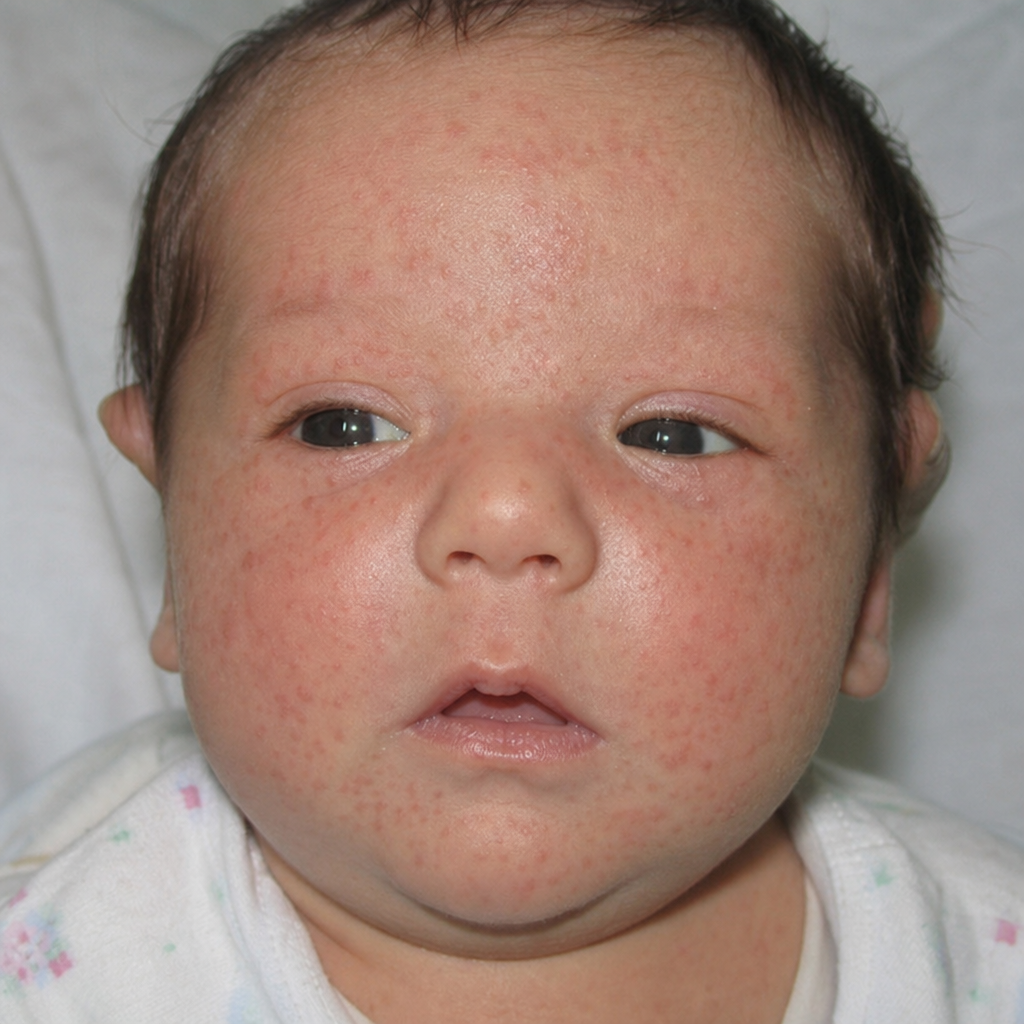
What is the most probable diagnosis in this neonate?

Which of the following is NOT a cause of neonatal eye infection?
An infant born at 35 weeks' gestation to a mother with no prenatal care is noted to be jittery and irritable, and is having difficulty feeding. The infant exhibits coarse tremors, a high-pitched cry, and has experienced several episodes of diarrhea and emesis. What substance is the infant most likely withdrawing from?
The APGAR score includes all of the following except?
What is the most common anomaly seen in the fetus of a mother taking lithium carbonate?
Which of the following is NOT a complication in formula-fed infants compared to human milk-fed infants?
Explanation: **Explanation:** Physiological jaundice is a common, benign condition in neonates resulting from a transient imbalance between bilirubin production and elimination. **Why the correct answer is right:** Physiological jaundice is **always unconjugated (indirect) hyperbilirubinemia**. It occurs due to a combination of factors: increased red blood cell turnover (shorter lifespan), immature hepatic conjugation (low UGT1A1 enzyme activity), and increased enterohepatic circulation. By definition, if the conjugated (direct) bilirubin fraction exceeds 1.0 mg/dL or >20% of total bilirubin, it is considered **pathological** (suggesting cholestasis or biliary atresia). **Analysis of Incorrect Options:** * **Option A:** Physiological jaundice **never** appears within the first 24 hours. Jaundice in the first day of life is always pathological (usually due to hemolysis like Rh or ABO incompatibility). Physiological jaundice typically appears on day 2 or 3. * **Option B:** Jaundice involving the **palms and soles** indicates very high serum bilirubin levels (>15–20 mg/dL) according to Kramer’s Rule. Physiological jaundice is usually mild to moderate and rarely reaches these levels. * **Option C:** In term neonates, physiological jaundice usually disappears by **7–10 days**. If jaundice persists beyond 14 days in term infants (or 21 days in preterm), it is termed "prolonged jaundice" and requires investigation. **High-Yield Clinical Pearls for NEET-PG:** * **Peak levels:** In term infants, bilirubin peaks at 12–15 mg/dL on day 3–5. * **Kramer’s Rule:** Jaundice progresses in a **cephalo-caudal** direction (head to toe). * **Treatment:** Physiological jaundice usually requires no treatment, but if levels cross the threshold on the Bhutani Nomogram, phototherapy is initiated. * **Rule of Thumb:** Any jaundice that is present at birth, persists too long, or has a high direct component is **Pathological**.
Explanation: **Explanation** Neonatal polycythemia is defined as a venous hematocrit ≥65%. While it is commonly associated with maternal diabetes, the specific phrasing of this question hinges on the **pathophysiology of hyperviscosity.** **1. Why Option B is the "Except":** In infants of diabetic mothers (IDM), polycythemia occurs due to fetal hypoxia (caused by increased metabolic demand), which triggers erythropoietin production. However, **fetal macrosomia** itself is a result of hyperinsulinism and excessive growth. While macrosomic babies *can* have polycythemia, the condition is most classically and severely associated with **placental insufficiency** or **acute transfusions**. In the context of this specific MCQ, macrosomia is often considered the "least likely" primary driver for symptomatic hyperviscosity compared to the direct volume or hypoxia-driven shifts in the other options. *(Note: In some clinical texts, IDM is a cause; however, in competitive exams, if placental insufficiency or transfusion is present, macrosomia is the outlier).* **2. Analysis of Other Options:** * **Twin-to-twin transfusion (A):** The recipient twin receives a massive volume of blood from the donor, leading to direct polycythemia and hyperviscosity. * **Fetal/Placental Growth Restriction (C):** Chronic intrauterine hypoxia in IUGR/SGA fetuses stimulates a compensatory increase in erythropoietin, leading to high red cell mass. * **Transfusion at delivery (D):** Delayed cord clamping or "milking" the cord increases the neonate's blood volume by up to 30%, a common cause of polycythemia. **Clinical Pearls for NEET-PG:** * **Screening:** Always use **venous** blood; capillary samples (heel prick) often give falsely high hematocrit levels. * **Symptoms:** Most are asymptomatic, but look for "Plethora," lethargy, hypoglycemia, and neonatal jaundice (due to RBC breakdown). * **Treatment:** The gold standard for symptomatic hyperviscosity is **Partial Exchange Transfusion (PET)** using normal saline to reduce the hematocrit to ~50-55%.
Explanation: **Explanation:** The **APGAR score** is a rapid clinical assessment tool used at 1 and 5 minutes after birth to evaluate a neonate’s transition to extrauterine life. It was developed by Dr. Virginia Apgar and consists of five parameters, each scored from 0 to 2. **Why Option A is Correct:** **Color (Appearance)** is one of the five core components of the APGAR score. It reflects the infant's oxygenation status. A score of 0 is given for central cyanosis/pallor, 1 for acrocyanosis (blue extremities with a pink body), and 2 for a completely pink infant. **Why Incorrect Options are Wrong:** * **B. Bilirubin:** Bilirubin levels are used to assess neonatal jaundice, which typically manifests after the first 24 hours of life. It is not part of the immediate delivery room assessment. * **C. Blood Group:** Determining the blood group is a laboratory investigation (often from cord blood) used to check for ABO/Rh incompatibility, not a clinical bedside score. * **D. Respiratory Rate:** This is a common distractor. The APGAR score assesses **Respiratory Effort** (crying/gasping), not the numerical respiratory rate. A vigorous cry earns a score of 2. **NEET-PG High-Yield Pearls:** * **Mnemonic (APGAR):** **A**ppearance (Color), **P**ulse (Heart Rate), **G**rimace (Reflex Irritability), **A**ctivity (Muscle Tone), **R**espiration (Effort). * **Heart Rate:** This is the most important prognostic parameter. * **Scoring:** 7–10 is normal; 4–6 is mildly/moderately depressed; 0–3 is severely depressed. * **Note:** APGAR score is **not** used to decide the need for initial resuscitation; resuscitation must begin before the 1-minute score if the infant is apneic or bradycardic.
Explanation: **Explanation:** The classification of neonatal gestational age is a fundamental concept in pediatrics and neonatology. According to the **World Health Organization (WHO)** and the **American Academy of Pediatrics (AAP)**, a **preterm birth** is defined as any birth occurring **before 37 completed weeks of gestation** (less than 259 days), counting from the first day of the last menstrual period (LMP). **Why Option A is Correct:** The threshold of 37 weeks is clinically significant because it marks the point where the fetus has typically achieved sufficient physiological maturity (especially pulmonary surfactant production) to transition to extrauterine life with minimal risk of respiratory distress syndrome. **Why Other Options are Incorrect:** * **Options B, C, and D:** While these represent earlier stages of a "Term" pregnancy, they do not meet the standardized definition of preterm. A "Term" pregnancy is defined as 37 0/7 weeks to 41 6/7 weeks. Specifically, 37 to 38 weeks is now often categorized as "Early Term," while 39 to 40 weeks is "Full Term." **NEET-PG High-Yield Pearls:** * **Sub-categories of Preterm:** * **Late preterm:** 34 to <37 weeks. * **Very preterm:** 28 to <32 weeks. * **Extremely preterm:** <28 weeks. * **Post-term:** Born at or after 42 weeks (≥294 days). * **Low Birth Weight (LBW):** Defined by weight (<2500g) regardless of gestational age. Do not confuse "preterm" (a measure of time) with "LBW" (a measure of weight). * **New Ballard Score:** The gold standard clinical tool used to estimate gestational age postnatally by assessing physical and neuromuscular maturity.
Explanation: ***Infant of diabetic mother*** - Characteristic **macrosomic appearance** with **plump, rounded face**, **fat cheeks**, and **large body size** due to maternal hyperglycemia causing fetal hyperinsulinemia. - Classic **cushingoid features** including **truncal obesity** and **red, puffy appearance** are typical findings in IDM babies. *Beckwith Wiedemann syndrome* - Features **macroglossia** (enlarged tongue), **omphalocele**, and **hemihypertrophy** which are not described in this case. - Associated with **ear creases** and **increased risk of embryonal tumors**, distinct from IDM appearance. *Congenital hypothyroidism* - Presents with **prolonged jaundice**, **lethargy**, **constipation**, and **poor feeding** rather than macrosomic features. - Characteristic **coarse facial features** and **macroglossia** develop later, not the plump appearance seen here. *IUGR baby* - Shows **small for gestational age** appearance with **wasted muscle mass** and **thin subcutaneous tissue**. - Features include **wrinkled skin**, **prominent ribs**, and **scrawny appearance** - opposite of the described findings.
Explanation: **Explanation:** The question asks for the organism that is **not** a typical cause of neonatal eye infection (Ophthalmia Neonatorum). **Why Proteus mirabilis is the correct answer:** Ophthalmia neonatorum is defined as conjunctivitis occurring within the first 28 days of life, usually acquired during passage through the birth canal. While various Gram-positive and Gram-negative bacteria can cause neonatal conjunctivitis, **Proteus mirabilis** is an extremely rare cause and is not considered a standard or significant pathogen in this clinical context. It is more commonly associated with urinary tract infections or wound infections in older infants. **Analysis of incorrect options:** * **Chlamydia trachomatis (Serotypes D-K):** This is currently the **most common cause** of ophthalmia neonatorum worldwide. It typically presents 5–14 days after birth. * **Gonococci (Neisseria gonorrhoeae):** This is the **most serious cause** due to the risk of corneal perforation and blindness. It presents early (usually 2–5 days) with hyperacute purulent discharge. * **Staphylococcus aureus:** This is a common cause of "non-specific" bacterial conjunctivitis in neonates, often acquired from the environment or skin flora rather than the birth canal. **High-Yield Clinical Pearls for NEET-PG:** * **Incubation Periods:** * Chemical (Silver nitrate): <24 hours. * Gonococcal: 2–5 days (Most severe). * Chlamydia: 5–14 days (Most common). * **Treatment:** * Gonococcal: Systemic Ceftriaxone. * Chlamydia: **Oral Erythromycin** (Topical therapy is insufficient and oral treatment prevents Chlamydial pneumonia). * **Prophylaxis:** 0.5% Erythromycin ointment is the standard of care immediately after birth.
Explanation: ### Explanation The clinical presentation described is classic for **Neonatal Abstinence Syndrome (NAS)**, most commonly associated with **Opioid withdrawal** (e.g., Heroin or Methadone). **Why Heroin is correct:** Opioid withdrawal in neonates typically manifests within 24–72 hours of birth. The symptoms are categorized into three main areas: 1. **Neuromuscular Irritability:** Jitteriness, coarse tremors, hypertonicity, and a high-pitched cry. 2. **Gastrointestinal Dysfunction:** Poor feeding, diarrhea, and vomiting (emesis). 3. **Autonomic Reactivity:** Sweating, sneezing, and yawning. The combination of CNS irritability and GI distress is the hallmark of heroin withdrawal. **Why the other options are incorrect:** * **Alcohol:** Fetal Alcohol Syndrome (FAS) presents with structural defects (short palpebral fissures, thin upper lip, smooth philtrum) and growth retardation rather than acute withdrawal tremors and diarrhea. * **Marijuana:** Prenatal exposure may lead to mild neurobehavioral effects or low birth weight, but it does not cause a distinct, acute withdrawal syndrome like NAS. * **Cocaine:** Cocaine is a stimulant that causes vasoconstriction. Exposure typically leads to IUGR, placental abruption, or "jitteriness," but it does not produce a true withdrawal syndrome or significant GI symptoms like diarrhea. **High-Yield Clinical Pearls for NEET-PG:** * **Finnegan Scoring System:** Used to monitor the severity of NAS and guide pharmacological treatment. * **First-line Management:** Supportive care (swaddling, frequent small feeds, low-stimulation environment). * **Pharmacotherapy:** If supportive care fails, **Morphine** or **Methadone** is the drug of choice for opioid withdrawal. * **Timing:** Heroin withdrawal starts early (1–3 days), whereas Methadone withdrawal may be delayed (up to 2 weeks).
Explanation: **Explanation:** The **APGAR score** is a rapid clinical assessment tool used at 1 and 5 minutes after birth to evaluate a newborn's transition to extrauterine life. It was developed by Dr. Virginia Apgar and consists of five specific parameters. **Why Tendon Reflexes is the correct answer:** Tendon reflexes (like the knee-jerk) are **not** part of the APGAR assessment. The APGAR score evaluates "Reflex Irritability" (Grimace), which refers to the infant's response to stimulation (e.g., suctioning the oropharynx or flicking the soles), not deep tendon reflexes. **Analysis of other options:** * **Colour (Appearance):** Evaluates peripheral or central cyanosis vs. a completely pink baby. * **Muscle Tone (Activity):** Assesses the degree of flexion and resistance to extension of the limbs. * **Respiratory Effort (Respiration):** Evaluates the quality of the cry and breathing pattern (not the heart rate). **High-Yield NEET-PG Clinical Pearls:** * **Mnemonic:** **A**ppearance (Color), **P**ulse (Heart rate), **G**rimace (Reflex irritability), **A**ctivity (Muscle tone), **R**espiration (Respiratory effort). * **Scoring:** Each parameter is scored 0, 1, or 2. Total score ranges from 0 to 10. * **Interpretation:** 7–10 is Normal; 4–6 is Mildly/Moderately depressed; 0–3 is Severely depressed. * **Most Important Parameter:** Heart Rate is the most critical prognostic component. * **Sequence of Disappearance:** In neonatal depression, the parameters disappear in the following order: Colour → Respiration → Muscle Tone → Reflex Irritability → Heart Rate. * **Note:** APGAR score is **not** used to decide the need for initial resuscitation; resuscitation must begin before the 1-minute score if the infant is apneic or bradycardic.
Explanation: **Explanation:** Lithium carbonate, a mood stabilizer used for Bipolar Affective Disorder, is a known human teratogen. When taken during the first trimester of pregnancy, it primarily affects the developing heart. **1. Why Cardiac Deformities are correct:** Lithium exposure is classically associated with **Ebstein’s Anomaly**. This is a congenital heart defect characterized by the downward displacement of the tricuspid valve leaflets into the right ventricle, leading to "atrialization" of the ventricle and severe tricuspid regurgitation. While the absolute risk is low (approx. 1-2 per 1,000 exposures), it represents a 10-20 fold increase compared to the general population, making cardiac malformations the most characteristic and common anomaly associated with the drug. **2. Why other options are incorrect:** * **Neural Tube Defects (NTDs):** These are most commonly associated with **Valproate** and **Carbamazepine** due to their interference with folate metabolism. * **Limb Reduction:** This is the hallmark of **Thalidomide** (Phocomelia). Lithium does not typically affect limb bud development. * **Genitourinary Deformities:** These are more commonly associated with **ACE inhibitors** (renal dysgenesis) or fetal hydantoin syndrome (Phenytoin). **High-Yield Clinical Pearls for NEET-PG:** * **Ebstein’s Anomaly:** Look for "Box-shaped heart" on X-ray and "WPW Syndrome" on ECG in these neonates. * **Management:** If a pregnant woman is on Lithium, a **Fetal Echocardiogram** is recommended at 18–22 weeks of gestation to screen for cardiac defects. * **Breastfeeding:** Lithium is generally discouraged during breastfeeding as it is excreted in milk and can cause "Floppy Infant Syndrome" (cyanosis and hypotonia).
Explanation: **Explanation:** The correct answer is **Vitamin K deficiency**. In the neonatal period, Vitamin K deficiency is a risk for **all newborns**, regardless of the feeding method, because Vitamin K does not cross the placenta efficiently and the neonatal gut is sterile at birth. However, when comparing the two, **human milk is lower in Vitamin K** (approx. 1–2 μg/L) than commercial infant formula (approx. 50 μg/L). Therefore, breastfed infants are actually at a *higher* risk for Vitamin K Deficiency Bleeding (VKDB) if not given prophylactic Vitamin K at birth. **Analysis of Incorrect Options:** * **A. Necrotizing Enterocolitis (NEC):** Human milk contains bioactive factors (IgA, lactoferrin, oligosaccharides) that protect the gut mucosa. Formula feeding is a major risk factor for NEC due to its higher osmolarity and lack of protective immunoglobulins. * **B. Otitis Media:** Breastfeeding provides passive immunity and involves different sucking mechanics that prevent the reflux of milk into the Eustachian tubes. Formula-fed infants have a significantly higher incidence of respiratory and middle-ear infections. * **C. Hypocalcemia:** Early neonatal hypocalcemia is more common in formula-fed infants because cow’s milk-based formulas have a much higher **phosphorus** content. High phosphate intake leads to hyperphosphatemia, which secondary suppresses calcium levels. **High-Yield Clinical Pearls for NEET-PG:** * **Vitamin K Prophylaxis:** All newborns should receive 1 mg of Vitamin K intramuscularly (0.5 mg for preterms <1kg) to prevent VKDB. * **Iron Content:** While human milk has less iron than formula, its **bioavailability** is much higher (50% vs. 4-7% in formula). * **Whey:Casein Ratio:** Human milk is 60:40 (easier to digest), while unmodified cow's milk is 20:80.
Neonatal Resuscitation
Practice Questions
Care of the Normal Newborn
Practice Questions
Prematurity and Low Birth Weight
Practice Questions
Respiratory Distress Syndrome
Practice Questions
Neonatal Jaundice
Practice Questions
Neonatal Sepsis
Practice Questions
Necrotizing Enterocolitis
Practice Questions
Intraventricular Hemorrhage
Practice Questions
Persistent Pulmonary Hypertension
Practice Questions
Perinatal Asphyxia
Practice Questions
Neonatal Seizures
Practice Questions
Congenital Anomalies
Practice Questions
Get full access to all questions, explanations, and performance tracking.
Start For Free