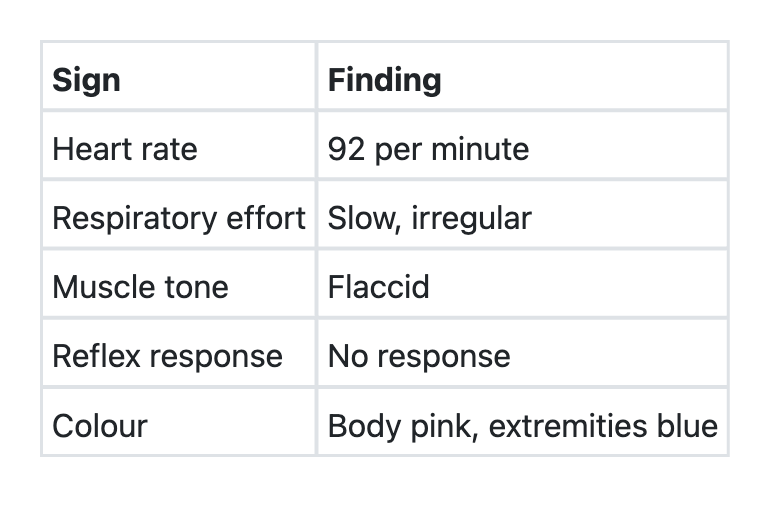
The neonatal period extends up to which day of life?
Floppy baby syndrome occurs due to fetal exposure to which of the following?
A neonate born to a hyperthyroid mother can present with which of the following conditions, except?
Meconium contains all except?
Which of the following are complications seen in infants of diabetic mothers?
A newborn has meconium aspiration. Despite three attempts at resuscitation, there is no breathing. What is the next step in resuscitation?
Which of the following conditions is NOT associated with surfactant deficiency?
According to the perinatal risk stratification of preterm neonates and developmental outcomes, which of the following constitutes a moderate risk category?
All of the following cause jaundice at birth or within 24 hours EXCEPT?
A male baby born at term with an uncomplicated pregnancy, labor, and delivery developed severe respiratory distress within a few hours of birth. His chest X-ray revealed a normal heart shadow and fine reticulonodular infiltrates radiating from the hilum. Echocardiogram findings revealed no abnormality, and the results of routine cultures were also negative. Family history reveals a similar clinical course and death of a male sibling at 1 month and a female sibling at 2 months of age, respectively. What is the most likely diagnosis?
Explanation: **Explanation:** The **neonatal period** is defined as the first **28 days of life**. This period is further subdivided into two phases based on the physiological changes and risks associated with the newborn: 1. **Early Neonatal Period:** Birth to 7 completed days (0–6 days). This is the period of highest mortality, primarily due to birth asphyxia, prematurity, and congenital anomalies. 2. **Late Neonatal Period:** From 7 completed days to 28 days (7–28 days). Deaths in this period are often attributed to infections like neonatal sepsis and pneumonia. **Analysis of Options:** * **Option C (28 days):** This is the standard definition used by the WHO and the National Neonatology Forum (NNF). It represents the first four weeks of life, a critical window for survival. * **Option A & D (21 and 35 days):** These are arbitrary numbers with no clinical or statistical significance in pediatric classification. * **Option B (30 days):** While a calendar month is roughly 30 days, the medical definition strictly adheres to the 28-day (4-week) rule. **High-Yield NEET-PG Pearls:** * **Perinatal Period:** Starts from **28 weeks of gestation** and ends at **7 days after birth**. * **Infancy:** Extends from birth to **1 year** of age. * **Neonatal Mortality Rate (NMR):** Defined as the number of neonatal deaths per 1,000 live births. It is a key indicator of a country’s socioeconomic status and newborn care facilities. * **Most common cause of Neonatal Mortality in India:** Prematurity and Low Birth Weight (LBW), followed by infection (Sepsis).
Explanation: **Explanation:** **Floppy Baby Syndrome** (neonatal hypotonia) occurs due to fetal exposure to **Lithium** during pregnancy. Lithium is a mood stabilizer used for bipolar disorder that crosses the placenta. When taken near term, it can cause neonatal lithium toxicity, characterized by lethargy, poor suck reflex, cyanosis, and marked hypotonia (the "floppy" appearance). Additionally, first-trimester exposure to Lithium is classically associated with **Ebstein’s anomaly** (tricuspid valve displacement). **Analysis of Incorrect Options:** * **Warfarin (A):** Exposure leads to **Fetal Warfarin Syndrome**, characterized by nasal hypoplasia, stippled epiphyses (chondrodysplasia punctata), and CNS defects. It does not typically present as acute neonatal floppiness. * **Valproate (B):** Primarily associated with **Neural Tube Defects** (e.g., spina bifida) due to interference with folate metabolism, as well as "Fetal Valproate Syndrome" (craniofacial dysmorphism). * **Phenytoin (C):** Causes **Fetal Hydantoin Syndrome**, presenting with midface hypoplasia, cleft lip/palate, and digital hypoplasia (hypoplastic nails/phalanges). **NEET-PG High-Yield Pearls:** * **Lithium Toxicity:** Apart from floppiness, it can cause neonatal diabetes insipidus and thyroid dysfunction. * **Management:** Most cases of Lithium-induced floppiness are self-limiting as the drug is cleared by the neonate’s kidneys; however, hydration is key. * **Other causes of Floppy Baby:** Must be differentiated from Down Syndrome (most common chromosomal cause), Spinal Muscular Atrophy (SMA Type 1), and Prader-Willi Syndrome. * **Drug of choice for Bipolar in Pregnancy:** Lamotrigine is often preferred over Lithium/Valproate due to a lower teratogenic profile.
Explanation: ### Explanation The thyroid status of a neonate born to a mother with hyperthyroidism (most commonly Graves' disease) depends on the transplacental passage of maternal antibodies or medications. Because all the listed conditions can occur, the correct answer is **None of the above**. #### 1. Why "None of the above" is correct: A hyperthyroid mother can pass three distinct substances across the placenta, leading to different neonatal outcomes: * **TSH-Receptor Stimulating Antibodies (TSI):** These cause **Neonatal Graves' Disease**, presenting as **Goitrous Thyrotoxicosis**. * **Antithyroid Drugs (ATDs):** If the mother is on high-dose Carbimazole or Propylthiouracil, these cross the placenta and inhibit the fetal thyroid gland, leading to **Goitrous Hypothyroidism** (elevated TSH causes goiter). * **TSH-Receptor Blocking Antibodies (TRBAb):** In some cases of autoimmune thyroid disease, blocking antibodies are predominant. These prevent the development/function of the fetal thyroid, leading to **Non-goitrous Hypothyroidism** (Thyroid Dysgenesis/Aplasia-like picture). #### 2. Analysis of Options: * **Option A (Goitrous Thyrotoxicosis):** Occurs due to maternal TSI. It is a classic presentation of neonatal hyperthyroidism. * **Option B (Goitrous Hypothyroidism):** Occurs due to the "iatrogenic" effect of maternal antithyroid medication crossing the placenta. * **Option C (Non-goitrous Hypothyroidism):** Occurs when maternal blocking antibodies (TRBAb) inhibit fetal thyroid growth and function. #### 3. Clinical Pearls for NEET-PG: * **Transient Nature:** Neonatal thyroid dysfunction caused by maternal antibodies is usually **transient**, resolving within 3–12 weeks as maternal IgG is cleared from the infant's circulation. * **Wolff-Chaikoff Effect:** High maternal iodine intake (e.g., povidone-iodine use) can also cause transient neonatal hypothyroidism. * **Treatment:** Neonatal thyrotoxicosis is a medical emergency treated with Propranolol and Lugol’s iodine/PTU to prevent high-output heart failure and craniosynostosis.
Explanation: **Explanation:** **Meconium** is the first stool passed by a newborn, typically within the first 24–48 hours of life. The key to this question lies in the **sterile environment** of the fetal gastrointestinal tract. **Why "Bacterial Flora" is the correct answer:** In utero, the fetal gut is considered sterile. Colonization by bacteria (bacterial flora) only begins **after birth** through exposure to the mother’s vaginal flora, skin, and breastfeeding/formula feeding. Therefore, true meconium—which is formed in utero—does not contain bacterial flora. **Analysis of Incorrect Options:** * **Lanugo (A):** These are fine fetal hairs that are shed into the amniotic fluid. The fetus swallows amniotic fluid, leading to the presence of lanugo in the meconium. * **Epithelial debris (C):** Squamous cells (vernix caseosa) are shed from the fetal skin into the amniotic fluid and subsequently swallowed, forming a significant portion of the meconium bulk. * **Bilirubin (D):** Meconium contains bile pigments (mainly biliverdin and bilirubin), which give it its characteristic dark green-to-black color. **High-Yield Clinical Pearls for NEET-PG:** * **Composition:** Meconium consists of 70-80% water, amniotic fluid components (lanugo, skin cells), intestinal secretions, and bile. * **Delayed Passage:** Failure to pass meconium within 48 hours should raise suspicion for **Hirschsprung disease** or **Meconium Ileus** (associated with Cystic Fibrosis). * **Meconium Aspiration Syndrome (MAS):** Occurs when the fetus passes meconium in utero (often due to fetal distress/hypoxia) and aspirates it, leading to chemical pneumonitis. * **Microbiology:** While traditionally considered sterile, recent advanced molecular studies suggest the presence of some low-level microbial DNA, but for standard clinical examinations like NEET-PG, **meconium is considered sterile.**
Explanation: **Explanation:** Infants of Diabetic Mothers (IDM) face a spectrum of complications due to maternal hyperglycemia, which leads to fetal hyperinsulinemia (Pedersen Hypothesis). Since insulin is the primary anabolic hormone for the fetus, this state results in various multisystemic issues. * **Macrosomia (Option A):** Excess maternal glucose crosses the placenta, stimulating fetal pancreatic beta cells to secrete insulin. This causes increased fat deposition and organomegaly (except for the brain), leading to birth weights >4000g or >90th percentile. * **Neural Tube Defects (Option B):** Poor glycemic control during the period of organogenesis (first trimester) is teratogenic. IDMs have a 2-3 fold increased risk of congenital anomalies. While **Sacral Agenesis (Caudal Regression Syndrome)** is the most specific, **Neural Tube Defects** and Congenital Heart Diseases (e.g., VSD, Transposition of Great Arteries) are more common in absolute numbers. * **Hypocalcemia (Option C):** This typically occurs within the first 24–72 hours. It is attributed to functional hypoparathyroidism in the newborn, often exacerbated by maternal magnesium loss through urine, leading to neonatal hypomagnesemia which suppresses Parathyroid Hormone (PTH) release. **Clinical Pearls for NEET-PG:** * **Most common metabolic abnormality:** Hypoglycemia (due to persistent hyperinsulinemia after the cord is cut). * **Most common cardiac anomaly:** Ventricular Septal Defect (VSD). * **Most specific anomaly:** Caudal Regression Syndrome (Sacral Agenesis). * **Respiratory Distress:** IDMs are at higher risk for Respiratory Distress Syndrome (RDS) because hyperinsulinism antagonizes cortisol, delaying surfactant production by Type II pneumocytes. * **Hematology:** Polycythemia is common due to fetal hypoxemia stimulating erythropoietin.
Explanation: ### Explanation The correct answer is **D. Flicking/Tickling of the sole**. #### 1. Why "Tickling of the sole" is correct: In the initial steps of neonatal resuscitation, the priority is to provide **tactile stimulation** to initiate spontaneous breathing. According to the Neonatal Resuscitation Program (NRP) guidelines, if a newborn is apneic or has gasping respirations, the provider should perform initial steps: provide warmth, position the airway, clear secretions (if necessary), dry the baby, and **stimulate**. Flicking the soles of the feet or rubbing the back are the only two safe and recommended methods of tactile stimulation. In this scenario, since the baby has not started breathing after initial attempts, providing tactile stimulation is the immediate next step before escalating to assisted ventilation. #### 2. Why the other options are incorrect: * **A. Chest compressions:** These are only indicated if the heart rate remains below 60 bpm despite at least 30 seconds of effective Positive Pressure Ventilation (PPV). It is a late step in resuscitation. * **B. Oxygen inhalation:** Free-flow oxygen is used for babies who are breathing but remain cyanotic. It does not help a baby who is apneic. * **C. Bag and mask ventilation (PPV):** This is the most important step in resuscitation, but it is indicated only **after** tactile stimulation has failed to initiate breathing or if the heart rate is <100 bpm. #### 3. Clinical Pearls for NEET-PG: * **Order of Initial Steps:** TABC (Temperature, Airway, Breathing, Circulation). * **Meconium Aspiration Update:** Current NRP guidelines (8th Ed) no longer recommend routine endotracheal suctioning for non-vigorous infants born through meconium-stained amniotic fluid. Instead, proceed with the standard initial steps and start PPV if the baby is not breathing. * **Golden Minute:** The first 60 seconds are dedicated to completing the initial steps, evaluating the infant, and starting PPV if required. * **Stimulation Limit:** Do not waste time; if two brief attempts at stimulation do not result in breathing, proceed immediately to PPV.
Explanation: **Explanation:** The question asks which condition is **NOT** associated with surfactant deficiency. The correct answer is **A (Infant of a Diabetic Mother)** because IDM is actually a classic risk factor for **primary surfactant deficiency**, leading to Respiratory Distress Syndrome (RDS). **1. Why Option A is the correct answer (Medical Concept):** In infants of diabetic mothers, maternal hyperglycemia leads to fetal hyperinsulinemia. High levels of fetal **insulin** act as a potent antagonist to cortisol, inhibiting the production of surfactant by Type II pneumocytes. Therefore, IDM is a primary cause of surfactant deficiency, not a condition "not associated" with it. **2. Analysis of Incorrect Options:** * **B. Meconium Aspiration Syndrome (MAS):** Meconium contains free fatty acids and bile salts that directly **inactivate and "wash out"** existing surfactant, leading to secondary deficiency. * **C. Transient Tachypnea of the Newborn (TTN):** While primarily a disorder of fluid clearance, recent studies and clinical evidence suggest that mild, **qualitative surfactant dysfunction** or delayed secretion contributes to the pathophysiology of TTN. * **D. Bronchopulmonary Dysplasia (BPD):** Chronic lung injury in BPD involves the destruction of Type II pneumocytes and alveolar simplification, resulting in **chronic surfactant deficiency** and altered composition. **High-Yield Clinical Pearls for NEET-PG:** * **Lecithin/Sphingomyelin (L/S) Ratio:** A ratio >2:1 indicates lung maturity. In IDM, even with a 2:1 ratio, RDS can occur because insulin specifically inhibits the synthesis of **Phosphatidylglycerol (PG)**. * **Antenatal Steroids:** Dexamethasone/Betamethasone are given to mothers in preterm labor to accelerate surfactant production. * **Surfactant Composition:** 90% lipids (mainly Dipalmitoylphosphatidylcholine) and 10% proteins (SP-A, B, C, D). **SP-B deficiency** is the most common genetic cause of surfactant failure.
Explanation: ### Explanation The perinatal risk stratification for preterm neonates is a clinical framework used to predict neurodevelopmental outcomes based on gestational age, birth weight, and neonatal morbidities (like hypoglycemia or sepsis). **1. Why Option A is Correct:** According to standard neonatology protocols (often cited in the context of Indian neonatal follow-up guidelines like NNF), the **Moderate Risk** category typically includes: * **Gestation:** 30–34 weeks. * **Birth Weight:** 1000–1500 grams. * **Morbidities:** Short-duration hypoglycemia (1–3 days), mechanical ventilation < 72 hours, or sepsis without meningitis. Option A fits these criteria perfectly (30-32 weeks, 1000-1500g, 1-3 days hypoglycemia). **2. Analysis of Incorrect Options:** * **Option B & C:** These fall into the **High Risk** category. Any neonate with a gestation **< 28 weeks** or a birth weight **< 1000g** (extremely low birth weight) is automatically classified as high risk regardless of other factors. * **Option D:** While the gestation and weight are within moderate limits, **hypoglycemia for > 5 days** (prolonged/refractory) or mechanical ventilation > 72 hours upgrades the neonate to the **High Risk** category due to the increased potential for neurological insult. **3. High-Yield Clinical Pearls for NEET-PG:** * **High Risk Criteria:** Gestation < 30 weeks, BW < 1000g, Shock requiring inotropes, Exchange transfusion, or Grade III/IV Intraventricular Hemorrhage (IVH). * **Low Risk Criteria:** Gestation > 34 weeks, BW > 1500g, and no major neonatal complications. * **Follow-up:** High-risk infants require neurodevelopmental assessment (e.g., DASII or Bayley Scales) more frequently than moderate-risk infants.
Explanation: **Explanation:** Jaundice appearing **within the first 24 hours of life** is always considered **pathological**. **1. Why Physiological Jaundice is the correct answer:** Physiological jaundice occurs due to the transient inability of the immature neonatal liver to conjugate bilirubin. It typically appears **after 24 hours** of life (usually between 48–72 hours), peaks around day 4–5, and disappears by day 10–14. Since the question asks for causes *except* those appearing within 24 hours, physiological jaundice is the correct choice. **2. Analysis of Incorrect Options (Causes of Jaundice < 24 hours):** * **Hemolytic disease of the newborn:** Conditions like Rh incompatibility or ABO incompatibility cause rapid red cell destruction immediately after birth, leading to early unconjugated hyperbilirubinemia. * **Crigler-Najjar Syndrome:** This is a rare genetic deficiency of the enzyme UDP-glucuronosyltransferase (UGT1A1). Type 1 presents with severe, non-hemolytic unconjugated jaundice almost immediately after birth. * **Intrauterine infections (TORCH):** Infections like CMV, Rubella, or Toxoplasmosis cause hepatitis and biliary obstruction, leading to **conjugated hyperbilirubinemia** present at or shortly after birth. **High-Yield Clinical Pearls for NEET-PG:** * **Rule of Thumb:** Any jaundice in the first 24 hours, bilirubin rising >5 mg/dL/day, or conjugated bilirubin >2 mg/dL is **pathological**. * **Most common cause** of jaundice in the first 24 hours: Hemolytic disease (Rh/ABO incompatibility). * **Kramer’s Rule:** Used for clinical assessment of jaundice; it progresses in a **cephalo-caudal** direction (Head to Toe). * **Biliary Atresia:** Usually presents later (2–4 weeks) with conjugated jaundice and clay-colored stools.
Explanation: **Explanation:** The clinical presentation describes a term neonate with progressive, severe respiratory distress, a normal heart shadow, and characteristic **fine reticulonodular infiltrates** on X-ray. The definitive clue is the **family history** of similar deaths in siblings at a very young age. **1. Why Neonatal Alveolar Proteinosis (NAP) is correct:** NAP is a rare genetic disorder (often autosomal recessive) caused by mutations in genes encoding **Surfactant Protein B (SP-B)**, SP-C, or the ABCA3 transporter. This leads to the accumulation of lipoproteinaceous material within the alveoli. Unlike Respiratory Distress Syndrome (RDS) in preterms, NAP occurs in **term infants** and is typically refractory to conventional treatment (including exogenous surfactant). The positive family history of early neonatal death is a hallmark of genetic surfactant deficiency. **2. Why other options are incorrect:** * **TAPVC (Infracardiac):** While it presents with severe distress and a normal heart size, the echocardiogram in this case was specifically noted as **normal**, ruling out structural heart disease. * **Meconium Aspiration Syndrome (MAS):** This occurs in term/post-term infants but is preceded by a history of meconium-stained amniotic fluid. X-ray typically shows "patchy" opacities and hyperinflation, not fine reticulonodular patterns. * **Diffuse Herpes Simplex:** While it can cause respiratory failure, it usually presents with systemic signs (seizures, skin vesicles, or liver failure) and would not explain the recurrent sibling deaths in a pattern suggestive of a genetic disorder. **Clinical Pearls for NEET-PG:** * **Surfactant Protein B Deficiency:** The most common genetic cause of NAP; it is fatal without a lung transplant. * **X-ray finding:** "Ground glass" or reticulonodular opacities in a term infant should raise suspicion of genetic surfactant defects. * **Diagnosis:** Confirmed via lung biopsy (PAS-positive material in alveoli) or genetic testing.
Neonatal Resuscitation
Practice Questions
Care of the Normal Newborn
Practice Questions
Prematurity and Low Birth Weight
Practice Questions
Respiratory Distress Syndrome
Practice Questions
Neonatal Jaundice
Practice Questions
Neonatal Sepsis
Practice Questions
Necrotizing Enterocolitis
Practice Questions
Intraventricular Hemorrhage
Practice Questions
Persistent Pulmonary Hypertension
Practice Questions
Perinatal Asphyxia
Practice Questions
Neonatal Seizures
Practice Questions
Congenital Anomalies
Practice Questions
Get full access to all questions, explanations, and performance tracking.
Start For Free