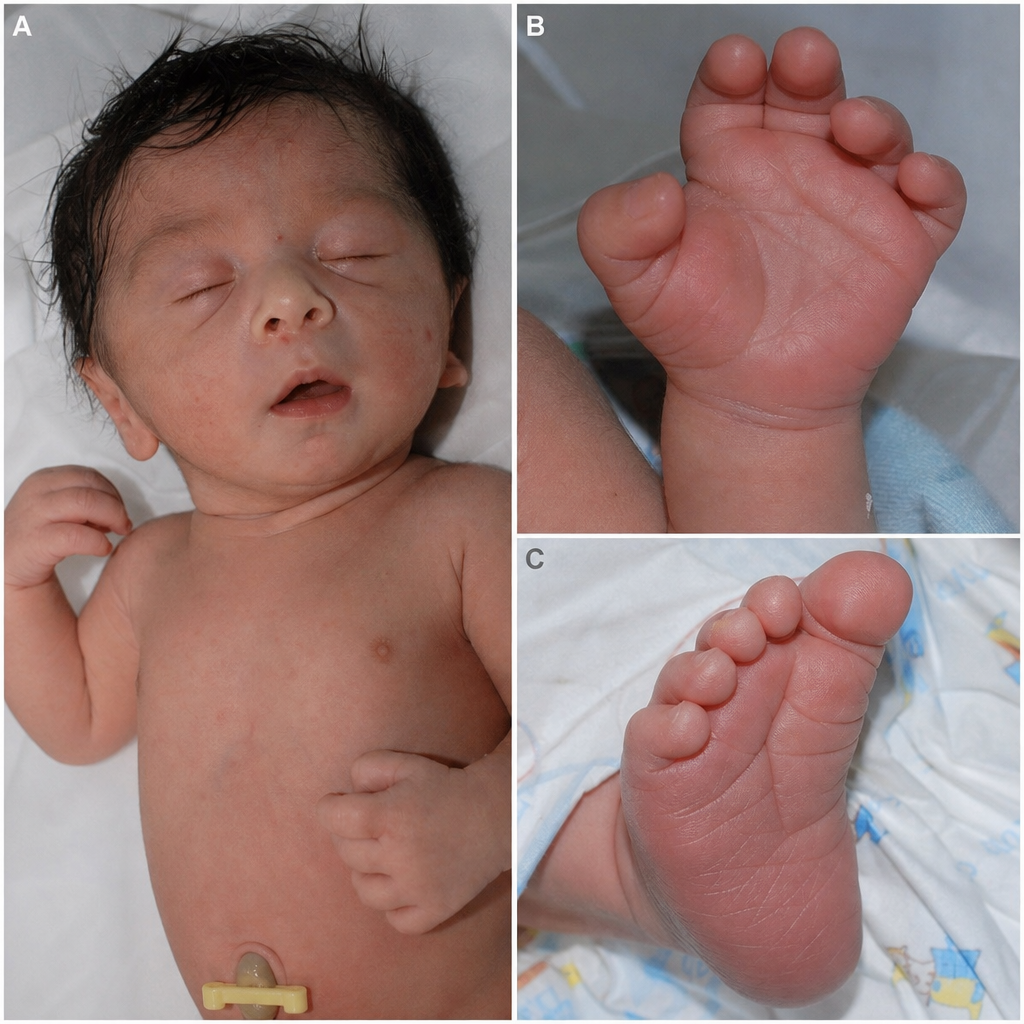
Which of the following causes can result in an infant being large for gestational age, EXCEPT?
What is the weight range for a Low Birth Weight (LBW) baby?
A newborn presents with frothing of the mouth and cyanosis on day one. What is the most probable diagnosis?
Which of the following is not a feature of neonatal lupus erythematosus?
A 1-day-old baby boy has developed abdominal distension and bilious emesis. Prenatal history was significant for areas of echogenic bowel seen on ultrasound. An abdominal radiograph and contrast enema were performed. Based on these findings, what is the most likely diagnosis?

Collection of sero-sanguineous fluid in the scalp is known as what?
A female infant is born approximately 10 weeks prematurely (at 30 weeks) and weighs 1710 gm. She has respiratory distress syndrome and is treated with exogenous surfactant. She is intubated endotracheally with mechanical ventilation immediately after birth. Over the first 4 days after birth, the ventilator pressure and the fraction of inspired oxygen are reduced. Beginning on the fifth day after birth, she has brief desaturations that become more persistent. She needs increased ventilator and oxygen support on the seventh day after birth. She becomes cyanotic. Further examination, echocardiogram, and x-rays reveal left atrial enlargement, an enlarged pulmonary artery, increased pulmonary vasculature, and a continuous machine-like murmur. Which of the following is the most likely diagnosis?
A neonate with multiple congenital anomalies has severe pulmonary hypoplasia of one lung. This is MOST likely secondary to which of the following congenital problems?
A 3-month-old boy is brought to the physician because his parents cannot find one of his testicles. Physical examination confirms the parents' observation. Which of the following is the most likely diagnosis?
All of the following are true about Cephalohematoma except?
Explanation: **Explanation:** **Large for Gestational Age (LGA)** is defined as a birth weight >90th percentile for a specific gestational age. The correct answer is **Maternal smoking** because it is a well-known cause of **Intrauterine Growth Restriction (IUGR)** and Small for Gestational Age (SGA) infants, not LGA. **Why Maternal Smoking is the correct answer:** Nicotine and carbon monoxide in cigarette smoke cause vasoconstriction of placental vessels and increase carboxyhemoglobin levels. This leads to chronic fetal hypoxia and reduced nutrient delivery, resulting in decreased birth weight. **Analysis of Incorrect Options:** * **Maternal Diabetes Mellitus:** This is the most common cause of LGA. Maternal hyperglycemia leads to fetal hyperglycemia, which stimulates the fetal pancreas to secrete excess **insulin** (a potent growth hormone), causing macrosomia and organomegaly. * **Hydrops Fetalis:** Excessive fluid accumulation in fetal compartments (edema, ascites, pleural effusion) significantly increases the total birth weight, often placing the infant in the LGA category despite potential underlying growth issues. * **Genetic Predisposition:** Constitutional factors, such as tall/large parents or certain overgrowth syndromes (e.g., **Beckwith-Wiedemann Syndrome**), are common non-pathological and pathological causes of LGA. **High-Yield Clinical Pearls for NEET-PG:** * **Beckwith-Wiedemann Syndrome Triad:** Macrosomia, Omphalocele, and Macroglossia. * **Infant of Diabetic Mother (IDM):** Look for complications like hypoglycemia, hypocalcemia, hyperbilirubinemia, and **Hypertrophic Cardiomyopathy** (asymmetric septal hypertrophy). * **SGA vs. LGA:** Maternal hypertension and smoking are the top causes of SGA; Maternal obesity and diabetes are the top causes of LGA.
Explanation: ### Explanation **Correct Answer: D. 1.5-2.5 kg** **Understanding the Concept:** The World Health Organization (WHO) defines **Low Birth Weight (LBW)** as a birth weight of **less than 2,500 grams (2.5 kg)**, regardless of gestational age. This measurement is taken immediately after birth (ideally within the first hour). LBW is a critical indicator of neonatal health as it is associated with increased risks of hypothermia, hypoglycemia, infection, and long-term neurodevelopmental delays. **Analysis of Options:** * **Option D (1.5-2.5 kg):** This represents the standard range for LBW. Specifically, a baby weighing between 1,500g and 2,499g falls into this category. * **Options A & B (2.6-2.9 kg):** These weights are considered **Normal Birth Weight**. In the Indian context, the average birth weight is approximately 2.7–2.9 kg, but medically, any weight $\geq$ 2.5 kg is not classified as LBW. * **Option C (3.2-3.5 kg):** This is the ideal/average birth weight range for infants in developed countries and is well above the LBW threshold. **High-Yield Clinical Pearls for NEET-PG:** To excel in Neonatology questions, remember the specific WHO sub-classifications: 1. **Low Birth Weight (LBW):** < 2,500 grams. 2. **Very Low Birth Weight (VLBW):** < 1,500 grams. 3. **Extremely Low Birth Weight (ELBW):** < 1,000 grams. 4. **Micropremie:** < 750 grams. 5. **Large for Gestational Age (LGA):** > 90th percentile or > 4,000 grams (Macrosomia). **Key Fact:** In India, the prevalence of LBW is high (approx. 20-30%), primarily due to intrauterine growth restriction (IUGR) and maternal malnutrition, whereas in developed nations, prematurity is the leading cause.
Explanation: ### Explanation **Correct Option: D. Esophageal Atresia** The classic clinical triad of **Esophageal Atresia (EA)** includes **frothing/drooling** at the mouth, **choking**, and **cyanosis** (often triggered by feeding attempts). * **Mechanism:** In EA, the esophagus ends in a blind pouch. Saliva cannot pass into the stomach, leading to accumulation in the upper pouch and subsequent overflow into the trachea (aspiration) or out of the mouth (frothing). * **Cyanosis:** This occurs due to laryngospasm or aspiration of saliva/feeds. If a **Tracheoesophageal Fistula (TEF)** is also present (most common type is Type C), air enters the stomach, and gastric acid can reflux into the lungs, worsening respiratory distress. **Why other options are incorrect:** * **A & B (Lung Hypoplasia/Lung Cyst):** These typically present with primary respiratory distress (tachypnea, grunting, retractions) immediately after birth, but they do not cause excessive oral frothing or drooling. * **C (Diaphragmatic Hernia):** While this causes severe cyanosis and respiratory distress, the hallmark signs are a **scaphoid abdomen** and shifted heart sounds. It does not typically present with frothing. **NEET-PG High-Yield Pearls:** * **Most Common Type:** Type C (85%) – Proximal atresia with distal TEF. * **Initial Diagnostic Step:** Attempt to pass a stiff, radio-opaque **nasogastric (NG) tube**; it will meet resistance and "coil" in the upper pouch (confirmed on X-ray). * **Associated Anomalies:** Look for **VACTERL** association (Vertebral, Anal, Cardiac, TEF, Renal, Limb). The most common cardiac defect is VSD. * **Antenatal Clue:** Polyhydramnios (due to inability of the fetus to swallow amniotic fluid).
Explanation: **Explanation:** Neonatal Lupus Erythematosus (NLE) is a rare acquired autoimmune disorder caused by the transplacental passage of maternal IgG autoantibodies (specifically **Anti-Ro/SSA** and **Anti-La/SSB**) into the fetal circulation. **Why Option C is the correct answer:** The question asks which is **not** a feature of the disease. While Anti-Ro positivity is the *cause* of the condition, the antibodies are found in the **mother’s serum**. In the neonate, these are passively acquired antibodies that disappear by 6–8 months of age as maternal IgG degrades. Therefore, Anti-Ro positivity is a **pathogenetic mechanism**, not a clinical "feature" or manifestation of the disease in the infant itself in the way that skin lesions or heart blocks are. **Analysis of other options:** * **A. Cutaneous lesions:** These are the most common manifestation. They typically appear as erythematous, annular (target-like) plaques, often in a "raccoon-eye" distribution. They are transient and resolve without scarring. * **B. Heart block:** Congenital Heart Block (usually third-degree) is the most serious complication. Unlike the skin or blood findings, the damage to the conduction system is **permanent** and irreversible. * **D. Thrombocytopenia:** Hematological abnormalities (thrombocytopenia, neutropenia, or anemia) and hepatobiliary involvement are common but transient systemic features of NLE. **High-Yield Clinical Pearls for NEET-PG:** * **Most common feature:** Cutaneous lesions. * **Most serious feature:** Third-degree (complete) AV block (requires a permanent pacemaker). * **Antibody association:** Anti-Ro (SSA) is most strongly associated with heart block; Anti-La (SSB) is also frequently present. * **Prognosis:** All features are reversible except for the heart block. * **Maternal status:** Many mothers are asymptomatic at the time of delivery but may later develop SLE or Sjögren’s syndrome.
Explanation: ***Cystic fibrosis*** - **Prenatal echogenic bowel** combined with **neonatal bilious emesis** and **abdominal distension** on day 1 strongly suggests **meconium ileus**, which is pathognomonic for cystic fibrosis. - The **ground-glass appearance** on abdominal X-ray (**Neuhauser sign**) and **microcolon** on contrast enema are classic imaging findings confirming meconium ileus in cystic fibrosis. *Duodenal atresia* - Typically presents with **double bubble sign** on abdominal X-ray, showing dilated stomach and proximal duodenum. - While it causes **bilious vomiting**, it doesn't cause **echogenic bowel** on prenatal ultrasound or the specific imaging findings described. *Gastroenteritis* - **Not a day-1 neonatal diagnosis** as infectious gastroenteritis requires exposure to pathogens after birth. - Presents with **diarrhea** and **fever**, not the constellation of prenatal echogenic bowel and immediate postnatal bilious vomiting. *Malrotation with volvulus* - Diagnosed with **upper GI series/barium swallow** showing abnormal **ligament of Treitz** position and **corkscrew appearance** of twisted bowel. - While it causes **bilious vomiting**, it doesn't typically present with **prenatal echogenic bowel** or the specific contrast enema findings of microcolon.
Explanation: The question refers to **Cephalhematoma**, which is a collection of blood between the skull bone and its overlying periosteum. ### **Explanation of the Correct Option** **C. It is limited to the periosteum:** This is the defining anatomical feature of a cephalhematoma. Because the bleeding occurs beneath the periosteum, the collection is trapped by the fibrous attachments of the periosteum at the cranial sutures. Therefore, a cephalhematoma **does not cross suture lines**, making it well-demarcated and limited to a single bone (usually the parietal). ### **Why Other Options are Incorrect** * **A. It is present at birth:** Incorrect. Unlike Caput Succedaneum, which is present at the time of delivery, a cephalhematoma usually **appears hours to days after birth** as the slow subperiosteal bleeding accumulates. * **B. It does not cause jaundice:** Incorrect. As the trapped blood breaks down and is reabsorbed, it can lead to **unconjugated hyperbilirubinemia**, increasing the risk of neonatal jaundice. * **D. It disappears within a few hours:** Incorrect. Cephalhematomas take **weeks to months** to resolve. They may also undergo calcification, leading to a "hard" feel on palpation. ### **High-Yield Clinical Pearls for NEET-PG** * **Caput Succedaneum:** Superficial edema (sero-sanguineous) above the periosteum; **crosses suture lines**; present at birth; disappears in 48–72 hours. * **Subgaleal Hemorrhage:** Bleeding between the aponeurosis and periosteum. It is the most dangerous because it can hold a large volume of blood, leading to hemorrhagic shock. * **Management:** Most cephalhematomas require **observation only**. Incision and drainage are contraindicated due to the high risk of infection (osteomyelitis).
Explanation: ### Explanation **Correct Answer: B. Patent ductus arteriosus (PDA)** **Pathophysiology & Clinical Presentation:** In a preterm infant, the ductus arteriosus often fails to close due to immaturity and low oxygen sensitivity. This case presents a classic "rebound" scenario: the infant initially improves after surfactant therapy (which decreases pulmonary vascular resistance), but this drop in resistance facilitates a **left-to-right shunt** through the PDA. The clinical hallmarks described are pathognomonic: 1. **Continuous "machinery" murmur** heard best at the left upper sternal border. 2. **Deterioration after initial improvement:** Increased oxygen/ventilator requirements around the end of the first week. 3. **Volume Overload:** Left-to-right shunting leads to pulmonary over-circulation (increased vasculature) and enlargement of the left atrium and pulmonary artery. **Why Incorrect Options are Wrong:** * **A. Persistent Foramen Ovale:** Usually asymptomatic or causes a mild right-to-left shunt if right-sided pressures are high; it does not cause a machinery murmur or significant pulmonary congestion. * **C. Ventricular Septal Defect (VSD):** While it causes a left-to-right shunt, the murmur is typically **holosystolic** (not continuous) and usually presents later as pulmonary resistance continues to fall. * **D. Pulmonary Stenosis:** This is an obstructive lesion presenting with a systolic ejection murmur and **decreased** pulmonary vascular markings on X-ray, not increased. **NEET-PG High-Yield Pearls:** * **Risk Factors:** Prematurity, RDS, and maternal Rubella infection. * **Clinical Signs:** Bounding peripheral pulses and a wide pulse pressure (due to diastolic "run-off" into the pulmonary artery). * **Management:** * *Medical:* **Indomethacin** or **Ibuprofen** (NSAIDs) to inhibit prostaglandins and promote closure. * *Surgical:* Ligation if medical therapy fails or is contraindicated (e.g., necrotizing enterocolitis or renal failure). * **Prostaglandin E1** is used to keep the ductus *open* in cyanotic heart diseases; **NSAIDs** are used to *close* it.
Explanation: **Explanation:** **1. Why Diaphragmatic Defect is Correct:** The most common cause of secondary pulmonary hypoplasia is a **Congenital Diaphragmatic Hernia (CDH)**. In CDH (most commonly the Bochdalek type on the left side), the failure of the pleuroperitoneal membrane to close allows abdominal viscera (stomach, intestines, liver) to herniate into the thoracic cavity during critical stages of lung development (pseudoglandular stage). This physical compression restricts the branching of the bronchial tree and pulmonary vasculature, leading to a reduction in the number of alveoli and severe **unilateral or bilateral pulmonary hypoplasia**. **2. Why the Other Options are Incorrect:** * **Endocardial Cushion Defect:** This is a cardiac septal defect (common in Down Syndrome). While it causes left-to-right shunting and pulmonary hypertension over time, it does not interfere with the embryological development of lung parenchyma or cause hypoplasia. * **Esophageal Atresia:** While often associated with a Tracheoesophageal Fistula (TEF), it typically presents with excessive salivation and choking. It does not occupy thoracic space or compress the developing lung tissue. * **Gastroschisis:** This is a paraumbilical abdominal wall defect where bowel herniates into the amniotic cavity, *outside* the body. Since the abdominal contents are not pushing into the thorax, the lungs develop normally. **3. Clinical Pearls for NEET-PG:** * **Bochdalek Hernia:** Most common type (Posterolateral), usually on the **Left side** (85%). * **Morgagni Hernia:** Retrosternal/Anterior, less common. * **Scaphoid Abdomen:** A classic clinical sign of CDH in a neonate with respiratory distress. * **Management Tip:** Avoid bag-and-mask ventilation in CDH (it distends the herniated bowel, further compressing the lung); **immediate endotracheal intubation** is the preferred initial step. * **Potter Sequence:** Another high-yield cause of pulmonary hypoplasia, secondary to oligohydramnios (often due to renal agenesis).
Explanation: **Explanation:** **Cryptorchidism** (undescended testis) is the most common congenital abnormality of the male endocrine/reproductive tract. It refers to the failure of one or both testes to descend into the scrotum. In a 3-month-old infant with a non-palpable or missing testis on examination, this is the most probable diagnosis. While many testes descend spontaneously by 3–4 months of age, the condition is considered pathological if they remain undescended beyond 6 months. **Analysis of Incorrect Options:** * **Anorchia:** This refers to the complete absence of one or both testes (vanishing testis syndrome). It is much rarer than cryptorchidism and is usually a diagnosis of exclusion confirmed via surgical exploration or imaging. * **Klinefelter Syndrome (47, XXY):** This typically presents post-puberty with small, firm testes, gynecomastia, and infertility. It does not typically present as a "missing" testis in infancy. * **Macroorchidism:** This refers to abnormally large testes, commonly associated with Fragile X Syndrome. It is the opposite of the clinical finding described. **NEET-PG High-Yield Pearls:** * **Most common site:** The inguinal canal is the most frequent location for an undescended testis. * **Management:** The gold standard treatment is **Orchidopexy**, ideally performed between **6 to 12 months** of age to preserve fertility and allow for early detection of malignancy. * **Complications:** Increased risk of **Infertility** (due to higher core body temperature) and **Testicular Germ Cell Tumors** (Seminoma is the most common). Note: Orchidopexy reduces the risk of infertility but does not completely eliminate the increased risk of malignancy; it primarily makes the testis accessible for screening. * **Retractile Testis:** A common differential where the testis can be manipulated into the scrotum and stays there (due to an overactive cremasteric reflex); this does not require surgery.
Explanation: **Explanation:** The correct answer is **D (May cross suture lines)** because this statement is false. A **Cephalohematoma** is a subperiosteal hemorrhage, meaning the blood collection occurs between the skull bone and its covering, the periosteum. Since the periosteum is firmly attached to the edges of each individual cranial bone at the **suture lines**, the bleeding is strictly confined to the surface of that specific bone. Therefore, it **does not cross suture lines**. **Analysis of other options:** * **Option A:** It typically appears several hours after birth and may **increase in size for 12–24 hours** as the slow capillary leak continues. * **Option B:** It is defined as a **subperiosteal hemorrhage**, usually involving the parietal or occipital bones. * **Option C:** As the trapped blood breaks down and is reabsorbed, it increases the bilirubin load on the neonatal liver, which **may lead to hyperbilirubinemia (jaundice)**. **High-Yield Clinical Pearls for NEET-PG:** * **Cephalohematoma vs. Caput Succedaneum:** Caput is a soft tissue edema (subcutaneous) that *is* present at birth and *does* cross suture lines. * **Subgaleal Hemorrhage:** This occurs between the aponeurosis and periosteum. It is the most dangerous as it can cross sutures and hold a massive volume of blood, leading to shock. * **Management:** Most cephalohematomas resolve spontaneously within weeks. **Incision and drainage are contraindicated** due to the high risk of secondary infection (osteomyelitis).
Neonatal Resuscitation
Practice Questions
Care of the Normal Newborn
Practice Questions
Prematurity and Low Birth Weight
Practice Questions
Respiratory Distress Syndrome
Practice Questions
Neonatal Jaundice
Practice Questions
Neonatal Sepsis
Practice Questions
Necrotizing Enterocolitis
Practice Questions
Intraventricular Hemorrhage
Practice Questions
Persistent Pulmonary Hypertension
Practice Questions
Perinatal Asphyxia
Practice Questions
Neonatal Seizures
Practice Questions
Congenital Anomalies
Practice Questions
Get full access to all questions, explanations, and performance tracking.
Start For Free