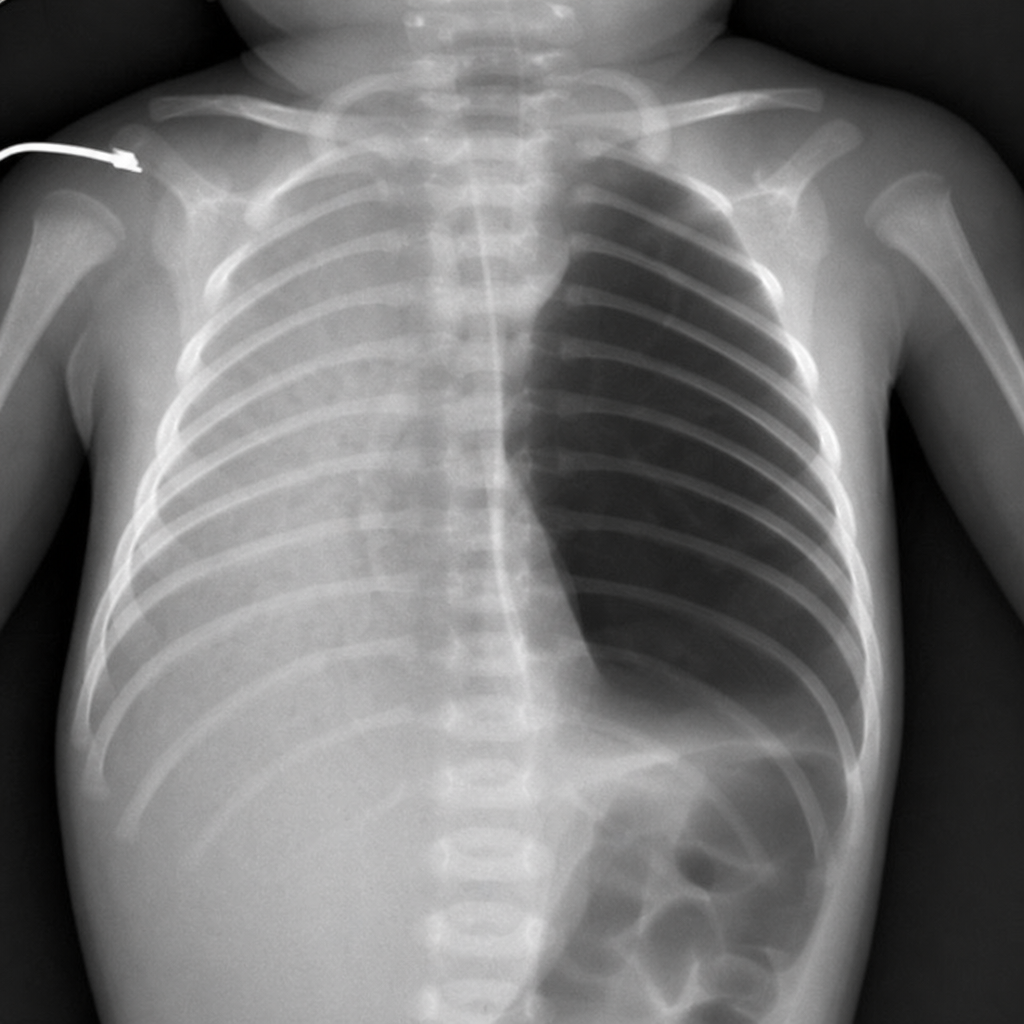
The item shown below is used to feed newborns born at what gestational age?

A 4-day-old infant, delivered at home, is brought to the emergency with complaints of bleeding from the umbilical stump. His PT is 24 seconds, APTT is 37 seconds, and platelet count is 200,000/mm3. Apart from maintaining intravascular volume, what would be the definitive line of management?
A three-day-old term infant, born at home and exclusively breast-fed, presented with lethargy, bulging fontanel, and bright red blood from the rectum. What is the most likely etiology of this condition?
What is true about cephalhematoma?
All of the following regarding meconium aspiration syndrome is true EXCEPT?
The neonatal period extends up to which day of life?
Harlequin skin change in the newborn is seen in which of the following conditions?
What is the approximate length of the small bowel in a full-term newborn?
Total body water in a neonate is approximately:
What is the recommended ratio of chest compressions to breathing during cardiopulmonary resuscitation in a newborn patient admitted to the ICU?
Explanation: ***33 weeks*** - The **paladai (cup feeder)** shown is ideal for preterm infants around **32-34 weeks** when **suck-swallow-breathe coordination** begins to mature but is not yet fully developed. - At this gestational age, infants can manage **cup feeding** as a bridge between **tube feeding** and direct **breastfeeding**. *27 weeks* - Extremely preterm infants at this age lack adequate **neurological maturation** for safe oral feeding and require **nasogastric** or **orogastric tube feeding**. - **Suck-swallow-breathe coordination** is underdeveloped, making any oral feeding method unsafe due to high **aspiration risk**. *30 weeks* - Most infants at 30 weeks still require **tube feeding** as their **sucking reflex** and **swallowing coordination** are immature. - The **respiratory control** necessary for safe feeding while breathing is not sufficiently developed at this gestational age. *37 weeks* - **Term infants** at 37 weeks have fully developed **feeding reflexes** and can directly **breastfeed** or bottle feed without assistance. - The paladai is unnecessary for term infants who have mature **suck-swallow-breathe coordination** and can feed efficiently from breast or bottle.
Explanation: ### Explanation **Correct Answer: A. Administer Vitamin K** The clinical presentation is a classic case of **Vitamin K Deficiency Bleeding (VKDB)**, formerly known as Hemorrhagic Disease of the Newborn. **1. Why Vitamin K is the definitive management:** * **Mechanism:** Newborns are naturally deficient in Vitamin K due to poor placental transfer, a sterile gut (no synthesis by flora), and low levels in breast milk. Vitamin K is essential for the gamma-carboxylation of **Factors II, VII, IX, and X**. * **Laboratory Profile:** Deficiency leads to a prolonged **Prothrombin Time (PT)** and **Activated Partial Thromboplastin Time (aPTT)**, while the **platelet count remains normal**. * **Clinical Context:** Home deliveries often miss the routine prophylactic Vitamin K injection (1mg IM) given at birth. Bleeding from the umbilical stump on day 4 fits the "Early" or "Classical" presentation of VKDB. Administering Vitamin K directly addresses the underlying deficiency. **2. Why other options are incorrect:** * **B. Transfuse FFP:** While FFP contains clotting factors and is used in life-threatening active hemorrhage (e.g., intracranial bleed), it is not the *definitive* treatment for simple VKDB. Vitamin K is the specific antidote. * **C. Start Antibiotics:** While umbilical sepsis (omphalitis) can cause bleeding, the isolated prolongation of PT/aPTT with a normal platelet count specifically points to a coagulation factor deficiency rather than infection/sepsis. * **D. Start Inotropic Support:** This is indicated for shock. The primary goal here is to stop the bleeding by correcting the coagulopathy. **3. High-Yield Pearls for NEET-PG:** * **VKDB Classification:** * *Early:* <24 hours (usually due to maternal drugs like Phenytoin/Warfarin). * *Classical:* Days 2–7 (usually umbilical or GI bleed). * *Late:* 2 weeks to 6 months (often presents as Intracranial Hemorrhage; associated with exclusive breastfeeding). * **Prophylaxis:** 1 mg IM Vitamin K at birth for all neonates (>1500g); 0.5 mg for preterm (<1500g). * **Factor Half-life:** Factor VII has the shortest half-life, which is why **PT** is the first lab value to become prolonged.
Explanation: This clinical scenario describes a classic presentation of **Vitamin K Deficiency Bleeding (VKDB)**, specifically the "Early" or "Classical" form. ### **Why Vitamin K Deficiency is Correct** Neonates are naturally deficient in Vitamin K due to poor placental transfer, a sterile gut (lack of K2-producing bacteria), and low concentrations in breast milk. Without Vitamin K, the liver cannot perform the **gamma-carboxylation** of clotting factors **II, VII, IX, and X**. * **Clinical Correlation:** The "bright red blood from the rectum" indicates gastrointestinal hemorrhage, while the "bulging fontanel" and "lethargy" are hallmark signs of **intracranial hemorrhage (ICH)**. Home births are a major risk factor as these infants often miss the routine prophylactic Vitamin K injection at birth. ### **Why Other Options are Incorrect** * **Fluoride deficiency:** Primarily affects dental enamel and bone mineralization; it does not cause acute bleeding or neurological symptoms. * **Calcium deficiency:** Neonatal hypocalcemia typically presents with jitteriness, seizures, or tetany, but not spontaneous systemic or intracranial bleeding. * **Iron deficiency:** Usually manifests as microcytic anemia later in infancy (4–6 months). It does not cause acute hemorrhagic disease in a three-day-old. ### **NEET-PG High-Yield Pearls** * **Classification of VKDB:** * **Early:** Within 24 hours (usually due to maternal drugs like anticonvulsants). * **Classical:** Days 1–7 (typically GI or skin bleeding). * **Late:** Week 2 to 6 months (highest risk of **Intracranial Hemorrhage**; often associated with malabsorption or exclusive breastfeeding). * **Lab Findings:** Prolonged **Prothrombin Time (PT)** is the earliest and most sensitive indicator. * **Prevention:** 1 mg of intramuscular Vitamin K1 (Phytonadione) at birth is the standard of care.
Explanation: ### Explanation **1. Why Option A is Correct:** Cephalhematoma is a subperiosteal collection of blood. As the trapped red blood cells (RBCs) break down, they release hemoglobin, which is metabolized into unconjugated bilirubin. This increased bilirubin load can overwhelm the immature neonatal liver, leading to **exaggerated or prolonged physiological jaundice**. **2. Why the Other Options are Incorrect:** * **Option B:** Cephalhematoma is a subperiosteal hemorrhage. Since the periosteum is firmly attached to the edges of the cranial bones at the sutures, the bleeding is confined to a single bone and **does not cross suture lines**. (Contrast this with Caput Succedaneum, which does cross). * **Option C:** It typically appears **several hours to days after birth**, not immediately. It is most commonly found over the **parietal bone**, not the occiput. * **Option D:** It is caused by the rupture of **subperiosteal capillaries** (small vessels), not bridging arteries. Rupture of bridging veins typically leads to a subdural hemorrhage. **3. Clinical Pearls for NEET-PG:** * **Caput Succedaneum:** Edema of the scalp; present at birth; crosses suture lines; disappears in 48–72 hours. * **Subgaleal Hemorrhage:** Bleeding between the aponeurosis and periosteum; can cross sutures; potentially life-threatening due to massive blood loss. * **Management:** Most cephalhematomas resolve spontaneously within 2–12 weeks. **Observation** is the rule; aspiration is contraindicated due to the risk of infection (osteomyelitis). * **Associated Finding:** A small percentage (5–25%) may be associated with an underlying linear skull fracture.
Explanation: **Explanation:** Meconium Aspiration Syndrome (MAS) occurs when a neonate inhales meconium-stained amniotic fluid (MSAF) into the lungs, leading to airway obstruction, chemical pneumonitis, and surfactant inactivation. **1. Why Option C is the Correct Answer (The "Except" statement):** Historically, **intrapartum amnioinfusion** (infusing saline into the amniotic cavity) was thought to dilute meconium and reduce MAS. However, large randomized controlled trials and current **ACOG/AAP guidelines** have proven that amnioinfusion **does not** reduce the risk of MAS or improve perinatal outcomes. Therefore, it is no longer recommended for this purpose. **2. Analysis of Incorrect Options:** * **Option A:** Aspirated meconium causes hypoxia and acidosis, which triggers pulmonary vasoconstriction. This frequently leads to **Persistent Pulmonary Hypertension of the Newborn (PPHN)**, a common and severe complication of MAS. * **Option B:** MAS is often associated with fetal distress and hypoxia. The resulting anaerobic metabolism leads to **metabolic and respiratory acidosis**, making it a significant risk factor for neonatal acidosis. * **Option D:** Management of MAS is supportive. Severe cases often require **ventilatory support** (CPAP or mechanical ventilation) to maintain oxygenation. In refractory cases, High-Frequency Oscillatory Ventilation (HFOV) or ECMO may be used. **High-Yield Clinical Pearls for NEET-PG:** * **Incidence:** MAS is primarily seen in **term and post-term** infants; it is rare in preterm infants. * **Chest X-ray:** Characterized by "patchy opacities" (atelectasis) alternating with areas of hyperinflation (emphysema) due to the ball-valve effect. * **Management Update:** Routine endotracheal suctioning of "non-vigorous" infants is **no longer recommended**. Current NRP guidelines emphasize standard resuscitation (PPV) if the infant is not breathing or has a low heart rate.
Explanation: **Explanation:** The **neonatal period** is defined as the interval from birth to **28 completed days of life**. This period is critical in pediatrics as it represents the time of greatest risk for mortality and the transition from intrauterine to extrauterine life. **Why Option C is Correct:** According to the World Health Organization (WHO) and standard pediatric textbooks (like Nelson and Ghai), the neonatal period spans the first 4 weeks of life. It is further subdivided into: * **Early Neonatal Period:** Birth to 7 completed days (0–6 days). * **Late Neonatal Period:** 7 to 28 completed days (7–27 days). **Why Other Options are Incorrect:** * **Option A (21 days):** This does not correspond to any standard clinical definition in neonatology. * **Option B (30 days):** While often used colloquially as "one month," it is medically inaccurate. The physiological and statistical definition strictly adheres to the 28-day rule. * **Option D (35 days):** This extends beyond the neonatal period into the infancy stage. **High-Yield Clinical Pearls for NEET-PG:** * **Infancy:** Extends from birth to 1 year of age. * **Perinatal Period:** Starts from 28 weeks of gestation and ends at 7 days after birth. * **Neonatal Mortality Rate (NMR):** Defined as the number of neonatal deaths per 1,000 live births. In India, the NMR contributes to nearly 70% of the Infant Mortality Rate (IMR), making this period a high-priority area for public health interventions. * **Most common cause of neonatal death:** Prematurity and low birth weight, followed by birth asphyxia and sepsis.
Explanation: **Explanation:** **Harlequin Color Change** is a benign, transient vascular phenomenon seen in approximately 10% of healthy newborns, typically between the 2nd and 5th day of life. **1. Why Autonomic Dysfunction is correct:** The condition is caused by the **immaturity of the hypothalamic centers** that control peripheral vascular tone. This leads to temporary **autonomic instability**, resulting in an imbalance in the tone of the capillary bed. When the infant is placed on their side, gravity causes blood to pool in the dependent half of the body. The dependent half turns deep red/pink, while the upper half remains pale, creating a sharp midline demarcation. It lasts from seconds to 20 minutes and resolves with activity or by reversing the infant's position. **2. Why other options are incorrect:** * **Ichthyosis:** Specifically "Harlequin Ichthyosis," is a severe genetic skin disorder characterized by thick, plate-like scales. It is a structural keratinization defect, not a transient vascular change. * **Septicemia:** While sepsis can cause mottled skin (cutis marmorata) or peripheral cyanosis due to poor perfusion, it does not produce the classic sharp midline color demarcation of Harlequin change. * **Polycythemia:** This leads to a generalized "ruddy" or plethoric appearance (hyperemia) across the entire body, rather than a unilateral distribution. **Clinical Pearls for NEET-PG:** * **Benign Nature:** No treatment is required; it is a physiological phenomenon. * **Differential Diagnosis:** Do not confuse this with **Harlequin Ichthyosis** (ABCA12 mutation) or **Port-wine stains** (which are permanent). * **Common Trigger:** Most commonly seen when the baby is in a lateral recumbent position.
Explanation: **Explanation:** The length of the small intestine in a newborn is a critical anatomical landmark, particularly when managing conditions like necrotizing enterocolitis (NEC) or congenital anomalies. **1. Why 250 cm is correct:** In a full-term neonate, the small bowel measures approximately **250 cm to 300 cm**. This length increases significantly during the third trimester of gestation and continues to grow postnatally, eventually reaching an average adult length of 600–700 cm. Knowing this baseline is vital for surgeons to determine the risk of "Short Bowel Syndrome" if a resection is required. **2. Why the other options are incorrect:** * **100 cm (Option D):** This is the approximate length of the small bowel in a very premature infant (around 27–30 weeks gestation). At this stage, the bowel has not yet undergone the rapid longitudinal growth seen in the final weeks of pregnancy. * **500 cm & 750 cm (Options B & C):** These values represent adolescent or adult lengths. A newborn’s abdomen is too small to accommodate such lengths, and the intestinal surface area expands as the child grows to meet increasing nutritional demands. **High-Yield Clinical Pearls for NEET-PG:** * **Short Bowel Syndrome (SBS):** In neonates, SBS is generally defined when there is less than **75 cm** of functional small intestine remaining or a loss of >70% of the total length. * **Growth Pattern:** The small bowel doubles in length between the 24th week of gestation and full term. * **Ileocecal Valve:** Preservation of this valve is more critical than the absolute length of the bowel for preventing bacterial overgrowth and improving nutritional outcomes.
Explanation: **Explanation:** The correct answer is **75%**. Total Body Water (TBW) is inversely proportional to age and body fat content. In a term neonate, TBW accounts for approximately **75-78%** of the total body weight. This high percentage is primarily due to a larger Extracellular Fluid (ECF) compartment compared to adults. **Breakdown of Options:** * **A (90%):** This value is seen in early fetal life (around 12-15 weeks of gestation). As the fetus matures, the percentage of water decreases as fat and protein stores increase. * **B (75%):** **Correct.** This is the standard physiological value for a term newborn. In preterm infants, the TBW is even higher, ranging from 80% to 85%. * **C (60%):** This is the average TBW for an **adult male**. By the end of the first year of life, a child’s TBW percentage drops to approximately 60%, reaching adult levels. * **D (30%):** This value is too low for any physiological state and is inconsistent with human life. **High-Yield Clinical Pearls for NEET-PG:** 1. **Physiological Weight Loss:** Neonates lose 5-10% of their birth weight in the first week of life, primarily due to the contraction of the ECF volume (diuresis). 2. **ECF vs. ICF:** At birth, ECF (45%) is greater than ICF (30%). By one year of age, this ratio flips to the adult pattern where ICF is greater than ECF. 3. **Preterm Considerations:** The more premature the infant, the higher the TBW and ECF percentage, making them highly susceptible to fluid electrolyte imbalances and insensible water loss.
Explanation: **Explanation:** In neonatal resuscitation, the primary cause of cardiac arrest is almost always **respiratory failure** rather than primary cardiac pathology. Therefore, the focus is on establishing effective ventilation and ensuring adequate oxygenation. **1. Why 3:1 is Correct:** The Neonatal Resuscitation Program (NRP) guidelines recommend a **3:1 ratio** (3 compressions to 1 ventilation) for newborns. This ratio ensures that both ventilation and circulation are supported while maintaining a high frequency of events. In one minute, this translates to **90 compressions and 30 breaths**, totaling 120 events per minute. This rhythm prioritizes ventilation, which is the most critical step in reversing neonatal bradycardia. **2. Why the other options are incorrect:** * **15:2 (Option C):** This is the ratio used for **infants and children** (up to puberty) when there are **two rescuers** present. * **30:2 (Option D):** This is the standard ratio for **adults** and for **infants/children** when there is only **one rescuer**. * **5:1 (Option B):** This ratio is not currently recommended in any standard Basic Life Support (BLS) or NRP protocols. **High-Yield Clinical Pearls for NEET-PG:** * **Depth of Compression:** Approximately **one-third** of the anterior-posterior diameter of the chest. * **Technique:** The **two-thumb-encircling hands technique** is preferred over the two-finger technique as it generates higher coronary perfusion pressure. * **When to start compressions:** Only if the heart rate remains **<60 bpm** despite at least 30 seconds of effective positive pressure ventilation (PPV). * **Oxygen Concentration:** Once compressions begin, the FiO2 should be increased to **100%**.
Neonatal Resuscitation
Practice Questions
Care of the Normal Newborn
Practice Questions
Prematurity and Low Birth Weight
Practice Questions
Respiratory Distress Syndrome
Practice Questions
Neonatal Jaundice
Practice Questions
Neonatal Sepsis
Practice Questions
Necrotizing Enterocolitis
Practice Questions
Intraventricular Hemorrhage
Practice Questions
Persistent Pulmonary Hypertension
Practice Questions
Perinatal Asphyxia
Practice Questions
Neonatal Seizures
Practice Questions
Congenital Anomalies
Practice Questions
Get full access to all questions, explanations, and performance tracking.
Start For Free