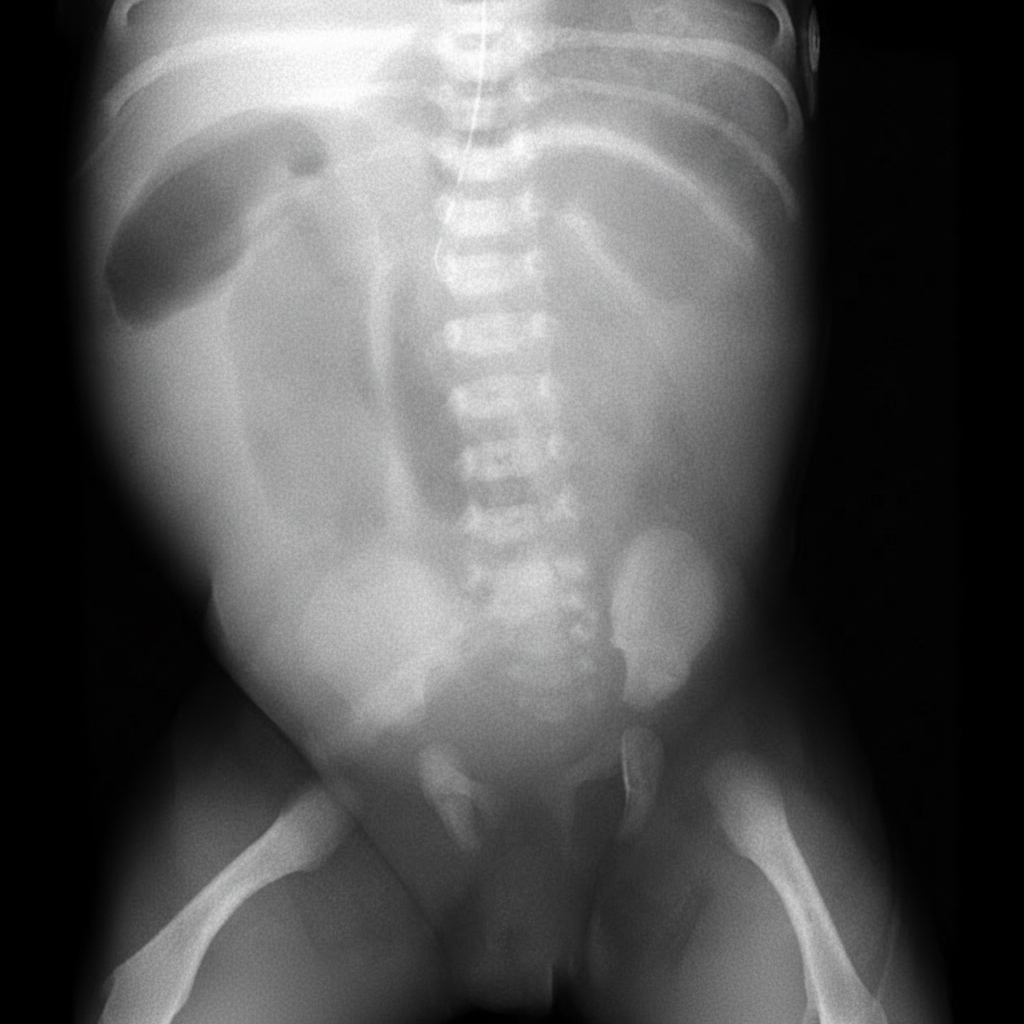
A child died soon after birth. On examination, there was hepatosplenomegaly and edema all over the body. What is the most probable diagnosis?
What is the most common abdominal tumor in a neonate?
A 5-day-old child presents with intractable seizures and generalized rashes. Blood examination shows hyperammonemia and lactic acidosis. What is the probable diagnosis?
A woman who developed chickenpox 2 days ago is admitted in labor. What is the best method to prevent infection in the neonate?
A 2-hour-old male infant vomits stomach contents and bile. The vomiting continues for 2 days. In addition, abdominal distension is noted, and he is unable to pass meconium. Which of the following is the most common cause of this condition?
A neonate requires bag and mask ventilation during cardiopulmonary resuscitation. The heart rate is 60-100 beats per minute. What is the next recommended treatment?
In a baby born to a diabetic mother, which of the following is typically NOT observed?
The neonatal kidney achieves concentrating ability equivalent to the adult kidney by which age?
Donor breast milk is known to transmit which of the following infections?
Kangaroo mother care is FALSE regarding which of the following statements?
Explanation: ### Explanation The clinical presentation of a neonate with generalized edema (anasarca) and hepatosplenomegaly who dies shortly after birth is classic for **Hydrops Fetalis**. **Why Alpha Thalassemia is Correct:** The most severe form of Alpha Thalassemia is **Hb Bart’s (α-thalassemia major)**, where all four alpha-globin genes are deleted (--/--). Since alpha chains are essential for the formation of both fetal hemoglobin (HbF, α2γ2) and adult hemoglobin (HbA, α2β2), their absence leads to the formation of gamma-chain tetramers (γ4), known as **Hb Bart’s**. * **Pathophysiology:** Hb Bart’s has an extremely high affinity for oxygen and does not release it to tissues, leading to severe intrauterine hypoxia, high-output cardiac failure, massive hepatosplenomegaly (due to extramedullary hematopoiesis), and ultimately, **Hydrops Fetalis**. **Why the Other Options are Incorrect:** * **Beta Thalassemia:** Symptoms do not appear at birth because newborns primarily have HbF (α2γ2). Beta-chain production only becomes significant around 6 months of age, which is when Beta Thalassemia Major typically manifests. * **Hereditary Spherocytosis:** While it can cause neonatal jaundice or anemia, it rarely causes hydrops fetalis or immediate neonatal death. * **Sickle Cell Anemia:** Similar to Beta Thalassemia, symptoms are delayed until HbF levels drop and beta-S chains increase (usually after 6 months). **High-Yield Clinical Pearls for NEET-PG:** * **Hb Bart’s:** γ4 tetramers (Alpha-thalassemia major, 4 gene deletion). * **HbH Disease:** β4 tetramers (3 gene deletion). * **Most common cause of non-immune hydrops** in Southeast Asia is Alpha Thalassemia. * **Diagnosis:** Confirmed by Hemoglobin electrophoresis showing Hb Bart’s.
Explanation: **Explanation:** In the neonatal period (first 28 days of life), the most common **malignant** abdominal tumor is **Neuroblastoma**. While multicystic dysplastic kidney and hydronephrosis are the most common causes of an abdominal *mass* overall, among true neoplasms, neuroblastoma takes precedence. It originates from the neural crest cells of the sympathetic nervous system, most commonly in the adrenal medulla. **Analysis of Options:** * **B. Neuroblastoma (Correct):** It is the most frequent malignancy in neonates. A unique feature in this age group is "Stage 4S," which often involves the liver, skin, and bone marrow, and has a remarkably high rate of spontaneous regression. * **A. Wilms Tumor:** While it is the most common renal tumor in children, it typically presents between **2 to 5 years** of age. It is extremely rare in the neonatal period (where Congenital Mesoblastic Nephroma is the more likely renal tumor). * **C. Hydronephrosis:** This is the most common cause of a palpable abdominal **mass** in a neonate, but it is a structural/obstructive abnormality, not a **tumor** (neoplasm). * **D. Bladder Tumor:** These are exceptionally rare in neonates. Rhabdomyosarcoma is the most common bladder malignancy in children, but it usually presents in toddlers or older children. **High-Yield Clinical Pearls for NEET-PG:** * **Most common neonatal abdominal mass:** Hydronephrosis (followed by Multicystic Dysplastic Kidney). * **Most common neonatal malignancy:** Neuroblastoma. * **Most common renal tumor in neonates:** Congenital Mesoblastic Nephroma (benign). * **Diagnostic Marker:** Elevated urinary catecholamines (VMA/HVA) are seen in 90% of neuroblastoma cases. * **Pepper Syndrome:** Massive hepatomegaly in neonatal neuroblastoma due to extensive liver metastasis.
Explanation: ### Explanation The clinical presentation of a neonate with **intractable seizures**, **hyperammonemia**, and **lactic acidosis** is classic for **Organic Aciduria** (e.g., Methylmalonic acidemia, Propionic acidemia). **1. Why Organic Aciduria is Correct:** Organic acidurias are metabolic disorders characterized by the accumulation of organic acids in blood and urine. * **Lactic Acidosis:** The accumulation of toxic metabolites inhibits the pyruvate dehydrogenase complex, leading to secondary lactic acidosis. * **Hyperammonemia:** High levels of organic acids inhibit the first step of the urea cycle (N-acetylglutamate synthase), leading to elevated ammonia levels. * **Clinical Clues:** The presence of **generalized rashes** (often erythematous or desquamating) and **intractable seizures** in the first week of life are hallmark signs of these metabolic crises. **2. Why Other Options are Incorrect:** * **Mitochondrial Encephalopathy (MELAS):** While it causes lactic acidosis and seizures, it rarely presents with significant hyperammonemia or skin rashes in the first 5 days of life. * **Phenylketonuria (PKU):** Presents later with developmental delay and "mousy odor." It does **not** cause acute hyperammonemia or lactic acidosis. * **Urea Cycle Enzyme Deficiencies (UCDs):** While UCDs cause severe hyperammonemia and seizures, they typically present with a **normal or low anion gap** and **no lactic acidosis**. The pH is usually alkalotic (respiratory alkalosis) due to hyperventilation triggered by ammonia. **High-Yield Clinical Pearls for NEET-PG:** * **Differentiating Point:** Hyperammonemia + Ketosis/Acidosis = **Organic Aciduria**. * **Differentiating Point:** Hyperammonemia + Respiratory Alkalosis = **Urea Cycle Disorder**. * **Sweet/Fruity Odor:** Isovaleric acidemia ("sweaty feet" odor). * **Initial Management:** Stop protein intake, start IV glucose, and consider peritoneal dialysis/hemodialysis to remove ammonia.
Explanation: **Explanation:** The clinical scenario describes a case of **Perinatal Varicella**, which carries a high risk of severe, life-threatening disseminated disease in the neonate. **Why Option A is correct:** The critical window for maternal-fetal transmission of varicella is when the mother develops the rash **5 days before to 2 days after delivery**. In this period, the mother has not yet developed or transferred protective IgG antibodies to the fetus, but the virus has already crossed the placenta. Administering **Varicella Zoster Immunoglobulin (VZIG)** to the neonate immediately after birth provides passive immunity to neutralize the virus and prevent or attenuate the severity of the infection. **Why other options are incorrect:** * **Option B:** The varicella vaccine is a **live-attenuated vaccine**. It is contraindicated in neonates and takes weeks to produce an immune response, making it useless for post-exposure prophylaxis in a newborn. * **Option C:** Cesarean section does not prevent transmission, as the virus is transmitted transplacentally (hematogenous spread) rather than through the birth canal. * **Option D:** Breastfeeding is not contraindicated. In fact, breast milk may contain maternal antibodies (if present) and is encouraged once the mother is no longer in the highly infectious stage. **NEET-PG High-Yield Pearls:** * **The "Danger Zone":** Maternal rash 5 days before to 2 days after delivery. * **Congenital Varicella Syndrome:** Occurs when the mother is infected in the **first 20 weeks** of pregnancy (presents with cicatricial skin scars, limb hypoplasia, and microcephaly). * **Treatment:** If the neonate develops symptoms despite VZIG, the drug of choice is **Intravenous Acyclovir**. * **Isolation:** The mother and neonate should be isolated from other pregnant women and infants in the nursery.
Explanation: ### Explanation The clinical presentation of **bilious vomiting**, **abdominal distension**, and **failure to pass meconium** in a newborn indicates a low intestinal obstruction. The most common cause of **jejunoileal atresia** (implied here) is a vascular accident in utero. **1. Why Option A is Correct:** Unlike duodenal atresia, which is a developmental failure of recanalization, **jejunoileal atresia** is caused by a **vascular catastrophe** (ischemic necrosis) during fetal life. This is most commonly due to **volvulus**, intussusception, or internal herniation. The resulting infarction leads to the resorption of the affected bowel segment, leaving behind a blind-ending pouch or a "string-like" fibrous cord. **2. Analysis of Incorrect Options:** * **Option B (Incomplete closure of lateral folds):** This refers to the embryological defect causing **gastroschisis**, where the bowel herniates through the abdominal wall, usually to the right of the umbilicus. * **Option C (Failure of recanalization):** This is the mechanism for **Duodenal Atresia** (associated with Down Syndrome). The ileum does not go through a solid cord stage that requires recanalization. * **Option D (Remnant of omphaloenteric duct):** This describes **Meckel’s Diverticulum**. While it can cause obstruction via intussusception or a fibrous band, it is not the most common cause of neonatal intestinal atresia. **Clinical Pearls for NEET-PG:** * **Duodenal Atresia:** "Double Bubble" sign on X-ray; associated with Down Syndrome; mechanism is failure of recanalization. * **Jejunoileal Atresia:** "Triple Bubble" sign or multiple air-fluid levels; mechanism is vascular accident (infarction). * **Meconium Ileus:** Often the earliest manifestation of **Cystic Fibrosis**; presents with a "ground glass" or "soap bubble" appearance (Neuhauser sign) on X-ray. * **Hirschsprung Disease:** Delayed meconium passage (>48 hours) with a transition zone on contrast enema.
Explanation: **Explanation:** The management of neonatal resuscitation follows the **NRP (Neonatal Resuscitation Program) algorithm**, which is strictly guided by the heart rate (HR). 1. **Why Option D is Correct:** In neonatal resuscitation, the primary goal is establishing effective ventilation. Chest compressions are indicated only when the HR remains **below 60 bpm** despite 30 seconds of effective positive pressure ventilation (PPV). If the HR rises to **60–100 bpm**, the criteria for chest compressions are no longer met. Therefore, compressions should be stopped to avoid unnecessary trauma and to focus on improving oxygenation, while PPV (ventilation) must continue until the HR exceeds 100 bpm and spontaneous respiration is established. 2. **Why Other Options are Incorrect:** * **Option A:** Adrenaline is only indicated if the HR remains **below 60 bpm** after at least 60 seconds of coordinated chest compressions and ventilation with 100% oxygen. * **Option B & C:** Chest compressions are contraindicated if the HR is above 60 bpm. Continuing them at a HR of 60–100 bpm is unnecessary and interferes with effective ventilation. **Clinical Pearls for NEET-PG:** * **Golden Minute:** The first 60 seconds of life are critical for completing the initial steps and starting PPV if needed. * **Compression-to-Ventilation Ratio:** In neonates, it is **3:1** (90 compressions and 30 breaths per minute). * **Target SpO2:** Do not expect 100% saturation immediately; at 1 minute, the target is only 60-65%. * **Depth of Compression:** One-third of the anteroposterior diameter of the chest. * **Preferred Technique:** The **two-thumb technique** is superior to the two-finger technique as it generates better perfusion pressure.
Explanation: ### Explanation The correct answer is **D. Heart failure**. While Infants of Diabetic Mothers (IDM) are prone to various cardiac issues, overt heart failure is **not** a typical or common clinical feature. **1. Why Heart Failure is the Correct Answer:** IDMs frequently develop **Asymmetric Septal Hypertrophy (ASH)** due to fetal hyperinsulinemia, which causes glycogen and fat deposition in the interventricular septum. While this can lead to subaortic outflow tract obstruction, it is usually **asymptomatic** and resolves spontaneously within weeks as insulin levels normalize. Congestive heart failure is rare unless there is a severe associated structural malformation. **2. Analysis of Incorrect Options:** * **A. Malformations:** IDMs have a 2-8 fold higher risk of congenital anomalies. The most specific is **Caudal Regression Syndrome**, while the most common are **Cardiac defects** (VSD, Transposition of the Great Arteries). * **B. Macrosomia:** This is the most common finding. Maternal hyperglycemia leads to fetal hyperglycemia, triggering **fetal hyperinsulinemia**. Insulin acts as a potent growth hormone, causing organomegaly and increased adipose tissue. * **C. Growth Restriction:** While macrosomia is common, **Small for Gestational Age (SGA)** babies are seen in mothers with long-standing diabetes (Class F or R) involving **renovascular complications** and placental insufficiency. **3. High-Yield Clinical Pearls for NEET-PG:** * **Most common metabolic abnormality:** Hypoglycemia (occurs within 1-2 hours of birth). * **Most common electrolyte abnormality:** Hypocalcemia and Hypomagnesemia. * **Hematological:** Polycythemia (due to increased erythropoietin from fetal hypoxia). * **Respiratory:** Delayed surfactant synthesis leading to Respiratory Distress Syndrome (RDS). * **Neurological:** Increased risk of Neural Tube Defects (NTDs).
Explanation: **Explanation:** The neonatal kidney is anatomically complete at birth (nephrogenesis ends at 34-36 weeks of gestation), but it is physiologically immature. The ability to concentrate urine depends on the length of the Loop of Henle, the responsiveness of the distal tubule to Antidiuretic Hormone (ADH), and the osmotic gradient in the renal medulla. **1. Why "One year of age" is correct:** At birth, a neonate’s maximum urinary concentration is only about 700–800 mOsm/L (compared to 1200–1400 mOsm/L in adults). This limitation is due to shorter loops of Henle and lower urea concentration in the medullary interstitium. As the infant grows, the tubular function matures and the medullary gradient increases. By **one year of age**, the infant’s renal concentrating capacity reaches adult levels. **2. Why the other options are incorrect:** * **Three to six months of age:** While Glomerular Filtration Rate (GFR) increases significantly during this period (reaching near-adult levels per $m^2$ by 1–2 years), the specific tubular concentrating mechanism is still maturing. * **Eighteen months of age:** This is beyond the typical milestone for concentrating ability, though some other complex metabolic functions continue to refine. * **Just before puberty:** Renal function is fully mature long before this stage; puberty primarily involves hormonal and reproductive maturation, not basic renal physiology. **High-Yield Clinical Pearls for NEET-PG:** * **GFR Maturity:** GFR reaches adult levels (adjusted for surface area) by **2 years** of age. * **Bicarbonate Threshold:** Neonates have a lower renal threshold for bicarbonate (~18-21 mEq/L vs. 24-26 mEq/L in adults), making them more prone to metabolic acidosis. * **Clinical Implication:** Due to poor concentrating ability, neonates are at a high risk of **hypernatremic dehydration** if fluid intake is inadequate or if they lose free water.
Explanation: **Explanation:** The transmission of infectious agents through donor breast milk is a critical concern in neonatal intensive care. While pasteurization (Holder method) effectively eliminates most pathogens, the question focuses on which specific virus can be transmitted via breast milk. **Why Rubella is Correct:** Rubella virus is known to be excreted in breast milk. While postnatal transmission of Rubella through breast milk usually results in a mild or asymptomatic infection in the infant (unlike the devastating effects of Congenital Rubella Syndrome), it remains a documented route of transmission. In the context of donor milk, if the milk is not processed or if the donor is acutely infected, the virus can be present. **Analysis of Incorrect Options:** * **HIV:** While HIV is transmitted through fresh breast milk, it is **not** transmitted via donor breast milk from a certified milk bank. Standard screening of donors and mandatory **Holder pasteurization** (62.5°C for 30 minutes) effectively inactivates HIV. * **CMV:** Cytomegalovirus is commonly found in breast milk. However, **pasteurization and freezing** significantly reduce or eliminate the viral load. In milk bank settings, the risk of CMV transmission is considered negligible due to these processing standards. * **Tuberculosis:** *Mycobacterium tuberculosis* is not typically transmitted through the milk itself. The risk to the infant arises from respiratory droplets if the mother has active pulmonary TB. Breastfeeding is only contraindicated if the mother has active TB mastitis (which is rare). **NEET-PG High-Yield Pearls:** * **Holder Pasteurization:** The gold standard for donor milk (62.5°C for 30 mins). It kills HIV, CMV, and HBV, but preserves most immunological components (IgA, Lysozyme). * **Absolute Contraindications to Breastfeeding:** HIV (in developed settings), HTLV-1/2, active Ebola virus, and infant Galactosemia. * **Temporary Contraindications:** Active Herpes simplex lesions on the breast, untreated active Tuberculosis (until 2 weeks of therapy), and active Varicella (if developed 5 days before to 2 days after delivery).
Explanation: **Explanation:** Kangaroo Mother Care (KMC) is a standardized, evidence-based care system for newborn infants, particularly preterm and low birth weight (LBW) babies. **Why Option A is the correct answer (False statement):** The question asks which statement is **FALSE**. However, in standard medical practice and WHO guidelines, KMC **can** be provided by the father, grandmother, or any other family member. The term "Mother" in KMC is traditional, but the physiological benefits of skin-to-skin contact are achieved regardless of the provider. Therefore, stating it "can also be given by the father" is a **true** statement. *Note: In the context of this specific MCQ structure, if Option A is marked as the "False" statement, it is technically a pedagogical error in the question itself, as all three options (A, B, and C) are clinically true statements regarding KMC.* **Analysis of other options:** * **Option B:** KMC is specifically indicated for stable LBW babies (<2500g) and preterm infants to promote growth and reduce morbidity. * **Option C:** One of the primary pillars of KMC is providing "Effective Thermal Control" through continuous skin-to-skin contact, which prevents hypothermia. **High-Yield Clinical Pearls for NEET-PG:** 1. **Components of KMC:** 1) Kangaroo position (Skin-to-skin), 2) Kangaroo nutrition (Exclusive breastfeeding), and 3) Early discharge and follow-up. 2. **Eligibility:** The baby must be hemodynamically stable. There is no minimum weight limit, but the baby should not be in respiratory distress or shock. 3. **Duration:** Should be practiced as long as possible (at least 1 hour per session to avoid frequent handling) until the baby reaches ~2500g or term gestation. 4. **Benefits:** Reduces neonatal mortality, sepsis, and hypoglycemia; improves maternal-infant bonding and breastfeeding rates.
Neonatal Resuscitation
Practice Questions
Care of the Normal Newborn
Practice Questions
Prematurity and Low Birth Weight
Practice Questions
Respiratory Distress Syndrome
Practice Questions
Neonatal Jaundice
Practice Questions
Neonatal Sepsis
Practice Questions
Necrotizing Enterocolitis
Practice Questions
Intraventricular Hemorrhage
Practice Questions
Persistent Pulmonary Hypertension
Practice Questions
Perinatal Asphyxia
Practice Questions
Neonatal Seizures
Practice Questions
Congenital Anomalies
Practice Questions
Get full access to all questions, explanations, and performance tracking.
Start For Free