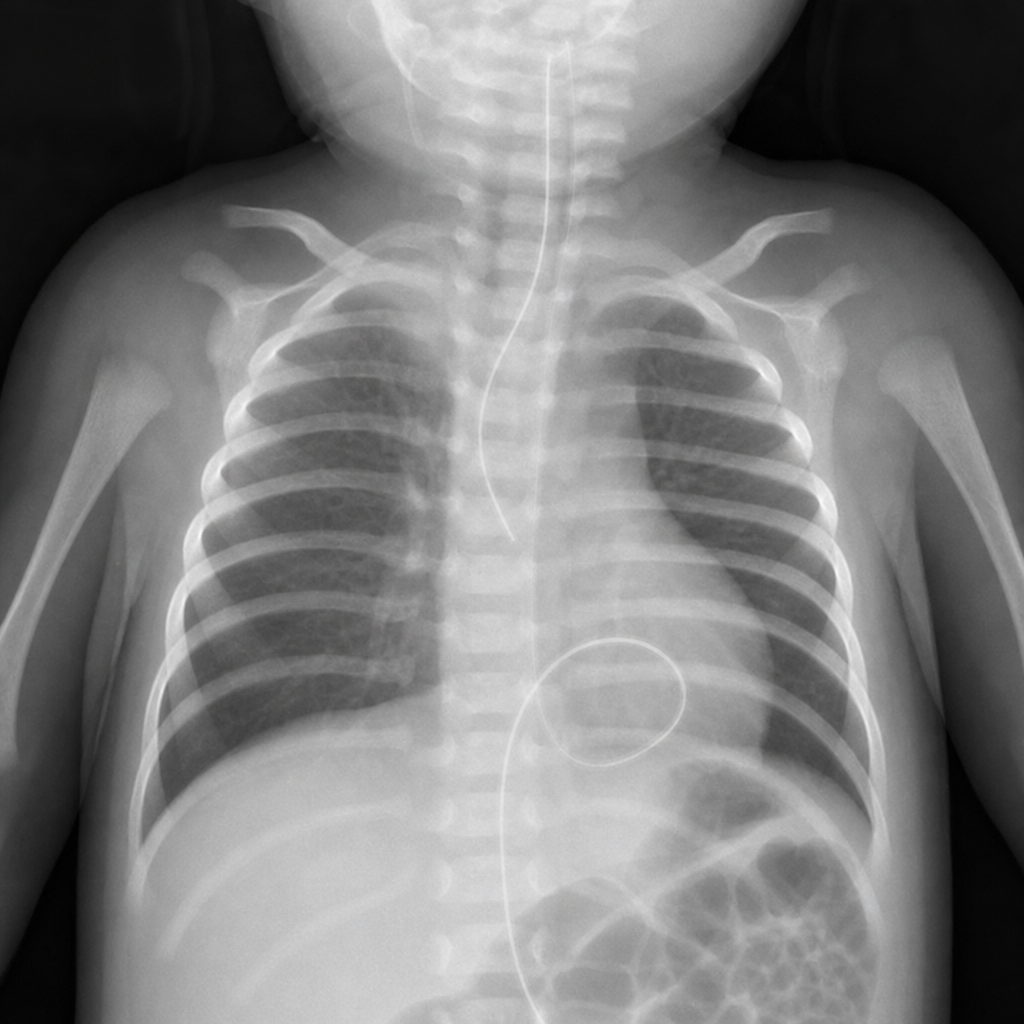
A neonate born at 36 weeks' gestation manifests severe hydrops fetalis, hepatosplenomegaly, generalized icterus, and scattered ecchymoses of the skin. Laboratory studies show a hemoglobin concentration of 9.4 g/dL and platelet count of 67,000/mm3. Ultrasound of the head shows ventricular enlargement. Death occurs 14 days after birth. At autopsy, there is extensive subependymal necrosis, with microscopic evidence of encephalitis. Within the areas of necrosis, there are large cells containing intranuclear inclusions. Congenital infection with which of the following organisms is most likely to produce these findings?
Natal teeth can be seen in all of the following conditions except:
Which of the following findings is NOT typically seen in an infant of a diabetic mother?
What is the definitive test for the diagnosis of neonatal sepsis?
A neonate presents with respiratory distress, contralateral mediastinal shift, and multiple cystic air-filled lesions in the chest. What is the most likely diagnosis?
What is the best next step in managing a breastfed infant with jaundice?
What is the approximate heart rate of a newborn?
A mother does not remember the date of her last menstrual period, and no antenatal ultrasound reports are available. Which of the following tools can be used to assess the gestational age of the neonate born to this mother?
What is the definition of low birth weight?
Surfactant deficiency causes which of the following conditions?
Explanation: **Explanation:** The clinical presentation of hydrops fetalis, hepatosplenomegaly, jaundice, and thrombocytopenia (ecchymoses) in a neonate points toward a **TORCH infection**. The definitive diagnostic clues in this case are the **periventricular (subependymal) involvement** and the histopathological finding of **large cells with intranuclear inclusions**. 1. **Why Cytomegalovirus (CMV) is correct:** CMV is the most common congenital infection. The hallmark pathological finding is **cytomegaly** (enlarged cells) with prominent basophilic intranuclear inclusions surrounded by a clear halo, classically described as **"Owl’s eye" appearance**. CMV has a predilection for the germinal matrix in the **subependymal/periventricular** region, leading to necrosis, ventriculomegaly, and eventually **periventricular calcifications** (a high-yield differentiator from Toxoplasmosis). 2. **Why other options are incorrect:** * **Herpes Simplex Virus (HSV):** Usually presents with skin vesicles, keratoconjunctivitis, or acute encephalitis (temporal lobe predilection). It is typically acquired during delivery, not as a chronic intrauterine infection causing hydrops. * **HIV:** Congenital HIV is usually asymptomatic at birth; it does not cause hydrops fetalis or acute necrotizing encephalitis in the neonatal period. * **Parvovirus B19:** A major cause of **hydrops fetalis** due to severe fetal anemia (aplastic crisis), but it does not typically cause encephalitis or the characteristic intranuclear inclusions in brain tissue; it targets erythroid progenitor cells. **NEET-PG High-Yield Pearls:** * **CMV:** Most common cause of sensorineural hearing loss (SNHL) and periventricular calcifications. * **Toxoplasmosis:** Classic triad of Chorioretinitis, Hydrocephalus, and **Diffuse** intracranial calcifications. * **Congenital Rubella:** PDA, Cataracts, and "Blueberry muffin" spots. * **Syphilis:** Snuffles, Hutchinson’s teeth, and periostitis.
Explanation: **Explanation:** **Natal teeth** are teeth present at birth, most commonly occurring in the mandibular incisor region. While often idiopathic, they are frequently associated with specific craniofacial syndromes. **1. Why Option B is the correct answer:** **Van der Woude syndrome** is the most common cause of syndromic orofacial clefts. Its classic clinical triad includes **cleft lip (with or without cleft palate)** and **paramedian lower lip pits**. Crucially, it is **not** typically associated with natal teeth. In NEET-PG, distinguishing between syndromes with similar midline defects is key; Van der Woude is defined by lip pits, not premature dentition. **2. Why the other options are incorrect:** * **Cleft Palate (Option A):** Natal teeth are a recognized clinical association with midline defects like cleft palate. The disruption in the dental lamina during development can lead to the superficial positioning of tooth buds. * **Pierre Robin Syndrome (Option C):** This sequence (micrognathia, glossoptosis, and U-shaped cleft palate) is a classic association for natal teeth. The restricted mandibular space and developmental anomalies often trigger early eruption. **3. Clinical Pearls for NEET-PG:** * **Most common site:** Mandibular central incisors (85%). * **Complication:** **Riga-Fede disease** (sublingual ulceration due to trauma from the tooth during feeding). * **Management:** If the tooth is supernumerary or hypermobile (risk of aspiration), it should be extracted. If it is part of the normal primary dentition, it should be preserved if possible. * **Other associated syndromes:** Ellis-van Creveld syndrome (Chondroectodermal dysplasia), Hallermann-Streiff syndrome, and Jadassohn-Lewandowsky syndrome.
Explanation: **Explanation:** The hallmark metabolic derangement in an **Infant of a Diabetic Mother (IDM)** is **Hypoglycemia**, not hyperglycemia. **1. Why Hyperglycemia is the Correct Answer (The Mechanism):** According to the **Pedersen Hypothesis**, maternal hyperglycemia leads to fetal hyperglycemia because glucose crosses the placenta via facilitated diffusion. In response, the fetal pancreas undergoes islet cell hyperplasia, leading to **fetal hyperinsulinism**. After birth, the high supply of maternal glucose is abruptly cut off, but the infant’s insulin levels remain high, causing rapid glucose uptake and profound **neonatal hypoglycemia** (usually within the first 1–3 hours of life). **2. Why the other options are typically seen in IDM:** * **Polycythemia (B):** Chronic fetal hyperglycemia and hyperinsulinism increase fetal oxygen consumption, leading to relative fetal hypoxia. This stimulates erythropoietin production, resulting in polycythemia. * **Hyperbilirubinemia (A):** This occurs secondary to polycythemia (increased RBC breakdown) and hepatic immaturity. * **Hypocalcemia (D):** Often seen within the first 24–72 hours, likely due to functional hypoparathyroidism and delayed parathyroid hormone response in these infants. **Clinical Pearls for NEET-PG:** * **Most common anomaly:** Congenital Heart Disease (specifically VSD and Transposition of Great Arteries). * **Most specific anomaly:** Caudal Regression Syndrome (Sacral Agenesis). * **Cardiac finding:** Transient Hypertrophic Subaortic Stenosis (asymmetric septal hypertrophy). * **Respiratory:** Increased risk of Respiratory Distress Syndrome (RDS) because hyperinsulinism inhibits surfactant production by interfering with cortisol action.
Explanation: **Explanation:** **1. Why Blood Culture is the Correct Answer:** In neonatology, **Blood Culture** is considered the **gold standard** and definitive test for diagnosing neonatal sepsis. The isolation of a pathogenic microorganism from a sterile site (blood) provides irrefutable evidence of systemic infection. It not only confirms the diagnosis but also identifies the specific causative organism and its antibiotic sensitivity, allowing for targeted therapy. **2. Analysis of Incorrect Options:** * **Urine Culture:** While important in late-onset sepsis (after 72 hours), it is rarely positive in early-onset sepsis and is not the primary definitive test for systemic infection. * **Immature:Total (I:T) Neutrophil Ratio:** This is a component of the hematological profile. An I:T ratio **>0.2** is a sensitive indicator of sepsis but lacks the specificity to be definitive. * **Sepsis Screen:** This is a bedside tool used to *exclude* or *suspect* sepsis. It typically includes CRP, TLC, ANC, I:T ratio, and micro-ESR. While it helps in the decision to start antibiotics, it does not provide a definitive microbiological diagnosis. **3. Clinical Pearls for NEET-PG:** * **Volume Matters:** For optimal yield in neonates, at least **1 mL** of blood should be collected for culture. * **Sepsis Screen Positivity:** A screen is considered positive if **two or more** parameters are abnormal. It has a high **Negative Predictive Value (NPV)**, meaning if the screen is negative, sepsis is unlikely. * **Most Common Organisms:** In India, *Klebsiella* is the most common cause of neonatal sepsis, whereas, in the West, Group B Streptococcus (GBS) is more prevalent. * **CSF Culture:** Should always be performed if sepsis is suspected, as 10-15% of neonates with sepsis may have associated meningitis.
Explanation: **Explanation:** The clinical presentation of respiratory distress, mediastinal shift, and cystic air-filled lesions in the chest of a neonate is a classic description of **Congenital Diaphragmatic Hernia (CDH)**. **Why the correct answer is right:** In CDH (most commonly the left-sided **Bochdalek hernia**), abdominal viscera (stomach, intestines) herniate into the thoracic cavity through a defect in the diaphragm. On a chest X-ray, the air-filled loops of the bowel appear as **multiple cystic lesions**. These loops occupy space, leading to a **contralateral mediastinal shift** and compression of the lungs, resulting in pulmonary hypoplasia and immediate respiratory distress. **Why the other options are incorrect:** * **Pneumonia:** While it causes respiratory distress, it typically presents with opacities (consolidation) rather than discrete cystic air-filled lesions and rarely causes a significant mediastinal shift. * **Congenital Lung Cyst:** These are usually solitary or few in number. While they can cause a shift if large, the presence of "multiple" lesions in a neonate with a scaphoid abdomen (implied) strongly points toward the bowel. * **Congenital Lobar Emphysema (CLE):** This involves hyperinflation of a single lobe (usually the left upper lobe). It presents as a **hyperlucent** area with mass effect, but it lacks the characteristic "bubbly" appearance of multiple bowel loops. **High-Yield Clinical Pearls for NEET-PG:** * **Physical Exam:** Look for a **scaphoid abdomen** (sunken appearance) because the abdominal contents are in the chest. * **Management Tip:** **Never use bag-and-mask ventilation** in suspected CDH, as it distends the intrathoracic bowel with air, further compressing the lungs. Immediate **endotracheal intubation** is the gold standard. * **Most common site:** Posterolateral (Bochdalek) on the **left side** (85%). * **Prognostic factor:** The degree of **pulmonary hypoplasia** and pulmonary hypertension determines survival.
Explanation: ### Explanation The clinical scenario describes **Breastfeeding Jaundice** (also known as "lack-of-breastmilk jaundice"), which typically occurs in the first week of life. It is caused by inadequate milk intake leading to dehydration, weight loss, and delayed passage of meconium. This results in increased enterohepatic circulation of bilirubin. **Why Option D is Correct:** The primary management for breastfeeding jaundice is to **improve breastfeeding technique and frequency**. Increasing the duration (15–20 minutes) and frequency (every 2 hours) of feeds stimulates milk production, ensures the infant receives high-calorie hindmilk, and promotes bowel movements to excrete bilirubin. This addresses the root cause: caloric deprivation and sluggish intestinal motility. **Why Other Options are Incorrect:** * **A & B (Phototherapy/Exchange Transfusion):** These are reserved for pathological levels of bilirubin based on age-specific nomograms (Bhutani curves). In simple breastfeeding jaundice, conservative management is the first step unless levels cross the threshold for intervention. * **C (Switch to Cow's Milk):** Cow’s milk is contraindicated in infants under one year due to high solute load and risk of intestinal bleeding. While "Breast Milk Jaundice" (a different entity occurring later, at 2–3 weeks) may occasionally require a brief 24-hour pause in breastfeeding, it is never replaced with cow's milk; formula is used if necessary. **NEET-PG High-Yield Pearls:** * **Breastfeeding Jaundice:** Occurs in **Week 1**; due to *inadequate* intake (dehydration/decreased calories). * **Breast Milk Jaundice:** Occurs in **Week 2–3**; due to *factors in milk* (e.g., beta-glucuronidase, pregnanediol) that inhibit conjugation. * **Management Rule:** Never advise stopping breastfeeding as the first step. Always optimize feeding frequency first (aim for 8–12 times/day). * **Bilirubin excretion:** 90% is excreted via feces; hence, frequent stooling is vital to prevent reabsorption.
Explanation: **Explanation:** The normal heart rate of a healthy newborn typically ranges from **120 to 160 beats per minute (bpm)**. This high rate compared to adults is physiological, as neonates have a higher metabolic demand and a relatively fixed stroke volume; therefore, they must maintain a high cardiac output primarily by increasing their heart rate. * **Why Option A is correct:** In the immediate neonatal period, the resting heart rate fluctuates between 120–160 bpm. It may drop to 80–100 bpm during deep sleep or surge up to 180 bpm during vigorous crying. * **Why Options B, C, and D are incorrect:** These ranges (160–220 bpm) are considered **Neonatal Tachycardia**. While transient elevations occur during stress or crying, a persistent resting heart rate above 160–180 bpm warrants investigation for underlying causes such as sepsis, respiratory distress, hyperthermia, or cardiac arrhythmias (e.g., SVT). **High-Yield Clinical Pearls for NEET-PG:** 1. **NRP Guidelines:** During Neonatal Resuscitation (NRP), the most important indicator of successful ventilation is a rising heart rate. A heart rate **<100 bpm** is the threshold to start Positive Pressure Ventilation (PPV), and **<60 bpm** is the threshold to start chest compressions. 2. **Respiratory Rate:** The normal respiratory rate for a newborn is **40–60 breaths/min**. Periodic breathing (pauses <20 seconds) is normal. 3. **Blood Pressure:** At birth, the average BP is approximately **60/40 mmHg**. 4. **Bradycardia:** In a neonate, bradycardia is usually secondary to **hypoxia** rather than primary cardiac disease.
Explanation: **Explanation:** The assessment of gestational age is crucial in neonatology, especially when antenatal records (LMP or ultrasound) are unavailable. **1. Why the Correct Answer is Right:** The **New Ballard Score (NBS)** is the gold standard clinical tool for estimating gestational age. It evaluates two components: **Neuromuscular Maturity** (e.g., posture, square window, arm recoil) and **Physical Maturity** (e.g., skin, lanugo, plantar surface). The **Expanded** version is specifically designed to accurately assess extremely premature neonates (as low as 20 weeks of gestation). Each parameter is assigned a score from -1 to 5, and the total score is plotted on a scale to determine the maturity in weeks. **2. Why the Other Options are Incorrect:** * **Apgar Score:** Used to assess the clinical status of the newborn and the success of transition/resuscitation at 1 and 5 minutes after birth. It does not determine gestational age. * **Downe’s Score:** A clinical scoring system used to assess the severity of **respiratory distress** in term and preterm neonates. * **Silverman-Andersen Score:** Similar to Downe’s, this is used specifically to grade the severity of respiratory distress, particularly in **preterm** infants. **Clinical Pearls for NEET-PG:** * **Timing:** The New Ballard Score is most accurate when performed within **12 to 24 hours** of birth. * **Physical vs. Neuromuscular:** Physical criteria are more reliable in the first few hours, while neuromuscular criteria may be affected by maternal anesthesia or neonatal illness. * **Dubowitz Score:** An older system involving 21 criteria; the Ballard score is a simplified, more commonly used version of this.
Explanation: **Explanation:** The World Health Organization (WHO) defines **Low Birth Weight (LBW)** as a birth weight of **less than 2,500 grams (2.5 kg)**, regardless of gestational age. This measurement must be taken within the first hour of life, before significant postnatal weight loss occurs. LBW is a critical indicator of neonatal health and is a major predictor of infant morbidity and mortality. **Analysis of Options:** * **Option C (Correct):** Weight < 2.5 kg is the standard global definition for LBW. It includes both preterm infants and those with Intrauterine Growth Restriction (IUGR). * **Option B:** Weight **less than 1.5 kg** is defined as **Very Low Birth Weight (VLBW)**. * **Option D:** Weight **less than 1.0 kg** is defined as **Extremely Low Birth Weight (ELBW)**. * **Option A:** While 2 kg is a clinical threshold often used for initiating specific interventions (like Kangaroo Mother Care in some protocols), it is not a formal WHO classification category. **High-Yield Clinical Pearls for NEET-PG:** 1. **Incidence:** India has one of the highest incidences of LBW globally (approx. 25-30%). 2. **Microsomia:** Birth weight < 500g is often considered the limit of viability (though this varies by region). 3. **Ponderal Index:** Used to differentiate between symmetrical and asymmetrical IUGR. 4. **Kangaroo Mother Care (KMC):** Recommended for all stable LBW infants, especially those < 2 kg. 5. **Common Complications:** LBW infants are at high risk for hypothermia, hypoglycemia, hypocalcemia, and sepsis.
Explanation: **Explanation:** **Respiratory Distress Syndrome (RDS)**, also known as Hyaline Membrane Disease, is primarily caused by a deficiency of **pulmonary surfactant**. Surfactant is a phospholipid-protein complex (mainly dipalmitoylphosphatidylcholine) produced by **Type II pneumocytes**. Its primary role is to reduce surface tension at the alveolar-air interface, preventing alveolar collapse (atelectasis) during expiration. In premature infants, inadequate surfactant leads to widespread atelectasis, decreased lung compliance, and impaired gas exchange, manifesting as respiratory distress. **Analysis of Incorrect Options:** * **Transient Tachypnea of the Newborn (TTN):** Caused by delayed resorption of fetal lung fluid, typically seen in term infants or those born via Cesarean section. It is not a surfactant deficiency. * **Neonatal Jaundice:** Caused by the accumulation of bilirubin due to immature liver conjugation or hemolysis; it is unrelated to pulmonary mechanics. * **Hypertensive Encephalopathy:** A neurological manifestation of severe hypertension; it does not involve the surfactant system. **High-Yield Clinical Pearls for NEET-PG:** * **Risk Factors:** Prematurity (most common), maternal diabetes, and Cesarean delivery without labor. * **Chest X-ray Findings:** Characterized by a diffuse **"ground-glass appearance"** with **air bronchograms** and low lung volumes. * **L/S Ratio:** An Lecithin/Sphingomyelin ratio of **<2:1** in amniotic fluid indicates lung immaturity. * **Management:** Antenatal corticosteroids (e.g., Betamethasone) given to the mother significantly reduce the risk of RDS. Postnatal treatment involves exogenous surfactant replacement and respiratory support (CPAP/Ventilation).
Neonatal Resuscitation
Practice Questions
Care of the Normal Newborn
Practice Questions
Prematurity and Low Birth Weight
Practice Questions
Respiratory Distress Syndrome
Practice Questions
Neonatal Jaundice
Practice Questions
Neonatal Sepsis
Practice Questions
Necrotizing Enterocolitis
Practice Questions
Intraventricular Hemorrhage
Practice Questions
Persistent Pulmonary Hypertension
Practice Questions
Perinatal Asphyxia
Practice Questions
Neonatal Seizures
Practice Questions
Congenital Anomalies
Practice Questions
Get full access to all questions, explanations, and performance tracking.
Start For Free