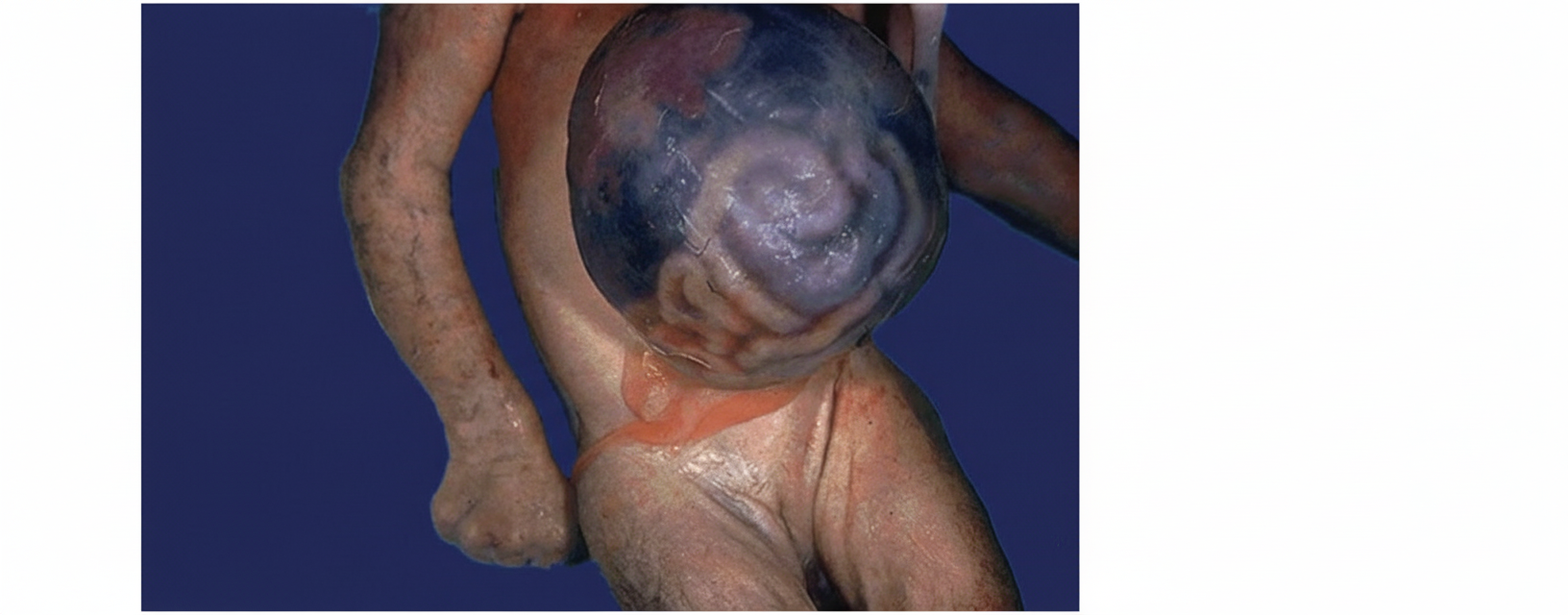
A patient was induced for being post-term at 42 3/7 weeks. Immediately following the delivery, you examine the baby and note the following on physical exam: a small amount of cartilage in the earlobe, occasional creases over the anterior two-thirds of the soles of the feet, 4-mm breast nodule diameter, fine and fuzzy scalp hair, and a scrotum with some but not extensive rugae. Based on this physical exam, what is the approximate gestational age of this male infant?
What is the definition of a preterm infant?
A 2-day-old neonate developed respiratory distress due to pneumonia. What is the most common causative agent?
Which of the following is not a normal finding in a newborn?
A newborn baby presents with regurgitation of feeds and continuous drooling of saliva. What is the most likely diagnosis?
Macrosomia is a result of:
Jaundice in the new-born is considered physiological when?
What is the indication for using adrenaline in neonatal resuscitation?
A newborn child is presenting with regurgitation of all feeds and develops coughing and cyanosis with feeding. What is the most probable diagnosis?
When does the umbilical cord typically become black?
Explanation: This question tests the application of the **New Ballard Score**, a clinical tool used to estimate gestational age based on neuromuscular and physical maturity. ### **Explanation of the Correct Answer** The physical findings described align most closely with a gestational age of **38 weeks**. According to the Ballard criteria: * **Ear Cartilage:** A "small amount of cartilage" suggests moderate maturity (37–38 weeks). In post-term infants, the ear is stiff and stands away from the head. * **Plantar Creases:** Creases over the "anterior two-thirds" are characteristic of 37–38 weeks. By 40+ weeks, creases should cover the entire sole. * **Breast Nodule:** A 4-mm diameter is typical for 37–38 weeks. (At 40+ weeks, it is usually >5-10 mm). * **Scrotum:** "Some but not extensive rugae" indicates the testes have descended, but the deep pendulous rugae of a post-term infant are absent. * **Scalp Hair:** "Fine and fuzzy" hair is seen in late preterm/early term infants; post-term infants usually have coarse, silky hair. Despite the mother being 42 weeks (post-term), the **infant's physical exam** suggests a maturity of 38 weeks, indicating a discrepancy between menstrual dates and clinical maturity. ### **Why Other Options are Incorrect** * **A (33 weeks):** At this age, the ear would have little to no cartilage (stays folded), no breast bud would be palpable, and the scrotum would be small with few rugae. * **B (36 weeks):** Plantar creases would only be on the anterior transverse line, and the breast nodule would be smaller (1–2 mm). * **D (42 weeks):** A true post-term infant would show leathery, cracked, or wrinkled skin, deep creases over the entire sole, thick ear cartilage, and a pendulous scrotum with deep rugae. ### **NEET-PG High-Yield Pearls** * **Ballard Score Timing:** Should be performed within **29 hours** of birth for maximum accuracy. * **Skin:** The most reliable physical sign in the first few hours. * **Neuromuscular Signs:** Include posture, square window (wrist), arm recoil, popliteal angle, scarf sign, and heel-to-ear maneuver. * **Key Differentiator:** If a question mentions "parchment-like" or "leathery" skin, always think **Post-term (>42 weeks)**.
Explanation: ### Explanation **Correct Answer: C. Born before 37 weeks gestation** The classification of neonates is based on the **Gestational Age (GA)**, calculated from the first day of the mother's Last Menstrual Period (LMP). According to the World Health Organization (WHO), a **preterm infant** is defined as any baby born alive before **37 completed weeks** of pregnancy (less than 259 days). This threshold is clinically significant because infants born before this period have immature organ systems, particularly the lungs (surfactant deficiency) and the brain, increasing the risk of morbidity and mortality. **Analysis of Incorrect Options:** * **Option A (37-42 weeks):** This defines a **Term infant**. These infants have the lowest risk of complications. (Note: "Early term" is 37 0/7 to 38 6/7 weeks). * **Option B (After 42 weeks):** This defines a **Post-term infant**. These babies are at risk for meconium aspiration syndrome and placental insufficiency. * **Option D (Before 25 weeks):** While these are preterm, this specific cutoff often refers to "extreme prematurity" or the "limit of viability" in many clinical settings, but it is not the standard definition for preterm birth. **High-Yield Clinical Pearls for NEET-PG:** * **Sub-categories of Preterm:** * *Late preterm:* 34 to <37 weeks. * *Very preterm:* <32 weeks. * *Extremely preterm:* <28 weeks. * **New Ballard Score:** The most commonly used clinical tool to estimate gestational age postnatally based on physical and neuromuscular maturity. * **Common Complications:** Respiratory Distress Syndrome (RDS), Intraventricular Hemorrhage (IVH), Necrotizing Enterocolitis (NEC), and Retinopathy of Prematurity (ROP).
Explanation: **Explanation:** The neonate in the question is 2 days old, placing the condition in the category of **Early-Onset Neonatal Sepsis/Pneumonia** (occurring within the first 72 hours of life). **1. Why Group-B Streptococci (GBS) is correct:** *Streptococcus agalactiae* (GBS) is the most common cause of early-onset neonatal pneumonia, sepsis, and meningitis worldwide. The infection is typically acquired via **vertical transmission** from the maternal genital tract during labor or through ascending infection. In the lungs, GBS causes an inflammatory response that often mimics Hyaline Membrane Disease (HMD) on X-ray, presenting with respiratory distress shortly after birth. **2. Why the other options are incorrect:** * **A. Haemophilus influenzae:** While it can cause respiratory infections, it is a rare cause of neonatal pneumonia in the immediate postnatal period. * **C. Staphylococci:** *Staphylococcus aureus* is a common cause of **Late-Onset** pneumonia (after 72 hours), often associated with skin infections or hospital-acquired (nosocomial) settings. * **D. Pseudomonas:** This is typically a **nosocomial (NICU-acquired)** pathogen. It is seen in neonates on prolonged mechanical ventilation or those with long hospital stays, rather than as a primary cause on day 2. **Clinical Pearls for NEET-PG:** * **Most common cause of Early-Onset Sepsis (EOS):** Group-B Streptococci (followed by *E. coli*). * **Most common cause of Late-Onset Sepsis (LOS):** Coagulase-negative Staphylococci (CONS). * **Drug of Choice for GBS:** Penicillin G or Ampicillin. * **Radiological Mimic:** GBS pneumonia can be indistinguishable from Respiratory Distress Syndrome (RDS) on a chest X-ray (both show diffuse reticulogranular patterns).
Explanation: ### Explanation In neonatology, distinguishing between physiological transitions and pathological signs is crucial for the NEET-PG exam. **1. Why "Pulse rate of 100/min" is the correct answer:** The normal resting heart rate for a newborn ranges from **120 to 160 beats per minute (bpm)**. While the heart rate may drop to 80–90 bpm during deep sleep, a persistent pulse rate of 100/min in an awake newborn is considered **neonatal bradycardia**. In the context of neonatal resuscitation, a heart rate below 100/min is a critical threshold indicating the need for positive pressure ventilation (PPV). **2. Why the other options are considered normal:** * **Systolic Murmur:** Transient systolic murmurs are common in the first 24–48 hours of life. These are usually "innocent" and result from the physiological closing of the **Ductus Arteriosus** or peripheral pulmonary artery stenosis as the newborn adapts to extrauterine circulation. * **Peripheral Cyanosis (Acrocyanosis):** This refers to the bluish discoloration of the hands and feet. It is a normal finding in the first 24–48 hours due to benign peripheral vasoconstriction and sluggish capillary flow. It must be distinguished from **Central Cyanosis** (tongue and lips), which is always pathological. **Clinical Pearls for NEET-PG:** * **Respiratory Rate:** Normal is 40–60 breaths/min. Periodic breathing (pauses <20 seconds) is normal; apnea (>20 seconds) is pathological. * **Apgar Score:** Heart rate is the most important prognostic component. * **Bradycardia:** The most common cause of bradycardia in a newborn is **hypoxia**, not primary cardiac disease. * **Blood Pressure:** Usually 60–90/20–60 mmHg at birth.
Explanation: ### Explanation **Correct Answer: A. Esophageal Atresia** **Why it is correct:** The clinical hallmark of **Esophageal Atresia (EA)** is the inability of the newborn to swallow saliva or feeds due to a blind-ending proximal esophageal pouch. This leads to the classic triad of: 1. **Excessive frothy salivation (drooling):** Saliva cannot pass into the stomach and spills out of the mouth. 2. **Regurgitation:** Immediate return of feeds. 3. **Choking/Cyanosis:** Often occurs during the first feeding attempt (especially if a Tracheoesophageal Fistula is present). The diagnosis is confirmed by the inability to pass a firm, large-bore orogastric tube into the stomach (it typically coils in the upper pouch). **Why the other options are incorrect:** * **B. GERD:** While common in neonates, it typically presents with effortless vomiting after feeds rather than continuous drooling of saliva from birth. * **C. Diffuse Esophageal Spasm:** This is a motility disorder primarily seen in adults, presenting with intermittent chest pain and dysphagia, not neonatal drooling. * **D. Zenker’s Diverticulum:** This is an acquired pulsion diverticulum through Killian’s dehiscence, almost exclusively seen in elderly patients. It is not a congenital neonatal condition. **High-Yield Clinical Pearls for NEET-PG:** * **Most Common Type:** Type C (Vogt-Cameron classification) – Esophageal atresia with a **distal** Tracheoesophageal Fistula (85% of cases). * **Radiology:** Presence of **air in the stomach/bowel** on X-ray indicates a distal fistula. A "gasless abdomen" suggests pure atresia without a distal fistula. * **Associated Anomalies:** 50% of cases are associated with **VACTERL** syndrome (Vertebral, Anal, Cardiac, TEF, Renal, Limb anomalies). * **Antenatal Clue:** Maternal **polyhydramnios** (fetus cannot swallow amniotic fluid).
Explanation: **Explanation:** The primary driver of macrosomia in infants of diabetic mothers is explained by the **Pedersen Hypothesis**. **1. Why Maternal Hyperglycemia is the Correct Answer:** Maternal hyperglycemia is the **initiating event**. Glucose crosses the placenta via facilitated diffusion (GLUT-1 transporters). When the mother is hyperglycemic, the fetus is exposed to high levels of glucose. This stimulates the fetal pancreas to secrete excessive insulin, leading to **fetal hyperinsulinemia**. Since insulin is the primary anabolic hormone for fetal growth, it causes excessive deposition of fat and glycogen, resulting in macrosomia. While fetal hyperinsulinemia is the *mechanism*, maternal hyperglycemia is the *root cause* or the "result of" factor requested in the question. **2. Analysis of Incorrect Options:** * **Fetal Hyperglycemia:** This is a transient state secondary to maternal hyperglycemia; it is the *stimulus* for insulin release, not the direct cause of growth. * **Fetal Hyperinsulinemia:** This is the *pathophysiological mechanism* that leads to macrosomia. However, in the context of etiology (what starts the process), maternal hyperglycemia is the definitive answer. * **Maternal Hyperinsulinemia:** Insulin is a large peptide molecule and **does not cross the placenta**. Therefore, maternal insulin levels have no direct effect on fetal growth. **3. NEET-PG High-Yield Pearls:** * **Definition:** Macrosomia is typically defined as a birth weight >4000g or >4500g (or >90th percentile for gestational age). * **Organomegaly:** These infants have enlargement of all organs (visceromegaly) **except the brain**. * **Complications:** Increased risk of shoulder dystocia, birth asphyxia, neonatal hypoglycemia (due to persistent hyperinsulinemia after the glucose source is cut), and polycythemia. * **Congenital Anomaly:** The most specific cardiac anomaly is **Asymmetric Septal Hypertrophy (ASH)**; the most specific overall anomaly is **Caudal Regression Syndrome**.
Explanation: **Explanation:** Physiological jaundice is a common, benign condition in neonates resulting from the transient inability of the immature liver to handle increased bilirubin production from a high red cell mass. To differentiate it from pathological jaundice, specific clinical criteria must be met. **Why Option B is Correct:** In physiological jaundice, the rate of rise in serum bilirubin is slow. A rise of **<5 mg/dL per day** (or roughly 0.2 mg/dL per hour) is considered physiological. Therefore, an increase of **1 mg/dL per day** falls well within the safe, physiological limits. **Why Other Options are Incorrect:** * **Option A:** Any jaundice appearing within the **first 24 hours** of life is always considered **pathological** (most commonly due to hemolysis like Rh or ABO incompatibility). Physiological jaundice typically appears on the 2nd or 3rd day. * **Option C:** In term infants, physiological jaundice usually peaks at **12–13 mg/dL**. A total serum bilirubin (TSB) **>15 mg/dL** is generally a red flag for pathological jaundice. * **Option D:** Physiological jaundice typically disappears by **7–10 days** in term infants and by 14 days in preterm infants. Persistence beyond 2 weeks is termed "prolonged jaundice" and requires investigation (e.g., to rule out biliary atresia or hypothyroidism). **High-Yield Clinical Pearls for NEET-PG:** * **Kramer’s Rule:** Used for clinical assessment of jaundice (Face: 5 mg/dL; Umbilicus: 10 mg/dL; Feet: 15 mg/dL). * **Direct Bilirubin:** If the conjugated fraction is **>1 mg/dL** (if TSB <5) or **>20% of TSB**, it is always pathological. * **Treatment:** Phototherapy is the first line; Exchange Transfusion is used for severe hyperbilirubinemia to prevent **Kernicterus** (bilirubin encephalopathy affecting the basal ganglia).
Explanation: ### Explanation In neonatal resuscitation, the primary goal is effective ventilation. However, if the heart rate remains critically low despite adequate respiratory support, pharmacological intervention is required. **Why Option B is correct:** According to the **NRP (Neonatal Resuscitation Program) 8th Edition guidelines**, adrenaline is indicated when the heart rate remains **<60 beats per minute** after at least **60 seconds of high-quality chest compressions** coordinated with positive-pressure ventilation (PPV) using 100% oxygen. Adrenaline acts as a potent alpha-adrenergic agonist, causing peripheral vasoconstriction that improves coronary perfusion pressure and oxygen delivery to the myocardium. **Why other options are incorrect:** * **Option A (<100 bpm):** A heart rate below 100 bpm is the threshold to start Positive Pressure Ventilation (PPV), not drugs. * **Options C & D:** These values do not align with standardized international resuscitation algorithms. The "60 bpm" cutoff is the universal trigger for both starting chest compressions and, subsequently, administering adrenaline if compressions fail. **High-Yield Clinical Pearls for NEET-PG:** 1. **Route:** The **Intravenous (IV)** or **Intraosseous (IO)** route is preferred. The **Endotracheal (ET)** route can be used once while IV access is being established, but it requires a much higher dose. 2. **Dosage:** * **IV/IO:** 0.01 to 0.03 mg/kg (0.1 to 0.3 mL/kg of 1:10,000 solution). * **ET:** 0.05 to 0.1 mg/kg (0.5 to 1.0 mL/kg of 1:10,000 solution). 3. **Concentration:** Always use the **1:10,000 (0.1 mg/mL)** concentration for neonates. 4. **Timing:** If the heart rate remains <60 bpm, adrenaline doses can be repeated every **3 to 5 minutes**.
Explanation: **Explanation:** The clinical presentation of a newborn with **regurgitation of all feeds** accompanied by **coughing and cyanosis** (the "3 Cs": Coughing, Choking, and Cyanosis) is a classic hallmark of **Esophageal Atresia (EA)**, often associated with a **Tracheoesophageal Fistula (TEF)**. 1. **Why it is correct:** In EA, the esophagus ends in a blind pouch, preventing milk from reaching the stomach and causing immediate regurgitation. If a TEF is present (most commonly the distal type), gastric acid can reflux into the lungs, or oral secretions can overflow from the blind pouch into the trachea, leading to aspiration, coughing, and cyanosis. 2. **Why the other options are incorrect:** * **CHAOS:** This is a rare fetal condition involving complete obstruction of the upper airway (e.g., laryngeal atresia). It usually presents with stillbirth or immediate respiratory failure at birth, not specifically triggered by feeding. * **Hirschsprung Disease:** This is a lower gastrointestinal obstruction caused by aganglionosis in the colon. It presents with delayed passage of meconium and abdominal distension, not immediate regurgitation and choking. * **Achalasia:** While it causes dysphagia and regurgitation, it is extremely rare in neonates and typically presents in older children or adults due to failure of the Lower Esophageal Sphincter (LES) to relax. **High-Yield Pearls for NEET-PG:** * **Most common type:** Type C (85%) – Proximal EA with Distal TEF. * **Diagnostic test:** Inability to pass a stiff, radiopaque nasogastric tube (NGT) into the stomach (coils in the pouch on X-ray). * **Associated anomalies:** Look for **VACTERL** association (Vertebral, Anal, Cardiac, TEF, Renal, Limb). * **Antenatal clue:** Polyhydramnios (fetus cannot swallow amniotic fluid).
Explanation: **Explanation:** The process of umbilical cord separation involves **dry gangrene** followed by aseptic necrosis. After birth, the umbilical cord undergoes a predictable sequence of changes: 1. **Initial Phase (0–24 hours):** The cord is bluish-white and moist. 2. **Dry Phase (2–3 days):** Due to exposure to air and lack of blood supply, the cord undergoes dehydration. It becomes shriveled, hard, and turns **black** in color. This is the correct answer (Option A). 3. **Separation Phase (7–10 days):** A line of demarcation forms at the base due to leucocytic infiltration and subsequent sloughing. **Analysis of Incorrect Options:** * **Option B (5–7 days):** At this stage, the cord is significantly shriveled and dry, but the color change to black typically occurs earlier, by the end of the 3rd day. * **Option C (7–10 days):** This is the typical timeframe for the **detachment/falling off** of the umbilical cord, not the initial color change. * **Option D (10–14 days):** This represents delayed separation. If the cord persists beyond 3 weeks, it is considered pathological. **High-Yield Clinical Pearls for NEET-PG:** * **Delayed Cord Separation (>3 weeks):** Most commonly associated with **Leukocyte Adhesion Deficiency (LAD) Type 1**. Other causes include hypothyroidism and severe infection. * **Omphalitis:** Redness and swelling of the periumbilical skin; it is a neonatal emergency as it can lead to sepsis. * **Single Umbilical Artery:** Associated with congenital anomalies, most commonly renal (VATER/VACTERL association) and chromosomal (Trisomy 18). * **Cord Care:** Current WHO guidelines recommend **dry cord care** (keeping it clean and dry) rather than routine application of antiseptics, except in high-risk home delivery settings.
Neonatal Resuscitation
Practice Questions
Care of the Normal Newborn
Practice Questions
Prematurity and Low Birth Weight
Practice Questions
Respiratory Distress Syndrome
Practice Questions
Neonatal Jaundice
Practice Questions
Neonatal Sepsis
Practice Questions
Necrotizing Enterocolitis
Practice Questions
Intraventricular Hemorrhage
Practice Questions
Persistent Pulmonary Hypertension
Practice Questions
Perinatal Asphyxia
Practice Questions
Neonatal Seizures
Practice Questions
Congenital Anomalies
Practice Questions
Get full access to all questions, explanations, and performance tracking.
Start For Free