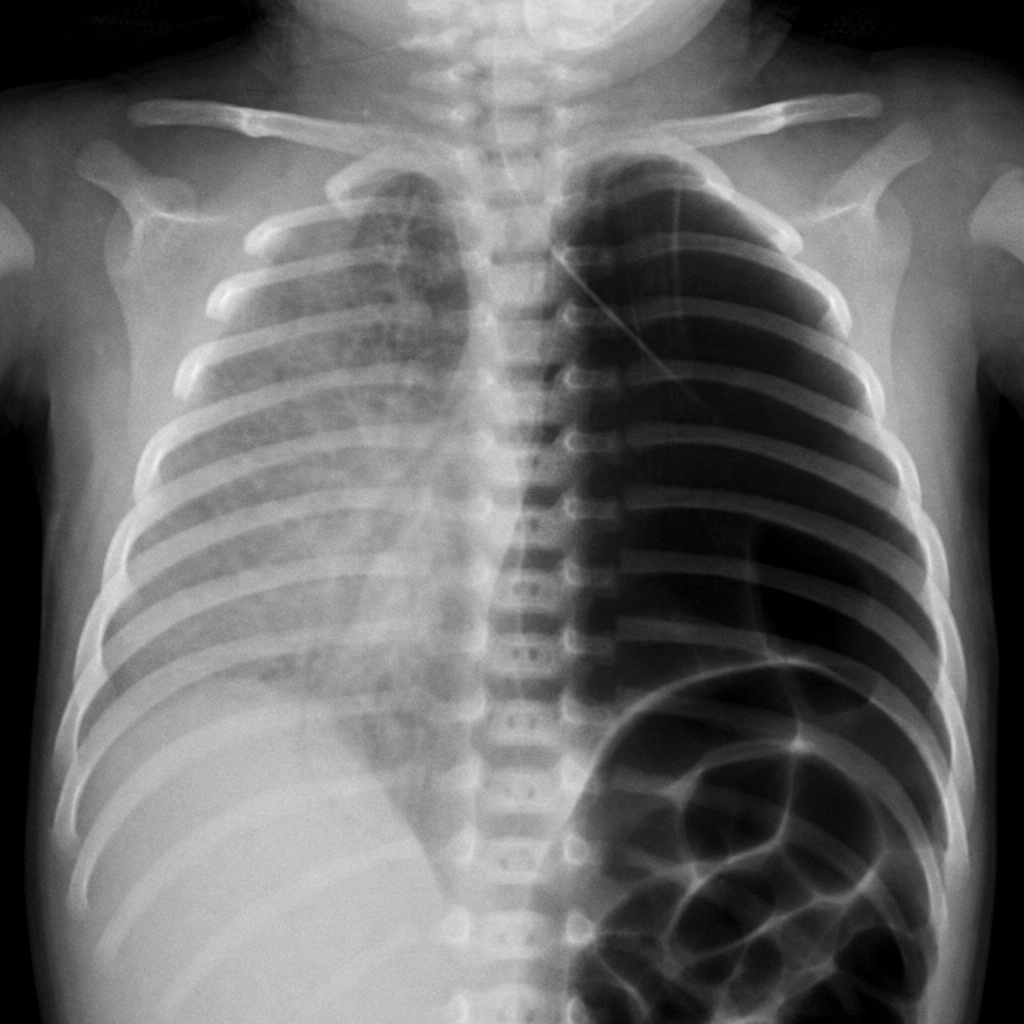
Pneumothorax in the newborn can be treated by which of the following methods?
In Rh incompatibility, on what factor does the prognosis primarily depend?
A preterm infant showed apnoea at birth associated with bradycardia. Apnoea is defined as cessation of respiration for at least:
What is the most common cause of congenital sensorineural hearing loss?
What is the definition of a small for gestational age (SGA) baby?
A 1.5 kg child born at 32 weeks gestation presents with moderate respiratory difficulty (Respiratory Rate: 70/min, SpO2: 92%). What is the next best step?
In which order should the airway of neonates requiring suctioning be suctioned during neonatal resuscitation?
A woman delivered a baby of 2.2 kg weight. Her LMP is not known. Which of the following is NOT used to assess the maturity of the baby?
In a neonate with "classic" symptoms of congenital cytomegalovirus (CMV) infection, which one of the following tests would be most useful in establishing a diagnosis?
What is true about Hyaline membrane disease?
Explanation: **Explanation:** **Pneumothorax** in the newborn is a common form of air leak syndrome, often occurring spontaneously or as a complication of mechanical ventilation or Meconium Aspiration Syndrome (MAS). **Why Needle Aspiration is Correct:** In a symptomatic neonate or one with a tension pneumothorax, immediate decompression is life-saving. **Needle aspiration** (thoracocentesis) is the primary emergency procedure used to evacuate air from the pleural space. It is typically performed in the 2nd intercostal space in the mid-clavicular line or the 4th/5th intercostal space in the anterior axillary line. If the air re-accumulates, a formal tube thoracostomy (chest tube) is indicated. **Analysis of Incorrect Options:** * **A. Oxygen administration:** While 100% oxygen ("nitrogen washout") can theoretically hasten the absorption of a small, asymptomatic pneumothorax in term infants, it is **not** a definitive treatment for a clinically significant pneumothorax and is avoided in preterm infants due to the risk of Retinopathy of Prematurity (ROP). * **B. Surfactant administration:** This is the treatment for Respiratory Distress Syndrome (RDS). While RDS can lead to pneumothorax, surfactant itself does not treat an existing air leak. * **C. Transillumination:** This is a **diagnostic tool**, not a treatment. A high-intensity cold light source placed on the chest wall will "glow" or show increased lucency on the side of the pneumothorax. **Clinical Pearls for NEET-PG:** * **Diagnosis:** The gold standard is a Chest X-ray (showing a visceral pleural line and absence of lung markings), but in emergencies, **Transillumination** is the fastest bedside diagnostic method. * **Spontaneous Pneumothorax:** Occurs in 1-2% of healthy newborns due to the high transpulmonary pressures generated during the first few breaths of life. * **Management Rule:** Small/Asymptomatic → Observation; Large/Symptomatic → Needle aspiration/Chest tube.
Explanation: **Explanation:** In Rh incompatibility (Rh isoimmunization), the primary clinical concern is the rapid destruction of fetal/neonatal red blood cells by maternal IgG antibodies. The prognosis—specifically the risk of permanent neurological damage—depends primarily on the **Serum Bilirubin Level**. 1. **Why Serum Bilirubin is the key:** The breakdown of hemoglobin leads to unconjugated hyperbilirubinemia. Because the neonatal blood-brain barrier is immature, high levels of unconjugated bilirubin can cross into the brain, depositing in the basal ganglia and brainstem nuclei. This leads to **Kernicterus** (bilirubin-induced neurologic dysfunction), which is the most dreaded complication. Management decisions (phototherapy vs. exchange transfusion) are dictated by bilirubin trends. 2. **Why other options are incorrect:** * **Direct Antiglobulin Test (DAT):** While a positive DAT confirms the diagnosis of immune-mediated hemolysis, the *strength* of the reaction does not always correlate with the severity of the disease or the risk of brain damage. * **Blood Smear:** This may show polychromasia and nucleated RBCs (erythroblasts), but it cannot quantify the risk of neurological injury. * **Serum Albumin:** While albumin binds bilirubin, its concentration alone does not determine prognosis; it is the "free" unbound bilirubin that is toxic. **High-Yield NEET-PG Pearls:** * **Most common cause of Hydrops Fetalis:** Rh isoimmunization (though non-immune causes are more common overall in developed regions). * **First sign of Kernicterus:** Poor feeding, lethargy, and loss of Moro reflex. * **Prophylaxis:** Anti-D gamma globulin (300 mcg) is given to Rh-negative mothers at 28 weeks and within 72 hours of delivery of an Rh-positive infant. * **Indicator of severity in utero:** Delta OD450 (Liley Chart) or Middle Cerebral Artery (MCA) Peak Systolic Velocity on Doppler.
Explanation: ### Explanation **Apnea of Prematurity (AOP)** is a common clinical condition in neonates due to the immaturity of the respiratory control centers in the brainstem. **1. Why Option D is Correct:** In neonatology, **Apnea** is clinically defined as the cessation of breathing for: * **≥ 20 seconds**, OR * **< 20 seconds** if it is accompanied by **bradycardia** (Heart rate < 100 bpm) or **cyanosis/oxygen desaturation**. In this question, the infant exhibits both cessation of respiration and bradycardia. However, the standard definition of apnea based on duration alone is 20 seconds. **2. Why Other Options are Incorrect:** * **Options A & B (2-5 seconds):** These are normal respiratory pauses. * **Option C (10 seconds):** While a 10-second pause is significant, it is classified as **Periodic Breathing** (a benign pattern where short pauses of 5–10 seconds are followed by bursts of rapid breathing) unless it is associated with a drop in heart rate or oxygen levels. **3. High-Yield Clinical Pearls for NEET-PG:** * **Types of Apnea:** * **Central:** No respiratory effort (most common in preterms). * **Obstructive:** Effort exists but no airflow (due to pharyngeal collapse). * **Mixed:** Combination of both (most frequent clinical presentation). * **Management:** The drug of choice for Apnea of Prematurity is **Caffeine Citrate** (preferred over Theophylline due to a wider therapeutic index and longer half-life). * **Incidence:** It is inversely proportional to gestational age; almost all infants born at <28 weeks will experience apnea. * **Positioning:** Prone positioning and avoiding neck hyperextension/flexion can reduce obstructive episodes.
Explanation: **Explanation:** **Cytomegalovirus (CMV)** is the most common cause of non-hereditary (acquired) congenital sensorineural hearing loss (SNHL) worldwide. While most infants with congenital CMV are asymptomatic at birth (90%), approximately 10–15% of these "asymptomatic" infants will eventually develop SNHL. In symptomatic cases, the incidence of SNHL rises to over 50%. The hearing loss is often progressive, can be unilateral or bilateral, and may have a delayed onset, making CMV a critical diagnosis to consider in pediatric audiology. **Analysis of Incorrect Options:** * **Parvovirus B19 (A):** Primarily associated with hydrops fetalis due to severe fetal anemia and aplastic crisis; it is not a recognized cause of congenital hearing loss. * **Rubella (C):** Historically, Congenital Rubella Syndrome (CRS) was a leading cause of SNHL (presenting with the classic triad of cataracts, PDA, and deafness). However, due to widespread MMR vaccination, its incidence has drastically declined, making CMV more prevalent. * **Toxoplasmosis (D):** Part of the TORCH spectrum, it typically presents with the triad of chorioretinitis, hydrocephalus, and intracranial calcifications. While it can cause SNHL, it is significantly less common than CMV. **High-Yield Clinical Pearls for NEET-PG:** * **Imaging:** CMV typically shows **periventricular calcifications**, whereas Toxoplasmosis shows **diffuse** intracranial calcifications. * **Diagnosis:** The gold standard for congenital CMV is detecting the virus in **urine or saliva via PCR** within the first 3 weeks of life. * **Treatment:** Oral **Valganciclovir** (or IV Ganciclovir) for 6 months is indicated for symptomatic neonates to improve hearing and neurodevelopmental outcomes. * **Overall Cause:** While CMV is the most common *infectious* cause, **GJB2 gene mutations** (Connexin 26) are the most common *genetic* cause of congenital SNHL.
Explanation: ### Explanation **1. Why Option A is Correct:** The definition of **Small for Gestational Age (SGA)** is based on a statistical distribution rather than a fixed weight. A neonate is classified as SGA if their birth weight is **less than the 10th percentile** for their specific gestational age and sex, based on standardized growth curves (like the Lubchenco or Fenton charts). This definition identifies infants who have not reached their full growth potential in utero, regardless of whether they are preterm, term, or post-term. **2. Why Other Options are Incorrect:** * **Option B:** The 50th percentile represents the "average" or median weight. Babies between the 10th and 90th percentiles are considered **Appropriate for Gestational Age (AGA)**. * **Option C:** 2000 grams is a specific weight cutoff but does not define a standard clinical category in neonatology. * **Option D:** Weight less than 2500 grams defines a **Low Birth Weight (LBW)** baby. This is a static definition based solely on weight at birth, irrespective of the gestational age. **3. Clinical Pearls for NEET-PG:** * **SGA vs. IUGR:** While often used interchangeably, SGA is a *description of size* at birth, whereas Intrauterine Growth Restriction (IUGR) is a *pathological process* occurring in utero (often diagnosed via serial ultrasound). * **Symmetric vs. Asymmetric SGA:** * **Symmetric:** Insult occurs early (e.g., chromosomal, TORCH infections); Weight, Length, and Head Circumference are all <10th percentile. * **Asymmetric:** Insult occurs late (e.g., placental insufficiency); Head is spared (Head Circumference >10th percentile, Weight <10th percentile). * **Common Complications:** Hypoglycemia (due to low glycogen stores), polycythemia, hypocalcemia, and hypothermia.
Explanation: ### Explanation The child is a **preterm neonate (32 weeks)** with **moderate respiratory distress** (tachypnea and borderline SpO2). In such cases, the most likely diagnosis is Respiratory Distress Syndrome (RDS) due to surfactant deficiency. **Why CPAP is the correct answer:** Continuous Positive Airway Pressure (CPAP) is the **initial treatment of choice** for preterm infants with respiratory distress who are breathing spontaneously. It provides a constant pressure that prevents alveolar collapse at the end of expiration (increasing Functional Residual Capacity), improves gas exchange, and reduces the work of breathing. Current guidelines (like the European Consensus Guidelines) emphasize "Early CPAP" to avoid the lung injury associated with invasive ventilation. **Analysis of Incorrect Options:** * **A. Mechanical Ventilation:** This is reserved for "CPAP failure" (e.g., persistent hypoxia, severe acidosis, or frequent apnea). Starting with ventilation increases the risk of Bronchopulmonary Dysplasia (BPD). * **B. 100% Oxygen:** High concentrations of oxygen are toxic to preterm lungs and retinas (causing ROP). Oxygen should be titrated to maintain target saturation (90–94%), not given at 100% blindly. * **D. Surfactant and Ventilation:** While surfactant is indicated for RDS, the modern approach is the **INSURE** technique (Intubate-Surfactant-Extubate to CPAP) or **LISA** (Less Invasive Surfactant Administration). Immediate mechanical ventilation is not the "next best step" if the child is stable enough for a CPAP trial. **Clinical Pearls for NEET-PG:** * **Silverman-Anderson Score:** Used to assess the severity of respiratory distress in neonates (Score >7 indicates severe distress). * **Target SpO2 in Preterm:** 90–94% is the standard range to prevent oxygen toxicity. * **Ground Glass Appearance:** The classic X-ray finding in RDS (along with air bronchograms). * **Antenatal Steroids:** The most effective way to prevent RDS in preterm deliveries.
Explanation: **Explanation:** The correct sequence for suctioning a neonate during resuscitation is **Mouth followed by Nose (M before N)**. **Why the correct answer is right:** The primary goal of suctioning is to clear the airway of secretions, blood, or meconium to facilitate breathing. Suctioning the mouth first ensures that the oral cavity is clear before the nose is stimulated. If the nose is suctioned first, it often triggers a **gasping reflex** or a deep inspiration in the neonate. If the mouth still contains secretions at that moment, the infant may aspirate that material into the lungs, leading to aspiration pneumonia or airway obstruction. **Analysis of Incorrect Options:** * **Option A (Nose followed by mouth):** This is incorrect because nasal stimulation triggers gasping, which increases the risk of aspirating oral secretions. * **Option C (Pharynx followed by oral cavity followed by trachea):** This is an incorrect sequence. Deep pharyngeal suctioning should be avoided initially as it can cause vagal-induced bradycardia or laryngospasm. Tracheal suctioning is only indicated in specific scenarios (e.g., non-vigorous infants with meconium-stained liquor and suspected obstruction). * **Option D (Nose followed by trachea):** Incorrect for the same reasons as Option A; it ignores the priority of clearing the oral reservoir first. **Clinical Pearls for NEET-PG:** * **Mnemonic:** Remember **"M"** comes before **"N"** in the alphabet (**M**outh before **N**ose). * **Avoid Over-suctioning:** Routine suctioning is no longer recommended for healthy, vigorous babies. It should only be performed if the airway is obstructed or if positive pressure ventilation (PPV) is required. * **Vagal Response:** Vigorous or deep suctioning of the posterior pharynx can cause **bradycardia and apnea** due to stimulation of the vagus nerve. * **Suction Pressure:** The recommended negative pressure for neonatal suctioning is **80–100 mmHg**.
Explanation: To assess the maturity (gestational age) of a newborn, clinicians rely on physical and neurological characteristics that evolve predictably with fetal age. **Why "Weight of the baby" is the correct answer:** The weight of a baby is a measure of **growth**, not **maturity**. While there is a general correlation between weight and gestational age, weight can be misleading. For example, a "Small for Gestational Age" (SGA) baby may be full-term (mature) but weigh only 2.0 kg due to intrauterine growth restriction (IUGR). Conversely, an "Infant of a Diabetic Mother" (IDM) may be preterm (immature) but weigh 4.0 kg. Therefore, weight cannot reliably determine if a baby is preterm or term. **Explanation of Incorrect Options (Maturity Indicators):** These features are components of the **New Ballard Score** or **Expanded Dubowitz Score**, used to estimate gestational age: * **Sole creases:** These appear first on the anterior portion and progress to the heel as the fetus matures. A full-term baby has creases covering the entire sole. * **Ear cartilage:** In very preterm babies, the pinna is flat and lacks recoil. As maturity increases, cartilage develops, making the ear firm with immediate recoil. * **Breast nodule:** The size of the breast tissue (measured in mm) increases with gestational age, influenced by maternal hormones in the final weeks of pregnancy. **Clinical Pearls for NEET-PG:** * **New Ballard Score:** The most commonly used clinical tool to assess gestational age (valid for 20–44 weeks). It assesses 6 physical and 6 neuromuscular criteria. * **Preterm vs. SGA:** Always distinguish between the two. A baby <2.5 kg is "Low Birth Weight," but only a baby born <37 weeks is "Preterm." * **Neuromuscular signs:** Features like the **Square window**, **Arm recoil**, and **Popliteal angle** are also vital indicators of maturity.
Explanation: **Explanation:** The diagnosis of congenital Cytomegalovirus (CMV) infection relies on demonstrating the virus or the fetal immune response to it shortly after birth. **Why Option C is Correct:** * **IgM does not cross the placenta:** Unlike IgG, maternal IgM cannot cross the placental barrier. Therefore, the presence of CMV-specific IgM in a neonate’s serum at birth indicates an **in-utero (congenital) infection** rather than passive transfer from the mother. * **Persistence/Rising Titre:** Testing at birth and again at 1 month helps confirm the diagnosis. A persistent or rising titre reinforces the diagnosis of active congenital infection. **Why Other Options are Incorrect:** * **Options A & B (CMV IgG):** Maternal IgG antibodies cross the placenta freely (starting from the second trimester). A positive IgG in a neonate at birth usually reflects maternal immunity rather than active fetal infection. * **Option D (Total IgM):** While a raised total IgM (>20 mg/dL) is a non-specific marker of intrauterine infection (TORCH), it is not diagnostic for CMV specifically. It can be elevated in Syphilis, Rubella, or even non-infectious conditions. **NEET-PG High-Yield Pearls:** * **Gold Standard:** The most sensitive and specific method for diagnosing congenital CMV is **PCR of urine or saliva** (performed within the first 3 weeks of life). * **Classic Triad:** Chorioretinitis, Microcephaly, and **Periventricular calcifications** (Contrast this with Toxoplasmosis, which features diffuse intracerebral calcifications). * **Most Common:** CMV is the most common congenital viral infection and the leading non-syndromic cause of **sensorineural hearing loss (SNHL)** in children. * **Treatment:** Symptomatic neonates are treated with **Valganciclovir** (oral) or Ganciclovir (IV) to improve hearing and neurodevelopmental outcomes.
Explanation: **Explanation:** Hyaline Membrane Disease (HMD), or Respiratory Distress Syndrome (RDS), is primarily caused by a deficiency of **surfactant**. Surfactant reduces surface tension at the alveolar-air interface, preventing alveolar collapse at the end of expiration. **Why Option B is correct:** In HMD, the lack of surfactant leads to high surface tension, causing widespread atelectasis (alveolar collapse). This significantly reduces the **Functional Residual Capacity (FRC)**—the volume of air remaining in the lungs after a normal expiration. The **Closing Volume** is the lung volume at which small airways begin to close. In HMD, the FRC drops so low that it falls **below the closing volume**. This means that even during normal tidal breathing, the airways and alveoli collapse, leading to profound ventilation-perfusion (V/Q) mismatch and hypoxia. **Why other options are incorrect:** * **Option A:** If FRC were above the closing volume, the airways would remain open during expiration, which is the physiological state in a healthy term neonate. * **Option C & D:** These do not reflect the pathological state of HMD. The relationship between FRC and closing volume is the fundamental physiological determinant of airway patency and gas exchange. **High-Yield Clinical Pearls for NEET-PG:** * **Radiology:** Characterized by a "Ground Glass Appearance" and "Air Bronchograms." * **L/S Ratio:** A Lecithin/Sphingomyelin ratio of **<2:1** in amniotic fluid indicates lung immaturity. * **Management:** The most effective preventive measure is **Antenatal Corticosteroids** (Betamethasone/Dexamethasone) given to the mother. * **Treatment:** Exogenous surfactant replacement (e.g., Curosurf) and CPAP (to maintain FRC above closing volume).
Neonatal Resuscitation
Practice Questions
Care of the Normal Newborn
Practice Questions
Prematurity and Low Birth Weight
Practice Questions
Respiratory Distress Syndrome
Practice Questions
Neonatal Jaundice
Practice Questions
Neonatal Sepsis
Practice Questions
Necrotizing Enterocolitis
Practice Questions
Intraventricular Hemorrhage
Practice Questions
Persistent Pulmonary Hypertension
Practice Questions
Perinatal Asphyxia
Practice Questions
Neonatal Seizures
Practice Questions
Congenital Anomalies
Practice Questions
Get full access to all questions, explanations, and performance tracking.
Start For Free