Community-acquired neonatal pneumonia: What is the treatment of choice?
A neonate develops sepsis with organism showing CAMP test positive. Likely organism?
Which of the following is not a complication of Congenital Rubella Syndrome (CRS)?
An appropriate single antibiotic for the empiric treatment of presumed bacterial meningitis in a six month old child would be:
A patient with a fever presents with a heart rate of 120 beats per minute and a respiratory rate of 30 breaths per minute. What does this indicate?
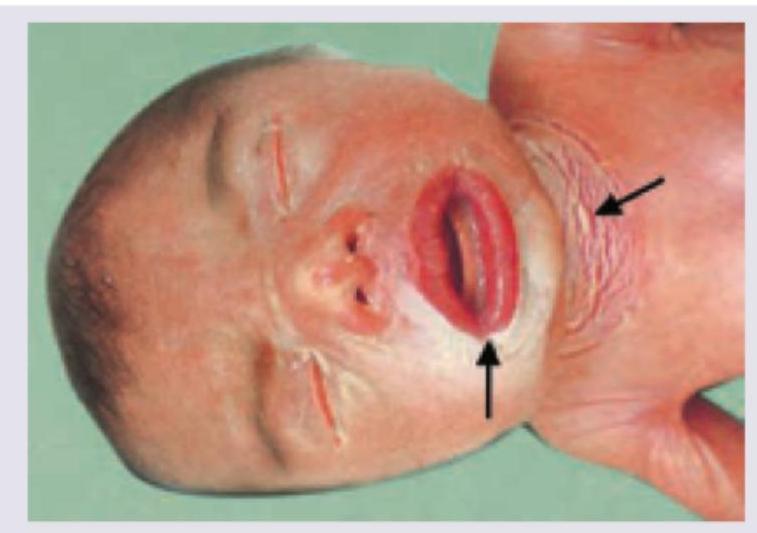
A neonate presents with the condition shown in the image below. This condition has all of the following features EXCEPT:
What is the most common cause of pneumonia in early onset sepsis in neonates?
A neonate who is febrile, presents with features of encephalitis. On examination, the baby is found to have vesicular skin lesions. Most probable causative organism is:
A term neonate, with a birth weight of 2700 g, who is otherwise well, and is exclusively breastfed, presents for routine evaluation. His total serum bilirubin is found to be 14mg/dl on day 5. What is the management?
Erythematous blotchy rash is seen on the abdomen, trunk, and face of a 3-day-old child along with yellowish papules. The child appears well. What is the appropriate management?
Explanation: ***Ampicillin + Gentamicin*** - This combination is the recommended empirical treatment for **neonatal sepsis** and pneumonia, effectively covering common causative organisms like **Group B Streptococcus** (GBS) and **E. coli**. - **Ampicillin** targets gram-positive bacteria, while **gentamicin** (an aminoglycoside) provides broad-spectrum coverage for gram-negative bacteria, acting synergistically. *Ampicillin + Chloramphenicol* - While ampicillin covers common neonatal pathogens, **chloramphenicol** is generally avoided in neonates due to the risk of **Gray Baby Syndrome**. - Its use is reserved for specific, severe infections where other effective and safer alternatives are not available. *Metronidazole + Amikacin* - **Metronidazole** is primarily effective against anaerobic bacteria and parasites, which are not typical primary causes of community-acquired neonatal pneumonia. - **Amikacin** is an aminoglycoside similar to gentamicin but is generally reserved for infections resistant to other aminoglycosides. *Cefotaxime + Amikacin* - **Cefotaxime** (a third-generation cephalosporin) is an excellent choice for neonatal sepsis and meningitis, covering a broad spectrum of bacteria. - However, in community-acquired neonatal pneumonia, the combination with **ampicillin and gentamicin** is often preferred as a first-line empirical therapy, with cefotaxime reserved for specific indications or resistance patterns.
Explanation: ***Group B Streptococcus*** - **Group B Streptococcus (GBS)**, or *Streptococcus agalactiae*, is the **most common cause of neonatal sepsis** and is the **classic organism** associated with a **positive CAMP test**. - The **CAMP test** (Christie-Atkins-Munch-Petersen) detects synergistic hemolysis between the CAMP factor produced by GBS and *Staphylococcus aureus* beta-lysin, resulting in an **arrowhead-shaped zone of enhanced hemolysis**. - GBS is strongly associated with **early-onset neonatal sepsis** (within first 7 days), transmitted vertically during delivery. - When the CAMP test is mentioned in the context of neonatal sepsis, **GBS is the intended answer** due to its classical association and epidemiological importance. *S. aureus* - *Staphylococcus aureus* can cause **sepsis** in neonates but is **CAMP test negative**. - It provides the beta-lysin used in the CAMP test to detect other organisms but does not produce the CAMP factor itself. *E. coli* - *Escherichia coli* is a **Gram-negative rod** and a frequent cause of **neonatal sepsis** and meningitis. - As a Gram-negative bacterium, *E. coli* is **CAMP test negative**. The CAMP test is specific for certain Gram-positive bacteria. *Listeria* - *Listeria monocytogenes* is **also CAMP test positive**, which can cause diagnostic confusion. - However, it causes a distinct clinical pattern: **granulomatosis infantiseptica**, meningoencephalitis, and is associated with **maternal ingestion of contaminated food**. - Listeria is **less common** than GBS as a cause of neonatal sepsis and is not the classic teaching association for CAMP positivity. - The CAMP positivity of Listeria is **weaker** and shows a different pattern (reverse CAMP) compared to the strong, characteristic arrowhead pattern of GBS.
Explanation: ***Macrocephaly*** - While CRS can lead to various neurological complications, **macrocephaly** (abnormally large head circumference) is not a typical manifestation of the syndrome. Neurological issues in CRS more commonly involve **microcephaly** due to brain damage. - Other common neurological complications include **meningoencephalitis** and developmental delays, but not an enlarged head. *Retinopathy* - **Pigmentary retinopathy** (salt-and-pepper retinopathy) is a classic ocular manifestation of CRS, often present at birth. - This is a direct consequence of the rubella virus affecting the developing retinal structures. *Spontaneous abortion* - Maternal rubella infection, especially during the **first trimester**, carries a significant risk of **spontaneous abortion** due to severe fetal damage. - The virus's teratogenic effects can be so profound that the fetus is not viable. *Cardiac abnormalities* - **Congenital heart defects** are a hallmark of CRS, with **patent ductus arteriosus (PDA)** and **pulmonary artery stenosis** being the most common. - These abnormalities result from the rubella virus interfering with normal cardiac development during embryogenesis.
Explanation: ***Cefotaxime*** - As a **third-generation cephalosporin**, cefotaxime has excellent penetration into the **cerebrospinal fluid (CSF)** and provides broad-spectrum coverage against common bacterial meningitis pathogens in young children, including *Streptococcus pneumoniae*, *Neisseria meningitidis*, and *Haemophilus influenzae*. - In a 6-month-old child, cefotaxime is an excellent choice for empiric therapy. While both cefotaxime and ceftriaxone are appropriate at this age, cefotaxime is specifically preferred over ceftriaxone in **neonates younger than 28 days** due to concerns about biliary pseudolithiasis and bilirubin displacement, which can worsen jaundice and increase the risk of kernicterus. *Ampicillin* - While effective against *Listeria monocytogenes* (particularly important in neonates and infants <3 months) and Group B *Streptococcus*, ampicillin provides **insufficient coverage** for many other common causes of bacterial meningitis in this age group, particularly penicillin-resistant *Streptococcus pneumoniae* and *Haemophilus influenzae*. - Its use alone as empiric therapy for bacterial meningitis in a 6-month-old would be inadequate, often warranting combination therapy with a third-generation cephalosporin in younger infants. *Cefadroxil* - Cefadroxil is a **first-generation cephalosporin** primarily used for skin, soft tissue, and urinary tract infections. - It has **poor penetration into the CSF** and therefore is not an appropriate choice for treating meningitis. *Cefuroxime* - Cefuroxime is a **second-generation cephalosporin** with limited activity against *Streptococcus pneumoniae* and certain **Gram-negative bacteria** compared to third-generation cephalosporins. - While it has some central nervous system penetration, its efficacy is **inferior to third-generation cephalosporins** like cefotaxime or ceftriaxone for treating bacterial meningitis, especially considering the potential for resistant strains.
Explanation: ***Early sepsis*** - A heart rate of 120 bpm (**tachycardia**) and a respiratory rate of 30 bpm (**tachypnea**) in the setting of fever meet the criteria for **Systemic Inflammatory Response Syndrome (SIRS)**, which can indicate early sepsis. - Sepsis is defined by life-threatening organ dysfunction caused by a dysregulated host response to infection, and these vital sign abnormalities are key indicators. *Tachypnea due to anxiety* - While anxiety can cause tachypnea and tachycardia, the presence of **fever** suggests an underlying infectious or inflammatory process rather than isolated anxiety. - Relying solely on anxiety as the cause without considering other indicators can lead to delayed diagnosis and treatment of serious conditions. *Expected response to fever* - While a moderate increase in heart rate and respiratory rate is expected with fever (e.g., 8-10 bpm increase per degree Celsius of fever), a heart rate of **120 bpm** and especially a respiratory rate of **30 bpm** are disproportionately elevated and exceed a typical physiological response. - These elevated vital signs signal a more significant physiological stress or dysregulation beyond a simple febrile response. *Normal physiological response to fever* - A "normal" physiological response to fever would involve a mild-to-moderate elevation in heart rate and respiratory rate; however, a heart rate of **120 bpm** and a respiratory rate of **30 bpm** are considered *abnormal* for a typical febrile response. - These values are sufficiently high to raise concern for **SIRS** or early sepsis, requiring further investigation.
Explanation: ***Satellite lesions*** - **Satellite lesions** (smaller lesions located near a main rash) are characteristic of certain fungal infections like candidiasis or some viral rashes, but not of **collodion baby/harlequin ichthyosis**, which is suggested by the image. - The image shows features consistent with a severe congenital ichthyosis, where **skin scaling** and **facial deformities** are prominent, not scattered papules or pustules. *Ectropion* - **Ectropion** (eversion of the eyelids) is clearly visible in the image, where the eyelids are pulled outwards, exposing the conjunctiva. - This is a common feature in conditions like **collodion baby** and **harlequin ichthyosis** due to the restrictive outer skin layer. *Eclabium* - **Eclabium** (eversion of the lips) is also distinctly present in the image, with the lips appearing stretched and everted. - This is another characteristic manifestation of severe congenital ichthyosis, resulting from the **tight, hardened skin** around the mouth. *Hard elastic scales over the neck area* - The image shows **thickened, furrowed, and scaly skin** texture, particularly noticeable around the neck area (indicated by the arrow), which aligns with the description of **hard, elastic scales**. - This is a hallmark feature of **ichthyosis**, where there is impaired skin barrier function and excessive scale production.
Explanation: ***Group B streptococcus*** - **Group B Streptococcus (GBS)** is the leading cause of **early-onset sepsis** and pneumonia in neonates, typically acquired during passage through the birth canal. - Maternal GBS colonization is a significant risk factor, and GBS can cause **severe respiratory distress** in affected newborns. *H influenzae* - **_Haemophilus influenzae_** is a more common cause of **late-onset sepsis** or pneumonia in infants and children, rather than early-onset neonatal disease. - While it can cause neonatal infections, it is much less frequent than GBS in the early-onset period. *Coagulase positive staph aureus* - **_Staphylococcus aureus_** is a common cause of **nosocomial infections** or late-onset sepsis in neonates, particularly in ventilated or catheterized infants. - It is not the most common pathogen for community-acquired **early-onset neonatal pneumonia**. *Listeria* - **_Listeria monocytogenes_** can cause severe neonatal sepsis and pneumonia, often associated with maternal consumption of contaminated food. - While it is a significant pathogen, it is less common overall than GBS as a cause of early-onset neonatal pneumonia in most regions.
Explanation: ***HSV II*** - **Herpes simplex virus type 2 (HSV-2)** is the most common cause of **neonatal herpes**, presenting with neurological manifestations like encephalitis and characteristic vesicular skin lesions. - Transmission usually occurs during **vaginal delivery** from a mother with genital herpes, leading to widespread infection in the neonate. *Meningococci* - While *Neisseria meningitidis* can cause **meningitis** and **septicemia** in neonates, it does not typically produce vesicular skin lesions. - Its infections are more commonly associated with a **petechial or purpuric rash**, not vesicles. *Streptococci* - **Group B Streptococcus (GBS)** is a leading cause of **neonatal sepsis and meningitis**, but it does not cause vesicular skin lesions. - GBS typically presents with non-specific signs of sepsis or meningitis in neonates. *HSV I* - Although **herpes simplex virus type 1 (HSV-1)** can cause neonatal herpes, **HSV-2 remains the predominant cause** of vertically transmitted neonatal infection with encephalitis and disseminated disease. - HSV-1 is more commonly associated with **oral herpes (cold sores)** in older children and adults, though its incidence in neonatal infection is increasing.
Explanation: ***No active treatment required*** - A total serum bilirubin of **14 mg/dL** on day 5 in an otherwise well, exclusively breastfed term neonate (birth weight 2700g, which is >2500g) falls within the **physiologic jaundice range** and below thresholds for intervention. - This level is considered **normal for breastfed infants** at this age and does not warrant medical intervention as per current guidelines. *Stop breastfeeding for 2 days* - This intervention, known as **breast milk jaundice interruption**, is usually reserved for higher bilirubin levels or if there is concern for significant breast milk jaundice, which is not indicated here. - Temporarily stopping breastfeeding can disrupt the establishment of breastfeeding and is generally discouraged unless strictly necessary. *Phototherapy* - **Phototherapy** is indicated for bilirubin levels typically >15-18 mg/dL in a healthy term neonate on day 5, depending on risk factors, which this infant does not meet. - It works by converting unconjugated bilirubin into water-soluble isomers that can be excreted more easily. *Exchange transfusion* - **Exchange transfusion** is reserved for severe hyperbilirubinemia, usually with bilirubin levels approaching or exceeding 20-25 mg/dL, especially if there are signs of **acute bilirubin encephalopathy**. - This level is far below the threshold for such an invasive procedure.
Explanation: ***No treatment (Correct Answer)*** The described symptoms—erythematous blotchy rash with yellowish papules on the abdomen, trunk, and face in a well-appearing 3-day-old neonate—are **classic for erythema toxicum neonatorum**. **Key Features:** - **Benign, self-limiting rash** of unknown etiology - Affects **50-70% of term newborns** - Typically appears on **days 2-5** of life - Characterized by **erythematous macules/patches** with overlying **yellowish-white papules/pustules** - Infant appears **well and thriving** - **Resolves spontaneously** within 1-2 weeks without treatment - Histology shows **eosinophils** in pustules **Management:** Reassurance to parents; no medical intervention required. --- *Topical steroid and antibiotic lotion (Incorrect)* This approach is inappropriate because erythema toxicum neonatorum is: - **Not an infection** (no bacterial or fungal cause) - **Not an inflammatory condition** requiring steroids - Misdiagnosis and overtreatment could lead to unnecessary side effects, antibiotic resistance, and mask other conditions --- *Topical steroid cream (Incorrect)* Topical steroids are: - **Unnecessary** for this benign, self-resolving condition - **Potentially harmful** in neonates (can cause skin atrophy, increased absorption) - Provide **no therapeutic benefit** for erythema toxicum neonatorum --- *Intravenous antibiotics (Incorrect)* Systemic antibiotics are: - **Entirely unwarranted** as this is a non-infectious, benign rash - Would represent **gross overtreatment** with significant risks - Contribute to **antibiotic resistance** - Carry risks of adverse reactions, disruption of normal flora, and unnecessary hospitalization **Differentials to consider (but not present here):** - Transient neonatal pustular melanosis (present at birth) - Neonatal acne (appears later, at 2-4 weeks) - Miliaria (smaller, clear vesicles) - Infectious causes (infant appears ill, requires septic workup)
Get full access to all questions, explanations, and performance tracking.
Start For Free