A 5 year old child with unprovoked dog bite, appropriate management is
A 3-year-old child is brought to the outpatient department with an upper respiratory tract infection. On asking about their previous immunization history, it is found that they have had no primary immunizations from birth. What is the most appropriate step in the management of this patient?
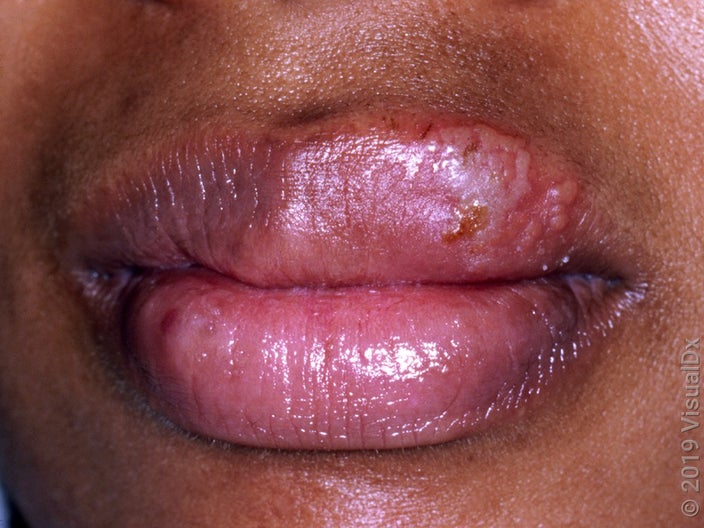
A 10-year-old child had fever for 5 days, along with which he developed multiple fluid filled lesions on the lips as shown below. What is the probable underlying etiology for the skin lesions?
A 3-year-old boy was admitted to the hospital for high fever and difficulty in breathing. He had been well until 4 days before admission, when he developed sneezing and a runny and stuffy nose followed by a non-productive cough the next day. This was followed by appearance of characteristic rash on face, trunk, extremities and back along with fever. On examination: Shotty anterior cervical and supraclavicular lymph nodes, hyperemic conjunctiva, and Koplik spots on buccal mucosa. The white blood cell count was 3,100/ml, with a differential of 70% polymorphonuclear leukocytes. All of the following are complications of the above disease EXCEPT?
A child suffering from Rubella presented with small red spots (petechiae) on the soft palate. These are known as __________.
Prior to discharge of a patient with H. influenzae meningitis, the essential investigation to be done is?
Fever stops and rash begins is diagnostic of –
Which of the following is the most appropriate treatment for a child with severe falciparum malaria with high parasitemia?
Which of the following is NOT true regarding rheumatic chorea in children?
A young child of 7 years of age is seen with indurated ulcers, lymphadenopathy and fever. The likely treatment is:
Explanation: ***Anti Rabies vaccine and Rabies Immunoglobulin*** - For an **unprovoked dog bite**, especially in a child, presumptive exposure to **rabies** should be assumed, necessitating **both active immunization (vaccine)** and **passive immunization (immunoglobulin)**. - The **Rabies Immunoglobulin (RIG)** provides immediate, short-term protection, while the **rabies vaccine** stimulates the child's immune system for long-term protection. *Only Rabies Immunoglobulin at the site of bite* - While RIG provides immediate protection, it does not induce **long-term immunity**. - **Vaccination is essential** alongside RIG for sustained protection against rabies. *Kill the dog and send brain for Biopsy* - Killing the dog and performing a brain biopsy is a method to **confirm rabies in the animal**, but it does not provide immediate or preventative treatment for the exposed individual. - **Post-exposure prophylaxis (PEP)** should be initiated promptly without waiting for animal test results, especially if the animal's rabid status is unknown or suspected. *Observe the dog* - Observing the dog for **10 days** is appropriate if the bite was provoked, or if the animal is known and healthy, and **rabies risk is low**. - However, for an **unprovoked bite**, particularly from an unknown or stray dog, the risk of rabies is higher, and **post-exposure prophylaxis (PEP)** should not be delayed by observation.
Explanation: **Give BCG, OPV, DPT, measles vaccines and vitamin A** - For a 3-year-old child with **no primary immunizations**, it is crucial to initiate catch-up vaccinations immediately with all age-appropriate vaccines. - Key vaccines include **BCG** (if not given at birth), **polio vaccine** (OPV/IPV as per local guidelines), **DPT**, and **Measles** vaccine. - **Vitamin A supplementation** (1 lakh IU for 9-12 months, 2 lakh IU for >12 months) should be administered concurrently with measles vaccination to reduce morbidity and mortality, especially in vitamin A deficiency-endemic regions. - This represents the **most comprehensive approach** ensuring immediate protection and nutritional support. *Give BCG, OPV, DPT and advise to come after 4 weeks for the next doses of OPV and DPT* - While this option correctly initiates BCG and first doses of polio and DPT vaccines, it **misses the crucial measles vaccine** for a 3-year-old who is long overdue (measles is typically given at 9-12 months). - Although follow-up for subsequent doses is necessary, the **immediate administration of all due vaccines** including measles is the priority in catch-up immunization. - Delaying measles vaccination increases risk in an already vulnerable unimmunized child. *Advise to come on the fixed immunization day of the week* - This approach **inappropriately delays essential vaccinations** for a child with zero prior immunization history, leaving them vulnerable to vaccine-preventable diseases. - In catch-up immunization scenarios, vaccines should be initiated **immediately on the same day** rather than waiting for designated immunization days. - This represents poor clinical judgment given the child's high-risk status. *Give BCG, OPV, DPT, measles vaccines* - This option correctly includes all key vaccines (BCG, polio, DPT, measles) needed for a 3-year-old with no prior immunizations. - However, it **omits Vitamin A supplementation**, which is a critical component of the catch-up strategy, especially when given with measles vaccine. - Vitamin A reduces measles-related complications and overall child mortality, making its inclusion essential in the management plan.
Explanation: **Herpes simplex virus** - The image shows **multiple small, fluid-filled vesicles** on the lips, consistent with **herpes labialis**, commonly caused by **Herpes Simplex Virus type 1 (HSV-1)**. - The presentation with **fever for 5 days** preceding or accompanying the lesions is typical, as fever can **trigger HSV reactivation** or be part of primary herpetic gingivostomatitis in children. *HIV* - HIV infection can lead to various oral manifestations, but **direct fever blisters (herpes labialis)** are not a primary feature of HIV itself; rather, recurrent HSV infections may be more severe or frequent in immunocompromised individuals. - The lesions in the image are classic for HSV and do not directly suggest the underlying etiology is HIV without other clinical findings. *Syphilis* - Oral lesions of syphilis, such as chancre (primary stage) or mucous patches (secondary stage), are typically **painless ulcers** or **whitish plaques**, not clusters of fluid-filled vesicles. - Syphilis is also less common in a 10-year-old child presenting solely with these oral lesions and fever. *Cytomegalovirus* - CMV can cause oral lesions, particularly in immunocompromised patients, but these are often **ulcerative** and not typically presenting as the vesicular "cold sore" appearance seen in the image. - CMV also causes a wider range of systemic symptoms and is less likely to present purely with fever and these specific lip lesions in an otherwise healthy child.
Explanation: ***Orchitis*** - **Orchitis** is a common complication of **mumps**, an unrelated viral infection, and is not typically associated with **measles (rubeola)**. - The presenting symptoms (rash, Koplik spots, lymphadenopathy, fever) are classic for **measles**, which does not cause orchitis. *Otitis media* - **Acute otitis media** is a frequent bacterial superinfection following measles, often caused by streptococcal species, and is one of the most common complications. - The **immunosuppression** caused by measles makes children highly susceptible to secondary bacterial infections, including ear infections. *SSPE* - **Subacute sclerosing panencephalitis (SSPE)** is a rare, but fatal, chronic progressive encephalitis caused by persistent measles virus infection in the brain, developing years after the initial infection. - The measles virus can remain latent and reactivate, leading to severe neurological degeneration. *Encephalitis* - **Acute post-infectious encephalitis** is a serious neurological complication of measles, occurring in approximately 1 in 1000 cases, usually 5-7 days after the onset of the rash. - It is typically an **autoimmune demyelinating process**, rather than direct viral invasion of the brain.
Explanation: **Forchheimer spots** - These are **petechiae** that appear on the **soft palate** and **uvula** during the **prodromal phase** of **Rubella** (German measles). - They are a classic, though not always present, clinical sign that helps in the diagnosis of Rubella. *Nagayama spots* - These are **erythematous papules** on the **uvula and soft palate** that are seen in **Roseola infantum** (Exanthem subitum), caused by HHV-6 and HHV-7. - While similar in location to Forchheimer spots, their viral etiology and morphology differ significantly. *Koplik spots* - These are **pathognomonic enanthem** of **measles** (rubeola), characterized by **tiny white spots** on an erythematous base on the **buccal mucosa** opposite the molars. - They are an early sign of measles and are distinctly different in appearance and location from Forchheimer spots. *None of the options* - This option is incorrect as **Forchheimer spots** specifically describe the petechiae on the soft palate seen in Rubella. - The other options refer to different clinical signs associated with other viral exanthems.
Explanation: ***Correct: ABER*** - **Hearing loss** is a well-known and common complication following **H. influenzae meningitis**, making audiological assessment crucial before discharge. - An **Auditory Brainstem Response (ABR) test**, or ABER, is an **objective measure of hearing** that can detect sensorineural hearing loss, which might otherwise be missed in young children. - **Standard of care** recommends hearing assessment in all cases of bacterial meningitis prior to discharge as per IAP and AAP guidelines. *Incorrect: Developmental screening test* - While significant neurological insult from meningitis can affect development, a **developmental screening test** is not the *most essential* immediate post-meningitis investigation prior to discharge. - Neurological and developmental sequelae are typically assessed over time during follow-up rather than as a primary discharge screen. *Incorrect: ECG* - An **ECG (electrocardiogram)** assesses cardiac function and is generally not indicated for routine discharge after uncomplicated bacterial meningitis unless there are specific cardiac concerns. - **H. influenzae meningitis** primarily affects the central nervous system, not directly the heart. *Incorrect: EEG* - An **EEG (electroencephalogram)** measures brain electrical activity and is used to diagnose seizure disorders or assess for encephalopathy. - While seizures can be a complication, an EEG is typically performed if there are clinical signs of **seizure activity** or altered mental status, rather than as an essential routine discharge investigation for all patients.
Explanation: ***Roseola infantum*** - This condition is characterized by a **high fever** that subsides abruptly, followed by the appearance of a **rose-pink maculopapular rash** on the trunk and neck. - The classic presentation is **"fever stops, rash begins,"** making this the most likely diagnosis. *Measles* - Measles typically presents with a **prodrome of fever**, cough, coryza, and conjunctivitis, followed by a **maculopapular rash that starts on the face** and spreads downwards, usually while the fever is still present. - **Koplik spots** are characteristic enanthem of measles, which are not seen in Roseola. *Fifth disease* - Also known as **Erythema infectiosum**, it classically presents with a **"slapped cheek" rash** on the face, followed by a **lacy, reticular rash** on the trunk and limbs, usually without preceding high fever. - Fever, if present, is usually **low-grade** and not followed by a rash upon its resolution. *Toxic shock syndrome* - This is a severe, acute condition characterized by **high fever**, hypotension, and a diffuse, **erythematous rash that can desquamate**, often associated with bacteremia. - The rash does not typically appear after the fever has resolved; rather, it's a concurrent symptom of severe illness.
Explanation: ***Artesunate injection*** - **Artesunate** is the drug of choice for severe malaria due to its rapid action and high efficacy in reducing parasite load and mortality. - It is recommended by the **WHO** for initial treatment of severe malaria in both children and adults. *Hyperbaric oxygen* - This treatment is primarily used for conditions like **carbon monoxide poisoning** or **decompression sickness**, not malaria. - It does not directly target the **Plasmodium falciparum** parasite or its pathophysiology. *Exchange transfusion* - While sometimes considered in very severe cases with extremely high parasitemia (>10%) and multiple organ dysfunction, it is an **invasive procedure** with risks and is not the primary treatment. - Its efficacy in improving outcomes in severe malaria is **not definitively established** and it is often reserved for situations where standard antimalarials are failing or unavailable. *IV corticosteroids* - **Corticosteroids** are generally contraindicated in severe malaria as they can worsen the outcome, especially in **cerebral malaria**. - They have been shown to have **no benefit** and may increase the risk of complications such as infections and gastrointestinal bleeding.
Explanation: ***Within 8-12 weeks of disease*** - Rheumatic chorea, or **Sydenham's chorea**, typically manifests several weeks to months (often 1-6 months) after the initial **Group A Streptococcus (GAS)** infection. - It is not usually limited to an 8-12 week timeframe from the onset of the entire rheumatic fever disease process but rather represents a delayed manifestation. *Chorea disappears during sleep* - This is a true characteristic of Sydenham's chorea and other forms of chorea; the involuntary movements **cease during sleep**. - This cessation during sleep helps differentiate chorea from other movement disorders like some forms of **myoclonus** or tics, which may persist. *Remits spontaneously* - Sydenham's chorea is generally **self-limited**, with symptoms often resolving spontaneously over weeks to months, although resolution can take up to a year or more. - While it may recur in some cases, the natural course is one of **spontaneous remission**. *Rapid jerky movements of distal extremities* - Sydenham's chorea is characterized by **involuntary, abrupt, purposeless, and rapid jerky movements**, which are often more prominent in the distal extremities and face. - These movements can involve any part of the body, leading to difficulties with coordination, gait, and fine motor tasks.
Explanation: ***Systemic antibiotics*** - This clinical triad of **indurated ulcers, lymphadenopathy, and fever** in a child is highly suggestive of **ulceroglandular tularemia** (Francisella tularensis), **cat-scratch disease** (Bartonella henselae), or **atypical mycobacterial infection**. - **Tularemia** presents with a painful ulcer at the inoculation site with regional lymphadenopathy and systemic symptoms - treated with **streptomycin or gentamicin**. - **Cat-scratch disease** may present similarly after feline contact - treated with **azithromycin**. - **Atypical mycobacteria** (M. marinum) cause "swimming pool granuloma" with similar features - requiring **clarithromycin and rifampicin**. - **Systemic antibiotic therapy is essential** to prevent complications and disease progression. *Symptomatic treatment* - **Symptomatic treatment alone is inadequate** for bacterial infections presenting with indurated ulcers and lymphadenopathy. - While fever and pain management may be adjunctive, **definitive antimicrobial therapy is required** for these infectious conditions. - Failure to treat appropriately can lead to **systemic dissemination** and serious complications. *Excise the lesion* - **Surgical excision is not the primary treatment** for infectious ulcers with lymphadenopathy. - Excision may be considered for **localized atypical mycobacterial lymphadenitis** that fails medical therapy, but is not first-line. - The presence of **systemic symptoms (fever)** indicates need for medical rather than surgical management. *I.V. fluids* - **Intravenous fluids are supportive therapy** for dehydration, not definitive treatment. - The clinical presentation requires **antimicrobial therapy**, not just hydration. - IV fluids may be needed as adjunctive therapy if the child is unable to maintain oral hydration, but do not address the underlying infection.
Vaccine-Preventable Diseases
Practice Questions
Immunization Schedule
Practice Questions
Common Childhood Infections
Practice Questions
Pediatric HIV
Practice Questions
Congenital Infections
Practice Questions
Fever in Infants and Children
Practice Questions
Meningitis and Encephalitis
Practice Questions
Respiratory Tract Infections
Practice Questions
Gastrointestinal Infections
Practice Questions
Parasitic Infections
Practice Questions
Tuberculosis in Children
Practice Questions
Opportunistic Infections
Practice Questions
Get full access to all questions, explanations, and performance tracking.
Start For Free