A 12-year-old child presents with fever and cervical lymphadenopathy for the last 36 hours. Oral examination shows a grey membrane on the right tonsil. What is the primary treatment?
Aspirin is avoided in children with influenza infection because of its association with which of the following conditions?
Prolonged use of antibiotics in children can result in which of the following conditions?
A 6-year-old child develops a sore throat with high-grade fever. On examination, there was tender bilateral cervical adenopathy. Considering the findings, which of the following complications or outcomes will NOT be prevented or reduced by the administration of antibiotics?
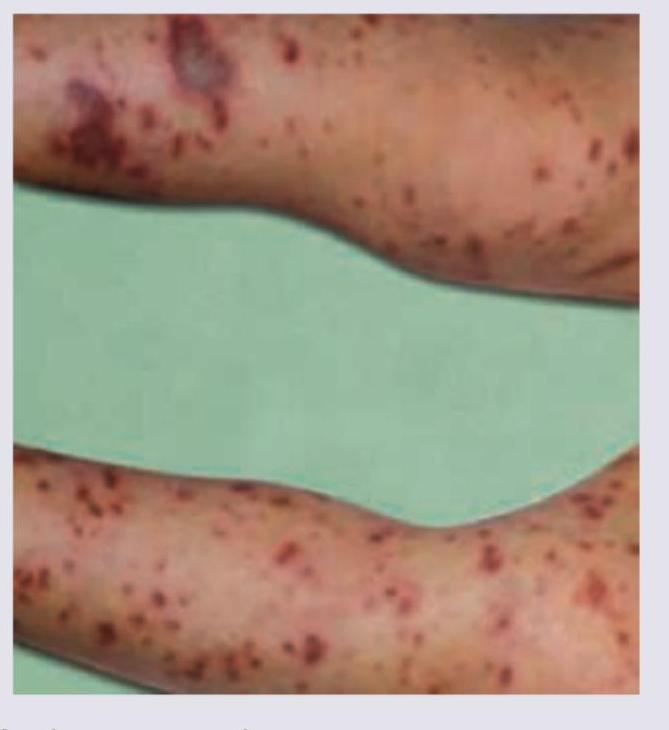
A child patient presents to the outpatient department with a history of black central arch rashes on their body. What is your diagnosis?
A child presents with a cough and a characteristic inspiratory whoop. What is the most appropriate sample for investigation?
Which vaccine is contraindicated in an HIV-positive child?
A 8-year-old boy presented with swelling on both sides of the face, below the ears, of 4 days duration. The swelling first started on the left side and then, 3 days later, appeared on the right side. Immunization to this disease can be achieved by which of the following vaccinations?
What is true about congenital Rubella syndrome?
A lactating woman has sputum positive TB. The neonate is 3 months old. What is the recommended chemoprophylaxis?
Explanation: **Explanation:** The clinical presentation of fever, cervical lymphadenopathy ("bull neck" appearance), and a greyish adherent membrane on the tonsils is classic for **Faucial Diphtheria** caused by *Corynebacterium diphtheriae*. **Why Option B is Correct:** The primary and most urgent treatment for diphtheria is the administration of **Diphtheria Antitoxin (DAT)**. Since the exotoxin causes irreversible tissue damage and myocarditis, the antitoxin must be given immediately based on clinical suspicion without waiting for culture results. The dosage is determined by the site and severity of the disease: * **Tonsillar/Pharyngeal (limited):** 20,000–40,000 units. * **Nasopharyngeal:** 40,000–60,000 units. * **Severe/Late presentation (>48 hours) or Systemic:** 80,000–120,000 units. As this patient has localized tonsillar involvement and presented within 36 hours, 20,000–40,000 units is the appropriate dose. **Why Other Options are Incorrect:** * **Option A & D:** Antibiotics (Penicillin or Erythromycin) are **secondary** treatments. They serve to stop further toxin production and prevent the spread of the organism to others, but they do not neutralize the toxin already circulating in the body. * **Option C:** This higher dose is reserved for extensive disease, laryngeal involvement, or patients presenting late (usually >3 days of symptoms). **High-Yield Clinical Pearls for NEET-PG:** 1. **Schick Test:** Used to determine the immune status of an individual (not for diagnosis). 2. **Culture Media:** Löffler’s serum slope (rapid growth) and Potassium Tellurite agar (black colonies). 3. **Microscopy:** Albert stain shows metachromatic granules (Babes-Ernst granules) in a "Chinese letter" pattern. 4. **Most Common Complication:** Myocarditis (usually occurs in the 2nd week). 5. **Neurological Complication:** Palatal palsy is the most common early neurological sign.
Explanation: **Explanation:** **Reye’s Syndrome** is a rare but life-threatening condition characterized by **acute encephalopathy** and **fatty degeneration of the liver**. It is strongly associated with the use of salicylates (Aspirin) during viral prodromes, most commonly **Influenza B** and **Varicella**. 1. **Why Option A is Correct:** The pathophysiology involves **mitochondrial injury**, leading to impaired fatty acid oxidation. This results in hyperammonemia and cerebral edema. Clinically, it presents with persistent vomiting, altered sensorium, and hepatomegaly without jaundice. 2. **Why Other Options are Incorrect:** * **Nausea and Diarrhea (B & C):** While these are common side effects of many medications, they are not the specific life-threatening reason for contraindicating aspirin in viral infections. * **Acid-base imbalance (D):** While aspirin overdose (salicylate toxicity) causes a mixed respiratory alkalosis and metabolic acidosis, it is not the specific syndrome triggered by viral infections in children. **High-Yield Clinical Pearls for NEET-PG:** * **Biochemical markers:** Elevated AST/ALT (>3x normal), elevated serum ammonia, and prolonged Prothrombin Time (PT), but **normal bilirubin** (a key diagnostic feature). * **Liver Biopsy:** Shows **microvesicular steatosis** (small fat droplets) without significant inflammation. * **Safe Alternatives:** Acetaminophen (Paracetamol) or Ibuprofen are the drugs of choice for fever in children. * **Exception:** Aspirin is still used in children for specific conditions like **Kawasaki disease** and **Juvenile Idiopathic Arthritis (JIA)**, under strict supervision.
Explanation: **Explanation:** The correct answer is **B. Candidiasis**. **Mechanism of Action:** The human oral cavity and gastrointestinal tract maintain a delicate balance of normal microbial flora. Broad-spectrum or prolonged antibiotic therapy suppresses the growth of beneficial commensal bacteria (such as *Lactobacillus*). These bacteria normally compete with *Candida albicans* for nutrients and binding sites and maintain an acidic pH that inhibits fungal overgrowth. When this bacterial "interference" is removed, *Candida*—an opportunistic fungus—proliferates, leading to conditions like oral thrush or diaper dermatitis. **Analysis of Incorrect Options:** * **A. Necrotising Ulcerative Gingivitis (NUG):** Also known as "Trench Mouth," this is an acute infection caused by a fuso-spirochetal complex (e.g., *Prevotella intermedia*). It is associated with poor hygiene and immunosuppression, not antibiotic use. In fact, antibiotics are part of its treatment. * **C. Actinomycosis:** This is a chronic granulomatous infection caused by *Actinomyces israelii*. It typically occurs following local trauma (like dental extraction) and is treated with long-term penicillin; it is not caused by antibiotic use. * **D. Aphthous Ulcers:** These are painful, non-infectious oral ulcers. While their exact etiology is idiopathic, they are often linked to stress, trauma, or vitamin deficiencies (B12, Folate), rather than antibiotic-induced flora changes. **High-Yield Clinical Pearls for NEET-PG:** * **Oral Candidiasis (Thrush):** Characterized by white, "curd-like" plaques that **can be scraped off**, leaving an erythematous (bleeding) base. * **Other complications of prolonged antibiotics:** Pseudomembranous colitis (caused by *Clostridioides difficile* overgrowth) and Vitamin K deficiency (due to destruction of gut flora). * **Treatment:** Topical Nystatin or oral Fluconazole are the first-line agents for pediatric candidiasis.
Explanation: The clinical presentation of sore throat, high-grade fever, and tender cervical adenopathy is classic for **Group A Beta-Hemolytic Streptococcus (GABHS)** pharyngitis. ### **Explanation of the Correct Answer** **Option B (Acute Glomerulonephritis)** is the correct answer because **Acute Post-Streptococcal Glomerulonephritis (PSGN)** is a non-suppurative complication that is **not prevented** by antibiotic therapy. PSGN is an immune-mediated (Type III hypersensitivity) reaction that can occur following either a skin infection (impetigo) or a throat infection. Unlike Rheumatic Fever, the occurrence and severity of PSGN are independent of the administration or timing of antibiotics. ### **Analysis of Incorrect Options** * **Option A (Rheumatic Fever):** Antibiotics (specifically Penicillin) are highly effective in preventing Acute Rheumatic Fever (ARF) if administered within **9 days** of the onset of symptoms. This is a primary goal of treating streptococcal pharyngitis. * **Option C (Transmission):** Antibiotics rapidly reduce the bacterial load in the pharynx. A child is typically considered non-infectious 24 hours after starting appropriate antibiotic therapy. * **Option D (Peritonsillar abscess):** These are **suppurative (pus-forming) complications**. Prompt antibiotic treatment prevents the local spread of infection, thereby reducing the risk of abscesses (peritonsillar/retropharyngeal), otitis media, and sinusitis. ### **High-Yield NEET-PG Pearls** * **Rheumatic Fever:** Follows **only** pharyngeal infection; preventable by antibiotics. * **PSGN:** Follows **both** skin and pharyngeal infections; **not** preventable by antibiotics. * **Drug of Choice:** Oral Penicillin V for 10 days or a single dose of IM Benzathine Penicillin G remains the gold standard for GABHS. * **Centor Criteria:** Used clinically to estimate the probability of GABHS pharyngitis (Fever, Tonsillar exudates, Tender anterior cervical lymphadenopathy, and Absence of cough).
Explanation: ### Explanation **Correct Option: A. Meningococcemia** The hallmark clinical sign of Meningococcemia (caused by *Neisseria meningitidis*) is a rapidly progressing petechial or purpuric rash. These lesions often undergo central necrosis due to **disseminated intravascular coagulation (DIC)** and perivascular inflammation, leading to a characteristic **"black central arch"** or "gunmetal grey" appearance. This represents skin infarction and is a medical emergency, often progressing to Waterhouse-Friderichsen syndrome (adrenal hemorrhage). **Why other options are incorrect:** * **B. Dengue Hemorrhagic Fever:** While it presents with petechiae and ecchymosis due to thrombocytopenia, the classic rash is described as **"islands of white in a sea of red"** (convalescent rash). It typically lacks the necrotic black centers seen in meningococcemia. * **C. Leptospirosis:** Presents with conjunctival suffusion (pathognomonic), calf tenderness, and jaundice (Weil’s disease). While a petechial rash can occur, it is not the defining feature. * **D. Scrub Typhus:** The characteristic skin finding is an **Eschar**—a painless ulcer with a black crust at the site of the chigger bite—rather than generalized black central arch rashes. **NEET-PG High-Yield Pearls:** * **DOC for Prophylaxis:** Rifampicin (Close contacts); Ceftriaxone is preferred for pregnant women. * **DOC for Treatment:** Ceftriaxone or Cefotaxime. * **Glass Test:** Petechiae and purpura in meningococcemia are **non-blanching** (do not disappear when pressed with a glass). * **Most common serogroup in India:** Historically Serogroup A, though W-135 and Y are emerging globally.
Explanation: **Explanation:** The clinical presentation of a cough followed by a characteristic **inspiratory whoop** is pathognomonic for **Pertussis (Whooping Cough)**, caused by *Bordetella pertussis*. **Why Nasopharyngeal Swab is the Correct Answer:** *Bordetella pertussis* is a fastidious organism that specifically colonizes the **ciliated respiratory epithelium of the nasopharynx**. Therefore, a **nasopharyngeal (NP) swab or aspirate** is the gold standard for both culture (using Regan-Lowe or Bordet-Gengou medium) and PCR. PCR is currently the preferred diagnostic method due to its high sensitivity and rapid results compared to culture. **Analysis of Incorrect Options:** * **Tracheal aspiration:** While it contains respiratory secretions, it is an invasive procedure and unnecessary for diagnosing a primary upper/middle respiratory tract infection like pertussis. * **Cough plate culture:** This is an obsolete method where a culture plate was held in front of the patient's mouth during a paroxysm. It has a very low yield and is no longer recommended. * **Sputum culture:** Pertussis is not a deep-seated lung parenchymal infection like pneumonia; furthermore, young children rarely produce adequate sputum. The organism resides in the nasopharynx, not the lower secretions. **NEET-PG High-Yield Pearls:** * **Best Time for Sampling:** Highest yield is during the **catarrhal stage** or early paroxysmal stage (first 2-3 weeks). * **Swab Material:** Use **Dacron or calcium alginate** swabs. Avoid cotton swabs as they contain fatty acids inhibitory to *B. pertussis*. * **Drug of Choice:** Macrolides (Azithromycin is preferred in infants <1 month to avoid risk of pyloric stenosis associated with Erythromycin). * **Prophylaxis:** Post-exposure prophylaxis is recommended for all household contacts regardless of vaccination status.
Explanation: ### Explanation **Correct Answer: A. Oral Polio Vaccine (OPV)** **Why OPV is the correct answer:** The primary concern in HIV-positive children is the risk of **vaccine-derived disease** from live-attenuated vaccines. OPV contains live attenuated viruses that are shed in the stool. In an immunocompromised host, the virus can undergo prolonged replication, leading to **Vaccine-Associated Paralytic Poliomyelitis (VAPP)**. Furthermore, the child can shed the virus for an extended period, posing a risk to the community. Therefore, the **Inactivated Polio Vaccine (IPV)** is the preferred alternative as it contains killed virus and carries zero risk of VAPP. **Analysis of Incorrect Options:** * **B. MMR Vaccine:** While MMR is a live vaccine, it is **not** contraindicated in HIV-positive children unless they are **severely immunocompromised** (CD4 percentage <15% or CD4 count <200 cells/mm³). For most HIV-positive children, the benefits of protection against measles outweigh the risks. * **C. Rabies Vaccine:** This is a **killed/inactivated vaccine**. It is safe to administer to HIV-positive individuals, though the immune response may be suboptimal. * **D. Influenza Vaccine:** The **injectable** influenza vaccine is an **inactivated** vaccine and is recommended annually for HIV-positive children to prevent secondary bacterial pneumonia. (Note: The intranasal live-attenuated flu vaccine would be contraindicated). **High-Yield Clinical Pearls for NEET-PG:** * **BCG Vaccine:** Generally contraindicated in HIV-positive infants due to the risk of disseminated BCG infection (*BCGosis*), unless the infant is asymptomatic and in a high-burden area (WHO guidelines vary slightly by region). * **Symptomatic vs. Asymptomatic:** In HIV, live vaccines are generally avoided if there is evidence of severe immunosuppression. * **Household Contacts:** Family members of an HIV-positive child should also receive IPV instead of OPV to prevent "fecal-oral" transmission of the vaccine virus to the patient.
Explanation: **Explanation:** The clinical presentation of bilateral facial swelling below the ears, starting on one side and progressing to the other, is a classic description of **Parotitis**, the hallmark of **Mumps**. Mumps is an acute viral infection caused by the *Rubulavirus* (Paramyxoviridae family). **Why MMR is correct:** The **MMR (Measles, Mumps, and Rubella)** vaccine is a live-attenuated vaccine that provides effective immunity against the Mumps virus. In the National Immunization Schedule (India) and IAP guidelines, it is typically administered in two doses (at 9 months as MR/MMR and 15 months as MMR). **Why other options are incorrect:** * **BCG (Bacillus Calmette-Guérin):** A live bacterial vaccine used to prevent severe forms of Tuberculosis (miliary and meningeal TB). * **Hepatitis B:** A subunit vaccine (HBsAg) used to prevent viral hepatitis caused by the Hepatitis B virus. * **Polio:** Administered as OPV (Sabin - live) or IPV (Salk - inactivated) to prevent poliomyelitis. **High-Yield Clinical Pearls for NEET-PG:** * **Most common complication in children:** Aseptic meningitis. * **Most common complication in post-pubertal males:** Epididymo-orchitis (usually unilateral; rarely leads to sterility). * **Other complications:** Pancreatitis (look for elevated serum amylase), Oophoritis, and Sensorineural hearing loss (usually unilateral). * **Infectivity:** Patients are most infectious from 2 days before to 5 days after the onset of parotid swelling. * **Diagnosis:** Primarily clinical; however, IgM antibodies or PCR can confirm the diagnosis.
Explanation: **Explanation:** Congenital Rubella Syndrome (CRS) occurs due to transplacental transmission of the Rubella virus, primarily affecting infants born to non-immune mothers. **1. Why Option A is Correct:** The **"Blueberry muffin rash"** is a classic clinical sign of CRS. It represents **extramedullary hematopoiesis** in the skin, appearing as non-blanching, purplish-blue maculopapular lesions. While also seen in CMV, neuroblastoma, and leukemia, it is a high-yield association for Rubella in the context of congenital infections. **2. Analysis of Incorrect Options:** * **Option B:** This is technically an underestimate. Infants with CRS are chronically infected and can shed the virus in nasopharyngeal secretions and urine for **up to 1 year** (or longer), making them a significant infection control risk. * **Option C:** The classic **Gregg’s Triad** consists of **Cataracts** (or glaucoma), **Cardiac defects** (most commonly Patent Ductus Arteriosus/PDA), and **Sensorineural hearing loss** (the most common finding). Cerebral palsy is not part of the triad. * **Option D:** The risk is highest during the **first trimester** (specifically the first 8–12 weeks). Infection after 20 weeks (5 months) rarely results in congenital defects. **Clinical Pearls for NEET-PG:** * **Most common cardiac lesion:** PDA (Peripheral pulmonary artery stenosis is the second most common). * **Eye findings:** "Salt and pepper" retinopathy is the most common ocular manifestation, though cataracts are more specific. * **Diagnosis:** Presence of Rubella-specific IgM antibodies in the newborn or persistence of IgG beyond 6–12 months. * **Prevention:** Live attenuated **RA 27/3 vaccine**. It is contraindicated in pregnancy; women should avoid conception for 1 month post-vaccination.
Explanation: **Explanation:** The management of a neonate born to or in contact with a sputum-positive tuberculosis (TB) mother is a high-yield topic for NEET-PG, governed by the **National Tuberculosis Elimination Program (NTEP)** guidelines. **1. Why Option D is Correct:** In cases where a lactating mother is diagnosed with infectious pulmonary TB, the primary goal is to prevent the transmission and development of primary TB in the infant. The recommended chemoprophylaxis is **Isoniazid (INH) at a dose of 5 mg/kg daily for a duration of 6 months.** * **Mechanism:** INH is highly bactericidal and effectively prevents the progression of latent infection to active disease in highly susceptible infants. * **Breastfeeding:** The mother should continue breastfeeding but must follow cough hygiene and wear a mask. INH is secreted in breast milk in negligible amounts and is safe for the infant. **2. Why Other Options are Incorrect:** * **Options A & C (3 mg/kg):** The standard prophylactic dose for INH in children is 5 mg/kg. A dose of 3 mg/kg is sub-therapeutic for prophylaxis. * **Options A & B (3 months):** A 3-month duration is insufficient. According to Indian guidelines, prophylaxis must extend to 6 months to ensure adequate protection during the period of highest vulnerability. **3. Clinical Pearls for NEET-PG:** * **BCG Vaccination:** If the infant has not been vaccinated, BCG should be deferred until the 6-month course of INH is completed. If already vaccinated, prophylaxis is still given. * **Screening:** Before starting prophylaxis, the infant must be screened (Clinical exam + X-ray) to rule out active TB. If active TB is found, full **ATT (Anti-Tubercular Treatment)** is started instead. * **Pyridoxine:** While not always mandatory in infants, it may be supplemented (1 mg/kg) to prevent peripheral neuropathy if the infant is exclusively breastfed. * **Post-Prophylaxis:** After 6 months of INH, if the infant is asymptomatic, BCG can be administered (if not given at birth).
Vaccine-Preventable Diseases
Practice Questions
Immunization Schedule
Practice Questions
Common Childhood Infections
Practice Questions
Pediatric HIV
Practice Questions
Congenital Infections
Practice Questions
Fever in Infants and Children
Practice Questions
Meningitis and Encephalitis
Practice Questions
Respiratory Tract Infections
Practice Questions
Gastrointestinal Infections
Practice Questions
Parasitic Infections
Practice Questions
Tuberculosis in Children
Practice Questions
Opportunistic Infections
Practice Questions
Get full access to all questions, explanations, and performance tracking.
Start For Free