A 9-year-old girl child developed a 10 mm area of induration on the left forearm 72 hours after intradermal injection of 0.1 ml of purified protein derivative (PPD). Which of the following is most likely to be seen on the X-ray of this patient?
Increased sweat chloride is seen in all conditions except?
A 5-year-old unimmunized child presented with high fever, sore throat, dysphagia, and voice change. A throat swab from a whitish lesion was taken for diagnosis. What is the most likely diagnosis?
Which of the following is NOT true about Herpangina?
A pregnant female is infected with Rubella. Which of the following immunoglobulins is produced by in-utero infection?
Pastia's lines are seen in which condition?
The classic triad of congenital rubella includes all of the following except?
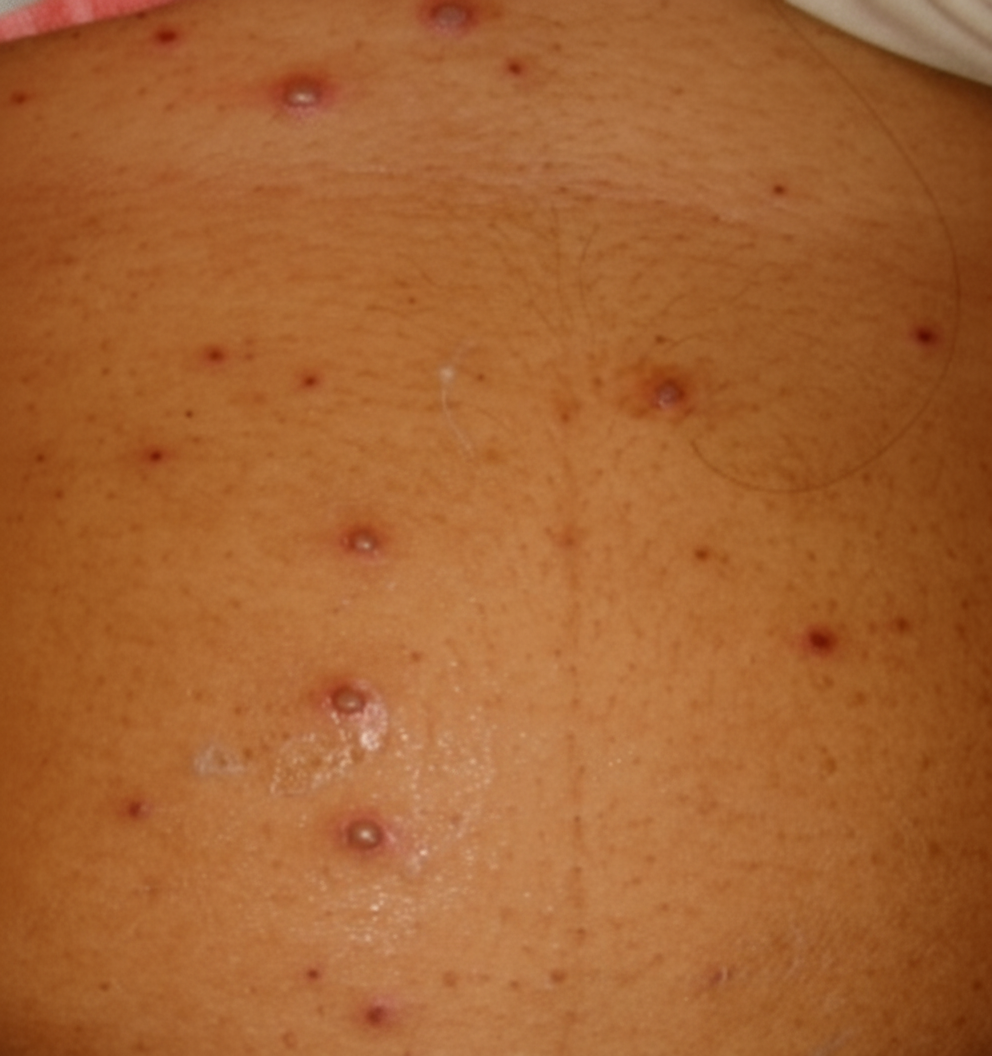
The risk of neonatal chickenpox is maximum if maternal infection occurs:
A child presents with fever and redness of a cheek. What is the causative organism for this condition?
Which of the following is NOT a complication of chickenpox?
Explanation: ### Explanation **1. Why the Correct Answer is Right:** The core concept here is the distinction between **Latent Tuberculosis Infection (LTBI)** and **Active Tuberculosis Disease**. A 10 mm induration on a Mantoux test (PPD) in a 9-year-old child is considered a **positive result** (the cutoff is ≥10 mm for children in high-prevalence areas like India or those with specific risk factors). However, a positive Mantoux test only indicates that the child has been infected with *Mycobacterium tuberculosis* and has developed a delayed-type hypersensitivity reaction. It does **not** equate to active disease. In the absence of symptoms (fever, cough, weight loss), the most common scenario is LTBI, where the chest X-ray is typically **normal**. **2. Why the Other Options are Wrong:** * **Option A (Hilar Adenopathy):** This is the hallmark of **Primary Symptomatic Tuberculosis** in children. While possible if the child had active disease, the question asks for the "most likely" finding in a child who is otherwise asymptomatic except for a positive skin test. * **Option B (Upper Lobe Calcifications):** These represent healed, old granulomatous lesions (e.g., Simon foci) or chronic secondary TB, which is less common as an initial finding in a 9-year-old compared to primary infection patterns. * **Option D (Reticulo-nodular Densities):** This pattern is characteristic of **Miliary Tuberculosis**, a severe, disseminated form of the disease associated with high fever and systemic illness, not an isolated positive PPD. **3. Clinical Pearls for NEET-PG:** * **Mantoux Interpretation Cut-offs:** * **≥5 mm:** HIV positive, recent contact with active TB case, fibrotic changes on CXR. * **≥10 mm:** Children <4 years, residents of high-prevalence countries (India), IV drug users, medical conditions (Diabetes, Renal failure). * **≥15 mm:** Persons with no known risk factors for TB. * **False Positive:** BCG vaccination (though usually <10mm), Nontuberculous mycobacteria (NTM). * **False Negative (Anergy):** Severe malnutrition, Miliary TB, Viral infections (Measles, HIV), Steroid use. * **Golden Rule:** A positive Mantoux test confirms infection; a Chest X-ray and clinical correlation confirm disease.
Explanation: The sweat chloride test is the gold standard for diagnosing Cystic Fibrosis (CF), but several non-CF conditions can cause false-positive elevations. **Explanation of the Correct Answer:** **Obesity (Option D)** is the correct answer because it is **not** associated with increased sweat chloride levels. In fact, there is no physiological mechanism linking excess adipose tissue to impaired chloride transport in the eccrine glands. **Explanation of Incorrect Options:** * **Ectodermal Dysplasia (Option A):** This genetic disorder affects the development of sweat glands. Structural abnormalities in these glands can lead to an inability to reabsorb chloride, resulting in elevated levels. * **Nephrogenic Diabetes Insipidus (Option B):** Chronic dehydration and electrolyte imbalances associated with NDI can lead to concentrated sweat and elevated chloride readings. * **Glucose-6-Phosphatase Deficiency (Option C):** Also known as Von Gierke Disease (GSD Type I). The exact mechanism is complex but involves metabolic derangements that interfere with normal ion transport in sweat ducts. **High-Yield Clinical Pearls for NEET-PG:** * **Thresholds:** Sweat chloride **>60 mmol/L** is diagnostic for CF; **40–59 mmol/L** is intermediate/borderline. * **Other False Positives:** Adrenal insufficiency (Addison’s), Hypothyroidism, Malnutrition (Anorexia), Mucopolysaccharidosis, and Fucosidosis. * **False Negatives:** Edema (hypoproteinemia) and technical errors (inadequate sweat collection). * **The "Gold Standard" Method:** Quantitative pilocarpine iontophoresis.
Explanation: ### Explanation **Correct Answer: A. Diphtheria** The clinical presentation is classic for **Faucial Diphtheria**, caused by *Corynebacterium diphtheriae*. The key diagnostic markers in this scenario are: 1. **Unimmunized Status:** Diphtheria is a vaccine-preventable disease (part of the DPT/Pentavalent vaccine); lack of immunization is a major risk factor. 2. **Whitish Lesion (Pseudomembrane):** The hallmark of diphtheria is a greyish-white, tough, leathery pseudomembrane that is firmly adherent to the tonsils, pharynx, or larynx. Attempting to scrape it typically causes bleeding. 3. **Symptoms:** High fever, dysphagia (difficulty swallowing), and voice change (suggesting laryngeal involvement or edema) are characteristic. **Why other options are incorrect:** * **B. Mumps:** Primarily presents with painful swelling of the parotid glands (parotitis). It does not feature a pharyngeal pseudomembrane. * **C. Pertussis:** Also known as "Whooping Cough," it presents with paroxysmal cough followed by an inspiratory "whoop." It does not cause a visible throat membrane or significant dysphagia. * **D. Streptococcal pharyngitis:** While it causes sore throat and fever, the exudate is typically patchy and non-adherent (easily wiped off), unlike the leathery membrane of diphtheria. --- ### NEET-PG High-Yield Pearls * **Microscopy:** *C. diphtheriae* shows Gram-positive, club-shaped bacilli in **Chinese-letter patterns** (cuneiform arrangement). * **Special Stains:** Albert’s stain or Neisser’s stain reveals **Metachromatic granules** (Volutin/Babes-Ernst granules). * **Culture Media:** **Löffler's serum slope** (rapid growth) and **Potassium Tellurite agar** (black colonies). * **Bull Neck:** Severe cervical lymphadenopathy and soft tissue edema in diphtheria are referred to as "Bull neck" appearance. * **Complications:** The most common cause of death is **Myocarditis** (due to exotoxin), followed by neurological palsies (e.g., palatal palsy).
Explanation: **Explanation:** Herpangina is a common viral infection in children, primarily caused by **Coxsackievirus A**. Understanding its clinical presentation is crucial for differentiating it from other pediatric oral lesions. **1. Why Option C is the correct answer (The False Statement):** Contrary to the option, **Herpangina is generally milder** than Primary Herpetic Gingivostomatitis (PHGS). PHGS, caused by HSV-1, typically presents with high-grade fever, significant malaise, extensive friable/bleeding gums, and widespread oral ulcerations. Herpangina, while uncomfortable, usually involves fewer lesions and a faster recovery period (3–5 days). **2. Analysis of Incorrect Options (True Statements):** * **Option A (Epidemics):** Herpangina frequently occurs in seasonal outbreaks, particularly during summer and autumn months, often spreading in daycare settings. * **Option B (Site Specific):** This is a hallmark diagnostic feature. Lesions in Herpangina are localized to the **posterior oropharynx**, specifically the soft palate, uvula, and tonsillar pillars. In contrast, HSV lesions are usually anterior. * **Option D (Gingivitis is absent):** This is the key clinical differentiator. In Herpangina, the gingiva (gums) are spared. In Primary Herpetic Gingivostomatitis, **gingivitis** (swollen, red, bleeding gums) is a pathognomonic finding. **Clinical Pearls for NEET-PG:** * **Etiology:** Coxsackievirus A (most common); also Coxsackie B and Echoviruses. * **Hand-Foot-Mouth Disease (HFMD):** Caused by Coxsackie A16 or Enterovirus 71; presents like Herpangina but includes a maculopapular/vesicular rash on palms and soles. * **Treatment:** Purely supportive (hydration and analgesics); antibiotics and acyclovir have no role in Herpangina.
Explanation: **Explanation:** The correct answer is **IgM**. **Why IgM is correct:** The human fetus begins producing its own immunoglobulins around the 20th week of gestation. However, the placenta is selective; only maternal **IgG** can cross the placental barrier to provide passive immunity. **IgM** is a pentameric molecule with a high molecular weight, making it too large to cross the placenta. Therefore, if IgM antibodies against Rubella are detected in a newborn or a fetus, it serves as definitive evidence of a **primary intrauterine infection**, as these antibodies could only have been synthesized by the fetal immune system in response to the virus. **Why other options are incorrect:** * **IgG:** While IgG is found in the fetus, it is predominantly of maternal origin (passive transfer). It does not signify an active fetal infection unless titers remain persistently high or rise after the disappearance of maternal antibodies (usually after 6–12 months). * **IgA:** IgA is primarily secreted in colostrum and breast milk. While the fetus can produce trace amounts, it is not the diagnostic marker for acute in-utero infection. * **IgD:** This immunoglobulin acts mainly as an antigen receptor on B cells and has no diagnostic significance in congenital infections. **High-Yield Clinical Pearls for NEET-PG:** * **Gregg’s Triad (Congenital Rubella Syndrome):** Cataracts, Sensorineural hearing loss (most common), and Congenital Heart Disease (PDA is most common; Peripheral Pulmonary Artery Stenosis is most specific). * **Blueberry Muffin Rash:** Characteristic finding in CRS due to extramedullary hematopoiesis. * **Risk Period:** The risk of malformation is highest if the infection occurs in the **first trimester** (up to 80% risk in the first 12 weeks). * **Diagnosis:** Detection of Rubella-specific IgM in the cord blood or neonatal serum is the gold standard for diagnosing CRS at birth.
Explanation: **Explanation:** **Scarlet Fever (Option D)** is the correct answer. It is caused by Group A Beta-hemolytic *Streptococcus* (GABHS) which produces **erythrogenic toxins**. **Pastia’s lines** (or Thompson’s lines) are a classic clinical sign characterized by linear petechiae or pink/red lines found in the skin folds, particularly the antecubital fossa, axilla, and groin. These lines occur because the rash is more intense in areas of skin friction and capillary fragility. **Analysis of Incorrect Options:** * **Measles (Option A):** Characterized by **Koplik spots** (enanthem) and a maculopapular rash that starts behind the ears and spreads downwards. It does not feature Pastia’s lines. * **Varicella (Option B):** Presents with a pleomorphic rash (macules, papules, vesicles, and crusts appearing simultaneously) often described as **"dewdrops on a rose petal."** * **Syphilis (Option C):** Secondary syphilis presents with a generalized maculopapular rash involving the **palms and soles**, but not linear petechiae in skin folds. **High-Yield Clinical Pearls for Scarlet Fever:** 1. **Sandpaper Rash:** The rash has a rough, "sunburn-with-goosebumps" texture. 2. **Strawberry Tongue:** Initially "White Strawberry Tongue" (coated), followed by "Red Strawberry Tongue" (denuded papillae). 3. **Circumoral Pallor:** Redness of the face with a distinct pale area around the mouth. 4. **Schultz-Charlton Reaction:** Blanching of the scarlet fever rash when specific antitoxin is injected (historical diagnostic test). 5. **Dick Test:** Used to determine susceptibility to scarlet fever.
Explanation: The classic triad of Congenital Rubella Syndrome (CRS), also known as **Gregg’s Triad**, consists of specific ocular, auditory, and cardiac malformations. **Explanation of the Correct Answer:** **C. Retinitis** is the correct answer because it is not part of the classic triad. While ocular involvement is common in CRS, the hallmark finding is **Cataract** (typically bilateral and "pearly"). While "Salt and Pepper Retinopathy" is a frequent finding in CRS, it is not part of the defining triad and usually does not affect vision as severely as cataracts. **Explanation of Incorrect Options:** * **A. Cataract:** This is the primary ocular component of the triad. It results from the virus interfering with lens fiber development during the first trimester. * **B. Deafness:** Sensorineural hearing loss is the **most common** manifestation of CRS. It may be the only finding in late-gestation infections. * **D. Congenital Heart Disease:** This is the third component of the triad. The most characteristic lesion is **Patent Ductus Arteriosus (PDA)**, followed by peripheral pulmonary artery stenosis. **High-Yield Clinical Pearls for NEET-PG:** * **Most common finding:** Sensorineural hearing loss. * **Most common cardiac lesion:** PDA. * **Ocular findings:** "Pearly" cataracts, microphthalmia, and **Salt and Pepper Retinopathy** (the most common ocular sign, though not in the triad). * **Dermal finding:** "Blueberry muffin" spots (extramedullary hematopoiesis). * **Radiology:** "Celery stalking" (longitudinal radiolucent striations in the metaphysis of long bones). * **Risk:** The risk of fetal infection is highest (up to 90%) if the mother is infected before 11 weeks of gestation.
Explanation: **Explanation:** The risk of severe neonatal chickenpox is highest when maternal varicella occurs **within 5 days before to 2 days after delivery**. This specific window is critical because of the timing of transplacental antibody transfer. When a mother develops varicella, it takes approximately 5 days for her body to produce **IgG antibodies**. If delivery occurs within this 5-day window, the virus crosses the placenta and infects the fetus, but the protective maternal antibodies have not yet developed or been transferred. Consequently, the neonate receives a high viral load without passive immunity, leading to severe, disseminated, and potentially fatal disease (neonatal varicella). **Analysis of Options:** * **Options A & B (First/Second Trimester):** Infection during early pregnancy (especially weeks 13–20) can lead to **Congenital Varicella Syndrome**, characterized by limb hypoplasia, cicatricial skin scarring, and microcephaly. While serious, the risk of transmission is low (~2%), and it does not cause the acute neonatal chickenpox described. * **Option D (Six weeks of delivery):** If infection occurs weeks before delivery, the mother has sufficient time to transfer protective IgG antibodies to the fetus, resulting in a much milder or asymptomatic course for the newborn. **High-Yield Clinical Pearls for NEET-PG:** * **Management:** If maternal infection occurs in the "danger window" (5 days before to 2 days after), the neonate must receive **Varicella-Zoster Immunoglobulin (VZIG)** immediately after birth. * **Treatment:** If the neonate develops symptoms, **Intravenous Acyclovir** is the treatment of choice. * **Incubation Period:** The incubation period for varicella is 10–21 days. * **Contagiousness:** Patients are contagious from 48 hours before the rash appears until all lesions have crusted over.
Explanation: ### Explanation The clinical presentation of fever followed by a characteristic redness of the cheek (often described as a **"slapped-cheek" appearance**) is the hallmark of **Erythema Infectiosum**, also known as **Fifth Disease**. **1. Why Parvovirus B-19 is correct:** Parvovirus B-19 is a DNA virus that infects erythroid progenitor cells. In children, it typically presents with a mild prodromal fever followed by a bright red exanthem on the cheeks (sparing the nasolabial folds). As the facial rash fades, a secondary **"lace-like" or reticular rash** often appears on the trunk and extremities. The rash is immune-mediated and usually appears once the child is no longer contagious. **2. Why the other options are incorrect:** * **Herpes virus:** HSV-1 typically causes gingivostomatitis or herpetic whitlow. While it causes skin lesions, they are vesicular (fluid-filled) rather than a diffuse erythematous "slapped-cheek" rash. * **Adenovirus:** Commonly causes pharyngoconjunctival fever (fever, sore throat, and conjunctivitis). While it can cause a nonspecific rash, it does not present with the classic malar erythema of Fifth disease. * **Rubella:** Also known as German Measles, it presents with a maculopapular rash that starts on the face and spreads downward (cephalocaudal progression) along with characteristic **Forchheimer spots** on the soft palate and retroauricular lymphadenopathy. **Clinical Pearls for NEET-PG:** * **Aplastic Crisis:** Parvovirus B-19 can cause a life-threatening cessation of red blood cell production in patients with high RBC turnover (e.g., **Sickle Cell Anemia**, Hereditary Spherocytosis). * **Pregnancy:** Infection in pregnancy can lead to **Hydrops Fetalis** due to severe fetal anemia. * **Adults:** Often presents with arthralgia or symmetric arthritis rather than a rash. * **Receptor:** The virus enters cells via the **P-antigen** (globoside) on erythrocytes.
Explanation: **Explanation:** Chickenpox, caused by the **Varicella-Zoster Virus (VZV)**, is a highly contagious viral infection. While it is typically self-limiting in healthy children, it can lead to various systemic complications. **Why Enteritis is the Correct Answer:** Enteritis (inflammation of the small intestine) is **not** a recognized complication of chickenpox. VZV primarily targets the skin, respiratory system, and central nervous system. Gastrointestinal involvement is extremely rare and not part of the classic clinical spectrum of the disease. **Analysis of Incorrect Options:** * **Pneumonia:** This is the **most serious complication in adults** and immunocompromised individuals. It typically presents with cough and dyspnea 3–5 days after the rash appears. * **Meningitis/Encephalitis:** Neurological complications are well-documented. **Acute Cerebellar Ataxia** (presenting with nystagmus and unsteady gait) is the most common CNS complication in children, while encephalitis and aseptic meningitis can also occur. * **Reye’s Syndrome:** This is a rare but fatal condition involving acute encephalopathy and fatty liver degeneration. It is strongly associated with the use of **aspirin (salicylates)** during a viral prodrome like chickenpox or influenza. **High-Yield Clinical Pearls for NEET-PG:** * **Most common complication in children:** Secondary bacterial infection of skin lesions (usually *Staph. aureus* or *Group A Strep*). * **Congenital Varicella Syndrome:** Occurs if the mother is infected in the first 20 weeks of pregnancy; characterized by cicatricial skin scarring, limb hypoplasia, and microcephaly. * **Treatment of choice:** Oral Acyclovir (if started within 24 hours of rash) for high-risk cases; supportive care for healthy children. * **Prevention:** Live attenuated vaccine (Oka strain).
Vaccine-Preventable Diseases
Practice Questions
Immunization Schedule
Practice Questions
Common Childhood Infections
Practice Questions
Pediatric HIV
Practice Questions
Congenital Infections
Practice Questions
Fever in Infants and Children
Practice Questions
Meningitis and Encephalitis
Practice Questions
Respiratory Tract Infections
Practice Questions
Gastrointestinal Infections
Practice Questions
Parasitic Infections
Practice Questions
Tuberculosis in Children
Practice Questions
Opportunistic Infections
Practice Questions
Get full access to all questions, explanations, and performance tracking.
Start For Free