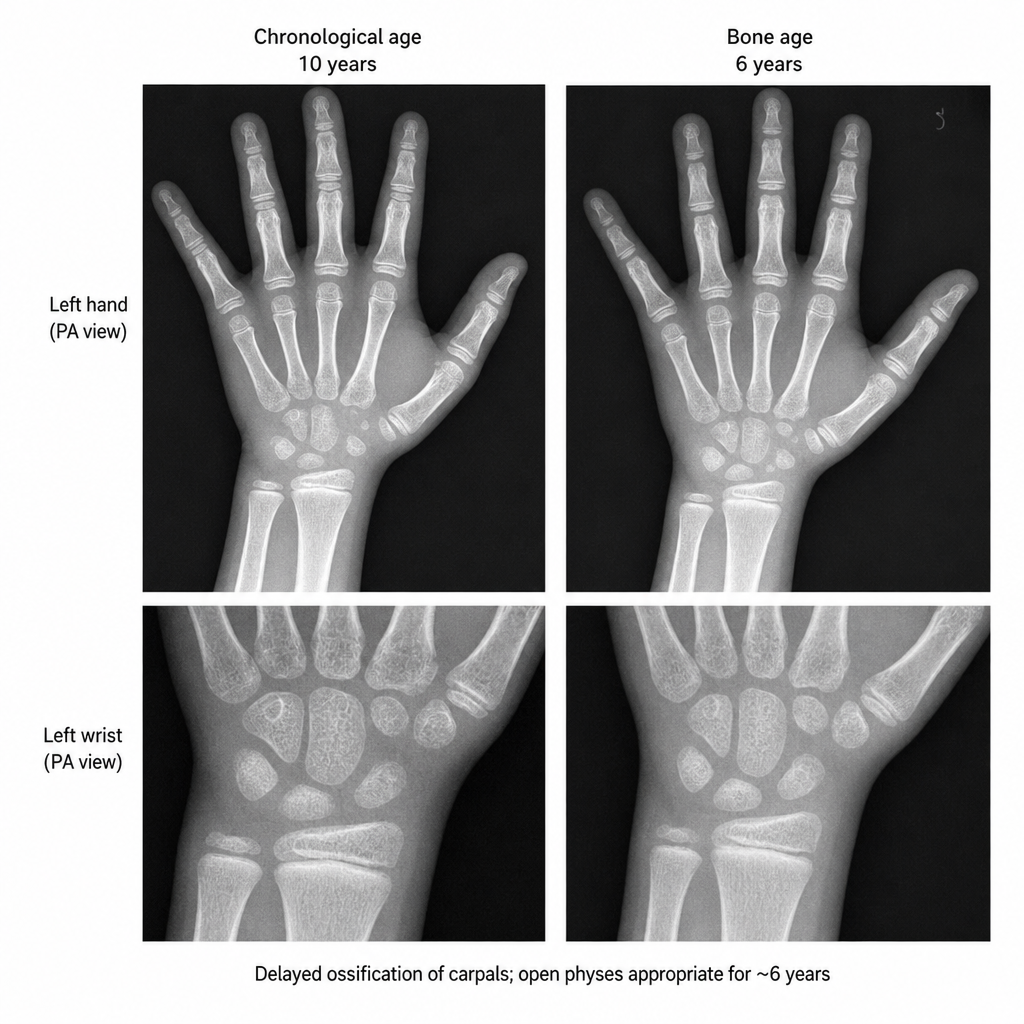
Early epiphyseal closure is seen with _________?
Which of the following complications has been associated with the adverse effects of rotavirus vaccine?
Juene syndrome is characterized by which mode of inheritance?
A baby can hold their neck and sit with support, but cannot sit without support. What is the typical age of this baby?
Delayed dentition with multiple supernumerary teeth is seen in which of the following conditions?
What is the approximate water content of breast milk?
A neonate is found to have a condition as shown in the image. Which of the following is a common associated anomaly?

Down's syndrome is most commonly caused by?
How many teeth are typically present in a 3-year-old child?
At what age does handedness typically develop?
Explanation: ### Explanation **Correct Option: C (Estrogen)** The primary hormone responsible for the fusion of the epiphyseal growth plates in both males and females is **Estrogen**. While Growth Hormone (GH) and Insulin-like Growth Factor-1 (IGF-1) drive linear bone growth, Estrogen acts on the estrogen receptors (ER-α) in the growth plate to trigger the maturation of chondrocytes and the eventual replacement of the cartilaginous plate with bone. In puberty, low levels of estrogen initially stimulate the "pubertal growth spurt," but as levels rise toward the end of puberty, they induce **epiphyseal senescence and closure**, effectively stopping linear growth. This is why conditions like precocious puberty (excess early estrogen) lead to short adult stature despite an initial growth spurt. **Why other options are incorrect:** * **LH and FSH (Options A & B):** These are gonadotropins secreted by the anterior pituitary. While they stimulate the gonads to produce sex steroids (estrogen/testosterone), they do not have a direct physiological effect on the epiphyseal plate closure themselves. * **Progesterone (Option D):** This hormone is primarily involved in the menstrual cycle and pregnancy maintenance; it has no significant role in bone maturation or epiphyseal fusion. **High-Yield Clinical Pearls for NEET-PG:** * **Aromatase Deficiency:** In individuals lacking the aromatase enzyme (which converts testosterone to estrogen), the epiphyses **fail to fuse**, leading to tall stature and continued growth into adulthood. * **Androgens:** Testosterone also contributes to bone growth, but its effect on plate closure is largely mediated by its peripheral conversion into estrogen. * **Thyroid Hormone:** Essential for bone age; deficiency (Hypothyroidism) causes significant **delayed bone age**. * **Glucocorticoids:** Excess levels (Cushing’s) inhibit bone growth and lead to stunted stature.
Explanation: **Explanation:** The correct answer is **D. Intussusception.** **Why Intussusception is the correct answer:** Rotavirus vaccines (such as Rotarix and RotaTeq) are live-attenuated oral vaccines. Historically, the first-generation vaccine (Rotashield) was withdrawn in 1999 due to a significant association with **intussusception** (telescoping of one segment of the intestine into another). While current vaccines have a much lower risk profile, a small but statistically significant risk (approximately 1 to 5 cases per 100,000 vaccinated infants) remains. The risk is highest within the first **7 days** following the first dose. Consequently, the vaccine is contraindicated in infants with a prior history of intussusception or uncorrected congenital malformations of the GI tract (like Meckel’s diverticulum). **Why other options are incorrect:** * **A. Guillain-Barré syndrome:** This is primarily associated with the **Influenza vaccine** and *Campylobacter jejuni* infections, not rotavirus. * **B. Hemolytic anemia:** This is not a recognized side effect of the rotavirus vaccine. It is more commonly associated with drugs (e.g., dapsone in G6PD deficiency) or infections. * **C. Febrile seizures:** While common after DPT or MMR vaccines, they are not a characteristic adverse effect of the oral rotavirus vaccine. **High-Yield Clinical Pearls for NEET-PG:** * **Age Limits:** To minimize the risk of intussusception, the WHO/IAP recommends the first dose be given after 6 weeks and the series completed by **8 months** of age. * **Vaccine Types:** Rotarix (Monovalent, 2 doses) and RotaTeq/Rotavac (Pentavalent, 3 doses). * **Contraindications:** History of intussusception, SCID (Severe Combined Immunodeficiency), and acute gastroenteritis.
Explanation: **Explanation:** **Jeune Syndrome**, also known as **Asphyxiating Thoracic Dystrophy (ATD)**, is a rare ciliopathy characterized primarily by a narrow, bell-shaped rib cage, short limbs (micromelia), and polydactyly. 1. **Why Autosomal Recessive (AR) is correct:** Jeune syndrome follows an **Autosomal Recessive** pattern of inheritance. It is caused by mutations in genes responsible for intraflagellar transport (IFT) proteins (most commonly *IFT80*, *DYNC2H1*, and *WDR19*). These proteins are essential for the proper functioning of primary cilia, which play a critical role in chondrocyte proliferation and skeletal development. Because it is AR, there is a 25% recurrence risk in subsequent pregnancies for carrier parents. 2. **Why other options are incorrect:** * **Autosomal Dominant:** Most skeletal dysplasias like Achondroplasia are AD. However, Jeune syndrome requires two copies of the mutated gene to manifest. * **X-Linked (Dominant/Recessive):** There is no evidence of sex-linked transmission in Jeune syndrome; it affects males and females equally, ruling out X-linked patterns. **High-Yield Clinical Pearls for NEET-PG:** * **Clinical Presentation:** The hallmark is a **constricted, bell-shaped thorax** leading to severe respiratory distress in the neonatal period. * **Radiology:** Look for "Handlebar" clavicles (horizontal clavicles), short ribs, and "trident" appearance of the acetabulum. * **Extraskeletal manifestations:** Progressive **renal failure** (juvenile nephronophthisis), hepatic fibrosis, and retinal degeneration. * **Prognosis:** Mortality is high in infancy due to pulmonary hypoplasia and recurrent infections. Those who survive infancy often develop chronic kidney disease.
Explanation: ### Explanation The development of gross motor skills follows a **cephalocaudal (head-to-toe) progression**. This question tests the ability to differentiate between various stages of trunk stability and postural control. **Why 6 months is correct:** At **6 months**, an infant has achieved significant core strength. The key milestones at this age are: * **Sitting with support:** The baby can sit when propped up or by leaning forward on their hands (tripod position). * **Neck holding:** This is well-established by 3–4 months; by 6 months, there is no head lag when pulled to sit. * **Rolling:** Usually rolls from back to stomach (supine to prone). Sitting *without* support typically occurs later, at **8 months**. **Analysis of Incorrect Options:** * **1 Month (A):** The infant has complete head lag and lies in a tonic neck reflex posture. * **2 Months (B):** The infant begins to lift their head intermittently when prone (45 degrees) but cannot sit, even with support. * **4 Months (C):** This is the age of **stable neck holding**. While the baby can be propped up, the ability to maintain a sitting posture with minimal support is more characteristic of the 5–6 month transition. **NEET-PG High-Yield Pearls:** * **Neck Holding:** 3 months (Earliest milestone of postural control). * **Sitting with Support:** 6 months. * **Sitting without Support:** 8 months. * **Creeping (crawling on belly):** 8 months; **Crawling (on all fours):** 10 months. * **Standing with support:** 9 months; **Standing without support:** 12 months. * **Red Flag:** Failure to sit with support by 9 months warrants developmental evaluation.
Explanation: **Explanation:** **Cleidocranial Dysplasia (CCD)** is an autosomal dominant skeletal dysplasia caused by a mutation in the **RUNX2 gene**, which is essential for osteoblast differentiation and dental morphogenesis. The hallmark of CCD is the failure of primary teeth to exfoliate and permanent teeth to erupt, leading to **delayed dentition**. This is characteristically associated with **multiple supernumerary teeth** (often forming a "third dentition") and a high-arched palate. **Analysis of Options:** * **Hypoparathyroidism:** While it causes delayed dentition and enamel hypoplasia due to hypocalcemia, it is **not** associated with supernumerary teeth. * **Pierre Robin Syndrome:** This is a triad of micrognathia, glossoptosis, and cleft palate. While dental crowding may occur due to a small mandible, supernumerary teeth are not a feature. * **Down’s Syndrome:** Common dental findings include **delayed eruption**, microdontia, and **hypodontia** (missing teeth), rather than supernumerary teeth. **High-Yield Clinical Pearls for NEET-PG:** * **Cleidocranial Dysplasia Triad:** 1. Delayed closure of cranial sutures (persistent fontanelles/Wormian bones), 2. Hypoplastic or absent clavicles (allowing the patient to approximate shoulders in the midline), 3. Multiple supernumerary teeth. * **Gardner Syndrome:** Another high-yield condition featuring supernumerary teeth, but it is distinguished by intestinal polyposis and osteomas. * **Delayed Dentition Definition:** Failure of the first tooth to erupt by **13 months** of age. The most common cause is idiopathic, but the most common pathological cause is **Hypothyroidism**.
Explanation: **Explanation:** **Correct Option: C (88%)** Human breast milk is the gold standard for infant nutrition, and its primary component is water. Approximately **87% to 88%** of breast milk is water. This high water content is physiologically significant as it ensures that an exclusively breastfed infant remains well-hydrated, even in hot and humid climates, without the need for supplemental water. The remaining 12-13% consists of solids, including carbohydrates (lactose), fats, proteins, vitamins, and minerals. **Analysis of Incorrect Options:** * **Option A (48%) & B (68%):** These values are significantly lower than the actual water content. If breast milk were this concentrated, it would lead to a high renal solute load, potentially causing dehydration and hypernatremia in the neonate. * **Option D (98%):** This value is too high. If milk were 98% water, it would lack the caloric density (approx. 67 kcal/100ml) required to support the rapid growth and brain development seen in the first six months of life. **NEET-PG High-Yield Pearls:** * **Caloric Value:** Breast milk provides approximately **67 kcal/100 ml** (or 20 kcal/oz). * **Primary Carbohydrate:** Lactose is the main sugar, facilitating calcium absorption and providing energy. * **Protein Composition:** The whey-to-casein ratio in early lactation is roughly **60:40**, making it easily digestible compared to cow’s milk (which is 20:80). * **Foremilk vs. Hindmilk:** Foremilk (released at the start of a feed) is watery and rich in lactose to quench thirst, while hindmilk (released at the end) is rich in fat to provide satiety and weight gain. * **WHO Recommendation:** Exclusive breastfeeding is recommended for the first **6 months** of life. No additional water is required during this period.
Explanation: ***Heart disease*** - **Cardiac defects** are the most common associated anomaly with **omphalocele (exomphalos)**, occurring in **30-50%** of cases. - These include **ventricular septal defects**, **atrial septal defects**, and **tetralogy of Fallot**, requiring echocardiographic evaluation. *Cervical spine abnormalities* - While **spinal defects** can occur with abdominal wall defects, they are **much less common** than cardiac anomalies in omphalocele. - More typically associated with **neural tube defects** like **spina bifida** rather than omphalocele. *Hydrocephalus* - **Central nervous system anomalies** including hydrocephalus occur in **less than 10%** of omphalocele cases. - More commonly associated with **neural tube defects** and **chromosomal abnormalities** like trisomy 18. *Duodenal atresia* - **Gastrointestinal anomalies** like duodenal atresia are **rare** in isolated omphalocele cases. - More frequently associated with **Down syndrome** and occurs in **less than 5%** of omphalocele patients.
Explanation: **Explanation:** Down’s syndrome (Trisomy 21) is the most common chromosomal aberration in humans. The correct answer is **Maternal nondisjunction** because approximately **95%** of cases are caused by a numerical error where chromosomes fail to separate during meiosis. 1. **Why Maternal Nondisjunction is Correct:** In about 90–95% of trisomy 21 cases, the extra chromosome is of maternal origin. This occurs due to failure of separation of homologous chromosomes during **Meiosis I** (most common) or sister chromatids during Meiosis II. The risk increases significantly with advanced maternal age (especially >35 years) due to the prolonged "dictyotene" stage of oocytes. 2. **Why other options are incorrect:** * **Paternal nondisjunction:** While it can occur, it accounts for only about 3–5% of cases. * **Translocation:** Seen in ~3–4% of cases. It usually involves a Robertsonian translocation between chromosomes 14 and 21. Unlike nondisjunction, this type can be inherited from a carrier parent and is independent of maternal age. * **Mosaicism:** Seen in ~1–2% of cases. It occurs due to mitotic nondisjunction *after* fertilization, resulting in two different cell lines (some with 46 and some with 47 chromosomes). These patients often have milder clinical features. **High-Yield Clinical Pearls for NEET-PG:** * **Most common cause:** Maternal nondisjunction (95%). * **Most common mechanism:** Meiosis I error. * **Recurrence risk:** ~1% for nondisjunction; up to 10–15% if the mother is a 14;21 translocation carrier. * **Screening:** Low AFP, Low Estriol, High hCG, and High Inhibin-A (Quadruple test) are characteristic markers.
Explanation: **Explanation:** The correct answer is **20**. This is based on the standard timeline of primary (deciduous) dentition in children. **1. Why 20 is correct:** A child’s primary dentition consists of a total of **20 teeth**: 10 in the maxillary arch and 10 in the mandibular arch (4 incisors, 2 canines, and 4 molars per jaw). Eruption typically begins at 6 months with the lower central incisors and is usually **complete by 2.5 to 3 years of age**. Therefore, a healthy 3-year-old will have their full set of primary teeth. **2. Why the other options are incorrect:** * **A (14):** This is an incomplete set. By 18–24 months, a child usually has about 12–16 teeth. * **C (24):** This number does not correspond to a standard stage of dentition. Permanent dentition starts replacing primary teeth around age 6, but the count jumps from 20 to 24 only after the eruption of the four first permanent molars. * **D (32):** This represents the full complement of **permanent teeth** in an adult (including third molars/wisdom teeth), which is not achieved until late adolescence or early adulthood. **3. High-Yield Clinical Pearls for NEET-PG:** * **Rule of Thumb:** Number of teeth = Age in months minus 6 (Valid up to 24 months). * **Sequence of Eruption:** Central Incisor → Lateral Incisor → **First Molar** → Canine → Second Molar. (Note: The first molar erupts *before* the canine). * **Delayed Dentition:** Defined if no teeth have erupted by **13 months**. The most common cause is idiopathic, but it is also associated with Hypothyroidism, Rickets, and Down Syndrome. * **First Permanent Tooth:** The **First Molar** (6-year molar), which erupts behind the deciduous second molar without replacing any primary tooth.
Explanation: **Explanation:** **Handedness** (hand preference) is a significant milestone in neurodevelopment, reflecting the functional lateralization of the cerebral hemispheres. * **Why 36 months is correct:** While infants may show a temporary preference earlier, true established handedness typically develops by **36 months (3 years)**. By this age, the corticospinal tracts are sufficiently mature, and hemispheric dominance is established. If a child consistently uses one hand before the age of 18–24 months, it is often considered a "red flag" rather than a developmental milestone. * **Why other options are incorrect:** * **12 months:** At this age, infants should demonstrate bilateral hand coordination (e.g., transferring objects or using a pincer grasp). Unilateral preference here is abnormal. * **18–24 months:** During this period, children are still refining fine motor skills and may alternate hands frequently. Early handedness (before age 2) may indicate a motor deficit (like hemiplegic cerebral palsy) in the non-preferred limb. **Clinical Pearls for NEET-PG:** 1. **Red Flag:** Hand preference appearing **before 18 months** is pathological and necessitates an evaluation for contralateral neurological deficit or early-onset cerebral palsy. 2. **Ambidexterity:** It is normal for children to be ambidextrous up until the age of 2 to 3 years. 3. **Associated Milestones at 3 years:** At the same age a child develops handedness, they can also ride a tricycle, copy a circle, and speak in 3-word sentences. 4. **Genetics:** Handedness has a genetic component but is also influenced by prenatal testosterone levels and environmental factors.
Normal Growth Parameters
Practice Questions
Developmental Milestones
Practice Questions
Puberty and Adolescent Development
Practice Questions
Growth Disorders
Practice Questions
Failure to Thrive
Practice Questions
Developmental Screening and Assessment
Practice Questions
Developmental Delays
Practice Questions
Growth Charts and Monitoring
Practice Questions
Short Stature
Practice Questions
Tall Stature
Practice Questions
Precocious and Delayed Puberty
Practice Questions
Psychosocial Development
Practice Questions
Get full access to all questions, explanations, and performance tracking.
Start For Free