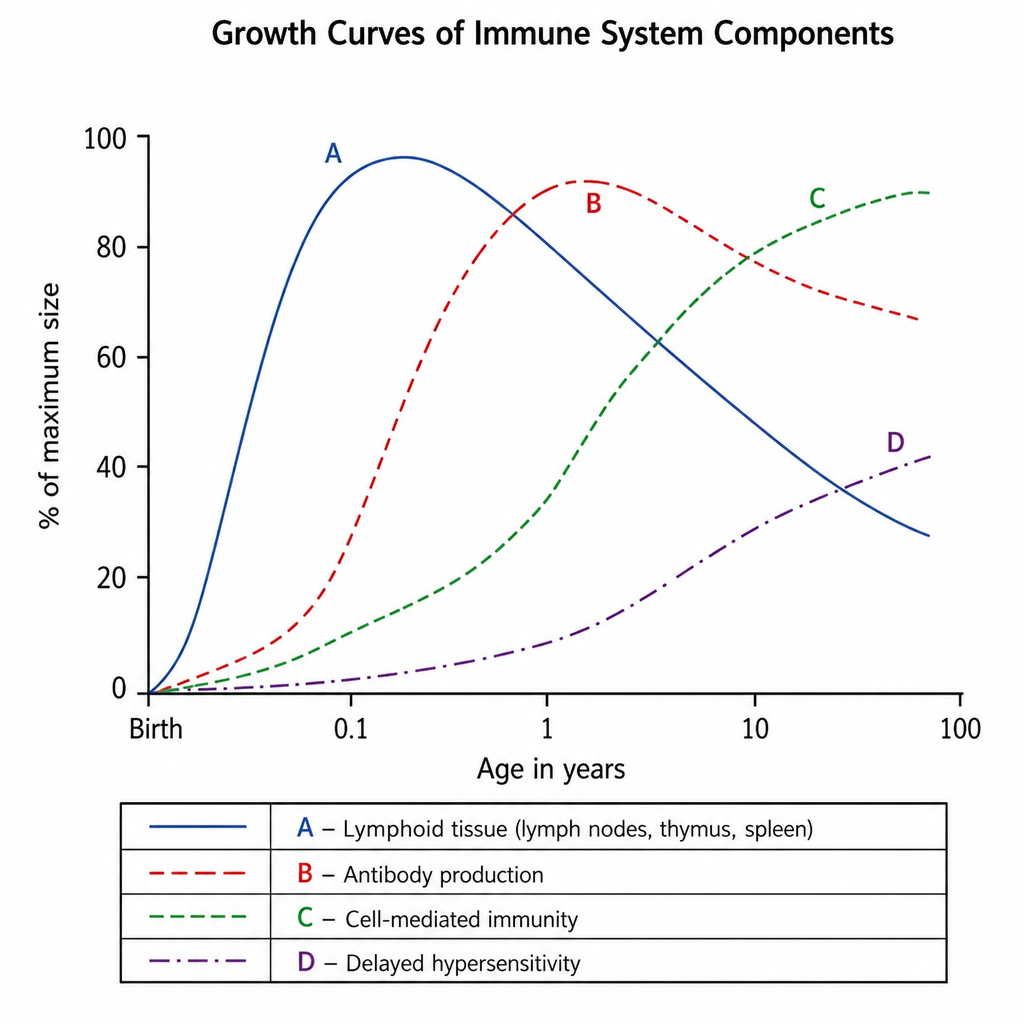
Which of the following is NOT true about the WHO growth chart?
A child can put three words together at what age?
An abnormal palmar crease is seen in all the following conditions EXCEPT:
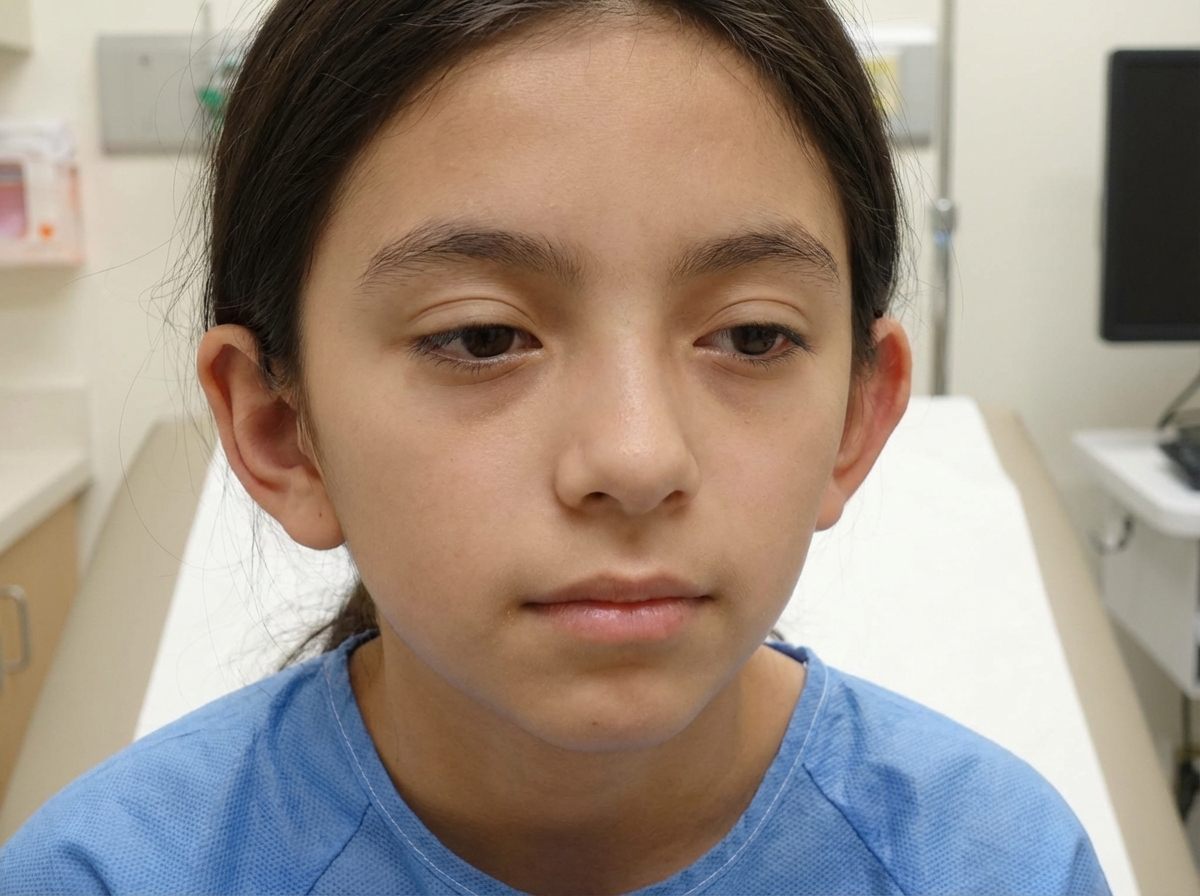
A 4-year-old baby is having a large face, large jaw, large ears, and macroorchidism. What is the diagnosis?
At what age is a child typically able to tell stories?
Closure of the anterior fontanelle is delayed in all of the following conditions except?
A 2-month-old infant presents for her first immunization. Physical examination reveals shivering and a body temperature of 39°C. The mother reports the infant is constantly crying, irritable, and refusing to feed. What is the most appropriate medical intervention in this case?
A 7-year-old child presents with ambiguous genitalia that has become more pronounced with age. Examination reveals normal height, weight, and blood pressure. The patient has bifid labia with two separate perineal openings, a phallic length of 2.5 cm, and no palpable gonads in the inguinal region. Ultrasound shows the presence of Mullerian structures. What is the most probable diagnosis?
Which of the following is NOT a characteristic of dyslexia?
At what age do most normal babies typically recognize their gender?
Explanation: The WHO Growth Charts are the international gold standard for monitoring child growth. In the context of the NEET-PG exam, it is crucial to distinguish between the **WHO Growth Standards (MGRS)** and the **IAP (Indian Academy of Pediatrics) charts.** ### **Explanation of the Correct Answer** **Option B is the correct answer (the "NOT true" statement)** because the standard WHO growth charts used globally and in India (under the National Health Mission) primarily display **Z-scores (Standard Deviation scores)** rather than percentiles. While percentile charts exist, the WHO recommends Z-scores because they are more sensitive for identifying extreme malnutrition (e.g., -3 SD for Severe Acute Malnutrition) and allow for precise tracking beyond the limits of percentiles. ### **Analysis of Incorrect Options** * **Option A:** True. Growth charts are the primary tool for longitudinal monitoring of physical growth and nutritional status, helping clinicians detect early signs of failure to thrive or obesity. * **Option C:** True. On standard percentile-based charts, the **97th percentile** is typically the highest line, while on WHO Z-score charts, the **+2 or +3 SD** lines are the upper limits. * **Option D:** True. By definition, the **Median** (the middle value) corresponds exactly to the **50th percentile** or the **0 Z-score**. ### **High-Yield NEET-PG Pearls** * **WHO MGRS Study:** Based on children from 6 countries (including India) raised in optimal environments (breastfed, non-smoking mothers). * **Standard Deviations to Remember:** * **Stunting:** Height-for-age < -2 SD. * **Wasting:** Weight-for-height < -2 SD. * **SAM (Severe Acute Malnutrition):** Weight-for-height < -3 SD or MUAC < 11.5 cm. * **IAP Growth Charts:** Revised in 2015 for Indian children (5–18 years) to account for the "Asian Indian Phenotype" and higher risk of obesity.
Explanation: **Explanation:** Language development follows a predictable chronological sequence in children. The ability to combine words into short phrases is a key milestone of the **24-month (2-year)** mark. **Why 24 months is correct:** At 2 years of age, a child typically has a vocabulary of about 50–200 words and begins to use **telegraphic speech**. This involves putting 2 to 3 words together to form simple sentences (e.g., "Want more milk" or "Daddy go car"). This stage signifies the transition from using single labels to expressing functional relationships. **Analysis of Incorrect Options:** * **18 months:** At this age, a child usually speaks about 10–20 words individually. They can follow simple single-step commands but do not yet combine words into phrases. * **36 months:** By 3 years, language becomes much more complex. A child can use 4–5 word sentences, knows their name/age/sex, and their speech is approximately 75% intelligible to strangers. * **48 months:** At 4 years, children use complex sentences, can tell stories, and their speech is almost completely intelligible. **High-Yield Clinical Pearls for NEET-PG:** * **Rule of Thumb for Sentences:** A child typically uses the same number of words in a sentence as their age in years (2 words at 2 years, 3 words at 3 years). * **Intelligibility Milestone:** 2 years = 50% understood by strangers; 3 years = 75%; 4 years = 100%. * **First Word:** Usually appears at 10–12 months. * **Red Flag:** If a child has no single words by 18 months or no 2-word phrases by 24 months, a developmental evaluation for hearing or autism spectrum disorder is indicated.
Explanation: **Explanation:** The presence of an abnormal palmar crease (most commonly a **Single Palmar Crease** or Simian Crease) is a physical marker of altered fetal development during the first trimester. It occurs when the hand does not flex normally during early gestation, often due to chromosomal or syndromic abnormalities. **Why LPAC Syndrome is the correct answer:** **LPAC Syndrome (Low Phospholipid Associated Cholestasis)** is a genetic biliary disorder characterized by the formation of cholesterol gallstones due to a mutation in the *ABCB4* gene. It is a metabolic/biochemical condition affecting the liver and gallbladder, typically manifesting in young adulthood. It is **not** a dysmorphic or chromosomal syndrome and, therefore, is not associated with palmar crease abnormalities. **Analysis of Incorrect Options:** * **Down Syndrome (Trisomy 21):** The most classic association. Approximately 45-50% of patients with Down syndrome exhibit a single transverse palmar crease. * **Fetal Alcohol Syndrome (FAS):** Prenatal alcohol exposure disrupts morphogenesis. Common findings include a single palmar crease (hockey-stick crease), smooth philtrum, and thin upper lip. * **Cri-du-chat Syndrome (5p deletion):** This chromosomal deletion presents with microcephaly, a cat-like cry, and dermatoglyphic abnormalities, including a single palmar crease. **NEET-PG High-Yield Pearls:** * **Single Palmar Crease** is also seen in Patau syndrome (Trisomy 13), Edward syndrome (Trisomy 18), and Noonan syndrome. * **Sydney Crease:** A variation where the proximal transverse crease extends to the ulnar border; often associated with Rubella embryopathy or Alzheimer’s. * **Clinodactyly:** (Incurving of the 5th finger) is another high-yield hand finding frequently co-existing with abnormal creases in Down syndrome.
Explanation: ### Explanation **Correct Option: D. Fragile X Syndrome** Fragile X Syndrome is the most common cause of inherited intellectual disability. It is caused by an **expansion of CGG trinucleotide repeats** in the *FMR1* gene on the X chromosome. The clinical presentation typically includes a characteristic triad of physical features: 1. **Facial Dysmorphism:** Long face, prominent forehead, large/everted ears, and a prominent jaw (prognathism). 2. **Macroorchidism:** Enlarged testes, which usually becomes more apparent post-puberty but can be seen in early childhood. 3. **Behavioral Issues:** Intellectual disability, ADHD, and features of Autism Spectrum Disorder. **Why other options are incorrect:** * **A. McCune-Albright Syndrome:** Characterized by the triad of polyostotic fibrous dysplasia, café-au-lait spots (Coast of Maine borders), and precocious puberty. It does not present with macroorchidism or the specific facial features mentioned. * **B. Down’s Syndrome (Trisomy 21):** Features include a flat facial profile, up-slanting palpebral fissures, Simian crease, and Brushfield spots. Testicular size is usually small or normal, not enlarged. * **C. Cri-du-chat Syndrome (5p deletion):** Characterized by a high-pitched "cat-like" cry, microcephaly, and a round (moon) face, which is the opposite of the long face seen in Fragile X. **High-Yield Clinical Pearls for NEET-PG:** * **Genetics:** X-linked Dominant inheritance with anticipation. * **Repeat Count:** Normal (<55), Premutation (55–200), Full Mutation (>200 repeats). * **Diagnosis:** PCR is used for screening; **Southern Blot analysis** is the gold standard to determine the degree of methylation and full mutation. * **Associated Findings:** Mitral Valve Prolapse (MVP) and joint hypermobility are common due to connective tissue involvement.
Explanation: **Explanation:** Language development follows a predictable sequence of milestones, progressing from simple sounds to complex narrative structures. By **4 years of age**, a child reaches a significant cognitive and linguistic milestone: the ability to **tell stories** and relate sequences of events. At this stage, their vocabulary expands to approximately 1,500 words, and they can use sentences of 4–5 words, allowing them to describe experiences and engage in imaginative play. **Analysis of Options:** * **1 year (Incorrect):** At this age, a child typically speaks only **1–3 clear words** with meaning (e.g., "Mama," "Dada"). They follow simple one-step commands but lack the syntax for storytelling. * **2 years (Incorrect):** A 2-year-old uses **2-word phrases** (telegraphic speech, e.g., "Want milk"). Their vocabulary is around 50–200 words, but they cannot yet link sentences into a narrative. * **3 years (Incorrect):** While a 3-year-old can speak in 3-word sentences and give their name/age/sex, their language is primarily functional. They can ask questions but generally lack the narrative complexity required to "tell a story." * **4 years (Correct):** This is the milestone for **storytelling**, using past tense, and identifying colors. **High-Yield Clinical Pearls for NEET-PG:** * **Rule of 4s:** At 4 years, a child speaks in 4-word sentences, tells stories, can draw a **square**, and is 100% intelligible to strangers. * **Speech Intelligibility:** 2 years (50%), 3 years (75%), 4 years (100%). * **Vocabulary Growth:** 1 year (1-3 words), 2 years (200 words), 3 years (900 words), 4 years (1,500 words). * **Red Flag:** If a child is not using single words by 18 months or 2-word phrases by 2 years, a developmental evaluation is mandatory.
Explanation: The **anterior fontanelle** typically closes between **9 to 18 months** of age. Delayed closure is a significant clinical marker for various skeletal, endocrine, and genetic disorders. ### **Why Hypogonadism is the Correct Answer** **Hypogonadism** does not cause delayed closure of the anterior fontanelle. In fact, it is **Hypothyroidism** (cretinism) that is a classic endocrine cause of delayed closure. Hypogonadism typically affects bone maturation and epiphyseal fusion during puberty, rather than the cranial sutures in infancy. ### **Explanation of Incorrect Options (Causes of Delayed Closure)** * **Down’s Syndrome:** Chromosomal anomalies often present with delayed ossification and large fontanelles. * **Osteogenesis Imperfecta:** This connective tissue disorder leads to defective bone formation and "wormian bones," resulting in a persistently open anterior fontanelle. * **Hypothyroidism:** Thyroid hormone is essential for linear bone growth and maturation of the skeleton. Deficiency leads to significantly delayed bone age and fontanelle closure. ### **High-Yield Clinical Pearls for NEET-PG** * **Early Closure (Craniosynostosis):** Closure before 3 months. Most common cause is primary craniosynostosis; also seen in microcephaly and hyperthyroidism. * **Delayed Closure Mnemonic (DR. SHIP):** * **D:** Down’s syndrome * **R:** Rickets (Most common cause) * **S:** Syphilis (Congenital) * **H:** Hypothyroidism / Hydrocephalus * **I:** Increased Intracranial Pressure * **P:** Pyknodysostosis / Preterm birth * **Achondroplasia:** Another high-yield cause of delayed closure and a large head circumference. * **Bulging Fontanelle:** Indicates raised ICP (Meningitis, Hydrocephalus, Vitamin A toxicity). * **Depressed Fontanelle:** A classic sign of significant dehydration.
Explanation: ### Explanation **Correct Option: A. Delay immunization; return in 2-3 days** The core principle in pediatric immunization is that **moderate to severe acute illness** (with or without fever) is a valid precaution/contraindication for vaccination. In this case, the infant presents with a high-grade fever (39°C), shivering, irritability, and poor feeding—signs suggestive of a significant underlying infection or systemic illness. Immunization should be deferred in such cases for two primary reasons: 1. **Diagnostic Clarity:** Post-vaccination side effects (fever, fussiness) could mask or be confused with the progression of the current acute illness. 2. **Patient Safety:** An infant refusing to feed and showing systemic signs requires immediate clinical evaluation and stabilization rather than the added physiological stress of an immune challenge. Once the acute phase resolves (usually 2–3 days), the child can be vaccinated. **Analysis of Incorrect Options:** * **Option B:** Minor illnesses (e.g., mild URI, low-grade fever <38.5°C, or mild diarrhea) are **not** contraindications. However, this infant’s symptoms are severe, making immediate administration inappropriate. * **Option C:** There is no clinical rationale for spacing out routine primary immunizations by one week; they are designed to be given simultaneously for maximum efficacy and compliance. * **Option D:** Postponing for 6 months is excessive and leaves the infant vulnerable to vaccine-preventable diseases (VPDs) during a high-risk period. **Clinical Pearls for NEET-PG:** * **True Contraindications:** Anaphylaxis to a previous dose/component and encephalopathy within 7 days of a previous pertussis vaccine. * **False Contraindications (Safe to Vaccinate):** Mild fever, malnutrition, breastfeeding, family history of seizures, or being on stable antibiotic therapy. * **Live Vaccines:** Should be avoided in severely immunocompromised children or those on high-dose systemic steroids.
Explanation: ### Explanation The clinical presentation describes a **46,XX female with virilization** (ambiguous genitalia) due to Congenital Adrenal Hyperplasia (CAH). **1. Why Simple Virilizing CAH is correct:** The presence of **Mullerian structures** (uterus, fallopian tubes) on ultrasound confirms the patient is genetically female (46,XX). The ambiguous genitalia (phallic enlargement, bifid labia) indicate exposure to high levels of androgens in utero. In **Simple Virilizing 21-Hydroxylase deficiency**, there is enough enzyme activity to produce aldosterone and cortisol to prevent a salt-wasting crisis, explaining the **normal blood pressure** and lack of acute illness, but insufficient activity to prevent the shunting of precursors toward androgen synthesis. **2. Why other options are incorrect:** * **Classic Salt-Wasting CAH:** This typically presents in the first 2–3 weeks of life with a life-threatening adrenal crisis (hyponatremia, hyperkalemia, hypotension). This child is 7 years old and hemodynamically stable. * **Complete Androgen Insensitivity Syndrome (CAIS):** These individuals are 46,XY and appear phenotypically female. They lack Mullerian structures (no uterus) because Anti-Mullerian Hormone (AMH) is produced by the testes. * **5-Alpha Reductase Deficiency:** This affects 46,XY males. While they have ambiguous genitalia, they **lack Mullerian structures** because their testes produce AMH normally. **3. High-Yield Clinical Pearls for NEET-PG:** * **Most common cause of ambiguous genitalia** in a newborn: 21-Hydroxylase deficiency. * **Mullerian structures present:** Think 46,XX (Female Pseudohermaphroditism). * **Mullerian structures absent:** Think 46,XY (Male Pseudohermaphroditism). * **Prader Staging:** Used to describe the degree of virilization in female infants with CAH. * **Key Diagnostic Marker:** Elevated **17-hydroxyprogesterone (17-OHP)** levels.
Explanation: **Explanation:** **Dyslexia** is a specific learning disability characterized by difficulties with accurate and/or fluent word recognition and by poor spelling and decoding abilities. **Why Option A is the correct answer:** The hallmark of dyslexia is that the reading difficulty is **unexpected** in relation to the individual's chronological age and **intellectual ability**. By definition, children with dyslexia have a **normal or even superior Intelligence Quotient (IQ)**. Therefore, mental retardation (Intellectual Disability) is not a characteristic of dyslexia; in fact, an IQ below 70 would generally preclude a primary diagnosis of dyslexia, as the learning struggle would be attributed to global cognitive impairment rather than a specific learning disorder. **Analysis of Incorrect Options:** * **Option B (Inability to interpret written language):** This is a core feature. Dyslexics struggle with phonological processing, making it difficult to bridge the gap between spoken and written symbols. * **Option C (Familial tendency):** Dyslexia has a strong genetic component. Approximately 30-50% of children with an affected parent will also have the condition. * **Option D (Reading retardation):** This is a clinical synonym for the primary symptom of dyslexia, where reading achievement is significantly below the expected level for the child's age and schooling. **NEET-PG High-Yield Pearls:** * **Most common** type of Learning Disability (LD). * **Gender:** More common in boys. * **Clinical Sign:** "Mirror writing" or letter reversals (e.g., confusing 'b' and 'd') are common but not pathognomonic. * **Associated Condition:** High comorbidity with **ADHD**. * **Management:** Multisensory educational interventions (e.g., Orton-Gillingham approach); it is not treated with medication.
Explanation: **Explanation:** The development of gender identity is a progressive cognitive milestone in early childhood. By the age of **3 years**, most children can accurately identify themselves as a boy or a girl. This is the age where they achieve **gender labeling**, recognizing that they belong to a specific category based on physical appearance and societal labels. **Why 3 years is correct:** According to developmental milestones (e.g., Nelson Textbook of Pediatrics), a 3-year-old child has developed sufficient cognitive and language skills to categorize themselves and others by gender. While they recognize their gender, they do not yet understand that it is a permanent trait (gender constancy). **Analysis of Incorrect Options:** * **1 year:** At this age, infants are developing social smiles and stranger anxiety. They cannot distinguish gender categories. * **2 years:** Children begin to notice physical differences between sexes and can point to pictures of "moms" or "dads," but they lack a stable internal sense of their own gender identity. * **4 years:** By this age, gender identity is well-established, and children begin to adopt gender-role behaviors (stereotypes). Waiting until 4 years would be considered a late milestone for basic recognition. **High-Yield Clinical Pearls for NEET-PG:** * **Gender Identity:** Established by **3 years**. * **Gender Stability:** Realizing gender stays the same over time (occurs by **4–5 years**). * **Gender Constancy:** Realizing gender remains the same despite changes in hair length or clothing (occurs by **6–7 years**). * **Parallel Play:** A characteristic social milestone of a **2-year-old**. * **Cooperative Play:** A characteristic social milestone of a **4-year-old**.
Normal Growth Parameters
Practice Questions
Developmental Milestones
Practice Questions
Puberty and Adolescent Development
Practice Questions
Growth Disorders
Practice Questions
Failure to Thrive
Practice Questions
Developmental Screening and Assessment
Practice Questions
Developmental Delays
Practice Questions
Growth Charts and Monitoring
Practice Questions
Short Stature
Practice Questions
Tall Stature
Practice Questions
Precocious and Delayed Puberty
Practice Questions
Psychosocial Development
Practice Questions
Get full access to all questions, explanations, and performance tracking.
Start For Free