This milestone develops at the age of ________?

Enamel hypocalcification and hypomaturation of the tooth is seen in which of the following conditions?
The weight of a child at 3 years is usually how many times the birth weight?
What is the typical vocabulary of a 2-year-old child?
A normal-born child presents with mental retardation, blond hair, and convulsions at 1 year of age. What is the most probable diagnosis?
A patient presents with growth retardation, delayed milestones, and kinky hair. What is the most likely diagnosis?
A normal healthy child has a height of 100 cm and weight of 16 kg. What is his most likely age?
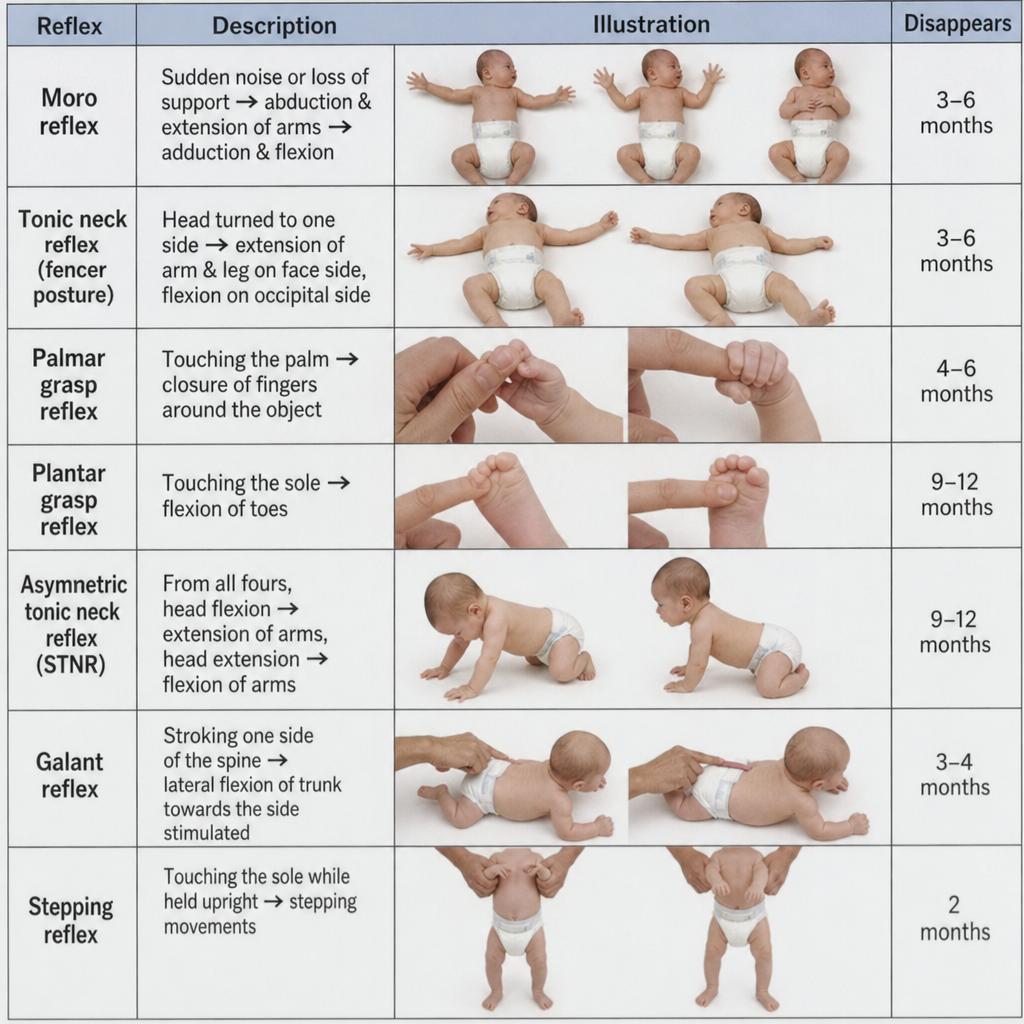
Which of the following developmental reflexes does NOT disappear in a child?
The characteristic facies of which of the following conditions may resemble that of Down syndrome?
What is the upper segment to lower segment ratio in a 3-year-old child?
Explanation: ***4 months*** - By 4 months, infants achieve **head control** in sitting position and can perform **prone head-chest lift** (lifting head and chest while lying on stomach). - This is also when babies typically begin **rolling over** from prone to supine, marking significant **gross motor development**. *2 months* - At 2 months, infants demonstrate **social smile** and begin to **follow objects** with their eyes. - **Head lag** is still present when pulled to sit, indicating insufficient **neck muscle strength** for full head control. *3 months* - By 3 months, babies show **decreased head lag** and can **lift head briefly** when prone, but not sustained head-chest lift. - Other milestones include **hand regard** and beginning to **bat at objects**, but full head control is not yet achieved. *5 months* - At 5 months, infants can **roll from supine to prone** and demonstrate **voluntary grasp** without thumb involvement. - They also begin **transferring objects** between hands and show increased **trunk stability**, which are more advanced than basic head control.
Explanation: **Explanation:** The correct answer is **Tricho-dento-osseous (TDO) syndrome**. This is an autosomal dominant multisystem disorder characterized by the triad of hair abnormalities (kinky/curly hair at birth), bone defects (increased bone density), and dental defects. The hallmark dental finding in TDO syndrome is **Amelogenesis Imperfecta (Type IV)**, which manifests as generalized enamel hypocalcification and hypomaturation, often associated with **taurodontism** (enlarged pulp chambers). **Analysis of Options:** * **Osteogenesis Imperfecta (OI):** While OI is a connective tissue disorder involving Type I collagen, its primary dental manifestation is **Dentinogenesis Imperfecta**, not enamel defects. The enamel is usually normal but flakes off because the underlying dentin is poorly formed. * **Dentinogenesis Imperfecta:** As the name suggests, this is a hereditary defect of **dentin** formation. While the teeth may appear translucent or discolored, the primary pathology lies in the dentin, leading to obliterated pulp chambers and weak support for the enamel. * **Turner Tooth:** This refers to localized enamel hypoplasia of a single permanent tooth, usually caused by periapical infection or trauma to the preceding primary tooth. It is an acquired, focal defect rather than a generalized syndrome-based hypomaturation. **High-Yield Clinical Pearls for NEET-PG:** * **Taurodontism** is a "bull-like" tooth with an elongated body and low furcation; it is a key radiographic feature of TDO syndrome. * **Amelogenesis Imperfecta** affects only enamel; **Dentinogenesis Imperfecta** affects only dentin. * In **Osteogenesis Imperfecta**, look for the clinical triad: Blue sclera, fragile bones (fractures), and early-onset hearing loss.
Explanation: **Explanation:** The weight of a child follows a predictable pattern of multiplication based on the birth weight. This is a high-yield topic for NEET-PG as it forms the basis of assessing physical growth. **Why Option C (5 times) is correct:** In a healthy, term infant, weight gain follows these standard milestones: * **Doubles** by 5 months. * **Triples** by 1 year. * **Quadruples** by 2 years. * **Quintuples (5 times)** by **3 years**. * **Sextuples (6 times)** by 5 years. * **Septuples (7 times)** by 7 years. * **Ten times** by 10 years. **Analysis of Incorrect Options:** * **Option A (3 times):** This occurs at **1 year** of age. * **Option B (4 times):** This occurs at **2 years** of age. * **Option D (7 times):** This occurs at **7 years** of age. **High-Yield Clinical Pearls for NEET-PG:** 1. **Initial Weight Loss:** Newborns normally lose **5–10%** of their birth weight in the first week of life due to the excretion of excess extravascular fluid and low intake. They typically regain their birth weight by **day 10–14**. 2. **Daily Weight Gain:** In the first 3 months, an infant gains approximately **25–30 g/day**. This slows to about 400 g/month by the end of the first year. 3. **Formula for Weight Estimation (Weech’s Formula):** * 3–12 months: (Age in months + 9) / 2 * 1–6 years: (Age in years × 2) + 8 * 7–12 years: [(Age in years × 7) – 5] / 2 4. **Average Birth Weight:** In the Indian context, the average birth weight is approximately **2.5–3 kg**.
Explanation: **Explanation:** Language development is a critical milestone in pediatrics, often tested in the NEET-PG exam. By the age of **2 years (24 months)**, a child typically reaches a vocabulary of approximately **50 to 100 words**. In standard pediatric textbooks (like Ghai Pediatrics), the milestone for a 2-year-old is defined by the ability to join 2–3 words into short phrases (telegraphic speech) and a vocabulary of at least 50–100 words. **Analysis of Options:** * **A (20 words):** This is more characteristic of a child aged **15–18 months**. At 15 months, a child usually speaks 4–6 words; by 18 months, they have about 10–20 words. * **B (50 words):** While 50 words is the *minimum* threshold for a 2-year-old, **100 words** is the more commonly accepted upper-average milestone for this age group in competitive exams. * **C (100 words):** **Correct.** This represents the typical vocabulary size at 24 months. At this stage, the child also begins using pronouns like "I," "Me," and "You." * **D (200 words):** This is an overestimate for a typical 2-year-old and is closer to the vocabulary expected at **2.5 to 3 years** of age. **High-Yield Clinical Pearls for NEET-PG:** * **1 year:** Says 1–3 words with meaning (e.g., "Mama", "Dada"). * **2 years:** 50–100 words; uses 2-word phrases; 50% of speech is intelligible to strangers. * **3 years:** ~900 words; uses 3-word sentences; 75% of speech is intelligible. * **4 years:** ~1500 words; tells stories; 100% of speech is intelligible. * **Red Flag:** If a child has no single words by 18 months or no 2-word phrases by 24 months, a developmental evaluation is mandatory.
Explanation: ### Explanation **Phenylketonuria (PKU)** is an autosomal recessive disorder caused by a deficiency of the enzyme **phenylalanine hydroxylase (PAH)**. This deficiency leads to the accumulation of phenylalanine in the blood and brain. **Why Option B is Correct:** The clinical triad described is classic for untreated PKU: * **Mental Retardation:** High levels of phenylalanine are neurotoxic, leading to severe intellectual disability if not managed early. * **Blond Hair/Fair Skin:** Phenylalanine is a precursor to tyrosine, which is essential for **melanin** synthesis. A block in this pathway leads to hypopigmentation (blond hair, blue eyes). * **Convulsions:** Neurological irritability and seizures are common due to neurotransmitter imbalances. * **Mousy Odor:** (Often mentioned in exams) Due to the excretion of phenylacetic acid in sweat and urine. **Why Other Options are Incorrect:** * **A. Albuminuria:** This refers to protein in the urine, typically associated with renal pathology (e.g., Nephrotic syndrome), not developmental delay or pigmentary changes. * **C. Gaucher’s Disease:** A lysosomal storage disorder characterized by hepatosplenomegaly, bone pain, and "Gaucher cells" on biopsy. It does not typically cause blond hair. * **D. Tyrosinemia:** While it involves the same metabolic pathway, Type I presents primarily with **liver failure**, renal tubular dysfunction (Fanconi syndrome), and a "boiled cabbage" odor. **High-Yield Clinical Pearls for NEET-PG:** * **Screening:** Done via the **Guthrie Test** (bacterial inhibition assay). * **Diagnosis:** Confirmed by plasma phenylalanine levels >20 mg/dL. * **Management:** Lifelong restriction of phenylalanine; supplementation with **Tyrosine** (which becomes an essential amino acid in these patients). * **Maternal PKU:** If a mother with PKU doesn't control her diet during pregnancy, the fetus may suffer from microcephaly, CHD, and growth retardation.
Explanation: ### Explanation **Correct Answer: A. Menke’s Disease** Menke’s disease (also known as Menkes Kinky Hair Syndrome) is an **X-linked recessive** disorder caused by a mutation in the **ATP7A gene**. This mutation leads to defective copper transport and absorption, resulting in systemic copper deficiency. * **Clinical Triad:** The classic presentation includes **growth retardation**, **progressive neurological deterioration** (delayed milestones and seizures), and characteristic **"kinky" or "steely" hair** (pili torti). * **Pathophysiology:** Copper is a vital cofactor for enzymes like *lysyl oxidase* (cross-linking of collagen/elastin) and *tyrosinase* (melanin synthesis). Deficiency leads to connective tissue defects, brittle hair, and depigmentation. **Why the other options are incorrect:** * **B. Trisomy 21 (Down Syndrome):** While it presents with growth retardation and delayed milestones, the characteristic features are almond-shaped eyes, flat nasal bridge, Simian crease, and hypotonia, rather than kinky hair. * **C. Lesch-Nyhan Syndrome:** This is an X-linked disorder of purine metabolism (HGPRT deficiency). It is characterized by **self-mutilation**, choreoathetosis, and hyperuricemia (orange sand in diapers), not hair abnormalities. * **D. Wilson Disease:** This involves a mutation in the **ATP7B gene**, leading to copper **overload** (toxicity). It typically presents in older children or adolescents with hepatic failure, Kayser-Fleischer (KF) rings, and basal ganglia symptoms. **NEET-PG High-Yield Pearls:** * **Gene involved:** ATP7A (Menkes - "A"bsorption defect) vs. ATP7B (Wilson - "B"iliary excretion defect). * **Microscopy of hair:** Shows **Pili torti** (hair twisted 180° on its axis). * **Biochemical markers:** Low serum copper and low serum ceruloplasmin. * **Radiology:** May show "wormian bones" in the skull and metaphyseal spurring.
Explanation: This question tests the knowledge of standard anthropometric milestones in pediatric growth. For NEET-PG, remembering the "doubling" and "average" rules for height and weight is high-yield. ### **Explanation** The correct answer is **4 years** based on the following standard growth parameters: 1. **Height:** A child’s birth length is approximately 50 cm. It increases by 25 cm in the 1st year, 12 cm in the 2nd year, and roughly 7–9 cm in the 3rd and 4th years. A key milestone is that **height doubles (reaches 100 cm) at 4 years of age.** 2. **Weight:** The average birth weight is 3 kg. It doubles at 5 months, triples at 1 year, and **quadruples at 2 years.** For children aged 2–6 years, the formula **(Age + 4) × 2** can be used. For a 4-year-old: (4 + 4) × 2 = 16 kg. ### **Analysis of Options** * **A. 3 years:** Average height is ~90–95 cm; average weight is ~14 kg. * **C. 5 years:** Average height is ~107–110 cm; average weight is ~18 kg. * **D. 6 years:** Average height is ~115 cm; weight is ~20 kg. ### **Clinical Pearls for NEET-PG** * **Height Milestones:** * Birth: 50 cm * 1 Year: 75 cm * **4 Years: 100 cm (Doubles)** * 13 Years: 150 cm (Triples) * **Weight Formulas:** * 3–12 months: (Age in months + 9) / 2 * 1–6 years: (Age in years × 2) + 8 * 7–12 years: [ (Age in years × 7) – 5 ] / 2 * **Head Circumference:** 35 cm at birth; equals chest circumference at **1 year**.
Explanation: **Explanation:** Developmental reflexes are categorized into **Primitive Reflexes** (present at birth and disappear as the CNS matures) and **Postural Reflexes** (appear later and persist throughout life to maintain balance and protection). **Correct Answer: D. Parachute Reflex** The Parachute reflex is a protective postural response. It appears at approximately **6–9 months** of age and is the only reflex among the options that **persists for life**. It is elicited by suddenly tilting the infant forward; the child extends their arms as a defensive mechanism to break a fall. Its absence after 9 months can indicate a delay in motor development or neurological impairment. **Incorrect Options:** * **A. Landau Reflex:** This is a postural reflex that appears at 3 months and typically **disappears by 12–24 months**. It is characterized by the infant extending their head and legs when held in a prone position (the "superman" pose). * **B. Palmar Grasp:** A primitive reflex present at birth. It **disappears by 2–3 months** as voluntary grasping begins. Persistence beyond this age suggests cerebral palsy. * **C. Tonic Neck Reflex (Asymmetric):** Often called the "fencing posture," it appears at birth and **disappears by 4–6 months**. Persistence interferes with the infant’s ability to roll over or bring hands to the midline. **High-Yield Clinical Pearls for NEET-PG:** * **Sequence of disappearance:** Palmar grasp (2-3m) → Moro (3-6m) → ATNR (4-6m). * **Babinski Reflex:** Unlike adults, a positive Babinski (upgoing toe) is normal in infants and may persist up to **12–24 months** due to incomplete myelination of the corticospinal tract. * **Clinical Significance:** The reappearance of primitive reflexes in an adult (e.g., Snout, Suck, or Grasp) is pathological and indicates **Frontal Lobe** damage.
Explanation: **Explanation:** **Zellweger Syndrome (Cerebrohepatorenal Syndrome)** is the most severe form of the Peroxisomal Biogenesis Disorders (PBD). It is the correct answer because its craniofacial features strikingly mimic those of Down syndrome (Trisomy 21). **Why Zellweger syndrome is correct:** Infants with Zellweger syndrome present with a characteristic "Down-like" facies due to a combination of: * **Severe hypotonia** (the most prominent feature). * **Flattened face and broad nasal bridge.** * **High forehead and large anterior fontanelle.** * **Up-slanting palpebral fissures** and epicanthal folds. Additionally, these patients exhibit profound neurological impairment, seizures, hepatomegaly, and cortical renal cysts. **Why other options are incorrect:** * **Infantile Refsum disease & Neonatal adrenoleukodystrophy:** These are also PBDs but represent a milder spectrum. While they share some biochemical defects, they do not typically present with the classic, severe dysmorphism that mimics Down syndrome as seen in Zellweger. * **Rhizomelic chondrodysplasia punctata:** This is a peroxisomal disorder characterized primarily by proximal limb shortening (rhizomelia), cataracts, and ichthyosis, rather than Down-like facial features. **High-Yield Clinical Pearls for NEET-PG:** * **Biochemical Marker:** Elevated levels of **Very Long Chain Fatty Acids (VLCFA)** in plasma are diagnostic for PBDs. * **Radiology:** Look for **stippled epiphyses** (chondrodysplasia punctata) on X-rays, which can be seen in Zellweger syndrome. * **Organelle:** The underlying defect is the failure to import proteins into **peroxisomes** due to mutations in *PEX* genes. * **Prognosis:** Zellweger syndrome is usually fatal within the first year of life.
Explanation: **Explanation:** The **Upper Segment to Lower Segment (US:LS) ratio** is a critical anthropometric measurement used to assess skeletal proportions and identify growth disorders. The ratio changes predictably as a child grows because the limbs (lower segment) grow faster than the trunk (upper segment). * **At Birth:** The ratio is approximately **1.7:1**, as the head and trunk are relatively large compared to the legs. * **At 3 Years:** The ratio decreases to **1.3:1**. * **At 7–10 Years:** The ratio reaches **1:1** (the "symphysis pubis" becomes the midpoint). * **Adulthood:** The ratio remains roughly **0.9:1**. **Analysis of Options:** * **Option B (1.3) is Correct:** This is the physiological norm for a 3-year-old child. * **Option A (1.2):** This ratio is typically seen around **4–5 years** of age. * **Option C (1.4):** This ratio is characteristic of a child around **1–2 years** of age. * **Option D (1.6):** This ratio is seen in **infancy** (shortly after birth). **High-Yield Clinical Pearls for NEET-PG:** 1. **Measurement:** The lower segment (LS) is measured from the top of the symphysis pubis to the floor. The upper segment (US) is calculated as: *Total Height minus LS*. 2. **Increased US:LS Ratio (Delayed maturation):** Seen in **Hypothyroidism** (most common cause of disproportionate short stature) and **Achondroplasia**. 3. **Decreased US:LS Ratio (Longer limbs):** Seen in **Marfan Syndrome**, Homocystinuria, and Klinefelter Syndrome. 4. **Rule of Thumb:** If the ratio is significantly higher than expected for age, think of conditions that affect bone mineralization or epiphyseal growth.
Normal Growth Parameters
Practice Questions
Developmental Milestones
Practice Questions
Puberty and Adolescent Development
Practice Questions
Growth Disorders
Practice Questions
Failure to Thrive
Practice Questions
Developmental Screening and Assessment
Practice Questions
Developmental Delays
Practice Questions
Growth Charts and Monitoring
Practice Questions
Short Stature
Practice Questions
Tall Stature
Practice Questions
Precocious and Delayed Puberty
Practice Questions
Psychosocial Development
Practice Questions
Get full access to all questions, explanations, and performance tracking.
Start For Free