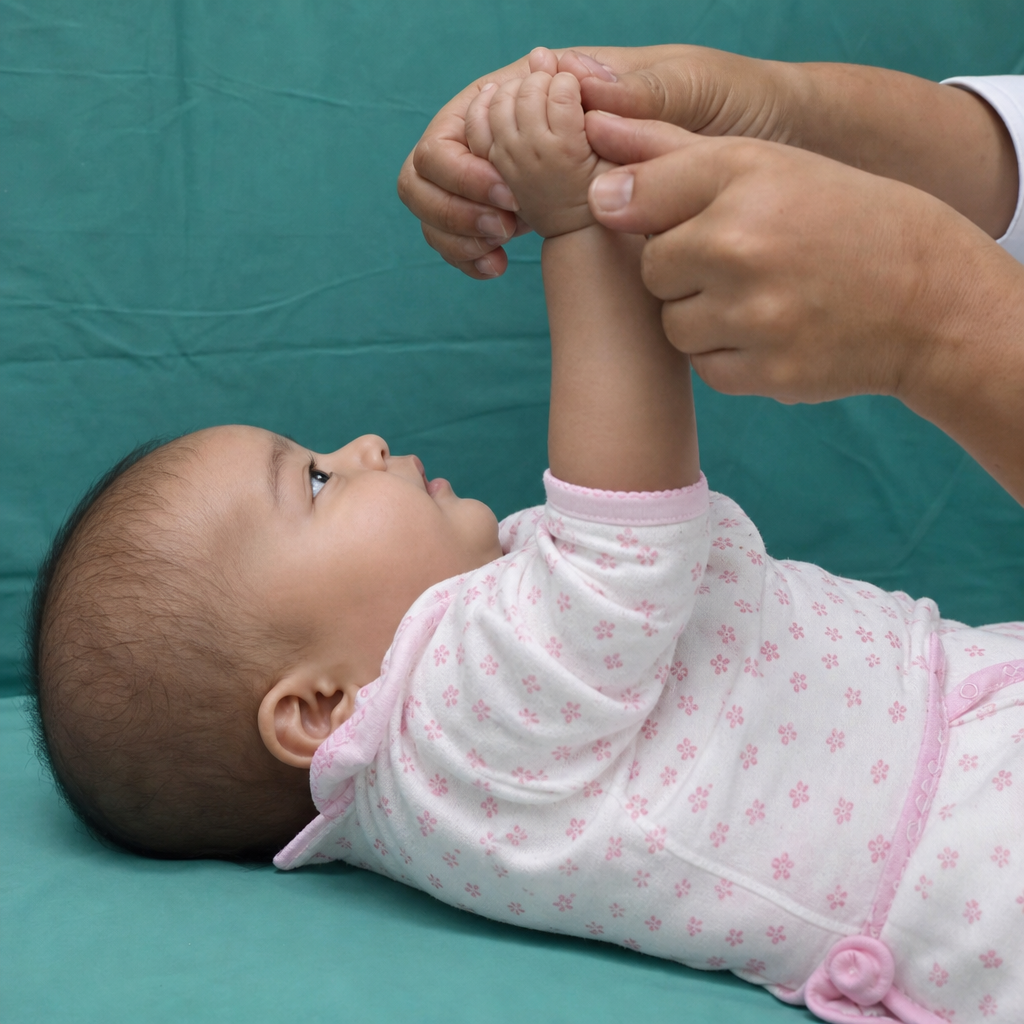
What is the most likely diagnosis in a neonate with multiple, healed fractures of long bones?
What is the normal gain in length for a full-term baby during the first 6 months of life?
A child exhibits growth variation that is normal, but bone development does not align with chronological age. What is the diagnosis?
Wind Swept deformity is seen in which of the following conditions?
What is the most common genetic cause of mental retardation?
A child presents with a broad nose, anteverted nostrils, clinodactyly of the 5th finger, and a shawl scrotum. The child is also noted to be short for his age. What is the most probable diagnosis?
Moro's reflex is considered abnormal if present after which age?
Which of the following complaints would NOT require admission for a one-year-old child?
What developmental milestone can a 10-month-old child typically NOT perform?
Physical examination of an infant delivered to a 42-year-old, gravida 3, para 2, woman, is remarkable for slight hypotonia and a poor Moro reflex. Further examination reveals upslanting palpebral fissures, epicanthal folds, excess nuchal skin, an enlarged tongue, clinodactyly of the fifth fingers, and a single transverse palmar crease. Which of the following is the most likely diagnosis?
Explanation: **Explanation:** **1. Why Osteogenesis Imperfecta (OI) is correct:** Osteogenesis Imperfecta, also known as "Brittle Bone Disease," is a genetic disorder primarily caused by mutations in the **COL1A1 and COL1A2 genes**, leading to defective **Type 1 Collagen** synthesis. In its most severe forms (specifically **Type II**, which is autosomal dominant/new mutation), the fragility is so extreme that fractures occur **in utero**. Finding multiple fractures in various stages of healing (including callus formation) in a neonate is a hallmark of OI. **2. Why the other options are incorrect:** * **Osteomalacia:** This refers to the softening of bones due to Vitamin D deficiency in adults (after epiphyseal closure). It does not present with congenital fractures in neonates. * **Osteopetrosis:** Also known as "Marble Bone Disease," this involves defective osteoclast function leading to excessively dense but brittle bones. While fractures can occur, they typically manifest later in infancy or childhood, and the classic radiological finding is increased bone density (Erlenmeyer flask deformity), not multiple healed fractures at birth. * **Congenital Rickets:** While maternal Vitamin D deficiency can cause neonatal rickets, it typically presents with hypocalcemia or craniotabes. It rarely causes multiple intrauterine fractures compared to the structural defect of OI. **3. NEET-PG High-Yield Pearls:** * **Blue Sclera:** A classic sign due to the thinning of collagen, allowing the underlying choroidal veins to show through (most common in Type I). * **Dentogenesis Imperfecta:** Opalescent teeth are a common association. * **Hearing Loss:** Conductive hearing loss due to otosclerosis is common in early adulthood. * **Radiology:** Look for "Wormian bones" (extra sutural bones in the skull) and "Codfish vertebrae" (biconcave vertebrae). * **Treatment:** Bisphosphonates (e.g., Pamidronate) are used to increase bone mineral density and reduce fracture rates.
Explanation: ### Explanation **1. Why Option C is Correct:** The growth in length of an infant follows a predictable, decelerating pattern during the first year of life. On average, a full-term baby is born with a length of **50 cm**. During the first year, the total increase in length is approximately **25 cm**. This growth is distributed as follows: * **0–3 months:** 3 cm/month (Total: 9 cm) * **3–6 months:** 2 cm/month (Total: 6 cm) * **6–12 months:** 1.25 cm/month (Total: 7.5–10 cm) Therefore, the total gain in the **first 6 months** is approximately **15 cm** (9 cm + 6 cm). **2. Why Other Options are Incorrect:** * **Option A (6 cm):** This represents the growth specifically between months 3 and 6, not the cumulative gain from birth. * **Option B (9 cm):** This represents the growth specifically during the first 3 months of life. * **Option D (24 cm):** This is close to the total growth expected for the **entire first year** (approx. 25 cm), rather than just the first 6 months. **3. High-Yield Clinical Pearls for NEET-PG:** * **Average Lengths:** Birth (50 cm), 1 year (75 cm), 2 years (87–90 cm), 4 years (100 cm). * **Doubling/Tripling:** Length doubles at **4 years** (100 cm) and triples at **12–13 years** (150 cm). * **Formula for Height (2–12 years):** (Age in years × 6) + 77 cm. * **Measurement:** Use an **infantometer** for children <2 years (recumbent length) and a **stadiometer** for children >2 years (standing height). Length is typically 1–2 cm greater than height.
Explanation: **Explanation:** The correct answer is **Constitutional Delay of Growth and Puberty (CDGP)**. This is a common variation of normal growth where a child is a "late bloomer." 1. **Why Constitutional Delay is correct:** In CDGP, the child’s **Bone Age is significantly delayed** compared to their **Chronological Age**. These children typically have a normal growth velocity but follow a lower percentile curve. The hallmark of this condition is that puberty is delayed, but once it begins, the child undergoes a catch-up growth spurt, eventually reaching a **normal final adult height** consistent with their mid-parental height. 2. **Why the other options are incorrect:** * **Familial Short Stature (FSS):** In FSS, the child is genetically programmed to be short. Crucially, the **Bone Age equals the Chronological Age**. The child grows at a normal velocity but stays on a lower percentile, reaching a final height that is short but appropriate for the family. * **Genetic/Dwarfism:** These terms usually refer to pathological conditions (like Achondroplasia or Growth Hormone Deficiency). In these cases, growth velocity is typically abnormal (subnormal), and there are often dysmorphic features or disproportionate limb lengths, unlike the "normal variation" described in the question. **High-Yield Clinical Pearls for NEET-PG:** * **CDGP:** Bone Age < Chronological Age; Final height is **Normal**. * **FSS:** Bone Age = Chronological Age; Final height is **Short**. * **Growth Velocity:** This is the most sensitive indicator of growth. If growth velocity is normal, the cause is likely a normal variant (CDGP or FSS). * **Formula for Mid-Parental Height:** * Boys: [Father's height + Mother's height + 13cm] / 2 * Girls: [Father's height + Mother's height - 13cm] / 2
Explanation: **Explanation:** **Wind-swept deformity** is a clinical finding where both knees are deviated in the same direction—one knee exhibits **genu valgum** (knock-knee) while the other exhibits **genu varum** (bow-leg). **Why Rheumatoid Arthritis (RA) is the correct answer:** In the context of adult orthopedics and rheumatology, wind-swept deformity is a classic late-stage manifestation of **Rheumatoid Arthritis**. It occurs due to asymmetrical joint destruction, ligamentous laxity, and muscle imbalances, leading to the characteristic lateral deviation of both knees. While it can also be seen in Osteoarthritis, it is a high-yield association for RA in competitive exams. **Analysis of Incorrect Options:** * **Ankylosing Spondylitis:** Primarily affects the axial skeleton (sacroiliac joints and spine). While it can involve peripheral joints (hips/shoulders), it typically leads to joint fusion (ankylosis) rather than the "wind-swept" angulation of the knees. * **Scurvy:** Vitamin C deficiency leads to subperiosteal hemorrhages and "pseudoparalysis." While it affects bone health (e.g., Wimberger’s ring sign), it does not typically present with this specific knee deformity. * **Rickets:** While Rickets is a common cause of genu valgum or genu varum in children, the term "wind-swept deformity" in a pediatric context specifically refers to **Vitamin D-resistant rickets** or severe nutritional rickets. However, given the standard NEET-PG options, RA is the most established association for this specific terminology. **High-Yield Clinical Pearls for NEET-PG:** * **Wind-swept Deformity:** Genu valgum on one side + Genu varum on the other. * **Other RA Hand Deformities:** Swan neck deformity, Boutonniere deformity, and Z-deformity of the thumb. * **Pediatric Note:** If the question specifically mentions a child with metabolic bone disease, Rickets becomes a strong contender; however, in a general clinical sense, RA is the classic answer.
Explanation: **Explanation:** The correct answer is **Down's Syndrome (Trisomy 21)**. In the context of medical examinations, it is crucial to distinguish between the "most common genetic cause" and the "most common inherited cause" of intellectual disability (mental retardation). 1. **Down's Syndrome (Option A):** This is the **most common genetic/chromosomal cause** of mental retardation, occurring in approximately 1 in 800 live births. Most cases (95%) arise from non-disjunction during meiosis, which is a genetic accident rather than an inherited trait from parents. 2. **Fragile X Syndrome (Option B):** This is the **most common *inherited* cause** of mental retardation. It is an X-linked dominant condition caused by a CGG trinucleotide repeat expansion in the *FMR1* gene. While it is a genetic disorder, it ranks second to Down's syndrome in overall prevalence. 3. **Friedreich's Ataxia (Option C):** This is an autosomal recessive neurodegenerative disorder characterized by progressive ataxia, cardiomyopathy, and diabetes. While it involves neurological decline, it is not a primary cause of global mental retardation. 4. **Ataxia Telangiectasia (Option D):** This is an autosomal recessive DNA repair defect (ATM gene) characterized by cerebellar ataxia, oculocutaneous telangiectasia, and immunodeficiency. It does not typically present as primary mental retardation. **High-Yield Clinical Pearls for NEET-PG:** * **Most common cause of MR:** Fetal Alcohol Syndrome (Environmental/Non-genetic). * **Most common genetic/chromosomal cause of MR:** Down's Syndrome. * **Most common inherited cause of MR:** Fragile X Syndrome. * **Fragile X Clinical Features:** Large ears, long face, macro-orchidism (post-pubertal), and autistic features. * **Down's Syndrome Screening:** Low AFP, low Estriol, and high hCG/Inhibin-A (Quadruple screen) are suggestive of Trisomy 21.
Explanation: **Explanation:** The clinical presentation described—**broad nose, anteverted nostrils, clinodactyly, and a shawl scrotum**—is the classic diagnostic tetrad for **Aarskog syndrome** (also known as Aarskog-Scott syndrome). This is an X-linked recessive disorder caused by mutations in the **FGD1 gene**. The "shawl scrotum" (where the scrotal skin surrounds the base of the penis) is a highly specific, pathognomonic finding for this condition. **Analysis of Options:** * **Aarskog syndrome (Correct):** Characterized by short stature and a constellation of facial (hypertelorism, anteverted nares), skeletal (clinodactyly, brachydactyly), and genital (shawl scrotum, cryptorchidism) anomalies. * **Laron syndrome:** A condition of GH insensitivity. It presents with extreme short stature, prominent forehead, and small genitalia, but lacks the specific dysmorphic features like shawl scrotum or clinodactyly. * **Rothmund-Thomson syndrome:** A rare genodermatosis characterized by **poikiloderma** (skin atrophy, telangiectasia), sparse hair, juvenile cataracts, and skeletal abnormalities (radial ray defects), which are absent here. * **Seckel syndrome:** Known as "bird-headed dwarfism," it presents with severe microcephaly, a prominent beak-like nose, and intellectual disability, which does not match the described phenotype. **NEET-PG High-Yield Pearls:** * **Pathognomonic sign:** Shawl scrotum is the "gold standard" clue for Aarskog syndrome in MCQ patterns. * **Inheritance:** Primarily X-linked Recessive (FGD1 gene). * **Growth:** Short stature is common but usually becomes more apparent after age 3. * **Differential:** Often confused with Noonan syndrome, but Noonan lacks the shawl scrotum and typically features webbed neck and pulmonary stenosis.
Explanation: **Explanation:** The **Moro reflex** is a primitive, involuntary protective reflex integrated into the central nervous system. It is characterized by a symmetrical response to a sudden loss of support, consisting of three distinct phases: abduction of the arms, extension of the arms, and finally, adduction of the arms (the "embrace" gesture), often accompanied by crying. **Why 12 weeks is correct:** The Moro reflex is present at birth (appearing at 28-32 weeks of gestation) and typically peaks in intensity during the first month of life. As the cerebral cortex matures and frontal lobe inhibitory functions develop, primitive reflexes are suppressed to allow for voluntary motor activity. The Moro reflex begins to fade around 3 months (**12 weeks**) and should completely disappear by 6 months of age. Its persistence beyond 3-4 months is a sensitive indicator of upper motor neuron lesions or delayed neurological maturation. **Analysis of Incorrect Options:** * **A (4 weeks) & B (10 weeks):** At these stages, the reflex is still physiologically normal and expected. In fact, a *lack* of the reflex at these ages would be considered abnormal. * **D (20 weeks):** While some sources suggest the reflex can linger until 24 weeks (6 months), standard clinical teaching for competitive exams like NEET-PG identifies **12 weeks (3 months)** as the critical threshold where its continued presence starts being flagged as abnormal/delayed. **High-Yield Clinical Pearls for NEET-PG:** * **Asymmetrical Moro:** Suggests Erb’s palsy (C5-C6 injury), fractured clavicle, or hemiplegic cerebral palsy. * **Absent Moro:** Indicates significant CNS depression, hypoxia, or lower motor neuron lesions. * **Sequence of disappearance:** Stepping reflex (2 months) → Moro (3-4 months) → Rooting (3-4 months) → Palmar grasp (6 months) → Babinski (up to 12-24 months).
Explanation: In pediatric practice, the decision to admit a child is based on identifying **"Danger Signs"** that indicate potential clinical instability or severe systemic illness. ### **Explanation of the Correct Answer** **C. Fever of 39°C:** While a temperature of 39°C (102.2°F) requires evaluation and management (antipyretics and hydration), it is not an absolute indication for admission in a one-year-old child if they are otherwise hemodynamically stable, active, and feeding well. In the absence of "Red Flags" or a focus of severe infection (like meningitis), simple febrile illnesses are managed on an outpatient basis. ### **Analysis of Incorrect Options (Indications for Admission)** * **A. Refusal of feed:** In an infant or young child, the inability to drink or feed is a WHO-defined danger sign. It leads to rapid dehydration, hypoglycemia, and electrolyte imbalances, necessitating IV fluids and monitoring. * **B. Respiratory rate of 50/min with chest retraction:** For a one-year-old, a RR of ≥40/min is tachypnea. The presence of **chest retractions** (indrawing) signifies increased work of breathing and potential respiratory failure (Severe Pneumonia), requiring oxygen therapy and close observation. * **C. Difficulty in waking:** This indicates an altered sensorium or encephalopathy. Lethargy or unconsciousness in a febrile child is a medical emergency, suggesting conditions like sepsis, meningitis, or severe cerebral malaria. ### **NEET-PG High-Yield Pearls** * **WHO General Danger Signs:** Inability to drink/breastfeed, persistent vomiting, convulsions, and lethargy/unconsciousness. * **Tachypnea Cut-offs:** * <2 months: ≥60/min * 2–12 months: ≥50/min * 1–5 years: ≥40/min * **Fever Rule:** Fever in a neonate (<28 days) always requires admission and a full septic workup, unlike in older infants.
Explanation: To answer this question correctly, one must understand the chronological progression of gross motor, fine motor, and language milestones in infancy. ### **Explanation of the Correct Answer** **D. Saying two words with meaning:** This is the correct answer because it is an advanced language milestone. While a 10-month-old can typically "babble" (da-da, ma-ma) without specific meaning, the ability to use **1–2 words with meaning** (referring specifically to the correct parent or object) is typically achieved at **12 months**. At 10 months, a child is usually at the stage of "polysyllabic vowels" or imitative sounds. ### **Analysis of Incorrect Options** * **A. Standing with support:** This is a gross motor milestone achieved by **8–9 months**. By 10 months, most children can pull themselves up to a standing position using furniture. * **B. Pincer grasp:** This fine motor milestone (using the thumb and index finger to pick up small objects) typically matures between **9–10 months**. An immature pincer grasp starts at 9 months, becoming mature by 10–11 months. * **C. Walking with support (Cruising):** This gross motor milestone is typically achieved by **10 months**. The child moves around holding onto furniture (cruising). ### **High-Yield Clinical Pearls for NEET-PG** * **Language Rule of Thumb:** * 10 months: Dada/Mama (non-specific). * 12 months: 1–2 words with meaning. * 18 months: 10–20 words. * 24 months: 2-word phrases (e.g., "want milk"). * **Social Milestone:** "Stranger anxiety" peaks at **9–10 months**, coinciding with the child's ability to crawl or cruise away from the caregiver. * **Object Permanence:** This cognitive milestone (knowing an object exists even when hidden) is also firmly established by **9–10 months**.
Explanation: **Explanation:** The clinical presentation described is a classic constellation of features for **Down syndrome (Trisomy 21)**. The most significant risk factor mentioned is **advanced maternal age (42 years)**, which increases the risk of meiotic non-disjunction. **Why Down Syndrome is Correct:** The infant exhibits hallmark physical findings: * **Neurological:** Hypotonia and a poor Moro reflex are common neonatal signs. * **Facial:** Upslanting palpebral fissures, epicanthal folds, and macroglossia (enlarged tongue). * **Skeletal/Dermatoglyphic:** Clinodactyly (incurving of the 5th finger), a single transverse palmar crease (Simian crease), and excess nuchal skin (nuchal translucency on ultrasound). **Why Other Options are Incorrect:** * **Edwards Syndrome (Trisomy 18):** Characterized by micrognathia, low-set malformed ears, prominent occiput, and "rocker-bottom feet." A key differentiator is **clenched fists with overlapping fingers**. * **Fetal Alcohol Syndrome (FAS):** Presents with smooth philtrum, thin upper lip (vermilion border), and short palpebral fissures (unlike the upslanting fissures in Down syndrome). It also involves microcephaly and growth retardation. * **Marfan Syndrome:** An autosomal dominant connective tissue disorder. Features include arachnodactyly (long, thin fingers), tall stature, and ectopia lentis. It does not typically present with hypotonia or the specific facial dysmorphism seen here. **High-Yield Clinical Pearls for NEET-PG:** * **Most common cause:** Meiotic non-disjunction (95%). * **Cardiac:** Endocardial cushion defects (Atrioventricular Septal Defect) are the most common congenital heart diseases. * **GI:** Duodenal atresia ("Double bubble" sign) and Hirschsprung disease. * **Hematology:** Increased risk of ALL (Acute Lymphoblastic Leukemia) and AML (specifically M7 subtype). * **Screening:** Low AFP, low unconjugated estriol, and high hCG/Inhibin A (Quadruple test).
Normal Growth Parameters
Practice Questions
Developmental Milestones
Practice Questions
Puberty and Adolescent Development
Practice Questions
Growth Disorders
Practice Questions
Failure to Thrive
Practice Questions
Developmental Screening and Assessment
Practice Questions
Developmental Delays
Practice Questions
Growth Charts and Monitoring
Practice Questions
Short Stature
Practice Questions
Tall Stature
Practice Questions
Precocious and Delayed Puberty
Practice Questions
Psychosocial Development
Practice Questions
Get full access to all questions, explanations, and performance tracking.
Start For Free