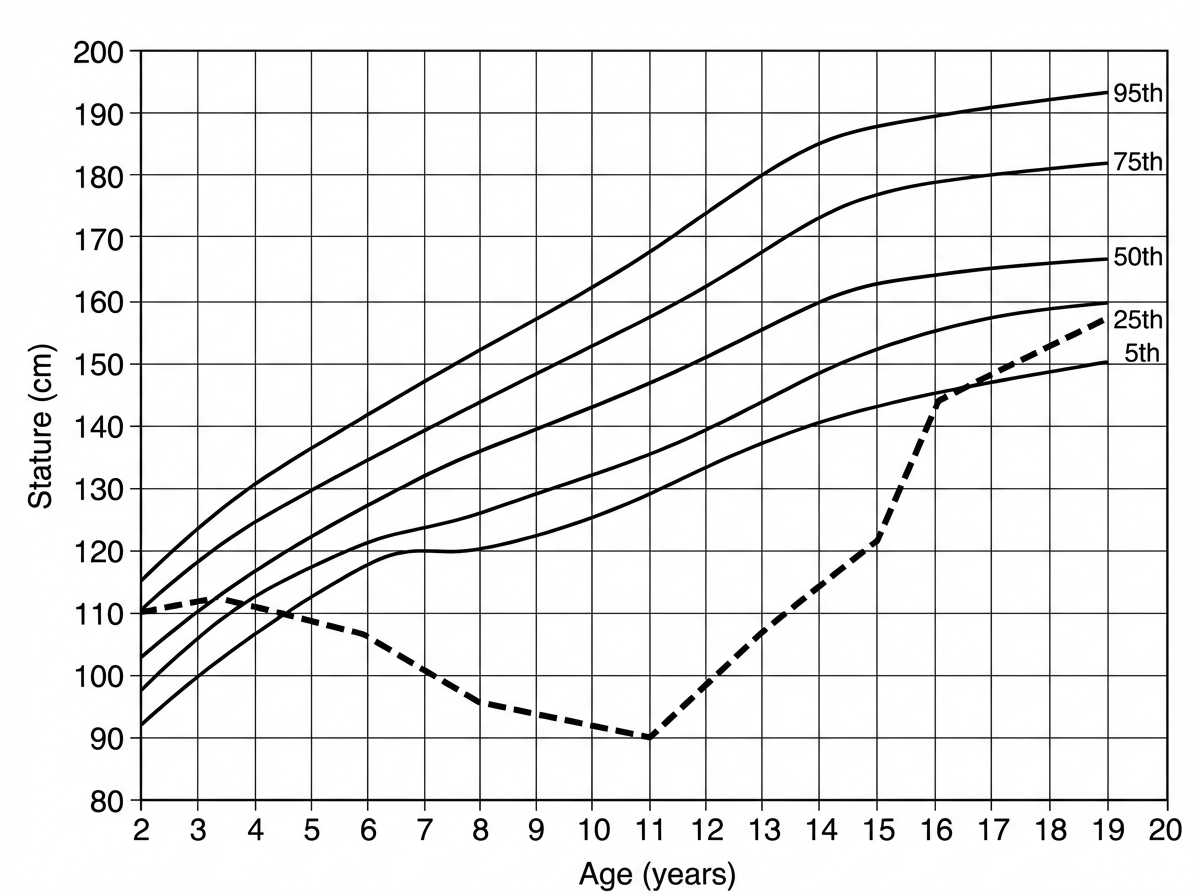
The Integrated Management of Childhood Illness (IMCI) initiative was implemented to prevent morbidity and mortality from which of the following conditions, except?
Clinical features of congenital edema include all except?
90% of brain growth is achieved by which age?
Which of the following countries was NOT included in the MGRS study that led to the development of the 2006 WHO growth charts?
Which neonatal reflex disappears by 6 months of age?
A full-term baby, exclusively breastfed, at the end of 1 week was passing golden yellow stools and was found to have adequate hydration with normal systemic examination. The weight of the baby was the same as it was at birth. What should the pediatrician advise?
What is the first visible sign of puberty in males?
What is the most common preventable cause of mental retardation?
A 15-month-old child can do all of the following, EXCEPT:
At what age can a child draw a triangle?
Explanation: **Explanation:** The **Integrated Management of Childhood Illness (IMCI)** is a strategy developed by WHO and UNICEF to reduce global child mortality. It focuses on the most common causes of death in children under five years of age through an integrated approach rather than focusing on a single disease. **Why Neonatal Tetanus is the correct answer:** IMCI primarily targets children aged **1 week to 5 years**. While it does include a component for "Young Infants" (0–2 months), its clinical algorithms are designed to manage common acute conditions like sepsis and jaundice. **Neonatal Tetanus** is specifically excluded from the IMCI management protocols because it requires specialized intensive care and is largely addressed through maternal immunization (Tetanus Toxoid) and clean delivery practices under programs like the Maternal and Neonatal Tetanus Elimination (MNTE) initiative. **Analysis of Incorrect Options:** * **Malaria:** One of the five major pillars of IMCI. The protocol uses fever as a primary entry point to assess and treat malaria in endemic areas. * **Malnutrition:** IMCI includes a mandatory assessment of nutritional status and breastfeeding practices for every child, recognizing that malnutrition is an underlying cause in over 50% of childhood deaths. * **Otitis Media:** IMCI specifically addresses ear infections (ear pain/discharge) to prevent complications like mastoiditis and hearing loss. **High-Yield Clinical Pearls for NEET-PG:** * **The Big Five:** IMCI focuses on **Pneumonia, Diarrhea, Malaria, Measles, and Malnutrition.** * **Color Coding:** IMCI uses a "triage" system: **Pink** (Urgent referral), **Yellow** (Outpatient treatment/Antibiotics), and **Green** (Home management). * **Age Groups:** It covers two cohorts: 0–2 months (Young Infants) and 2 months–5 years (Older Children). * **Key Exclusion:** It does not cover trauma/accidents, congenital anomalies, or specific neonatal conditions like tetanus.
Explanation: ### Explanation The question asks for the feature that is **NOT** characteristic of congenital lymphedema. **1. Why "Onset before 2 years of age" is the correct (incorrect) option:** Congenital lymphedema (Milroy’s disease) is defined by its presence **at birth** or within the first few days of life. The option "onset before 2 years of age" is technically incorrect because it describes *Lymphedema Praecox*, which typically manifests during puberty or before age 35. Congenital edema is a primary lymphedema caused by the hypoplasia or aplasia of lymphatic vessels, manifesting immediately in the neonatal period. **2. Analysis of other options:** * **Bilateral (A):** Congenital lymphedema is characteristically bilateral and symmetrical, most commonly affecting the lower extremities. * **Involvement of face (B):** While the limbs are the primary site, congenital lymphatic obstruction can involve the face, eyelids, and even the genitals. * **Limb involvement (D):** This is the hallmark of the condition. The edema is firm, non-pitting, and usually involves the dorsum of the feet and legs. **3. Clinical Pearls for NEET-PG:** * **Milroy’s Disease:** Autosomal dominant inheritance; linked to mutations in the **VEGFR3** gene. It presents as congenital, firm, non-pitting edema. * **Lymphedema Praecox (Meige Disease):** The most common form of primary lymphedema; onset is usually around puberty. * **Lymphedema Tarda:** Onset after age 35. * **Stemmer’s Sign:** Inability to pinch the skin on the dorsal surface of the base of the second toe; a pathognomonic sign of chronic lymphedema. * **Differential Diagnosis:** Always rule out Turner Syndrome in a female neonate presenting with congenital lymphedema of the hands and feet.
Explanation: **Explanation:** The human brain undergoes its most rapid period of development during early childhood. At birth, the brain is approximately 25% of its adult weight. By **2 years of age**, it reaches approximately **80–90% of its adult size and weight**. This rapid growth is primarily due to synaptogenesis, glial cell proliferation, and the onset of myelination, rather than an increase in the number of neurons. **Analysis of Options:** * **Option A (2 years):** Correct. Standard pediatric textbooks (like Nelson and Ghai) state that brain growth is nearly complete (90%) by the end of the second year. Head circumference, a proxy for brain growth, increases from ~35 cm at birth to ~48 cm at 2 years. * **Option B (3 years):** Incorrect. While significant development continues, the 90% milestone is already surpassed by this age. * **Option C (5 years):** Incorrect. By age 5–6, the brain has reached nearly 95–100% of its adult volume. * **Option D (15 years):** Incorrect. By this age, the brain has reached full adult weight. Development during adolescence focuses on "pruning" and functional maturation (especially the prefrontal cortex) rather than physical growth. **High-Yield Clinical Pearls for NEET-PG:** * **Head Circumference Growth:** 2 cm/month (0–3 months), 1 cm/month (3–6 months), and 0.5 cm/month (6–12 months). * **Total Increase:** The head circumference increases by ~12 cm in the first year and only ~2 cm in the second year. * **Mid-Parental Height:** A common related calculation; remember the formula for boys: [(Father's + Mother's height + 13) / 2] and girls: [(Father's + Mother's height - 13) / 2]. * **Posterior Fontanelle:** Closes by 6–8 weeks; **Anterior Fontanelle:** Closes by 12–18 months.
Explanation: The **WHO Multicentre Growth Reference Study (MGRS)**, conducted between 1997 and 2003, was a landmark study designed to create a single international standard for how children *should* grow under optimal environmental and health conditions. ### **Why Nigeria is the Correct Answer** Nigeria was **not** one of the six participating countries. The MGRS specifically selected six diverse geographical regions to ensure the standards were globally applicable. The African representative in this study was **Ghana** (specifically Accra), not Nigeria. ### **Analysis of Incorrect Options** The study included six sites representing different ethnicities and cultural settings: * **Norway (Oslo):** Represented the European population. * **India (New Delhi):** Represented the Asian population (specifically affluent populations with optimal growth potential). * **USA (Davis, California):** Represented the North American population. * **Brazil (Pelotas):** Represented South America. * **Oman (Muscat):** Represented the Middle East. * **Ghana (Accra):** Represented the African continent. ### **High-Yield Clinical Pearls for NEET-PG** * **Prescriptive vs. Descriptive:** The 2006 WHO charts are **prescriptive** (how children *should* grow) rather than descriptive (how they *do* grow), as they only included children raised in optimal conditions (e.g., breastfeeding, non-smoking mothers). * **Age Group:** The MGRS followed children from **birth to 5 years (71 months)**. * **Gold Standard:** These charts replaced the NCHS/WHO growth reference, which was based primarily on formula-fed American infants. * **Key Indicator:** The WHO charts identify **breastfed infants** as the biological norm for growth and development.
Explanation: **Explanation:** The correct answer is **6 months**. Neonatal reflexes (primitive reflexes) are involuntary motor responses originating in the brainstem and spinal cord. They are essential for survival in early infancy but must be inhibited (integrated) as the cerebral cortex matures to allow for voluntary motor development. **Moro Reflex** is the most clinically significant reflex in this context. It typically appears at birth, peaks at 2 months, and **disappears by 6 months**. If the Moro reflex persists beyond 6 months, it is a strong indicator of upper motor neuron lesions or neurodevelopmental delay (e.g., Cerebral Palsy). **Analysis of Options:** * **A & C (4-5 months):** While some reflexes like the **Rooting reflex** (when awake) and the **Palmar grasp** typically disappear by 3–4 months, the question asks for the specific milestone of 6 months, which marks the upper limit for the Moro and the **Tonic Neck Reflex (ATNR)**. * **D (9 months):** This is too late for most primitive reflexes. However, the **Plantar grasp** is an exception, typically disappearing by 9–10 months (before the child begins to walk). **High-Yield Clinical Pearls for NEET-PG:** 1. **Parachute Reflex:** This is a *protective* reflex, not a primitive one. It appears at **6–9 months** and **persists for life**. 2. **Babinski Sign:** In neonates, a positive Babinski (upgoing toes) is physiological and can persist until **12–24 months** due to incomplete myelination of the corticospinal tract. 3. **Asymmetric Moro:** If the Moro reflex is absent on one side, consider **Erb’s Palsy** or a **fractured clavicle**. 4. **Integration Rule:** Most primitive reflexes disappear between 3 and 6 months as cortical inhibition begins.
Explanation: **Explanation:** The correct answer is **D. Reassure the mother that nothing is abnormal.** **1. Why it is correct:** The clinical scenario describes a healthy, full-term, exclusively breastfed neonate. The key concept here is **Physiological Weight Loss**. * **Weight Dynamics:** It is normal for a term neonate to lose **5–10% of their birth weight** during the first 3–5 days of life due to the excretion of excess extravascular fluid and low initial caloric intake. * **Weight Regain:** Most healthy term infants regain their birth weight by **7–10 days of age** (and by 14 days for preterm infants). * Since this baby has regained their birth weight by the end of 1 week and shows signs of adequate hydration (golden yellow stools, normal systemic exam), the growth pattern is perfectly physiological. **2. Why other options are incorrect:** * **Option A:** ORS is indicated for dehydration. The baby is adequately hydrated and passing normal stools; adding ORS interferes with exclusive breastfeeding and is unnecessary. * **Option B:** Complementary feeding should only be started at 6 months. Introducing solids at 1 week is contraindicated and dangerous. * **Option C:** Lactic acidosis would present with systemic distress (lethargy, tachypnea, poor feeding). This baby is clinically normal. **3. High-Yield Clinical Pearls for NEET-PG:** * **Weight Gain Pattern:** After the initial loss, a neonate typically gains **25–30 g/day** for the first 3 months. * **Stool Transition:** Transition from Meconium (dark green/black) to Transitional stools (brown/yellow) to typical Breastmilk stools (mustard yellow/golden, seedy) by day 5 is a positive sign of adequate milk intake. * **Milestones:** Birth weight **doubles by 5 months**, **triples by 1 year**, and **quadruples by 2 years**. * **Length:** Increases by 50% at 1 year and doubles at 4 years.
Explanation: **Explanation:** The first clinical sign of puberty in males is **testicular enlargement**, specifically reaching a volume of **≥ 4 ml** (or a longitudinal diameter of > 2.5 cm). This marks the transition from Tanner Stage I (pre-pubertal) to **Tanner Stage II**. This growth is primarily due to the proliferation of seminiferous tubules under the influence of Follicle-Stimulating Hormone (FSH). **Analysis of Options:** * **Option B (Correct):** Testicular volume of 4 ml is the objective threshold for Tanner Stage II and the definitive onset of male puberty. * **Option A:** Tanner Stage III involves further enlargement (typically 6–12 ml) and lengthening of the penis; it is a mid-pubertal stage, not the first sign. * **Option C:** Penile growth usually follows testicular enlargement by approximately 6–12 months. If penile growth occurs without testicular enlargement, it suggests precocious pseudopuberty (e.g., adrenal tumors). * **Option D:** Tanner Stage I is the pre-pubertal stage where testicular volume is typically < 4 ml (usually 1–3 ml). **High-Yield Clinical Pearls for NEET-PG:** * **Age of Onset:** Normal male puberty begins between **9 and 14 years**. * **Prader Orchidometer:** The standard clinical tool used to measure testicular volume. * **Sequence of Events:** Testicular enlargement → Penile growth → Pubic hair (Pubarche) → Peak Height Velocity (occurs late in males, Tanner Stage IV) → Axillary hair/Facial hair. * **Precocious Puberty:** Defined in boys as the onset of secondary sexual characteristics before **9 years** of age. * **Delayed Puberty:** Defined as a lack of testicular enlargement by **14 years** of age.
Explanation: **Explanation:** The correct answer is **Congenital Hypothyroidism**. **1. Why Congenital Hypothyroidism is correct:** Congenital hypothyroidism is the **most common preventable cause** of intellectual disability (mental retardation) worldwide. Thyroid hormones are critical for fetal and neonatal brain development, specifically for neuronal migration, myelination, and synaptogenesis. While the damage is irreversible once it occurs, it is entirely preventable if detected early through **newborn screening** and treated with Levothyroxine within the first 2–4 weeks of life. **2. Why the other options are incorrect:** * **Down’s Syndrome (Trisomy 21):** This is the most common **genetic/chromosomal** cause of mental retardation. However, it is not "preventable" in the medical sense once conception has occurred. * **Fragile X Syndrome:** This is the most common **inherited** cause of mental retardation (affecting the FMR1 gene). Like Down’s syndrome, it cannot be reversed or prevented through postnatal medical intervention. * **Rett’s Syndrome:** A neurodevelopmental disorder (primarily in females due to MECP2 mutation) characterized by a period of normal growth followed by loss of purposeful hand skills and speech. It is a genetic condition and not preventable. **3. High-Yield Clinical Pearls for NEET-PG:** * **Most common cause of Congenital Hypothyroidism:** Thyroid dysgenesis (Ectopy is the most common specific type). * **Clinical Features:** Most neonates are asymptomatic at birth due to maternal T4. Early signs include a large posterior fontanelle, prolonged physiological jaundice, hoarse cry, and umbilical hernia. * **Screening:** Ideally done via heel-prick test for TSH between **48–72 hours** of life to avoid the physiological neonatal TSH surge.
Explanation: The correct answer is **C (Builds a tower of two blocks)** because this milestone is typically achieved by **18 months**, not 15 months. ### **Explanation of Milestones** * **Option C (Correct Answer):** A 15-month-old child can typically build a tower of **two blocks**. However, in the context of standardized developmental screening (like the Denver II or Nelson’s), the ability to build a tower of **3-4 blocks** is expected by 18 months. By 15 months, the child is just beginning to stack two blocks; if the question implies a higher level of fine motor coordination or if we follow strict developmental charts, building a stable tower of two is often the transition point between 15 and 18 months. In many competitive exams, "Tower of 2 blocks" is the classic milestone for **18 months**, making it the "Except" for a 15-month-old. ### **Why other options are wrong:** * **Option A (Feeds with a spoon):** By 15 months, a child develops the fine motor skills to pick up a spoon and feed themselves, though it remains messy. * **Option B (Says three words):** Language development at 15 months typically includes a vocabulary of 3–6 words with meaning (beyond "Mama/Dada"). * **Option D (Creeps upstairs):** Gross motor skills at 15 months include walking independently (usually by 13 months) and creeping/crawling up stairs. ### **High-Yield Clinical Pearls for NEET-PG:** * **Block Towers:** 15 months (2 blocks), 18 months (3 blocks), 24 months (6 blocks), 36 months (9 blocks/Bridge). *Formula: (Age in years × 3) = Number of blocks.* * **Copying Shapes:** 3 years (Circle), 4 years (Cross/Square), 5 years (Triangle). * **Social Milestone:** 15 months (Hugs parents), 18 months (Kissing parents, Domestic mimicry).
Explanation: **Explanation:** The ability to copy geometric shapes is a key component of **fine motor development**, reflecting the maturation of hand-eye coordination and cognitive processing. Drawing a **triangle** is a complex skill that requires the child to execute diagonal lines and sharp angles, which typically develops by **5 years** of age. **Analysis of Options:** * **A. 1 year:** At this age, fine motor skills are limited to a pincer grasp and the ability to release objects. A child may spontaneously scribble but cannot draw specific shapes. * **B. 3 years:** A 3-year-old can typically copy a **circle**. This is the first geometric shape mastered as it involves a continuous curved motion. * **C. 5 years (Correct):** By age 5, the child has the neurological maturity to handle the intersecting diagonal lines required for a triangle. * **D. 7 years:** By this age, a child has progressed beyond basic shapes and can draw more complex figures, such as a **diamond** (usually mastered by age 7) or a three-dimensional cube (by age 9). **High-Yield Clinical Pearls for NEET-PG:** To remember the sequence of drawing shapes, use the following chronological milestones: * **2 years:** Vertical line * **2.5 years:** Horizontal line * **3 years:** Circle * **4 years:** Plus sign (+) and Cross (x) / Square * **5 years:** Triangle * **7 years:** Diamond **Note:** In some developmental charts (like the Denver II), a square is often cited at 4 years and a triangle at 5 years. Always look for the "earliest" age these milestones are consistently achieved.
Normal Growth Parameters
Practice Questions
Developmental Milestones
Practice Questions
Puberty and Adolescent Development
Practice Questions
Growth Disorders
Practice Questions
Failure to Thrive
Practice Questions
Developmental Screening and Assessment
Practice Questions
Developmental Delays
Practice Questions
Growth Charts and Monitoring
Practice Questions
Short Stature
Practice Questions
Tall Stature
Practice Questions
Precocious and Delayed Puberty
Practice Questions
Psychosocial Development
Practice Questions
Get full access to all questions, explanations, and performance tracking.
Start For Free