A 5-year-old has the following anthropometry findings: Weight/age < -3.2 SD, Height/age < -2.5 SD, Weight/height < -1.7 SD. What is the most likely diagnosis?
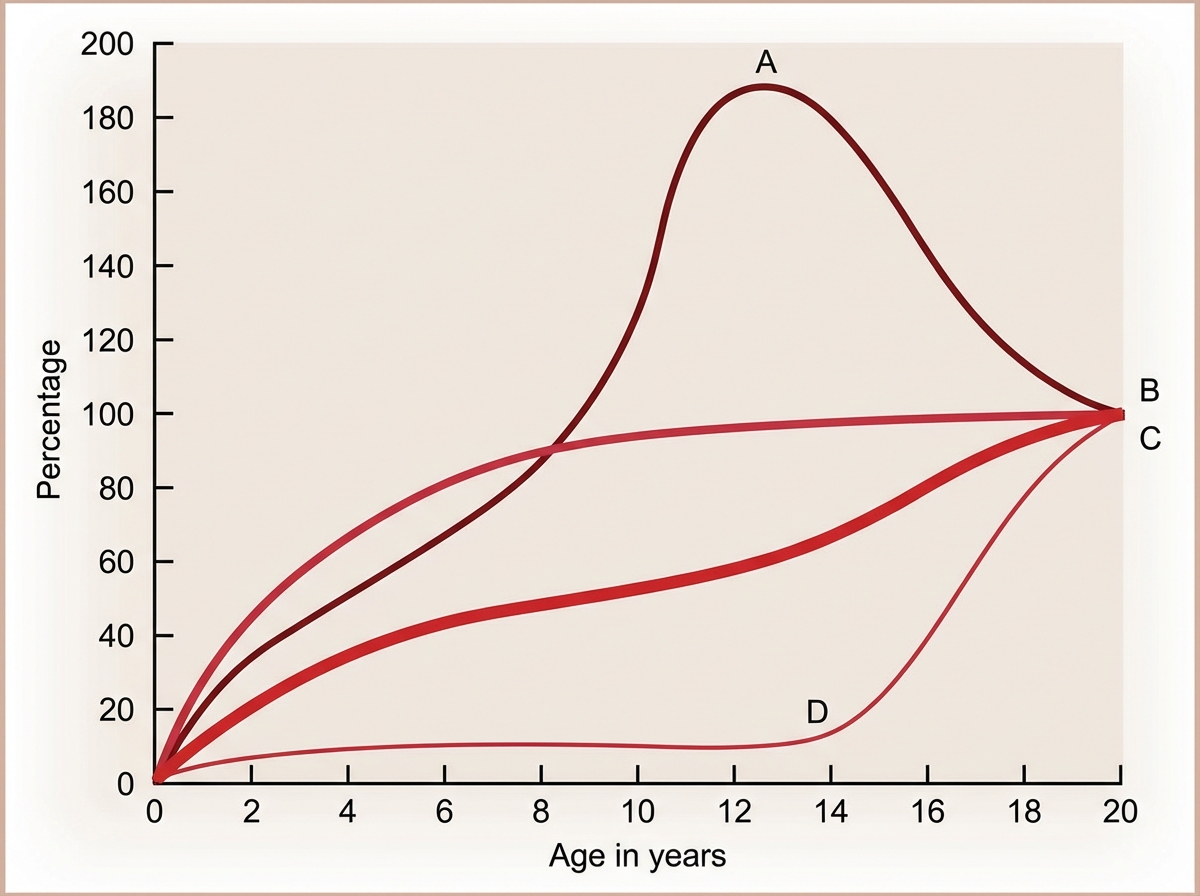
Anthropometric assessment, which does not show much change over a period of 1-4 years, is characteristic of:
Type of growth chart used by anganwadi workers (ICDS) for growth monitoring is:
In anthropometric assessment, which of the following does not show much change in 1-4 years ?
What is the true statement regarding an 'at-risk baby'?
Which of the following is not a feature of hypothyroidism in infancy?
At what age does the height of a newborn typically double?
Deficit in weight for height in a 3-year-old child indicates a type of malnutrition:
The following are recognized signs and symptoms of raised intracranial tension in a 9-month-old infant, except which of the following?
A child presents with short stature. His bone age is less than chronological age. The height of his parents is normal. What is the most likely diagnosis?
Explanation: ***Severe Acute Malnutrition with stunting*** - This child has **both acute and chronic malnutrition** indicators that must be identified together for accurate diagnosis and management. - **Height-for-age < -2.5 SD** confirms **stunting (chronic malnutrition)**, indicating long-term nutritional deprivation. - **Weight-for-age < -3.2 SD** indicates **severe underweight**, which in the context of stunting reflects the combined impact of both chronic and acute malnutrition. - **Weight-for-height < -1.7 SD** shows mild wasting, indicating an acute component, though not meeting the < -3 SD threshold for SAM by W/H alone. - The combination of severe underweight, stunting, and wasting requires the comprehensive diagnosis of **SAM with stunting** for appropriate clinical management and nutritional rehabilitation. *Severe Acute Malnutrition (without mentioning stunting)* - While this child has severe underweight, diagnosing only SAM **ignores the documented stunting** (H/A < -2.5 SD). - SAM is typically defined by **Weight-for-height < -3 SD**, but this child's W/H is only -1.7 SD, not meeting the strict SAM criteria by this parameter alone. - In pediatric nutrition, when stunting coexists with severe underweight, both components must be identified as they have different management implications. *Moderate acute malnutrition* - Moderate acute malnutrition requires **Weight-for-height between -2 SD and -3 SD** or MUAC between 11.5-12.5 cm. - This child's W/A is **< -3.2 SD** (severe underweight, not moderate), making this diagnosis inadequate. - The presence of stunting and severe underweight indicates a more serious condition than moderate acute malnutrition. *Chronic malnutrition* - While **Height-for-age < -2.5 SD confirms chronic malnutrition (stunting)**, this diagnosis alone doesn't capture the full clinical picture. - The **Weight-for-age < -3.2 SD** indicates severe underweight with an acute wasting component, requiring urgent intervention beyond addressing chronic malnutrition alone. - A diagnosis of only "chronic malnutrition" would underestimate the severity and miss the acute component requiring immediate management.
Explanation: ***Chest-to-head circumference ratio*** - **Chest-to-head circumference ratio remains relatively stable between 1-4 years of age** after the initial crossover period. - At birth, head circumference is greater than chest circumference. - At approximately **6-12 months**, the two measurements equalize, and chest circumference exceeds head circumference. - **After 1 year of age, this ratio stabilizes** and remains relatively constant throughout the 1-4 year period, making it a useful stable reference point. - This stability makes it less useful for detecting acute changes but confirms normal proportionate growth. *Mid arm circumference* - Mid-arm circumference (MAC) is used to assess nutritional status but **does show changes during the 1-4 year growth period**. - MAC typically ranges from 14-16 cm in this age group and increases with normal growth. - It is **sensitive to acute malnutrition** and can fluctuate with nutritional status, making it less stable over time. *Height* - Height is a dynamic measure that **changes significantly during childhood**. - Children grow approximately 10-12 cm per year between ages 1-4 years. - Height is used to assess **chronic malnutrition (stunting)** and shows continuous change, not stability. *Skin fold thickness* - Skin fold thickness (e.g., triceps skin fold) measures subcutaneous fat and reflects nutritional status. - It is **variable based on calorie intake, physical activity, and nutritional fluctuations**. - It does not remain stable over the 1-4 year period and is used to detect changes in fat stores.
Explanation: ***WHO Growth Standards*** - The **WHO Growth Standards** are officially used by Anganwadi workers under the Integrated Child Development Services (ICDS) program in India. - Since 2019, the Ministry of Women and Child Development adopted WHO growth standards for **routine growth monitoring** of children 0-5 years. - WHO standards are based on healthy breastfed children from **six diverse countries** and represent optimal growth patterns. - These charts are internationally recognized and recommended by WHO as the **best tool** for assessing child growth and nutritional status. *IAP (Indian Academy of Pediatrics)* - IAP growth charts are adapted for Indian children and used in **some clinical settings**. - While valuable for pediatric practice, they are **not the official standard** used by Anganwadi workers in ICDS. - IAP charts are more commonly used by private practitioners and hospitals. *NCHS* - The **National Center for Health Statistics (NCHS) growth charts** were previously used by ICDS before the shift to WHO standards. - These were replaced because WHO growth standards better represent optimal growth and are based on **breastfed children**. - NCHS charts are now considered outdated for growth monitoring in India. *CDC (Centers for Disease Control and Prevention)* - CDC growth charts are primarily used in the **United States**. - These are based on US population data and are **not recommended** for use in India. - CDC charts do not reflect the growth patterns of Indian children.
Explanation: ***Mid arm circumference*** - From birth up to around **5 years of age**, the **mid-arm circumference (MAC)** does not change significantly. - This makes MAC a useful **screening tool** for diagnosing protein-energy malnutrition within this age range. *Skin fold thickness* - **Skinfold thickness** measurements, like those from the triceps, reflect subcutaneous fat stores and can change significantly with nutritional status and growth. - Changes in fat deposition occur rapidly during early childhood depending on energy intake and expenditure. *Height* - **Height** is a primary indicator of linear growth and changes considerably and consistently throughout childhood. - Significant increases in height (length) are expected over a 1-4 year period as a child grows. *Chest circumference: Head circumference ratio* - The **head circumference (HC)** grows rapidly during the first year of life, then slows, while **chest circumference (CC)** overtakes HC around the age of 1 year. - The ratio between these two measurements changes significantly as the child develops, making it an unreliable stable marker over several years in early childhood.
Explanation: ***Socioeconomic risk due to high birth order (more than 3).*** - An **"at-risk baby"** is defined by specific criteria that identify infants vulnerable to adverse health outcomes during the neonatal and early infantile period. - **High birth order (>3)** is a recognized risk factor as per IAP (Indian Academy of Pediatrics) and WHO guidelines, primarily due to: - **Maternal depletion syndrome** (depleted maternal nutritional reserves from multiple pregnancies) - **Socioeconomic constraints** (limited resources spread across more children) - **Reduced parental attention** and care per child - Other criteria for "at-risk baby" include: birth weight <2.5 kg, preterm birth, birth asphyxia, congenital anomalies, and maternal risk factors. *Severe malnutrition with weight significantly below expected norms.* - This describes **severe acute malnutrition (SAM)** in an infant or child, which is a **nutritional disorder**, not a defining criterion of an "at-risk baby" at birth. - While malnutrition increases morbidity risk, the term "at-risk baby" specifically refers to **perinatal and neonatal risk factors** present at or around the time of birth. - SAM is a **consequence** that may develop later, rather than a defining characteristic of the "at-risk" classification. *Mild malnutrition with weight slightly below expected norms.* - **Mild malnutrition** is not a criterion for classifying a baby as "at-risk" in the standard pediatric definition. - The "at-risk baby" classification focuses on **specific measurable risk factors** (birth weight, gestational age, birth order, etc.) rather than mild nutritional deviations. *Normal birth weight above the critical threshold of 2.5 kg.* - A **normal birth weight (≥2.5 kg)** is actually a **protective factor** and indicates lower risk at birth. - This statement describes a baby who does **not meet the "at-risk" criteria** based on birth weight, though other risk factors could still be present. - Birth weight ≥2.5 kg is one indicator of adequate intrauterine growth and lower neonatal mortality risk.
Explanation: ***Premature closure of posterior fontanelle*** - Delayed closure of fontanelles, particularly the **posterior fontanelle**, is a characteristic feature of **congenital hypothyroidism** due to impaired bone maturation. - Therefore, **premature closure** would be inconsistent with a diagnosis of hypothyroidism in infancy. *Coarse facies* - **Coarse facial features** such as a broad nasal bridge, puffy eyelids, and a protuberant tongue are common manifestations of **congenital hypothyroidism** due to the accumulation of glycosaminoglycans. - This is a direct consequence of the metabolic derangements caused by insufficient thyroid hormone. *Umbilical hernia* - An **umbilical hernia** is frequently observed in infants with hypothyroidism, resulting from generalized **hypotonia** and incomplete closure of the umbilical ring. - The reduced muscle tone characteristic of the condition contributes to this physical finding. *Constipation* - **Constipation** is a common gastrointestinal symptom in infants with hypothyroidism, caused by **decreased gut motility** secondary to reduced thyroid hormone levels. - This is a clinical indicator of the systemic metabolic slowing associated with the condition.
Explanation: ***4 years*** - A newborn's length typically **doubles by 4 years of age** (from approximately 50 cm at birth to 100 cm at 4 years). - This is an important growth milestone reflecting rapid skeletal growth during early childhood. - Growth pattern: Birth length increases by ~50% at 1 year, ~75% at 2 years, and doubles by 4 years. *1 year* - By 1 year, a newborn's **length increases by approximately 50%** (from 50 cm to about 75 cm), not double. - Weight triples by 1 year, which may cause confusion with length doubling. *2 years* - By 2 years, length increases to approximately **85-87 cm**, which is about 75% more than birth length. - This represents significant growth but not yet doubling of birth length. *3 years* - At 3 years, a child's length is typically **90-95 cm**, approaching but not yet double the birth length. - The doubling milestone is specifically achieved around 4 years of age.
Explanation: ***Acute malnutrition*** - A deficit in **weight for height** is a key indicator of **acute malnutrition**, often referred to as **wasting**. - This condition reflects a recent and often rapid loss of weight, indicating insufficient nutritional intake or severe disease over a short period. *Chronic malnutrition* - **Chronic malnutrition** is characterized by a deficit in **height for age**, indicating **stunting**. - This reflects prolonged undernutrition, leading to impaired growth over a longer duration. *Concomitant acute and chronic* - This describes a situation where both **weight for height** (wasting) and **height for age** (stunting) are deficient. - While possible, a deficit in **weight for height** *specifically* refers to acute malnutrition, even if chronic malnutrition is also present. *Underweight* - **Underweight** refers to a deficit in **weight for age**, which can be caused by either **acute** or **chronic malnutrition**, or both. - It is a more general term and does not specifically differentiate between the acute or chronic nature of the malnutrition as precisely as weight-for-height or height-for-age.
Explanation: ***Normal head circumference*** - **Raised intracranial tension (RIC)** in infants often leads to an **increased head circumference** if the sutures have not yet fused, making a normal circumference *less likely* for RIC. - A persistent increase in head circumference is a key indicator of **hydrocephalus** or other conditions causing RIC in infants. *Bulging fontanel* - A **full or bulging fontanel** is a classic sign of RIC in infants because the open fontanelle provides a direct route for pressure to manifest. - This occurs due to increased pressure within the skull pushing the brain and cerebrospinal fluid outwards. *Papilledema* - **Papilledema**, or swelling of the optic disc, indicates increased pressure transmitted to the optic nerve. - While it can be harder to detect in infants than in older children, it is a significant sign of RIC when present. *Vomiting* - **Vomiting**, especially projectile vomiting without associated nausea, is a common non-specific symptom of RIC in infants and children. - This is thought to be due to pressure on the **brainstem's emetic center**.
Explanation: ***Constitutional short stature*** - This condition is characterized by a **delayed bone age** compared to chronological age, indicating a delay in skeletal maturation. - Children with constitutional short stature typically have **normal parental height** and will eventually reach a normal adult height, although puberty and growth spurts are often delayed. *Malnutrition* - While malnutrition causes **short stature** and **delayed bone age**, it would also likely present with other signs of nutritional deficiency such as **weight loss** or failure to thrive. - The case does not mention any dietary issues or poor socioeconomic conditions typically associated with malnutrition. *Familial short stature* - In familial short stature, the child's height is typically proportional to the parents' height, indicating a strong genetic component to their shorter stature. - It is characterized by a **normal bone age** for chronological age, unlike the delayed bone age seen in this child. *Cretinism* - Cretinism, or congenital hypothyroidism, results in **severe growth retardation** and **delayed bone age**. - However, it is also associated with distinct features like **coarse facial features**, macroglossia, umbilical hernia, and severe developmental delays, which are not mentioned in this case.
Get full access to all questions, explanations, and performance tracking.
Start For Free