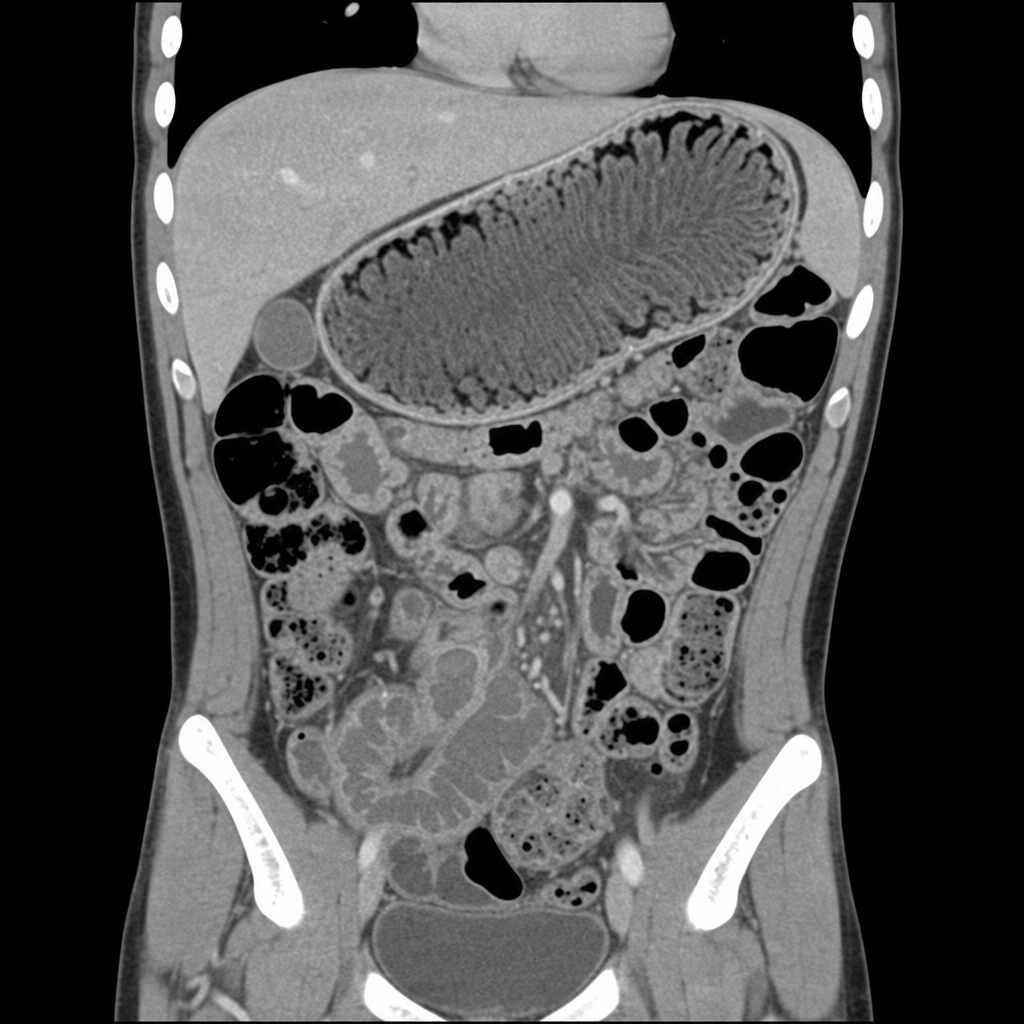
Which of the following is true about Reye's syndrome?
As per the latest guidelines, which of the following dehydration statuses requires oral rehydration solution prescription?
String sign on barium meal is seen in:
The 'dance sign' is characteristically seen in which of the following conditions?
A newborn with Down syndrome presents with constipation. Rectal examination reveals no stool in the rectal ampulla, and a radiograph shows dilation of the proximal rectosigmoid. What is the most likely underlying mechanism for this condition?
Which of the following laboratory findings is most specific for acute pancreatitis in children?
A 3-month-old child presents with a one-month history of clay-colored stools and dark yellow urine. Initial management included steroids and ursodeoxycholic acid. Further investigation revealed a direct bilirubin level of 6 mg%. Which of the following investigations is most sensitive for diagnosing this condition?
Projectile vomiting is a characteristic clinical feature of which of the following conditions?
In neonatal cholestasis, if the serum gamma-glutamyl transpeptidase (gamma GTP) is more than 600 IU/L, what is the most likely diagnosis?
What is the major clinical manifestation of Wilson disease in children aged 8-16 years?
Explanation: **Explanation:** Reye’s Syndrome is a rare but life-threatening condition characterized by acute non-inflammatory encephalopathy and fatty liver failure. It typically follows a viral prodrome (Influenza B or Varicella) and is strongly associated with **aspirin (salicylate)** use in children. **Why Option A is the Correct Answer:** The hallmark pathological feature of Reye’s syndrome is **microvesicular fatty infiltration** of the liver. Unlike macrovesicular steatosis (seen in alcohol or obesity), this involves the accumulation of small fat droplets within hepatocytes without displacing the nucleus. This occurs due to **mitochondrial dysfunction**, leading to impaired fatty acid oxidation. **Analysis of Other Options:** While Options B, C, and D are all clinical features of Reye’s syndrome, they are considered **consequences or manifestations** rather than the definitive pathological hallmark. * **Hepatic Encephalopathy (B):** Occurs due to hyperammonemia but is a clinical stage, not the primary histological marker. * **Brain Edema (C):** A critical complication leading to increased intracranial pressure, but it is secondary to metabolic failure. * **Hypoglycemia (D):** A common metabolic finding due to liver glycogen depletion and impaired gluconeogenesis. **NEET-PG High-Yield Pearls:** * **Mitochondria:** The "target organelle" damaged in Reye's syndrome (look for "swollen, pleomorphic mitochondria" on electron microscopy). * **Liver Enzymes:** AST/ALT and Ammonia are significantly elevated, but **Bilirubin is usually normal or only slightly raised** (Anicteric hepatitis). * **Prothrombin Time (PT):** Characteristically prolonged. * **Safe Alternative:** Acetaminophen (Paracetamol) is the drug of choice for fever in children to avoid this syndrome. * **Exception:** Aspirin is still used in children for **Kawasaki Disease** and Juvenile Idiopathic Arthritis (JIA) under strict monitoring.
Explanation: **Explanation:** The management of dehydration in pediatrics is standardized by the WHO and IAP based on clinical severity. The correct answer is **"Any dehydration"** because Oral Rehydration Solution (ORS) is the cornerstone of management for all patients who are not in shock or severely dehydrated. 1. **Why "Any Dehydration" is Correct:** According to the WHO Integrated Management of Childhood Illness (IMCI) guidelines, ORS is indicated for **Plan A** (No dehydration - to prevent it), **Plan B** (Some dehydration - to treat it), and even in **Plan C** (Severe dehydration) once the patient is stable enough to swallow or after initial IV resuscitation. Therefore, any degree of fluid deficit in a conscious patient warrants ORS prescription. 2. **Analysis of Incorrect Options:** * **A & B (Mild/Moderate Dehydration):** These are older clinical terms. While ORS is used for these, selecting them individually is too restrictive. Modern guidelines use the classifications "No," "Some," and "Severe" dehydration. * **C (Some Dehydration):** While ORS is the primary treatment for "Some dehydration" (Plan B), this option is incomplete. Patients with "No dehydration" (Plan A) also require ORS at home to prevent progression. **High-Yield Clinical Pearls for NEET-PG:** * **ORS Composition (Reduced Osmolarity):** Total osmolarity is **245 mOsm/L**. (Glucose: 75 mmol/L, Sodium: 75 mmol/L, Chloride: 65 mmol/L, Potassium: 20 mmol/L, Citrate: 10 mmol/L). * **Zinc Supplementation:** Essential adjunct to ORS; 10 mg/day for infants <6 months and 20 mg/day for >6 months for 14 days. * **Plan B Dosage:** 75 ml/kg of ORS over 4 hours. * **Contraindications to ORS:** Paralytic ileus, persistent vomiting (more than 3 episodes/hour), and altered sensorium (risk of aspiration).
Explanation: **Explanation:** **Congenital Hypertrophic Pyloric Stenosis (CHPS)** is the correct answer. The "String Sign" is a classic radiological finding on a barium meal, representing a thin, elongated line of contrast passing through the narrowed, elongated pyloric canal. This occurs due to hypertrophy and hyperplasia of the circular muscle layers of the pylorus, which causes a functional gastric outlet obstruction. **Analysis of Incorrect Options:** * **Duodenal Atresia:** Characterized by the **"Double Bubble Sign"** on X-ray (gas in the stomach and proximal duodenum). Barium studies are rarely needed but would show a complete cutoff at the second part of the duodenum. * **Intestinal Obstruction:** Typically presents with multiple air-fluid levels on an erect abdominal X-ray. Specific signs depend on the level of obstruction (e.g., "Coiled spring appearance" in intussusception). * **Duodenal Ulcer:** Often shows a "Cloverleaf deformity" (due to healing and scarring of a chronic ulcer) or a persistent "crater" or "niche" where contrast pools. **High-Yield Clinical Pearls for NEET-PG:** * **Clinical Presentation:** Non-bilious, projectile vomiting in a 3–6 week old infant. * **Physical Exam:** A palpable, olive-shaped mass in the epigastrium and visible gastric peristalsis. * **Metabolic Abnormality:** Hypochloremic, hypokalemic metabolic alkalosis with paradoxical aciduria. * **Other Radiological Signs (Barium):** * **Beak Sign:** Contrast entering the narrowed pylorus. * **Shoulder Sign:** Bulging of the pyloric muscle into the antrum. * **Mushroom Sign:** Hypertrophied pylorus indenting the duodenal bulb. * **Investigation of Choice:** Ultrasonography (Criteria: Pyloric muscle thickness >4mm or length >14mm). * **Treatment:** Ramstedt’s Pyloromyotomy.
Explanation: **Explanation:** The **'Dance sign'** (also known as Signe de Dance) is a classic physical examination finding in **Intussusception**. It refers to a **palpable emptiness in the Right Lower Quadrant (RLQ)** or right iliac fossa. This occurs because the cecum and ascending colon have telescoped (invaginated) into the distal colon, migrating away from their normal anatomical position in the right side of the abdomen. **Analysis of Options:** * **Intussusception (Correct):** In addition to the Dance sign, patients typically present with the triad of intermittent colicky abdominal pain, a "sausage-shaped" mass (usually in the right upper quadrant), and "red currant jelly" stools. * **Appendicitis:** Characterized by tenderness at McBurney’s point and guarding in the RLQ. There is no migration of the bowel that would cause an "empty" feeling; rather, there is localized inflammatory fullness. * **Meconium Ileus:** Associated with Cystic Fibrosis, this presents as neonatal distal small bowel obstruction. The RLQ often feels "doughy" or contains firm masses (meconium pellets), rather than being empty. * **Large Bowel Obstruction:** Generally presents with generalized abdominal distension and tympany. While the cecum may be dilated, it does not vacate the RLQ. **High-Yield Clinical Pearls for NEET-PG:** * **Gold Standard Investigation:** Ultrasound (shows the **Target/Donut sign** or **Pseudokidney sign**). * **Treatment of Choice:** Non-operative reduction using **Air or Hydrostatic (Barium/Saline) Enema**. * **Lead Points:** In children, most cases are idiopathic (hypertrophied Peyer’s patches post-viral infection); in adults, a pathological lead point (like a tumor or Meckel’s diverticulum) is usually present.
Explanation: **Explanation:** The clinical presentation of a newborn with Down syndrome, constipation, an empty rectal ampulla on digital examination, and proximal dilation on imaging is classic for **Hirschsprung Disease (Congenital Aganglionic Megacolon).** **1. Why the Correct Answer is Right:** Hirschsprung disease is caused by the **failure of neural crest cells to migrate** cranio-caudally during the 5th to 12th week of gestation. This results in the **absence of ganglion cells** in the **Meissner (submucosal)** and **Auerbach (myenteric)** plexuses. The affected segment (usually the rectum and sigmoid) remains in a state of tonic contraction because it lacks the inhibitory signals required for relaxation. This functional obstruction leads to proximal bowel dilation (megacolon) and an empty rectum on examination. **2. Why Incorrect Options are Wrong:** * **Option A:** Imperforate anus is a structural defect visible on external inspection at birth; it does not typically present with a dilated rectosigmoid on internal radiography in this manner. * **Option B:** Inflammatory lesions (like Ulcerative Colitis) are rare in newborns and do not explain the congenital absence of stool in the ampulla. * **Option C:** This describes **Meconium Ileus**, typically seen in **Cystic Fibrosis**. While it causes obstruction, it is characterized by "ground-glass" appearance on X-ray and is not specifically associated with Down syndrome. **3. NEET-PG High-Yield Pearls:** * **Association:** ~10% of Hirschsprung cases occur in children with **Down Syndrome (Trisomy 21).** * **Gold Standard Diagnosis:** Rectal Suction Biopsy (shows absence of ganglion cells and hypertrophied nerve bundles). * **Radiology:** "Squirt sign" or "Blast sign" (explosive release of stool/gas after digital rectal exam). * **Genetics:** Associated with mutations in the **RET proto-oncogene.**
Explanation: **Explanation:** **Lipase (Option C)** is the most specific and sensitive biochemical marker for acute pancreatitis in children. While both amylase and lipase are released from damaged pancreatic acinar cells, lipase is preferred because it remains elevated for a longer duration (up to 8–14 days) and is not produced by as many extrapancreatic tissues as amylase. In pediatric patients, a serum lipase level ≥3 times the upper limit of normal is a key diagnostic criterion according to the NASPGHAN guidelines. **Incorrect Options:** * **Amylase (Option A):** Though commonly used, it lacks specificity. It can be elevated in mumps (parotitis), intestinal perforation, or macroamylasemia. In children, amylase levels may also be normal in the early stages of pancreatitis. * **Tryptase (Option B):** This is a marker of mast cell degranulation and is used primarily in the diagnosis of anaphylaxis or mastocytosis, not pancreatitis. * **Chymotrypsin (Option D):** While a pancreatic enzyme, fecal chymotrypsin is used to assess pancreatic exocrine *insufficiency* (e.g., in Cystic Fibrosis) rather than acute inflammation. **High-Yield Clinical Pearls for NEET-PG:** * **Diagnosis:** Requires 2 of 3 criteria: (1) Characteristic abdominal pain, (2) Serum lipase or amylase ≥3x normal, (3) Imaging findings (USG/CT) suggestive of pancreatitis. * **Etiology in Children:** Unlike adults (alcohol/gallstones), the most common causes in children are **trauma** (e.g., bicycle handlebar injury), **infections** (Mumps, Coxsackie), and **systemic diseases** (HUS, SLE). * **Imaging:** Ultrasonography is the initial investigation of choice in children to avoid radiation.
Explanation: ### **Explanation** The clinical presentation of **clay-colored (acholic) stools**, dark urine, and **conjugated hyperbilirubinemia** (Direct Bilirubin >1 mg/dL) in a 3-month-old is a classic hallmark of **Biliary Atresia (BA)**. #### **Why HIDA Scan is Correct** The **Hepatobiliary Iminodiacetic Acid (HIDA) scan** (Radionuclide Scintigraphy) is the most sensitive non-invasive investigation for Biliary Atresia. * **Mechanism:** Technetium-99m labeled tracers are taken up by hepatocytes and excreted into the bile. * **Diagnostic Finding:** In Biliary Atresia, there is good hepatic uptake of the isotope, but a **complete absence of excretion into the intestine** even after 24 hours. * **Sensitivity:** It has a sensitivity approaching 100% for diagnosing biliary obstruction. To enhance accuracy, patients are often pre-treated with **Phenobarbital** (5 mg/kg/day for 3–5 days) to stimulate bile flow. #### **Why Other Options are Incorrect** * **Ultrasound (A):** Often the first-line screening tool. It may show a "Triangular Cord Sign" (fibrous cone at the porta hepatis) or an absent/contracted gallbladder, but it is less sensitive than HIDA. * **Liver Function Tests (C):** Confirms conjugated hyperbilirubinemia and cholestasis (elevated GGT/Alkaline Phosphatase) but cannot differentiate between neonatal hepatitis and anatomical obstruction. * **CT Abdomen (D):** Not a standard diagnostic modality for neonatal cholestasis; it lacks the functional detail provided by scintigraphy. #### **Clinical Pearls for NEET-PG** * **Gold Standard Investigation:** Intraoperative Cholangiogram (IOC). * **Most Definitive Diagnostic Procedure:** Liver Biopsy (shows bile duct proliferation and portal fibrosis). * **Management:** The surgery of choice is **Kasai Portoenterostomy**. * **Prognostic Factor:** For the best outcome, the Kasai procedure should ideally be performed **before 60 days of life**. Beyond 90 days, the success rate drops significantly due to established cirrhosis.
Explanation: **Explanation:** **Hypertrophic Pyloric Stenosis (HPS)** is the correct answer because it involves hypertrophy and hyperplasia of the pyloric sphincter muscles, leading to a gastric outlet obstruction. As the stomach attempts to force contents through the narrowed canal, intraluminal pressure builds up, resulting in **non-bilious, forceful "projectile" vomiting**. This typically presents in infants aged 3–6 weeks. **Analysis of Incorrect Options:** * **Esophageal Atresia:** Presents immediately after birth with excessive salivation, drooling, and choking/cyanosis during the first feed. Vomiting is not "projectile" as the obstruction is proximal to the stomach. * **Cholera:** Characterized by profuse, painless, watery diarrhea ("rice-water stools"). While vomiting can occur due to acidosis or electrolyte imbalance, it is not the hallmark projectile type. * **Intussusception:** Typically presents with sudden onset colicky abdominal pain, a "sausage-shaped" mass, and "red currant jelly" stools. Vomiting occurs late due to intestinal obstruction and is usually bilious. **Clinical Pearls for NEET-PG:** * **Metabolic Profile:** HPS causes **Hypochloremic, Hypokalemic, Metabolic Alkalosis** with paradoxical aciduria. * **Physical Exam:** A palpable, olive-shaped mass in the epigastrium is pathognomonic. * **Imaging:** Ultrasound is the gold standard (pyloric muscle thickness >4mm or length >14mm). On Barium swallow, look for the **"String sign"** or **"Beak sign."** * **Management:** Initial priority is fluid resuscitation (Normal Saline). The definitive surgery is **Ramstedt’s Pyloromyotomy**.
Explanation: **Explanation:** In neonatal cholestasis, **Gamma-Glutamyl Transpeptidase (GGT)** is a critical biochemical marker used to differentiate between obstructive (extrahepatic) and non-obstructive (intrahepatic) causes. **1. Why Biliary Atresia is correct:** Biliary Atresia (BA) is characterized by progressive fibro-inflammatory destruction of the extrahepatic bile ducts. This mechanical obstruction leads to significant bile duct proliferation and high pressure within the biliary tree, which triggers a marked release of GGT. In neonatal cholestasis, a GGT level **>150-200 IU/L** is highly suggestive of BA, and levels **>600 IU/L** are almost pathognomonic for an obstructive etiology, with BA being the most common cause in this age group. **2. Why other options are incorrect:** * **Neonatal Hepatitis:** This is an intrahepatic cause (e.g., idiopathic or infectious). While GGT can be elevated, it is typically much lower than in BA. Low or normal GGT in a cholestatic neonate actually suggests **Progressive Familial Intrahepatic Cholestasis (PFIC) Type 1 or 2**. * **Choledochal Cyst:** While this is an obstructive cause and can present with high GGT, it is usually associated with a palpable mass and is easily identified on ultrasound. BA remains the more common "high-GGT" surgical emergency in the early neonatal period. * **Sclerosing Cholangitis:** Neonatal Sclerosing Cholangitis (NSC) is rare. While it presents with high GGT, it is a diagnosis of exclusion and less common than BA. **High-Yield Clinical Pearls for NEET-PG:** * **Kasai Procedure (Hepatoportoenterostomy):** Best outcomes if performed before **60 days** of life. * **Gold Standard Diagnosis:** Intraoperative Cholangiogram (IOCG). * **Triangular Cord Sign:** A high-yield USG finding in Biliary Atresia representing fibrous tissue at the porta hepatis. * **HIDA Scan:** Shows good uptake by the liver but **no excretion** into the bowel in BA.
Explanation: ### Explanation **Wilson Disease (Hepatolenticular Degeneration)** is an autosomal recessive disorder caused by a mutation in the **ATP7B gene** on chromosome 13. This leads to impaired biliary copper excretion and deficient incorporation of copper into ceruloplasmin, resulting in toxic copper accumulation in various organs. **Why Hepatic Dysfunction is Correct:** The clinical presentation of Wilson disease follows a distinct age-related pattern. In children and adolescents (typically aged **8–16 years**), the **liver** is the primary site of copper accumulation and injury. Manifestations range from asymptomatic hepatomegaly and elevated transaminases to chronic hepatitis, cirrhosis, or life-threatening fulminant hepatic failure. Neuropsychiatric symptoms usually appear later, typically in the late teens or early 20s. **Why Other Options are Incorrect:** * **B. Cardiac Failure:** While copper can deposit in the heart (cardiomyopathy), it is an extremely rare clinical presentation and never the "major" manifestation. * **C. Thromboembolic Event:** Wilson disease is not a prothrombotic state. In fact, advanced liver disease often leads to coagulopathy and bleeding tendencies. * **D. Blindness:** While **Kayser-Fleischer (KF) rings** (copper deposition in Descemet’s membrane) are a hallmark, they do not cause visual impairment or blindness. Sunflower cataracts may occur but also rarely affect vision significantly. **High-Yield Clinical Pearls for NEET-PG:** * **Best Initial Screening Test:** Serum Ceruloplasmin (decreased; <20 mg/dL). * **Gold Standard Diagnosis:** Liver biopsy (increased copper content >250 μg/g dry weight). * **Kayser-Fleischer Rings:** Present in 99% of patients with neurological symptoms but only ~50-60% of those with isolated hepatic Wilson disease. * **Treatment:** Chelating agents like **D-Penicillamine** (first-line) or Trientine; Zinc is used for maintenance or asymptomatic patients.
Gastroesophageal Reflux
Practice Questions
Peptic Ulcer Disease
Practice Questions
Inflammatory Bowel Disease
Practice Questions
Celiac Disease
Practice Questions
Malabsorption Syndromes
Practice Questions
Acute and Chronic Diarrhea
Practice Questions
Constipation and Encopresis
Practice Questions
Gastrointestinal Bleeding
Practice Questions
Intestinal Obstruction
Practice Questions
Liver Diseases in Children
Practice Questions
Pancreatic Disorders
Practice Questions
Pediatric Nutritional Support
Practice Questions
Get full access to all questions, explanations, and performance tracking.
Start For Free