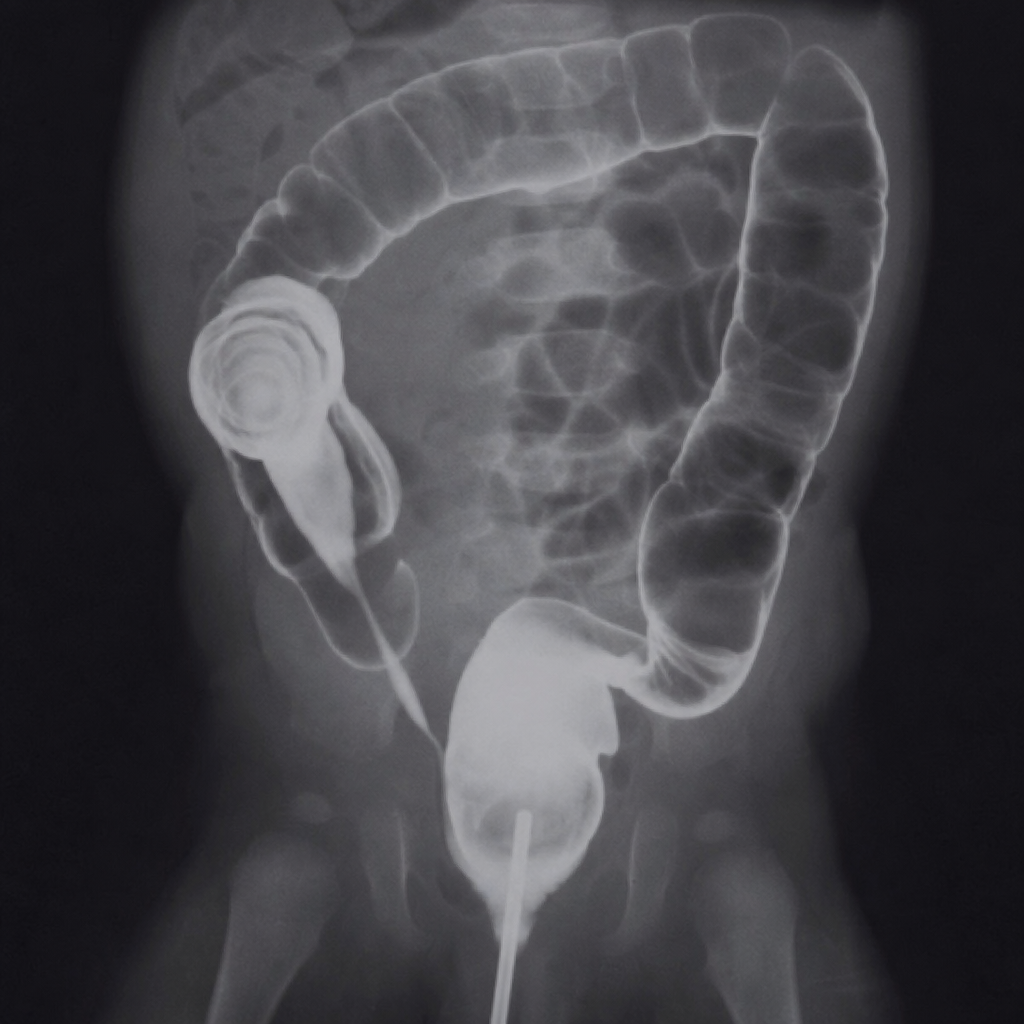
If you suspect a child to have Congenital Hypertrophic Pyloric Stenosis clinically, what is the next best investigation?
A 5-year-old child presents with diarrhea. How much oral rehydration solution (ORS) should be administered according to Plan A after each episode of stool?
What is the total osmolarity of low osmolarity ORS?
Which of the following is NOT true for annular pancreas?
What is the primary benefit of Oral Rehydration Solution (ORS) plus Zinc?
All of the following are causes of blood in stools in children except?
Pseudopolyps are a feature of which of the following conditions?
Antiendomysial antibody is used in the screening of which condition?
Which of the following is a sign of severe dehydration in a child?
What is the concentration of potassium in ORS in milliequivalents per liter?
Explanation: **Explanation:** **Congenital Hypertrophic Pyloric Stenosis (CHPS)** is characterized by hypertrophy of the pyloric sphincter muscle, leading to gastric outlet obstruction. **Why USG is the Correct Answer:** Ultrasonography (USG) is the **investigation of choice** because it is non-invasive, avoids radiation, and provides high sensitivity and specificity. It allows for direct measurement of the pyloric muscle. The diagnostic criteria on USG (Rule of 3 and 4) are: * **Pyloric muscle thickness > 3 mm** (most reliable) * **Pyloric channel length > 14 mm** * **Pyloric diameter > 10 mm** Additionally, USG can show the "Target sign" or "Donut sign" in cross-section. **Why Other Options are Incorrect:** * **A. Barium Meal:** Previously the gold standard, it is now reserved for cases where USG is inconclusive. It shows classic signs like the **"String sign"** (narrowed pyloric canal), **"Beak sign,"** or **"Mushroom sign."** However, it involves radiation and risk of aspiration. * **C & D. CT and MRI:** These are expensive, unnecessary, and may require sedation. They offer no diagnostic advantage over USG for this condition. **High-Yield Clinical Pearls for NEET-PG:** * **Clinical Presentation:** Non-bilious, projectile vomiting in a 3–6 week old infant. * **Physical Exam:** A palpable, mobile, hard, **olive-shaped mass** in the epigastrium and visible gastric peristalsis. * **Metabolic Abnormality:** Hypochloremic, hypokalemic, metabolic alkalosis with **paradoxical aciduria**. * **Management:** Initial step is fluid resuscitation (Normal Saline); definitive treatment is **Ramstedt’s Pyloromyotomy**.
Explanation: **Explanation:** The management of diarrhea in children is categorized into three plans (A, B, and C) based on the degree of dehydration. This question pertains to **Plan A**, which is used for children with **no signs of dehydration** to prevent it from developing. **Why Option B is Correct:** According to the WHO and IAP guidelines for Plan A, the amount of ORS to be administered after each loose stool depends on the child's age: * **Children <2 years:** 50–100 ml after each stool. * **Children 2–10 years:** 100–200 ml after each stool. * **Older children/Adults:** As much as they want. Since the child in the question is **5 years old**, the appropriate dose falls within the **100–200 ml** range. Among the choices provided, **100 ml** is the standard minimum recommended volume for this age group. **Analysis of Incorrect Options:** * **Option A (50 ml):** This is the lower limit for infants and children under 2 years of age. * **Option C (200 ml):** While 200 ml is the upper limit for a 5-year-old, 100 ml is the standard benchmark often tested in exams for the start of the 2–10 year range. * **Option D (According to thirst):** While thirst is a guide for older children and adults, specific volume guidelines are mandated for younger children to ensure adequate replacement of losses. **High-Yield Clinical Pearls for NEET-PG:** * **Plan B (Some Dehydration):** Dose is **75 ml/kg** over 4 hours. * **Plan C (Severe Dehydration):** Requires IV fluids (Ringer’s Lactate). Dose is **100 mg/kg** (30 ml/kg then 70 ml/kg). * **Zinc Supplementation:** Essential in all diarrhea cases; **10 mg/day** for infants <6 months and **20 mg/day** for >6 months for 14 days. * **ORS Composition:** Low osmolarity ORS (245 mOsm/L) is the current standard.
Explanation: **Explanation:** The World Health Organization (WHO) and UNICEF recommended the **Low Osmolarity ORS** (Oral Rehydration Solution) in 2004 to replace the standard ORS. The correct osmolarity is **245 mmol/L**. **Why 245 mmol/L is correct:** The shift from the older formula (311 mmol/L) to the low osmolarity version (245 mmol/L) was driven by clinical evidence showing that lower sodium and glucose concentrations reduce stool output, decrease the incidence of vomiting, and minimize the need for unscheduled intravenous fluids. The reduced sodium (75 mmol/L) and glucose (75 mmol/L) maintain the 1:1 molar ratio required for optimal sodium-glucose co-transport in the small intestine while avoiding osmotic diarrhea. **Analysis of Incorrect Options:** * **A. 311 mmol/L:** This was the osmolarity of the **Standard (Old) WHO ORS**. It was discontinued due to the risk of hypernatremia and increased stool output in children with non-cholera diarrhea. * **B. 300 mmol/L:** This is a distractor value and does not correspond to any WHO-recommended ORS formulation. * **D. 250 mmol/L:** While close, it is technically incorrect. The precise sum of the components (Sodium 75 + Chloride 65 + Glucose 75 + Potassium 20 + Citrate 10) equals exactly 245 mmol/L. **High-Yield Clinical Pearls for NEET-PG:** * **Composition of Low Osmolarity ORS (mmol/L):** Sodium (75), Chloride (65), Glucose (75), Potassium (20), Trisodium Citrate (10). * **Total Weight:** 20.5 grams per liter. * **Re-Reduced ORS:** Used specifically in **SAM (Severe Acute Malnutrition)**, known as **ReSoMal**, which has an even lower osmolarity (approx. 300 mOsm/L but with only 45 mmol/L Sodium) and higher Potassium. * **Zinc Supplementation:** Always given alongside ORS (10 mg/day for infants <6 months; 20 mg/day for >6 months) for 14 days to reduce the duration and recurrence of diarrhea.
Explanation: ### **Explanation: Annular Pancreas** **Annular pancreas** is a rare congenital anomaly where a ring of pancreatic tissue encircles the second part of the duodenum. It results from the failure of the **ventral pancreatic bud** to rotate properly behind the duodenum, leading to extrinsic compression. #### **Why Option A is the Correct Answer (The False Statement)** While an Upper GI series (Barium swallow/meal) can show the "double bubble" sign or extrinsic narrowing of the duodenum, it is **not the investigation of choice**. * In **neonates**, the investigation of choice is an **Abdominal X-ray**, which typically reveals the classic **"double bubble" sign** (air in the stomach and proximal duodenum). * In **adults**, the gold standard/investigation of choice is **ERCP** (or MRCP), as it can definitively visualize the pancreatic duct encircling the duodenum. #### **Analysis of Other Options** * **B. Duodenal obstruction may be present:** This is true. The pancreatic ring causes extrinsic stenosis. In neonates, this presents as non-bilious or bilious vomiting (depending on the site of obstruction relative to the ampulla). * **C. ERCP can be performed:** This is true. In symptomatic adults, ERCP is used to confirm the diagnosis by demonstrating the characteristic ductal anatomy. * **D. Non-rotation of the gut is associated:** This is true. Annular pancreas is frequently associated with other congenital anomalies, including **malrotation (non-rotation)**, Down syndrome, duodenal atresia, and tracheoesophageal fistula. #### **NEET-PG High-Yield Pearls** * **Embryology:** Caused by the persistence of the tip of the **left ventral pancreas** or abnormal migration of the ventral bud. * **Clinical Presentation:** Bimodal distribution (neonatal period or 3rd–5th decade of life). * **X-ray Finding:** Double bubble sign (shared with duodenal atresia and malrotation). * **Treatment of Choice:** **Duodenojejunostomy** or Duodenoduodenostomy (Bypass surgery). * *Note:* Never resect the pancreatic ring itself, as this leads to pancreatic fistulas and does not relieve the intrinsic duodenal stenosis often present.
Explanation: **Explanation:** The correct answer is **C. Reduces the duration of diarrhea.** Zinc supplementation is a cornerstone in the management of acute diarrhea in children, as recommended by the WHO and UNICEF. The primary therapeutic benefit of Zinc is its ability to **reduce the duration and severity of the diarrheal episode**. Mechanistically, Zinc acts as an intestinal "astringent" and a vital cofactor for over 300 enzymes. It improves the absorption of water and electrolytes, regenerates the intestinal epithelium (brush border), and enhances the local immune response, thereby accelerating recovery. **Analysis of Incorrect Options:** * **A. Reduces the incidence of infections:** While Zinc does boost immunity and can reduce the incidence of *subsequent* episodes of diarrhea for 2–3 months, its primary role during an active episode (alongside ORS) is therapeutic (reducing duration) rather than prophylactic against all infections. * **B. Acts as an antispasmodic agent:** Zinc has no direct effect on smooth muscle relaxation or intestinal motility; it works at the cellular and enzymatic level of the mucosa. * **C. Enhances sodium absorption:** This is the primary function of **Glucose** in the ORS (via the SGLT-1 transporter), not Zinc. While Zinc helps restore the mucosal surface, it is not the primary driver of the sodium-glucose co-transport mechanism. **High-Yield Clinical Pearls for NEET-PG:** * **WHO Recommended Dosage:** 20 mg/day for children >6 months and 10 mg/day for infants <6 months, for a total of **14 days**. * **Impact:** Zinc reduces the stool volume and the likelihood of the episode persisting beyond 7 days (persistent diarrhea). * **ORS Composition:** Remember that the current standard is **Low Osmolarity ORS** (245 mOsm/L) to minimize the risk of osmotic diarrhea and the need for IV fluids.
Explanation: **Explanation:** The correct answer is **B. Carcinoma**. In the pediatric age group, gastrointestinal malignancies like colorectal carcinoma are exceedingly rare. While they can cause hematochezia in adults, they are not considered a standard differential diagnosis for blood in stools in children unless there is a strong genetic predisposition (e.g., Familial Adenomatous Polyposis). **Analysis of Options:** * **Meckel’s Diverticulum:** This is the most common cause of **painless, profuse lower GI bleeding** in toddlers. It contains ectopic gastric mucosa which secretes acid, leading to ulceration of the adjacent ileal mucosa. * **Intussusception:** Characteristically presents in infants (6–18 months) with a triad of colicky abdominal pain, a palpable sausage-shaped mass, and **"red currant jelly" stools** (a mixture of mucus and blood due to venous congestion). * **Juvenile Polyp:** These are benign hamartomatous polyps and represent the most common cause of **painless bright red streaks of blood** over the surface of stools in children aged 2–10 years. **Clinical Pearls for NEET-PG:** * **Most common cause of GI bleed in neonates:** Swallowed maternal blood (Apt test is used to differentiate). * **Most common cause of lower GI bleed in infants:** Anal fissures or Milk Protein Allergy. * **Rule of 2s (Meckel’s):** 2% of the population, 2 inches long, 2 feet from the ileocecal valve, 2 types of ectopic tissue (gastric/pancreatic), and presents by age 2. * **Investigation of choice for Meckel’s:** Technetium-99m pertechnetate scan (Meckel’s scan).
Explanation: **Explanation:** **Pseudopolyps** (inflammatory polyps) are a hallmark endoscopic and histopathological feature of **Ulcerative Colitis (UC)**. They are not true neoplastic growths but represent islands of regenerating, inflamed residual mucosa surrounded by areas of extensive ulceration and mucosal denudation. As the ulcerated areas heal, the remaining elevated islands of mucosa project into the lumen, mimicking polyps. **Analysis of Options:** * **Ulcerative Colitis (Correct):** Characterized by continuous, superficial mucosal inflammation. The repeated cycle of ulceration and regeneration leads to the formation of pseudopolyps. * **Crohn’s Disease:** While pseudopolyps can occasionally occur, the classic endoscopic features are **"cobblestone appearance"** (due to longitudinal ulcers and fissuring) and **"skip lesions."** * **Celiac Sprue:** This is a malabsorption syndrome characterized by **villous atrophy**, crypt hyperplasia, and intraepithelial lymphocytosis, primarily in the duodenum. It does not present with polyps. * **Whipple’s Disease:** Caused by *Tropheryma whipplei*, it features PAS-positive macrophages in the lamina propria. It typically presents with diarrhea, weight loss, and arthralgia, but not pseudopolyps. **High-Yield Clinical Pearls for NEET-PG:** * **Lead Pipe Appearance:** Loss of haustrations in UC on barium enema. * **String Sign of Kantor:** Seen in Crohn’s disease due to terminal ileal narrowing. * **Crypt Abscesses:** A characteristic histological finding in Ulcerative Colitis. * **Backwash Ileitis:** Involvement of the terminal ileum in UC (unlike the transmural involvement in Crohn's). * **Cancer Risk:** Both UC and Crohn’s increase the risk of colorectal cancer, but the risk is significantly higher in chronic, extensive Ulcerative Colitis.
Explanation: **Explanation:** The correct answer is **Myasthenia Gravis (A)**. While Anti-endomysial antibody (EMA) is classically associated with Celiac disease, in the context of specific medical examinations and clinical pathology, it is also recognized as a marker for Myasthenia Gravis (MG). In MG, these antibodies are directed against the endomysium of **skeletal muscle** (specifically the intermyofibrillar substance), whereas in Celiac disease, they are directed against the endomysium of **smooth muscle** (targeting tissue transglutaminase). **Analysis of Options:** * **A. Myasthenia Gravis:** Patients often possess antibodies against skeletal muscle components. Anti-striational and anti-endomysial antibodies are found in a significant percentage of MG patients, especially those with thymoma. * **B. Autoimmune Hepatitis:** Characterized by Anti-Nuclear Antibodies (ANA), Anti-Smooth Muscle Antibodies (ASMA) - specifically anti-actin, and Liver-Kidney Microsomal type 1 (LKM-1) antibodies. * **C. Celiac Disease:** While EMA is a highly specific screening marker for Celiac disease (IgA EMA), the question's key focuses on the broader application of the term in skeletal muscle pathology. *Note: In most clinical scenarios, Celiac is the primary association, but in specific competitive formats, MG is the tested skeletal muscle association.* * **D. Graves Disease:** Associated with Thyroid Stimulating Immunoglobulins (TSI) and Anti-TPO antibodies. **High-Yield Clinical Pearls for NEET-PG:** * **Celiac Disease Gold Standard:** Intestinal biopsy showing villous atrophy and crypt hyperplasia. * **Most Sensitive for Celiac:** Anti-tissue Transglutaminase (tTG) IgA. * **Most Specific for Celiac:** Anti-Endomysial Antibody (EMA) IgA. * **Myasthenia Gravis Gold Standard:** Anti-AChR (Acetylcholine Receptor) antibodies; MuSK antibodies in seronegative cases.
Explanation: In Pediatrics, dehydration is classified by the WHO into three categories: **No Dehydration**, **Some Dehydration**, and **Severe Dehydration**. This classification is a high-yield topic for NEET-PG. ### **Why Lethargy is Correct** **Lethargy** (or being unconscious) is a hallmark sign of **Severe Dehydration**. It indicates significant intravascular volume depletion leading to cerebral hypoperfusion. According to WHO guidelines, a child must have at least two of the following to be classified as severely dehydrated: 1. Lethargy or unconsciousness 2. Inability to drink or drinking poorly 3. Sunken eyes 4. Very slow skin pinch (returns in >2 seconds) ### **Why Other Options are Incorrect** * **Irritability (B):** This is a sign of **Some Dehydration**. As dehydration progresses to "Severe," the child’s sensorium worsens from irritability to lethargy. * **Increased duration of skin pinch (C):** While a "slow" skin pinch is seen in "Some Dehydration," the specific sign for "Severe Dehydration" is a **"very slow"** skin pinch (taking more than 2 seconds). * **Sunken eyes (D):** This sign is common to both **Some** and **Severe Dehydration**. Since "Lethargy" is specific only to the Severe category, it is the more definitive answer for severity. ### **Clinical Pearls for NEET-PG** * **Plan C:** Severe dehydration is treated with IV fluids (Ringer’s Lactate is the fluid of choice). * **The "Skin Pinch" (Skin Turgor):** In children with **Severe Acute Malnutrition (SAM)** or **hypernatremic dehydration**, the skin pinch test is unreliable. * **Key Differentiator:** If a child is "Restless/Irritable," think **Some Dehydration**. If the child is "Lethargic/Floppy," think **Severe Dehydration**.
Explanation: The correct answer is **20 mEq/L**. This is a high-yield fact based on the **WHO Reduced Osmolarity ORS** formulation, which is the current global standard for managing dehydration due to diarrhea. ### **Educational Explanation** The primary goal of Oral Rehydration Salts (ORS) is to utilize the sodium-glucose cotransport mechanism in the small intestine to facilitate water absorption. Potassium is included to replace the significant fecal losses of potassium that occur during acute watery diarrhea, thereby preventing hypokalemia and associated complications like paralytic ileus. * **Why 20 mEq/L is correct:** The WHO Reduced Osmolarity ORS contains **1.5 g/L of Potassium Chloride**, which provides exactly **20 mEq/L** of potassium. This concentration is optimized to maintain electrolyte balance without causing hyperkalemia. ### **Analysis of Incorrect Options** * **A. 30 mEq/L:** This is not a standard concentration in WHO ORS. However, it is worth noting that ReSoMal (Rehydration Solution for Malnutrition) contains a higher potassium level (40 mEq/L) to address the chronic depletion seen in SAM patients. * **C. 90 mEq/L:** This was the **Sodium** concentration in the "Old" WHO ORS (Standard ORS). It is far too high for potassium. * **D. 60 mEq/L:** This was the **Chloride** concentration in the "Old" WHO ORS. In the current Reduced Osmolarity ORS, the chloride concentration is 65 mEq/L. ### **NEET-PG High-Yield Pearls** | Component | Reduced Osmolarity ORS (Current) | | :--- | :--- | | **Sodium** | 75 mEq/L | | **Chloride** | 65 mEq/L | | **Glucose (Anhydrous)** | 75 mmol/L (13.5 g/L) | | **Potassium** | **20 mEq/L** | | **Citrate** | 10 mmol/L | | **Total Osmolarity** | **245 mOsm/L** | * **Clinical Tip:** Reduced osmolarity ORS (245 mOsm/L) is superior to the older version (311 mOsm/L) because it reduces stool output, decreases vomiting, and reduces the need for unscheduled IV fluids.
Gastroesophageal Reflux
Practice Questions
Peptic Ulcer Disease
Practice Questions
Inflammatory Bowel Disease
Practice Questions
Celiac Disease
Practice Questions
Malabsorption Syndromes
Practice Questions
Acute and Chronic Diarrhea
Practice Questions
Constipation and Encopresis
Practice Questions
Gastrointestinal Bleeding
Practice Questions
Intestinal Obstruction
Practice Questions
Liver Diseases in Children
Practice Questions
Pancreatic Disorders
Practice Questions
Pediatric Nutritional Support
Practice Questions
Get full access to all questions, explanations, and performance tracking.
Start For Free