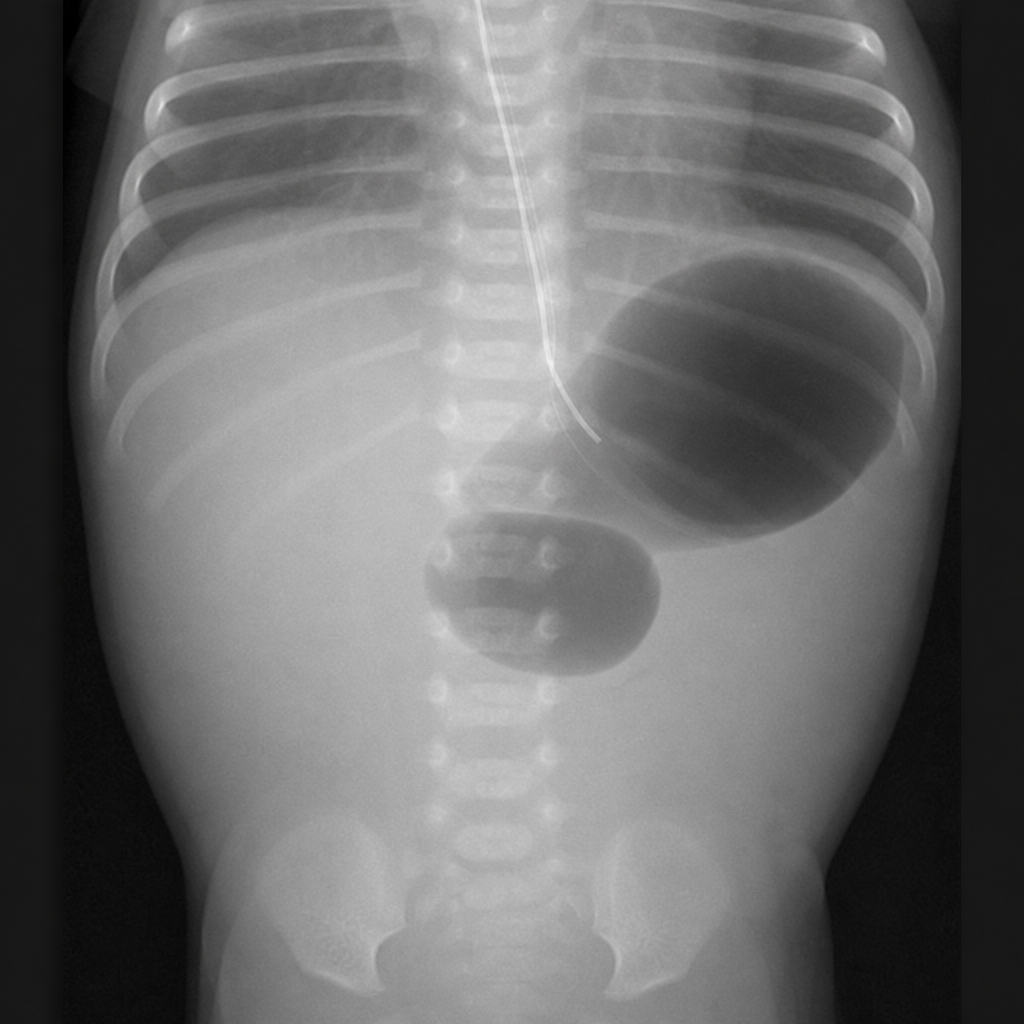
A neonate with Down syndrome presents with bilious vomiting. Which of the following is the most likely diagnosis?
All are features of neonatal necrotizing enterocolitis except?
According to WHO, all of the following are true about reduced osmolarity ORS (in mmol/L) except:
Which intestinal enzyme is generally deficient in children following an attack of severe infectious enteritis?
In neonatal cholestasis, what percentage of direct bilirubin is typically considered elevated?
A 5-year-old child presents with watery diarrhea for 7 days. On examination, the child's weight is 10 kg and shows hanging skin folds with a normal skin pinch. What should be the sodium concentration in the oral rehydration solution (ORS)?
A 1-year-old boy presented with failure to thrive and symptoms of severe fat malabsorption. The child was born at 39 weeks gestation via spontaneous vaginal delivery. The mother reported that the child's stools were pale, foul-smelling, and bulky. On examination, the child had a distended abdomen, absent deep tendon reflexes (DTRs), and slow intellectual development. Laboratory findings revealed low levels of serum cholesterol and serum triglycerides, with non-detectable VLDL and chylomicron levels. What of the following fatty acids should be most likely avoided in the diet in the described condition?
Henoch-Schonlein purpura may rarely cause which of the following complications?
Which of the following is NOT true of Reduced Osmolarity Oral Rehydration Solution (ORS)?
For a neonate at 48 hours of age with a history of non-passage of meconium, what is the next step in evaluation?
Explanation: **Explanation:** **1. Why Duodenal Atresia is Correct:** Duodenal atresia is the most common cause of neonatal intestinal obstruction in patients with **Down syndrome (Trisomy 21)**, occurring in approximately 30% of these cases. The hallmark clinical presentation is **bilious vomiting** within the first 24–48 hours of life because the obstruction is typically distal to the Ampulla of Vater. Radiologically, it is characterized by the classic **"Double Bubble Sign"** (air in the stomach and the proximal duodenum). **2. Why the Other Options are Incorrect:** * **Congenital Hypertrophic Pyloric Stenosis (CHPS):** This presents with **non-bilious**, projectile vomiting, typically between 3–6 weeks of age (not the immediate neonatal period). It is associated with a palpable "olive-shaped" mass. * **Ileal Atresia:** While it causes bilious vomiting, it is not specifically associated with Down syndrome. It usually presents with more significant abdominal distension and multiple air-fluid levels on X-ray. * **Anorectal Malformation:** While associated with VACTERL syndrome and Down syndrome, the primary presentation is the **failure to pass meconium** within 48 hours, rather than isolated early bilious vomiting. **3. High-Yield Clinical Pearls for NEET-PG:** * **Association:** 30% of infants with Duodenal Atresia have Down syndrome. * **Antenatal finding:** Polyhydramnios (due to inability of the fetus to swallow amniotic fluid). * **X-ray:** Double Bubble Sign. * **Management:** Gastric decompression followed by **Duodenoduodenostomy** (Kimura’s procedure). * **Differential for Bilious Vomiting:** Always rule out **Malrotation with Midgut Volvulus**, which is a surgical emergency.
Explanation: **Explanation:** Necrotizing Enterocolitis (NEC) is the most common life-threatening gastrointestinal emergency in neonates, particularly preterm infants. It is characterized by ischemic necrosis of the intestinal mucosa. **Why "Increased bowel sound" is the correct answer:** In NEC, the inflammatory process and intestinal ischemia lead to **ileus** (paralysis of bowel motility). Consequently, clinical examination typically reveals **absent or sluggish (decreased) bowel sounds**, rather than increased sounds. Hyperactive bowel sounds are more characteristic of early mechanical obstruction or acute gastroenteritis, not the intestinal gangrene seen in NEC. **Analysis of incorrect options:** * **Abdominal distension:** This is the most common clinical sign of NEC, resulting from gas accumulation in the bowel loops due to ileus and bacterial fermentation. * **Metabolic acidosis:** This is a marker of systemic toxicity and poor perfusion. Persistent metabolic acidosis in a neonate with NEC often suggests bowel gangrene or impending perforation. * **Pneumoperitoneum:** This signifies **intestinal perforation** (Bell’s Stage IIIb). On X-ray, it is seen as free air under the diaphragm or the "Football sign," and it is an absolute indication for emergency surgery. **High-Yield Clinical Pearls for NEET-PG:** * **Pathognomonic X-ray finding:** *Pneumatosis intestinalis* (gas within the bowel wall). * **Most common site:** Terminal ileum and proximal colon. * **Risk Factors:** Prematurity (most important), formula feeding, and intestinal ischemia. * **Modified Bell’s Staging:** Used to grade severity (Stage I: Suspected, Stage II: Definite/Pneumatosis, Stage III: Advanced/Perforation). * **Management:** "NPO" (Nothing by mouth), gastric decompression, antibiotics, and surgery if perforation occurs.
Explanation: The correct answer is **A. Glucose - 90**. ### **Explanation** The World Health Organization (WHO) and UNICEF transitioned from the standard high-osmolarity ORS to **Reduced Osmolarity ORS** in 2002. This change was implemented because lower sodium and glucose concentrations reduce stool output, decrease vomiting, and minimize the risk of hypernatremia. In the reduced osmolarity formula, the **Glucose concentration is 75 mmol/L**, not 90 mmol/L. A 1:1 molar ratio of sodium to glucose is maintained to optimize the SGLT-1 (Sodium-Glucose Luminal Cotransporter) mechanism in the small intestine, which facilitates water absorption. ### **Analysis of Options** * **A. Glucose (90 mmol/L):** This is **incorrect** for reduced osmolarity ORS (it was the value in the older 1975 formula). The current value is **75 mmol/L**. * **B. Sodium (75 mmol/L):** This is **correct**. The sodium concentration was reduced from 90 to 75 to prevent osmotic overload. * **C. Potassium (20 mmol/L):** This is **correct**. Potassium levels remain unchanged from the original formula to replace losses from diarrhea. * **D. Citrate (10 mmol/L):** This is **correct**. Trisodium citrate is used to correct metabolic acidosis; it also increases the shelf life of the ORS packet compared to bicarbonate. ### **High-Yield Clinical Pearls for NEET-PG** * **Total Osmolarity:** The total osmolarity of reduced ORS is **245 mOsm/L** (compared to 311 mOsm/L in the old formula). * **Chloride Concentration:** 65 mmol/L. * **Zinc Supplementation:** Always remember that WHO recommends Zinc (20 mg/day for 10–14 days; 10 mg for infants <6 months) alongside ORS to reduce the duration and severity of diarrhea. * **ReSoMal:** A special ORS used for **Severely Malnourished** children; it has lower Sodium (45 mmol/L) and higher Potassium (40 mmol/L).
Explanation: **Explanation:** The correct answer is **Lactase (Option A)**. **Why Lactase is the correct answer:** Lactase is a brush-border enzyme located at the **tips of the intestinal villi**. In cases of severe infectious enteritis (especially viral infections like Rotavirus), the inflammatory process leads to the destruction of these villous tips (villous atrophy). Because lactase is the most superficial and the last enzyme to mature during fetal development, it is the **first to be lost** and the **last to recover** following mucosal injury. This leads to **secondary lactose intolerance**, characterized by osmotic diarrhea, abdominal distension, and acidic stools (positive reducing substances) after milk ingestion. **Why the other options are incorrect:** * **Trypsin (Option B), Lipase (Option C), and Amylase (Option D):** These are **pancreatic enzymes**, not intestinal brush-border enzymes. They are secreted by the pancreas into the duodenal lumen. While severe malnutrition (like Kwashiorkor) can affect pancreatic function, a standard bout of infectious enteritis primarily damages the intestinal mucosa, leaving pancreatic enzyme production largely intact. **High-Yield Clinical Pearls for NEET-PG:** * **Most common cause of secondary disaccharidase deficiency:** Post-gastroenteritis (Rotavirus is the classic culprit). * **Stool findings in Lactose Intolerance:** Stool pH < 5.5 and presence of reducing substances (Clinitest positive). * **Management:** Temporary switch to a lactose-free diet or soy-based formula until the mucosa heals (usually 2–4 weeks). * **Location Hierarchy:** Lactase is at the tips (most vulnerable), while sucrase and maltase are located deeper in the villi (more resistant).
Explanation: **Explanation:** Neonatal cholestasis is defined by the presence of prolonged conjugated hyperbilirubinemia. According to the North American Society for Pediatric Gastroenterology, Hepatology, and Nutrition (NASPGHAN) and the ESPGHAN guidelines, the biochemical definition of cholestasis depends on the total serum bilirubin (TSB) level: 1. **If TSB is >5 mg/dL:** Direct bilirubin is considered elevated if it is **>20%** of the total bilirubin. 2. **If TSB is <5 mg/dL:** Direct bilirubin is considered elevated if it is **>1.0 mg/dL**. **Why C is correct:** The threshold of **>20%** is the standard diagnostic criterion used to differentiate physiological jaundice from pathological cholestasis when total bilirubin levels are significantly high. This percentage indicates a failure in bile flow or excretion rather than just increased production or impaired conjugation. **Why other options are incorrect:** * **A (>10%) and B (>15%):** These values are too low and lack the specificity required to diagnose cholestasis, as minor fluctuations in laboratory reporting or mild hemolysis could result in these percentages without true biliary pathology. * **D (>25%):** While a value >25% is certainly cholestatic, it is not the minimum diagnostic threshold. Using 25% as the cutoff would result in missing early or mild cases of Biliary Atresia or Neonatal Hepatitis. **High-Yield Clinical Pearls for NEET-PG:** * **Golden Rule:** Any neonate with jaundice persisting beyond **2 weeks** of age must be evaluated for cholestasis with a fractionated bilirubin test. * **Stool Color:** Pale or acholic stools are the most sensitive clinical indicator of obstructive cholestasis (e.g., Biliary Atresia). * **Most Common Cause:** Extrahepatic Biliary Atresia (EHBA) is the most common surgical cause, while Idiopathic Neonatal Hepatitis is the most common medical cause. * **Kasai Procedure:** For Biliary Atresia, the best outcomes occur when surgery is performed before **60 days** of life.
Explanation: ### Explanation The core of this question lies in identifying the child's nutritional status and the standard of care for dehydration. **1. Why 75 mEq/L is Correct:** The clinical description of "hanging skin folds" in a 5-year-old weighing only 10 kg (expected weight for age is ~18 kg) indicates **Severe Acute Malnutrition (SAM)**. However, the child has a **normal skin pinch**, which is a crucial distractor. In SAM, skin pinch is often unreliable due to the loss of subcutaneous fat. According to the current **WHO and IAP guidelines**, the standard **Low Osmolarity ORS** (containing **75 mEq/L of Sodium**) is the fluid of choice for managing diarrhea in children with some dehydration. While a specific formula called ReSoMal (30–45 mEq/L Sodium) is used for dehydration in SAM, it is strictly reserved for children who are *not* having watery diarrhea (cholera-like). For children with watery diarrhea, even those with SAM, standard Low Osmolarity ORS (75 mEq/L) is preferred to prevent hyponatremia. **2. Why Other Options are Incorrect:** * **45 mEq/L (Option A):** This is the sodium concentration in **ReSoMal**. It is used for SAM children with dehydration *unless* they have watery diarrhea/cholera, as the low sodium may worsen electrolyte imbalances in high-purge states. * **60 mEq/L (Option B):** This does not correspond to any standard WHO-recommended ORS formulation for acute diarrhea. * **90 mEq/L (Option D):** This was the sodium concentration in the **Old WHO ORS** (High Osmolarity). It was replaced by the low-osmolarity version to reduce the risk of hypernatremia and decrease stool output. **3. Clinical Pearls for NEET-PG:** * **Standard Low Osmolarity ORS:** Total Osmolarity = **245 mOsm/L**; Sodium = 75 mEq/L; Glucose = 75 mmol/L. * **ReSoMal:** Used in SAM; has lower Sodium (45 mEq/L) and higher Potassium (40 mEq/L). * **Zinc Supplementation:** 20 mg/day for 14 days (10 mg if <6 months) is essential in all diarrhea cases to reduce recurrence.
Explanation: **Explanation:** The clinical presentation of severe fat malabsorption, failure to thrive, absent deep tendon reflexes (due to Vitamin E deficiency), and laboratory findings of near-zero cholesterol, VLDL, and chylomicrons is diagnostic of **Abetalipoproteinemia (Bassen-Kornzweig syndrome)**. **Why the Correct Answer is Right:** Abetalipoproteinemia is caused by a mutation in the **Microsomal Triglyceride Transfer Protein (MTP)** gene. MTP is essential for loading ApoB-48 (in enterocytes) and ApoB-100 (in hepatocytes) with lipids. Without functional MTP, chylomicrons cannot be formed. **Long-Chain Fatty Acids (LCFA)** and **Very Long-Chain Fatty Acids (VLCFA)** require chylomicron formation for transport into the lymphatic system. In this condition, these fats accumulate within enterocytes (seen as vacuolated enterocytes on biopsy), leading to malabsorption and steatorrhea. Therefore, VLCFAs (and LCFAs) must be strictly restricted in the diet to prevent intestinal accumulation and worsening symptoms. **Why Incorrect Options are Wrong:** * **Medium Chain Fatty Acids (MCFA):** These are the **preferred** energy source in this condition. MCFAs are water-soluble and can be absorbed directly into the portal venous circulation without requiring MTP or chylomicron assembly. * **Short Chain Fatty Acids (SCFA):** These are primarily produced by colonic fermentation of fiber and do not require the chylomicron pathway for absorption. * **Long Chain Fatty Acids (LCFA):** While LCFAs should also be restricted, VLCFAs are even more dependent on complex transport mechanisms. (Note: In many clinical contexts, LCFA and VLCFA restriction are discussed together for this condition). **Clinical Pearls for NEET-PG:** * **Peripheral Smear:** Look for **Acanthocytes** (spur cells). * **Biopsy:** Characterized by **clear vacuoles** (lipid-laden) in the intestinal villi. * **Neurological symptoms:** Caused by severe deficiency of fat-soluble vitamins, especially **Vitamin E**, leading to spinocerebellar degeneration and ataxia. * **Treatment:** Low-fat diet (restricting LCFAs/VLCFAs), MCFA supplementation, and high doses of oral fat-soluble vitamins (A, D, E, K).
Explanation: **Explanation:** Henoch-Schönlein Purpura (HSP), now commonly referred to as **IgA Vasculitis**, is a small-vessel vasculitis characterized by the deposition of IgA immune complexes. The classic tetrad includes palpable purpura, arthralgia, abdominal pain, and renal involvement. **Why Intussusception is the correct answer:** Gastrointestinal involvement occurs in approximately 75% of cases due to submucosal hemorrhage and edema within the bowel wall. These focal areas of swelling (hematomas) act as a **pathological lead point**, allowing one segment of the intestine to telescope into another. * **High-Yield Note:** Unlike idiopathic intussusception (which is usually ileocolic), HSP-associated intussusception is frequently **ileo-ileal** (small bowel) and may require surgical reduction if radiological reduction fails. **Why other options are incorrect:** * **Volvulus:** While HSP causes bowel wall thickening, it does not typically lead to the twisting of the mesentery (volvulus) unless there is a pre-existing malrotation. * **Hernia:** Hernias are anatomical defects in the abdominal wall or internal membranes; they are not pathophysiologically linked to the inflammatory vasculitis seen in HSP. **Clinical Pearls for NEET-PG:** 1. **Most common GI symptom:** Colicky abdominal pain. 2. **Most common site of Intussusception in HSP:** Small bowel (Ileo-ileal). 3. **Diagnosis:** Ultrasound is the investigation of choice to detect the "target sign" or "doughnut sign." 4. **Management:** While steroids may help with joint and GI pain, they do not prevent renal progression or the occurrence of intussusception.
Explanation: The World Health Organization (WHO) and UNICEF recommended the **Reduced Osmolarity ORS** in 2002 to improve the efficacy of oral rehydration therapy. The goal was to reduce the risk of hypernatremia and decrease the stool output and vomiting associated with the older, high-osmolarity formula. ### **Explanation of Options:** * **Option C (Correct):** This statement is **incorrect**. The actual **Chloride content** in Reduced Osmolarity ORS is **65 mmol/L**, not 45 mmol/L. This is why it is the right answer for a "NOT true" question. * **Option A:** This is **true**. The Sodium concentration was reduced from 90 mmol/L (Standard ORS) to **75 mmol/L** to prevent the risk of hypernatremia. * **Option B:** This is **true**. The Potassium concentration remains unchanged at **20 mmol/L** to replace losses and prevent hypokalemia. * **Option D:** This is **true**. The total osmolarity of the new formula is **245 mOsm/L** (reduced from the previous 311 mOsm/L). ### **High-Yield Composition Table (WHO Reduced Osmolarity ORS):** | Component | Concentration (mmol/L) | | :--- | :--- | | **Sodium** | 75 | | **Chloride** | **65** | | **Glucose (Anhydrous)** | 75 | | **Potassium** | 20 | | **Citrate** | 10 | | **Total Osmolarity** | **245 mOsm/L** | ### **Clinical Pearls for NEET-PG:** 1. **Glucose-Sodium Ratio:** The ratio is **1:1**, which is optimal for the SGLT-1 transporter in the small intestine to maximize water absorption. 2. **Advantages:** Reduced osmolarity ORS leads to a **33% reduction** in the need for IV fluids, a **20% reduction** in stool volume, and a **30% reduction** in vomiting. 3. **Re-Somal:** This is a special ORS used for **Severely Malnourished children**; it has lower Sodium (45 mmol/L) and higher Potassium (40 mmol/L).
Explanation: **Explanation:** The failure to pass meconium within the first 24–48 hours of life is a clinical red flag, most commonly associated with **Hirschsprung Disease (HD)** or **Meconium Ileus (MI)**. **Why Lower GI Study is the Correct Next Step:** A **Contrast Enema (Lower GI Study)** is the initial diagnostic imaging of choice. It serves two critical purposes: 1. **Diagnostic:** It helps differentiate between HD (showing a "transition zone" with a narrow distal segment and dilated proximal colon) and MI (showing a "microcolon" with pellet-like meconium). 2. **Therapeutic:** In cases of Meconium Ileus, water-soluble contrast (like Gastrografin) can help dissolve and flush out the inspissated meconium. **Analysis of Incorrect Options:** * **A & B (Sweat Chloride & CFTR Analysis):** While Meconium Ileus is the earliest manifestation of Cystic Fibrosis (CF), these tests are not the *immediate* next step. Sweat chloride is often unreliable in the first 48 hours due to low sweat rates in neonates, and genetic testing is a confirmatory step, not an initial evaluation for intestinal obstruction. * **D (Manometry):** Anorectal manometry is used to look for the absence of the Rectoanal Inhibitory Reflex (RAIR) in Hirschsprung Disease. However, it is technically difficult to perform and interpret in neonates and is usually reserved for older children or as a secondary investigation. **Clinical Pearls for NEET-PG:** * **Gold Standard for HD:** Rectal Suction Biopsy (showing absence of ganglion cells and hypertrophied nerve bundles). * **Most Common Site for HD:** Rectosigmoid region (Short-segment disease). * **X-ray finding:** "Target sign" or dilated bowel loops; however, a contrast enema provides more anatomical detail for surgical planning. * **Associated Syndrome:** Down Syndrome is frequently associated with Hirschsprung Disease.
Gastroesophageal Reflux
Practice Questions
Peptic Ulcer Disease
Practice Questions
Inflammatory Bowel Disease
Practice Questions
Celiac Disease
Practice Questions
Malabsorption Syndromes
Practice Questions
Acute and Chronic Diarrhea
Practice Questions
Constipation and Encopresis
Practice Questions
Gastrointestinal Bleeding
Practice Questions
Intestinal Obstruction
Practice Questions
Liver Diseases in Children
Practice Questions
Pancreatic Disorders
Practice Questions
Pediatric Nutritional Support
Practice Questions
Get full access to all questions, explanations, and performance tracking.
Start For Free