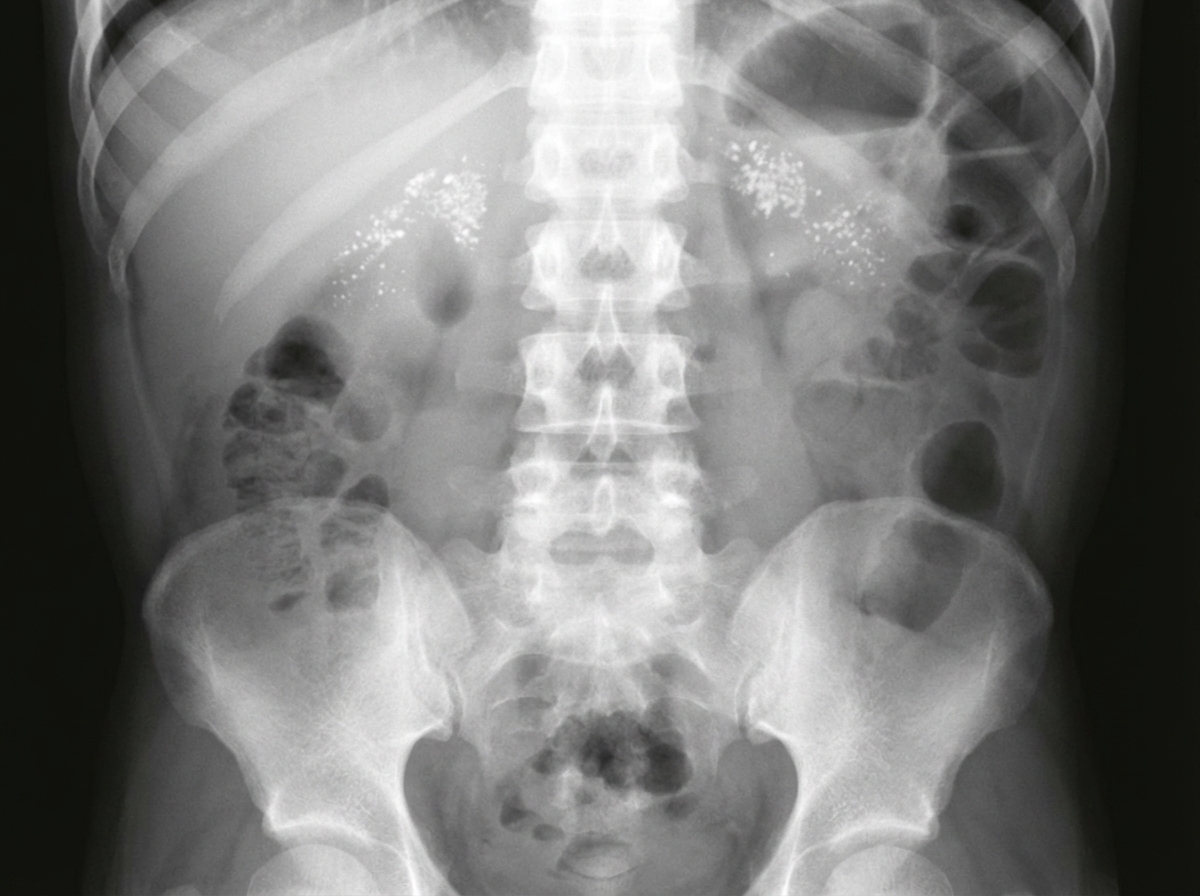
A 7-year-old child presents with increased thirst and enuresis. Despite increased appetite, there has been a 5-pound weight loss over the past month. A urine dipstick reveals glucosuria. What is the most likely finding in a blood sample from this patient compared to a normal individual?
What is the most common presentation of congenital hypothyroidism?
Which of the following is NOT a feature of Allgrove syndrome?
What is true about rickets?
A child with increased conjugated bilirubin develops seizures and cataract. What is the probable diagnosis?
Which of the following is a common presentation of juvenile hypothyroidism?
What drug is used in the treatment of congenital adrenal hyperplasia (CAH) in a child?
The features of neonatal hyperthyroidism include all except?
Features of Laurence-Moon-Bardet-Biedl syndrome include all of the following EXCEPT?
A 2-year-old child presents with a history of drowsiness, progressing to unconsciousness and seizures. On evaluation, the blood glucose level is found to be 25 mg/dL. Following the administration of 5 mL/kg of dextrose, there is no improvement. A repeat blood glucose measurement shows the level has risen to 130 mg/dL. Considering this clinical scenario, which of the following interventions could be detrimental?
Explanation: ### Explanation **Diagnosis: Type 1 Diabetes Mellitus (T1DM)** The clinical triad of polyuria (enuresis), polydipsia (thirst), and polyphagia (increased appetite) accompanied by weight loss and glucosuria in a child is a classic presentation of Type 1 Diabetes Mellitus. **1. Why Option D is Correct:** T1DM is an autoimmune condition characterized by the T-cell-mediated destruction of pancreatic beta cells. In over 90% of newly diagnosed cases, autoantibodies are present. **Antibodies against Glutamic Acid Decarboxylase (GAD65)** are among the most common and persistent markers. Other markers include Insulin Autoantibodies (IAA) and Islet Cell Antibodies (ICA/IA-2). **2. Why Incorrect Options are Wrong:** * **Option A (Increased C-peptide):** C-peptide is a byproduct of endogenous insulin production. In T1DM, beta-cell destruction leads to absolute insulin deficiency, resulting in **decreased** C-peptide levels. * **Option B (Decreased HbA1c):** HbA1c reflects average blood glucose over 3 months. Chronic hyperglycemia in undiagnosed T1DM would result in an **increased** HbA1c (typically >6.5%). * **Option C (Decreased Osmolarity):** Hyperglycemia increases serum glucose, which is an osmotically active particle. This leads to **increased** serum osmolarity, which triggers the thirst mechanism. **3. NEET-PG High-Yield Pearls:** * **Most common HLA associations:** HLA-DR3 and HLA-DR4. * **First sign of T1DM:** Often presents as Diabetic Ketoacidosis (DKA) in children. * **Diagnostic Criteria:** Fasting Plasma Glucose ≥126 mg/dL, 2-hour Post-Prandial ≥200 mg/dL, or HbA1c ≥6.5%. * **Honeymoon Phase:** A transient period after starting insulin where remaining beta cells function temporarily, reducing exogenous insulin requirements.
Explanation: **Explanation:** The correct answer is **D. Asymptomatic at birth.** **Why it is correct:** The most common presentation of congenital hypothyroidism (CH) is an **asymptomatic neonate**. This occurs because of the **transplacental transfer of maternal thyroid hormones (T4)**, which provides approximately 33% of normal fetal levels. This maternal contribution is sufficient to prevent clinical symptoms and protect the developing fetal brain in the immediate postnatal period, even if the infant’s thyroid gland is absent (athyreosis) or dysgenetic. **Analysis of Incorrect Options:** * **A, B, and C:** While prolonged jaundice, a wide posterior fontanelle (>0.5 cm), macroglossia, umbilical hernia, and poor feeding are classic clinical signs of CH, they are **late manifestations**. Only about 5% of affected newborns exhibit these signs in the first few days of life. If a clinician waits for these symptoms to appear, irreversible intellectual disability may have already begun. **High-Yield Clinical Pearls for NEET-PG:** * **Most Common Cause:** Thyroid Dysgenesis (80-85%), with ectopic thyroid being the most frequent subtype. * **Screening:** This is why **Universal Newborn Screening** (usually via heel prick for TSH or T4 between 48–72 hours) is critical; it identifies the condition during the asymptomatic window. * **Early Sign:** If symptoms *do* appear early, a **wide posterior fontanelle** is often the earliest physical marker. * **Treatment:** Levothyroxine (10-15 μg/kg/day) should be started immediately to ensure normal neurodevelopment.
Explanation: **Explanation:** **Allgrove Syndrome**, also known as **Triple A Syndrome**, is a rare autosomal recessive disorder caused by mutations in the *AAAS* gene on chromosome 12q13, which encodes the protein **ALADIN**. **Why Option A is correct:** The hallmark of Allgrove syndrome is **ACTH-resistant adrenal insufficiency** (Addisonian-like state), not ACTH excess. Patients suffer from a deficiency of glucocorticoids because the adrenal cortex fails to respond to ACTH. Therefore, it leads to **adrenal crisis**, not Cushing syndrome (which is characterized by cortisol excess). **Why the other options are incorrect:** * **B. Achalasia:** This is one of the three "A"s. It involves the failure of the lower esophageal sphincter to relax, leading to dysphagia. * **C. Alacrimia:** Often the earliest presenting sign, it refers to the absence or severe reduction of tear production. * **D. Hyperpigmentation:** Because the adrenal gland is resistant to ACTH, the body produces compensatory **high levels of ACTH**. High ACTH cross-reacts with melanocortin-1 receptors, leading to skin and mucosal hyperpigmentation, similar to primary adrenal insufficiency. **High-Yield Clinical Pearls for NEET-PG:** * **The 3 "A"s:** **A**chalasia, **A**lacrimia, and **A**drenal insufficiency. * **The 4th "A":** Many experts include **A**utonomic dysfunction (e.g., pupillary abnormalities, orthostatic hypotension) as a fourth feature. * **Diagnosis:** Schirmer’s test is used to confirm alacrimia. * **Management:** Glucocorticoid replacement is life-saving; mineralocorticoid function is usually preserved in these patients.
Explanation: **Explanation:** Rickets is a disorder of defective mineralization of the osteoid matrix at the growth plates, most commonly due to Vitamin D deficiency. **1. Why Hypophosphatemia is Correct:** In Vitamin D deficiency, there is decreased intestinal absorption of Calcium ($Ca^{2+}$). This leads to **secondary hyperparathyroidism** (increased PTH). PTH acts on the kidneys to increase calcium reabsorption but simultaneously **decreases renal phosphate reabsorption** (phosphaturia). This results in low serum phosphate levels (**Hypophosphatemia**). Low phosphate is the primary driver of the failure of chondrocyte apoptosis and subsequent defective mineralization seen in rickets. **2. Why the other options are incorrect:** * **A. Hyperphosphatemia:** Incorrect. As explained, PTH-mediated renal loss leads to low, not high, serum phosphate. * **C. Hypophosphaturia:** Incorrect. PTH causes **Hyperphosphaturia** (increased phosphate in urine) by inhibiting the Na-Pi cotransporter in the proximal tubule. * **D. Decreased alkaline phosphatase:** Incorrect. **Elevated Alkaline Phosphatase (ALP)** is the hallmark biochemical marker of rickets. It reflects increased osteoblastic activity attempting to compensate for the mineralization defect. **High-Yield Clinical Pearls for NEET-PG:** * **Earliest Biochemical Sign:** Decreased serum $25(OH)D$ levels. * **Earliest Radiological Sign:** Rarefaction of the zone of provisional calcification (seen at the wrist). * **Classic Radiological Triad:** Cupping, Splaying, and Fraying of the metaphysis. * **Key Biochemical Profile:** ↓/Normal Calcium, **↓ Phosphate**, **↑ ALP**, and **↑ PTH**. * **Craniotabes:** The earliest clinical sign of rickets (softening of skull bones).
Explanation: **Explanation:** The clinical triad of **conjugated hyperbilirubinemia (jaundice), cataracts, and seizures** (due to hypoglycemia) in an infant is a classic presentation of **Classic Galactosemia**. **1. Why Galactosemia is correct:** Galactosemia is most commonly caused by a deficiency of **Galactose-1-phosphate uridyltransferase (GALT)**. When an infant is fed breast milk or cow’s milk (containing lactose), galactose accumulates. * **Liver:** Accumulation of galactose-1-phosphate causes hepatotoxicity, leading to cholestasis and conjugated hyperbilirubinemia. * **Eyes:** Excess galactose is converted to **galactitol** by aldose reductase. Galactitol is osmotically active, drawing water into the lens and causing "oil-drop" cataracts. * **Brain:** Severe hypoglycemia occurs because accumulated phosphates inhibit glycogenolysis and gluconeogenesis, leading to seizures. **2. Why other options are incorrect:** * **Tyrosinemia (Type I):** Presents with liver failure, rickets, and a "cabbage-like" odor. While it causes jaundice, it does **not** typically cause cataracts. * **Fructosemia (Hereditary Fructose Intolerance):** Symptoms begin only after introducing fructose/sucrose (fruits/juices). It causes hypoglycemia and jaundice but **not** cataracts. * **Glycogen Storage Disorders (GSD):** GSD Type I (von Gierke) presents with massive hepatomegaly, lactic acidosis, and hypoglycemia, but typically features **unconjugated** bilirubinemia and lacks cataracts. **High-Yield Clinical Pearls for NEET-PG:** * **Deficiency:** GALT (Chromosome 9p). * **Screening:** Reducing substances in urine (Clinitest positive) while glucose oxidase (Dipstick) is negative. * **Infection Risk:** Increased susceptibility to **E. coli sepsis** (due to inhibition of leucocyte bactericidal activity). * **Management:** Immediate lifelong exclusion of lactose and galactose from the diet.
Explanation: **Explanation:** **Juvenile Hypothyroidism** refers to hypothyroidism acquired after the period of infancy (usually after 2 years of age). Unlike congenital hypothyroidism, the clinical presentation is often subtle and insidious. 1. **Why Growth Retardation is Correct:** The hallmark of juvenile hypothyroidism is a **deceleration in growth velocity**, leading to short stature. Thyroid hormones are essential for linear bone growth and skeletal maturation. A key clinical finding is that the **bone age is significantly delayed** compared to the chronological age. This is often the earliest and most common reason for presentation in clinical practice. 2. **Analysis of Incorrect Options:** * **Mental Retardation (B):** This is a feature of **Congenital Hypothyroidism** if not treated within the first few weeks of life. In juvenile hypothyroidism, the brain is already developed, so while children may show sluggishness or poor school performance, permanent intellectual disability (mental retardation) does not occur. * **Delayed Puberty (C):** While hypothyroidism can cause delayed puberty, it is classically associated with **Precocious Puberty** (Van Wyk-Grumbach Syndrome). High levels of TSH can cross-react with FSH receptors, leading to early breast development or testicular enlargement. * **Umbilical Hernia (D):** This is a classic sign of **Congenital Hypothyroidism** (infantile presentation), along with a large tongue and prolonged jaundice, rather than the juvenile form. **High-Yield NEET-PG Pearls:** * **Most common cause:** Hashimoto’s Thyroiditis (Autoimmune). * **Earliest Sign:** Growth failure (falling across centiles on a growth chart). * **Dental Sign:** Delayed eruption of permanent teeth. * **Van Wyk-Grumbach Syndrome:** Triad of Juvenile Hypothyroidism, Precocious Puberty, and Delayed Bone Age.
Explanation: **Explanation:** The primary goal in treating **Congenital Adrenal Hyperplasia (CAH)** is to replace deficient cortisol and suppress the excess secretion of Corticotropin-Releasing Hormone (CRH) and ACTH, thereby reducing adrenal androgen overproduction. **Why Hydrocortisone is the Correct Answer:** Hydrocortisone is the **drug of choice** for pediatric CAH because it is the most physiological glucocorticoid. It has a short half-life and lower potency compared to synthetic steroids, which allows for better titration. Most importantly, it has the **least suppressive effect on linear growth** and bone maturation, making it ideal for the growing skeleton of a child. **Analysis of Incorrect Options:** * **Dexamethasone (A) & Betamethasone (B):** These are long-acting, highly potent synthetic glucocorticoids. They are avoided in children because they cause profound and prolonged suppression of the hypothalamic-pituitary-adrenal (HPA) axis, leading to severe **growth retardation** and iatrogenic Cushing’s syndrome. (Note: Dexamethasone is used for *prenatal* treatment of CAH in the mother). * **Prednisolone (C):** This is an intermediate-acting steroid. While sometimes used in adolescents who have completed their growth, it is still more growth-suppressive than hydrocortisone and is not the first-line choice in growing children. **High-Yield Clinical Pearls for NEET-PG:** * **Monitoring:** The adequacy of treatment is monitored by measuring levels of **17-hydroxyprogesterone (17-OHP)** and **Androstenedione**. * **Mineralocorticoid Replacement:** In the salt-wasting variety, **Fludrocortisone** is added to the regimen. * **Stress Dosing:** During periods of illness, trauma, or surgery, the dose of hydrocortisone must be doubled or tripled ("stress doses") to prevent an adrenal crisis. * **Gold Standard Diagnosis:** Elevated 17-OHP levels (usually >200 ng/dL on screening).
Explanation: **Explanation:** Neonatal hyperthyroidism (Neonatal Graves' Disease) is a rare but serious condition typically caused by the transplacental passage of maternal **Thyroid Stimulating Immunoglobulins (TSI)**. **Why "Goiter is rare" is the correct (incorrect statement) answer:** In neonatal hyperthyroidism, **goiter is actually a common and characteristic finding**. The maternal antibodies (TSI) stimulate the fetal thyroid gland, leading to hyperplasia and enlargement. A large goiter in a neonate can occasionally cause airway obstruction or interfere with swallowing. **Analysis of other options:** * **Triangular facies and Craniosynostosis:** Chronic exposure to excess thyroid hormones in utero or early infancy accelerates bone growth. This leads to premature fusion of cranial sutures (craniosynostosis) and a characteristic triangular facial appearance (frontal bossing with a pointed chin). * **Congestive Cardiac Failure (CCF):** Hyperthyroidism induces a hyperdynamic state. Neonates often present with severe tachycardia, arrhythmias, and high-output cardiac failure, which is a leading cause of mortality if untreated. * **Advanced Osseous Maturation:** Thyroid hormone is a potent stimulator of bone maturation. Affected neonates often show advanced bone age on X-rays (e.g., presence of the distal femoral epiphysis earlier than expected). **Clinical Pearls for NEET-PG:** * **Etiology:** Most cases are transient, resolving in 3–12 weeks as maternal antibodies are cleared from the infant's circulation. * **Clinical Features:** Irritability, poor weight gain despite polyphagia (voracious appetite), exophthalmos, and hepatosplenomegaly. * **Treatment:** The drug of choice is **Methimazole**. Propranolol is used to manage tachycardia/CCF, and Lugol’s iodine may be used to acutely inhibit hormone release.
Explanation: **Explanation:** Laurence-Moon-Bardet-Biedl (LMBB) syndrome is a rare autosomal recessive ciliopathy characterized by multi-system involvement. The correct answer is **Cataract**, as it is not a classic feature of this syndrome. Instead, the hallmark ocular finding is **Retinitis Pigmentosa** (rod-cone dystrophy), which leads to night blindness and progressive vision loss. **Analysis of Options:** * **Hypogonadism (Option A):** This is a primary feature, often manifesting as delayed puberty, small genitalia, or infertility due to hypogonadotropic hypogonadism. * **Obesity (Option B):** Truncal obesity is one of the most common and earliest signs, typically appearing in early childhood. * **Polydactyly (Option C):** Post-axial polydactyly (extra digits on the ulnar/fibular side) is a classic diagnostic criterion. * **Cataract (Option D):** While vision is affected, it is due to retinal degeneration, not lens opacification. Therefore, Cataract is the "Except" option. **Clinical Pearls for NEET-PG:** * **The "Pentad" of LMBB:** 1. Obesity, 2. Hypogonadism, 3. Polydactyly, 4. Retinitis Pigmentosa, 5. Mental Retardation (Intellectual disability). * **Renal Involvement:** Chronic renal failure is the most common cause of morbidity and mortality in these patients. * **Distinction:** Historically, **Laurence-Moon** was associated with spastic paraplegia and no polydactyly, while **Bardet-Biedl** featured polydactyly and obesity. They are now often grouped together as a spectrum. * **Mnemonic:** Remember **"PRORH"** (Polydactyly, Retinitis pigmentosa, Obesity, Renal failure, Hypogonadism).
Explanation: **Explanation:** The core concept in this scenario is the management of **hypoglycemic encephalopathy** and the risk of **cerebral edema**. The child presented with severe hypoglycemia (25 mg/dL) and neurological symptoms (seizures, unconsciousness). Despite the correction of blood glucose to a normal range (130 mg/dL), the child remains unconscious. This suggests that the brain has already suffered an insult, likely leading to cerebral edema. **Why Option B is Correct:** Administering further **hypertonic dextrose (10% Dextrose)** when the blood glucose is already normal (130 mg/dL) is detrimental. Excessive glucose administration in the setting of post-hypoglycemic brain injury can exacerbate **cerebral edema** and worsen neuronal damage through increased lactic acid production and osmotic shifts. Once hypoglycemia is biochemically corrected, the focus must shift to managing the neurological consequences, not further increasing glucose levels. **Analysis of Incorrect Options:** * **A. Inhaled Oxygen:** This is a supportive measure to ensure adequate cerebral oxygenation during a state of altered consciousness and is not detrimental. * **C. Levetiracetam:** This is an appropriate anti-epileptic drug to control seizures that persist or occur after the correction of the metabolic trigger (hypoglycemia). * **D. Dexamethasone:** While its role in cytotoxic edema is limited, it is often used in pediatric practice to reduce intracranial pressure in specific encephalopathic states and is not considered "detrimental" in this acute context compared to unnecessary dextrose. **NEET-PG High-Yield Pearls:** * **Whipple’s Triad:** Symptoms of hypoglycemia, low plasma glucose, and relief of symptoms after glucose administration. * **Critical Sample:** Always collect blood for insulin, c-peptide, cortisol, and growth hormone *during* the hypoglycemic episode before giving dextrose. * **Management:** The standard bolus for pediatric hypoglycemia is **2–5 mL/kg of 10% Dextrose (D10W)**. Avoid D25W or D50W in infants due to the risk of rebound hyperinsulinism and osmotic injury.
Disorders of Growth
Practice Questions
Thyroid Disorders
Practice Questions
Disorders of Puberty
Practice Questions
Adrenal Disorders
Practice Questions
Diabetes Mellitus in Children
Practice Questions
Disorders of Calcium and Phosphate Metabolism
Practice Questions
Disorders of Sexual Development
Practice Questions
Hypoglycemia
Practice Questions
Obesity and Metabolic Syndrome
Practice Questions
Pituitary Disorders
Practice Questions
Multiple Endocrine Neoplasia Syndromes
Practice Questions
Endocrine Emergencies
Practice Questions
Get full access to all questions, explanations, and performance tracking.
Start For Free