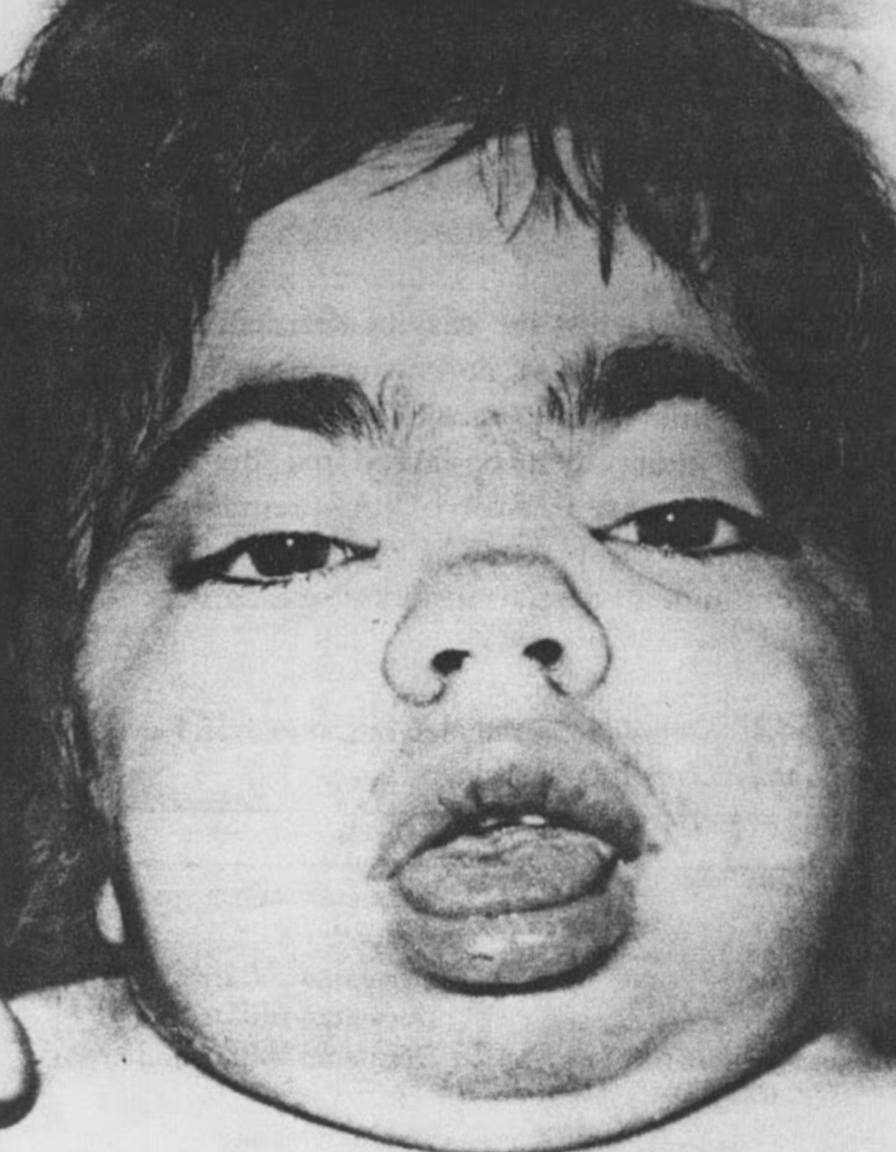
Laron syndrome is due to which of the following?
An 18-month-old child with ambiguous genitalia presented to the hospital. His BP is 118/78 mm Hg, serum K+ is 6 mEq/L, and serum sodium is 120 mEq/L. The patient was started on I.V. fluids. What additional specific therapy will you add?
The diagnostic triad of exophthalmos, diabetes insipidus, and bone lesions is characteristic of which condition?
A child has deficient bone mineralization with low serum calcium, high serum phosphorus, with decreased urinary excretion of calcium and phosphorus, and elevated levels of alkaline phosphatase. What is the most likely diagnosis?
Which of the following is true in cretinism?
Which of the following may be a presenting feature of phenylketonuria?
A 5-year-old boy with IDDM (Insulin-Dependent Diabetes Mellitus) on a single morning dose of insulin has begun to have nightly enuresis. His fasting blood sugar (FBS) level generally is 200-250 mg/dl, and his blood glucose level before supper generally is 75-150 mg/dl. What is the most likely cause of this patient's enuresis?
In Pheochromocytoma, which of the following is increased in urine?
Mental retardation is not a feature of which one of the following mucopolysaccharidoses?
What is the most common cause of congenital adrenal hyperplasia?
Explanation: **Explanation:** **Laron Syndrome** (also known as Laron-type dwarfism) is an autosomal recessive disorder characterized by a mutation in the **Growth Hormone Receptor (GHR) gene**. This results in **Growth Hormone (GH) insensitivity**, meaning that while the pituitary gland produces GH, the peripheral tissues (especially the liver) cannot respond to it. Consequently, there is a failure to produce **Insulin-like Growth Factor-1 (IGF-1)**, which is essential for linear growth. * **Why Option A is correct:** The primary defect is at the receptor level. Patients present with clinical features of GH deficiency but have **elevated or normal serum GH levels** and **very low IGF-1 levels**. * **Why Option B is incorrect:** GH deficiency (Hypopituitarism) involves a lack of hormone production. In Laron syndrome, GH is present but ineffective. * **Why Option C is incorrect:** "Paradoxical GH deficiency" is not a standard clinical term for this pathology. * **Why Option D is incorrect:** Cushing syndrome causes growth failure due to hypercortisolism, which inhibits the growth plate directly and interferes with GH secretion, but it is not the mechanism for Laron syndrome. **High-Yield Clinical Pearls for NEET-PG:** * **Phenotype:** Severe short stature, "doll-like" facies (prominent forehead, depressed nasal bridge), small hands/feet, and truncal obesity. * **Biochemical Hallmark:** ↑ GH + ↓ IGF-1. * **Treatment:** Recombinant human **IGF-1 (Mecasermin)**. Exogenous GH is ineffective because the receptors are non-functional. * **Unique Fact:** Patients with Laron syndrome have a notably **reduced risk of developing cancer and Type 2 diabetes.**
Explanation: ### **Explanation** The clinical presentation of **ambiguous genitalia**, **hyponatremia** (120 mEq/L), **hyperkalemia** (6 mEq/L), and **hypotension** (implied by the need for IV fluids, though the BP of 118/78 is high for an 18-month-old, suggesting a potential hypertensive variant or compensatory stage) strongly points toward **Congenital Adrenal Hyperplasia (CAH)**. #### **Why Hydrocortisone is Correct** The most common cause of CAH is **21-hydroxylase deficiency**, which leads to a deficiency in cortisol and aldosterone. * **Cortisol deficiency** causes an increase in ACTH, leading to adrenal hyperplasia and excess androgen production (causing ambiguous genitalia). * **Aldosterone deficiency** leads to "salt-wasting" (hyponatremia and hyperkalemia). **Hydrocortisone** is the treatment of choice because it provides necessary glucocorticoid replacement, suppresses the excess ACTH (stopping the androgen overproduction), and possesses some mineralocorticoid activity to help stabilize electrolytes. #### **Why Other Options are Incorrect** * **Potassium binding resin:** While it lowers K+, it does not address the underlying hormonal deficiency causing the crisis. * **Digoxin:** Used for heart failure; it has no role in CAH and can actually worsen arrhythmias in the setting of hyperkalemia. * **Calcium gluconate:** Used to stabilize the myocardium in severe hyperkalemia (usually K+ >6.5 or ECG changes). While it treats a symptom, it is not the "specific therapy" for the underlying disease. #### **Clinical Pearls for NEET-PG** * **Most common cause of CAH:** 21-hydroxylase deficiency (90-95%). * **Diagnostic Marker:** Elevated **17-hydroxyprogesterone (17-OHP)**. * **Differentiating CAH types:** * **21-hydroxylase deficiency:** Salt wasting + Virilization + Hypotension. * **11β-hydroxylase deficiency:** Virilization + **Hypertension** (due to 11-deoxycorticosterone buildup). * **17α-hydroxylase deficiency:** Hypertension + **No virilization** (delayed puberty). * **Emergency Management:** In an adrenal crisis, the priority is aggressive fluid resuscitation (Normal Saline) and IV Hydrocortisone.
Explanation: ### Explanation **Hand-Schüller-Christian disease** is a chronic disseminated form of **Langerhans Cell Histiocytosis (LCH)**. It typically presents in children and is classically defined by the **Christian Triad**: 1. **Bone Lesions:** Specifically "punched-out" lytic lesions in the skull. 2. **Exophthalmos:** Caused by histiocytic infiltration of the retro-orbital space. 3. **Diabetes Insipidus:** Resulting from infiltration of the posterior pituitary or hypothalamus (leading to polyuria and polydipsia). #### Analysis of Incorrect Options: * **B. Letterer-Siwe disease:** This is the acute disseminated form of LCH, occurring usually in infants (<2 years). It presents with a seborrheic-like skin rash, hepatosplenomegaly, and lymphadenopathy. It is more aggressive and lacks the specific triad mentioned. * **C. Fibrous dysplasia:** A skeletal disorder where normal bone is replaced by fibrous tissue. While it can cause bone lesions and facial asymmetry (Leontiasis ossea), it does not cause diabetes insipidus. * **D. Osteoporosis:** A metabolic bone disease characterized by low bone mineral density and increased fracture risk; it has no association with exophthalmos or diabetes insipidus. #### High-Yield Clinical Pearls for NEET-PG: * **LCH Pathology:** Characterized by the proliferation of Langerhans cells which are **CD1a+**, **S100+**, and **CD207 (Langerin)+**. * **Electron Microscopy:** Look for **Birbeck granules** (tennis-racket shaped cytoplasmic inclusions). * **Radiology:** Skull X-rays show "punched-out" lytic lesions without a sclerotic rim. * **Eosinophilic Granuloma:** The mildest, localized form of LCH, usually involving a single bone.
Explanation: **Explanation:** The clinical presentation of deficient bone mineralization (rickets) combined with **high serum phosphorus** and **low urinary phosphorus excretion** is the hallmark of **Renal Glomerular Rickets** (also known as Renal Osteodystrophy). **1. Why Renal Glomerular Rickets is correct:** In chronic kidney disease (CKD), a decrease in the Glomerular Filtration Rate (GFR) leads to **phosphate retention** (hyperphosphatemia). High phosphorus levels reciprocally lower serum calcium and inhibit the enzyme 1-alpha-hydroxylase, leading to a deficiency of active Vitamin D ($1,25(OH)_2D$). This results in hypocalcemia, which triggers secondary hyperparathyroidism. The damaged kidneys cannot excrete phosphorus or calcium effectively, leading to **low urinary excretion** of both. Alkaline phosphatase is elevated due to increased osteoblastic activity (bone turnover). **2. Why other options are incorrect:** * **Nutritional Rickets:** Characterized by **low/normal serum phosphorus** and **high urinary phosphorus** (due to secondary hyperparathyroidism acting on healthy kidneys to cause phosphaturia). * **Renal Tubular Rickets (e.g., Fanconi Syndrome):** Characterized by **low serum phosphorus** due to a primary tubular defect causing **high urinary phosphorus excretion** (phosphaturia). * **Celiac Rickets:** A form of malabsorptive rickets. Like nutritional rickets, it presents with **low serum phosphorus** due to vitamin D deficiency and compensatory phosphaturia. **3. NEET-PG High-Yield Pearls:** * **The "Rule of Phosphorus":** In almost all forms of rickets (Nutritional, Vitamin D Dependent, Tubular), serum phosphorus is **LOW**. If serum phosphorus is **HIGH**, think **Renal Glomerular Rickets** or Hypoparathyroidism. * **FGF-23:** In early CKD, FGF-23 rises to increase phosphorus excretion, but as GFR fails further, this mechanism is overwhelmed, leading to the hyperphosphatemia seen here. * **Key Lab Triad for Renal Rickets:** $\uparrow$ Phosphate, $\downarrow$ Calcium, $\uparrow$ PTH.
Explanation: **Explanation:** Congenital hypothyroidism (Cretinism) is one of the most common preventable causes of intellectual disability. The clinical presentation is often subtle at birth due to the transplacental passage of maternal thyroid hormones. **Why Option C is Correct:** Prolonged physiological jaundice (unconjugated hyperbilirubinemia) is one of the earliest clinical signs of cretinism. Thyroid hormones are essential for the maturation of the enzyme **hepatic glucuronosyltransferase**. Deficiency leads to delayed conjugation of bilirubin, causing jaundice to persist beyond the typical 10–14 day window. **Analysis of Incorrect Options:** * **Option A:** Goiter is **not** a universal finding. While it can occur in dyshormonogenesis or maternal antithyroid drug use, the most common cause of sporadic cretinism is **thyroid dysgenesis** (aplasia, hypoplasia, or ectopy), where the thyroid gland is absent or small, meaning no goiter is present. * **Option B:** While T4 levels are low, the **gold standard screening test** and the most sensitive indicator for primary hypothyroidism is an **elevated serum TSH**. Relying solely on T4 can miss cases of mild or compensated hypothyroidism. **High-Yield Clinical Pearls for NEET-PG:** * **Most common cause:** Thyroid Dysgenesis (80-85%). * **Early Signs:** Poor feeding, lethargy, macroglossia, large posterior fontanelle (>0.5 cm), and umbilical hernia. * **Radiological Sign:** Absence of the **distal femoral epiphysis** (normally present at birth) indicates prenatal hypothyroidism. * **Treatment:** Levothyroxine (10-15 μg/kg/day) should be started immediately to prevent irreversible neurodevelopmental delay.
Explanation: **Explanation:** **Phenylketonuria (PKU)** is an autosomal recessive inborn error of metabolism caused by a deficiency of the enzyme **phenylalanine hydroxylase (PAH)**. This leads to the accumulation of phenylalanine and its metabolites (like phenylpyruvic acid) in the blood and brain. **Why Option A is Correct:** Untreated PKU leads to severe intellectual disability and neurological manifestations. **Salaam spasms** (also known as infantile spasms or West Syndrome) are a classic neurological presentation in infants with PKU. The accumulation of phenylalanine interferes with neurotransmitter synthesis (dopamine and serotonin) and myelination, leading to hypsarrhythmia on EEG and clinical spasms. **Analysis of Incorrect Options:** * **B. Huntington’s chorea:** This is an autosomal dominant neurodegenerative disorder characterized by CAG repeats. It is unrelated to phenylalanine metabolism. * **C. Diarrhoea:** While some metabolic disorders present with GI distress, PKU is not typically associated with diarrhea. * **D. Haematemesis:** This refers to vomiting blood, usually seen in portal hypertension or peptic ulcer disease, and is not a feature of PKU. **High-Yield Clinical Pearls for NEET-PG:** * **Classic Triad:** Intellectual disability, seizures (Salaam spasms), and hypopigmentation (fair skin/blue eyes due to decreased melanin). * **Odour:** Patients often have a characteristic **"mousy" or "musty" odor** in urine and sweat. * **Diagnosis:** Guthrie test (bacterial inhibition assay) or tandem mass spectrometry for screening. * **Management:** Lifelong restriction of dietary phenylalanine (maintain levels between 2–6 mg/dL). * **Maternal PKU:** If a mother has high phenylalanine levels during pregnancy, the fetus may develop microcephaly, CHD, and growth restriction (teratogenic effect).
Explanation: **Explanation:** The core issue in this clinical scenario is **inadequate insulin coverage** during the night. The patient is on a single morning dose of insulin, which typically peaks in the afternoon and wears off by the evening/night. 1. **Why Option A is correct:** The high Fasting Blood Sugar (FBS) of 200–250 mg/dl indicates that the insulin effect has dissipated overnight. When blood glucose exceeds the **renal threshold (approx. 180 mg/dl)**, glucose is excreted in the urine (glycosuria). Glucose acts as an osmotic diuretic, leading to **polyuria**. In a child, this increased urine volume during sleep manifests as secondary nocturnal enuresis. 2. **Why other options are incorrect:** * **Option B:** While chronic disease can cause psychological stress, the physiological evidence of hyperglycemia (FBS 200+) strongly points toward a metabolic cause. * **Option C:** UTIs can cause enuresis, but the classic presentation would include dysuria, frequency, or urgency, and it wouldn't explain the high FBS. * **Option D:** The **Somogyi phenomenon** refers to rebound hyperglycemia in the morning following *nocturnal hypoglycemia*. However, this patient's pre-supper glucose (75–150 mg/dl) is relatively normal/low, and a single morning dose is unlikely to cause midnight hypoglycemia followed by such high fasting levels without intermediate coverage. **Clinical Pearls for NEET-PG:** * **Renal Threshold for Glucose:** 180 mg/dl. * **Dawn Phenomenon:** Early morning hyperglycemia due to a physiological surge in growth hormone and cortisol (requires *increasing* nighttime insulin). * **Somogyi Effect:** Post-hypoglycemic hyperglycemia (requires *decreasing* nighttime insulin). * **Management:** For this patient, the best step is moving to a **split-mixed regimen** (morning and evening doses) or a basal-bolus regimen to ensure 24-hour coverage.
Explanation: **Explanation:** **Pheochromocytoma** is a catecholamine-secreting tumor arising from the chromaffin cells of the adrenal medulla (or extra-adrenal sympathetic ganglia). The pathophysiology involves the overproduction of epinephrine and norepinephrine. **Why VMA is the correct answer:** Catecholamines are metabolized via two primary pathways involving the enzymes **COMT** (Catechol-O-methyltransferase) and **MAO** (Monoamine oxidase). * Norepinephrine and Epinephrine are first converted into **Metanephrines** (Metanephrine and Normetanephrine). * These are further broken down into **Vanillylmandellic Acid (VMA)**, which is the final stable end-product excreted in the urine. * *Note:* While 24-hour urinary VMA is a classic marker, **urinary/plasma metanephrines** are now considered more sensitive for screening. **Why other options are incorrect:** * **B. Aldosterone:** Secreted by the *Zona Glomerulosa* of the adrenal cortex. It is increased in Conn’s Syndrome, not Pheochromocytoma. * **C. Cortisol:** Secreted by the *Zona Fasciculata* of the adrenal cortex. It is the hallmark of Cushing’s Syndrome. * **D. 17-Hydroxyprogesterone:** A precursor in the cortisol synthesis pathway. It is the primary screening marker for **Congenital Adrenal Hyperplasia (CAH)** due to 21-hydroxylase deficiency. **High-Yield Clinical Pearls for NEET-PG:** * **Rule of 10s:** 10% are bilateral, 10% are malignant, 10% are extra-adrenal (Paragangliomas), and 10% occur in children. * **Clinical Triad:** Episodic headache, sweating (diaphoresis), and tachycardia/palpitations. * **Associated Syndromes:** MEN 2A and 2B, von Hippel-Lindau (VHL), and Neurofibromatosis type 1 (NF1). * **Surgical Management:** Always give **Alpha-blockers** (e.g., Phenoxybenzamine) *before* Beta-blockers to prevent a hypertensive crisis.
Explanation: **Explanation:** The Mucopolysaccharidoses (MPS) are a group of lysosomal storage disorders caused by the deficiency of enzymes required to break down glycosaminoglycans (GAGs). The presence or absence of mental retardation (MR) depends on whether the specific GAG metabolites cross the blood-brain barrier and accumulate in the central nervous system. **Why Morquio Syndrome (MPS IV) is the correct answer:** In Morquio syndrome, there is a deficiency of N-acetylgalactosamine-6-sulfatase (Type A) or beta-galactosidase (Type B), leading to the accumulation of **Keratan Sulfate**. Unlike other GAGs, Keratan sulfate accumulation is primarily restricted to skeletal and connective tissues. Therefore, patients with Morquio syndrome characteristically have **normal intelligence**, despite having severe skeletal dysplasia (spondyloepiphyseal dysplasia) and ligamentous laxity. **Analysis of Incorrect Options:** * **Hurler Syndrome (MPS I):** Caused by alpha-L-iduronidase deficiency. It is the most severe form, characterized by significant accumulation of Dermatan and Heparan sulfate in the brain, leading to progressive developmental delay and severe MR. * **Hunter Syndrome (MPS II):** An X-linked recessive disorder. Like Hurler, it involves Heparan sulfate accumulation, which leads to progressive mental retardation (though a "mild" form without MR exists, the classic phenotype includes it). * **Sanfilippo Syndrome (MPS III):** This syndrome is characterized by **severe CNS involvement** with relatively mild physical/skeletal features. It presents with the most profound intellectual disability and behavioral disturbances among all MPS types. **High-Yield Clinical Pearls for NEET-PG:** * **Morquio Syndrome:** Key features include short-trunk dwarfism, odontoid hypoplasia (risk of atlantoaxial subluxation), and aortic regurgitation, but **normal IQ**. * **Hunter Syndrome:** The only **X-linked** MPS; all others are Autosomal Recessive. It is also unique for the **absence of corneal clouding**. * **Sanfilippo Syndrome:** Think "Sanfilippo = Severe CNS." It has the most rapid neurological decline. * **Scheie Syndrome:** A mild form of MPS I that also features normal intelligence, but Morquio is the classic "textbook" answer for MPS without MR.
Explanation: **Explanation:** Congenital Adrenal Hyperplasia (CAH) is a group of autosomal recessive disorders caused by a deficiency of enzymes required for cortisol synthesis. **Why 21-Hydroxylase deficiency is correct:** Deficiency of **21-Hydroxylase** is the most common cause, accounting for **>90-95% of all CAH cases**. This enzyme is responsible for converting progesterone to 11-deoxycorticosterone and 17-hydroxyprogesterone to 11-deoxycortisol. Its absence leads to decreased cortisol and aldosterone, with a compensatory increase in ACTH. This "shunts" precursors toward the androgen pathway, leading to virilization. **Why the other options are incorrect:** * **11-beta-Hydroxylase deficiency:** The second most common cause (~5-8%). It presents with virilization but is uniquely characterized by **hypertension** due to the accumulation of 11-deoxycorticosterone (a mineralocorticoid). * **17-alpha-Hydroxylase deficiency:** Rare. It leads to a decrease in both cortisol and sex hormones, resulting in **delayed puberty/sexual infantilism** and hypertension (due to excess mineralocorticoids). * **3-beta-Hydroxysteroid dehydrogenase deficiency:** Very rare. It affects all three pathways (mineralocorticoids, glucocorticoids, and sex steroids), often leading to ambiguous genitalia in both males and females. **High-Yield Clinical Pearls for NEET-PG:** * **Classic Presentation:** Salt-wasting (hypotension, hyponatremia, hyperkalemia) and ambiguous genitalia in females. * **Diagnostic Marker:** Elevated **17-hydroxyprogesterone (17-OHP)** levels. * **Treatment:** Glucocorticoid (Hydrocortisone) and Mineralocorticoid (Fludrocortisone) replacement. * **Rule of Thumb:** If the enzyme starts with **'1'** (11, 17), it causes **Hypertension**. If it ends with **'1'** (21, 11), it causes **Virilization**.
Disorders of Growth
Practice Questions
Thyroid Disorders
Practice Questions
Disorders of Puberty
Practice Questions
Adrenal Disorders
Practice Questions
Diabetes Mellitus in Children
Practice Questions
Disorders of Calcium and Phosphate Metabolism
Practice Questions
Disorders of Sexual Development
Practice Questions
Hypoglycemia
Practice Questions
Obesity and Metabolic Syndrome
Practice Questions
Pituitary Disorders
Practice Questions
Multiple Endocrine Neoplasia Syndromes
Practice Questions
Endocrine Emergencies
Practice Questions
Get full access to all questions, explanations, and performance tracking.
Start For Free