In a child with ambiguous genitalia, what is the first test to be done?
Which of the following statements about 21-alpha hydroxylase deficiency is false?
Coarse facies, hepatosplenomegaly, and tall QRS on ECG are characteristic features of which of the following conditions?
All of the following are features of Turner syndrome, EXCEPT:
An infant presents with clitoral enlargement and some degree of labial fusion. What is the initial step in the diagnostic workup?
What is the upper segment to lower segment ratio in growth hormone deficiency?
What is the screening test for neonatal hypothyroidism?
Gynecomastia in neonates is typically caused by which of the following?
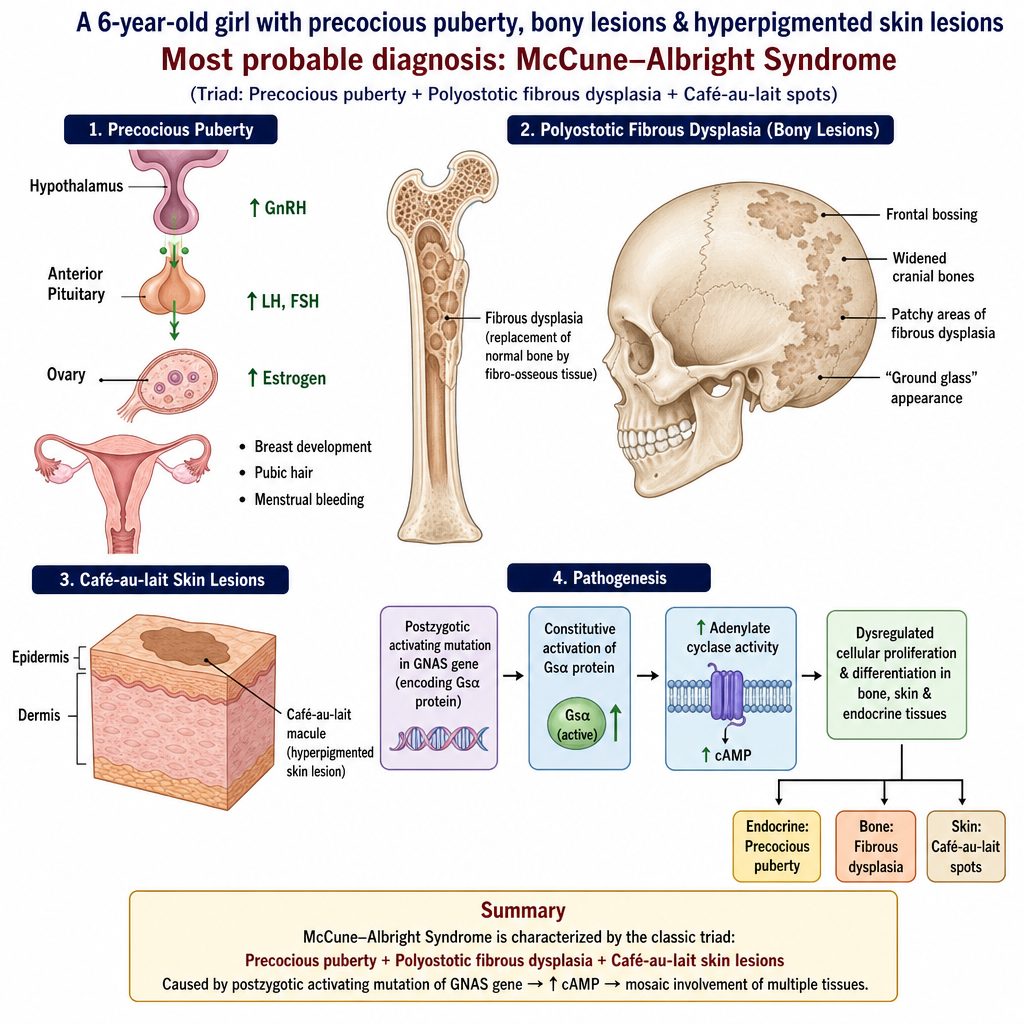
What is the diagnosis for a patient presenting with familial Polyostosis, Precocious puberty, and Pigmentation?
Which of the following is NOT a feature of Turner's syndrome?
Explanation: **Explanation:** In the evaluation of a child with ambiguous genitalia, the primary goal is to determine the genetic sex and identify life-threatening conditions like salt-wasting Congenital Adrenal Hyperplasia (CAH). **Karyotyping** is considered the gold standard and the definitive first step because it establishes the chromosomal sex (46,XX or 46,XY), which dictates the entire diagnostic algorithm. Knowing the genotype is essential to differentiate between disorders of sexual development (DSD), such as 46,XX DSD (most commonly CAH) and 46,XY DSD (such as Androgen Insensitivity Syndrome). **Analysis of Incorrect Options:** * **Serum 17-hydroxyprogesterone (17-OHP):** While this is the most important biochemical test to diagnose the most common cause of ambiguous genitalia (21-hydroxylase deficiency), it is often unreliable in the first 24–48 hours of life due to maternal hormone interference. * **Serum 17-ketosteroids:** This is an outdated marker for adrenal androgen production and has been replaced by more specific assays like 17-OHP and DHEAS. * **Ultrasound Pelvis:** This is a crucial secondary step to identify the presence or absence of internal Mullerian structures (uterus/ovaries), but it is operator-dependent and does not provide the definitive genetic diagnosis required to initiate the workup. **High-Yield Clinical Pearls for NEET-PG:** * **Most common cause of ambiguous genitalia:** Congenital Adrenal Hyperplasia (specifically 21-hydroxylase deficiency). * **Most common cause of female pseudohermaphroditism:** CAH (46,XX). * **Most common cause of male pseudohermaphroditism:** Androgen Insensitivity Syndrome (46,XY). * **Emergency Management:** Any neonate with ambiguous genitalia should be monitored for an **adrenal crisis** (hyponatremia, hyperkalemia, and hypoglycemia) until CAH is ruled out.
Explanation: **Explanation:** **21-alpha hydroxylase deficiency** is the most common form of Congenital Adrenal Hyperplasia (CAH), accounting for over 90% of cases. The enzyme deficiency leads to a block in the conversion of progesterone to deoxycorticosterone (mineralocorticoid pathway) and 17-OH progesterone to 11-deoxycortisol (glucocorticoid pathway). **Why Option D is False (The Correct Answer):** In 21-alpha hydroxylase deficiency, there is a **deficiency of aldosterone** (mineralocorticoid). Aldosterone normally functions to retain sodium and excrete potassium/hydrogen ions. Its absence leads to "Salt Wasting," characterized by **Hyponatremia, Hyperkalemia, and Metabolic Acidosis**. Therefore, the statement "Hypokalemic alkalosis is seen" is incorrect; that presentation is actually seen in 11-beta or 17-alpha hydroxylase deficiencies where mineralocorticoid activity is increased. **Analysis of Other Options:** * **Option A:** It is indeed the most common cause (>90%) of CAH. * **Option B:** Excess 17-OH progesterone is shunted into the androgen pathway. High prenatal androgens cause virilization of female fetuses, leading to **ambiguous genitalia** (clitoromegaly, fused labia). * **Option C:** In males, excess androgens cause **isosexual precocious puberty** (early pubic hair, phallic enlargement, accelerated bone age) but with small testes. **High-Yield Clinical Pearls for NEET-PG:** * **Gold Standard Diagnosis:** Elevated serum **17-hydroxyprogesterone (17-OHP)** levels. * **Salt-Wasting Crisis:** Typically occurs in the 2nd week of life; presents with vomiting, dehydration, and shock. * **Karyotype:** Females are 46, XX (Internal genitalia like the uterus/ovaries are normal). * **Treatment:** Glucocorticoid (Hydrocortisone) to suppress ACTH and Mineralocorticoid (Fludrocortisone) for salt replacement.
Explanation: **Explanation:** The clinical triad of **coarse facies**, **hepatosplenomegaly**, and **tall QRS complexes** on ECG is classic for **Hurler’s Syndrome (MPS I)**. **1. Why Hurler’s Disease is Correct:** Hurler’s syndrome is a lysosomal storage disorder caused by a deficiency of **alpha-L-iduronidase**, leading to the accumulation of dermatan and heparan sulfate. * **Coarse Facies & Organomegaly:** Progressive deposition of glycosaminoglycans (GAGs) in tissues leads to characteristic facial features (depressed nasal bridge, bulging forehead) and hepatosplenomegaly. * **Cardiac Involvement:** GAG deposition in the myocardium and valves leads to hypertrophic cardiomyopathy. On an ECG, this manifests as **left ventricular hypertrophy (LVH)**, which presents as **tall QRS complexes**. **2. Why Incorrect Options are Wrong:** * **Glycogen Storage Disease Type II (Pompe Disease):** While it presents with massive cardiomegaly and tall QRS complexes (due to glycogen deposition), it typically lacks coarse facies and significant splenomegaly. * **Hunter’s Disease (MPS II):** Similar to Hurler’s but follows an **X-linked recessive** inheritance. Crucially, it **lacks corneal clouding**, which is a hallmark of Hurler’s. * **Hemochromatosis:** While it causes organomegaly and cardiomyopathy, it typically presents in adulthood with "bronze diabetes" and does not feature coarse facies or the pediatric presentation described. **Clinical Pearls for NEET-PG:** * **Hurler vs. Hunter:** "The Hunter needs his eyes to see" (Hunter has **no** corneal clouding) and "The Hunter is a male" (X-linked). * **ECG in Pompe:** Look for a **short PR interval** alongside giant QRS complexes. * **Diagnosis:** Initial screening via urinary GAGs; definitive diagnosis via enzyme assay or genetic testing.
Explanation: **Explanation:** Turner syndrome (45,X) is the most common sex chromosomal abnormality in females. The correct answer is **Mental retardation** because, unlike many other chromosomal disorders (like Down syndrome), Turner syndrome is typically associated with **normal intelligence**. While these patients may have specific learning disabilities (e.g., difficulties with visuospatial organization or non-verbal memory), global cognitive impairment or mental retardation is not a characteristic feature. **Analysis of other options:** * **Streaky gonads:** Due to accelerated oocyte atresia, the ovaries are replaced by fibrous tissue (streak gonads), leading to primary amenorrhea and hypergonadotropic hypogonadism. * **Webbed neck (Pterygium colli):** This is a classic phenotypic feature caused by lymphatic obstruction (fetal cystic hygroma) during development. * **Coarctation of aorta:** This is the most common cardiovascular malformation in Turner syndrome (occurring in ~15-20% of cases). Bicuspid aortic valve is the overall most common cardiac anomaly. **High-Yield Clinical Pearls for NEET-PG:** * **Short Stature:** The most consistent clinical finding (due to SHOX gene haploinsufficiency). * **Karyotype:** 45,X is the most common (50%), but mosaicism (45,X/46,XX) is frequent and often presents with milder features. * **Renal Anomaly:** Horseshoe kidney is the most common renal finding. * **Lymphedema:** Congenital lymphedema of hands and feet at birth is a strong diagnostic clue. * **Treatment:** Growth hormone (for height) and Estrogen replacement (for secondary sexual characteristics and bone health).
Explanation: **Explanation:** The clinical presentation of clitoral enlargement and labial fusion indicates **Disorders of Sex Development (DSD)**, specifically virilization of a female infant (ambiguous genitalia). **1. Why Karyotype is the Initial Step:** In any infant with ambiguous genitalia, the most critical first step is to determine the **genetic sex**. The karyotype (Option A) is the gold standard for defining the chromosomal sex (46,XX vs. 46,XY), which dictates the subsequent diagnostic algorithm. While Congenital Adrenal Hyperplasia (CAH) is the most common cause of ambiguous genitalia in a 46,XX infant, one cannot assume the diagnosis without first confirming the chromosomal sex to rule out conditions like Mixed Gonadal Dysgenesis or Ovotesticular DSD. **2. Why Other Options are Incorrect:** * **Option B (Ultrasound):** While useful to identify the presence of a uterus or gonads, it is operator-dependent and performed alongside or after the karyotype. * **Option C (17-OHP):** This is the specific test for 21-hydroxylase deficiency (the most common form of CAH). However, 17-OHP levels can be physiologically high in the first 24–48 hours of life, leading to false positives. It is usually performed after or in parallel with the karyotype. * **Option D (Testosterone):** This is measured to evaluate testicular function or androgen excess but is not the primary initial step in the broad workup of ambiguous genitalia. **High-Yield Clinical Pearls for NEET-PG:** * **Prader Staging:** Used to describe the degree of virilization of female genitalia (Stage 1 to 5). * **Emergency Alert:** Ambiguous genitalia + salt-wasting (hyponatremia, hyperkalemia, vomiting) = **Adrenal Crisis** (Medical Emergency). * **Most Common Cause:** 21-Hydroxylase deficiency (CAH) is the most common cause of 46,XX DSD. * **Rule of Thumb:** If gonads are palpable, it is likely a 46,XY DSD; if gonads are non-palpable, it is likely a 46,XX DSD (CAH).
Explanation: **Explanation:** The **Upper Segment to Lower Segment (US:LS) ratio** is a clinical marker used to differentiate between proportionate and disproportionate growth failure. 1. **Why the correct answer is right:** Growth Hormone (GH) deficiency results in **proportionate short stature**. In this condition, there is a global deficiency in linear growth affecting both the trunk (upper segment) and the limbs (lower segment) equally. Because both segments are reduced in the same proportion, the US:LS ratio remains **normal for the child's chronological age**. 2. **Why the incorrect options are wrong:** * **Increases (Option A):** An increased US:LS ratio (short limbs relative to trunk) is seen in **disproportionate short stature**, most commonly in **Achondroplasia** or **Hypothyroidism** (where skeletal maturation is delayed). * **Decreases (Option B):** A decreased US:LS ratio (long limbs relative to trunk) is characteristic of conditions like **Marfan Syndrome**, **Ehlers-Danlos Syndrome**, or **Homocystinuria**. * **Cannot comment (Option D):** The ratio is a predictable clinical finding based on the pathophysiology of GH deficiency. **High-Yield Clinical Pearls for NEET-PG:** * **Normal US:LS Ratios:** At birth (1.7:1), at 3 years (1.3:1), and at **7–10 years (1:1)**. After puberty, it becomes <1 (approx. 0.9:1). * **GH Deficiency Triad:** Proportionate short stature, delayed bone age, and increased subcutaneous fat (cherubic appearance/doll-like face). * **Key Distinction:** If a child has short stature with a **normal** US:LS ratio, think GH deficiency or Constitutional Delay. If the ratio is **increased**, think Hypothyroidism.
Explanation: **Explanation:** Congenital Hypothyroidism (CH) is one of the most common preventable causes of intellectual disability. Early diagnosis is critical because clinical features are often absent at birth due to the transplacental transfer of maternal thyroid hormones. **Why Option C is Correct:** The gold standard for screening is the measurement of **TSH and/or T4** using a **heel prick blood sample** collected on a filter paper (Guthrie card). * **Timing:** Ideally performed between **48 to 72 hours of life**. Screening before 48 hours is avoided to prevent false positives caused by the physiological postnatal TSH surge. * **Mechanism:** Most programs use a primary TSH screen; an elevated TSH indicates primary hypothyroidism, which is the most common form in neonates (often due to thyroid dysgenesis). **Why Other Options are Incorrect:** * **A. Blood iodine levels:** These do not reflect thyroid function and are only used for epidemiological studies of iodine deficiency. * **B. Radioiodine uptake:** This is an imaging modality used to determine the *etiology* (e.g., aplasia vs. ectopic gland) after a diagnosis is confirmed; it is never a screening tool. * **D. Ultrasound (USG):** Similar to uptake studies, USG is used for anatomical localization but cannot assess the functional status of the thyroid gland. **High-Yield Clinical Pearls for NEET-PG:** * **Most common cause:** Thyroid Dysgenesis (Ectopy is the most common specific type). * **Clinical sign:** A large posterior fontanelle (>0.5 cm) and prolonged physiological jaundice are early clues. * **Treatment:** Levothyroxine (10–15 μg/kg/day) should be started immediately to prevent permanent neurocognitive impairment. * **Target:** The goal is to normalize T4 within 2 weeks and TSH within 1 month.
Explanation: **Explanation:** **Neonatal gynecomastia** (breast engorgement) is a common, physiological finding occurring in up to 60–90% of newborns. **1. Why Option A is Correct:** The primary cause is the **transplacental transfer of maternal estrogen** during pregnancy. High levels of circulating maternal estrogens stimulate the neonatal breast tissue in utero. After birth, the sudden withdrawal of maternal estrogen, combined with the newborn's high prolactin levels (from the pituitary), can also lead to "witch’s milk" (transient neonatal galactorrhea). This condition is benign and typically resolves spontaneously within weeks to months as hormone levels decline. **2. Why the Other Options are Incorrect:** * **Option B:** While progesterone is elevated during pregnancy, it primarily influences ductal development but is not the trigger for the glandular hyperplasia seen in neonatal gynecomastia. * **Option C & D:** While the hypothalamic-pituitary-gonadal axis is active in neonates (the "mini-puberty" of infancy), the immediate postnatal breast enlargement is a direct result of the hormonal environment established *in utero* by maternal steroids, not the infant's own GnRH or gonadotropins. **High-Yield Clinical Pearls for NEET-PG:** * **Management:** Reassurance is key. Advise parents **not to squeeze** the breast tissue, as this can cause trauma, mastitis, or breast abscess. * **Timeline:** It usually appears in the first week of life and disappears by 2–6 months. * **Witch’s Milk:** Secretion of milk from the newborn's nipple is normal and occurs in about 5% of cases. * **Precocious Puberty:** If breast development persists beyond 2 years or is accompanied by other signs of puberty, investigate for premature thelarche or endocrine disorders.
Explanation: ### Explanation **McCune-Albright Syndrome (MAS)** is the correct diagnosis. It is characterized by a classic clinical triad: 1. **Polyostotic Fibrous Dysplasia:** Multiple bone lesions where normal bone is replaced by fibrous tissue, leading to fractures and deformities (e.g., "Shepherd’s crook" deformity). 2. **Precocious Puberty:** Specifically **GnRH-independent (peripheral)** precocious puberty, caused by autonomous hyperfunctioning of the gonads. 3. **Café-au-lait Macules:** Large, hyperpigmented skin patches with irregular borders, often described as having the **"Coast of Maine"** appearance. **Pathophysiology:** MAS is caused by a somatic (post-zygotic) mutation in the **GNAS1 gene**, which leads to constitutive activation of the **Gsα protein**. This results in overproduction of cAMP, causing autonomous overactivity in various endocrine glands. --- ### Why the other options are incorrect: * **Tuberous Sclerosis:** Presents with the triad of seizures, mental retardation, and adenoma sebaceum. Skin findings include ash-leaf spots and Shagreen patches, not polyostosis. * **Klinefelter Syndrome (47, XXY):** Characterized by primary hypogonadism (small testes, infertility) and gynecomastia, rather than precocious puberty or bone dysplasia. * **Systemic Lupus Erythematosus (SLE):** An autoimmune multisystem disorder presenting with malar rash, joint pain, and renal involvement; it does not cause polyostotic fibrous dysplasia or precocious puberty. --- ### High-Yield Clinical Pearls for NEET-PG: * **Inheritance:** It is **not inherited**; it occurs due to a sporadic somatic mutation. If the mutation were germline, it would be lethal. * **Skin Lesions:** Unlike Neurofibromatosis (Coast of California - smooth borders), MAS lesions have **jagged borders (Coast of Maine)** and usually do not cross the midline. * **Other Endocrine Features:** Can include hyperthyroidism, GH-secreting pituitary adenomas (acromegaly), and Cushing syndrome.
Explanation: **Explanation:** Turner’s syndrome (45,XO) is a common chromosomal abnormality characterized by the complete or partial absence of one X chromosome in females. **Why Cubitus Varus is the Correct Answer:** The characteristic elbow deformity in Turner’s syndrome is **Cubitus Valgus** (an increased carrying angle), not Cubitus varus. This occurs due to abnormal development of the trochlea. In NEET-PG, "Varus" (inward) vs. "Valgus" (outward) is a frequent distractor for Turner's syndrome questions. **Analysis of Incorrect Options:** * **Short Stature (A):** This is the most consistent clinical feature (seen in >95% of cases). It is primarily due to the haploinsufficiency of the **SHOX gene** located on the pseudoautosomal region of the X chromosome. * **Normal IQ (B):** Most patients with Turner’s syndrome have a **normal global IQ**. While they may exhibit specific neurocognitive deficits (e.g., difficulties with visuospatial tasks or mathematics), they do not typically present with generalized intellectual disability. * **Streak Ovaries (D):** Accelerated oocyte atresia leads to fibrous, non-functional "streak ovaries." This results in hypergonadotropic hypogonadism, causing primary amenorrhea and lack of secondary sexual characteristics. **High-Yield Clinical Pearls for NEET-PG:** * **Cardiac:** Bicuspid aortic valve (most common) and Coarctation of the aorta. * **Renal:** Horseshoe kidney. * **Lymphedema:** Congenital lymphedema of hands/feet and cystic hygroma (leading to "webbed neck"). * **Screening:** Karyotyping is the gold standard for diagnosis. GH therapy is used for height; Estrogen is used for pubertal induction.
Disorders of Growth
Practice Questions
Thyroid Disorders
Practice Questions
Disorders of Puberty
Practice Questions
Adrenal Disorders
Practice Questions
Diabetes Mellitus in Children
Practice Questions
Disorders of Calcium and Phosphate Metabolism
Practice Questions
Disorders of Sexual Development
Practice Questions
Hypoglycemia
Practice Questions
Obesity and Metabolic Syndrome
Practice Questions
Pituitary Disorders
Practice Questions
Multiple Endocrine Neoplasia Syndromes
Practice Questions
Endocrine Emergencies
Practice Questions
Get full access to all questions, explanations, and performance tracking.
Start For Free