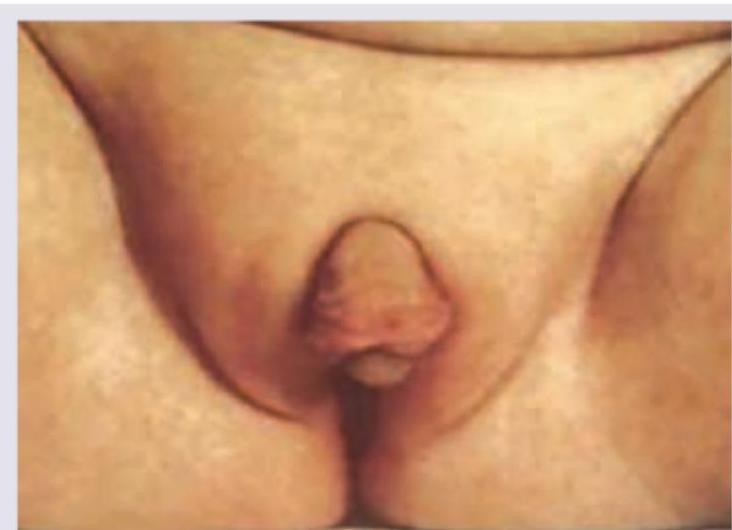
A baby is born with ambiguous genitalia. Which of the following statements is true?
A 4-week-old female child with normal genitalia presents to the emergency department with severe dehydration, hyperkalemia, and hyponatremia. The measurement of which of the following blood levels will be helpful?
All of the following may occur in Noonan's syndrome except?
Central precocious puberty in a girl is defined as breast development before what age?
A 7-year-old girl presents with bowing of legs and difficulty walking. Her height is below average for her age group, and a sibling experiences similar issues. X-ray examination reveals metaphyseal widening and funnel-like beaking of the metaphyses. Investigations show a serum calcium of 9 mg/dL and serum phosphorus of 2.5 mg/dL. What is the most likely cause?
Which of the following is NOT typically seen in congenital hypothyroidism?
What is the treatment for virilizing adrenal hyperplasia?
A child presents with obesity, short stature, hypertension, and hyperglycemia. What is the most probable diagnosis?
Delayed puberty is defined as the absence of secondary sexual characteristics by age 13 in girls and 14 in boys, or the absence of menarche by age 15. What is the age threshold for primary amenorrhea without the development of secondary sexual characters that defines delayed puberty?
A 6-year-old child complains of difficulty in swallowing and on examination, there is a sublingual swelling, which is suspected to be lingual thyroid. What is the first step in the management of this child?
Explanation: **Explanation:** Ambiguous genitalia in a newborn is a **medical emergency**, primarily because the most common cause is **Congenital Adrenal Hyperplasia (CAH)**, specifically 21-hydroxylase deficiency. This condition can lead to a life-threatening salt-wasting crisis. **Why Option C is Correct:** CAH is an **autosomal recessive** disorder. Therefore, a family history of a sibling with CAH or unexplained neonatal death is a significant risk factor and a critical diagnostic clue. In a 46,XX infant, excess androgens lead to virilization of female genitalia, making it the most frequent cause of ambiguous genitalia. **Why Other Options are Incorrect:** * **Option A:** A **karyotype** is the gold standard and is almost **always required** to determine the chromosomal sex (46,XX vs. 46,XY), which guides the entire diagnostic algorithm. * **Option B:** Evaluation must be initiated **immediately (within 24 hours)**. Delaying assessment until 1 month is dangerous, as salt-wasting crises typically occur within the first 1–2 weeks of life. * **Option D:** Physical examination alone (e.g., presence/absence of gonads) can provide clues but **cannot definitively determine the true sex** or the underlying etiology. Biochemical and genetic testing are mandatory. **High-Yield NEET-PG Pearls:** * **Most common cause of ambiguous genitalia:** CAH (46,XX DSD). * **First step in management:** Stabilize the airway/vitals and check electrolytes (look for hyponatremia and hyperkalemia). * **Initial investigations:** Karyotype, USG (to look for uterus/gonads), and 17-OH Progesterone levels. * **Prader Staging:** Used to describe the degree of virilization in female infants.
Explanation: ### Explanation The clinical presentation of a **4-week-old female** with **normal genitalia**, severe dehydration, **hyponatremia**, and **hyperkalemia** is classic for a salt-wasting state. In a female with normal genitalia, the most likely diagnosis is **Pseudohypoaldosteronism (PHA)** or rare forms of Congenital Adrenal Hyperplasia (CAH) that do not cause virilization (e.g., StAR deficiency or 20,22-desmolase deficiency). **1. Why Aldosterone is the Correct Answer:** The combination of hyponatremia and hyperkalemia indicates a failure of mineralocorticoid action. In **Pseudohypoaldosteronism**, there is peripheral resistance to aldosterone. Consequently, the body attempts to compensate by producing massive amounts of aldosterone. Measuring **Aldosterone** levels is crucial to differentiate between **hypoaldosteronism** (low levels) and **aldosterone resistance** (very high levels). **2. Analysis of Incorrect Options:** * **A. 17-hydroxyprogesterone (17-OHP):** This is the screening test for 21-hydroxylase deficiency. However, 21-hydroxylase deficiency in a female would present with **ambiguous genitalia** (virilization) due to excess androgens. Since this child has normal genitalia, 17-OHP is less likely to be the primary diagnostic clue. * **B. Renin:** While renin would be elevated in salt-wasting states, it is a non-specific marker of volume depletion and does not pinpoint the specific defect in the adrenal axis as effectively as aldosterone in this context. * **C. Cortisol:** While cortisol deficiency occurs in many forms of CAH, it does not explain the electrolyte imbalance as specifically as the mineralocorticoid pathway. **Clinical Pearls for NEET-PG:** * **Female + Ambiguous Genitalia + Salt Wasting:** 21-hydroxylase deficiency (Most common CAH). * **Female + Normal Genitalia + Salt Wasting:** Think Pseudohypoaldosteronism (High Aldosterone) or Lipoid CAH (Low Aldosterone). * **Male + Ambiguous Genitalia + Hypertension:** 17-alpha-hydroxylase deficiency. * **Hypertension + Virilization:** 11-beta-hydroxylase deficiency.
Explanation: **Explanation:** Noonan’s syndrome is often referred to as the **"Male Turner Syndrome"** because it shares several phenotypic features with Turner syndrome (short stature, webbed neck, cubitus valgus) but affects both males and females and is caused by mutations in the RAS-MAPK signaling pathway (most commonly the **PTPN11 gene**). **Why Option C is the correct answer:** In Noonan’s syndrome, **females typically have normal pubertal development and are fertile.** In contrast, males frequently exhibit cryptorchidism (undescended testes), which can lead to Sertoli cell dysfunction and impaired spermatogenesis, often resulting in male infertility. This is a high-yield distinction from Turner syndrome (45,XO), where females have streak ovaries and are almost always infertile. **Analysis of incorrect options:** * **A. Hypertrophic cardiomyopathy (HCM):** This is the most common cardiac muscle disease in Noonan’s (seen in ~20-30%). However, the most common overall cardiac defect is **Pulmonary Stenosis** (dysplastic valve). * **B. Cryptorchidism:** This is a hallmark feature in males with Noonan’s syndrome, occurring in up to 80% of cases. * **D. Autosomal dominant transmission:** Noonan’s syndrome is an autosomal dominant condition, though many cases arise from *de novo* mutations. **NEET-PG High-Yield Pearls:** * **Genetics:** Most common gene involved is **PTPN11** (Chromosome 12). It is part of the "RASopathies." * **Cardiac:** Pulmonary Stenosis (Most common) > HCM > ASD. * **Hematology:** Increased risk of **Juvenile Myelomonocytic Leukemia (JMML)** and bleeding diathesis (Factor XI deficiency). * **Facies:** Triangular face, hypertelorism, downward-slanting palpebral fissures, and low-set posteriorly rotated ears.
Explanation: **Explanation:** **1. Why Option B is Correct:** Precocious puberty is defined as the onset of secondary sexual characteristics at an age that is **more than 2.5 standard deviations (SD) below the mean** for the population. In girls, the first sign of puberty is typically **thelarche** (breast development). The globally accepted clinical cutoff for precocious puberty in girls is the development of breast tissue before the age of **8 years**. In boys, the cutoff is the enlargement of testes (volume >4 ml) before the age of 9 years. **2. Why Other Options are Incorrect:** * **Option A (6 years):** While some studies suggest that breast development in African-American or obese girls may start earlier without pathology, 6 years is too restrictive and would miss many cases of pathological precocity. * **Option D (10 years):** This is within the normal range for the onset of puberty. The average age for thelarche is approximately 10–10.5 years. * **Option C (12 years):** This is near the average age of **menarche** (first menstruation), which typically occurs 2–2.5 years after thelarche. **3. NEET-PG High-Yield Pearls:** * **Central vs. Peripheral:** Central Precocious Puberty (CPP) is **GnRH-dependent** (isosexual), while Peripheral is GnRH-independent. * **Etiology:** In girls, CPP is most commonly **Idiopathic** (80-90%). In boys, CPP is more likely to be due to an **organic CNS lesion** (e.g., hypothalamic hamartoma). * **Bone Age:** A key diagnostic step; bone age is typically **advanced** in precocious puberty. * **Treatment of Choice:** Long-acting **GnRH agonists** (e.g., Leuprolide) are used to desensitize the pituitary and halt progression to preserve final adult height.
Explanation: ### Explanation **Correct Answer: B. Hypophosphatemic Rickets** The clinical presentation of bowing of legs, short stature, and a positive family history (sibling affected) strongly suggests **X-linked Hypophosphatemic Rickets (XLH)**, the most common form of heritable rickets. The biochemical hallmark of this condition is **isolated low serum phosphorus** with **normal serum calcium** and normal-to-low Vitamin D levels. The pathophysiology involves a defect in the *PHEX* gene, leading to increased levels of **FGF-23**, which causes renal phosphate wasting and inhibits the activation of Vitamin D. Radiologically, the "funnel-like beaking" of the metaphyses is a classic description of the metaphyseal changes seen in rickets. **Why other options are incorrect:** * **Nutritional Rickets:** Typically presents with **low or low-normal serum calcium** and significantly elevated PTH. It usually responds to Vitamin D supplementation, whereas hypophosphatemic rickets is "Vitamin D resistant." * **Azotemic Renal Osteodystrophy:** This occurs in the setting of chronic kidney disease. It is characterized by **high serum phosphorus** (due to decreased renal excretion) and low calcium, which contradicts the laboratory findings in this case. * **Primary Hyperparathyroidism:** While this causes low phosphorus, it is characterized by **hypercalcemia** (high serum calcium), whereas this patient has a normal calcium level (9 mg/dL). **High-Yield Pearls for NEET-PG:** * **Biochemical Triad of XLH:** Low Phosphorus + Normal Calcium + High/Normal Alkaline Phosphatase. * **Inheritance:** Most commonly X-linked Dominant. * **Treatment:** Oral phosphate supplements and Calcitriol (active Vitamin D). * **Key Differentiator:** Unlike nutritional rickets, there is **no** myopathy or tetany in hypophosphatemic rickets because serum calcium remains normal.
Explanation: **Explanation:** Congenital Hypothyroidism (CH) is one of the most common treatable causes of intellectual disability. The correct answer is **Short metacarpals**, as this is a characteristic feature of **Pseudohypoparathyroidism (Albright Hereditary Osteodystrophy)** or Turner Syndrome, rather than hypothyroidism. **Why the other options are seen in Congenital Hypothyroidism:** * **Delayed bone age (A):** Thyroid hormones are essential for linear growth and epiphyseal maturation. Deficiency leads to a significant lag in bone age compared to chronological age. * **Delayed puberty (B):** Thyroid hormone is required for the normal maturation of the hypothalamic-pituitary-gonadal axis. While severe juvenile hypothyroidism can rarely cause precocious puberty (Van Wyk-Grumbach syndrome), the standard presentation of untreated hypothyroidism is delayed puberty. * **Large anterior fontanelle (D):** Delayed ossification of the skull bones leads to a large anterior fontanelle and a persistently open posterior fontanelle (a key early diagnostic clue). **Clinical Pearls for NEET-PG:** * **Most common cause:** Thyroid dysgenesis (Ectopy is the most common specific type). * **Early signs:** Prolonged physiological jaundice, poor feeding, hoarse cry, and umbilical hernia. * **Late signs:** Macroglossia, "pot-bellied" appearance, and developmental delay (Cretinism). * **Radiological sign:** Absence of the distal femoral epiphysis at birth (normally appears at 36 weeks gestation) is a strong indicator of in-utero hypothyroidism. * **Treatment:** Levothyroxine (10–15 μg/kg/day) initiated as early as possible to prevent permanent neurocognitive impairment.
Explanation: **Explanation:** Virilizing Adrenal Hyperplasia (Congenital Adrenal Hyperplasia - CAH) is most commonly caused by a deficiency of the enzyme **21-hydroxylase**. This deficiency leads to impaired synthesis of cortisol. Due to the lack of negative feedback from cortisol, the pituitary gland secretes excessive **ACTH**. High ACTH levels overstimulate the adrenal cortex, causing hyperplasia and shunting steroid precursors into the androgen pathway, resulting in virilization. **Why Cortisone is correct:** The primary goal of treatment is **hormone replacement**. Administering glucocorticoids (like Cortisone, Hydrocortisone, or Prednisolone) serves two purposes: 1. It replaces the deficient physiological cortisol. 2. It provides negative feedback to the pituitary to **suppress ACTH secretion**, thereby halting the overproduction of adrenal androgens and preventing further virilization. **Why other options are incorrect:** * **Estrogens:** These do not address the underlying enzyme deficiency or the ACTH excess. * **Antiandrogens:** While they may block androgen action, they do not correct the life-threatening cortisol deficiency or the adrenal hyperplasia. * **ACTH:** Administering ACTH would worsen the condition by further stimulating the adrenal gland to produce more androgens. **High-Yield Clinical Pearls for NEET-PG:** * **Most common cause:** 21-hydroxylase deficiency (90-95% of cases). * **Diagnostic Marker:** Elevated levels of **17-hydroxyprogesterone (17-OHP)**. * **Salt-wasting type:** Occurs in 75% of cases; requires additional **Mineralocorticoid** replacement (Fludrocortisone). * **Clinical Presentation:** Ambiguous genitalia in females; precocious puberty or salt-wasting crisis (hyponatremia, hyperkalemia) in males.
Explanation: ### Explanation **Cushing’s Syndrome** is the correct diagnosis because it results from chronic exposure to excessive glucocorticoids (hypercortisolism). In pediatrics, the hallmark clinical presentation is the combination of **obesity** (typically central/truncal) and **growth failure (short stature)**. This is a critical diagnostic differentiator: while simple exogenous obesity usually leads to accelerated linear growth and advanced bone age, endocrine obesity (like Cushing’s) causes a decrease in growth velocity. The other features mentioned—**hypertension** and **hyperglycemia**—occur because cortisol has mineralocorticoid-like effects (causing sodium and water retention) and acts as a potent counter-regulatory hormone that increases gluconeogenesis and insulin resistance. #### Why the other options are incorrect: * **Addison’s Disease:** This is primary adrenal insufficiency (low cortisol/aldosterone). It presents with weight loss, hypotension, and hypoglycemia—the exact opposite of this clinical picture. * **Congenital Hypothyroidism:** While it causes short stature and obesity, it typically presents with bradycardia, constipation, and developmental delay, not hypertension or hyperglycemia. * **Congenital Adrenal Hyperplasia (CAH):** The most common form (21-hydroxylase deficiency) typically presents with virilization and salt-wasting (hypotension). While some forms can cause hypertension (11β-hydroxylase deficiency), they are usually associated with accelerated growth/tall stature in childhood due to excess androgens, not short stature. #### NEET-PG High-Yield Pearls: * **Most common cause of Cushing’s syndrome in children:** Exogenous (iatrogenic) administration of glucocorticoids. * **Most common endogenous cause (<7 years):** Adrenal tumors (often carcinomas). * **Most common endogenous cause (>7 years):** Cushing’s Disease (ACTH-secreting pituitary adenoma). * **Screening Test:** 24-hour urinary free cortisol or late-night salivary cortisol. * **Gold Standard for localization:** Inferior Petrosal Sinus Sampling (IPSS).
Explanation: **Explanation:** Delayed puberty and primary amenorrhea are critical topics in pediatric endocrinology. The definition of delayed puberty is based on the statistical deviation from the mean age of pubertal onset. **1. Why Option C is Correct:** In clinical practice, **primary amenorrhea** is defined by two distinct age thresholds: * **13 years:** If there is an absence of secondary sexual characteristics (specifically breast development/Thelarche). * **15-16 years:** If secondary sexual characteristics **are present**, but menarche has not occurred. However, many standard pediatric textbooks (including Ghai Pediatrics) and clinical guidelines historically used **16 years** as the upper limit for the onset of menstruation regardless of secondary sexual development. In the context of this specific question—which asks for the threshold of primary amenorrhea *without* secondary sexual characters—13 is the starting point for evaluation, but **16 years** remains the traditional diagnostic cutoff for the definitive diagnosis of primary amenorrhea in many examination patterns. **2. Why Other Options are Incorrect:** * **A (12 years):** This is within the normal range for pubertal progression; the average age of menarche is approximately 12.5 years. * **B (14 years):** This is the cutoff for delayed puberty in **boys** (absence of testicular enlargement >4ml). * **D (18 years):** This is far beyond the physiological limit and would represent a significant delay requiring urgent intervention. **High-Yield Clinical Pearls for NEET-PG:** * **Most common cause of delayed puberty:** Constitutional Delay of Growth and Puberty (CDGP) – characterized by "late bloomers" with delayed bone age. * **Most common pathological cause (Hypergonadotropic Hypogonadism):** Turner Syndrome (45,XO) in girls and Klinefelter Syndrome (47,XXY) in boys. * **Kallmann Syndrome:** A common cause of Hypogonadotropic Hypogonadism associated with anosmia (loss of smell). * **Sequence in Girls:** Thelarche (Breast) → Pubarche (Hair) → Growth Spurt → Menarche (Menstruation).
Explanation: **Explanation:** The correct answer is **Thyroid scan (Option B)**. A **lingual thyroid** is the most common form of ectopic thyroid tissue, resulting from the failure of the thyroid gland to descend from the foramen cecum to its normal pre-tracheal position during embryogenesis. In approximately **70-75% of cases**, the lingual thyroid is the **only functioning thyroid tissue** present in the body. Before any surgical intervention or biopsy, it is mandatory to perform a thyroid scan (using Technetium-99m or Iodine-123) to: 1. Confirm the presence of ectopic thyroid tissue. 2. Determine if there is any normally located thyroid tissue in the neck. Removing a lingual thyroid without checking for a normal gland would render the patient permanently hypothyroid. **Why other options are incorrect:** * **Options A & C:** Tracheostomy and intubation are emergency measures for acute airway obstruction. While a large lingual thyroid can cause dysphagia or mild respiratory distress, it rarely presents as a sudden airway emergency requiring immediate invasive procedures unless there is acute hemorrhage or severe stridor. * **Option D:** Surgery is not the immediate first step. Many patients are managed conservatively with suppressive levothyroxine therapy to shrink the gland. Surgery is reserved for severe obstruction, bleeding, or malignancy. **Clinical Pearls for NEET-PG:** * **Most common site of ectopic thyroid:** Base of the tongue (Lingual thyroid). * **Gender Predilection:** More common in females (4:1 ratio). * **Clinical Presentation:** Often asymptomatic until puberty or pregnancy (due to increased physiological demand for T4). * **Diagnosis:** Thyroid scan is the gold standard; Ultrasound of the neck is used to check for the presence of a normal gland.
Disorders of Growth
Practice Questions
Thyroid Disorders
Practice Questions
Disorders of Puberty
Practice Questions
Adrenal Disorders
Practice Questions
Diabetes Mellitus in Children
Practice Questions
Disorders of Calcium and Phosphate Metabolism
Practice Questions
Disorders of Sexual Development
Practice Questions
Hypoglycemia
Practice Questions
Obesity and Metabolic Syndrome
Practice Questions
Pituitary Disorders
Practice Questions
Multiple Endocrine Neoplasia Syndromes
Practice Questions
Endocrine Emergencies
Practice Questions
Get full access to all questions, explanations, and performance tracking.
Start For Free