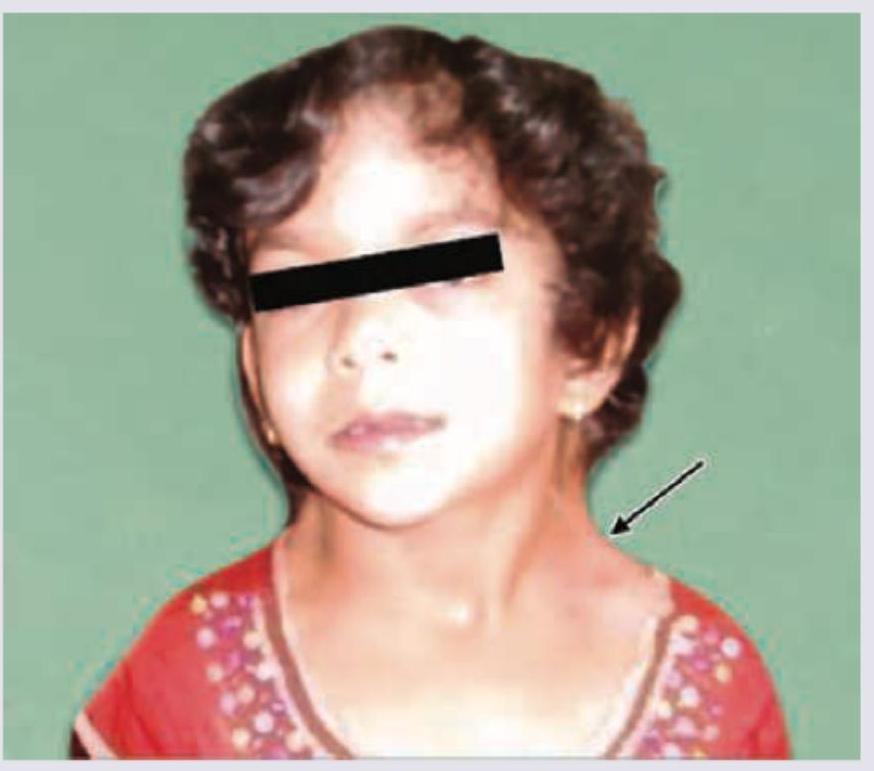
Which one of the following is not a feature of Turner syndrome?
A 5-year-old boy presents with peculiar facial features, enlarged head, hepatosplenomegaly, a protuberant abdomen, breathing difficulty with obstructive sleep apnea, and cardiac valve thickening. What is the likely diagnosis?
A six-year-old child underwent complete surgical removal of a craniopharyngioma and developed multiple endocrinopathies. Which of the following hormones should be replaced first?
A child presents with anti-mongoloid slant, pulmonary stenosis, short stature, and undescended testis. What is the most likely diagnosis?
McCune Albright syndrome is characterised by all EXCEPT:
All of the following are true for Turner syndrome except?
What is the clinical manifestation of hypothyroidism in children?
What is the most common endocrine abnormality observed in Down's syndrome?
What is the first clinical sign of hypophosphatasia?
Bony deformities, hyperpigmentation of the skin, and precocious puberty are seen in which of the following conditions?
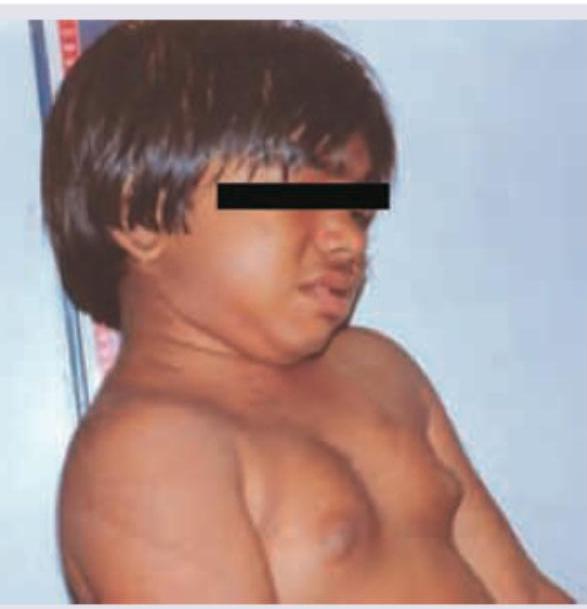
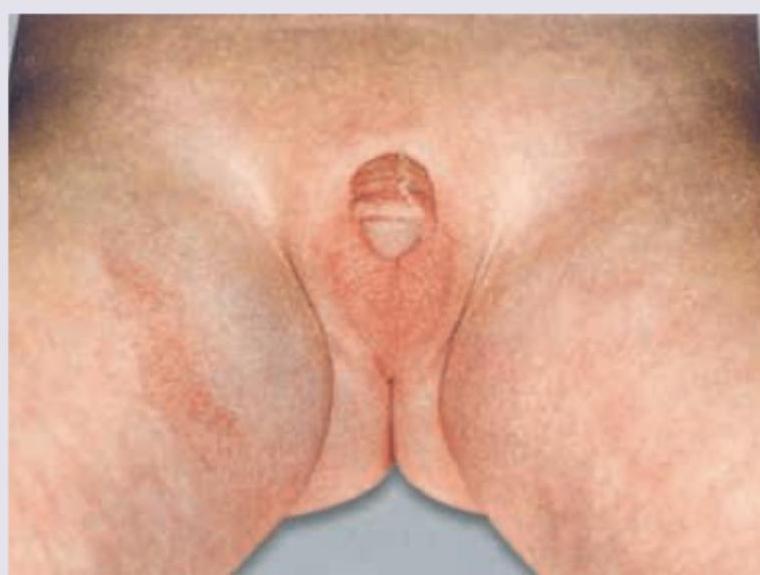
Explanation: **Explanation:** Turner syndrome (45,X) is the most common sex chromosome abnormality in females. The hallmark of the condition is the absence of one X chromosome, which leads to gonadal dysgenesis and various somatic stigmata. **Why Mental Retardation is the correct answer:** Most individuals with Turner syndrome have **normal intelligence**. While they may experience specific learning disabilities (particularly in visuospatial processing, non-verbal memory, and mathematics), global intellectual disability or mental retardation is **not** a characteristic feature. If significant mental retardation is present, clinicians should investigate other chromosomal rearrangements or a ring X chromosome. **Analysis of incorrect options:** * **Short Stature (Option A):** This is the most consistent clinical finding (seen in >95% of cases). It is primarily due to the haploinsufficiency of the **SHOX gene** located on the pseudoautosomal region of the X chromosome. * **Coarctation of Aorta (Option C):** This is the most common specific cardiac malformation (found in ~15-20% of patients). Bicuspid aortic valve is the overall most common cardiac anomaly (~30%). * **Lymphedema (Option D):** Congenital lymphedema of the hands and feet is a classic neonatal presentation, caused by lymphatic hypoplasia. This often resolves with age but may leave behind "shield chest" or "webbed neck" (cystic hygroma remnants). **High-Yield Clinical Pearls for NEET-PG:** * **Karyotype:** 45,X is the most common; however, 50% are mosaics (e.g., 45,X/46,XX). * **Gonads:** "Streak ovaries" leading to hypergonadotropic hypogonadism (high FSH/LH, low Estrogen) and primary amenorrhea. * **Renal:** Horseshoe kidney is the most common renal anomaly. * **Screening:** Annual thyroid function tests (increased risk of Hashimoto’s) and blood pressure monitoring are essential.
Explanation: The clinical presentation describes a classic case of **Mucopolysaccharidosis (MPS)**, characterized by the accumulation of glycosaminoglycans (GAGs) in various tissues. ### **Explanation of the Correct Answer** **Hunter’s Disease (MPS II)** is the correct diagnosis. It is caused by a deficiency of the enzyme **Iduronate-2-sulfatase**. The clinical features mentioned—coarse facial features, macrocephaly, hepatosplenomegaly, obstructive sleep apnea (due to GAG deposition in the airway), and valvular heart disease—are hallmark signs. *Note on the Question:* While Hurler’s and Hunter’s share these features, Hunter’s is often distinguished in exams by the **absence of corneal clouding** and its **X-linked recessive** inheritance (affecting males). Although the question doesn't explicitly mention the eyes, in a competitive MCQ format like NEET-PG, if Hunter's is the keyed answer for a male child with these symptoms, it points toward this specific subtype. ### **Why Other Options are Incorrect** * **Hurler’s Disease (MPS IH):** The most severe MPS. While it presents almost identically to Hunter’s, it typically includes **corneal clouding** and follows an Autosomal Recessive pattern. * **Fragile X Syndrome:** Presents with macrocephaly and intellectual disability, but features include a long face, large prominent ears, and **macro-orchidism**, not hepatosplenomegaly or GAG-related storage symptoms. * **Tay-Sachs Disease:** A sphingolipidosis characterized by developmental regression, seizures, and a **cherry-red spot** on the macula. It notably lacks hepatosplenomegaly. ### **NEET-PG High-Yield Pearls** * **Mnemonic:** "The **Hunter** needs clear eyes to see the **X** (target)." → Hunter’s has **No** corneal clouding and is **X-linked Recessive**. (All other MPS are Autosomal Recessive). * **Dermal Sign:** Hunter’s disease may present with unique **pebbly skin lesions** (ivory-colored papules) over the scapular region. * **Diagnosis:** Initial screening via urinary GAGs; confirmed by enzyme assay or genetic testing.
Explanation: **Explanation:** In patients with panhypopituitarism (often following craniopharyngioma surgery), the sequence of hormone replacement is critical for patient safety. **Hydrocortisone (Glucocorticoids) must always be replaced first.** **Why Hydrocortisone is the priority:** The underlying medical concept is the prevention of an **Adrenal Crisis**. If thyroxine (T4) is administered before hydrocortisone, it increases the basal metabolic rate and accelerates the hepatic clearance of any remaining cortisol. In a patient with ACTH deficiency, this sudden metabolic demand can precipitate an acute, life-threatening adrenal crisis. Therefore, adrenal sufficiency must be established or treated before addressing other axes. **Analysis of Incorrect Options:** * **Thyroxine (C):** While essential for growth and metabolism, it must only be started *after* the patient is hemodynamically stable on glucocorticoids to avoid the "pseudotumor cerebri" effect or adrenal collapse. * **Growth Hormone (B):** GH replacement is never an emergency. It is typically started last, usually 6–12 months post-surgery, once the patient is stable and there is no evidence of tumor recurrence. * **Prolactin (D):** Prolactin is not routinely replaced in clinical practice; in fact, craniopharyngiomas often cause *hyperprolactinemia* due to stalk effect (loss of dopamine inhibition). **High-Yield Clinical Pearls for NEET-PG:** * **Rule of Thumb:** "Steroids before Thyroid." * **Craniopharyngioma:** Most common suprasellar tumor in children; derived from **Rathke’s pouch**. * **Post-op Complication:** Diabetes Insipidus (DI) is the most common immediate postoperative endocrine complication, but among the options provided for long-term replacement, steroids take precedence.
Explanation: **Explanation:** The clinical presentation described is classic for **Noonan Syndrome**, an autosomal dominant disorder often referred to as the "Male Turner Syndrome" (though it affects both sexes). **1. Why Noonan Syndrome is Correct:** Noonan syndrome is primarily caused by mutations in the **PTPN11 gene** (RASopathy). Key diagnostic features present in this case include: * **Facial Features:** Anti-mongoloid slant (down-slanting palpebral fissures), low-set ears, and hypertelorism. * **Cardiac Defects:** **Pulmonary stenosis** (most common) and hypertrophic cardiomyopathy. * **Genitourinary:** Cryptorchidism (undescended testes) is a hallmark in males. * **Growth:** Short stature and webbed neck. **2. Why Other Options are Incorrect:** * **Turner Syndrome (45, XO):** While it shares features like short stature and webbed neck, it affects only females. Crucially, the characteristic cardiac lesion is **Coarctation of the Aorta**, not pulmonary stenosis. * **Down Syndrome (Trisomy 21):** Features an **up-slanting** (mongoloid) slant, Brushfield spots, and mental retardation. The most common cardiac defect is an **Endocardial Cushion Defect** (AVSD). * **Klinefelter Syndrome (47, XXY):** Presents with **tall stature**, gynecomastia, and small firm testes, rather than short stature and facial dysmorphism. **High-Yield Clinical Pearls for NEET-PG:** * **Mnemonic for Noonan:** **P**ulmonary stenosis, **P**TPN11 gene, **P**ectus excavatum/carinatum. * **Cardiac Distinction:** Noonan = **Right** sided heart (Pulmonary Stenosis); Turner = **Left** sided heart (Coarctation, Bicuspid Aortic Valve). * **Inheritance:** Noonan is Autosomal Dominant; Turner is a chromosomal aneuploidy.
Explanation: **Explanation:** McCune-Albright Syndrome (MAS) is a rare genetic disorder caused by a post-zygotic somatic mutation in the **GNAS1 gene**. This mutation leads to a constitutive activation of the **α-subunit of the G-protein (Gsα)**, resulting in the overproduction of cAMP. This "always-on" signaling mimics the effects of various hormones (ACTH, TSH, FSH, LH), leading to autonomous endocrine overactivity. **Why "Delayed Puberty" is the correct answer:** In MAS, the autonomous activation of the ovaries (in girls) or testes (in boys) leads to **Precocious Puberty** (specifically peripheral/GnRH-independent), not delayed puberty. In girls, this typically presents as recurrent follicular cysts and vaginal bleeding. **Analysis of incorrect options:** * **Cafe au lait skin spots:** These are classic features, often described as having irregular "Coast of Maine" borders (unlike the smooth "Coast of California" borders seen in Neurofibromatosis Type 1). They are usually large and unilateral, respecting the midline. * **Polyostotic fibrous dysplasia:** This involves the replacement of normal bone with fibrous tissue in multiple bones, leading to fractures, deformities (e.g., Shepherd’s crook deformity), and a "ground-glass" appearance on X-ray. * **Mutated α-subunit of G-protein:** This is the fundamental molecular defect (GNAS mutation) that defines the syndrome. **Clinical Pearls for NEET-PG:** * **Classic Triad:** Polyostotic fibrous dysplasia + Cafe au lait spots + Precocious puberty. * **Inheritance:** It is **not inherited**; it occurs due to a sporadic somatic mutation. If the mutation were germline (present in all cells), it would be lethal. * **Other Endocrine Associations:** Hyperthyroidism, Growth Hormone excess (Acromegaly), and Cushing Syndrome. * **Treatment of Precocious Puberty in MAS:** Aromatase inhibitors (e.g., Letrozole) or Estrogen receptor modulators (e.g., Tamoxifen).
Explanation: **Explanation:** Turner Syndrome (45,XO) is the most common sex chromosomal abnormality in females. The correct answer is **Option A** because **short stature** is the most consistent clinical feature of Turner syndrome. Without growth hormone therapy, the average adult height is typically significantly **less than 145 cm** (usually around 140 cm). This growth failure is primarily attributed to the haploinsufficiency of the **SHOX gene** located on the X chromosome. **Analysis of other options:** * **Webbing of neck (Option B):** This is a classic dysmorphic feature (pterygium colli) resulting from the resolution of fetal cystic hygromas and lymphatic obstruction. * **Increased carrying angle (Option C):** Also known as **Cubitus valgus**, this is a characteristic skeletal finding where the forearm is angled away from the body to a greater degree than normal. * **Coarctation of aorta (Option D):** This is the most common specific obstructive cardiac lesion in Turner syndrome (seen in ~10-20% of cases). Bicuspid aortic valve is the most common overall cardiac anomaly. **High-Yield Clinical Pearls for NEET-PG:** * **Karyotype:** 45,XO is the most common, but mosaicism (45,X/46,XX) is frequent and may present with milder features. * **Gonads:** "Streak ovaries" lead to hypergonadotropic hypogonadism (primary amenorrhea, elevated FSH/LH). * **Renal:** Horseshoe kidney is the most common renal anomaly. * **Dermatoglyphics:** High ridge count on fingertips. * **Treatment:** Recombinant Growth Hormone (for height) and Estrogen replacement (for secondary sexual characteristics and bone health).
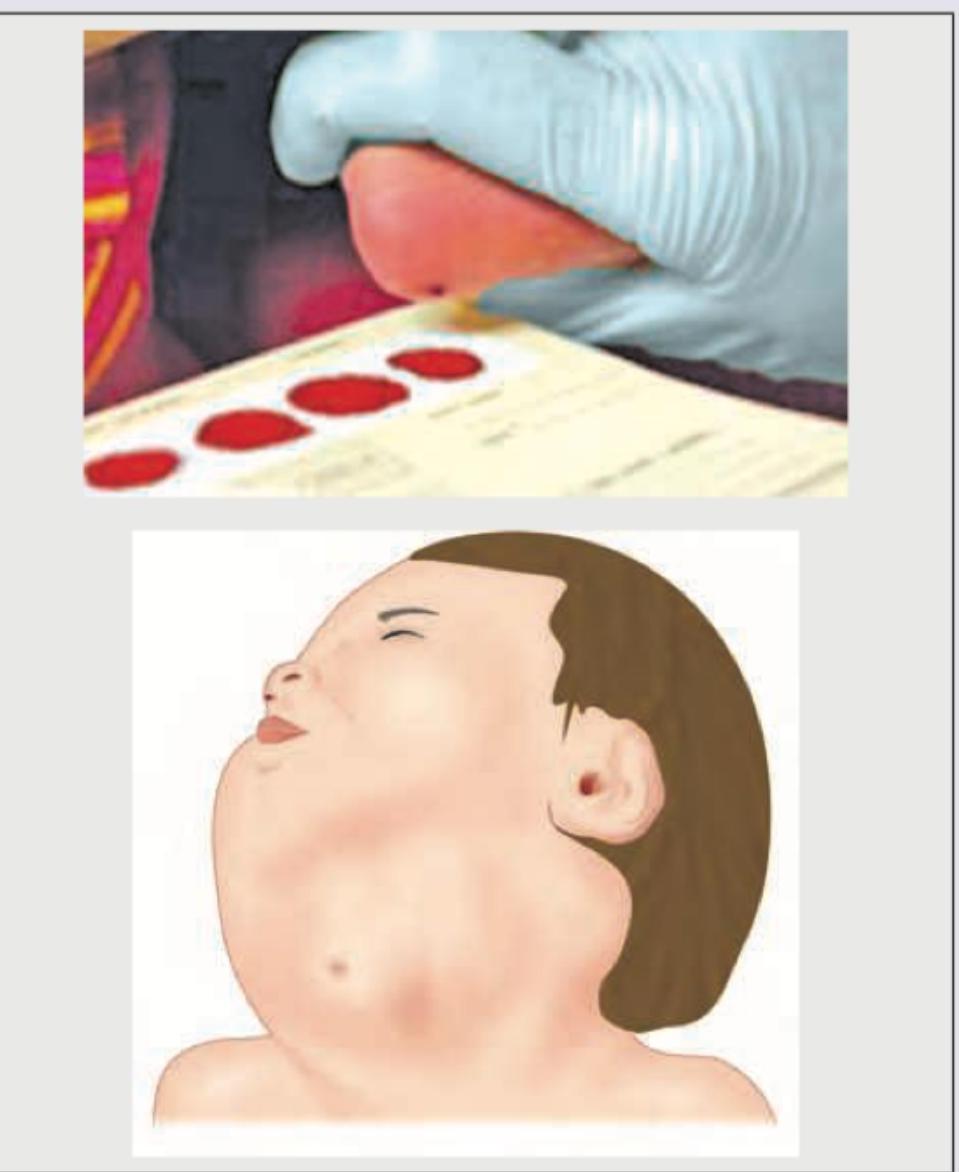
Explanation: **Explanation:** **1. Why Cretinism is Correct:** Cretinism is the term used for untreated **congenital hypothyroidism**. In children, thyroid hormones are critical for the development of the central nervous system and skeletal maturation. A deficiency during infancy leads to irreversible intellectual disability and stunted physical growth (short-statured "cretin"). Clinical features include a large protruding tongue, umbilical hernia, coarse facies, and delayed bone age. **2. Analysis of Incorrect Options:** * **B. Myxedema:** This refers to severe hypothyroidism in **adults**. It is characterized by non-pitting edema due to the accumulation of glycosaminoglycans in the dermis. While children can have "myxedematous" features, the specific clinical syndrome associated with childhood onset is Cretinism. * **C. Acromegaly:** This is caused by excessive Growth Hormone (GH) secretion **after** the closure of epiphyseal plates (adults), leading to the enlargement of hands, feet, and jaw. * **D. Gigantism:** This results from excessive GH secretion **before** the closure of epiphyseal plates in children, leading to proportional overgrowth of long bones and extreme height. **3. NEET-PG High-Yield Pearls:** * **Most Common Cause:** Worldwide, iodine deficiency is the most common cause; in developed areas/iodine-sufficient regions, **Thyroid Dysgenesis** (ectopy or aplasia) is the most common cause. * **Screening:** The best time for neonatal screening is **48–72 hours** after birth to avoid the physiological TSH surge. * **Early Sign:** Prolonged physiological jaundice is often the earliest clinical sign of neonatal hypothyroidism. * **Treatment:** Levothyroxine is the treatment of choice; initiating therapy before **2 weeks of age** is crucial to prevent permanent neurocognitive deficits.
Explanation: **Explanation:** **Hypothyroidism** is the most common endocrine disorder associated with Down’s syndrome (Trisomy 21). The prevalence is significantly higher than in the general population, affecting approximately 10–15% of individuals. The abnormality can manifest as **congenital hypothyroidism** (detected via newborn screening) or, more commonly, as **acquired autoimmune (Hashimoto’s) thyroiditis** later in childhood or adolescence. Additionally, many patients exhibit "compensated hypothyroidism" (elevated TSH with normal T4), necessitating regular thyroid function monitoring throughout their lives. **Analysis of Incorrect Options:** * **Hypoparathyroidism:** While Down’s syndrome is associated with various autoimmune conditions, primary hypoparathyroidism is not a characteristic feature. It is more classically associated with DiGeorge syndrome (22q11.2 deletion). * **Congenital Adrenal Hyperplasia (CAH):** This is a genetic enzymatic defect (most commonly 21-hydroxylase deficiency) and does not have an increased incidence specifically linked to Trisomy 21. * **Cushing’s Disease:** This results from an ACTH-secreting pituitary adenoma. There is no established epidemiological link between Down’s syndrome and an increased risk of Cushing’s disease. **High-Yield Clinical Pearls for NEET-PG:** * **Screening:** AAP guidelines recommend thyroid screening (TSH) at birth, 6 months, 12 months, and then **annually** for life in Down’s syndrome patients. * **Other Endocrine Links:** There is also an increased risk of **Type 1 Diabetes Mellitus** (autoimmune) in these patients. * **Non-Endocrine Associations:** Common associations include AVSD (most common cardiac defect), duodenal atresia, and early-onset Alzheimer’s disease.
Explanation: **Explanation:** **Hypophosphatasia (HPP)** is a rare genetic metabolic disorder caused by a deficiency of the **tissue-nonspecific alkaline phosphatase (TNSALP)** enzyme. This deficiency leads to an accumulation of inorganic pyrophosphate, which inhibits bone mineralization. **Why Option A is correct:** The **premature loss of primary (deciduous) teeth** (typically before age 5) is the most common and often the **first clinical sign** of the childhood and odontohypophosphatasia forms. This occurs due to the failure of **cementum** (the specialized bone-like substance covering the tooth root) to form correctly. Without cementum, the periodontal ligaments cannot attach the tooth to the alveolar bone, leading to painless exfoliation of teeth (most commonly the incisors) with the roots still intact. **Why other options are incorrect:** * **B. Bowed limb bones:** While rickets-like skeletal deformities (bowing) are a hallmark of HPP, they typically manifest after or alongside dental symptoms in the childhood form. * **C. Skull bone deficiency:** Severe hypomineralization of the skull (caput membranaceum) is characteristic of the **perinatal lethal form**, but in the more common clinical presentations, dental manifestations precede overt skeletal changes. * **D. All of the above:** While all are features of HPP, they do not all represent the *first* clinical sign. **High-Yield Clinical Pearls for NEET-PG:** * **Biochemical Marker:** Characterized by **low serum alkaline phosphatase (ALP)** levels (Note: Most other bone diseases have high ALP). * **Urinary Marker:** Elevated levels of **phosphoethanolamine** in the urine. * **Radiology:** "Copper beaten skull" appearance due to craniosynostosis and characteristic "metaphyseal lucencies" (tongues of radiolucency). * **Treatment:** Enzyme replacement therapy with **Asfotase alfa**.
Explanation: **Explanation:** The correct answer is **McCune-Albright Syndrome (MAS)**. This condition is characterized by a classic clinical triad: 1. **Polyostotic Fibrous Dysplasia:** Bony deformities and replacement of normal bone with fibrous tissue, leading to pathological fractures. 2. **Café-au-lait spots:** Hyperpigmented skin lesions with irregular borders (often described as the "Coast of Maine" appearance). 3. **Precocious Puberty:** Specifically **GnRH-independent (peripheral)** precocious puberty, most common in girls. **Pathophysiology:** MAS is caused by a somatic mutation in the **GNAS1 gene**, which leads to constitutive activation of the **Gsα protein**. This results in overproduction of cAMP, causing autonomous hyperfunction of multiple endocrine glands (ovaries, thyroid, adrenals, and pituitary). **Why other options are incorrect:** * **Alport Syndrome:** A genetic disorder of Type IV collagen characterized by progressive glomerulonephritis, sensorineural hearing loss, and ocular abnormalities (lenticonus). * **Laurence-Moon-Biedl (Bardet-Biedl) Syndrome:** Characterized by rod-cone dystrophy (retinitis pigmentosa), obesity, polydactyly, hypogonadism, and renal anomalies. * **Frohlich’s Syndrome (Adiposogenital Dystrophy):** Caused by hypothalamic lesions, leading to obesity, stunted growth, and delayed puberty (hypogonadotropic hypogonadism). **High-Yield Clinical Pearls for NEET-PG:** * **Genetics:** It is a **mosaic** condition; the mutation occurs post-zygotically. If it were germline (in all cells), it would be lethal. * **Skin Lesions:** Unlike Neurofibromatosis (Coast of California), MAS spots have jagged "Coast of Maine" borders and typically do not cross the midline. * **Endocrinopathies:** Beyond puberty, patients may present with hyperthyroidism, GH excess (acromegaly), or Cushing syndrome.
Disorders of Growth
Practice Questions
Thyroid Disorders
Practice Questions
Disorders of Puberty
Practice Questions
Adrenal Disorders
Practice Questions
Diabetes Mellitus in Children
Practice Questions
Disorders of Calcium and Phosphate Metabolism
Practice Questions
Disorders of Sexual Development
Practice Questions
Hypoglycemia
Practice Questions
Obesity and Metabolic Syndrome
Practice Questions
Pituitary Disorders
Practice Questions
Multiple Endocrine Neoplasia Syndromes
Practice Questions
Endocrine Emergencies
Practice Questions
Get full access to all questions, explanations, and performance tracking.
Start For Free