Fluid of choice for shock in a child with severe acute malnutrition + hypoglycemia
A patient with DKA has a pH of 7.1, Na 130, and K 5.5. What is the best initial treatment?
Which of the following is a common finding in patients with Syndrome of Inappropriate Antidiuretic Hormone Secretion (SIADH)?
Which of the following is not true about syndrome of inappropriate antidiuretic hormone secretion (SIADH)?
A 37-week small-for-date neonate is most likely to develop
A child presented to the casualty department with fever, unconsciousness, and papilledema. What is the next step?
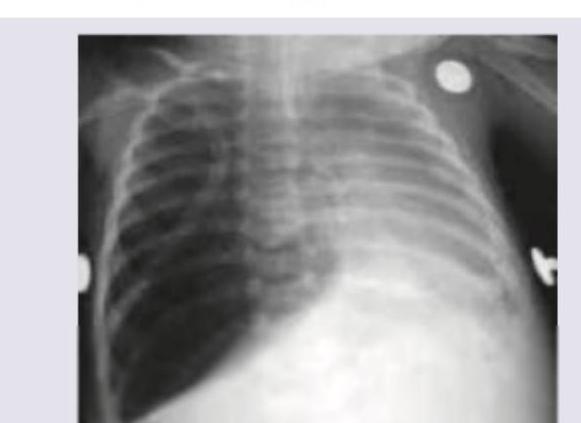
A 4-year-old admitted in ward with pneumonia. He develops sudden onset of breathlessness. What is the next step in management?
The image shows a child with virilisation and clitoromegaly. What laboratory finding is typical for this condition, assuming the most common enzyme defect?
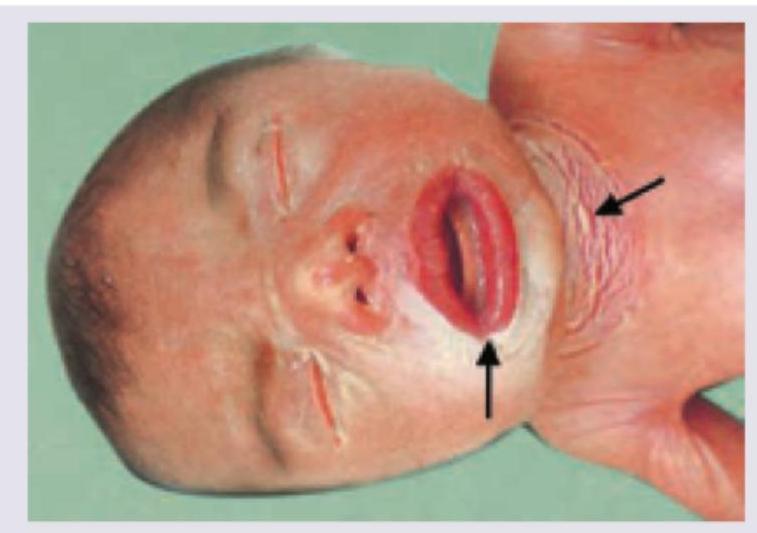
A neonate presents with the condition shown in the image below. This condition has all of the following features EXCEPT:
A 3-week-old female infant presents with ambiguous genitalia and hyperpigmentation of the skin. Laboratory findings include hyponatremia and hyperkalemia. What is the most likely diagnosis?
Explanation: ***Ringer lactate + 5% dextrose*** - This combination provides both **electrolytes** (from Ringer lactate) to help correct **shock** and **glucose** (from 5% dextrose) to address **hypoglycemia** in a child with severe acute malnutrition (SAM). - Patients with SAM are at a high risk of **hypoglycemia** during shock, making glucose supplementation crucial. *Normal saline* - While suitable for initial fluid resuscitation in shock, it does **not contain glucose** and would not address the concomitant hypoglycemia. - Excessive use of normal saline can also lead to **hyperchloremic metabolic acidosis**, which is undesirable in already compromised patients. *Ringer lactate* - Ringer lactate provides **electrolytes** and is a good crystalloid for shock resuscitation, but it **lacks glucose** to correct hypoglycemia. - In SAM patients, where energy stores are depleted, simply providing Ringer lactate might not be sufficient to prevent or treat hypoglycemia. *10% dextrose* - 10% dextrose would effectively treat **hypoglycemia** but is not an appropriate fluid for fluid resuscitation in **shock**. - It would not adequately expand the intravascular volume or provide the necessary electrolytes for managing shock alone.
Explanation: ***IV fluids*** - Initial management of **diabetic ketoacidosis (DKA)** prioritizes aggressive **intravenous fluid resuscitation** to correct dehydration and improve renal perfusion, thereby facilitating ketone and glucose excretion [1]. - This step is critical before insulin administration to prevent rapid drops in osmolality, which can lead to **cerebral edema** [2]. *IV insulin* - While critical for resolving DKA by stopping ketone production and lowering glucose, **insulin is typically started after initial fluid resuscitation** and only once potassium levels are stable or >3.3 mEq/L to prevent hypokalemia. - Early insulin without adequate fluid replacement can worsen dehydration and increase the risk of **cerebral edema**. *IV potassium* - Although DKA patients are typically **potassium-depleted**, despite what appears to be normal or high serum potassium due to extracellular shift, IV potassium replacement is usually initiated only once serum potassium falls below 5.3 mEq/L and after the start of insulin, which drives potassium into cells [1]. - Administering potassium too early without baseline potassium re-evaluation after initial fluid resuscitation could lead to **hyperkalemia** if the initial high level is truly representative. *IV bicarbonate* - Bicarbonate therapy for DKA is controversial and generally **not recommended** unless the pH is extremely low, typically < 6.9, or in cases of severe cardiovascular instability. - Rapid correction of acidosis can lead to **cerebral edema**, **rebound metabolic alkalosis**, paradoxical central nervous system acidosis, and worsening hypokalemia.
Explanation: ***Normal BP*** - In SIADH, patients are typically **euvolemic** due to the primary issue being water retention rather than salt retention or frank dehydration [2]. - While hyponatremia occurs, the body's compensatory mechanisms usually prevent significant changes in blood pressure, maintaining it within the **normal range**. *Generalized edema* - Generalized edema is uncommon in SIADH because the excessive water retention is initially within the **intravascular compartment**, and the body attempts to excrete the additional volume of water [1]. - Although the patient is effectively retaining water, the osmolality is low, leading to fluid shifts rather than overt edema unless severe, protracted fluid overload occurs. *Ascites* - **Ascites**, which is the accumulation of fluid in the peritoneal cavity, is not a characteristic feature of SIADH [2]. - Ascites is more commonly associated with conditions like **liver cirrhosis**, heart failure, or malignancy. *Dry mucous membrane* - **Dry mucous membranes** are a sign of dehydration and fluid volume deficit. - In contrast, SIADH involves **fluid overload** (though euvolemic), making dry mucous membranes an unlikely finding [2].
Explanation: ***Urinary sodium <20 mEq/L*** - In **SIADH**, the inappropriate secretion of ADH leads to increased water reabsorption, causing **dilutional hyponatremia**. [1] - The kidneys respond by trying to excrete excess water and dilute the urine, leading to **increased urinary sodium concentration**, typically *greater than* 20 mEq/L. *Patient can be clinically euvolemic to hypovolemic* - Patients with **SIADH** are typically **euvolemic** because the excess water is retained intracellularly and extracellularly in balanced proportions, without significant edema or dehydration. [1] - While fluid retention occurs, it's not enough to cause significant clinical volume overload, and they are never truly hypovolemic. *Urine osmolality >100 mOsm/kg* - In **SIADH**, the continued action of **ADH** despite hypotonicity results in the reabsorption of water, leading to the production of **concentrated urine**. [1] - This elevated urine osmolality, typically **greater than 100 mOsm/kg**, indicates an inability to adequately excrete free water. [1] *Serum sodium <135 mEq/L* - **SIADH** is defined by **hyponatremia**, a serum sodium concentration **below 135 mEq/L**, due to the excessive retention of water. - This dilutes the extracellular fluid, leading to a reduction in the relative concentration of sodium.
Explanation: ***Hypoglycaemia*** - **Small-for-date** neonates have reduced **glycogen stores** due to chronic fetal stress or placental insufficiency. - Their increased metabolic demands relative to limited energy reserves make them prone to **low blood glucose**. - This is the **most immediate metabolic complication** requiring urgent screening and management. *Hyaline membrane disease* - This condition, also known as **respiratory distress syndrome**, primarily affects **premature neonates** due to surfactant deficiency. - **Small-for-date infants** at term (37 weeks) typically have **accelerated lung maturity** due to chronic intrauterine stress, making them **less susceptible** to RDS compared to appropriately grown preterm infants. *Hypocalcaemia* - While neonates can experience hypocalcemia, it is particularly common in infants of **diabetic mothers**, those with **asphyxia**, or those born **prematurely**. - Small-for-date status alone isn't the primary risk factor for **neonatal hypocalcaemia**. *Hypothermia* - **Small-for-date** infants have a larger **surface area to body mass ratio** and reduced **subcutaneous fat**, which significantly increases heat loss. - This is indeed a **major risk** requiring immediate attention at birth (thermal protection, skin-to-skin care). - However, **hypoglycemia** is considered the **most characteristic metabolic derangement** and "most likely" complication specifically associated with SGA status, making it the best answer for this question.
Explanation: **Intubation** - The presence of **unconsciousness** indicates a compromised airway and breathing, making immediate **airway management** and **ventilatory support** a priority. - Papilledema, fever, and unconsciousness suggest increased **intracranial pressure** which can lead to brainstem herniation and respiratory arrest, necessitating **controlled ventilation** to reduce CO2 and ICP. *Oxygenation* - While **oxygenation** is critical, it is often insufficient alone in an unconscious patient with a compromised airway. - **Intubation** ensures a patent airway and delivers controlled oxygenation and ventilation more effectively than oxygenation via mask in this situation. *CT scan* - A **CT scan** is a diagnostic tool, but it should only be performed after the patient is **stabilized** hemodynamically and respiratory-wise. - Transporting an **unconscious** patient with potential increased ICP for a CT scan without securing the airway carries significant risks. *All of the options* - While all listed steps are important in managing a child with these symptoms, **intubation** (airway and breathing stabilization) is the **most immediate and critical next step**. - The sequence of medical interventions follows the **ABC (Airway, Breathing, Circulation)** protocol, making airway management the top priority before diagnostics or other treatments.
Explanation: ***Emergency needle thoracostomy*** - This patient, a 4-year-old with pneumonia and sudden breathlessness, likely has a **tension pneumothorax**, which is a life-threatening emergency requiring immediate decompression. The chest X-ray shows a collapsed right lung and a mediastinal shift, consistent with tension pneumothorax. - An **emergency needle thoracostomy** (needle decompression) is the immediate life-saving procedure to relieve the pressure in a tension pneumothorax before more definitive treatment can be initiated. - Performed by inserting a large-bore needle (14-16G) into the **2nd intercostal space, mid-clavicular line** on the affected side. *Intercostal drainage tube insertion* - While an intercostal drainage tube (chest tube) is the definitive treatment for pneumothorax, it takes more time to insert and is not the immediate first step for a **tension pneumothorax** in an unstable patient. - The delay in performing needle decompression could be fatal in a rapidly deteriorating patient with tension pneumothorax. *Decrease mechanical ventilation setting* - Decreasing mechanical ventilation settings would not address the underlying pathology of a tension pneumothorax, which is trapped air causing lung collapse and mediastinal shift. - This action could further compromise the patient's respiratory status if the pneumothorax is severe and the patient is already hypoxemic. *Increase mechanical ventilation setting* - Increasing mechanical ventilation settings would likely worsen a **tension pneumothorax** by forcing more air into the pleural space and increasing intrathoracic pressure. - This would further compromise venous return to the heart and reduce cardiac output, rapidly leading to **cardiovascular collapse**.
Explanation: ***Increased urinary sodium*** - **Congenital adrenal hyperplasia (CAH)** due to **21-hydroxylase deficiency** is the most common cause of virilization and clitoromegaly in female infants, accounting for >90% of CAH cases. - This enzyme defect blocks the conversion of 17-hydroxyprogesterone to 11-deoxycortisol, impairing both **cortisol and aldosterone synthesis**. - The lack of **aldosterone** (mineralocorticoid) results in a **salt-wasting crisis** with renal sodium loss, leading to **hyponatremia, hyperkalemia, and inappropriately elevated urinary sodium excretion** despite low serum sodium. - Among the given options, increased urinary sodium is the characteristic laboratory finding of the salt-wasting form (seen in ~75% of 21-hydroxylase deficiency cases). *Low urinary sodium* - Low urinary sodium would suggest effective renal sodium retention with intact aldosterone function. - This is contrary to the aldosterone deficiency seen in salt-wasting CAH, where the kidneys cannot retain sodium appropriately. *Increased plasma cortisol* - In 21-hydroxylase deficiency, the enzyme block **prevents cortisol synthesis**, leading to **decreased plasma cortisol** levels. - The low cortisol triggers increased ACTH secretion, which drives adrenal androgen overproduction (causing virilization) and accumulation of precursors like 17-hydroxyprogesterone. *Increased aldosterone* - **Aldosterone synthesis is severely impaired** in 21-hydroxylase deficiency, leading to **decreased or absent aldosterone** levels. - Increased aldosterone would cause sodium retention and potassium excretion—the opposite of the salt-wasting crisis observed in this condition.
Explanation: ***Satellite lesions*** - **Satellite lesions** (smaller lesions located near a main rash) are characteristic of certain fungal infections like candidiasis or some viral rashes, but not of **collodion baby/harlequin ichthyosis**, which is suggested by the image. - The image shows features consistent with a severe congenital ichthyosis, where **skin scaling** and **facial deformities** are prominent, not scattered papules or pustules. *Ectropion* - **Ectropion** (eversion of the eyelids) is clearly visible in the image, where the eyelids are pulled outwards, exposing the conjunctiva. - This is a common feature in conditions like **collodion baby** and **harlequin ichthyosis** due to the restrictive outer skin layer. *Eclabium* - **Eclabium** (eversion of the lips) is also distinctly present in the image, with the lips appearing stretched and everted. - This is another characteristic manifestation of severe congenital ichthyosis, resulting from the **tight, hardened skin** around the mouth. *Hard elastic scales over the neck area* - The image shows **thickened, furrowed, and scaly skin** texture, particularly noticeable around the neck area (indicated by the arrow), which aligns with the description of **hard, elastic scales**. - This is a hallmark feature of **ichthyosis**, where there is impaired skin barrier function and excessive scale production.
Explanation: **Explanation:** The clinical presentation of ambiguous genitalia in a female infant, skin hyperpigmentation, and electrolyte imbalances (hyponatremia and hyperkalemia) is classic for **Congenital Adrenal Hyperplasia (CAH)**, specifically **21-hydroxylase deficiency**. **1. Why 21-hydroxylase deficiency is correct:** This is the most common cause of CAH (>90%). A deficiency in this enzyme blocks the conversion of progesterone to deoxycorticosterone (mineralocorticoid pathway) and 17-OH progesterone to 11-deoxycortisol (glucocorticoid pathway). * **Mineralocorticoid deficiency:** Leads to "salt-wasting" (hyponatremia, hyperkalemia, and hypotension). * **Glucocorticoid deficiency:** Triggers a feedback increase in ACTH, causing **hyperpigmentation** (due to shared precursor with MSH) and adrenal hyperplasia. * **Androgen excess:** Shunting of precursors toward the androgen pathway causes virilization/ambiguous genitalia in females. **2. Why other options are incorrect:** * **11-beta hydroxylase deficiency:** While it causes virilization and hyperpigmentation, it leads to **hypertension** and hypokalemia because 11-deoxycortisol (which builds up) has mineralocorticoid activity. * **17-alpha hydroxylase deficiency:** This results in decreased sex hormones. Females would have normal external genitalia at birth but fail puberty; males would present with ambiguous genitalia/pseudohermaphroditism. It also causes hypertension. * **17, 20 lyase deficiency:** This affects only sex hormone synthesis. It does not cause salt-wasting or hyperpigmentation as cortisol and aldosterone pathways remain intact. **High-Yield Pearls for NEET-PG:** * **Most common enzyme deficiency:** 21-hydroxylase. * **Diagnostic marker:** Elevated **17-hydroxyprogesterone (17-OHP)**. * **Karyotype:** Usually 46, XX in virilized females. * **Treatment:** Glucocorticoid (Hydrocortisone) and Mineralocorticoid (Fludrocortisone) replacement.
Get full access to all questions, explanations, and performance tracking.
Start For Free