At what age does the transfer of one object to another hand happen?
A 9-month-old child is brought to OPD with developmental concerns. The child cannot sit without support, says "dada" and "mama", and has stranger anxiety. What is the appropriate management?
Comment on the diagnosis of this child with hypoactive deep tendon reflexes and reduced range of movement at all joints:
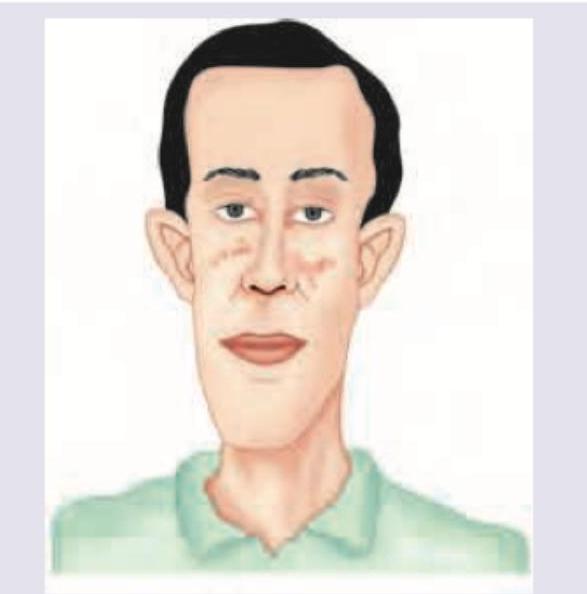
The picture depicts characteristic facial features of a child including a long face, prominent forehead, large ears, and prominent jaw. This disorder is also associated with intellectual disability, autistic behavior, and macroorchidism. Which syndrome is being described?
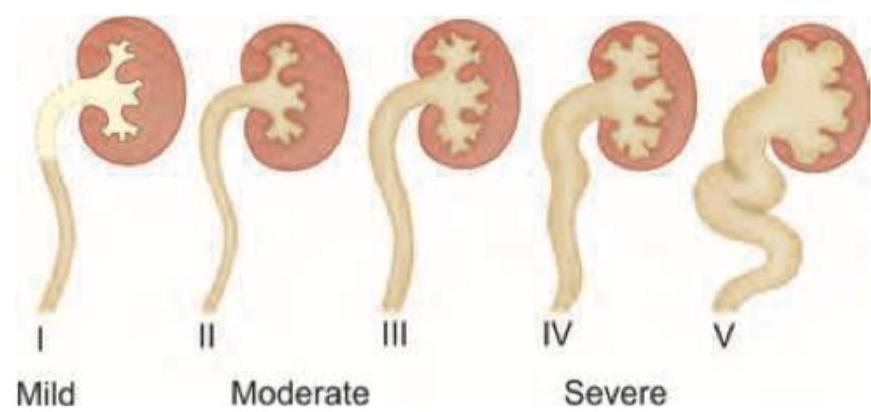
A child is having difficulty standing up from a sitting position and uses a characteristic maneuver shown in the image below. What is the most likely diagnosis?

The child can do this activity at which age?

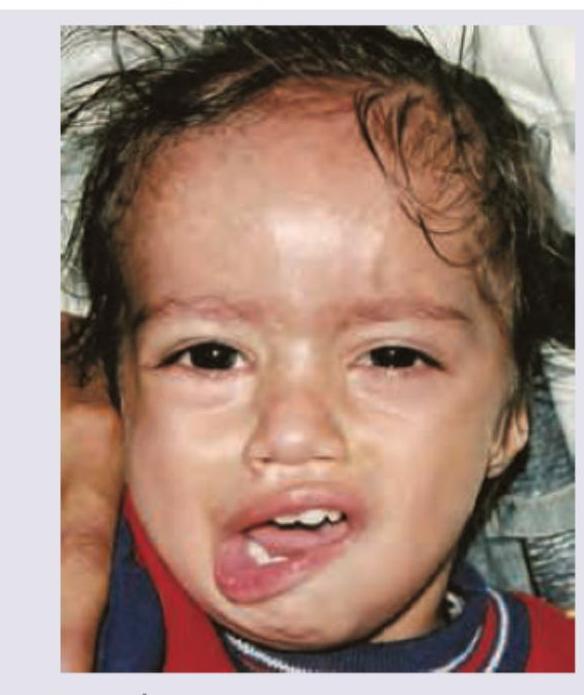
A 2-year-old child presents with developmental delay and hypotonia. The following image shows:
An obese 3-year-old, short stature child with history of hyperphagia, almond eyes and small hands and feet is brought for consultation. On neurological examination hypotonia is noted. IQ is very low. The probable cause is?
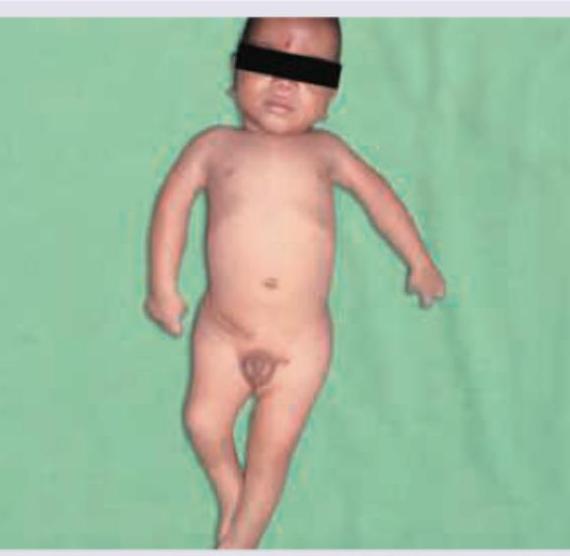
A neonate presents with the clinical features shown in the image below. What is the most likely diagnosis?

All are seen in this child except:

Explanation: ***7 months***- The transfer of an object from one hand to the other is a significant **fine motor milestone**, typically achieved between **6 and 8 months** of age, averaging around 7 months.- This milestone requires improved **bilateral coordination** and the ability to recognize that the object can be held by either hand, often coinciding with independent sitting.*4 months*- At **4 months**, infants generally begin reaching for objects deliberately and bringing them to their mouth using a primitive **palmar grasp**.- Transfer is not yet possible as the release mechanism and coordination between the two upper limbs are insufficiently developed.*9 months*- By **9 months**, infants are generally developing the **pincer grasp** (using the index finger and thumb) and possess well-established object transfer skills.- They move on to more complex manipulations, like banging two objects together or voluntarily releasing objects into a container.*12 months*- At **12 months**, fine motor skills are highly refined, allowing for precise actions such as stacking two blocks and using a mature **pincer grip** to pick up small crumbs.- Object transfer is fully developed and consolidated by this age, which is far beyond the initial stage of acquisition.
Explanation: ***Refer to neurologist for developmental assessment*** - The milestone of **sitting without support** is generally expected by **8-9 months**. Failure to achieve this at 9 months, especially when it should have been emerging, is a **red flag for motor delay**. - Although language (saying 'dada'/'mama' non-specifically) and social milestones (stranger anxiety) are adequate, the gross motor delay warrants a **specialized developmental assessment** to rule out conditions like hypotonia, cerebral palsy, or neuromuscular disorders. - Early identification and intervention are crucial for optimal developmental outcomes. *Incorrect: Order an immediate MRI* - **Neuroimaging (like MRI)** is an expensive and invasive diagnostic step, usually reserved for cases where an underlying structural brain abnormality is strongly suspected *after* a thorough clinical and developmental assessment. - Initial management for suspected developmental delay involves detailed assessment by a specialist (pediatrician/neurologist) and screening tests, not immediate imaging. *Incorrect: Reassure the parents that it's normal development* - This reassurance is inappropriate because the child is demonstrating a **lag in gross motor milestones** (cannot sit without support at 9 months). - Some children may sit slightly later, but given this is at the upper limit of normal, further assessment is warranted rather than simple reassurance. - Failure to address a developmental delay early can lead to missed opportunities for timely **early intervention services**. *Incorrect: Advise parents to start exercises* - While physical therapy (exercises) will likely be part of the recommended intervention, simply advising exercises without a formal **developmental diagnosis** or proper assessment by a **physiotherapist/specialist** is insufficient and potentially incomplete management. - The priority is to **identify the cause** of the delay (e.g., hypotonia, cerebral palsy, muscular dystrophy) through specialist evaluation before initiating targeted therapy.
Explanation: ***Arthrogryposis multiplex congenita*** - This condition is characterized by **multiple congenital joint contractures** at birth, which directly explains the reduced range of movement at all joints. - The hypoactive deep tendon reflexes can be associated with underlying neuromuscular involvement that contributes to the joint contractures. *Down's syndrome* - Children with Down's syndrome typically present with **generalized hypotonia** (low muscle tone) and often have **hypermobility** of joints, rather than reduced range of motion and contractures. - While they can have developmental delays, the specific combination of stiff joints and hypoactive reflexes does not align with the typical presentation of Down's syndrome. *Achondroplasia* - Achondroplasia is a form of **short-limbed dwarfism** characterized by disproportionately short limbs and a normal-sized trunk, primarily affecting bone growth. - It does not typically cause generalized joint contractures or hypoactive deep tendon reflexes. *Turner syndrome* - Turner syndrome (XO) affects females and is characterized by **short stature, webbed neck, and heart defects**, among other features. - It generally does not present with generalized joint contractures or hypoactive deep tendon reflexes as primary musculoskeletal findings.
Explanation: ***Fragile X syndrome*** - The constellation of **long face**, **prominent forehead**, **large ears**, and **prominent jaw** are classic facial features of Fragile X syndrome. - The association with **intellectual disability**, **autistic behavior**, and **macroorchidism** (large testes) further confirms Fragile X syndrome, which is caused by a trinucleotide repeat expansion in the *FMR1* gene. *Down syndrome* - Characterized by distinct facial features such as a **flat facial profile**, **upslanting palpebral fissures**, **epicanthic folds**, and a **single palmar crease**. - While it causes intellectual disability, it does not typically present with a long face, large ears, or macroorchidism. *Klinefelter syndrome* - Patients typically present with **tall stature**, **small testes** (hypogonadism), **gynecomastia**, and often some degree of learning disability, but not the specific facial features or macroorchidism described. - This syndrome is due to an extra X chromosome (47, XXY). *Prader-Willi syndrome* - Characterized by **obesity**, **hypotonia** in infancy, **hyperphagia**, and mild to moderate intellectual disability. - Facial features include a **narrow forehead**, small hands and feet, and almond-shaped eyes, which differ from those described in the question.
Explanation: ***Duchenne muscular dystrophy*** - The image shows a child exhibiting **Gowers' sign**, a classic indicator of proximal muscle weakness, particularly of the lower limbs, characteristic of Duchenne muscular dystrophy. - The child's posture, with prominent shoulders and an attempt to use their hands to "walk up" their body to stand, is consistent with the progression of muscle weakness in this condition. *Little's disease* - This is an older term primarily referring to **spastic diplegia**, a form of cerebral palsy characterized by increased muscle tone and reflexes, particularly in the lower limbs. - While it causes difficulties with movement, Gowers' sign is not a hallmark; rather, scissoring gait from spasticity would be more typical. *Athetoid cerebral palsy* - This type of cerebral palsy is characterized by **involuntary, slow, writhing movements** (athetosis) that are often worse with attempted voluntary movement. - The image does not depict the characteristic uncontrolled movements of athetosis; instead, it shows a specific compensatory movement due to weakness. *Down syndrome* - Down syndrome is a **chromosomal disorder (trisomy 21)** associated with intellectual disability, characteristic facial features, and various health issues, including congenital heart defects. - While hypotonia (low muscle tone) can be present, the specific Gowers' sign points away from Down syndrome as the primary diagnosis suggested by the image.
Explanation: ***5 years*** - **Skipping** is a complex gross motor skill that requires coordinated bilateral movements, balance, and rhythmic alternation between feet - This skill is typically achieved at **5 years of age** according to standard developmental milestones - At 5 years, children can **skip alternating feet smoothly and fluidly**, incorporating it into play activities - This represents the age at which **most children master true skipping** with proper coordination *3 years* - Children at **3 years** are developing skills like running, jumping with both feet together, and climbing stairs alternating feet - **Skipping is too complex** for 3-year-olds as it requires bilateral coordination they have not yet developed - They may attempt hopping or galloping movements, but cannot perform true alternating-foot skipping *4 years* - At **4 years**, children can hop on one foot (4-6 hops) and have improved gross motor coordination - They may **attempt skipping** but typically do so with uneven, uncoordinated movements or a galloping gait - True smooth alternating-foot skipping is generally **not yet mastered** at this age *6 years* - By **6 years**, skipping is well-established and refined, often incorporated into complex games and activities - Children at this age have mastered the skill and can perform it effortlessly - However, **6 years is beyond the typical age of initial skill acquisition** (which occurs at 5 years)
Explanation: ***Down syndrome*** - **Down syndrome** commonly presents with **developmental delay** and **hypotonia** in early childhood, which matches this 2-year-old's clinical presentation. - Characteristic facial features include **upward-slanting palpebral fissures**, **flat nasal bridge**, **epicanthal folds**, and **macroglossia** (large protruding tongue), though individual features may vary. *Cardiofacial syndrome* - **Cardiofacial syndrome** (DiGeorge syndrome/22q11.2 deletion) presents with **cardiac defects**, **cleft palate**, and **micrognathia** (small jaw). - The facial dysmorphism pattern differs significantly from Down syndrome, typically showing **narrow palpebral fissures** and **tubular nose**. *Noonan syndrome* - **Noonan syndrome** features include **webbed neck**, **hypertelorism** (widely spaced eyes), **ptosis**, and **low-set posterior hairline**. - Associated with **pulmonary stenosis** and **short stature**, but the facial phenotype is distinct from Down syndrome features. *Dandy-Walker syndrome* - **Dandy-Walker syndrome** is a **posterior fossa malformation** affecting cerebellar development and ventricular system. - Presents primarily with **neurological symptoms** like developmental delay and **macrocephaly**, but lacks distinctive facial dysmorphic features.
Explanation: ***Deletion of long arm of chromosome 15*** - The constellation of symptoms including **obesity**, **hyperphagia**, **short stature**, **hypotonia**, **small hands and feet**, **almond-shaped eyes**, and **developmental delay/low IQ** is highly characteristic of **Prader-Willi syndrome**. - Prader-Willi syndrome is caused by the **deletion of the paternal allele on the long arm of chromosome 15 (15q11-q13)** or maternal **uniparental disomy of chromosome 15**. *Trisomy 21* - **Trisomy 21 (Down syndrome)** typically presents with characteristic facial features such as a flat facial profile, upslanting palpebral fissures, and epicanthic folds, but not usually almond-shaped eyes in the same context as Prader-Willi. - While hypotonia and developmental delay are common in Down syndrome, **hyperphagia leading to extreme obesity** and **small hands and feet** are not typical features. *Deletion of long arm of chromosome 7* - Deletion of the long arm of chromosome 7 is associated with **Williams syndrome**, which presents with distinct features such as a "elfin" facial appearance, outgoing personality, and cardiovascular anomalies (e.g., supravalvular aortic stenosis). - Features like **hyperphagia**, **obesity**, **hypotonia**, and **small hands and feet** are not characteristic of Williams syndrome. *Deletion of X chromosome* - **Deletion of the X chromosome** is associated with **Turner syndrome (45, XO)**, affecting females. - Key features include short stature, webbed neck, widely spaced nipples, and gonadal dysgenesis. **Obesity**, **hyperphagia**, **hypotonia**, and developmental delay (especially intellectual disability or low IQ) are not primary features.
Explanation: ***Congenital hypothyroidism*** - The image shows a neonate with **macroglossia** (large tongue), **umbilical hernia**, and possibly **puffy eyelids** and **dull facies**, all characteristic signs of congenital hypothyroidism. - Other features often include **hypotonia**, **feeding difficulties**, **prolonged jaundice**, and **constipation**. *Down syndrome* - While Down syndrome can present with **hypotonia** and some shared features, the characteristic **epicanthal folds**, **simian crease**, **brushfield spots**, and flattened facial profile are not clearly evident. - Macroglossia is common but other features like an umbilical hernia would be less specific. *Ellis-Van Creveld syndrome* - This syndrome is characterized by **chondroectodermal dysplasia**, typically presenting with **polydactyly**, **short-limbed dwarfism**, **nail dysplasia**, and **cardiac defects**. - These distinct skeletal and ectodermal abnormalities are not visible in the presented image. *Turner syndrome* - Turner syndrome (XO karyotype) primarily affects females and is characterized by **short stature**, **webbed neck**, **lymphedema of hands and feet**, and **cardiac anomalies** (e.g., coarctation of the aorta). - The features shown in the image, such as macroglossia and umbilical hernia, are not typical of Turner syndrome.
Explanation: ***Dysarthria (Correct Answer - NOT seen in cleft palate)*** - Dysarthria is a **neurological motor speech disorder** characterized by difficulty in articulating words due to weakness or paralysis of the muscles used for speech production - While children with cleft palate experience speech difficulties, these are related to **velopharyngeal insufficiency** and **structural abnormalities**, not a primary neurological motor deficit - **Cleft palate causes resonance disorders and articulation errors**, not dysarthria *Otitis media (Seen in cleft palate)* - Children with **cleft palate** are at significantly higher risk for recurrent **otitis media** (middle ear infections) due to Eustachian tube dysfunction - The Eustachian tube dysfunction results from the same developmental abnormalities that cause cleft palate, leading to fluid accumulation and infection - This is one of the **most common complications** requiring close monitoring *Aspiration pneumonia (Seen in cleft palate)* - Aspiration pneumonia is a common complication in infants with **cleft lip and/or palate** due to compromised feeding mechanics - The structural defects lead to **impaired oral-pharyngeal coordination** and misdirection of food or liquids into the airway - This increases aspiration risk, particularly during the neonatal period before surgical repair *Delayed speech (Seen in cleft palate)* - **Delayed speech development** is frequently observed in children with cleft palate, even after surgical repair - Results from difficulties with sound production including **hypernasality, nasal air emission**, and compensatory articulations - Speech therapy is typically required as part of comprehensive cleft care
Normal Development and Variations
Practice Questions
Developmental Delay and Intellectual Disability
Practice Questions
Autism Spectrum Disorders
Practice Questions
Attention Deficit Hyperactivity Disorder
Practice Questions
Learning Disabilities
Practice Questions
Language and Speech Disorders
Practice Questions
Motor Disorders
Practice Questions
Behavioral Problems in Young Children
Practice Questions
Sleep Disorders
Practice Questions
Mood and Anxiety Disorders
Practice Questions
Psychosomatic Disorders
Practice Questions
Developmental Surveillance and Screening
Practice Questions
Get full access to all questions, explanations, and performance tracking.
Start For Free