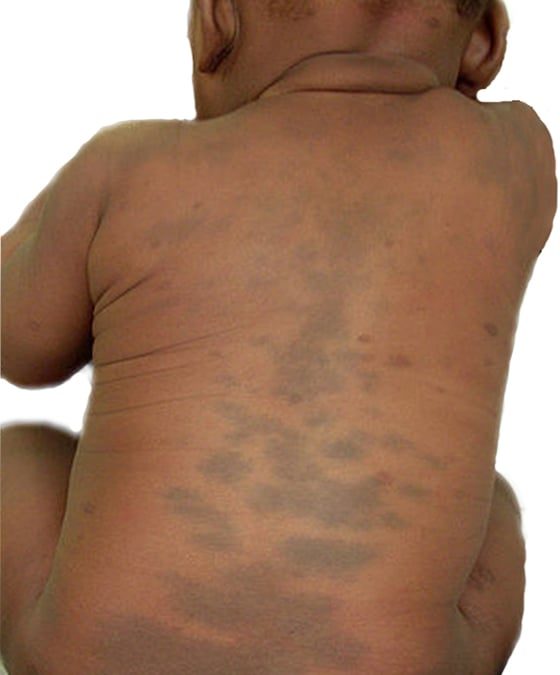
Radiographic studies of a 2-year-old child reveal a new fracture of the humerus and evidence of multiple old fractures in ribs and long bones. Despite the broken arm, the toddler shows minimal bruising. A physical examination reveals peculiar teeth, a blue tinge to the sclera, and unusually mobile joints. The condition suspected in this child is characterized by an abnormality of which of the following biochemical functions?
A 5-year-old child with a history of multiple fractures, blue-tinged sclera, hearing loss, and small, misshapen teeth is examined. Radiologic studies show numerous fractures of various ages. The child's presentation is suspicious for child abuse. The child's condition is most likely related to abnormal metabolism involving which of the following substances?
What is true about a fracture of the femoral shaft in an infant?
Which of the following is NOT a characteristic finding in non-accidental traumatic fractures, excluding all others?
A 6-month-old comatose infant presents with multiple broken bones in various stages of healing, a bulging anterior fontanelle, and retinal hemorrhages. Which of the following is the major abnormality most likely associated with this presentation?
A 4-year-old female is brought to the casualty department with multiple fractured ribs and an inconspicuous history from parents. Examination reveals multiple bruises and healed fractures. What is the probable diagnosis?
A 3-year-old girl presents with multiple bruises and X-rays reveal three fractures at different stages of healing, along with excessive callus formation. The mother claims the child fell down the stairs, but the father is reportedly an alcoholic. What is the most likely diagnosis?
Osteogenesis imperfecta (OI) may present similarly to child maltreatment. Besides blue sclera and osteopenia, which of the following is another distinguishing feature of OI?
Munchausen's syndrome by proxy involves which of the following?
A young boy presents to the emergency department with a spiral fracture of the femur and multiple ecchymoses. What is the most likely cause of these injuries?
Explanation: **Explanation:** The clinical presentation of multiple fractures at various stages of healing, blue sclerae, dental abnormalities (dentinogenesis imperfecta), and joint hypermobility in a 2-year-old is diagnostic of **Osteogenesis Imperfecta (OI)**, specifically Type I. While multiple fractures often raise suspicion for child abuse (Non-Accidental Injury), the presence of blue sclera and dental findings points toward a genetic connective tissue disorder. **1. Why Option A is correct:** Osteogenesis Imperfecta is primarily caused by autosomal dominant mutations in the **COL1A1 or COL1A2 genes**, which encode the alpha chains of **Type I Collagen**. Type I collagen is the major structural protein in bone, skin, tendons, and the sclera. Defective synthesis or structure of this collagen leads to "brittle bones," thin sclera (allowing the underlying choroid to show through as blue), and weak dentin. **2. Why other options are incorrect:** * **Option B (Type II Collagen):** Found primarily in **hyaline cartilage** and vitreous humor. Defects lead to skeletal dysplasias like Achondrogenesis. * **Option C (Type III Collagen):** Found in **blood vessels** and skin. Defects cause the Vascular type of Ehlers-Danlos Syndrome (Type IV EDS), characterized by arterial rupture but not bone fragility. * **Option D (Type IV Collagen):** A key component of the **basement membrane**. Defects lead to Alport Syndrome (nephritis, hearing loss, and ocular issues). **Clinical Pearls for NEET-PG:** * **Differentiate from Child Abuse:** In OI, look for blue sclera, family history, and wormian bones on skull X-ray. In child abuse, look for retinal hemorrhages, posterior rib fractures, and metaphyseal "bucket-handle" fractures. * **Wormian Bones:** Small, irregular bones within the cranial sutures; a classic radiographic sign of OI. * **Hearing Loss:** Conductive hearing loss is common in adults with OI due to otosclerosis of the ossicles.
Explanation: **Explanation:** The child’s presentation—recurrent fractures of varying ages, **blue sclera**, **dentinogenesis imperfecta** (misshapen teeth), and **hearing loss**—is a classic description of **Osteogenesis Imperfecta (OI)**, specifically Type I. **Why Collagen is Correct:** OI is a genetic disorder caused by mutations in the **COL1A1 or COL1A2** genes, which encode **Type I Collagen**. This protein is the primary structural component of bone, skin, and tendons. Defective synthesis or structure of Type I collagen leads to bone fragility (mimicking child abuse), thinning of the sclera (allowing the underlying choroid to show through as blue), and middle ear ossicle dysfunction (hearing loss). **Why Other Options are Incorrect:** * **Glycogen:** Defects in glycogen metabolism lead to Glycogen Storage Diseases (e.g., Von Gierke’s), typically presenting with hepatomegaly and hypoglycemia, not bone fragility. * **Mucopolysaccharides:** Disorders like Hurler or Hunter syndrome involve the accumulation of GAGs, leading to coarse facial features and organomegaly. * **Purines:** Abnormal purine metabolism (e.g., Lesch-Nyhan syndrome) presents with self-mutilation and gouty arthritis, not multiple fractures. **High-Yield Clinical Pearls for NEET-PG:** * **Differential Diagnosis:** Always differentiate OI from **Child Abuse (Non-Accidental Injury)**. While both present with multiple fractures, the presence of blue sclera and dental issues points strongly to OI. * **Radiology:** Look for "Wormian bones" (small accessory bones in cranial sutures) and "codfish vertebrae" in OI patients. * **Type II OI:** This is the most severe form, often lethal in the perinatal period due to respiratory failure. * **Management:** Bisphosphonates (e.g., Pamidronate) are used to increase bone mineral density and reduce fracture rates.
Explanation: **Explanation:** **Correct Answer: D. Fat embolism is a common complication.** In infants and young children, the bone marrow contains a high proportion of hematopoietic (red) marrow, but the long bones like the femur still contain significant fatty marrow. Upon a fracture of a large bone like the femoral shaft, fat globules can enter the systemic circulation through ruptured intramedullary veins. While clinically significant Fat Embolism Syndrome (FES) is traditionally considered more common in adults, pediatric literature and board exams (like NEET-PG) emphasize that fat embolism remains a recognized and serious complication of major long bone fractures in infants. **Analysis of Incorrect Options:** * **Option A:** While femoral fractures in non-ambulatory infants should raise a high index of suspicion for **Non-Accidental Injury (NAI)**, accidental trauma (e.g., falls) remains statistically more common in many clinical datasets. Abuse is a *significant* cause, but not the absolute "most common" across all infant populations. * **Option B:** While pediatric bones generally heal faster than adult bones due to a thick periosteum, "rapidly" is a relative term. In the context of this question, it is a general characteristic rather than a specific defining feature or complication. * **Option C:** Treatment of femoral fractures in infants (0–6 months) usually involves a **Pavlik harness** or a **Spica cast**. Traction is rarely the definitive "all that is required" treatment for this age group; it is often a temporary measure. **High-Yield Clinical Pearls for NEET-PG:** * **Suspicion of Abuse:** Any long bone fracture in a non-walking child (infant) is a red flag for child abuse until proven otherwise. * **Most Common Fracture in Abuse:** The most common are simple long bone fractures, but the **most specific** (pathognomonic) are **Metaphyseal Corner Fractures** (Bucket-handle fractures). * **Management:** For infants <6 months, a Pavlik harness is the preferred management for femoral shaft fractures. For children 6 months to 5 years, an immediate Spica cast is standard.
Explanation: ### Explanation In the context of **Non-Accidental Injury (NAI)** or Child Abuse, fractures are categorized by their "specificity" for abuse. The goal is to distinguish between common accidental injuries and those resulting from high-force, deliberate trauma. **Why Parietal Fracture is the Correct Answer:** Simple, linear fractures of the **parietal bone** are the most common type of skull fracture in children and are frequently **accidental** (e.g., a fall from a bed or couch). While skull fractures can occur in abuse, a simple parietal fracture lacks the high specificity associated with NAI. In contrast, complex, multiple, or bilateral fractures that cross sutures are more suggestive of abuse. **Analysis of Incorrect Options (High Specificity for Abuse):** * **Costochondral joint fracture (Option A):** Posterior rib fractures at the costochondral or costovertebral joints are highly specific for abuse. They result from forceful squeezing of the chest, which compresses the ribs over the transverse processes of the vertebrae. * **Sternal fracture (Option B):** The sternum is well-protected; fractures here require massive localized blunt force, which is extremely rare in accidental trauma in young children. * **Metaphyseal corner fracture (Option D):** Also known as **"Bucket-handle fractures,"** these are pathognomonic for abuse. They occur due to forceful pulling or twisting of limbs (torsional stress), causing avulsion of a fragment of the metaphysis. **NEET-PG High-Yield Pearls:** * **Most Specific Fracture for Abuse:** Metaphyseal corner/Bucket-handle fracture. * **Most Common Site of Abuse Fractures:** Long bones (Humerus, Femur, Tibia). * **Dating Fractures:** The presence of fractures in different stages of healing is a classic "red flag" for chronic abuse. * **Radiological Survey:** A "Skeletal Survey" (not a bone scan) is the gold standard for initial evaluation in suspected NAI for children under 2 years.
Explanation: ### Explanation This clinical presentation is a classic description of **Abusive Head Trauma (AHT)**, formerly known as **Shaken Baby Syndrome**. **1. Why Subdural Hemorrhage (SDH) is correct:** In AHT, vigorous shaking causes rapid acceleration-deceleration forces. This leads to the tearing of the **bridging veins** that traverse the subdural space, resulting in a **Subdural Hemorrhage**. The "triad" of AHT typically includes: * **Encephalopathy** (comatose state, bulging fontanelle due to increased ICP). * **Retinal Hemorrhages** (highly specific for non-accidental trauma). * **Subdural Hemorrhage.** The presence of multiple fractures in various stages of healing (metaphyseal "bucket-handle" or rib fractures) further confirms the diagnosis of repeated physical abuse. **2. Why the other options are incorrect:** * **Intraventricular Hemorrhage (IVH):** Most commonly seen in premature neonates due to the fragility of the germinal matrix; it is not the hallmark of shaking injuries. * **Caput Succedaneum:** This is diffuse edema of the scalp occurring during birth (crosses suture lines). It is a benign birth injury and unrelated to child abuse or intracranial pathology. * **Subarachnoid Hemorrhage (SAH):** While SAH can occur in trauma, SDH is the most frequent and characteristic intracranial finding associated with the shearing forces of shaking. **3. High-Yield Clinical Pearls for NEET-PG:** * **Most common cause of death** in child abuse is head injury. * **Pathognomonic imaging:** Skeletal survey showing posterior rib fractures or metaphyseal corner fractures. * **Diagnostic Triad:** SDH + Retinal Hemorrhage + Encephalopathy. * **Next Step in Management:** Stabilize the airway/breathing, followed by a non-contrast CT head and a skeletal survey. Always notify child protective services.
Explanation: **Explanation:** The clinical presentation of a 4-year-old with multiple fractures of varying ages (healed and fresh), bruises, and an inconsistent or "inconspicuous" history provided by caregivers is a classic hallmark of **Battered Baby Syndrome (BBS)**, also known as Non-Accidental Injury (NAI). **Why D is Correct:** Battered Baby Syndrome refers to physical abuse, usually by a parent or guardian. Key diagnostic indicators present in this case include: * **Discrepancy** between the clinical findings and the history provided. * **Multiple injuries** in different stages of healing (e.g., healed fractures alongside new rib fractures). * **Specific fracture patterns:** Rib fractures in children are highly suggestive of abuse (often due to forceful squeezing) as a child’s ribs are very elastic and rarely break from accidental falls. **Why other options are incorrect:** * **A. Polytrauma:** This is a general term for multiple traumatic injuries. While the child has multiple injuries, the presence of old, healed fractures and a vague history points specifically to a pattern of chronic abuse rather than a single accidental event. * **B. Flail Chest:** This is a clinical diagnosis where multiple adjacent ribs are broken in at least two places, causing paradoxical respiration. It is a complication of trauma, not a diagnosis of the underlying cause. * **C. Munchausen’s Syndrome:** This is a psychiatric disorder where a person feigns illness in themselves. If a caregiver induces illness in a child, it is called **Munchausen Syndrome by Proxy**, which typically involves poisoning or fabricating medical symptoms rather than physical trauma like fractures. **High-Yield Clinical Pearls for NEET-PG:** * **Most common cause of death in BBS:** Subdural Hematoma (often associated with Shaken Baby Syndrome). * **Radiological Pathognomonic Sign:** Metaphyseal "Bucket-handle" or "Corner" fractures. * **Most common site of bruising:** Soft tissues (buttocks, thighs, cheeks) rather than bony prominences. * **Legal Obligation:** In many jurisdictions, any suspicion of child abuse must be reported to the authorities immediately.
Explanation: **Explanation:** The clinical presentation of multiple fractures at **different stages of healing** with excessive callus formation is a classic hallmark of **Non-Accidental Injury (NAI)** or Child Abuse. 1. **Why Child Abuse is correct:** In cases of physical abuse, the history provided by the caregiver (falling down stairs) often does not match the severity or pattern of the injuries. The presence of fractures in various stages of healing indicates multiple episodes of trauma over time. Excessive callus formation suggests that the fractures were likely not immobilized or medically treated at the time of injury, further pointing toward neglect and abuse. 2. **Why other options are incorrect:** * **Scurvy (Vitamin C deficiency):** Presents with subperiosteal hemorrhage, "Pelkan spurs," and a "Wimberger ring" sign, but not typically multiple healing fractures. * **Rickets (Vitamin D deficiency):** Characterized by widening of the growth plate, cupping, and fraying of the metaphysis. While bones are soft (osteomalacia), the specific pattern of "different stages of healing" is not a primary feature. * **Osteopetrosis:** A genetic disorder causing increased bone density ("marble bone disease"). While bones are brittle and prone to fractures, the radiological picture would show diffuse sclerosis, which is absent here. **Clinical Pearls for NEET-PG:** * **Most common trigger for child abuse:** Incessant crying. * **Highly specific radiological signs:** Metaphyseal "bucket-handle" or "corner" fractures, posterior rib fractures, and bilateral fractures. * **Differential Diagnosis:** Always rule out **Osteogenesis Imperfecta** (look for blue sclera and family history). * **Legal Obligation:** In many jurisdictions, a doctor is legally mandated to report suspected child abuse to the authorities.
Explanation: **Explanation:** **Osteogenesis Imperfecta (OI)** is a genetic disorder of connective tissue, most commonly caused by mutations in the **COL1A1 or COL1A2** genes, leading to defective Type 1 collagen synthesis. Because Type 1 collagen is a primary component of both bone matrix and teeth, dental abnormalities are a hallmark feature. **Why Dental Involvement is Correct:** The specific dental manifestation in OI is **Dentinogenesis Imperfecta (DI)**. It occurs because the dentin (which is rich in Type 1 collagen) is malformed, causing the teeth to appear translucent, opalescent, or brownish-blue. The enamel often flakes off, leading to rapid wear and breakage. While child abuse causes fractures, it does not cause intrinsic dental structural defects, making DI a key clinical differentiator. **Analysis of Incorrect Options:** * **A. Multiple fractures with minimal trauma:** While characteristic of OI, this is **not** a distinguishing feature from child abuse. In fact, it is the primary reason the two are confused, as both present with multiple fractures at various stages of healing. * **C. Patent foramen ovale:** This is a common congenital heart finding in the general population and is not specifically associated with the diagnostic criteria for OI. * **D. Polydactyly:** This is a feature of various genetic syndromes (e.g., Patau syndrome, Ellis-van Creveld) but is not a component of the clinical spectrum of OI. **Clinical Pearls for NEET-PG:** * **Triad of OI:** Fragile bones, blue sclera (due to choroidal veins showing through thin collagen), and early-onset otosclerosis (conductive hearing loss). * **Wormian Bones:** Look for these accessory sutural bones on skull X-rays; they are a high-yield radiographic sign of OI. * **Legal Note:** In suspected child abuse, always rule out OI by checking for family history, scleral hue, and dental health before finalizing a diagnosis.
Explanation: **Explanation:** **Munchausen Syndrome by Proxy (MSBP)**, now clinically referred to as **Factitious Disorder Imposed on Another (FDIA)**, is a severe form of child abuse. In this condition, a caregiver (most commonly the biological mother) deliberately fabricates, exaggerates, or induces physical or psychological symptoms in a child to satisfy their own psychological need for attention or sympathy from medical personnel. **Why Option C is Correct:** The hallmark of MSBP is the **active induction of illness by a caregiver**. This may involve poisoning, suffocating, contaminating lab samples (e.g., adding blood to urine), or withholding medication to ensure the child remains ill and requires frequent medical interventions. **Why Other Options are Incorrect:** * **Option A (Drug abuse):** While a caregiver might use drugs to induce symptoms in the child (e.g., sedatives or insulin), MSBP is defined by the psychological motivation of the perpetrator, not by the caregiver's own substance addiction. * **Option B (Toxin-mediated neuropsychiatric disease):** This refers to organic conditions like PANDAS or heavy metal poisoning. MSBP is a behavioral/psychiatric disorder of the caregiver, not a primary neurological disease of the child. **High-Yield Clinical Pearls for NEET-PG:** * **The Perpetrator:** Usually the mother (85-95% of cases), often with some medical background or knowledge. * **The Victim:** Typically pre-verbal children or infants. * **Red Flags:** Symptoms that occur only in the caregiver’s presence, "miraculous" recoveries during hospitalization when the caregiver is away, and a caregiver who appears unusually calm or "too helpful" despite the child's grave illness. * **Management:** The primary goal is the **safety of the child**. Separation from the caregiver is often necessary for diagnosis and protection. Mandatory reporting to child protective services is required.
Explanation: ### Explanation **Correct Answer: C. Child abuse** The combination of a **spiral fracture of the femur** in a young child and **multiple ecchymoses** (bruises) at various stages of healing is a classic "red flag" for Non-Accidental Injury (NAI) or child abuse. A spiral fracture occurs due to a forceful **torsional (twisting) motion**. While it can occur accidentally, in the absence of a clear, high-impact witnessed trauma, it suggests someone forcefully twisted the child's limb. Furthermore, the presence of multiple ecchymoses—especially if located on soft tissues (buttocks, thighs, trunk) rather than over bony prominences—strongly suggests repetitive physical abuse. **Why other options are incorrect:** * **A. Automobile hit-and-run:** This typically results in high-energy "crush" injuries, comminuted fractures, or internal organ trauma rather than isolated spiral fractures. * **B & D. Fall from a tree/bicycle:** Simple falls usually result in transverse or greenstick fractures. While a fall can cause a spiral fracture, it is unlikely to explain "multiple ecchymoses" across different body parts unless the trauma was catastrophic, which would present with more acute systemic distress. **Clinical Pearls for NEET-PG:** * **Most common fracture in child abuse:** Long bone fractures (femur is common in infants). * **Most specific fracture for child abuse:** **Metaphyseal Corner Fractures** (Bucket-handle fractures) caused by jarring/shaking. * **Other Red Flags:** Posterior rib fractures, cigarette burns, retinal hemorrhages (Shaken Baby Syndrome), and injuries inconsistent with the developmental age of the child. * **Legal Obligation:** In India, under the **POCSO Act**, healthcare professionals are legally mandated to report suspected child abuse.
Explanation: ***Loop-shaped bruises on the back*** - **Loop-shaped bruises** are highly suspicious for **non-accidental trauma** as they are pathognomonic for impact with an object like a looped cord or belt - Bruises on the **back** of a young child are particularly concerning as the back is a non-bony prominence and less likely to be injured during normal play activities - Combined with the metaphyseal and posterior rib fractures already identified, patterned bruises strongly indicate inflicted trauma *Circular bruises on the knees* - Circular bruises on the knees are very common in toddlers and young children due to normal falls and play, which typically involve kneeling and crawling - This pattern is generally considered consistent with accidental injury and not indicative of abuse *Linear bruises on the shins* - Linear bruises on the shins can result from bumping into objects while playing or exploring, which is common in active children - The shins are bony prominences frequently injured during normal play activities *Irregular bruises on the forehead* - Irregular bruises on the forehead can result from accidental falls or bumps, which are common in young children learning to walk or play - While head injuries should always be carefully evaluated, irregular bruises on the forehead are common accidental injuries in ambulatory toddlers
Explanation: ***Acceleration-deceleration forces*** - **Bilateral subdural hematomas of different ages** and **retinal hemorrhages** are classic findings in **abusive head trauma (shaken baby syndrome)**, caused by severe acceleration-deceleration forces. - These forces lead to the tearing of **bridging veins** and vitreoretinal traction, resulting in these distinct injuries. *Infectious meningitis* - While it can cause seizures, meningitis typically presents with **fever**, **lethargy**, and neck stiffness, and would not cause **subdural hematomas** or **retinal hemorrhages**. - Its effects on the brain are usually due to inflammation and increased intracranial pressure, not traumatic injury. *Birth trauma* - **Birth trauma** might cause subdural hematomas, but they would typically be **acute** and of a **single age**, directly related to the birthing process. - It is highly unlikely to cause hematomas of "different ages" in a 4-month-old infant, nor would it characteristically cause retinal hemorrhages without other signs of severe, acute trauma. *Genetic coagulopathy* - A **genetic coagulopathy** could predispose to bleeding, but it would typically result in more widespread or spontaneous internal bleeding, not specifically **bilateral subdural hematomas** accompanied by **retinal hemorrhages** without other trauma. - The "different ages" of the hematomas also strongly suggest recurrent episodes of trauma rather than an underlying bleeding disorder.
Explanation: ***Sub-dural hematoma*** - **Shaken baby syndrome** results from violent shaking, leading to rapid acceleration and deceleration that causes tearing of the **bridging veins** in the brain. - This tearing results in a **subdural hematoma**, which is a collection of blood between the dura mater and arachnoid mater. *Ruptured spleen* - While possible in severe trauma, a ruptured spleen is less common with shaking alone and more often associated with **direct abdominal impact**. - The mechanisms of injury for splenic rupture typically involve significant blunt force to the abdomen, which is not the primary injury in shaken baby syndrome. *Rib fractures* - Rib fractures are indicators of significant chest compression or **direct impact**, which can occur in child abuse but are not the primary, immediate effect of shaking a baby. - While rib fractures can be a component of child abuse, they typically result from a different type of forceful interaction than shaking. *Pelvic fracture* - Pelvic fractures in infants typically require **high-energy trauma**, such as a fall from a significant height or a motor vehicle accident. - They are highly unlikely to result from shaking alone, as the pelvis is not directly impacted during a typical shaking event.
Explanation: ***Subdural haematoma*** - **Violent shaking** in infants (known as **shaken baby syndrome**) causes characteristic neurological injuries due to acceleration-deceleration forces, leading to tearing of **bridging veins** and often presenting as **subdural haematoma**. - The infant's immature brain and weak neck muscles make them particularly vulnerable to these forces, resulting in significant intracranial bleeding without direct impact. *Skull bone fracture* - While possible in cases of severe trauma, **skull fractures** are less specific to violent shaking alone, often requiring a direct impact. - Shaking causes shearing forces on the brain's delicate structures rather than directly fracturing the skull unless there is an impact. *Long bone fracture* - **Long bone fractures**, such as spiral fractures, can occur in child abuse but are typically associated with **twisting or direct impact** rather than the primary mechanism of violent shaking. - While possible, they are not the most immediate or common injury directly resulting from the shearing forces of shaking. *Ruptured spleen* - A **ruptured spleen** indicates significant **abdominal trauma**, usually a direct blow or crush injury, which is not the primary mechanism of injury in violent shaking. - While internal organ damage can occur in child abuse, it's less characteristic of trauma solely from violent shaking compared to intracranial injuries.
Explanation: ***To do a complete physical examination*** - A comprehensive **physical examination** is essential to assess the full extent of injuries and to identify any other signs of abuse that might not be immediately apparent. - This step ensures that all medical needs are addressed and that any potential harm is documented appropriately within the medical record. *To tell or discuss with colleagues that she is a case of abuse* - While suspicion of abuse is high, immediately labeling the patient as a "case of abuse" to colleagues without further assessment can be premature and may compromise patient confidentiality. - Discussing with colleagues should follow a thorough examination and be part of a structured approach to **interprofessional collaboration** once concerns are medically substantiated. *To inform higher authorities* - Reporting to higher authorities is a critical step in cases of suspected abuse, but it typically follows a **thorough medical evaluation** and documentation of findings. - Informing authorities prematurely without a complete medical assessment could lead to incomplete information and potentially delay necessary medical care for the patient. *To call local social worker for help* - Involving a social worker is an important component of managing suspected child abuse, as they can provide support and guidance for the patient and family. - However, the immediate priority is to address the patient's medical needs and gather medical evidence through a **complete physical examination** before initiating social services.
Explanation: ***Foreign body*** - **Most common benign cause** of vaginal spotting in prepubertal girls - Typically presents with **foul-smelling discharge**, spotting, and irritation - Common objects include toilet paper, small toys, or other inserted items - Diagnosis confirmed by **gentle examination** ± vaginoscopy - **However:** Foreign body insertion itself may indicate curiosity, accident, OR behavioral concerns that warrant evaluation *Sexual abuse* - **MUST be considered and ruled out** in ANY prepubertal vaginal bleeding - Can present with spotting, discharge, lacerations, bruising, or behavioral changes - May have **NO obvious physical findings** in many cases - **Critical point:** Presence of foreign body does NOT exclude abuse - All cases require **careful history, examination, and consideration of child protection protocols** - If **PID or STI** is found in a prepubertal child, sexual abuse is highly likely *PID* - Pelvic inflammatory disease requires ascending infection, almost exclusively in **sexually active** females - In a 6-year-old, PID or STI should **immediately raise suspicion for sexual abuse** - Not a typical cause of isolated spotting in this age group *Ovarian cancer* - Extremely **rare** in prepubertal children - Ovarian tumors (especially granulosa cell tumors) can cause **precocious puberty** with breast development and menstrual-like bleeding - Would present with additional findings: abdominal mass, hormonal changes, not isolated spotting **Clinical Approach:** While foreign body is statistically most common, every case of prepubertal vaginal bleeding requires thorough evaluation including detailed history (with child alone if appropriate), complete examination (may need anesthesia), and maintaining high index of suspicion for abuse.
Explanation: ***Failure to thrive*** - While **neglect** can lead to failure to thrive, it is **less directly indicative** of battered child syndrome compared to specific traumatic injuries - Failure to thrive reflects **chronic malnutrition and inadequate care** rather than acute physical abuse - Battered child syndrome primarily involves **physical trauma** (fractures, bruises, head injuries) rather than growth deficiencies - Of all the options, this finding is **LEAST characteristic** of direct physical battering *Subdural hematoma* - **Highly associated** with battered child syndrome, particularly in **abusive head trauma** (shaken baby syndrome) - Results from tearing of bridging veins due to violent shaking or impact - One of the most serious manifestations of physical abuse in children *Skin bruising* - The **most common visible sign** of physical abuse in children - Multiple bruises in **different stages of healing** and in unusual locations (face, neck, trunk, buttocks) are highly suspicious - Pattern bruising (hand prints, belt marks, loop marks) is pathognomonic of abuse *Multiple fractures in different stages of healing* - **Classic radiologic finding** in battered child syndrome - Metaphyseal corner fractures and posterior rib fractures are particularly specific for abuse - Different stages of healing indicate repeated episodes of trauma
Explanation: ***Child abuse*** - **Multiple bruises of varying ages** in a child, especially in areas not typically prone to accidental injury (e.g., torso, ears, neck), are highly suspicious for **child physical abuse**. - **Inconsistent explanations** from caregivers or a delay in seeking medical attention can further support this diagnosis. *Accidental injury* - Accidental injuries typically present with **bruises of a similar age** and in locations consistent with typical childhood activities, such as shins, elbows, or forehead. - The pattern of injury in this scenario (varying ages, unusual locations) makes accidental injury less likely. *Hemophilia* - **Hemophilia** is a genetic bleeding disorder characterized by easy bruising and prolonged bleeding due to a deficiency in clotting factors. - While it causes bruising, the description of **bruises of varying ages** and in **unusual locations** strongly points away from a primary bleeding disorder as the sole cause. *Scurvy* - **Scurvy**, caused by **vitamin C deficiency**, can lead to easy bruising, petechiae, and bleeding gums. - However, it is usually accompanied by other symptoms like **fatigue, joint pain**, and poor wound healing, and does not typically manifest as multiple bruises of various ages in isolated unusual locations without other systemic signs.
Explanation: ***Multiple bruises of different ages*** - The presence of **bruises in various stages of healing** suggests repeated injury over time, which is the **hallmark of non-accidental trauma**. - This pattern indicates a history of injury rather than a single accidental event, making it highly suspicious for **Battered Baby Syndrome**. - Different colored bruises (yellow-green vs purple-red) indicate different ages of injury, which is the **MOST characteristic finding** that distinguishes abuse from accidental trauma. *Incorrect: Single spiral fracture of femur* - A **spiral fracture** of the femur can occur from rotational forces, and while it should raise suspicion, a *single* injury may also result from a severe accident. - It does not inherently indicate a pattern of abuse as clearly as injuries of different ages do. *Incorrect: Single subdural hematoma* - A **subdural hematoma** can result from both accidental falls and non-accidental head trauma (e.g., shaken baby syndrome). - A *single* episode, without other accompanying injuries or a history of unexplained trauma, is not as definitive in distinguishing abuse from accident as multiple injuries of different ages. *Incorrect: Failure to thrive without other signs* - **Failure to thrive** can be multifactorial (e.g., medical conditions, nutritional deficiencies, neglect) and, by itself, doesn't distinguish physical abuse from other forms of neglect or medical causes. - While it can be *associated* with abuse, the absence of physical signs of trauma makes it less specific for **Battered Baby Syndrome** compared to active injury patterns.
Explanation: ***Correct: Osteopetrosis*** - Osteopetrosis is a rare genetic disorder characterized by **increased bone density** due to defective osteoclast function - While it causes bones to be brittle and prone to fracture, it has **distinctive radiological features** including diffuse sclerosis and "bone-within-bone" appearance - The **increased bone density on X-ray** is pathognomonic and readily distinguishes it from NAI, making it **less likely to be confused** with non-accidental injury in clinical practice - Fractures occur but the radiological pattern is diagnostic of the underlying metabolic bone disease *Incorrect: Osteogenesis imperfecta* - This is a **classic differential** for NAI causing **multiple brittle bone fractures** that can be mistaken for abuse - Features include **blue sclera**, **dentinogenesis imperfecta**, **wormian bones**, and **family history** - Often presents with multiple fractures at different stages of healing, mimicking the pattern seen in NAI *Incorrect: Scurvy* - Caused by **vitamin C deficiency**, leads to defective collagen synthesis - Results in **subperiosteal hemorrhages**, **metaphyseal fractures**, and **periosteal elevation** that closely mimic NAI - Additional features include **gingival bleeding**, **petechiae**, **follicular hyperkeratosis**, and **poor wound healing** *Incorrect: Caffey's disease* - Also known as **infantile cortical hyperostosis**, presents in infants under 6 months - Causes **periosteal reactions**, **bone thickening**, and **soft tissue swelling** in long bones, ribs, and mandible - The periosteal new bone formation can be mistaken for healing fractures from NAI, making it an important differential
Explanation: ***CSF Rhinorrhea*** - **CSF rhinorrhea** (leakage of cerebrospinal fluid from the nose) is not a typical finding in the classic triad of **shaken baby syndrome**. - It usually occurs due to a **fracture of the skull base**, which is possible in severe trauma but not a defining feature of the triad from shaking alone. *Retinal hemorrhaging* - **Retinal hemorrhages** are a hallmark sign of **shaken baby syndrome**, resulting from the violent back-and-forth motion that tears delicate retinal vessels. - Their presence, especially if bilateral and across multiple layers of the retina, is highly indicative of **abusive head trauma**. *Brain swelling* - **Cerebral edema** (brain swelling) is a common and severe consequence of **shaken baby syndrome**, often leading to increased intracranial pressure. - This swelling results from brain injury due to direct trauma, lack of oxygen, and vascular damage. *Subdural hematoma* - A **subdural hematoma** (bleeding between the dura mater and arachnoid mater) is a key component of the classic triad. - It occurs due to the tearing of **bridging veins** as the brain moves rapidly within the skull during violent shaking.
Physical Abuse Recognition
Practice Questions
Sexual Abuse Evaluation
Practice Questions
Emotional Abuse and Neglect
Practice Questions
Medical Child Abuse (Munchausen by Proxy)
Practice Questions
Failure to Thrive Due to Neglect
Practice Questions
Shaken Baby Syndrome
Practice Questions
Burns and Inflicted Trauma
Practice Questions
Documentation and Reporting
Practice Questions
Interviewing Techniques
Practice Questions
Forensic Evidence Collection
Practice Questions
Child Protection System
Practice Questions
Prevention Strategies
Practice Questions
Get full access to all questions, explanations, and performance tracking.
Start For Free